 by Tom Gurney
Tom Gurney BSc (Hons) is an art history expert with over 20 years experience
Published on June 19, 2020 / Updated on October 2, 2026
Email: tomgurney1@gmail.com / Phone: +44 7429 011000
The Story of Lucretia by Filippino Lippi
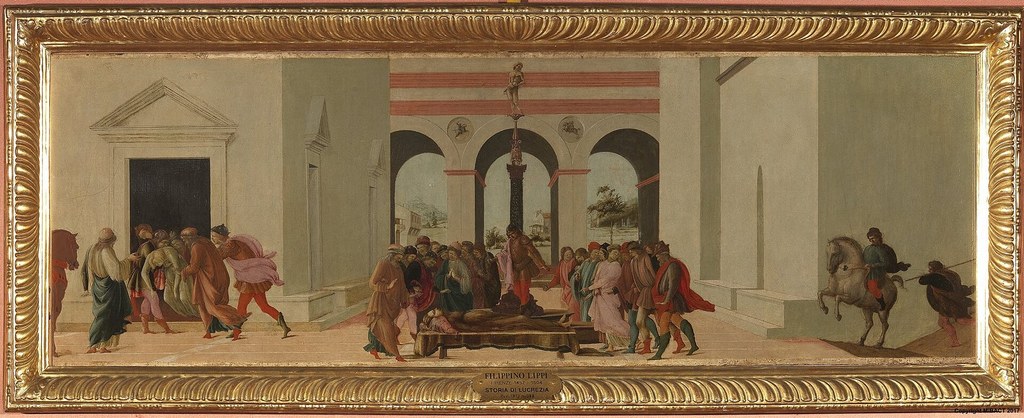
Filippino Lippi’s Story of Lucretia, painted around 1478–80 and now in the Palatine Gallery at Palazzo Pitti, is one of the most important secular works of his youth. Rather than representing a saint, Madonna or biblical episode, the long horizontal panel tells the violent Roman story of Lucretia, whose rape, suicide and public mourning became associated with the overthrow of monarchy and foundation of the Roman Republic.
The Uffizi identifies the work as tempera on wood, measuring 42 by 126 centimetres. Its unusually elongated proportions reflect its original function. The panel formed part of domestic furnishing, probably within a Florentine nuptial chamber, and was paired with Filippino’s Story of Virginia, now in the Louvre.[1] This context is essential. The painting was not conceived as an independent museum masterpiece. It belonged to the decorated interior of an elite household, where painted furniture, beds, coffers and wall panels could carry moralising stories drawn from ancient history.
Lucretia was especially appropriate to such a setting because Renaissance culture treated her as an exemplar of chastity and marital virtue. Yet the story is profoundly disturbing to modern viewers because the moral tradition placed enormous weight on a raped woman’s sexual honour and celebrated her suicide as proof of virtue. A responsible account therefore needs to separate the violence of the narrative from the values later cultures imposed upon it.
Filippino’s panel is equally important as an early artistic document. The Uffizi calls it a youthful work and suggests that its composition may have been inspired by Sandro Botticelli, Filippino’s teacher. The museum also notes strong emotional energy and dynamic tension alongside some uncertainty in coordinating figures and architecture perspectivally.[1] Those qualities make the work particularly useful. It shows Filippino before complete technical maturity, already ambitious enough to organise a complicated Roman history across a wide domestic panel.
At a Glance
- ArtistFilippino Lippi
- TitleThe Story of Lucretia
- Datec. 1478–80
- MediumTempera on wood
- Dimensions42 × 126 cm
- Current locationPalazzo Pitti, Palatine Gallery, Florence
- Original functiondomestic furnishing, probably associated with a nuptial chamber
- Companion panelStory of Virginia, now in the Louvre
- Subjectrape, suicide and funeral of Lucretia; political aftermath leading towards Roman Republic
- Career significanceyouthful secular work, still close to Botticelli
- Stylistic notestrong emotion and dynamic tension, with some early perspectival awkwardness
Contents
- Who Was Lucretia?
- Continuous Narrative
- Before Rome
- Florence and Republican Rome
- A Secular Filippino
- The Story before Filippino
- The Companion Virginia Panel
- The Catafalque
- Antique Statue and Humanist Culture
- Why the Pair Should Be Reconstructed Mentally
- Frequently Asked Questions
- References
Who Was Lucretia?
Lucretia belongs to the legendary history of early Rome. According to ancient accounts, she was the wife of Lucius Tarquinius Collatinus. Sextus Tarquinius, son of Rome’s last king, raped her after receiving hospitality in her household while her husband was absent.
Lucretia summoned her husband and father, told them what had happened, demanded vengeance and killed herself. Her death then became the catalyst for political revolt. Lucius Junius Brutus rallied the Romans against the Tarquin monarchy. The king was expelled and the Republic established. The story therefore combines sexual violence, family honour and political revolution.
Lucretia in Renaissance Culture. Renaissance writers and artists inherited Lucretia primarily as an exemplar of chastity. Her suicide was praised because it was interpreted as evidence that sexual violation had not compromised her moral virtue. That reading tells us a great deal about patriarchal ideas of honour in fifteenth-century Italy.
Modern viewers need not accept the moral logic in order to understand its historical importance. The story’s popularity in marriage furniture depended precisely on this reputation. Lucretia could be presented to newly married women as a model of fidelity and chastity. That function makes the work historically revealing and ethically uncomfortable.
What Does the Panel Show? Filippino does not represent one instant. He tells the story across time. At the left, Lucretia appears bloodless with the knife still in her chest, supported in the embrace of her husband.
At the centre, her body is laid on a catafalque for funeral rites. Lucius Junius Brutus approaches among the crowd. The narrative therefore moves from private death towards public consequence.
The panel does not show the rape itself. Its focus is aftermath. This choice turns Lucretia’s body into the centre of social and political response.
Continuous Narrative
The repeated presentation of the heroine belongs to the Renaissance convention of continuous narrative. Different moments can occupy one pictorial space. The viewer reads the panel almost like a sequence.
Lucretia dies. She is mourned. Brutus approaches.
The future Republic is implied. Time unfolds horizontally. This makes the long format especially suitable to storytelling. The object’s physical shape and narrative method work together.
The Funeral. The central funeral scene gives Lucretia’s death public visibility. Her body lies elevated on the catafalque. The private violence committed against one woman becomes a civic event.
This transition is crucial to the Roman story. Without public recognition, there is no revolt. The funeral therefore operates as the bridge between household tragedy and political history.
Lucius Junius Brutus. Brutus becomes the agent through whom grief becomes revolution. According to tradition, he swore to drive the Tarquins from Rome. Filippino includes him approaching the central group.
The image does not need to show the entire overthrow. Renaissance viewers familiar with the story knew what followed. Brutus’s presence therefore acts almost like a narrative arrow pointing beyond the panel.
The Armed Nude Statue. A column topped by a nude armed youth stands prominently in the setting. The Uffizi notes that the figure’s precise identity is uncertain.[1] This uncertainty is worth preserving.
The statue nonetheless gives the scene an unmistakably antique character. Filippino uses a classical-looking nude to establish Rome without reconstructing one specific ancient monument. The statue also shows that his interest in antiquity began well before the Carafa Chapel.
Before Rome
The panel predates Filippino’s documented Roman stay by roughly a decade. That chronology matters. Roman history and antique-looking sculpture were already part of his visual world.
Florence itself contained humanist culture, classical collections and antiquarian imagery. Rome later transformed his engagement with antiquity through direct study of ruins and fragments. The Story of Lucretia demonstrates that the intellectual interest came first.
Domestic Furniture. The Uffizi explains that the subject was commonly used in Florentine nuptial bedrooms.[1] Painted coffers, beds and wall furnishings formed coordinated decorative programmes. This means the panel belongs to furniture history as well as painting history.
Modern museums isolate pictures. Renaissance households often integrated them with objects. The panel’s elongated form makes much more sense once this original function is restored.
Marriage and Moral Example. A newly married couple encountering Lucretia’s story would have understood it through contemporary expectations about fidelity, chastity and family honour. The subject’s violence was therefore converted into moral instruction. For modern interpretation, this is precisely where critical distance is needed. The story reveals how female virtue was defined through sexual reputation and self-sacrifice. The painting can be admired artistically while also exposing the restrictive moral structures of the society that commissioned such imagery.
The Companion Story of Virginia. Filippino’s panel was paired with another Roman heroine, Virginia. Her story also involves sexual threat, family honour and political upheaval. Virginia’s father kills her to prevent her exploitation by Appius Claudius, and the resulting outrage contributes to political revolt.
Pairing Lucretia and Virginia therefore intensified a clear theme. Female bodies become the sites through which male tyranny is exposed and republican resistance begins. The two panels were not random classical stories. They formed a moral-political pair.
Florence and Republican Rome
Roman Republican history had obvious resonance in Florence. Florentines repeatedly described their own civic identity through comparison with ancient Rome. Stories about resistance to kingship could therefore carry political meaning even within private domestic decoration. This does not prove that Filippino’s panel encoded one immediate political statement. But the subject belonged naturally to a culture in which classical republican virtue remained an important language of civic identity.
Filippino and Botticelli. The Uffizi suggests Botticelli may have influenced the composition.[1] That is entirely consistent with the date. Filippino had trained in Botticelli’s workshop after the death of Fra Filippo Lippi.
Around 1478–80, he was still emerging from that environment. Linear movement, elegant figures and complex narrative arrangement reflect the shared workshop culture. The painting therefore provides useful evidence for the moment before Filippino’s style became unmistakably independent.
Youthful Ambition. The Uffizi’s observation that perspective remains somewhat awkward is valuable because it prevents retrospective idealisation.[1] Great artists do not begin fully formed. Filippino was taking on a difficult problem: many figures, architecture, multiple moments and a panoramic support.
Some relationships are less convincing than in his mature work. That technical unevenness is part of the painting’s historical interest. Ambition is already ahead of complete mastery.
Emotional Tension. At the same time, the Uffizi emphasises emotional and dynamic force.[1] That quality would remain central to Filippino. His figures rarely become inert.
Bodies turn. Crowds react. Narratives feel psychologically active. In the Story of Lucretia, this energy is especially appropriate because the painting moves from shock to mourning to political response. The young Filippino is already interested in reaction as much as event.
A Secular Filippino
The panel is important because it prevents Filippino’s career from appearing exclusively religious. Most surviving major works are Madonnas, altarpieces or chapel cycles. The Story of Lucretia shows him working within elite domestic classicism. Ancient history could serve household ethics just as saints served devotional practice. This broader range helps explain his appeal to sophisticated Florentine patrons.
Narrative Violence without the Assault. Filippino’s decision not to represent the rape itself shifts attention towards consequences. Lucretia’s body becomes the evidence of violence. The viewer is asked to contemplate mourning, honour and political revenge rather than the assault as spectacle.
That does not remove the gendered assumptions of the story. It does, however, shape the painting’s emotional register. The work is about what violence does to a household and city.
The Female Body and Political History. Both Lucretia and Virginia occupy a troubling position in ancient and Renaissance political thought. Their suffering provides the moral justification for male political action. The women become symbols around which republics are imagined.
Modern interpretation can therefore ask who is allowed agency. Lucretia speaks and kills herself, but Brutus transforms her death into revolution. The painting preserves that unequal structure. Such questions enrich rather than diminish historical understanding.
From Furniture to Museum. The panel is now displayed in Palazzo Pitti as a standalone artwork. Its current setting encourages attention to Filippino’s authorship and style. Its original setting would have emphasised the larger decorated room.
This change in context affects interpretation profoundly. What we now call a “painting” may once have been one element of a coordinated interior. Museum display creates artistic autonomy that the object did not originally possess.
The Story before Filippino
Lucretia’s story was known in Renaissance Florence through ancient Roman authors and later retellings. Livy gave one of the most influential accounts. The narrative entered humanist culture not simply as tragedy but as political history.
The overthrow of Tarquin monarchy made Lucretia’s death inseparable from the birth of republican government. This dual identity helps explain the subject’s appeal in Florence. It was both a moral story about chastity and a political story about liberty.
A Nuptial Bedroom and a Violent Story. The placement of Lucretia imagery in marriage chambers can feel jarring today. A newly married woman might have encountered the story in a room associated with sexuality, inheritance and reproduction. The image praised fidelity but did so through the example of a woman whose body had been violated.
That contradiction reveals the values embedded in Renaissance marriage culture. Chastity was treated as a family asset. Female sexual reputation affected household honour. Lucretia’s willingness to die rather than live under the stigma of rape was therefore interpreted very differently from how most modern viewers would understand victimhood and responsibility.
Marriage Furniture. Florentine marriage interiors could include richly decorated cassoni, painted spalliere, beds and other furnishings. Stories from ancient history were especially popular because they offered examples of virtue, courage, chastity and political loyalty. Filippino’s panel belongs to this environment.
Its long horizontal form would have integrated naturally into furniture or wall decoration. This original use explains why the composition unfolds like a frieze. The painting is not shaped like an altarpiece because it never needed to function like one.
The Companion Virginia Panel
The Louvre’s Story of Virginia makes the Lucretia panel easier to understand. Virginia’s story involves the abuse of political authority by Appius Claudius, who attempts to possess her. Her father kills her rather than surrender her.
The political outrage contributes to the fall of the Decemvirs. Paired with Lucretia, the two narratives create a disturbing but coherent programme. In both cases, female sexual vulnerability exposes corrupt male power. In both cases, violence against a woman triggers republican political change. The domestic pair therefore joined marriage ethics with civic ideology.
Republican Liberty. Florentines frequently used ancient Roman history to think about their own republic. The city’s elite were deeply invested in the language of liberty, citizenship and resistance to tyranny, even when real political power was distributed unevenly. Lucretia’s story fit this language perfectly.
Her death leads to expulsion of a king. The image could therefore praise chastity and republicanism simultaneously. This political layer helps explain why the story remained so attractive well beyond purely female moral instruction.
Brutus as Political Transformer. Brutus’s role is conceptually important because he converts personal grief into collective action. Without him, Lucretia’s death remains a family tragedy. With him, it becomes revolution.
Filippino places him within the crowd rather than giving him a completely separate heroic scene. That choice keeps Lucretia’s body at the centre. Political change emerges in response to the violated woman. The panel’s emotional logic therefore moves outward from household to city.
The Catafalque
The funeral bier gives the central section ceremonial gravity. Lucretia is no longer represented as an individual acting. She has become a public body.
Crowds gather. The funeral turns private shame and grief into collective memory. This visual transformation helps explain why the story could function politically. The body becomes evidence. Its public display demands response.
Architecture and Perspective. The Uffizi’s observation that Filippino struggles somewhat to coordinate figures and architecture is unusually useful.[1] Museums often emphasise masterpieces without discussing visible difficulty. Here the awkwardness helps date the work within artistic development.
The young painter is attempting a large spatial narrative with architecture, statue, crowd and repeated figure. His perspective is not yet as controlled as it would become. The work therefore records learning in progress.
Dynamic Figure Groups. What Filippino lacks in perfect perspective he compensates for through movement. Bodies lean. Figures cluster.
Grief is communicated through physical relationship. This dynamic quality already separates the painting from static classical illustration. The Roman story is made emotionally contemporary through gesture. The young artist’s strongest instinct is narrative energy.
Botticelli and Classical Narrative. Botticelli also painted secular classical and Roman subjects. Filippino’s apprenticeship therefore gave him direct access to a workshop culture capable of translating ancient literature into elegant domestic imagery. The influence may lie less in one exact copied composition than in a method.
Classical stories could be broken into episodes. Figures could move rhythmically across shallow space. Antique architecture and costume could evoke history without strict archaeology. Filippino learned that language and began to make it his own.
Antique Statue and Humanist Culture
The nude armed statue is particularly important because it shows classical quotation functioning as atmosphere. Its exact identity is uncertain. That does not make it meaningless.
The body tells viewers that this is ancient Rome. It also associates the scene with the rediscovered prestige of the classical nude. Filippino’s later Roman drawings would study antique sculpture directly and obsessively. The Lucretia panel shows the earlier stage, when antiquity is already culturally important but not yet the dominating visual engine of his art.
Women as Exempla. Lucretia and Virginia were treated as exempla: historical figures whose behaviour offered moral lessons. This was a powerful educational method in Renaissance culture. Examples were easier to remember than abstract rules.
A bride looking at Lucretia saw a story about fidelity embodied in a person. The method also exposes a major asymmetry.[3] Women were often asked to embody virtues through suffering, while male figures became political actors. Recognising that structure makes the painting more historically legible.
Modern Reception. Modern audiences are likely to respond differently. Lucretia is now more readily understood as a victim of rape than as a woman whose honour required suicide. This shift does not make historical interpretation impossible.
It makes comparison between value systems especially productive. The painting can show us how definitions of virtue change. Art history becomes a way to study moral history as well as style.
Pitti Palace Context. Today the panel is shown in the Palatine Gallery at Palazzo Pitti. That setting gives it elite architectural surroundings, but not the original nuptial interior. The museum presents the work primarily through authorship, date and art-historical importance.
The domestic moral programme has to be reconstructed through scholarship. This is a common fate for Renaissance furniture paintings. Their surviving panels outlast the rooms and objects to which they belonged.
Why the Pair Should Be Reconstructed Mentally
Even when the Lucretia and Virginia panels cannot be seen together physically, they should be interpreted together conceptually. The pair was designed as dialogue. One Roman woman’s suffering echoes the other.
One political overthrow parallels another. One image of sexual coercion amplifies the other. Separating the panels into different museums risks flattening both. Their original programme was larger than either surviving object alone.
Why the Story of Lucretia Matters. The Story of Lucretia matters because it reveals a side of Filippino that the church commissions cannot. It is secular, domestic, classical and morally instructional. It belongs to marriage culture rather than liturgy.
It also provides one of the clearest windows into his youthful development under Botticelli. The composition is ambitious enough to show narrative confidence and imperfect enough to show a young artist still solving perspective. The work also raises questions that make it unusually relevant today.
How did Renaissance households use stories of sexual violence? Why was a rape survivor’s suicide celebrated as chastity? How did female suffering become a symbol of republican liberty?
Those questions belong to the historical object rather than being modern additions imposed from outside. The panel preserves the values of the society that commissioned it. Understanding those values critically is part of understanding the Renaissance itself.
Frequently Asked Questions
Discussion
What stands out to you most about Story of Lucretia in relation to Filippino Lippi's wider career?
Reader Insights
Notice how the page connects close visual detail with patronage, workshop practice and the wider Renaissance setting.
Which comparison elsewhere in the cluster helps clarify this work or theme most strongly?
Join the Conversation
Have a thought or observation about Story of Lucretia? Share it below. Thoughtful responses may be added to this section.
References
- Uffizi Galleries, Filippino Lippi, The Story of Lucretia, Palatine Gallery object record. View Source
- Uffizi Galleries, Italian object record for Storia di Lucrezia. View Source
- Metropolitan Museum of Art, The Drawings of Filippino Lippi and His Circle, 1997. View Source
- Uffizi Galleries, Filippino Lippi collection resources and artist chronology.