 by Tom Gurney
Tom Gurney BSc (Hons) is an art history expert with over 20 years experience
Email: tomgurney1@gmail.com / Phone: +44 7429 011000
Expulsion of the Devils from Arezzo: Introduction
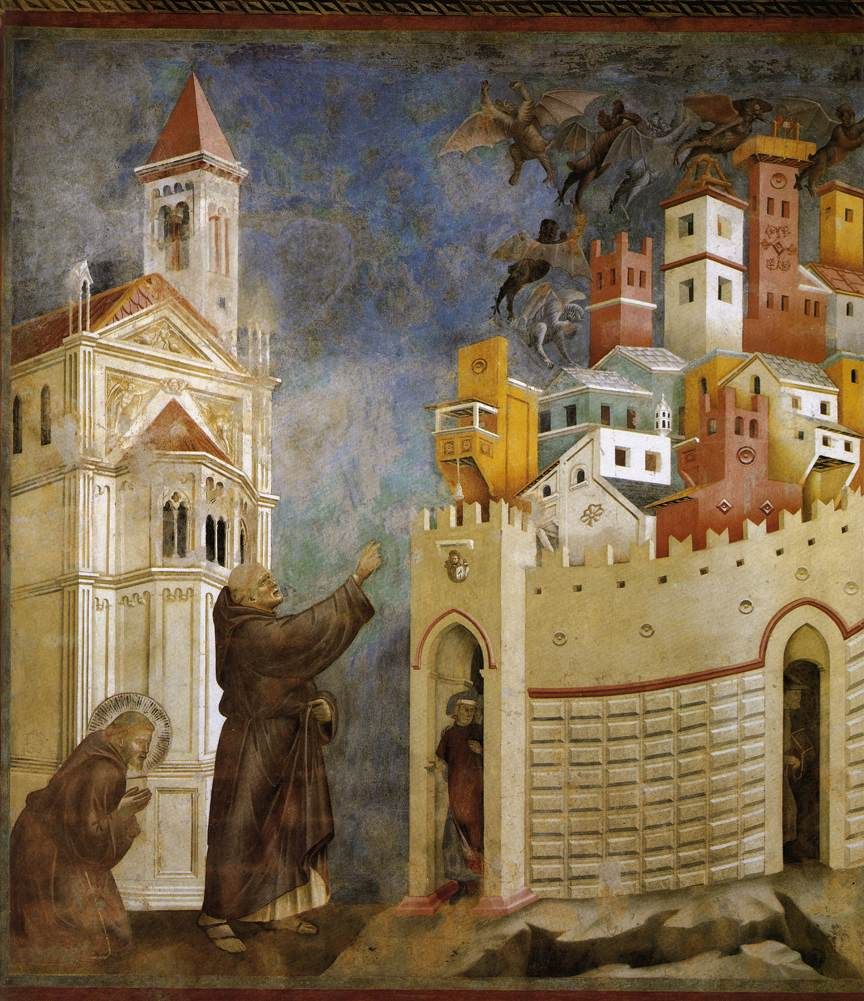
A raised hand reaches towards a city crowded with towers. Above the roofs, winged creatures twist through the air; below them, the walls and gateways remain standing. At the other side of the scene a church rises behind two brown-robed friars, one kneeling in prayer, the other standing to deliver a command. The Expulsion of the Devils from Arezzo makes a miracle visible through the relationship between these quiet figures and the restless shapes overhead. Its decisive action crosses an open stretch of sky.
This fresco is the tenth episode in the twenty-eight-scene life of Saint Francis painted in the Upper Church of the Basilica of Saint Francis at Assisi. [1] It belongs to the cycle traditionally associated with Giotto, whose authorship and chronology remain disputed. The basilica itself acknowledges the competing positions, including attribution to Giotto and to a Roman school of painting. [2] Within that larger debate, the Arezzo scene has a particularly clear identity: it tells how Francis, staying outside a city torn by internal conflict, sent Brother Silvester to drive away the demons stirring up its inhabitants.
The distinction between the two friars gives the picture its structure. Francis prays; Silvester speaks. Their different postures allow an action involving divine authority, a founder's instruction and a brother's obedience to be understood without showing a long conversation. Meanwhile, the city occupies so much of the painting that the welfare of an entire community becomes the subject of those individual acts.
At a Glance
- CycleTenth Franciscan episode in Assisi’s Upper Church. [1] [2]
- RolesFrancis sends Brother Silvester to drive the demons from Arezzo. [1] [2]
- Narrative sourceBonaventure’s Major Legend, VI.9, describing Arezzo’s civil conflict. [3]
This work across Giotto’s career
Santa Maria Novella Crucifix
Late 13th century; c.1288–89 or 1298–1301; disputed; track: c.1288–89 [4]Life of Saint Francis — Upper Church cycle, Assisi
Traditionally Giotto; late 13th–early 14th century; authorship and date disputed; track: c.1290–95 convention [5] [6] [7] [8] [9]Expulsion of Devils from Arezzo — Upper Church, Assisi (current article)
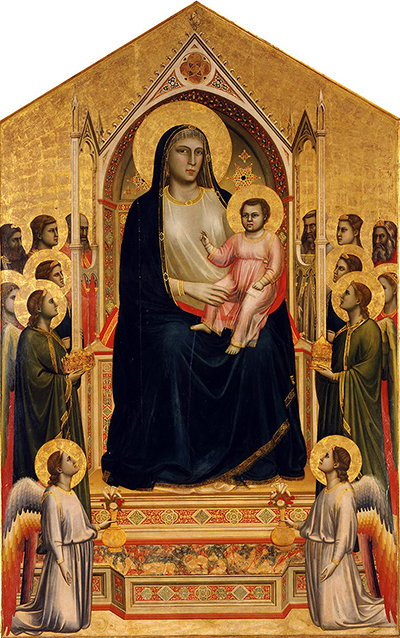
Traditionally Giotto; late 13th–early 14th century; authorship and date disputed; track: c.1290–95 convention [10] [6] [8] [9]Ognissanti Madonna
c.1300–05 (Uffizi); c.1310 also proposed; track: c.1300–05 [11]Scrovegni Chapel — painted decoration
c.1303–05 (chapel campaign); Giotto and workshop (painted decoration) [12] [13] [14]Madonna and Child — Washington / Goldman Madonna
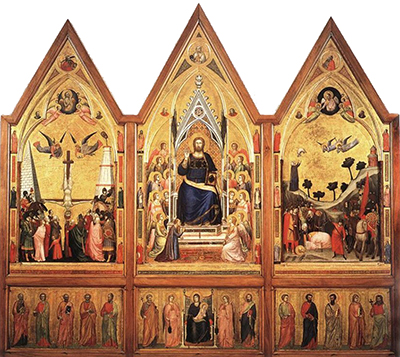
c.1310–1315 (National Gallery of Art) [15]Stefaneschi Triptych
c.1320; 1315–20 (Vatican Museums); Giotto and workshop [16]Bardi Chapel — painted decoration
After 1317, usually the 1320s; disputed; Giotto and workshop / Giottesque painters; individual hands disputed [17] [18]Baroncelli Polyptych
After 1328; completion uncertain; band continues to axis edge; Giotto and workshop [19]Giotto’s Campanile — Florence Cathedral bell tower
Giotto’s phase 1334–37; completed 1359 by successors [20] [21] [22]Contents
- The story behind the scene
- Francis prays, Silvester commands
- A city built for the story
- The disturbance above the roofs
- Humility and the recovery of civic life
- Between the thrones and the sultan
- An inherited arrangement, a disputed hand
The story behind the scene
The narrative comes from chapter VI, section 9 of Bonaventure's Major Legend of Saint Francis. Bonaventure describes Arezzo as shaken by civil war and threatened with destruction. Francis, lodging on its outskirts, sees demons rejoicing above the city and encouraging its angry citizens to kill one another. He sends Silvester to the gate with an instruction: invoke God and, through obedience, order the demons to depart. Silvester obeys, proclaiming the command aloud in God's name and at Francis's bidding. [3]
Bonaventure brings the outcome into ordinary civic life. Peace returns, and the citizens resume a lawful relationship with one another. In E. Gurney Salter's 1904 English translation, they begin peacefully to refashion their civil laws. The conclusion explains the miracle through Francis's humility and the power of humble obedience over the demons' arrogance. [3] The expulsion therefore concerns much more than removing frightening beings from a skyline. Its promised result is the recovery of a community's ability to live together.
This is a hagiographical account: a story shaped to reveal the saint's virtues and spiritual authority. It supplies the fresco's narrative and moral terms. It does not independently establish the presence of demons above medieval Arezzo, or identify a particular set of municipal reforms caused by Francis's intervention. Keeping that distinction clear makes the painting easier to understand. The demons express the cause of conflict as Bonaventure understands it; the buildings give that conflict a place and a human consequence.
The painting selects a compact moment from this sequence. Francis has already given his instruction, Silvester's gesture makes the spoken command intelligible, and the creatures' movement shows its effect. Several stages of the written story meet within one field. A viewer need not imagine the picture as a single instant caught by an eyewitness. It can display prayer, speech and response together, making their relationship the centre of attention.
Nor does the city need to be visibly wrecked to convey its peril. The masonry is substantial, the towers rise prominently and the gate remains usable. The threat described by Bonaventure is internal: citizens turning upon citizens. The fresco gives that danger an aerial form, then shows the disturbance being removed while the city survives.
Francis prays, Silvester commands
At the lower left, the haloed Francis bends close to the ground with his hands joined. His body forms a low, compact shape against the pale architecture behind him. Silvester stands nearer the centre, taller in the picture, with an arm lifted towards the city. His open gesture leads the eye upwards to the departing demons. These differences agree with both the narrative's division of responsibility and the familiar identification of the figures in the scene. [1] [3]
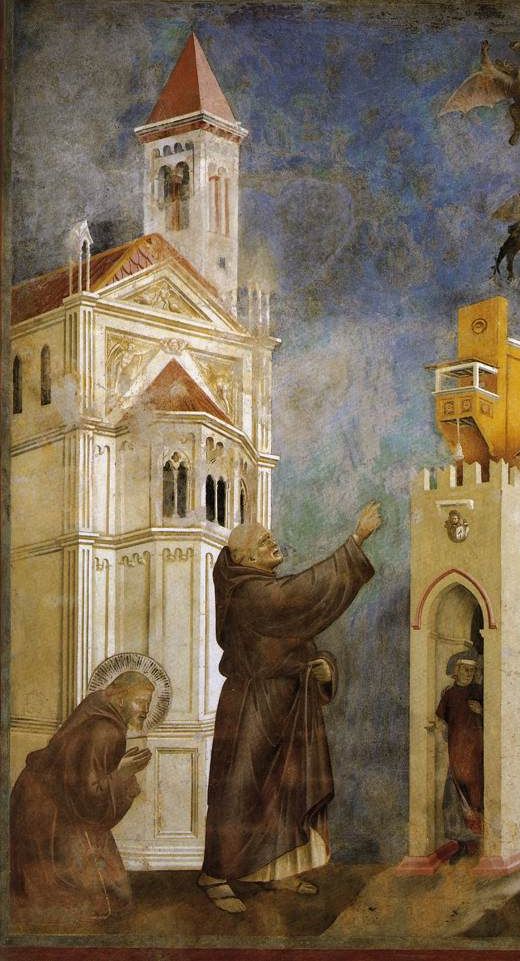
Francis kneels in prayer while Silvester raises his arm beside the church at Arezzo. Image source. Public domain. Cropped and proportionally reduced reproduction; no colour or content enhancement.
The saint's position is especially telling. He is placed at the edge of the action, near the bottom of the church, yet his prayer underlies the command being carried out. Silvester has the more conspicuous silhouette: a broad sleeve, an extended arm and a face directed towards the troubled skyline. A quick glance could mistake the standing brother for Francis. Looking for the kneeling figure and his halo restores the picture's carefully divided agency.
There is also a difference in the space each figure addresses. Francis's bowed head and joined hands turn attention inwards towards prayer. Silvester's raised arm opens the scene outwards. His body mediates between the kneeling saint and the city, carrying the instruction across the intervening space. The picture can thus honour its founder while giving his companion a necessary, active role.
Bonaventure's emphasis on obedience helps explain why this delegation matters. Silvester is effective through carrying out an instruction in God's name. The brother's visible authority grows from his willingness to serve. Francis's humility and Silvester's obedience are complementary virtues, and the pair's different poses give those virtues distinct bodily forms. The story would lose much of its point if both friars were reduced to a single generic miracle worker.
Their shared brown habits also matter visually. Amid pale stone, coloured towers and a large blue field, the friars belong together through the simple masses of their clothing. The standing figure's gesture is easy to follow because the sleeve gives it weight. Francis's bent outline is equally readable against the church. The painter uses substantial bodies and clear silhouettes to make a spiritual relationship visible.
A city built for the story
Arezzo fills the right side with a dense arrangement of walls, houses and towers. Cream, yellow, reddish and cooler-toned buildings overlap, their roofs stepping upwards towards the upper edge. A high crenellated wall gathers this variety into a single urban enclosure. The eye moves from its broad foreground surface to the small windows, projecting structures and towers behind it, discovering a whole city within a compressed space. [1]
The contrast with the church on the left is immediate. The church is also large and elaborate, with a steeply capped bell tower, pointed openings and richly articulated stonework. But its architecture is presented as a relatively coherent mass. The city proliferates: one building gives way to another, with changes of height, colour and direction. Between them, the friars occupy a comparatively open area. Their uncluttered setting makes their action legible beside the crowded urban fabric.
This contrast can support a reading of spiritual order confronting civic disturbance. It need not make the church and city absolute opposites. The purpose of the miracle is to save the city and restore its common life. Its attractive, varied architecture gives that salvation a tangible object. There are homes and public spaces to preserve, gateways through which people should be able to pass, and a collective world extending beyond the two friars.
The gate is particularly important because Bonaventure locates Silvester's command there. In the painting, a small human presence within an opening brings the immense wall back to the scale of daily life. The disparity between that figure and the standing friar also shows how selectively the composition handles proportion. The city has enough depth to suggest enclosure and inhabited streets, while the holy figures remain large enough for their postures to be read clearly.
The ground adds another division. Broken, angular rock runs across the foreground in front of the city, contrasting with the area beneath the friars. This uneven terrain reinforces the sense of a boundary between their position and the fortified settlement. Yet Silvester's gesture passes over it effortlessly. Wall, rocky ground and open air become different kinds of space through which the command operates.
Such organisation asks to be read pictorially. The scene names Arezzo, but its buildings do not provide a measured survey of the medieval town. The isolated church, packed skyline, differing scales and dramatic ground serve the story's clarity. Identifying the church as a literal portrait of a particular cathedral would require further evidence beyond its prominence here. The architecture gives the narrative a convincing urban setting without obliging every tower or window to correspond to a surviving monument.
That freedom is part of the fresco's appeal. A wall turns enough for its side to be seen; towers rise where their silhouettes can register; a roof opens a path towards another building. The city seems full of possible routes and enclosed spaces even though the painter has made it small enough to fit beside the friars. Its density invites prolonged looking, then returns attention to the broad sweep of Silvester's arm.
The disturbance above the roofs
The demons occupy the upper right, where their irregular bodies interrupt the comparatively steady lines of the architecture. Wings, bent limbs and turning torsos set up a fluttering movement above the towers. Their forms vary, but the essential distinction is between these unsettled airborne shapes and the solid city beneath them. The fresco gives agitation a body and a location. [1]
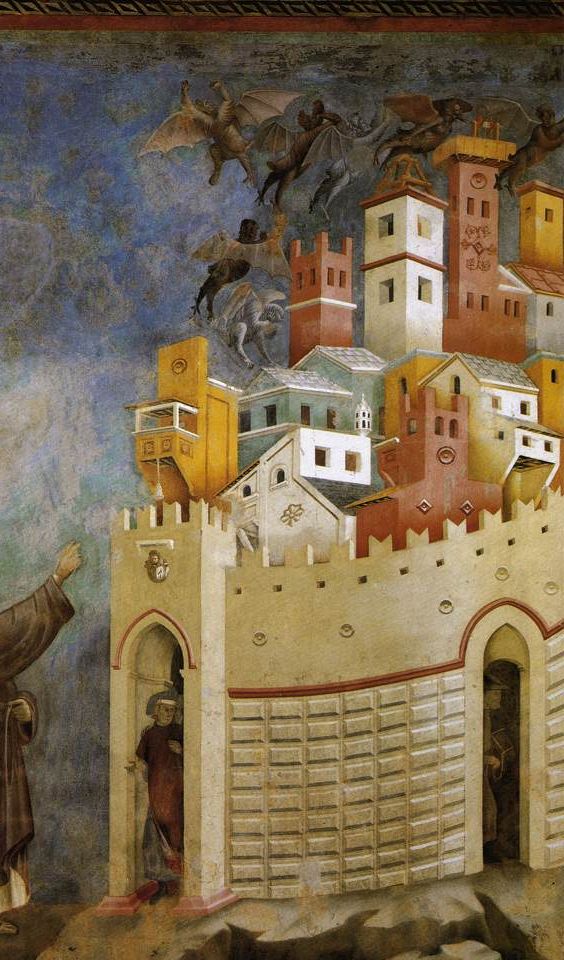
The clustered roofs and walls of Arezzo, with departing devils above the city. Image source. Public domain. Cropped and proportionally reduced reproduction; no colour or content enhancement.
They are already in motion. Silvester does not grapple with them, and Francis's prayer does not require physical contact with the wall or its inhabitants. This distance makes the scene's account of authority especially economical. A gesture below has an answer above; the intervening air allows that response to be seen.
The high placement also follows Bonaventure's story, in which Francis perceives the demons rejoicing over the city. The painting gives visible form to what the saint discerns: forces inciting human violence. Its citizens remain a community capable of peace, and the creatures' departure opens the possibility of renewed cooperation. [3]
The skyline consequently carries two kinds of movement. Buildings lead the eye upwards in a succession of stable blocks, while the demons scatter across and above them. Once the creatures have gone, the towers will still be there. The promise of the miracle takes shape through this contrast between lasting habitation and passing disturbance.
Humility and the recovery of civic life
Bonaventure places the Arezzo episode in a chapter devoted to humility and obedience. Its moral logic depends on a reversal of expectations. A poor friar, staying beyond the city's walls, possesses an authority that its formidable enclosure cannot provide. His companion exercises that authority by obeying. The demons' arrogance is overcome through virtues expressed by the kneeling and standing brothers. [3]
The fortified architecture makes this argument concrete. The city has towers and gates, the material signs of an organised and defended settlement. Yet the danger in the story has arisen among its own inhabitants. A wall can mark who belongs inside, but common life also requires its members to restrain their hostility towards one another. Bonaventure's move from exorcism to civic peace connects a spiritual diagnosis with the practical need for lawful coexistence.
The fresco leaves much of that recovery for viewers to imagine. It does not spread a reconciliation ceremony across the foreground or show a new law being written. Instead, it concentrates on the action that makes renewed peace possible. The small people near the openings and the densely built city stand for a wider human world. The outcome reaches beyond the space that can be shown in detail.
Prayer also acquires a public consequence here. Francis remains outside the city, but the story makes his devotion effective within it. Silvester's position gives that relation an outward voice. The two figures together connect religious life with the welfare of neighbours, and the immense architectural setting keeps the civic scale of their intervention before the viewer.
Between the thrones and the sultan
Within the Assisi sequence, Arezzo follows the Vision of the Thrones and precedes the Trial by Fire before the Sultan. The paired narrative index identifies these as episodes nine, ten and eleven, while linking each to a different passage in Bonaventure. [23] Their order creates a useful progression through forms of authority: humility receives heavenly recognition, obedience addresses civic conflict, and Francis's mission takes him before a ruler abroad.
These remain distinct stories. In the vision, a companion learns of a throne reserved for humble Francis. At Arezzo, Silvester carries out the saint's command. Before the sultan, Francis proposes a trial by fire which, in Bonaventure's account, is not carried through. [23] The cycle's arrangement gives viewers connections to consider without turning its successive pictures into a diary of securely dated journeys.
Arezzo has a special place within that progression because the saint acts through another brother. Its drama depends on the capacity of the community he founded to transmit an instruction and make it effective. The composition keeps both men visible, letting prayer and delegated speech occupy the same scene. For the larger programme and its different painted settings, the Assisi frescoes provide the wider context.
An inherited arrangement, a disputed hand
The pairing of the two friars also enters the scholarly discussion of how the cycle was made. Michael Viktor Schwarz observes that the Arezzo painting reuses a figure arrangement from Cimabue's Fall of Simon Magus in the basilica's north transept, while transforming its manner of presentation. [24] The comparison is visible in the two compositions: low at the left, a kneeling holy figure accompanies a standing figure with an arm raised towards an event above. [25] In Cimabue's painting, a tall scaffold occupies the middle of the scene and a group gathers on the right. The Arezzo fresco opens the space beyond the raised arm and gives most of its right side to the city. A familiar arrangement carries a new story through changes in its surroundings.
That resemblance is a specific relationship between images. It does not by itself identify the individual who painted Arezzo. Schwarz considers it within a broader argument about painters drawing on earlier Assisi work, the upper biblical scenes and the art of Padua. His proposed campaign around 1308, involving either limited direction by Giotto or the transmission of his style by a former assistant, is a scholarly hypothesis. [24] Other reconstructions differ: Miklós Boskovits's 2001 account argues for a major role for the young Giotto in the Upper Church while recognising that the campaign and extent of his participation remain debated. [26]
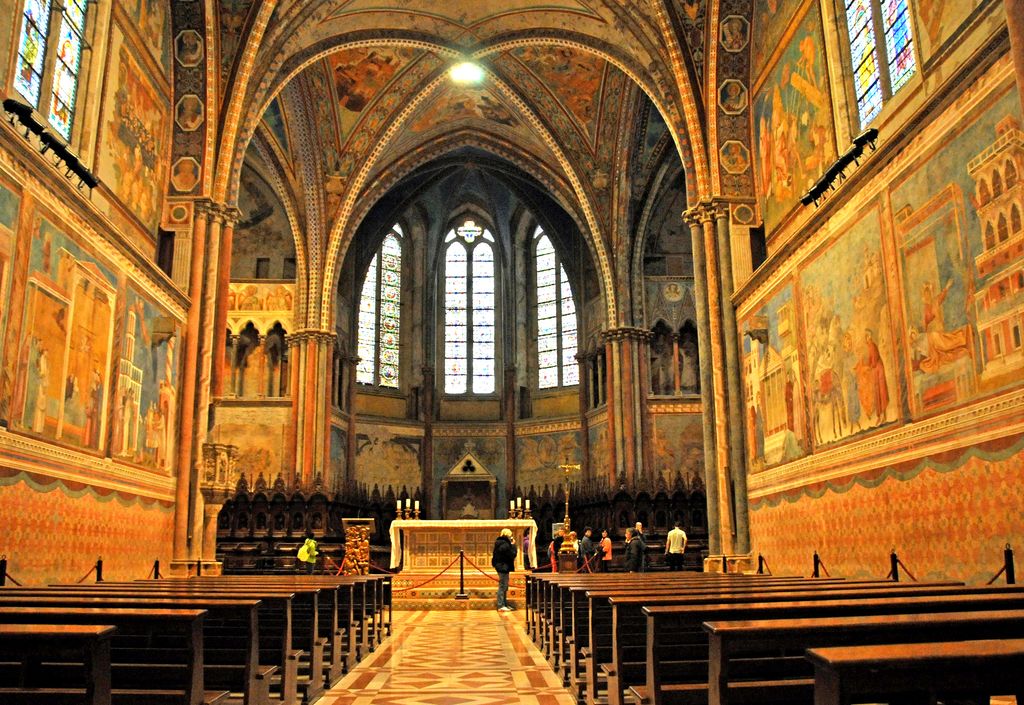
The nave of the Upper Church of San Francesco at Assisi, photographed in 2010. The Francis cycle occupies the lower narrative register; its authorship remains disputed. The photograph records the wider setting rather than an isolated scene. Dennis G. Jarvis. Image source. CC BY-SA 2.0. Proportionally reduced reproduction; original composition, colour and photographic lighting retained.
The fresco rewards attention at a scale smaller than those large disagreements. Francis's joined hands, Silvester's lifted arm, the person at the gate and the creatures above the rooftops each hold a precise place in its account of peace restored. The city's crowded buildings remain the lasting object of the brothers' concern. Beneath the departing demons, a human community has room to continue its life.
Watch: Explore Giotto’s Art
Choose an overview or a closer look at three major works. These films provide wider Giotto context alongside this article.
Artworks directory
This directory brings together 209 records for paintings, ensembles, individual scenes and components, architectural work, an associated disputed design, and reported or lost projects connected with Giotto. Ensembles and their parts appear separately, so 209 is a count of records rather than independent paintings or commissions. Attributions and dates remain qualified where disputed; inclusion does not establish Giotto’s own hand throughout.
| Name | Date | Medium, attribution and status |
|---|---|---|
| Expulsion of Joachim from the Temple — Scrovegni Chapel, Padua | c.1303–05 (chapel campaign) | Fresco / wall painting. Giotto and workshop. Scene within a cycle. Padova Musei. Chapel overview. |
| Joachim among the Shepherds — Scrovegni Chapel, Padua | c.1303–05 (chapel campaign) | Fresco / wall painting. Giotto and workshop. Scene within a cycle. Padova Musei. Chapel overview. |
| Annunciation to Saint Anne — Scrovegni Chapel, Padua | c.1303–05 (chapel campaign) | Fresco / wall painting. Giotto and workshop. Scene within a cycle. Padova Musei. Chapel overview. |
| Sacrifice of Joachim — Scrovegni Chapel, Padua | c.1303–05 (chapel campaign) | Fresco / wall painting. Giotto and workshop. Scene within a cycle. Padova Musei. Chapel overview. |
| Joachim’s Dream — Scrovegni Chapel, Padua | c.1303–05 (chapel campaign) | Fresco / wall painting. Giotto and workshop. Scene within a cycle. Padova Musei. Padova Musei. Chapel overview. |
| Meeting at the Golden Gate — Scrovegni Chapel, Padua | c.1303–05 (chapel campaign) | Fresco / wall painting. Giotto and workshop. Scene within a cycle. Padova Musei. Chapel overview. |
| Birth of the Virgin — Scrovegni Chapel, Padua | c.1303–05 (chapel campaign) | Fresco / wall painting. Giotto and workshop. Scene within a cycle. Padova Musei. Padova Musei. Chapel overview. |
| Presentation of the Virgin in the Temple — Scrovegni Chapel, Padua | c.1303–05 (chapel campaign) | Fresco / wall painting. Giotto and workshop. Scene within a cycle. Padova Musei. Chapel overview. |
| Delivery of the Rods — Scrovegni Chapel, Padua | c.1303–05 (chapel campaign) | Fresco / wall painting. Giotto and workshop. Scene within a cycle. Padova Musei. Chapel overview. |
| Prayer of Joseph and the Suitors — Scrovegni Chapel, Padua | c.1303–05 (chapel campaign) | Fresco / wall painting. Giotto and workshop. Scene within a cycle. Padova Musei. Chapel overview. |
| Marriage of the Virgin — Scrovegni Chapel, Padua | c.1303–05 (chapel campaign) | Fresco / wall painting. Giotto and workshop. Scene within a cycle. Padova Musei. Chapel overview. |
| Wedding Procession of Mary — Scrovegni Chapel, Padua | c.1303–05 (chapel campaign) | Fresco / wall painting. Giotto and workshop. Scene within a cycle. Padova Musei. Chapel overview. |
| Annunciation on the triumphal arch — complete ensemble (Scrovegni Chapel, Padua) | c.1303–05 (chapel campaign) | Wall painting with a central painted wooden panel. Giotto and workshop. Ensemble. Includes the Mission of Gabriel and the lower Annunciation pair; the original central wooden panel is in the Musei Civici agli Eremitani, with a conservation copy in the chapel. Padova Musei. Padova Musei. Scholarly study. Chapel overview. |
| Visitation — Scrovegni Chapel, Padua | c.1303–05 (chapel campaign) | Fresco / wall painting. Giotto and workshop. Scene within a cycle. Padova Musei. Chapel overview. |
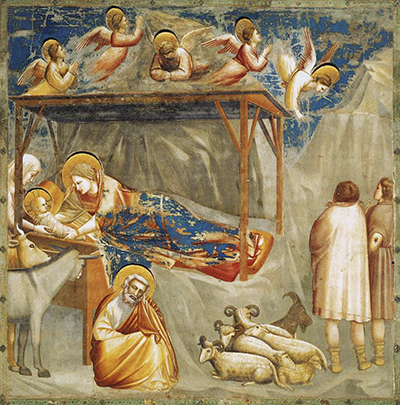
| Nativity — Scrovegni Chapel, Padua | c.1303–05 (chapel campaign) | Fresco / wall painting. Giotto and workshop. Scene within a cycle. Padova Musei. Chapel overview. |
| Adoration of the Magi — Scrovegni Chapel, Padua | c.1303–05 (chapel campaign) | Fresco / wall painting. Giotto and workshop. Scene within a cycle. Padova Musei. Chapel overview. |
| Presentation of Christ at the Temple — Scrovegni Chapel, Padua | c.1303–05 (chapel campaign) | Fresco / wall painting. Giotto and workshop. Scene within a cycle. Padova Musei. Chapel overview. |
| Flight into Egypt — Scrovegni Chapel, Padua | c.1303–05 (chapel campaign) | Fresco / wall painting. Giotto and workshop. Scene within a cycle. Padova Musei. Chapel overview. |
| Massacre of the Innocents — Scrovegni Chapel, Padua | c.1303–05 (chapel campaign) | Fresco / wall painting. Giotto and workshop. Scene within a cycle. Padova Musei. Chapel overview. |
| Christ among the Doctors — Scrovegni Chapel, Padua | c.1303–05 (chapel campaign) | Fresco / wall painting. Giotto and workshop. Scene within a cycle. Padova Musei. Chapel overview. |
| Baptism of Christ — Scrovegni Chapel, Padua | c.1303–05 (chapel campaign) | Fresco / wall painting. Giotto and workshop. Scene within a cycle. Padova Musei. Chapel overview. |
| Marriage at Cana — Scrovegni Chapel, Padua | c.1303–05 (chapel campaign) | Fresco / wall painting. Giotto and workshop. Scene within a cycle. Padova Musei. Padova Musei. Chapel overview. |
| Raising of Lazarus — Scrovegni Chapel, Padua | c.1303–05 (chapel campaign) | Fresco / wall painting. Giotto and workshop. Scene within a cycle. Padova Musei. Chapel overview. |
| Entry into Jerusalem — Scrovegni Chapel, Padua | c.1303–05 (chapel campaign) | Fresco / wall painting. Giotto and workshop. Scene within a cycle. Padova Musei. Chapel overview. |
| Expulsion of the Money Changers — Scrovegni Chapel, Padua | c.1303–05 (chapel campaign) | Fresco / wall painting. Giotto and workshop. Scene within a cycle. Padova Musei. Padova Musei. Chapel overview. |
| Judas Receiving the Payment — Scrovegni Chapel, Padua | c.1303–05 (chapel campaign) | Fresco / wall painting. Giotto and workshop. Scene within a cycle. Padova Musei. Chapel overview. |
| Last Supper — Scrovegni Chapel, Padua | c.1303–05 (chapel campaign) | Fresco / wall painting. Giotto and workshop. Scene within a cycle. Padova Musei. Chapel overview. |
| Washing of the Feet — Scrovegni Chapel, Padua | c.1303–05 (chapel campaign) | Fresco / wall painting. Giotto and workshop. Scene within a cycle. Padova Musei. Chapel overview. |
| Arrest of Christ — Scrovegni Chapel, Padua | c.1303–05 (chapel campaign) | Fresco / wall painting. Giotto and workshop. Scene within a cycle. Padova Musei. Chapel overview. |
| Christ before Annas and Caiaphas — Scrovegni Chapel, Padua | c.1303–05 (chapel campaign) | Fresco / wall painting. Giotto and workshop. Scene within a cycle. Padova Musei. Chapel overview. |
| Mocking of Christ and Flagellation — Scrovegni Chapel, Padua | c.1303–05 (chapel campaign) | Fresco / wall painting. Giotto and workshop. Scene within a cycle. Padova Musei. Chapel overview. |
| Road to Calvary — Scrovegni Chapel, Padua | c.1303–05 (chapel campaign) | Fresco / wall painting. Giotto and workshop. Scene within a cycle. Padova Musei. Chapel overview. |
| Crucifixion — Scrovegni Chapel, Padua | c.1303–05 (chapel campaign) | Fresco / wall painting. Giotto and workshop. Scene within a cycle. Padova Musei. Chapel overview. |
| Lamentation — Scrovegni Chapel, Padua | c.1303–05 (chapel campaign) | Fresco / wall painting. Giotto and workshop. Scene within a cycle. Padova Musei. Chapel overview. |
| Resurrection / Noli me tangere — Scrovegni Chapel, Padua | c.1303–05 (chapel campaign) | Fresco / wall painting. Giotto and workshop. Scene within a cycle. Padova Musei. Chapel overview. |
| Ascension — Scrovegni Chapel, Padua | c.1303–05 (chapel campaign) | Fresco / wall painting. Giotto and workshop. Scene within a cycle. Padova Musei. Chapel overview. |
| Pentecost — Scrovegni Chapel, Padua | c.1303–05 (chapel campaign) | Fresco / wall painting. Giotto and workshop. Scene within a cycle. Padova Musei. Padova Musei. Chapel overview. |
| Coretto — right painted recess (Scrovegni Chapel, Padua) | c.1303–05 (chapel campaign) | Fresco / painted fictive architecture. Giotto and workshop. Ensemble component. Padova Musei. Padova Musei. Scholarly study. Chapel overview. |
| Coretto — left painted recess (Scrovegni Chapel, Padua) | c.1303–05 (chapel campaign) | Fresco / painted fictive architecture. Giotto and workshop. Ensemble component. Padova Musei. Padova Musei. Scholarly study. Chapel overview. |
| Envy — Scrovegni Chapel, Padua | c.1303–05 (chapel campaign) | Grisaille fresco / wall painting. Giotto and workshop. Ensemble component. Padova Musei. Chapel overview. Scholarly study. Padova Musei. |
| Despair — Scrovegni Chapel, Padua | c.1303–05 (chapel campaign) | Grisaille fresco / wall painting. Giotto and workshop. Ensemble component. Padova Musei. Chapel overview. Scholarly study. Padova Musei. |
| Prudence — Scrovegni Chapel, Padua | c.1303–05 (chapel campaign) | Grisaille fresco / wall painting. Giotto and workshop. Ensemble component. Padova Musei. Chapel overview. Scholarly study. Padova Musei. |
| Fortitude — Scrovegni Chapel, Padua | c.1303–05 (chapel campaign) | Grisaille fresco / wall painting. Giotto and workshop. Ensemble component. Padova Musei. Chapel overview. Scholarly study. Padova Musei. |
| Temperance — Scrovegni Chapel, Padua | c.1303–05 (chapel campaign) | Grisaille fresco / wall painting. Giotto and workshop. Ensemble component. Padova Musei. Chapel overview. Scholarly study. Padova Musei. |
| Justice — Scrovegni Chapel, Padua | c.1303–05 (chapel campaign) | Grisaille fresco / wall painting. Giotto and workshop. Ensemble component. Padova Musei. Chapel overview. Scholarly study. Padova Musei. |
| Faith — Scrovegni Chapel, Padua | c.1303–05 (chapel campaign) | Grisaille fresco / wall painting. Giotto and workshop. Ensemble component. Padova Musei. Chapel overview. Scholarly study. Padova Musei. |
| Charity — Scrovegni Chapel, Padua | c.1303–05 (chapel campaign) | Grisaille fresco / wall painting. Giotto and workshop. Ensemble component. Padova Musei. Chapel overview. Scholarly study. Padova Musei. |
| Hope — Scrovegni Chapel, Padua | c.1303–05 (chapel campaign) | Grisaille fresco / wall painting. Giotto and workshop. Ensemble component. Padova Musei. Chapel overview. Scholarly study. Padova Musei. |
| Folly — Scrovegni Chapel, Padua | c.1303–05 (chapel campaign) | Grisaille fresco / wall painting. Giotto and workshop. Ensemble component. Padova Musei. Chapel overview. Scholarly study. Padova Musei. |
| Inconstancy — Scrovegni Chapel, Padua | c.1303–05 (chapel campaign) | Grisaille fresco / wall painting. Giotto and workshop. Ensemble component. Padova Musei. Chapel overview. Scholarly study. Padova Musei. |
| Wrath — Scrovegni Chapel, Padua | c.1303–05 (chapel campaign) | Grisaille fresco / wall painting. Giotto and workshop. Ensemble component. Padova Musei. Chapel overview. Scholarly study. Padova Musei. |
| Injustice — Scrovegni Chapel, Padua | c.1303–05 (chapel campaign) | Grisaille fresco / wall painting. Giotto and workshop. Ensemble component. Padova Musei. Chapel overview. Scholarly study. Padova Musei. |
| Infidelity / Idolatry — Scrovegni Chapel, Padua | c.1303–05 (chapel campaign) | Grisaille fresco / wall painting. Giotto and workshop. Ensemble component. Padova Musei. Chapel overview. Scholarly study. Padova Musei. |
| Starry vault — complete ensemble (Scrovegni Chapel, Padua) | c.1303–05 (chapel campaign) | Vault painting. Giotto and workshop. Ensemble. Padova Musei. Padova Musei. Chapel overview. |
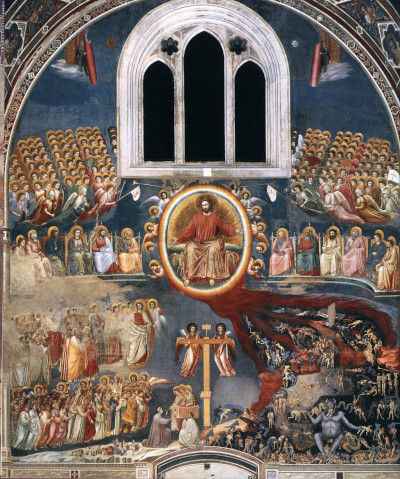
| Last Judgement — Scrovegni Chapel, Padua | c.1303–05 (chapel campaign) | Fresco / wall painting. Giotto and workshop. Scene within a cycle. Padova Musei. Padova Musei. Chapel overview. Padova Musei. |
| Prophet Malachi — vault medallion — Scrovegni Chapel, Padua | c.1303–05 (chapel campaign) | Fresco / wall painting. Giotto and workshop. Ensemble component. Padova Musei. Padova Musei. Chapel overview. Padova Musei. |
| Prophet Baruch — vault medallion — Scrovegni Chapel, Padua | c.1303–05 (chapel campaign) | Fresco / wall painting. Giotto and workshop. Ensemble component. Padova Musei. Padova Musei. Chapel overview. Padova Musei. |
| Prophet Isaiah — vault medallion — Scrovegni Chapel, Padua | c.1303–05 (chapel campaign) | Fresco / wall painting. Giotto and workshop. Ensemble component. Padova Musei. Padova Musei. Chapel overview. Padova Musei. |
| Prophet Daniel — vault medallion — Scrovegni Chapel, Padua | c.1303–05 (chapel campaign) | Fresco / wall painting. Giotto and workshop. Ensemble component. Padova Musei. Padova Musei. Chapel overview. Padova Musei. |
| Christ Pantocrator — vault medallion — Scrovegni Chapel, Padua | c.1303–05 (chapel campaign) | Fresco / wall painting. Giotto and workshop. Ensemble component. Padova Musei. Padova Musei. Chapel overview. Padova Musei. |
| Virgin and Child — vault medallion — Scrovegni Chapel, Padua | c.1303–05 (chapel campaign) | Fresco / wall painting. Giotto and workshop. Ensemble component. Padova Musei. Padova Musei. Chapel overview. Padova Musei. |
| Prophet Ezekiel — vault medallion — Scrovegni Chapel, Padua | c.1303–05 (chapel campaign) | Fresco / wall painting. Giotto and workshop. Ensemble component. Padova Musei. Padova Musei. Chapel overview. Padova Musei. |
| Prophet Micah — vault medallion — Scrovegni Chapel, Padua | c.1303–05 (chapel campaign) | Fresco / wall painting. Giotto and workshop. Ensemble component. Padova Musei. Padova Musei. Chapel overview. Padova Musei. |
| Saint John the Baptist — vault medallion — Scrovegni Chapel, Padua | c.1303–05 (chapel campaign) | Fresco / wall painting. Giotto and workshop. Ensemble component. Padova Musei. Padova Musei. Chapel overview. Padova Musei. |
| Scrovegni Chapel — painted decoration | c.1303–05 (chapel campaign) | Fresco / wall painting, with a painted wooden panel. Giotto and workshop (painted decoration). Ensemble. Includes separately listed scenes and components. The original central God the Father panel is in the Musei Civici agli Eremitani; a conservation copy is in the chapel. Chapel overview. Padova Musei. Padova Musei. Source. Source. Source. Padova Musei. Scholarly study. |
| Vices and Virtues — complete fourteen-figure programme | c.1303–05 (chapel campaign) | Grisaille fresco / wall painting. Giotto and workshop. Ensemble. Fourteen figures: seven virtues and seven opposed vices. Padova Musei. Chapel overview. Scholarly study. |
| Coretti — paired fictive chapels | c.1303–05 (chapel campaign) | Fresco / painted fictive architecture. Giotto and workshop. Ensemble. Two separate painted recesses, also listed individually. Padova Musei. Padova Musei. Scholarly study. |
| Mission of Gabriel — heavenly assembly | c.1303–05 (chapel campaign) | Wall painting with central painted wooden image. Giotto and workshop. Ensemble component. Central wooden God the Father panel preserved at the Musei Civici agli Eremitani; conservation copy in the chapel. Chapel overview. Padova Musei. Scholarly study. Padova Musei. |
| Annunciation — Gabriel and Mary in facing chambers | c.1303–05 (chapel campaign) | Fresco / wall painting. Giotto and workshop. Ensemble component. Chapel overview. Scholarly study. Padova Musei. |
| God the Father — central wooden panel of the Mission of Gabriel | c.1303–05 (chapel campaign) | Painting on wood. Associated with Giotto. Ensemble component. Original at the Musei Civici agli Eremitani, Padua; conservation copy in the Scrovegni Chapel. Padova Musei. Padova Musei. Scholarly study. Source. |
| Life of Saint Francis — Upper Church cycle, Assisi | Late 13th–early 14th century; dating disputed | Fresco / wall-painting cycle. Traditionally associated with Giotto; Giotto, Roman-school and other attributions disputed. Ensemble. Twenty-eight-scene nave cycle; scenes also listed individually. Basilica catalogue. Scholarly study. Basilica catalogue. Source. Source. |
| Homage of a Simple Man — Upper Church, Assisi | Late 13th–early 14th century; dating disputed | Wall painting. Traditionally associated with Giotto; authorship and dating disputed. Scene within a cycle. Source. Scholarly study. Source. Source. Source. |
| Gift of the Mantle — Upper Church, Assisi | Late 13th–early 14th century; dating disputed | Wall painting. Traditionally associated with Giotto; authorship and dating disputed. Scene within a cycle. Basilica catalogue. Scholarly study. Source. Source. Source. |
| Dream of the Palace Full of Arms — Upper Church, Assisi | Late 13th–early 14th century; dating disputed | Wall painting. Traditionally associated with Giotto; authorship and dating disputed. Scene within a cycle. Basilica catalogue. Source. Scholarly study. Source. Source. Source. |
| Prayer before the Crucifix at San Damiano — Upper Church, Assisi | Late 13th–early 14th century; dating disputed | Wall painting. Traditionally associated with Giotto; authorship and dating disputed. Scene within a cycle. Source. Source. Source. Scholarly study. Source. Source. |
| Renunciation of Worldly Goods — Upper Church, Assisi | Late 13th–early 14th century; dating disputed | Wall painting. Traditionally associated with Giotto; authorship and dating disputed. Scene within a cycle. Source. Scholarly study. Source. Source. |
| Dream of Innocent III — Upper Church, Assisi | Late 13th–early 14th century; dating disputed | Wall painting. Traditionally associated with Giotto; authorship and dating disputed. Scene within a cycle. Source. Source. Scholarly study. Source. Source. |
| Confirmation of the Rule — Upper Church, Assisi | Late 13th–early 14th century; dating disputed | Wall painting. Traditionally associated with Giotto; authorship and dating disputed. Scene within a cycle. Source. Scholarly study. Source. Source. |
| Vision of the Flaming Chariot — Upper Church, Assisi | Late 13th–early 14th century; dating disputed | Wall painting. Traditionally associated with Giotto; authorship and dating disputed. Scene within a cycle. Source. Source. Scholarly study. Source. Source. |
| Vision of the Thrones — Upper Church, Assisi | Late 13th–early 14th century; dating disputed | Wall painting. Traditionally associated with Giotto; authorship and dating disputed. Scene within a cycle. Basilica catalogue. Scholarly study. Source. Source. Source. |
| Expulsion of Devils from Arezzo — Upper Church, Assisi | Late 13th–early 14th century; dating disputed | Wall painting. Traditionally associated with Giotto; authorship and dating disputed. Scene within a cycle. Source. Source. Scholarly study. Source. Source. Source. |
| Trial by Fire before the Sultan — Upper Church, Assisi | Late 13th–early 14th century; dating disputed | Wall painting. Traditionally associated with Giotto; authorship and dating disputed. Scene within a cycle. Source. Source. Scholarly study. Source. Source. |
| Ecstasy of Saint Francis — Upper Church, Assisi | Late 13th–early 14th century; dating disputed | Wall painting. Traditionally associated with Giotto; authorship and dating disputed. Scene within a cycle. Source. Source. Source. Scholarly study. Source. Source. |
| Nativity at Greccio — Upper Church, Assisi | Late 13th–early 14th century; dating disputed | Wall painting. Traditionally associated with Giotto; authorship and dating disputed. Scene within a cycle. Basilica catalogue. Scholarly study. Source. Source. Source. |
| Miracle of the Spring — Upper Church, Assisi | Late 13th–early 14th century; dating disputed | Wall painting. Traditionally associated with Giotto; authorship and dating disputed. Scene within a cycle. Source. Scholarly study. Source. Source. Source. |
| Sermon to the Birds — Upper Church, Assisi | Late 13th–early 14th century; dating disputed | Wall painting. Traditionally associated with Giotto; authorship and dating disputed. Scene within a cycle. Basilica catalogue. Scholarly study. Source. Source. Source. |
| Death of the Knight of Celano — Upper Church, Assisi | Late 13th–early 14th century; dating disputed | Wall painting. Traditionally associated with Giotto; authorship and dating disputed. Scene within a cycle. Source. Source. Scholarly study. Source. Source. |
| Sermon before Pope Honorius III — Upper Church, Assisi | Late 13th–early 14th century; dating disputed | Wall painting. Traditionally associated with Giotto; authorship and dating disputed. Scene within a cycle. Source. Source. Scholarly study. Source. |
| Apparition at the Chapter of Arles — Upper Church, Assisi | Late 13th–early 14th century; dating disputed | Wall painting. Traditionally associated with Giotto; authorship and dating disputed. Scene within a cycle. Basilica catalogue. Scholarly study. Source. Source. Source. |
| Stigmatisation — Upper Church, Assisi | Late 13th–early 14th century; dating disputed | Wall painting. Traditionally associated with Giotto; authorship and dating disputed. Scene within a cycle. Source. Scholarly study. Source. Source. |
| Death and Ascension of Saint Francis — Upper Church, Assisi | Late 13th–early 14th century; dating disputed | Wall painting. Traditionally associated with Giotto; authorship and dating disputed. Scene within a cycle. Basilica catalogue. Scholarly study. Source. Source. Source. |
| Apparition to Brother Augustine and Bishop Guido — Upper Church, Assisi | Late 13th–early 14th century; dating disputed | Wall painting. Traditionally associated with Giotto; authorship and dating disputed. Scene within a cycle. Zeri catalogue. Scholarly study. Source. Source. Source. |
| Verification of the Stigmata — Upper Church, Assisi | Late 13th–early 14th century; dating disputed | Wall painting. Traditionally associated with Giotto; authorship and dating disputed. Scene within a cycle. Source. Source. Scholarly study. Source. Source. |
| Mourning of the Poor Clares — Upper Church, Assisi | Late 13th–early 14th century; dating disputed | Wall painting. Traditionally associated with Giotto; authorship and dating disputed. Scene within a cycle. Basilica catalogue. Source. Scholarly study. Source. Source. |
| Canonisation of Saint Francis — Upper Church, Assisi | Late 13th–early 14th century; dating disputed | Wall painting. Traditionally associated with Giotto; authorship and dating disputed. Scene within a cycle. Source. Source. Scholarly study. Source. Source. Source. |
| Apparition to Pope Gregory IX — Upper Church, Assisi | Late 13th–early 14th century; dating disputed | Wall painting. Traditionally associated with Giotto; authorship and dating disputed. Scene within a cycle. Zeri catalogue. Scholarly study. Source. Source. Source. |
| Healing of John of Lerida — Upper Church, Assisi | Late 13th–early 14th century; dating disputed | Wall painting. Traditionally associated with Giotto; authorship and dating disputed. Scene within a cycle. Source. Source. Scholarly study. Source. Source. |
| Resurrection of a Woman — Upper Church, Assisi | Late 13th–early 14th century; dating disputed | Wall painting. Traditionally associated with Giotto; authorship and dating disputed. Scene within a cycle. Source. Scholarly study. Source. Source. Source. |
| Liberation of the Prisoner Peter — Upper Church, Assisi | Late 13th–early 14th century; dating disputed | Wall painting. Traditionally associated with Giotto; authorship and dating disputed. Scene within a cycle. Source. Source. Scholarly study. Source. Source. Source. |
| Santa Maria Novella Crucifix | Late 13th century; c.1288–89 or 1298–1301; disputed | Tempera and gold on a shaped wooden cross. Giotto. Source. |
| Death of the Virgin / Dormition — Berlin | c.1310 | Tempera and gold on poplar; gabled dossal. Giotto. Source. Source. |
| Peruzzi Altarpiece | c.1311–1315 (North Carolina Museum of Art) | Tempera and gold on panel. Giotto and workshop. Ensemble. Source. |
| Bologna Polyptych | c.1330 | Tempera and gold on panel. Giotto and workshop. Ensemble. Source. |
| Death of Saint Francis, Bardi Chapel | After 1317, usually the 1320s; disputed | Wall painting with wet-plaster and dry-applied passages. Giotto. Scene within a cycle. Source. |
| Bardi Chapel — painted decoration | After 1317, usually the 1320s; disputed | Wall painting with wet-plaster and dry-applied passages. Giotto and workshop / Giottesque painters; individual hands disputed. Ensemble. Scholarly study. Source. |
| Badia Polyptych | c.1300; proposed dates include 1295–1300 and 1301–02 | Tempera and gold on panel; five cusped compartments. Giotto. Ensemble. Scholarly study. Source. Source. |
| Baroncelli Polyptych | After 1328; detached pinnacle c.1328–35 | Tempera and gold on panel; later altered framing. Giotto and workshop. Ensemble. Detached central pinnacle in San Diego. Santa Croce. |
| Adoration of the Magi / Epiphany — Metropolitan Museum panel | Possibly c.1320; c.1310–18 also proposed for the group | Tempera and gold on wood. Giotto. Part of the dispersed seven-scene board; original function disputed. Met catalogue. Source. |
| Franciscan Allegories | Early 14th century, often c.1315; disputed | Vault wall painting. Giotto and workshop / Giottesque painters; individual hands disputed. Ensemble. Basilica catalogue. |
| Navicella — lost / reworked original mosaic | Late 13th–early 14th century; date disputed | Mosaic. Original attributed to Giotto. Original lost / reworked; fragments and later remakes survive. Scholarly study. |
| Pentecost — London panel | Possibly c.1310–18 (Gordon) | Egg tempera on poplar. Giotto and workshop. Part of the dispersed seven-scene board; original function disputed. National Gallery. Source. |
| Saint Stephen — Horne panel | c.1330–1335 (Museo Horne) | Tempera and gold on panel. Giotto. Proposed association with the Washington and Chaalis panels remains hypothetical. Source. |
| Saint Francis Receiving the Stigmata — Louvre altarpiece | 1300–25 (Louvre) | Tempera and gold on poplar. Giotto. Louvre catalogue. |
| Stefaneschi Triptych | c.1320; 1315–20 (Vatican Museums) | Tempera and gold on panel; painted on both sides. Giotto and workshop. Ensemble. Vatican Museums. |
| Crucifixion, Berlin | c.1315–1320 | Tempera and gold on poplar. Giotto. Source. |
| Madonna and Child — Washington / Goldman Madonna | c.1310–1315 (National Gallery of Art) | Tempera and gold on poplar. Giotto. Washington panel, distinct from San Giorgio alla Costa; proposed Horne/Chaalis companions remain hypothetical. NGA catalogue. |
| Ognissanti Madonna | c.1300–05 (Uffizi); c.1310 also proposed | Tempera and gold on panel. Giotto. Uffizi. |
| Madonna of Borgo San Lorenzo | c.1290–95; dating and attribution debated | Tempera and gold on a fragment of a wooden panel. Giotto. Fragmentary. Source. |
| Madonna of San Giorgio alla Costa | c.1288–95 (Opera del Duomo); later dates also proposed | Tempera and gold on panel; cut edges. Giotto. Damaged in 1993 and treated in 1995. Source. |
| Magdalene Chapel — painted decoration | c.1307–08 (basilica); disputed | Wall painting with wet-plaster and dry-applied passages. Giotto and workshop / Giottesque painters; individual hands disputed. Ensemble. Basilica catalogue. |
| Ognissanti Crucifix | c.1315–1320 (Opificio) | Painting on a shaped wooden cross. Giotto and workshop. Workshop participation and alternative attributions debated. Source. |
| Padua Crucifix | c.1303–05 (Zeri catalogue) | Tempera and gold on a shaped wooden cross. Giotto. Zeri catalogue. |
| Peruzzi Chapel — painted decoration | c.1310–11 (Santa Croce); 1334–36 proposed by Schwarz | Wall painting with substantial dry-applied work and loss. Giotto and workshop / Giottesque painters; individual hands disputed. Ensemble. Santa Croce. |
| Rimini Crucifix | c.1300; late 13th century also proposed | Tempera and gold on a shaped wooden cross. Giotto. Source. |
| Giotto’s Campanile — Florence Cathedral bell tower | Begun 1334; completed 1359 under successors | Marble-clad masonry bell tower. Begun under Giotto; continued by Andrea Pisano and Francesco Talenti. Successive building and sculptural campaigns. Source. Scholarly study. Scholarly study. |
| Tower elevation on parchment, Siena — disputed relation to Giotto | 14th century; date and design context disputed | Brown ink and coloured washes over incised construction on three parchment skins. Attribution disputed; possibly a Giotto design transmitted through another hand. Associated design; autograph attribution unestablished. Alternative attributions include Lando di Pietro. Scholarly study. Source. Source. |
| Seven scenes of Christ — dispersed painted board | Possibly c.1310–18 (Gordon); component dates vary | Tempera and gold on a single wooden board, subsequently divided. Giotto and workshop; individual attributions vary. Reconstructed dispersed ensemble. Common board supported by matching wood grain; predella or dossal function disputed. Source. Source. |
| Presentation of Christ at the Temple — Boston panel | Possibly c.1310–18 (Gordon’s group dating) | Tempera and gold on wood. Giotto and workshop; individual attribution varies within the group. Ensemble component. Source. Source. |
| Last Supper — Munich panel | Possibly c.1310–18 (Gordon’s group dating) | Tempera and gold on wood. Giotto and workshop; individual attribution varies within the group. Ensemble component. Source. Source. Source. |
| Crucifixion — Munich panel | Possibly c.1310–18 (Gordon’s group dating) | Tempera and gold on wood. Giotto and workshop; individual attribution varies within the group. Ensemble component. Source. Source. Source. |
| Descent into Limbo — Munich panel | Possibly c.1310–18 (Gordon’s group dating) | Tempera and gold on wood. Giotto and workshop; individual attribution varies within the group. Ensemble component. Source. Source. Source. |
| Entombment — Villa I Tatti panel | Possibly c.1310–18 (Gordon’s group dating) | Tempera and gold on wood. Giotto and workshop; individual attribution varies within the group. Ensemble component. Source. Source. |
| God the Father with Angels — detached Baroncelli pinnacle | c.1328–1335 (San Diego Museum of Art) | Tempera and gold on wood. Giotto and workshop. Ensemble component. Detached in later remodelling; collection home in San Diego. Source. Source. |
| Saint John the Evangelist — Chaalis panel | c.1320 (INHA/RETIF) | Painting on wood. Giotto (INHA/RETIF attribution). Collection: Musée Jacquemart-André, Fontaine-Chaalis. Chantilly’s exhibition announcement, as of 1 November 2026, gives temporary display from 24 January 2026 with no end date. Association with the Washington/Horne altarpiece remains hypothetical. NGA catalogue. Source. Source. Source. Source. |
| Saint Lawrence — Chaalis panel | c.1320 (INHA/RETIF) | Painting on poplar. Giotto; possible execution by a collaborator (INHA/RETIF). Collection: Musée Jacquemart-André, Fontaine-Chaalis. Chantilly’s exhibition announcement, as of 1 November 2026, gives temporary display from 24 January 2026 with no end date. Association with the Washington/Horne altarpiece remains hypothetical. NGA catalogue. Source. Source. Source. Source. |
| Allegory of Poverty — Lower Church crossing vault, Assisi | Early 14th century, often c.1315; disputed | Vault wall painting. Giotto’s workshop / Giottesque painters; alternatives include Stefano. Ensemble component. Basilica catalogue. Source. Scholarly study. |
| Allegory of Chastity — Lower Church crossing vault, Assisi | Early 14th century, often c.1315; disputed | Vault wall painting. Giotto’s workshop / Giottesque painters; alternatives include Stefano. Ensemble component. Basilica catalogue. Source. Scholarly study. |
| Allegory of Obedience — Lower Church crossing vault, Assisi | Early 14th century, often c.1315; disputed | Vault wall painting. Giotto’s workshop / Giottesque painters; alternatives include Stefano. Ensemble component. Basilica catalogue. Source. Scholarly study. |
| Saint Francis in Glory — Lower Church crossing vault, Assisi | Early 14th century, often c.1315; disputed | Vault wall painting. Giotto’s workshop / Giottesque painters; alternatives include Stefano. Ensemble component. Basilica catalogue. Source. Scholarly study. |
| Renunciation of Worldly Goods — Bardi Chapel, Florence | After 1317, usually the 1320s; disputed | Wall painting: fresco with extensive dry-applied passages. Giotto and workshop; individual hands uncertain. Scene within a cycle. Source. Santa Croce. Scholarly study. Source. |
| Confirmation of the Rule — Bardi Chapel, Florence | After 1317, usually the 1320s; disputed | Wall painting: fresco with extensive dry-applied passages. Giotto and workshop; individual hands uncertain. Scene within a cycle. Source. Santa Croce. Scholarly study. Source. |
| Apparition at the Chapter of Arles — Bardi Chapel, Florence | After 1317, usually the 1320s; disputed | Wall painting: fresco with extensive dry-applied passages. Giotto and workshop; individual hands uncertain. Scene within a cycle. Source. Santa Croce. Scholarly study. Source. |
| Trial by Fire before the Sultan — Bardi Chapel, Florence | After 1317, usually the 1320s; disputed | Wall painting: fresco with extensive dry-applied passages. Giotto and workshop; individual hands uncertain. Scene within a cycle. Source. Santa Croce. Scholarly study. Source. |
| Apparitions to Brother Augustine and Bishop Guido — Bardi Chapel, Florence | After 1317, usually the 1320s; disputed | Wall painting: fresco with extensive dry-applied passages. Giotto and workshop; individual hands uncertain. Scene within a cycle. Source. Santa Croce. Scholarly study. Source. |
| Saint Francis Receiving the Stigmata — Bardi Chapel, Florence | After 1317, usually the 1320s; disputed | Wall painting: fresco with extensive dry-applied passages. Giotto and workshop; individual hands uncertain. Scene within a cycle. Source. Santa Croce. Scholarly study. Source. |
| Saint Louis of Toulouse — Bardi Chapel niche | After 1317; campaign date disputed | Wall painting. Giotto and workshop. Ensemble component. Source. Scholarly study. |
| Saint Clare — Bardi Chapel niche | After 1317; campaign date disputed | Wall painting. Giotto and workshop. Ensemble component. Source. Scholarly study. |
| Saint Elizabeth of Hungary — Bardi Chapel niche | After 1317; campaign date disputed | Wall painting. Giotto and workshop. Ensemble component. Source. Scholarly study. |
| Franciscan virtues — Bardi Chapel vault programme | After 1317; campaign date disputed | Vault wall painting. Giotto and workshop. Group of ensemble components. Santa Croce. Source. |
| Annunciation to Zacharias — Peruzzi Chapel, Florence | c.1310–11 (Santa Croce); 1334–36 proposed by Schwarz | Wall painting with substantial dry-applied work. Giotto and workshop. Scene within a cycle. Santa Croce. Scholarly study. Santa Croce. |
| Birth and Naming of John the Baptist — Peruzzi Chapel, Florence | c.1310–11 (Santa Croce); 1334–36 proposed by Schwarz | Wall painting with substantial dry-applied work. Giotto and workshop. Scene within a cycle. Santa Croce. Scholarly study. Santa Croce. |
| Feast of Herod — Peruzzi Chapel, Florence | c.1310–11 (Santa Croce); 1334–36 proposed by Schwarz | Wall painting with substantial dry-applied work. Giotto and workshop. Scene within a cycle. Santa Croce. Scholarly study. Santa Croce. |
| Vision of John on Patmos — Peruzzi Chapel, Florence | c.1310–11 (Santa Croce); 1334–36 proposed by Schwarz | Wall painting with substantial dry-applied work. Giotto and workshop. Scene within a cycle. Santa Croce. Scholarly study. Santa Croce. |
| Raising of Drusiana — Peruzzi Chapel, Florence | c.1310–11 (Santa Croce); 1334–36 proposed by Schwarz | Wall painting with substantial dry-applied work. Giotto and workshop. Scene within a cycle. Santa Croce. Scholarly study. Santa Croce. |
| Death and Ascension of John the Evangelist — Peruzzi Chapel, Florence | c.1310–11 (Santa Croce); 1334–36 proposed by Schwarz | Wall painting with substantial dry-applied work. Giotto and workshop. Scene within a cycle. Santa Croce. Scholarly study. Santa Croce. |
| Evangelist symbols — Peruzzi Chapel vault | c.1310–11 (Santa Croce); 1334–36 proposed by Schwarz | Wall painting. Giotto and workshop. Group of ensemble components. Santa Croce. |
| Eight prophets — Peruzzi Chapel entrance arch | c.1310–11 (Santa Croce); 1334–36 proposed by Schwarz | Wall painting. Giotto and workshop. Group of ensemble components. Santa Croce. |
| Mystic Lamb — Peruzzi Chapel fragment | c.1310–11 (Santa Croce); 1334–36 proposed by Schwarz | Wall painting. Giotto and workshop. Ensemble component; fragmentary. Santa Croce. |
| Meal in the Pharisee’s House — Magdalene Chapel, Assisi | c.1307–08 (basilica); disputed | Fresco / wall painting. Giotto and workshop; individual hands debated. Scene within a cycle. Basilica catalogue. Scholarly study. |
| Raising of Lazarus — Magdalene Chapel, Assisi | c.1307–08 (basilica); disputed | Fresco / wall painting. Giotto and workshop; individual hands debated. Scene within a cycle. Basilica catalogue. Scholarly study. |
| Noli me tangere — Magdalene Chapel, Assisi | c.1307–08 (basilica); disputed | Fresco / wall painting. Giotto and workshop; individual hands debated. Scene within a cycle. Basilica catalogue. Scholarly study. |
| Miracle of the Ruler of Marseille — Magdalene Chapel, Assisi | c.1307–08 (basilica); disputed | Fresco / wall painting. Giotto and workshop; individual hands debated. Scene within a cycle. Basilica catalogue. Scholarly study. |
| Angelic Elevation of Mary Magdalene — Magdalene Chapel, Assisi | c.1307–08 (basilica); disputed | Fresco / wall painting. Giotto and workshop; individual hands debated. Scene within a cycle. Basilica catalogue. Scholarly study. |
| Mary Magdalene Clothed by a Hermit — Magdalene Chapel, Assisi | c.1307–08 (basilica); disputed | Fresco / wall painting. Giotto and workshop; individual hands debated. Scene within a cycle. Basilica catalogue. Scholarly study. |
| Last Communion and Ascent of the Magdalene’s Soul — Magdalene Chapel, Assisi | c.1307–08 (basilica); disputed | Fresco / wall painting. Giotto and workshop; individual hands debated. Scene within a cycle. Basilica catalogue. Scholarly study. |
| Christ — Magdalene Chapel vault medallion | c.1307–08 (basilica); disputed | Vault wall painting. Giotto and workshop. Ensemble component. Basilica catalogue. Scholarly study. |
| Mary Magdalene — Magdalene Chapel vault medallion | c.1307–08 (basilica); disputed | Vault wall painting. Giotto and workshop. Ensemble component. Basilica catalogue. Scholarly study. |
| Martha — Magdalene Chapel vault medallion | c.1307–08 (basilica); disputed | Vault wall painting. Giotto and workshop. Ensemble component. Basilica catalogue. Scholarly study. |
| Lazarus — Magdalene Chapel vault medallion | c.1307–08 (basilica); disputed | Vault wall painting. Giotto and workshop. Ensemble component. Basilica catalogue. Scholarly study. |
| Teobaldo Pontano before Saint Rufinus — Magdalene Chapel donor image | c.1307–08 (chapel campaign) | Wall painting. Giotto and workshop; donor identified by Schwarz. Ensemble component. Scholarly study. |
| Teobaldo Pontano before Mary Magdalene — Magdalene Chapel donor image | c.1307–08 (chapel campaign) | Wall painting. Giotto and workshop; donor identified by Schwarz. Ensemble component. Scholarly study. |
| Penitential saints — Magdalene Chapel entrance programme | Early 14th century; associated with the c.1307–08 campaign | Wall painting. Giotto and workshop / associated chapel programme. Group of ensemble components. Scholarly study. |
| Life of Mary Magdalene — stained-glass window | Early 14th century; exact date uncertain | Stained glass. Associated chapel programme; designer and maker uncertain. Associated programme. Eleven-episode stained-glass window, distinct from the wall paintings. Basilica catalogue. Scholarly study. |
| Childhood of Christ and Franciscan miracles — Lower Church north transept | Early 14th century, often c.1315; disputed | Fresco / wall painting. Giotto and workshop; Stefano proposed by Schwarz; individual hands disputed. Ensemble. Basilica catalogue. Scholarly study. Source. |
| Flight into Egypt — Lower Church north transept, Assisi | Early 14th century; c.1308–11 (Zeri); disputed | Fresco / wall painting. Giotto’s workshop / Giottesque painters; Stefano proposed by Schwarz. Scene within a cycle. Basilica catalogue. Scholarly study. Source. Zeri catalogue. |
| Adoration of the Magi — Lower Church north transept, Assisi | Early 14th century; c.1308–11 (Zeri); disputed | Fresco / wall painting. Giotto’s workshop / Giottesque painters; Stefano proposed by Schwarz. Scene within a cycle. Basilica catalogue. Scholarly study. Source. Zeri catalogue. |
| Angel medallion from the Navicella — Vatican | Late 13th–early 14th-century original; later restoration | Mosaic. Associated with Giotto’s Navicella; medieval material and later restoration. Fragmentary and restored. Scholarly study. |
| Angel medallion from the Navicella — Boville Ernica | Late 13th–early 14th-century original; later restoration | Mosaic. Associated with Giotto’s Navicella; medieval material and later restoration. Fragmentary and restored. Scholarly study. |
| Dream of Innocent III — Louvre Stigmatisation predella | 1300–25 (Louvre’s dating of the altarpiece) | Tempera and gold on wood. Part of the signed Giotto altarpiece; individual hand uncertain. Ensemble component. Louvre catalogue. Louvre catalogue. |
| Approval of the Rule — Louvre Stigmatisation predella | 1300–25 (Louvre’s dating of the altarpiece) | Tempera and gold on wood. Part of the signed Giotto altarpiece; individual hand uncertain. Ensemble component. Louvre catalogue. Louvre catalogue. |
| Saint Francis Preaching to the Birds — Louvre Stigmatisation predella | 1300–25 (Louvre’s dating of the altarpiece) | Tempera and gold on wood. Part of the signed Giotto altarpiece; individual hand uncertain. Ensemble component. Louvre catalogue. Louvre catalogue. |
| Possible wall decoration at San Francesco, Rimini — lost | c.1300; exact date uncertain | Possibly fresco / wall painting. Possible association with Giotto. Possible lost commission. Programme and extent unknown. Source. Scholarly study. |
| Works at the Basilica of Saint Anthony, Padua — reported, lost | By c.1313 (reported activity); exact date unknown | Painting; wall or panel support uncertain. Giotto’s activity reported by Riccobaldo. Lost works reported in historical accounts. Scholarly study. Scholarly study. |
| Painted heaven / celestial decoration, Palazzo della Ragione — lost | Early 14th century (Giovanni da Nono’s account) | Painting; wooden-vault tempera or wall fresco disputed. Associated with Giotto in historical accounts. Lost. Wooden-vault interpretation proposed by Schwarz; present astrological murals follow the 1420 fire. Scholarly study. |
| Great chapel decoration, Castel Nuovo — disputed / largely lost | Documented 20 May 1331; Neapolitan service 1328–33 | Wall painting with metal decoration and mixed materials. Giotto-led documented commission. Largely lost; attribution of fragments disputed. Other masters participated; surviving window fragments leave the programme uncertain. Scholarly study. Source. |
| Private chapel decoration, Castel Nuovo — documented, lost | Documented 20 May 1331; execution dates unknown | Wall painting / chapel decoration; technique uncertain. Giotto. Documented commission; lost. Separate from the great chapel; programme unknown. Scholarly study. |
| Royal cona made in Giotto’s house, Naples — documented, lost | Recorded 20 May 1331 | Panel painting (cona); exact technique uncertain. Documented in Giotto’s house. Documented object; lost. Movable panel; subject, dimensions and composition unknown. Scholarly study. |
| Calvary and Lamentation / decoration — Santa Chiara, disputed fragments | Late 1320s–early 1330s; exact date uncertain | Wall painting and painted architectural furnishings. Associated with Giotto and collaborators; individual attributions disputed. Fragmentary programme. Extent of surviving decoration disputed. Source. Scholarly study. |
| Apocalypse paintings, Naples — reported, lost | Undated; associated in later accounts with Naples | Painting; support unknown. Attributed to Giotto in later accounts. Lost works reported in historical accounts. Programme uncertain. Source. Scholarly study. |
| Gloria mondana / Worldly Glory — disputed identification | Undated; proposed Milanese context disputed | Painting; support and format unknown. Association with Giotto and identity disputed. Lost; identity and location disputed. Scholarly study. Source. Scholarly study. |
| Marian cycle, Tosinghi-Spinelli Chapel — lost interior | Undated; reported by Ghiberti and Vasari | Wall painting. Attributed to Giotto by Ghiberti and Vasari. Lost cycle reported in historical accounts. Interior cycle distinct from the damaged entrance Assumption. Scholarly study. Scholarly study. |
| Assumption of the Virgin — Tosinghi-Spinelli entrance, badly preserved | Undated; associated with the Santa Croce decoration | Wall painting. Associated with Giotto in scholarship; attribution uncertain. Badly preserved trace reported in scholarship. Trace distinguished from the lost interior cycle by Schwarz and Theis. Scholarly study. Scholarly study. |
| Apostolic histories, Giugni Chapel — reported, lost | Undated; described by Vasari | Wall painting. Attributed to Giotto by Vasari. Lost cycle reported in historical accounts. Scholarly study. |
| Life of John the Baptist, Santa Maria del Carmine — reported, lost | Undated; attributed by Vasari | Wall painting. Attributed to Giotto by Vasari. Lost cycle reported in historical accounts. Scholarly study. |
| Marian wall decoration — Badia Fiorentina, disputed fragments | Undated; attribution disputed | Wall painting. Association with Giotto disputed. Fragmentary programme. Separate from the Badia Polyptych. Source. Scholarly study. |
| Allegory of the Commune Being Robbed — reported, lost | Undated; reported by Ghiberti | Wall painting / civic allegory. Attributed to Giotto by Ghiberti. Lost work reported in historical accounts. Composition uncertain. Scholarly study. Source. |
| Chapel decoration, Castello di Galliera, Bologna — reported, lost | Before 1334; chapel traces reported in 1560 | Wall painting. Associated with Giotto in historical accounts. Lost cycle reported in historical accounts. The chapel survived the fortress’s 1334 demolition; traces reported in 1560; date of final loss unknown. Scholarly study. Source. |
| Crucifixion — Lower Church north transept, Assisi | Early 14th century; c.1308–11 (Zeri); disputed | Fresco / wall painting. Giotto’s workshop (Zeri); alternative attributions disputed. Scene within a cycle. Zeri catalogue. |
| Young Man of Sessa Recovered from the Ruins — Lower Church north transept, Assisi | Early 14th century; c.1308–11 (Zeri); disputed | Fresco / wall painting. Giotto’s workshop (Zeri); alternative attributions disputed. Scene within a cycle. Separate scene from the Resurrection of the Young Man of Sessa. Zeri catalogue. Source. |
| Saint Francis Revives a Child Fallen from a Palace Window — Lower Church north transept, Assisi | Early 14th century; c.1308–11 (Zeri); disputed | Fresco / wall painting. Giotto’s workshop (Zeri); alternative attributions disputed. Scene within a cycle. Revival in Zeri’s title; the child’s identity and alternative harmless-fall interpretation remain disputed. Zeri catalogue. |
| Resurrection of the Young Man of Sessa — Lower Church north transept, Assisi | Early 14th century; c.1308–11 (Zeri); disputed | Fresco / wall painting. Giotto’s workshop (Zeri); alternative attributions disputed. Scene within a cycle. Separate scene from the Recovery of the Young Man of Sessa from the Ruins. Zeri catalogue. Source. |
| Saint Francis with Death — Lower Church north transept, Assisi | Early 14th century; c.1308–11 (Zeri); disputed | Fresco / wall painting. Giotto’s workshop (Zeri); alternative attributions disputed. Ensemble component. Zeri catalogue. |
| Visitation — Lower Church north transept, Assisi | Early 14th century; c.1308–11 (Zeri); disputed | Fresco / wall painting. Giotto’s workshop (Zeri); alternative attributions disputed. Scene within a cycle. Zeri catalogue. |
| Nativity — Lower Church north transept, Assisi | Early 14th century; c.1308–11 (Zeri); disputed | Fresco / wall painting. Giotto’s workshop (Zeri); alternative attributions disputed. Scene within a cycle. Zeri catalogue. |
| Presentation of Christ at the Temple — Lower Church north transept, Assisi | Early 14th century; c.1308–11 (Zeri); disputed | Fresco / wall painting. Giotto’s workshop (Zeri); alternative attributions disputed. Scene within a cycle. Zeri catalogue. |
| Massacre of the Innocents — Lower Church north transept, Assisi | Early 14th century; c.1308–11 (Zeri); disputed | Fresco / wall painting. Giotto’s workshop (Zeri); alternative attributions disputed. Scene within a cycle. Zeri catalogue. |
| Return of the Holy Family after the Temple Episode — Lower Church north transept, Assisi | Early 14th century; c.1308–11 (Zeri); disputed | Fresco / wall painting. Giotto’s workshop (Zeri); alternative attributions disputed. Scene within a cycle. Also titled Return to Bethlehem or Return to Nazareth; one physical painting. Zeri catalogue. |
| Annunciation — Lower Church north transept, Assisi | c.1310 (basilica); disputed | Fresco / wall painting. Collaborator of Giotto (basilica attribution). Scene within a cycle. Basilica catalogue. Scholarly study. |
| Christ among the Doctors — Lower Church north transept, Assisi | Early 14th century; disputed | Fresco / wall painting. Giottesque workshop; Stefano proposed by Schwarz. Scene within a cycle. Scholarly study. |
Discussion
Look again at the images and ideas explored in Expulsion of the Devils from Arezzo. These editorial prompts invite your observations.
Reader Insights
How does distinguishing Francis from Silvester clarify the two friars’ actions?
How does the crowded city make the restoration of civic peace visible?
Join the Conversation
Share a detail, comparison or question about Expulsion of the Devils from Arezzo below.
References
- Web Gallery of Art, Emil Krén and Daniel Marx, “Legend of St Francis: 10. Exorcism of the Demons at Arezzo,” catalogue record and full fresco reproduction, Upper Church, San Francesco, Assisi. View source 1. View source 2.
- Custodia Generale del Sacro Convento di San Francesco, “Chiesa Superiore”, institutional description of the Upper Church, especially the paragraph distinguishing the upper biblical paintings from the Franciscan cycle and acknowledging Giotto/Roman-school attribution positions. View source. (in Italian).
- Bonaventure, The Life of Saint Francis, translated by E. Gurney Salter (London: J. M. Dent & Co., 1904), chapter VI, section 9, pp. 64–65; digitised volume, Internet Archive. This is the Legenda maior or Major Legend; the cited passage is on physical scan pages 79–80. View source.
- Opera per Santa Maria Novella, “The Crucifix by Giotto,” current church account, undated, accessed 31 October 2026, . Its early dating, colour symbolism and theological interpretation are identified here as the institution's account. View source.
- Basilica Papale di San Francesco in Assisi, “Chiesa Superiore,” institutional description, accessed 1 November 2026, . Building, decorative registers and explicitly competing Giotto/Roman-school attributions. View source. (in Italian).
- Michael Viktor Schwarz, with Michaela Zöschg, Giottus Pictor, vol. II, Giottos Werke (Vienna, Cologne and Weimar: Böhlau, 2008), pp. 331–344, especially pp. 333–334 on programme relationships, 335–337 on campaigns, 338–342 on comparisons and proposed borrowing, and 343–344 on work sequence and the proposed chronology; . Schwarz's reconstruction is presented as his argument. View source. (in German).
- Felice Autieri, OFMConv, “Il Presepe di Greccio nella Basilica superiore,” Basilica Papale di San Francesco in Assisi, accessed 1 November 2026, . Episode identity, institutional dating and discussion of represented liturgical furniture. View source. (in Italian).
- Miklós Boskovits, “Giotto di Bondone,” Dizionario Biografico degli Italiani, vol. 55 (2001), sections on the Upper Church biblical paintings, the twenty-eight Storie della leggenda di s. Francesco and the 1307–09 Assisi connection; . The account's attribution and chronology are distinguished from later alternatives. View source.
- Directorio Franciscano, “Vida de San Francisco de Asís: Textos de San Buenaventura e ilustraciones de Giotto,” complete twenty-eight-episode index with paired Legenda maior references, , accessed 1 November 2026; narrative details checked against the Salter edition cited in note 3. View source. (in Spanish).
- Web Gallery of Art, Expulsion of Devils from Arezzo, Upper Church cycle. View source.
- Daniela Parenti, “Virgin and Child enthroned, surrounded by angels and saints (Ognissanti Maestà),” Uffizi Galleries, current collection record, accessed 1 November 2026. View source.
- Comune di Padova, Cappella degli Scrovegni, “La Cappella di Giotto,” official overview, programme, dedication, vault and Giovanni Pisano sculpture. View source. (in Italian).
- Padova Musei Civici, Vita di Maria, collection inventory. View source. (in Italian).
- Padova Musei Civici, Dio Padre incarica l’arcangelo Gabriele di dare l’annuncio a Maria, collection record. View source. (in Italian).
- National Gallery of Art, Washington, “Madonna and Child,” Giotto, c. 1310/1315, accession 1939.1.256, current artwork overview and object details, accessed 1 November 2026. View source.
- Vatican Museums, “Giotto di Bondone and assistants, Stefaneschi triptych,” Pinacoteca, Room II, current object description, consulted 1 November 2026; date 1315–1320, commission, two-sided arrangement and principal figures. View source.
- Michael Viktor Schwarz, with Michaela Zöschg, Giottus Pictor, vol. 2, Giottos Werke, Vienna, Cologne and Weimar: Böhlau, 2008, pp. 412–14, on the proposed chronology, and pp. 418–26: chapel status and liturgical memoria, pp. 418–19; Ridolfo, burial evidence and patronage, pp. 419–20; programme and memorial interpretation, pp. 420–26. View source. (in German).
- Opera di Santa Croce, , historical dossier, 11 September 2026, on programme, probable patron, post-1317 dating and the conservation history. View source.
- Opera di Santa Croce, “Incoronazione della Vergine tra angeli e santi (Polittico Baroncelli), Giotto,” current institutional catalogue, object information and introductory account, accessed 1 November 2026. View source. (in Italian).
- Opera di Santa Maria del Fiore, “Giotto's Bell Tower,” current institutional monument record, sections on structure, building chronology, sculpture and bells, consulted 1 November 2026. . The specialist museum records cited below control the early sculptors' names. View source.
- Michael Viktor Schwarz, with Michaela Zöschg, Giottus Pictor II: Giottos Werke (Vienna, Cologne and Weimar: Böhlau, 2008), “Der Campanile: Nachleben im Bau,” pp. 599–603 and 613–614: site sequence, design experience, structural breaks and sculptural attribution. View source. (in German).
- Michael Viktor Schwarz and Pia Theis, Giottus Pictor I: Giottos Leben (Vienna: Böhlau, 2004), pp. 58–62; appointment of 12 April 1334, pp. 267–269, transcribing Florence, Archivio di Stato, Provvisioni Registri 26, fols. 100v–101r. Foundation, 1335 witness and modern conversion of the death year: pp. 60–61. View source. (in German).
- Directorio Franciscano, “Vida de San Francisco de Asís: Textos de San Buenaventura e ilustraciones de Giotto,” episodes 9–12, especially episode 9 (Legenda maior VI.6), episode 10 (VI.9) and episode 11 (IX.8). The page pairs each scene with its narrative passage. View source.
- Michael Viktor Schwarz, with the collaboration of Michaela Zöschg, Giottus Pictor, II: Giottos Werke (Vienna, Cologne and Weimar: Böhlau, 2008), pp. 337–338 on the Arezzo/Cimabue figure arrangement and relationships with other Assisi paintings, and p. 344 on the proposed campaign and alternative routes for transmitting Giotto's Paduan style; open-access volume. View source. (in German).
- Cimabue, Fall of Simon Magus, Upper Church of San Francesco, Assisi, full painting reproduction, Wikimedia Commons, especially the kneeling and standing figures at the lower left. View source. (in Italian).
- Miklós Boskovits, “Giotto di Bondone,” Dizionario Biografico degli Italiani, vol. 55 (Rome: Istituto della Enciclopedia Italiana, 2001), discussion of the Upper Church campaign, the Isaac Master and the Franciscan frescoes. This is a particular scholarly reconstruction, distinct from the basilica's institutional statement and Schwarz's later proposal. View source. (in Italian).
- Splash image, Upper Assisi Expulsion of Devils from Arezzo Image source. Public domain. Proportionally reduced reproduction; no colour or content enhancement.
 Giotto.jpg)
 Giotto.jpg)