by Tom Gurney
Tom Gurney BSc (Hons) is an art history expert with over 20 years experience
Email: tomgurney1@gmail.com / Phone: +44 7429 011000
Giotto's Lost Works: Introduction
Giotto's career was larger than the paintings we can still see. A great mosaic confronted pilgrims at Old Saint Peter's in Rome. Royal chapels in Naples absorbed years of work and substantial expenditure. A painted heaven spread above a civic hall in Padua, while Florence remembered allegories through which a city could examine its own conduct. These commissions place Giotto among rulers, communal governments and the institutions of the papacy as well as the religious communities familiar from his surviving frescoes. Their disappearance has changed the balance of his reputation. [1]
The losses also leave very different kinds of traces. A treasury account can establish that a chapel was being painted without telling us the arrangement of a single scene. A copy can preserve figures while reversing the composition or recording alterations made centuries after Giotto. A small fragment may retain medieval material yet reveal almost nothing of the surrounding narrative. A later writer can name an impressive work whose location, authorship or subject remains uncertain. To recover something of this larger career, we have to follow each kind of evidence on its own terms.
Following these traces brings into view the practical business of making art: ceilings and windows, gold and gilded tin, a king's household, painters working alongside labourers, and viewers who carried the memory of a picture into another century. The lost works enlarge the surviving achievement even where their appearance cannot be recovered.
At a Glance
- RomeThe Navicella mosaic confronted pilgrims at Old Saint Peter’s. [1]
- NaplesRoyal chapel painting involved years of work and substantial expenditure. [1]
- Early witnessRiccobaldo names paintings in Padua’s communal palace as well as its Arena church. [2]
Contents
- An early reputation with missing foundations
- Padua's lost painted heaven
- Rome: a famous image surviving through other images
- Naples: the paintings disappear, the workshop comes into focus
- Milan and the problem of worldly glory
- Florence and Bologna: loss inside a familiar landscape
- What the absences change
An early reputation with missing foundations
One of the earliest accounts of Giotto already describes a geographically extensive career. In a passage belonging to the continuation of his chronicle to about 1313, Riccobaldo of Ferrara names works in the Franciscan churches of Assisi, Rimini and Padua, and paintings in Padua's communal palace and Arena church. The last is the building now generally called the Scrovegni Chapel. Riccobaldo presents the works as testimony to the painter's distinction: readers could judge Giotto by what he had made. [2]
The short notice is especially valuable because it predates the long biographical narratives that gathered around him. It is also less precise than a modern catalogue. Riccobaldo does not inventory individual subjects, distinguish the master's brush from assistants' work, or provide a dated contract for each location. Even the chronological placing of the passage within the chronicle needs care. Schwarz and Pia Theis explain that the surrounding entries do not supply a rigid sequence from which every commission can be assigned a year. The text establishes an early horizon for the reputation and the named activities, rather than a complete itinerary. [2]
For Rimini, the evidence creates a productive imbalance. The painted crucifix survives in the former Franciscan church, now the Tempio Malatestiano. The municipal account places Giotto's presence around 1300 and describes a possible fresco cycle lost when the church was remodelled. Its qualification matters. The surviving cross is an identifiable object; the extent and programme of the lost wall decoration cannot be read out of it. Riccobaldo's wording does not tell us which Franciscan stories, if any, appeared on those walls. [3]
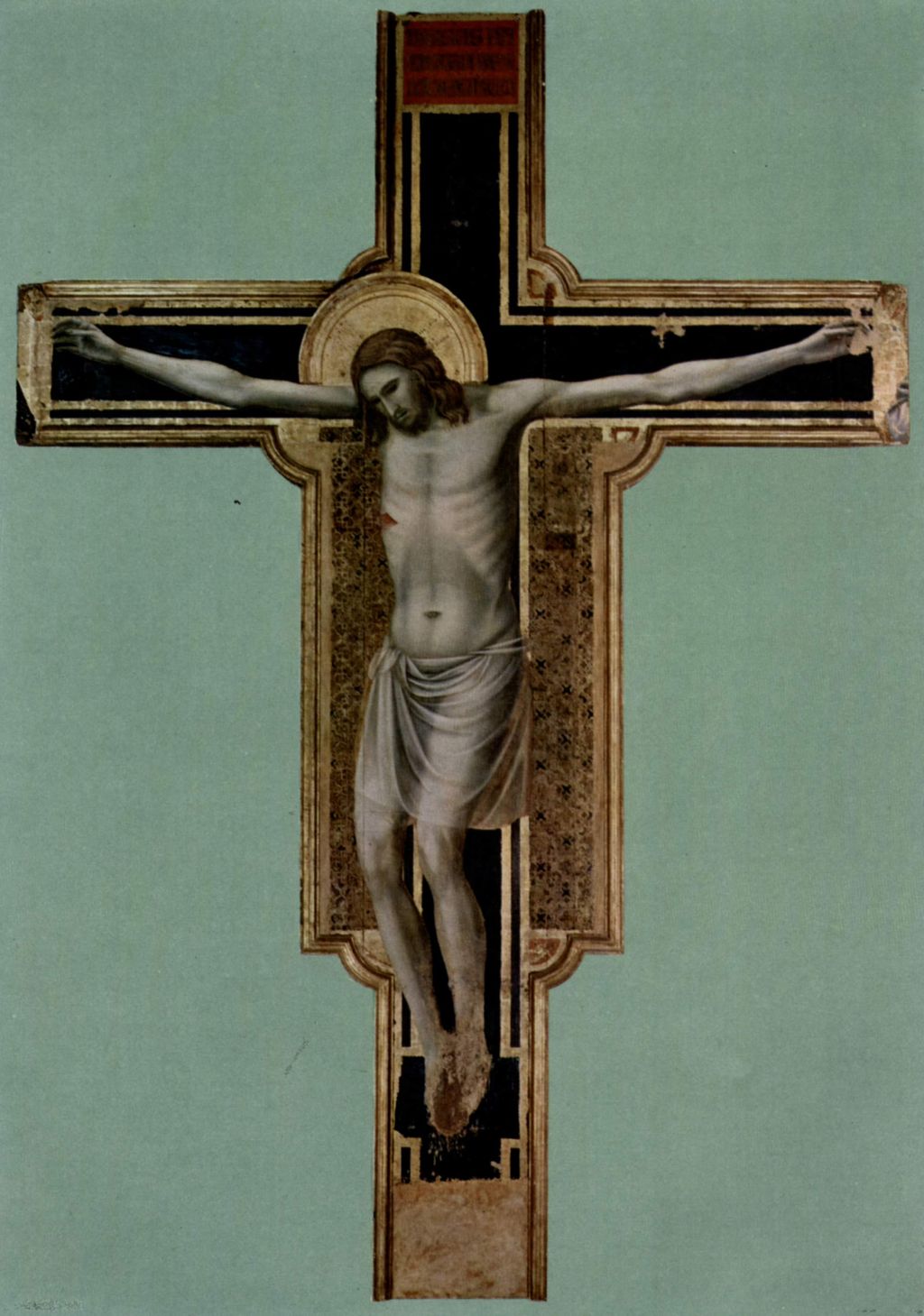
The Rimini Crucifix Image source. Public domain. Proportionally reduced reproduction; no colour or content enhancement.
Giotto's work at the Santo, the Basilica of Saint Anthony in Padua, is another reminder that a named institution and an identifiable painting are different things. The surviving decorations have been compared with Giotto and his followers, but Schwarz concludes that the works to which the early testimony refers are lost, whether they were murals or one or more panels. His discussion also leaves open the route by which Giotto obtained Paduan commissions: Franciscan connections are one possibility, while family and curial networks offer others. [4]
This uncertainty changes how we understand the Scrovegni Chapel's survival. It can appear to be an isolated, extraordinarily complete monument because so much of the surrounding activity has disappeared. Riccobaldo instead places it within a busy regional career, moving between churches and civic authority. The missing works once helped make the connections that the surviving chapel now seems to embody alone.
Padua's lost painted heaven
The Palazzo della Ragione offers something rarer than a simple name in a list: an early description of the decoration. Giovanni da Nono's Visio Egidii describes the enormous wooden roof over the communal hall, a structure resembling an overturned ship. Within it, the twelve zodiacal signs and seven planets, with their properties, would shine through Giotto's work. Other golden stars, mirrors and further images would contribute to the display. The future tense belongs to the literary form of a vision, rather than to a surviving commission instructing the painter. [5]
Even through this indirect account, the change of setting is striking. In the Arena church, the stories of Mary and Christ unfold beneath a starry vault. In the communal palace, celestial imagery addressed the world of civic government. The surviving testimony brings astronomy, astrology and the representation of an ordered universe into Giotto's range. It is one of the strongest reasons to resist confining him to the moving human encounters of sacred narrative.
How the scheme occupied the hall is debated. Taking Giovanni's words literally, Schwarz places Giotto's paintings on the wooden vault and infers painting in tempera. Other scholars have understood the original decoration as fresco on the walls below it. These alternatives affect the imagined materials, the relation of the images to the building, and what might have happened to them. Schwarz also cautions that the description need not mean every inch of the great ceiling was painted with figures: separate images distributed among stars are another possibility. [5]
The hall suffered a major fire in 1420. Its celebrated surviving astrological decoration belongs to the history of reconstruction and renewed painting after that disaster; it cannot be approached as an untouched Giotto cycle. A visitor can still experience the extraordinary scale of the room and the ambition of a civic heaven, but the later paintings do not supply a transparent window onto his lost arrangements. [5]
A familiar name attached to the programme requires equal care. Pietro d'Abano, the physician and astrologer who taught in Padua, is often described as its intellectual designer. Schwarz traces the explicit assignment of Giotto's programme to him to Bernardino Scardeone's history of 1560. Michele Savonarola had named Pietro in 1440, but in connection with the decoration made after the fire: an astrological text could inform a later cycle without its author having personally instructed Giotto. The distinction separates a plausible intellectual context from an established act of collaboration. [6]
The mirrors are a particularly evocative detail because they belong to the early description, not to a modern attempt to fill the void. They suggest that the ceiling's effect involved reflected light as well as painted forms. Their precise arrangement and operation remain unknown. We can retain the possibility of a glittering, materially varied heaven without inventing its colours, constellation figures or exact relation to every activity taking place below.
Rome: a famous image surviving through other images
The Navicella at Old Saint Peter's occupied a very different kind of public space. Commissioned by Cardinal Jacopo Stefaneschi, it stood high above the gateway building of Santa Maria in Turri at the approach to the basilica's atrium. Pilgrims passed beneath it and could turn towards it in prayer. Schwarz estimates an original width of roughly thirteen to fifteen metres and a height of nine to ten metres from the reconstructed setting. These are estimates of a lost installation, but they convey the scale behind the affectionate title, the little boat. [7]

The restored Boville Ernica angel medallion associated with the Navicella.
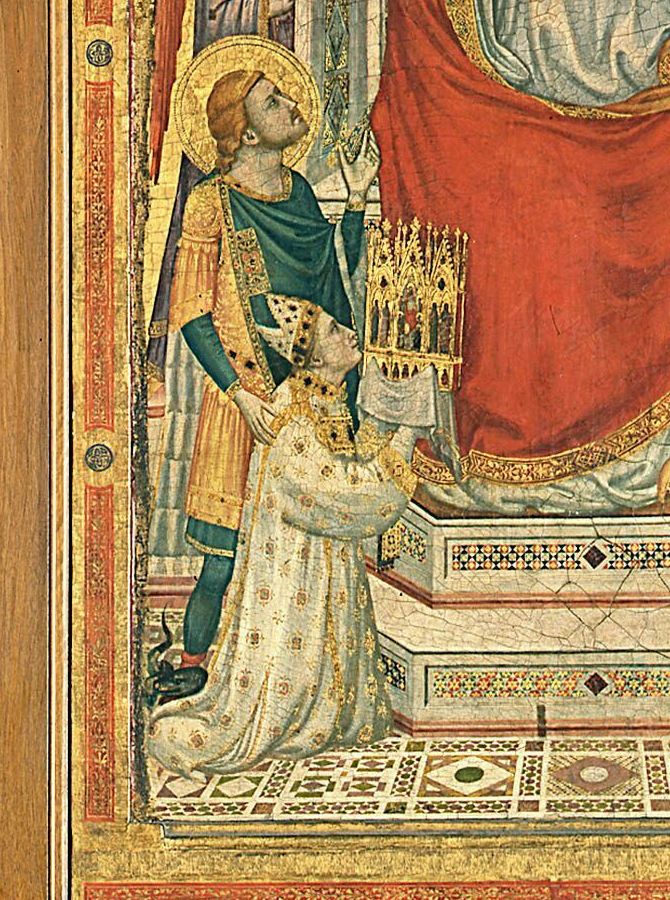
Cardinal Stefaneschi offering a model of his altarpiece, a separate Roman commission. Self-scanned reproduction, Commons uploader Eugene a. Image source. Public domain. Proportionally reduced reproduction; no colour or content enhancement.
Its narrative came from Matthew 14:22–33. The disciples struggle against wind on the lake; Christ approaches across the water; Peter steps out towards him, becomes afraid and begins to sink before Christ rescues him. The story joins the vulnerability of the boat's occupants to a moment of personal appeal and deliverance. At a basilica built around Peter's tomb, that subject gave the place of pilgrimage an image of its saint's dependence upon Christ. [8]
The enormous mosaic familiar to early viewers was progressively dismantled and transformed during the rebuilding of Saint Peter's. The version in the present portico is a later remake. Attribution of the original to Giotto is well established in the historical testimony, but its exact date remains debated. The often repeated year 1298 has an indirect transmission and cannot be treated as if it were written on a surviving execution contract. [7]
The copies let us go further than an account book could, although they make the process of recovery visible at every step. Nicolas Beatrizet's engraving of 1559 gives a crowded boat, a swelling sail, turbulent water and the encounter between Christ and Peter. Labacco's engraving of 1567 puts that encounter on the opposite side of the sheet. In Beatrizet's version, Christ faces more directly out towards the viewer; in Labacco's, he turns towards Peter. Those differences are visible in the prints themselves. They show why reproducing either sheet without identifying it as a copy would create a false impression of certainty. [9]
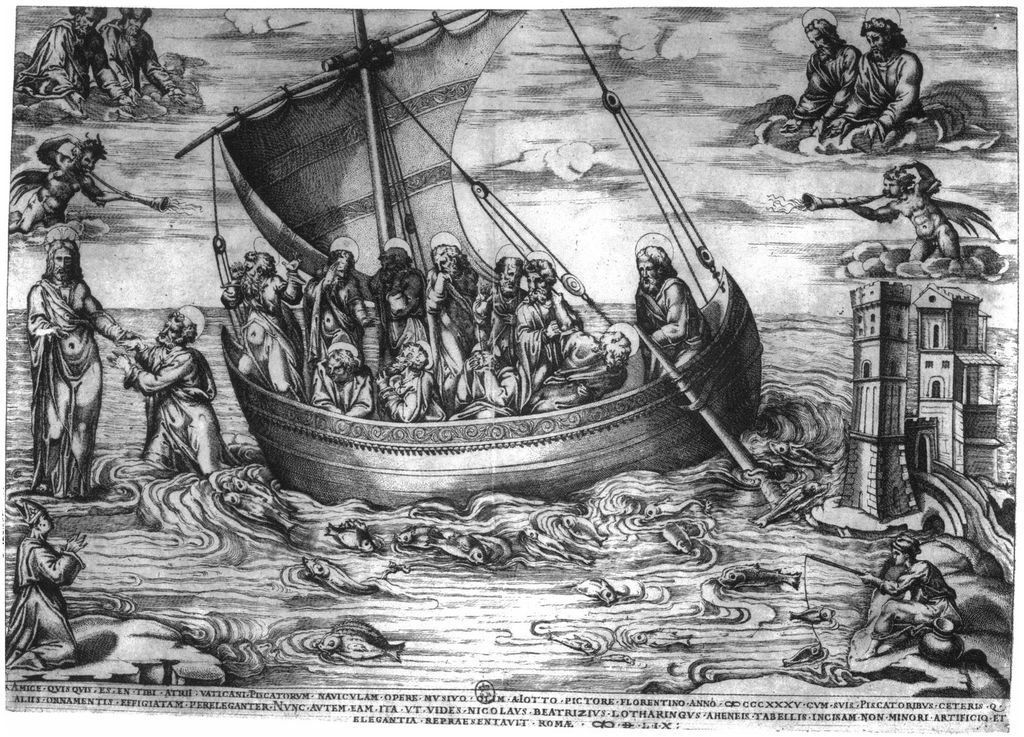
Nicolas Béatrizet’s engraving after the Navicella, circa 1559. The print is evidence for a lost and extensively reworked composition; it is not a photograph of Giotto’s original mosaic. Image source. Public domain. Proportionally reduced reproduction; original composition, colour and photographic lighting retained.
Schwarz argues that the prints are independent witnesses, rather than one simply depending on the other. He finds Labacco valuable for major compositional relationships but prefers other witnesses for Christ's frontal address. Agreement and disagreement must be evaluated detail by detail. An accurate relationship between the boat and the large foreground figures need not guarantee an accurate gesture, donor portrait or stretch of water. [9]
Francesco Beretta's painted copy of 1628 seems at first to offer a richer substitute, since a painting can transmit colour and modelling that a print cannot. Yet it records a mosaic already removed from its original site, stored, reinstalled and repaired. After the dismantling of 1610, significant portions had been renewed. Schwarz identifies the water and gold background, Peter, the cloud figures and other passages among the alterations represented in this later witness. Some features may preserve older forms with considerable fidelity; the whole painting cannot be relabelled as the medieval original. [10]
Two angel medallions, each about sixty-five centimetres across, carry the story from reproduction back to material survival. One remained at the Vatican and another reached San Pietro Ispano at Boville Ernica. Both have restoration histories. Schwarz's published comparisons show just how much the Boville image changed between its damaged nineteenth-century condition and its restored appearance. The Vatican medallion preserves more medieval substance in his assessment, but it too includes later additions. A surviving mosaic fragment is therefore evidence requiring interpretation, rather than a guarantee that every visible tessera or contour came directly from Giotto. [11]
A transmitted Latin inscription adds a further kind of witness. Its four lines connect Peter's passage across the water with the hope of reaching a harbour. Political interpretations have linked the image to papal authority or a demand for the papacy's return from Avignon. Schwarz instead argues for a devotional reading centred on rescue and salvation, and contests using the inscription to force a date after the papacy's move to Avignon in 1309. The inscription was reported on an architectural frieze below the mosaic; its relation to the picture needs to be understood through that setting. Even the meaning of a famous lost work can change when words, copies and locations are brought back together. [11]
The Navicella shows how Giotto could make a monumental image answer an architectural threshold and a pilgrim's bodily movement. The mosaic's remembered emotional power also outlived much of its material fabric. The original composition, its later reproductions and its continuing reputation have related but separate histories.
Naples: the paintings disappear, the workshop comes into focus
In Naples the balance of evidence changes again. Royal records preserve unusually concrete information about Giotto's employment, while the principal paintings have largely vanished. The critical edition of the transmitted documents by Schwarz and Theis records an order of 8 December 1328 authorising his monthly salary from 1 December. Its amount has not survived in the copy. On 20 January 1330, King Robert of Anjou admitted him as a royal familiar, giving him the honours and privileges associated with membership of the household. [12]
The status deserves its own name. A royal familiar enjoyed a recognised relationship with the ruler and his protection; this document does not record Giotto being knighted. Court employment could elevate a painter through an office and household connection. The transmitted records make that altered professional position unusually tangible. [12]
The most revealing account is dated 20 May 1331. It covers work in both the great chapel, the capella magna, and the private chapel, the capella secreta, of Castel Nuovo. It also mentions a cona, a panel painting made at the king's command in the house of Giotto, who is called the chief master of the painting enterprise. The entry ties a large decorative undertaking to the production of an individual movable picture. [13]
Its materials have an immediacy that a vanished scene can no longer supply. Fine gold, silver and gilded tin appear alongside lime, gypsum, glue, linen and other purchases. The account pays different masters, painters and manual workers; wine supplied for those working is included as well. These items reveal the coordinated provision of skills and supplies. They do not give us a recipe for every surface, but they establish that the splendour of the chapels depended on more than pigment applied to plaster. [13]
Other entries connect the painted decoration with alterations to the building. Water was to be allowed to escape through an opening so that it would not damage the chapel painting. Windows near the altar were adjusted so that certain figures of saints could be painted. Here the royal expenditure exposes the meeting of architecture and image: walls had to be kept usable, openings reconsidered, and a large team supported while the decoration took shape. [13]
Such details also complicate a simple contrast between a solitary master and an impersonal workshop. Giotto's name and leading role are explicit, but so are other masters and categories of labour. The records make it possible to describe responsibility for an enterprise while leaving individual hands unresolved. Later Neapolitan payment summaries continue into 1333, although the edition warns that not every abbreviated entry identifies Giotto himself as the recipient. Money assigned to the chapel project and money certainly received by the painter should not be added together indiscriminately. [14]
The documents themselves have suffered loss. The Neapolitan originals are unavailable, and the critical edition assembles transmitted texts from earlier copies and publications. Some facts, including the amount of the initial monthly salary, had already disappeared in the process of copying. The salary order and the May account preserve sharply defined information within an incomplete chain of survival. [12] [13]
What remains of the decoration is too slight to reverse the imbalance. Heads in medallions and ornament in the window embrasures of the great chapel preserve part of the painted environment. Scholars have debated their relationship to Giotto and named collaborators. Their survival establishes neither a complete narrative programme nor a secure map of the master's contribution. Even a persuasive attribution of a head would leave the scale, pacing and visual relationships of the lost walls largely unknown. [15]
Santa Chiara presents a related problem. Boskovits discusses fragments found after the Second World War in the nuns' choir, connected with a large Calvary and Lamentation, together with painted architectural furnishings whose invention has been associated with Giotto. The post-war discoveries belong to a history of fragmentary and contested survival; they do not amount to a complete Giotto cycle. Later reports of other Neapolitan works, including famous men and scenes from the Apocalypse, extend the questions; they do not authorise a detailed imaginary reconstruction. [15]
The surviving Neapolitan evidence thus adds something unusually substantial to Giotto's career even where it cannot restore an image. It shows a painter established within a royal household, directing related projects in several spaces, with court administration paying for varied labour and costly materials. Any account of his late style built solely from the surviving Florentine works must reckon with the absence of this major undertaking.
Milan and the problem of worldly glory
Giotto's connection with Milan rests on a strong early witness. Giovanni Villani reports that the Florentine commune sent him to serve the lord of Milan and that he died after his return. The date Villani gives, 8 January 1336 by Florentine reckoning, corresponds to 8 January 1337 in the modern calendar. The patron was Azzone Visconti, lord of Milan. [16]
The service is more secure than the detailed programme often attached to it. The lost Gloria mondana, or worldly glory, has been identified with a Milanese allegory of Fame containing famous figures. Boskovits presents that account through Creighton Gilbert's reconstruction. It offers a compelling image of Giotto applying his powers to a ruler's secular ambitions, and it has consequently become an attractive component of the late career. [17]
Yet the location of the work named by Lorenzo Ghiberti is disputed. In Ghiberti's fifteenth-century account, a worldly glory follows the Arena church and precedes a painting of the Christian faith in a palace. Schwarz reads the sequence and its local references as pointing to Padua. He questions moving the Gloria mondana to Milan or Naples by joining separate strands of testimony. He also allows that even a Paduan work shown to Ghiberti as Giotto's need not actually have been by him. [18]
Villani's evidence supports Milanese service while the identification of a particular allegory remains open. Ghiberti's title can preserve the memory of secular subject matter without supplying the work's precise address, date, surviving design or complete cast of figures. Gilbert's Milanese reconstruction and Schwarz's Paduan reading should remain recognisable as scholarly alternatives. [17] [18]
This distinction matters beyond one title. The losses make Giotto's secular production disproportionately dependent on words, whereas sacred works furnish many of the pictures through which we know him. Their unequal survival can make a difference in evidence look like a difference in the artist's abilities or interests. The uncertain title widens the questions we can ask about the career, while leaving the proposed cycle of Fame beyond secure reconstruction.
Florence and Bologna: loss inside a familiar landscape
Florence supplies an especially deceptive setting for lost works because so many important Giotto paintings remain there. The Bardi and Peruzzi chapels survive with serious losses and changes to their surfaces. Their chronology and the distribution of work within Giotto's circle remain debated. They belong to a discussion of damaged survival, rather than a list of wholly vanished commissions. [19]
Ghiberti remembered four chapels and four panels in the Franciscan church of Santa Croce. Vasari later supplied more detailed descriptions, including the Tosinghi-Spinelli chapel's Marian subjects and the Giugni chapel's apostolic histories. In the Tosinghi-Spinelli account he singled out the infant Christ turning towards his mother during the Presentation. This is a vivid record of what Vasari understood and valued, but a description transmitted in his biography cannot replace direct access to the vanished painted surface. [20]
The distinction between the decoration inside the Tosinghi-Spinelli chapel and the Assumption above its entrance is also important. Schwarz and Theis distinguish the lost interior cycle from the badly preserved exterior image. Calling everything lost erases a surviving trace; calling the chapel preserved exaggerates what that trace can represent. Florence's familiar monuments contain these uneven layers of absence and survival. [19]
Vasari also assigned a cycle of John the Baptist to a chapel in Santa Maria del Carmine. Such reports deserve to remain visible, with their witness identified, without treating every later attribution as a newly certified commission. At the Badia, surviving fragments from a Marian decoration have prompted differing assessments of Giotto's own involvement. Ghiberti's account of an allegory showing the commune being robbed in the palace of the podestà adds another dimension: painting could address the conduct of citizens and the condition of civic government. [20] [21]
Bologna makes the political vulnerability of monumental decoration particularly apparent. Historical accounts associate Giotto with the chapel of the Castello di Galliera, built for the papal legate Bertrand du Pouget. The fortress was demolished in 1334 after the legate's expulsion. That date should not be made to swallow the entire history of its paintings: the chapel survived the destruction of the castle, and Boskovits notes that Pietro Lamo still reported traces in 1560. A building's destruction, the survival of part of it, and the final disappearance of its images can occur at different moments. [22]
None of these reports supplies licence to populate a complete reconstructed room. Their collective value lies elsewhere. They show Giotto's name attached to several kinds of decorated environment: family chapels, a religious house, civic palaces and a legate's stronghold. They also reveal how later viewers selected memorable incidents and subjects from works already vulnerable to rebuilding, damage and shifting attribution.
What the absences change
Giotto's lost works change the shape of his career before they change the list of his paintings. Padua brings celestial and civic imagery into view; Rome adds a monumental mosaic encountered through pilgrimage; Naples reveals the organisation and materials of sustained royal employment; Milan documents service to another powerful court even where a famous proposed allegory remains uncertain. The Florentine and Bolognese losses connect those large commissions with the fragile painted fabric of chapels and palaces.
They also change what we can ask of the surviving works. The Scrovegni Chapel cannot stand for everything Giotto did. A late panel cannot single-handedly replace the missing decoration of Castel Nuovo. A restored angel or a compelling engraving can illuminate a portion of the Navicella without recovering its entire medieval effect. These are different routes into a career whose visual record has become uneven through centuries of use and alteration.
The result is both more expansive and more concrete. We recover the painter travelling between institutions, the chief master working within a royal building project, and the artist remembered for allegories as well as sacred stories. We can follow the wine paid for his workers and the changes made to a window more confidently than the gestures of figures on a vanished wall. That unevenness belongs to the history of Giotto. It helps explain both the extraordinary authority of the paintings that remain and the limits of the career we construct around them.
Watch: Explore Giotto’s Art
Choose an overview or a closer look at three major works. These films provide wider Giotto context alongside this article.
Artworks directory
This directory brings together 209 records for paintings, ensembles, individual scenes and components, architectural work, an associated disputed design, and reported or lost projects connected with Giotto. Ensembles and their parts appear separately, so 209 is a count of records rather than independent paintings or commissions. Attributions and dates remain qualified where disputed; inclusion does not establish Giotto’s own hand throughout.
| Name | Date | Medium, attribution and status |
|---|---|---|
| Expulsion of Joachim from the Temple — Scrovegni Chapel, Padua | c.1303–05 (chapel campaign) | Fresco / wall painting. Giotto and workshop. Scene within a cycle. Padova Musei. Chapel overview. |
| Joachim among the Shepherds — Scrovegni Chapel, Padua | c.1303–05 (chapel campaign) | Fresco / wall painting. Giotto and workshop. Scene within a cycle. Padova Musei. Chapel overview. |
| Annunciation to Saint Anne — Scrovegni Chapel, Padua | c.1303–05 (chapel campaign) | Fresco / wall painting. Giotto and workshop. Scene within a cycle. Padova Musei. Chapel overview. |
| Sacrifice of Joachim — Scrovegni Chapel, Padua | c.1303–05 (chapel campaign) | Fresco / wall painting. Giotto and workshop. Scene within a cycle. Padova Musei. Chapel overview. |
| Joachim’s Dream — Scrovegni Chapel, Padua | c.1303–05 (chapel campaign) | Fresco / wall painting. Giotto and workshop. Scene within a cycle. Padova Musei. Padova Musei. Chapel overview. |
| Meeting at the Golden Gate — Scrovegni Chapel, Padua | c.1303–05 (chapel campaign) | Fresco / wall painting. Giotto and workshop. Scene within a cycle. Padova Musei. Chapel overview. |
| Birth of the Virgin — Scrovegni Chapel, Padua | c.1303–05 (chapel campaign) | Fresco / wall painting. Giotto and workshop. Scene within a cycle. Padova Musei. Padova Musei. Chapel overview. |
| Presentation of the Virgin in the Temple — Scrovegni Chapel, Padua | c.1303–05 (chapel campaign) | Fresco / wall painting. Giotto and workshop. Scene within a cycle. Padova Musei. Chapel overview. |
| Delivery of the Rods — Scrovegni Chapel, Padua | c.1303–05 (chapel campaign) | Fresco / wall painting. Giotto and workshop. Scene within a cycle. Padova Musei. Chapel overview. |
| Prayer of Joseph and the Suitors — Scrovegni Chapel, Padua | c.1303–05 (chapel campaign) | Fresco / wall painting. Giotto and workshop. Scene within a cycle. Padova Musei. Chapel overview. |
| Marriage of the Virgin — Scrovegni Chapel, Padua | c.1303–05 (chapel campaign) | Fresco / wall painting. Giotto and workshop. Scene within a cycle. Padova Musei. Chapel overview. |
| Wedding Procession of Mary — Scrovegni Chapel, Padua | c.1303–05 (chapel campaign) | Fresco / wall painting. Giotto and workshop. Scene within a cycle. Padova Musei. Chapel overview. |
| Annunciation on the triumphal arch — complete ensemble (Scrovegni Chapel, Padua) | c.1303–05 (chapel campaign) | Wall painting with a central painted wooden panel. Giotto and workshop. Ensemble. Includes the Mission of Gabriel and the lower Annunciation pair; the original central wooden panel is in the Musei Civici agli Eremitani, with a conservation copy in the chapel. Padova Musei. Padova Musei. Scholarly study. Chapel overview. |
| Visitation — Scrovegni Chapel, Padua | c.1303–05 (chapel campaign) | Fresco / wall painting. Giotto and workshop. Scene within a cycle. Padova Musei. Chapel overview. |
| Nativity — Scrovegni Chapel, Padua | c.1303–05 (chapel campaign) | Fresco / wall painting. Giotto and workshop. Scene within a cycle. Padova Musei. Chapel overview. |
| Adoration of the Magi — Scrovegni Chapel, Padua | c.1303–05 (chapel campaign) | Fresco / wall painting. Giotto and workshop. Scene within a cycle. Padova Musei. Chapel overview. |
| Presentation of Christ at the Temple — Scrovegni Chapel, Padua | c.1303–05 (chapel campaign) | Fresco / wall painting. Giotto and workshop. Scene within a cycle. Padova Musei. Chapel overview. |
| Flight into Egypt — Scrovegni Chapel, Padua | c.1303–05 (chapel campaign) | Fresco / wall painting. Giotto and workshop. Scene within a cycle. Padova Musei. Chapel overview. |
| Massacre of the Innocents — Scrovegni Chapel, Padua | c.1303–05 (chapel campaign) | Fresco / wall painting. Giotto and workshop. Scene within a cycle. Padova Musei. Chapel overview. |
| Christ among the Doctors — Scrovegni Chapel, Padua | c.1303–05 (chapel campaign) | Fresco / wall painting. Giotto and workshop. Scene within a cycle. Padova Musei. Chapel overview. |
| Baptism of Christ — Scrovegni Chapel, Padua | c.1303–05 (chapel campaign) | Fresco / wall painting. Giotto and workshop. Scene within a cycle. Padova Musei. Chapel overview. |
| Marriage at Cana — Scrovegni Chapel, Padua | c.1303–05 (chapel campaign) | Fresco / wall painting. Giotto and workshop. Scene within a cycle. Padova Musei. Padova Musei. Chapel overview. |
| Raising of Lazarus — Scrovegni Chapel, Padua | c.1303–05 (chapel campaign) | Fresco / wall painting. Giotto and workshop. Scene within a cycle. Padova Musei. Chapel overview. |
| Entry into Jerusalem — Scrovegni Chapel, Padua | c.1303–05 (chapel campaign) | Fresco / wall painting. Giotto and workshop. Scene within a cycle. Padova Musei. Chapel overview. |
| Expulsion of the Money Changers — Scrovegni Chapel, Padua | c.1303–05 (chapel campaign) | Fresco / wall painting. Giotto and workshop. Scene within a cycle. Padova Musei. Padova Musei. Chapel overview. |
| Judas Receiving the Payment — Scrovegni Chapel, Padua | c.1303–05 (chapel campaign) | Fresco / wall painting. Giotto and workshop. Scene within a cycle. Padova Musei. Chapel overview. |
| Last Supper — Scrovegni Chapel, Padua | c.1303–05 (chapel campaign) | Fresco / wall painting. Giotto and workshop. Scene within a cycle. Padova Musei. Chapel overview. |
| Washing of the Feet — Scrovegni Chapel, Padua | c.1303–05 (chapel campaign) | Fresco / wall painting. Giotto and workshop. Scene within a cycle. Padova Musei. Chapel overview. |
| Arrest of Christ — Scrovegni Chapel, Padua | c.1303–05 (chapel campaign) | Fresco / wall painting. Giotto and workshop. Scene within a cycle. Padova Musei. Chapel overview. |
| Christ before Annas and Caiaphas — Scrovegni Chapel, Padua | c.1303–05 (chapel campaign) | Fresco / wall painting. Giotto and workshop. Scene within a cycle. Padova Musei. Chapel overview. |
| Mocking of Christ and Flagellation — Scrovegni Chapel, Padua | c.1303–05 (chapel campaign) | Fresco / wall painting. Giotto and workshop. Scene within a cycle. Padova Musei. Chapel overview. |
| Road to Calvary — Scrovegni Chapel, Padua | c.1303–05 (chapel campaign) | Fresco / wall painting. Giotto and workshop. Scene within a cycle. Padova Musei. Chapel overview. |
| Crucifixion — Scrovegni Chapel, Padua | c.1303–05 (chapel campaign) | Fresco / wall painting. Giotto and workshop. Scene within a cycle. Padova Musei. Chapel overview. |
| Lamentation — Scrovegni Chapel, Padua | c.1303–05 (chapel campaign) | Fresco / wall painting. Giotto and workshop. Scene within a cycle. Padova Musei. Chapel overview. |
| Resurrection / Noli me tangere — Scrovegni Chapel, Padua | c.1303–05 (chapel campaign) | Fresco / wall painting. Giotto and workshop. Scene within a cycle. Padova Musei. Chapel overview. |
| Ascension — Scrovegni Chapel, Padua | c.1303–05 (chapel campaign) | Fresco / wall painting. Giotto and workshop. Scene within a cycle. Padova Musei. Chapel overview. |
| Pentecost — Scrovegni Chapel, Padua | c.1303–05 (chapel campaign) | Fresco / wall painting. Giotto and workshop. Scene within a cycle. Padova Musei. Padova Musei. Chapel overview. |
| Coretto — right painted recess (Scrovegni Chapel, Padua) | c.1303–05 (chapel campaign) | Fresco / painted fictive architecture. Giotto and workshop. Ensemble component. Padova Musei. Padova Musei. Scholarly study. Chapel overview. |
| Coretto — left painted recess (Scrovegni Chapel, Padua) | c.1303–05 (chapel campaign) | Fresco / painted fictive architecture. Giotto and workshop. Ensemble component. Padova Musei. Padova Musei. Scholarly study. Chapel overview. |
| Envy — Scrovegni Chapel, Padua | c.1303–05 (chapel campaign) | Grisaille fresco / wall painting. Giotto and workshop. Ensemble component. Padova Musei. Chapel overview. Scholarly study. Padova Musei. |
| Despair — Scrovegni Chapel, Padua | c.1303–05 (chapel campaign) | Grisaille fresco / wall painting. Giotto and workshop. Ensemble component. Padova Musei. Chapel overview. Scholarly study. Padova Musei. |
| Prudence — Scrovegni Chapel, Padua | c.1303–05 (chapel campaign) | Grisaille fresco / wall painting. Giotto and workshop. Ensemble component. Padova Musei. Chapel overview. Scholarly study. Padova Musei. |
| Fortitude — Scrovegni Chapel, Padua | c.1303–05 (chapel campaign) | Grisaille fresco / wall painting. Giotto and workshop. Ensemble component. Padova Musei. Chapel overview. Scholarly study. Padova Musei. |
| Temperance — Scrovegni Chapel, Padua | c.1303–05 (chapel campaign) | Grisaille fresco / wall painting. Giotto and workshop. Ensemble component. Padova Musei. Chapel overview. Scholarly study. Padova Musei. |
| Justice — Scrovegni Chapel, Padua | c.1303–05 (chapel campaign) | Grisaille fresco / wall painting. Giotto and workshop. Ensemble component. Padova Musei. Chapel overview. Scholarly study. Padova Musei. |
| Faith — Scrovegni Chapel, Padua | c.1303–05 (chapel campaign) | Grisaille fresco / wall painting. Giotto and workshop. Ensemble component. Padova Musei. Chapel overview. Scholarly study. Padova Musei. |
| Charity — Scrovegni Chapel, Padua | c.1303–05 (chapel campaign) | Grisaille fresco / wall painting. Giotto and workshop. Ensemble component. Padova Musei. Chapel overview. Scholarly study. Padova Musei. |
| Hope — Scrovegni Chapel, Padua | c.1303–05 (chapel campaign) | Grisaille fresco / wall painting. Giotto and workshop. Ensemble component. Padova Musei. Chapel overview. Scholarly study. Padova Musei. |
| Folly — Scrovegni Chapel, Padua | c.1303–05 (chapel campaign) | Grisaille fresco / wall painting. Giotto and workshop. Ensemble component. Padova Musei. Chapel overview. Scholarly study. Padova Musei. |
| Inconstancy — Scrovegni Chapel, Padua | c.1303–05 (chapel campaign) | Grisaille fresco / wall painting. Giotto and workshop. Ensemble component. Padova Musei. Chapel overview. Scholarly study. Padova Musei. |
| Wrath — Scrovegni Chapel, Padua | c.1303–05 (chapel campaign) | Grisaille fresco / wall painting. Giotto and workshop. Ensemble component. Padova Musei. Chapel overview. Scholarly study. Padova Musei. |
| Injustice — Scrovegni Chapel, Padua | c.1303–05 (chapel campaign) | Grisaille fresco / wall painting. Giotto and workshop. Ensemble component. Padova Musei. Chapel overview. Scholarly study. Padova Musei. |
| Infidelity / Idolatry — Scrovegni Chapel, Padua | c.1303–05 (chapel campaign) | Grisaille fresco / wall painting. Giotto and workshop. Ensemble component. Padova Musei. Chapel overview. Scholarly study. Padova Musei. |
| Starry vault — complete ensemble (Scrovegni Chapel, Padua) | c.1303–05 (chapel campaign) | Vault painting. Giotto and workshop. Ensemble. Padova Musei. Padova Musei. Chapel overview. |
| Last Judgement — Scrovegni Chapel, Padua | c.1303–05 (chapel campaign) | Fresco / wall painting. Giotto and workshop. Scene within a cycle. Padova Musei. Padova Musei. Chapel overview. Padova Musei. |
| Prophet Malachi — vault medallion — Scrovegni Chapel, Padua | c.1303–05 (chapel campaign) | Fresco / wall painting. Giotto and workshop. Ensemble component. Padova Musei. Padova Musei. Chapel overview. Padova Musei. |
| Prophet Baruch — vault medallion — Scrovegni Chapel, Padua | c.1303–05 (chapel campaign) | Fresco / wall painting. Giotto and workshop. Ensemble component. Padova Musei. Padova Musei. Chapel overview. Padova Musei. |
| Prophet Isaiah — vault medallion — Scrovegni Chapel, Padua | c.1303–05 (chapel campaign) | Fresco / wall painting. Giotto and workshop. Ensemble component. Padova Musei. Padova Musei. Chapel overview. Padova Musei. |
| Prophet Daniel — vault medallion — Scrovegni Chapel, Padua | c.1303–05 (chapel campaign) | Fresco / wall painting. Giotto and workshop. Ensemble component. Padova Musei. Padova Musei. Chapel overview. Padova Musei. |
| Christ Pantocrator — vault medallion — Scrovegni Chapel, Padua | c.1303–05 (chapel campaign) | Fresco / wall painting. Giotto and workshop. Ensemble component. Padova Musei. Padova Musei. Chapel overview. Padova Musei. |
| Virgin and Child — vault medallion — Scrovegni Chapel, Padua | c.1303–05 (chapel campaign) | Fresco / wall painting. Giotto and workshop. Ensemble component. Padova Musei. Padova Musei. Chapel overview. Padova Musei. |
| Prophet Ezekiel — vault medallion — Scrovegni Chapel, Padua | c.1303–05 (chapel campaign) | Fresco / wall painting. Giotto and workshop. Ensemble component. Padova Musei. Padova Musei. Chapel overview. Padova Musei. |
| Prophet Micah — vault medallion — Scrovegni Chapel, Padua | c.1303–05 (chapel campaign) | Fresco / wall painting. Giotto and workshop. Ensemble component. Padova Musei. Padova Musei. Chapel overview. Padova Musei. |
| Saint John the Baptist — vault medallion — Scrovegni Chapel, Padua | c.1303–05 (chapel campaign) | Fresco / wall painting. Giotto and workshop. Ensemble component. Padova Musei. Padova Musei. Chapel overview. Padova Musei. |
| Scrovegni Chapel — painted decoration | c.1303–05 (chapel campaign) | Fresco / wall painting, with a painted wooden panel. Giotto and workshop (painted decoration). Ensemble. Includes separately listed scenes and components. The original central God the Father panel is in the Musei Civici agli Eremitani; a conservation copy is in the chapel. Chapel overview. Padova Musei. Padova Musei. Source. Source. Source. Padova Musei. Scholarly study. |
| Vices and Virtues — complete fourteen-figure programme | c.1303–05 (chapel campaign) | Grisaille fresco / wall painting. Giotto and workshop. Ensemble. Fourteen figures: seven virtues and seven opposed vices. Padova Musei. Chapel overview. Scholarly study. |
| Coretti — paired fictive chapels | c.1303–05 (chapel campaign) | Fresco / painted fictive architecture. Giotto and workshop. Ensemble. Two separate painted recesses, also listed individually. Padova Musei. Padova Musei. Scholarly study. |
| Mission of Gabriel — heavenly assembly | c.1303–05 (chapel campaign) | Wall painting with central painted wooden image. Giotto and workshop. Ensemble component. Central wooden God the Father panel preserved at the Musei Civici agli Eremitani; conservation copy in the chapel. Chapel overview. Padova Musei. Scholarly study. Padova Musei. |
| Annunciation — Gabriel and Mary in facing chambers | c.1303–05 (chapel campaign) | Fresco / wall painting. Giotto and workshop. Ensemble component. Chapel overview. Scholarly study. Padova Musei. |
| God the Father — central wooden panel of the Mission of Gabriel | c.1303–05 (chapel campaign) | Painting on wood. Associated with Giotto. Ensemble component. Original at the Musei Civici agli Eremitani, Padua; conservation copy in the Scrovegni Chapel. Padova Musei. Padova Musei. Scholarly study. Source. |
| Life of Saint Francis — Upper Church cycle, Assisi | Late 13th–early 14th century; dating disputed | Fresco / wall-painting cycle. Traditionally associated with Giotto; Giotto, Roman-school and other attributions disputed. Ensemble. Twenty-eight-scene nave cycle; scenes also listed individually. Basilica catalogue. Scholarly study. Basilica catalogue. Source. Source. |
| Homage of a Simple Man — Upper Church, Assisi | Late 13th–early 14th century; dating disputed | Wall painting. Traditionally associated with Giotto; authorship and dating disputed. Scene within a cycle. Source. Scholarly study. Source. Source. Source. |
| Gift of the Mantle — Upper Church, Assisi | Late 13th–early 14th century; dating disputed | Wall painting. Traditionally associated with Giotto; authorship and dating disputed. Scene within a cycle. Basilica catalogue. Scholarly study. Source. Source. Source. |
| Dream of the Palace Full of Arms — Upper Church, Assisi | Late 13th–early 14th century; dating disputed | Wall painting. Traditionally associated with Giotto; authorship and dating disputed. Scene within a cycle. Basilica catalogue. Source. Scholarly study. Source. Source. Source. |
| Prayer before the Crucifix at San Damiano — Upper Church, Assisi | Late 13th–early 14th century; dating disputed | Wall painting. Traditionally associated with Giotto; authorship and dating disputed. Scene within a cycle. Source. Source. Source. Scholarly study. Source. Source. |
| Renunciation of Worldly Goods — Upper Church, Assisi | Late 13th–early 14th century; dating disputed | Wall painting. Traditionally associated with Giotto; authorship and dating disputed. Scene within a cycle. Source. Scholarly study. Source. Source. |
| Dream of Innocent III — Upper Church, Assisi | Late 13th–early 14th century; dating disputed | Wall painting. Traditionally associated with Giotto; authorship and dating disputed. Scene within a cycle. Source. Source. Scholarly study. Source. Source. |
| Confirmation of the Rule — Upper Church, Assisi | Late 13th–early 14th century; dating disputed | Wall painting. Traditionally associated with Giotto; authorship and dating disputed. Scene within a cycle. Source. Scholarly study. Source. Source. |
| Vision of the Flaming Chariot — Upper Church, Assisi | Late 13th–early 14th century; dating disputed | Wall painting. Traditionally associated with Giotto; authorship and dating disputed. Scene within a cycle. Source. Source. Scholarly study. Source. Source. |
| Vision of the Thrones — Upper Church, Assisi | Late 13th–early 14th century; dating disputed | Wall painting. Traditionally associated with Giotto; authorship and dating disputed. Scene within a cycle. Basilica catalogue. Scholarly study. Source. Source. Source. |
| Expulsion of Devils from Arezzo — Upper Church, Assisi | Late 13th–early 14th century; dating disputed | Wall painting. Traditionally associated with Giotto; authorship and dating disputed. Scene within a cycle. Source. Source. Scholarly study. Source. Source. Source. |
| Trial by Fire before the Sultan — Upper Church, Assisi | Late 13th–early 14th century; dating disputed | Wall painting. Traditionally associated with Giotto; authorship and dating disputed. Scene within a cycle. Source. Source. Scholarly study. Source. Source. |
| Ecstasy of Saint Francis — Upper Church, Assisi | Late 13th–early 14th century; dating disputed | Wall painting. Traditionally associated with Giotto; authorship and dating disputed. Scene within a cycle. Source. Source. Source. Scholarly study. Source. Source. |
| Nativity at Greccio — Upper Church, Assisi | Late 13th–early 14th century; dating disputed | Wall painting. Traditionally associated with Giotto; authorship and dating disputed. Scene within a cycle. Basilica catalogue. Scholarly study. Source. Source. Source. |
| Miracle of the Spring — Upper Church, Assisi | Late 13th–early 14th century; dating disputed | Wall painting. Traditionally associated with Giotto; authorship and dating disputed. Scene within a cycle. Source. Scholarly study. Source. Source. Source. |
| Sermon to the Birds — Upper Church, Assisi | Late 13th–early 14th century; dating disputed | Wall painting. Traditionally associated with Giotto; authorship and dating disputed. Scene within a cycle. Basilica catalogue. Scholarly study. Source. Source. Source. |
| Death of the Knight of Celano — Upper Church, Assisi | Late 13th–early 14th century; dating disputed | Wall painting. Traditionally associated with Giotto; authorship and dating disputed. Scene within a cycle. Source. Source. Scholarly study. Source. Source. |
| Sermon before Pope Honorius III — Upper Church, Assisi | Late 13th–early 14th century; dating disputed | Wall painting. Traditionally associated with Giotto; authorship and dating disputed. Scene within a cycle. Source. Source. Scholarly study. Source. |
| Apparition at the Chapter of Arles — Upper Church, Assisi | Late 13th–early 14th century; dating disputed | Wall painting. Traditionally associated with Giotto; authorship and dating disputed. Scene within a cycle. Basilica catalogue. Scholarly study. Source. Source. Source. |
| Stigmatisation — Upper Church, Assisi | Late 13th–early 14th century; dating disputed | Wall painting. Traditionally associated with Giotto; authorship and dating disputed. Scene within a cycle. Source. Scholarly study. Source. Source. |
| Death and Ascension of Saint Francis — Upper Church, Assisi | Late 13th–early 14th century; dating disputed | Wall painting. Traditionally associated with Giotto; authorship and dating disputed. Scene within a cycle. Basilica catalogue. Scholarly study. Source. Source. Source. |
| Apparition to Brother Augustine and Bishop Guido — Upper Church, Assisi | Late 13th–early 14th century; dating disputed | Wall painting. Traditionally associated with Giotto; authorship and dating disputed. Scene within a cycle. Zeri catalogue. Scholarly study. Source. Source. Source. |
| Verification of the Stigmata — Upper Church, Assisi | Late 13th–early 14th century; dating disputed | Wall painting. Traditionally associated with Giotto; authorship and dating disputed. Scene within a cycle. Source. Source. Scholarly study. Source. Source. |
| Mourning of the Poor Clares — Upper Church, Assisi | Late 13th–early 14th century; dating disputed | Wall painting. Traditionally associated with Giotto; authorship and dating disputed. Scene within a cycle. Basilica catalogue. Source. Scholarly study. Source. Source. |
| Canonisation of Saint Francis — Upper Church, Assisi | Late 13th–early 14th century; dating disputed | Wall painting. Traditionally associated with Giotto; authorship and dating disputed. Scene within a cycle. Source. Source. Scholarly study. Source. Source. Source. |
| Apparition to Pope Gregory IX — Upper Church, Assisi | Late 13th–early 14th century; dating disputed | Wall painting. Traditionally associated with Giotto; authorship and dating disputed. Scene within a cycle. Zeri catalogue. Scholarly study. Source. Source. Source. |
| Healing of John of Lerida — Upper Church, Assisi | Late 13th–early 14th century; dating disputed | Wall painting. Traditionally associated with Giotto; authorship and dating disputed. Scene within a cycle. Source. Source. Scholarly study. Source. Source. |
| Resurrection of a Woman — Upper Church, Assisi | Late 13th–early 14th century; dating disputed | Wall painting. Traditionally associated with Giotto; authorship and dating disputed. Scene within a cycle. Source. Scholarly study. Source. Source. Source. |
| Liberation of the Prisoner Peter — Upper Church, Assisi | Late 13th–early 14th century; dating disputed | Wall painting. Traditionally associated with Giotto; authorship and dating disputed. Scene within a cycle. Source. Source. Scholarly study. Source. Source. Source. |
| Santa Maria Novella Crucifix | Late 13th century; c.1288–89 or 1298–1301; disputed | Tempera and gold on a shaped wooden cross. Giotto. Source. |
| Death of the Virgin / Dormition — Berlin | c.1310 | Tempera and gold on poplar; gabled dossal. Giotto. Source. Source. |
| Peruzzi Altarpiece | c.1311–1315 (North Carolina Museum of Art) | Tempera and gold on panel. Giotto and workshop. Ensemble. Source. |
| Bologna Polyptych | c.1330 | Tempera and gold on panel. Giotto and workshop. Ensemble. Source. |
| Death of Saint Francis, Bardi Chapel | After 1317, usually the 1320s; disputed | Wall painting with wet-plaster and dry-applied passages. Giotto. Scene within a cycle. Source. |
| Bardi Chapel — painted decoration | After 1317, usually the 1320s; disputed | Wall painting with wet-plaster and dry-applied passages. Giotto and workshop / Giottesque painters; individual hands disputed. Ensemble. Scholarly study. Source. |
| Badia Polyptych | c.1300; proposed dates include 1295–1300 and 1301–02 | Tempera and gold on panel; five cusped compartments. Giotto. Ensemble. Scholarly study. Source. Source. |
| Baroncelli Polyptych | After 1328; detached pinnacle c.1328–35 | Tempera and gold on panel; later altered framing. Giotto and workshop. Ensemble. Detached central pinnacle in San Diego. Santa Croce. |
| Adoration of the Magi / Epiphany — Metropolitan Museum panel | Possibly c.1320; c.1310–18 also proposed for the group | Tempera and gold on wood. Giotto. Part of the dispersed seven-scene board; original function disputed. Met catalogue. Source. |
| Franciscan Allegories | Early 14th century, often c.1315; disputed | Vault wall painting. Giotto and workshop / Giottesque painters; individual hands disputed. Ensemble. Basilica catalogue. |
| Navicella — lost / reworked original mosaic | Late 13th–early 14th century; date disputed | Mosaic. Original attributed to Giotto. Original lost / reworked; fragments and later remakes survive. Scholarly study. |
| Pentecost — London panel | Possibly c.1310–18 (Gordon) | Egg tempera on poplar. Giotto and workshop. Part of the dispersed seven-scene board; original function disputed. National Gallery. Source. |
| Saint Stephen — Horne panel | c.1330–1335 (Museo Horne) | Tempera and gold on panel. Giotto. Proposed association with the Washington and Chaalis panels remains hypothetical. Source. |
| Saint Francis Receiving the Stigmata — Louvre altarpiece | 1300–25 (Louvre) | Tempera and gold on poplar. Giotto. Louvre catalogue. |
| Stefaneschi Triptych | c.1320; 1315–20 (Vatican Museums) | Tempera and gold on panel; painted on both sides. Giotto and workshop. Ensemble. Vatican Museums. |
| Crucifixion, Berlin | c.1315–1320 | Tempera and gold on poplar. Giotto. Source. |
| Madonna and Child — Washington / Goldman Madonna | c.1310–1315 (National Gallery of Art) | Tempera and gold on poplar. Giotto. Washington panel, distinct from San Giorgio alla Costa; proposed Horne/Chaalis companions remain hypothetical. NGA catalogue. |
| Ognissanti Madonna | c.1300–05 (Uffizi); c.1310 also proposed | Tempera and gold on panel. Giotto. Uffizi. |
| Madonna of Borgo San Lorenzo | c.1290–95; dating and attribution debated | Tempera and gold on a fragment of a wooden panel. Giotto. Fragmentary. Source. |
| Madonna of San Giorgio alla Costa | c.1288–95 (Opera del Duomo); later dates also proposed | Tempera and gold on panel; cut edges. Giotto. Damaged in 1993 and treated in 1995. Source. |
| Magdalene Chapel — painted decoration | c.1307–08 (basilica); disputed | Wall painting with wet-plaster and dry-applied passages. Giotto and workshop / Giottesque painters; individual hands disputed. Ensemble. Basilica catalogue. |
| Ognissanti Crucifix | c.1315–1320 (Opificio) | Painting on a shaped wooden cross. Giotto and workshop. Workshop participation and alternative attributions debated. Source. |
| Padua Crucifix | c.1303–05 (Zeri catalogue) | Tempera and gold on a shaped wooden cross. Giotto. Zeri catalogue. |
| Peruzzi Chapel — painted decoration | c.1310–11 (Santa Croce); 1334–36 proposed by Schwarz | Wall painting with substantial dry-applied work and loss. Giotto and workshop / Giottesque painters; individual hands disputed. Ensemble. Santa Croce. |
| Rimini Crucifix | c.1300; late 13th century also proposed | Tempera and gold on a shaped wooden cross. Giotto. Source. |
| Giotto’s Campanile — Florence Cathedral bell tower | Begun 1334; completed 1359 under successors | Marble-clad masonry bell tower. Begun under Giotto; continued by Andrea Pisano and Francesco Talenti. Successive building and sculptural campaigns. Source. Scholarly study. Scholarly study. |
| Tower elevation on parchment, Siena — disputed relation to Giotto | 14th century; date and design context disputed | Brown ink and coloured washes over incised construction on three parchment skins. Attribution disputed; possibly a Giotto design transmitted through another hand. Associated design; autograph attribution unestablished. Alternative attributions include Lando di Pietro. Scholarly study. Source. Source. |
| Seven scenes of Christ — dispersed painted board | Possibly c.1310–18 (Gordon); component dates vary | Tempera and gold on a single wooden board, subsequently divided. Giotto and workshop; individual attributions vary. Reconstructed dispersed ensemble. Common board supported by matching wood grain; predella or dossal function disputed. Source. Source. |
| Presentation of Christ at the Temple — Boston panel | Possibly c.1310–18 (Gordon’s group dating) | Tempera and gold on wood. Giotto and workshop; individual attribution varies within the group. Ensemble component. Source. Source. |
| Last Supper — Munich panel | Possibly c.1310–18 (Gordon’s group dating) | Tempera and gold on wood. Giotto and workshop; individual attribution varies within the group. Ensemble component. Source. Source. Source. |
| Crucifixion — Munich panel | Possibly c.1310–18 (Gordon’s group dating) | Tempera and gold on wood. Giotto and workshop; individual attribution varies within the group. Ensemble component. Source. Source. Source. |
| Descent into Limbo — Munich panel | Possibly c.1310–18 (Gordon’s group dating) | Tempera and gold on wood. Giotto and workshop; individual attribution varies within the group. Ensemble component. Source. Source. Source. |
| Entombment — Villa I Tatti panel | Possibly c.1310–18 (Gordon’s group dating) | Tempera and gold on wood. Giotto and workshop; individual attribution varies within the group. Ensemble component. Source. Source. |
| God the Father with Angels — detached Baroncelli pinnacle | c.1328–1335 (San Diego Museum of Art) | Tempera and gold on wood. Giotto and workshop. Ensemble component. Detached in later remodelling; collection home in San Diego. Source. Source. |
| Saint John the Evangelist — Chaalis panel | c.1320 (INHA/RETIF) | Painting on wood. Giotto (INHA/RETIF attribution). Collection: Musée Jacquemart-André, Fontaine-Chaalis. Chantilly’s exhibition announcement, as of 1 November 2026, gives temporary display from 24 January 2026 with no end date. Association with the Washington/Horne altarpiece remains hypothetical. NGA catalogue. Source. Source. Source. Source. |
| Saint Lawrence — Chaalis panel | c.1320 (INHA/RETIF) | Painting on poplar. Giotto; possible execution by a collaborator (INHA/RETIF). Collection: Musée Jacquemart-André, Fontaine-Chaalis. Chantilly’s exhibition announcement, as of 1 November 2026, gives temporary display from 24 January 2026 with no end date. Association with the Washington/Horne altarpiece remains hypothetical. NGA catalogue. Source. Source. Source. Source. |
| Allegory of Poverty — Lower Church crossing vault, Assisi | Early 14th century, often c.1315; disputed | Vault wall painting. Giotto’s workshop / Giottesque painters; alternatives include Stefano. Ensemble component. Basilica catalogue. Source. Scholarly study. |
| Allegory of Chastity — Lower Church crossing vault, Assisi | Early 14th century, often c.1315; disputed | Vault wall painting. Giotto’s workshop / Giottesque painters; alternatives include Stefano. Ensemble component. Basilica catalogue. Source. Scholarly study. |
| Allegory of Obedience — Lower Church crossing vault, Assisi | Early 14th century, often c.1315; disputed | Vault wall painting. Giotto’s workshop / Giottesque painters; alternatives include Stefano. Ensemble component. Basilica catalogue. Source. Scholarly study. |
| Saint Francis in Glory — Lower Church crossing vault, Assisi | Early 14th century, often c.1315; disputed | Vault wall painting. Giotto’s workshop / Giottesque painters; alternatives include Stefano. Ensemble component. Basilica catalogue. Source. Scholarly study. |
| Renunciation of Worldly Goods — Bardi Chapel, Florence | After 1317, usually the 1320s; disputed | Wall painting: fresco with extensive dry-applied passages. Giotto and workshop; individual hands uncertain. Scene within a cycle. Source. Santa Croce. Scholarly study. Source. |
| Confirmation of the Rule — Bardi Chapel, Florence | After 1317, usually the 1320s; disputed | Wall painting: fresco with extensive dry-applied passages. Giotto and workshop; individual hands uncertain. Scene within a cycle. Source. Santa Croce. Scholarly study. Source. |
| Apparition at the Chapter of Arles — Bardi Chapel, Florence | After 1317, usually the 1320s; disputed | Wall painting: fresco with extensive dry-applied passages. Giotto and workshop; individual hands uncertain. Scene within a cycle. Source. Santa Croce. Scholarly study. Source. |
| Trial by Fire before the Sultan — Bardi Chapel, Florence | After 1317, usually the 1320s; disputed | Wall painting: fresco with extensive dry-applied passages. Giotto and workshop; individual hands uncertain. Scene within a cycle. Source. Santa Croce. Scholarly study. Source. |
| Apparitions to Brother Augustine and Bishop Guido — Bardi Chapel, Florence | After 1317, usually the 1320s; disputed | Wall painting: fresco with extensive dry-applied passages. Giotto and workshop; individual hands uncertain. Scene within a cycle. Source. Santa Croce. Scholarly study. Source. |
| Saint Francis Receiving the Stigmata — Bardi Chapel, Florence | After 1317, usually the 1320s; disputed | Wall painting: fresco with extensive dry-applied passages. Giotto and workshop; individual hands uncertain. Scene within a cycle. Source. Santa Croce. Scholarly study. Source. |
| Saint Louis of Toulouse — Bardi Chapel niche | After 1317; campaign date disputed | Wall painting. Giotto and workshop. Ensemble component. Source. Scholarly study. |
| Saint Clare — Bardi Chapel niche | After 1317; campaign date disputed | Wall painting. Giotto and workshop. Ensemble component. Source. Scholarly study. |
| Saint Elizabeth of Hungary — Bardi Chapel niche | After 1317; campaign date disputed | Wall painting. Giotto and workshop. Ensemble component. Source. Scholarly study. |
| Franciscan virtues — Bardi Chapel vault programme | After 1317; campaign date disputed | Vault wall painting. Giotto and workshop. Group of ensemble components. Santa Croce. Source. |
| Annunciation to Zacharias — Peruzzi Chapel, Florence | c.1310–11 (Santa Croce); 1334–36 proposed by Schwarz | Wall painting with substantial dry-applied work. Giotto and workshop. Scene within a cycle. Santa Croce. Scholarly study. Santa Croce. |
| Birth and Naming of John the Baptist — Peruzzi Chapel, Florence | c.1310–11 (Santa Croce); 1334–36 proposed by Schwarz | Wall painting with substantial dry-applied work. Giotto and workshop. Scene within a cycle. Santa Croce. Scholarly study. Santa Croce. |
| Feast of Herod — Peruzzi Chapel, Florence | c.1310–11 (Santa Croce); 1334–36 proposed by Schwarz | Wall painting with substantial dry-applied work. Giotto and workshop. Scene within a cycle. Santa Croce. Scholarly study. Santa Croce. |
| Vision of John on Patmos — Peruzzi Chapel, Florence | c.1310–11 (Santa Croce); 1334–36 proposed by Schwarz | Wall painting with substantial dry-applied work. Giotto and workshop. Scene within a cycle. Santa Croce. Scholarly study. Santa Croce. |
| Raising of Drusiana — Peruzzi Chapel, Florence | c.1310–11 (Santa Croce); 1334–36 proposed by Schwarz | Wall painting with substantial dry-applied work. Giotto and workshop. Scene within a cycle. Santa Croce. Scholarly study. Santa Croce. |
| Death and Ascension of John the Evangelist — Peruzzi Chapel, Florence | c.1310–11 (Santa Croce); 1334–36 proposed by Schwarz | Wall painting with substantial dry-applied work. Giotto and workshop. Scene within a cycle. Santa Croce. Scholarly study. Santa Croce. |
| Evangelist symbols — Peruzzi Chapel vault | c.1310–11 (Santa Croce); 1334–36 proposed by Schwarz | Wall painting. Giotto and workshop. Group of ensemble components. Santa Croce. |
| Eight prophets — Peruzzi Chapel entrance arch | c.1310–11 (Santa Croce); 1334–36 proposed by Schwarz | Wall painting. Giotto and workshop. Group of ensemble components. Santa Croce. |
| Mystic Lamb — Peruzzi Chapel fragment | c.1310–11 (Santa Croce); 1334–36 proposed by Schwarz | Wall painting. Giotto and workshop. Ensemble component; fragmentary. Santa Croce. |
| Meal in the Pharisee’s House — Magdalene Chapel, Assisi | c.1307–08 (basilica); disputed | Fresco / wall painting. Giotto and workshop; individual hands debated. Scene within a cycle. Basilica catalogue. Scholarly study. |
| Raising of Lazarus — Magdalene Chapel, Assisi | c.1307–08 (basilica); disputed | Fresco / wall painting. Giotto and workshop; individual hands debated. Scene within a cycle. Basilica catalogue. Scholarly study. |
| Noli me tangere — Magdalene Chapel, Assisi | c.1307–08 (basilica); disputed | Fresco / wall painting. Giotto and workshop; individual hands debated. Scene within a cycle. Basilica catalogue. Scholarly study. |
| Miracle of the Ruler of Marseille — Magdalene Chapel, Assisi | c.1307–08 (basilica); disputed | Fresco / wall painting. Giotto and workshop; individual hands debated. Scene within a cycle. Basilica catalogue. Scholarly study. |
| Angelic Elevation of Mary Magdalene — Magdalene Chapel, Assisi | c.1307–08 (basilica); disputed | Fresco / wall painting. Giotto and workshop; individual hands debated. Scene within a cycle. Basilica catalogue. Scholarly study. |
| Mary Magdalene Clothed by a Hermit — Magdalene Chapel, Assisi | c.1307–08 (basilica); disputed | Fresco / wall painting. Giotto and workshop; individual hands debated. Scene within a cycle. Basilica catalogue. Scholarly study. |
| Last Communion and Ascent of the Magdalene’s Soul — Magdalene Chapel, Assisi | c.1307–08 (basilica); disputed | Fresco / wall painting. Giotto and workshop; individual hands debated. Scene within a cycle. Basilica catalogue. Scholarly study. |
| Christ — Magdalene Chapel vault medallion | c.1307–08 (basilica); disputed | Vault wall painting. Giotto and workshop. Ensemble component. Basilica catalogue. Scholarly study. |
| Mary Magdalene — Magdalene Chapel vault medallion | c.1307–08 (basilica); disputed | Vault wall painting. Giotto and workshop. Ensemble component. Basilica catalogue. Scholarly study. |
| Martha — Magdalene Chapel vault medallion | c.1307–08 (basilica); disputed | Vault wall painting. Giotto and workshop. Ensemble component. Basilica catalogue. Scholarly study. |
| Lazarus — Magdalene Chapel vault medallion | c.1307–08 (basilica); disputed | Vault wall painting. Giotto and workshop. Ensemble component. Basilica catalogue. Scholarly study. |
| Teobaldo Pontano before Saint Rufinus — Magdalene Chapel donor image | c.1307–08 (chapel campaign) | Wall painting. Giotto and workshop; donor identified by Schwarz. Ensemble component. Scholarly study. |
| Teobaldo Pontano before Mary Magdalene — Magdalene Chapel donor image | c.1307–08 (chapel campaign) | Wall painting. Giotto and workshop; donor identified by Schwarz. Ensemble component. Scholarly study. |
| Penitential saints — Magdalene Chapel entrance programme | Early 14th century; associated with the c.1307–08 campaign | Wall painting. Giotto and workshop / associated chapel programme. Group of ensemble components. Scholarly study. |
| Life of Mary Magdalene — stained-glass window | Early 14th century; exact date uncertain | Stained glass. Associated chapel programme; designer and maker uncertain. Associated programme. Eleven-episode stained-glass window, distinct from the wall paintings. Basilica catalogue. Scholarly study. |
| Childhood of Christ and Franciscan miracles — Lower Church north transept | Early 14th century, often c.1315; disputed | Fresco / wall painting. Giotto and workshop; Stefano proposed by Schwarz; individual hands disputed. Ensemble. Basilica catalogue. Scholarly study. Source. |
| Flight into Egypt — Lower Church north transept, Assisi | Early 14th century; c.1308–11 (Zeri); disputed | Fresco / wall painting. Giotto’s workshop / Giottesque painters; Stefano proposed by Schwarz. Scene within a cycle. Basilica catalogue. Scholarly study. Source. Zeri catalogue. |
| Adoration of the Magi — Lower Church north transept, Assisi | Early 14th century; c.1308–11 (Zeri); disputed | Fresco / wall painting. Giotto’s workshop / Giottesque painters; Stefano proposed by Schwarz. Scene within a cycle. Basilica catalogue. Scholarly study. Source. Zeri catalogue. |
| Angel medallion from the Navicella — Vatican | Late 13th–early 14th-century original; later restoration | Mosaic. Associated with Giotto’s Navicella; medieval material and later restoration. Fragmentary and restored. Scholarly study. |
| Angel medallion from the Navicella — Boville Ernica | Late 13th–early 14th-century original; later restoration | Mosaic. Associated with Giotto’s Navicella; medieval material and later restoration. Fragmentary and restored. Scholarly study. |
| Dream of Innocent III — Louvre Stigmatisation predella | 1300–25 (Louvre’s dating of the altarpiece) | Tempera and gold on wood. Part of the signed Giotto altarpiece; individual hand uncertain. Ensemble component. Louvre catalogue. Louvre catalogue. |
| Approval of the Rule — Louvre Stigmatisation predella | 1300–25 (Louvre’s dating of the altarpiece) | Tempera and gold on wood. Part of the signed Giotto altarpiece; individual hand uncertain. Ensemble component. Louvre catalogue. Louvre catalogue. |
| Saint Francis Preaching to the Birds — Louvre Stigmatisation predella | 1300–25 (Louvre’s dating of the altarpiece) | Tempera and gold on wood. Part of the signed Giotto altarpiece; individual hand uncertain. Ensemble component. Louvre catalogue. Louvre catalogue. |
| Possible wall decoration at San Francesco, Rimini — lost | c.1300; exact date uncertain | Possibly fresco / wall painting. Possible association with Giotto. Possible lost commission. Programme and extent unknown. Source. Scholarly study. |
| Works at the Basilica of Saint Anthony, Padua — reported, lost | By c.1313 (reported activity); exact date unknown | Painting; wall or panel support uncertain. Giotto’s activity reported by Riccobaldo. Lost works reported in historical accounts. Scholarly study. Scholarly study. |
| Painted heaven / celestial decoration, Palazzo della Ragione — lost | Early 14th century (Giovanni da Nono’s account) | Painting; wooden-vault tempera or wall fresco disputed. Associated with Giotto in historical accounts. Lost. Wooden-vault interpretation proposed by Schwarz; present astrological murals follow the 1420 fire. Scholarly study. |
| Great chapel decoration, Castel Nuovo — disputed / largely lost | Documented 20 May 1331; Neapolitan service 1328–33 | Wall painting with metal decoration and mixed materials. Giotto-led documented commission. Largely lost; attribution of fragments disputed. Other masters participated; surviving window fragments leave the programme uncertain. Scholarly study. Source. |
| Private chapel decoration, Castel Nuovo — documented, lost | Documented 20 May 1331; execution dates unknown | Wall painting / chapel decoration; technique uncertain. Giotto. Documented commission; lost. Separate from the great chapel; programme unknown. Scholarly study. |
| Royal cona made in Giotto’s house, Naples — documented, lost | Recorded 20 May 1331 | Panel painting (cona); exact technique uncertain. Documented in Giotto’s house. Documented object; lost. Movable panel; subject, dimensions and composition unknown. Scholarly study. |
| Calvary and Lamentation / decoration — Santa Chiara, disputed fragments | Late 1320s–early 1330s; exact date uncertain | Wall painting and painted architectural furnishings. Associated with Giotto and collaborators; individual attributions disputed. Fragmentary programme. Extent of surviving decoration disputed. Source. Scholarly study. |
| Apocalypse paintings, Naples — reported, lost | Undated; associated in later accounts with Naples | Painting; support unknown. Attributed to Giotto in later accounts. Lost works reported in historical accounts. Programme uncertain. Source. Scholarly study. |
| Gloria mondana / Worldly Glory — disputed identification | Undated; proposed Milanese context disputed | Painting; support and format unknown. Association with Giotto and identity disputed. Lost; identity and location disputed. Scholarly study. Source. Scholarly study. |
| Marian cycle, Tosinghi-Spinelli Chapel — lost interior | Undated; reported by Ghiberti and Vasari | Wall painting. Attributed to Giotto by Ghiberti and Vasari. Lost cycle reported in historical accounts. Interior cycle distinct from the damaged entrance Assumption. Scholarly study. Scholarly study. |
| Assumption of the Virgin — Tosinghi-Spinelli entrance, badly preserved | Undated; associated with the Santa Croce decoration | Wall painting. Associated with Giotto in scholarship; attribution uncertain. Badly preserved trace reported in scholarship. Trace distinguished from the lost interior cycle by Schwarz and Theis. Scholarly study. Scholarly study. |
| Apostolic histories, Giugni Chapel — reported, lost | Undated; described by Vasari | Wall painting. Attributed to Giotto by Vasari. Lost cycle reported in historical accounts. Scholarly study. |
| Life of John the Baptist, Santa Maria del Carmine — reported, lost | Undated; attributed by Vasari | Wall painting. Attributed to Giotto by Vasari. Lost cycle reported in historical accounts. Scholarly study. |
| Marian wall decoration — Badia Fiorentina, disputed fragments | Undated; attribution disputed | Wall painting. Association with Giotto disputed. Fragmentary programme. Separate from the Badia Polyptych. Source. Scholarly study. |
| Allegory of the Commune Being Robbed — reported, lost | Undated; reported by Ghiberti | Wall painting / civic allegory. Attributed to Giotto by Ghiberti. Lost work reported in historical accounts. Composition uncertain. Scholarly study. Source. |
| Chapel decoration, Castello di Galliera, Bologna — reported, lost | Before 1334; chapel traces reported in 1560 | Wall painting. Associated with Giotto in historical accounts. Lost cycle reported in historical accounts. The chapel survived the fortress’s 1334 demolition; traces reported in 1560; date of final loss unknown. Scholarly study. Source. |
| Crucifixion — Lower Church north transept, Assisi | Early 14th century; c.1308–11 (Zeri); disputed | Fresco / wall painting. Giotto’s workshop (Zeri); alternative attributions disputed. Scene within a cycle. Zeri catalogue. |
| Young Man of Sessa Recovered from the Ruins — Lower Church north transept, Assisi | Early 14th century; c.1308–11 (Zeri); disputed | Fresco / wall painting. Giotto’s workshop (Zeri); alternative attributions disputed. Scene within a cycle. Separate scene from the Resurrection of the Young Man of Sessa. Zeri catalogue. Source. |
| Saint Francis Revives a Child Fallen from a Palace Window — Lower Church north transept, Assisi | Early 14th century; c.1308–11 (Zeri); disputed | Fresco / wall painting. Giotto’s workshop (Zeri); alternative attributions disputed. Scene within a cycle. Revival in Zeri’s title; the child’s identity and alternative harmless-fall interpretation remain disputed. Zeri catalogue. |
| Resurrection of the Young Man of Sessa — Lower Church north transept, Assisi | Early 14th century; c.1308–11 (Zeri); disputed | Fresco / wall painting. Giotto’s workshop (Zeri); alternative attributions disputed. Scene within a cycle. Separate scene from the Recovery of the Young Man of Sessa from the Ruins. Zeri catalogue. Source. |
| Saint Francis with Death — Lower Church north transept, Assisi | Early 14th century; c.1308–11 (Zeri); disputed | Fresco / wall painting. Giotto’s workshop (Zeri); alternative attributions disputed. Ensemble component. Zeri catalogue. |
| Visitation — Lower Church north transept, Assisi | Early 14th century; c.1308–11 (Zeri); disputed | Fresco / wall painting. Giotto’s workshop (Zeri); alternative attributions disputed. Scene within a cycle. Zeri catalogue. |
| Nativity — Lower Church north transept, Assisi | Early 14th century; c.1308–11 (Zeri); disputed | Fresco / wall painting. Giotto’s workshop (Zeri); alternative attributions disputed. Scene within a cycle. Zeri catalogue. |
| Presentation of Christ at the Temple — Lower Church north transept, Assisi | Early 14th century; c.1308–11 (Zeri); disputed | Fresco / wall painting. Giotto’s workshop (Zeri); alternative attributions disputed. Scene within a cycle. Zeri catalogue. |
| Massacre of the Innocents — Lower Church north transept, Assisi | Early 14th century; c.1308–11 (Zeri); disputed | Fresco / wall painting. Giotto’s workshop (Zeri); alternative attributions disputed. Scene within a cycle. Zeri catalogue. |
| Return of the Holy Family after the Temple Episode — Lower Church north transept, Assisi | Early 14th century; c.1308–11 (Zeri); disputed | Fresco / wall painting. Giotto’s workshop (Zeri); alternative attributions disputed. Scene within a cycle. Also titled Return to Bethlehem or Return to Nazareth; one physical painting. Zeri catalogue. |
| Annunciation — Lower Church north transept, Assisi | c.1310 (basilica); disputed | Fresco / wall painting. Collaborator of Giotto (basilica attribution). Scene within a cycle. Basilica catalogue. Scholarly study. |
| Christ among the Doctors — Lower Church north transept, Assisi | Early 14th century; disputed | Fresco / wall painting. Giottesque workshop; Stefano proposed by Schwarz. Scene within a cycle. Scholarly study. |
Discussion
Look again at the images and ideas explored in Giotto's Lost Works. These editorial prompts invite your observations.
Reader Insights
How do royal workshop accounts and later copies preserve different aspects of lost art?
How might the lost civic and court commissions change the balance of Giotto’s reputation?
Join the Conversation
Share a detail, comparison or question about Giotto's Lost Works below.
References
- Michael Viktor Schwarz and Pia Theis, Giottus Pictor, I: Giottos Leben. Mit einer Sammlung der Urkunden und Texte bis Vasari (Vienna, Cologne and Weimar: Böhlau, 2004), pp. 40–41, 55–61; open-access volume. Michael Viktor Schwarz, with Michaela Zöschg, Giottus Pictor, II: Giottos Werke (Vienna, Cologne and Weimar: Böhlau, 2008), pp. 159–163, 255–264; open-access volume. View source 1. View source 2. (in German).
- Riccobaldo of Ferrara, Compilatio cronologica, continuation to c. 1313, text and transmission commentary in Schwarz and Theis, Giottus Pictor I (2004), section II b 1, pp. 325–326; see also pp. 40–41. Critical edition. View source. (in German).
- Comune di Rimini, Rimini Turismo, “Crocifisso di Giotto,” current institutional description, consulted 1 November 2026; object and historical account. The account qualifies the lost fresco cycle as possible. View source. (in Italian).
- Schwarz, Giottus Pictor II (2008), p. 159, discussion of the Santo and the alternative networks behind the Paduan commissions; open-access volume. View source. (in German).
- Giovanni da Nono, Visio Egidii, Paduan communal-hall passage as reproduced and discussed by Schwarz, Giottus Pictor II (2008), pp. 160–162, especially p. 160 and note 256, distinguishing his wooden-vault reading from wall-fresco interpretations; open-access volume. View source. (in German).
- Schwarz, Giottus Pictor II (2008), pp. 162–163, on Michele Savonarola's 1440 account, Pietro d'Abano and Bernardino Scardeone's De antiquitate urbis Patavii (1560); open-access volume. View source. (in German).
- Schwarz, Giottus Pictor II (2008), pp. 255–257, on the commission testimony, disputed date, original location, estimated dimensions and later remake; open-access volume. View source. (in German).
- Gospel according to Matthew, 14:22–33, United States Conference of Catholic Bishops; chapter text. For the mosaic's pilgrim setting and recorded devotional response, see Schwarz, Giottus Pictor II (2008), p. 256, open-access volume. View source 1. View source 2. (in German).
- Nicolas Beatrizet, engraving after the Navicella (1559), and Labacco, engraving after the Navicella (1567), reproduced as figures 125–126 and assessed in Schwarz, Giottus Pictor II (2008), pp. 257–259; open-access volume. The prints are copies, not photographs of Giotto's mosaic. View source. (in German).
- Schwarz, Giottus Pictor II (2008), pp. 259–262, figure 127, on Francesco Beretta's 1628 painted copy and the alterations preceding it; open-access volume. View source. (in German).
- Schwarz, Giottus Pictor II (2008), pp. 262–269, figures 129–132, for the two angel medallions, their restoration states and the subsequent discussion of the transmitted inscription and competing interpretations; open-access volume. View source. (in German).
- Neapolitan royal orders of 8 December 1328 and 20 January 1330, edited with transmission histories in Schwarz and Theis, Giottus Pictor I (2004), section I b 1–2, pp. 222–223; critical edition. The salary order gives December, rather than September as in some summaries; the originals are unavailable. View source. (in German).
- Neapolitan treasury account of 20 May 1331, edited in Schwarz and Theis, Giottus Pictor I (2004), section I b 3, pp. 223–226, especially the Latin material and labour entries on p. 224, the window and water provisions on p. 225, and the final dating on p. 225; critical edition. The documentary date is 1331, despite a conflicting date in the volume's narrative on p. 57. View source. (in German).
- Schwarz and Theis, Giottus Pictor I (2004), section I b 7, pp. 227–228, distinguishing certain payments to Giotto, uncertain recipients and payments to other project officers; critical edition. View source. (in German).
- Miklós Boskovits, “Giotto di Bondone,” Dizionario Biografico degli Italiani, vol. 55 (Istituto della Enciclopedia Italiana, 2001), sections beginning with the 1328 Neapolitan payment and continuing through the discussion of Santa Chiara and the reported secular and Apocalypse cycles; biographical entry. Compare Schwarz and Theis, Giottus Pictor I (2004), pp. 55–57, open-access volume. Individual fragment attributions remain disputed. View source 1. View source 2. (in Italian, German).
- Giovanni Villani, Nuova Cronica, book XI, chapter XII, reproduced with commentary in Schwarz and Theis, Giottus Pictor I (2004), section II a 1, p. 285; death-year conversion discussed on p. 61; critical edition. Villani calls the patron the lord of Milan. View source. (in German).
- Boskovits, “Giotto di Bondone” (2001), paragraph on the lost Gloria mondana, reporting Creighton Gilbert's reconstruction; biographical entry. View source. (in Italian).
- Lorenzo Ghiberti, I Commentarii, book II, Giotto passage, in Schwarz and Theis, Giottus Pictor I (2004), section II a 4, p. 291, critical edition; Schwarz's alternative localisation and explanation in Giottus Pictor II (2008), p. 163 and note 263, open-access volume. View source 1. View source 2. (in German).
- Schwarz and Theis, Giottus Pictor I (2004), pp. 47–49, especially p. 47 on the Tosinghi-Spinelli interior and exterior Assumption; open-access volume. For the different survival and disputed dating of the Peruzzi paintings, Schwarz, Giottus Pictor II (2008), pp. 538–558, open-access volume. View source 1. View source 2. (in German).
- Ghiberti, I Commentarii, book II, in Schwarz and Theis, Giottus Pictor I (2004), p. 291; Giorgio Vasari, Le vite (1568), life of Giotto, passages reproduced in the same volume, section II a 10, p. 311, on Santa Croce and Santa Maria del Carmine; critical edition. These are later reports and attributions. View source. (in German).
- Boskovits, “Giotto di Bondone” (2001), closing Florentine discussion beginning with the allegory of the commune being robbed and continuing through the Badia fragments; biographical entry. For Ghiberti's civic-allegory testimony, see Schwarz and Theis, Giottus Pictor I (2004), p. 291, critical edition. View source 1. View source 2. (in Italian, German).
- Schwarz and Theis, Giottus Pictor I (2004), section II b 2, p. 326, on Giacomo Ronco's chronicle, the Galliera fortress and the chapel's separate survival; critical edition. Boskovits, “Giotto di Bondone” (2001), Bologna passage following the Neapolitan works, for the 1334 destruction and Lamo's 1560 notice; biographical entry. View source 1. View source 2. (in German, Italian).
- Splash image, Boville Ernica angel medallion associated with the Navicella; visible surface extensively restored
 Giotto.jpg)
 Giotto.jpg)