 by Tom Gurney
Tom Gurney BSc (Hons) is an art history expert with over 20 years experience
Email: tomgurney1@gmail.com / Phone: +44 7429 011000
The Peruzzi Chapel: Introduction
In Giotto’s Peruzzi Chapel, a palace opens towards the spectator, a funeral procession stops outside a walled city, and an old man rises out of his grave towards Christ. These events occupy walls that face one another across a narrow space in Santa Croce, Florence. The paintings are badly worn, yet their large gestures and projecting buildings still hold together. A hand extended over a bier, a woman carrying a child, or a column standing before a banquet can give a whole scene its direction.
The chapel brings together two saints called John: the Baptist, who announced Christ’s coming, and the Evangelist, associated in medieval tradition with the fourth Gospel and the Apocalypse. Each receives three principal scenes. Their stories move between birth and death, prophecy and fulfilment, the violence of earthly power and the hope of resurrection. Looking across the chapel makes those differences visible. The Baptist’s head passes through Herod’s palace on one wall; opposite, the Evangelist’s body escapes the grave.
The paintings belong to Giotto and his workshop. Their date remains disputed: Santa Croce’s current catalogue labels them about 1310–11, whereas Michael Viktor Schwarz has argued for 1334–36. That substantial disagreement matters when placing the chapel within Giotto’s career. It need not prevent a close encounter with what survives: six carefully selected narratives whose figures, buildings and relationships to the room deserve attention in their own right. [1] [2]
At a Glance
- AttributionGiotto and workshop. [1] [2]
- Disputed dateSanta Croce gives about 1310–11; Schwarz argues for 1334–36. [1] [2]
- SettingSanta Croce’s right transept, second from the high altar, beside the Bardi Chapel. [3]
This work across Giotto’s career
Santa Maria Novella Crucifix
Late 13th century; c.1288–89 or 1298–1301; disputed; track: c.1288–89 [4]Life of Saint Francis — Upper Church cycle, Assisi
Traditionally Giotto; late 13th–early 14th century; authorship and date disputed; track: c.1290–95 convention [5] [6] [7] [8] [9]Ognissanti Madonna
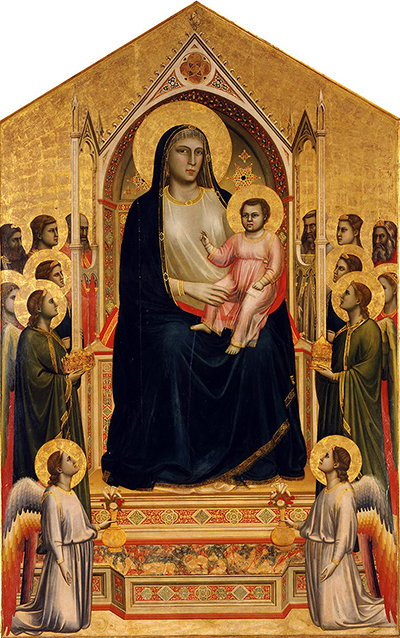
c.1300–05 (Uffizi); c.1310 also proposed; track: c.1300–05 [10]Scrovegni Chapel — painted decoration
c.1303–05 (chapel campaign); Giotto and workshop (painted decoration) [11] [12] [13]Madonna and Child — Washington / Goldman Madonna
c.1310–1315 (National Gallery of Art) [14]Peruzzi Chapel — painted decoration (current article)
c.1310–11 (Santa Croce); 1334–36 proposed by Schwarz; track: c.1310–11; Giotto and workshop / Giottesque painters; individual hands disputed [15]Stefaneschi Triptych
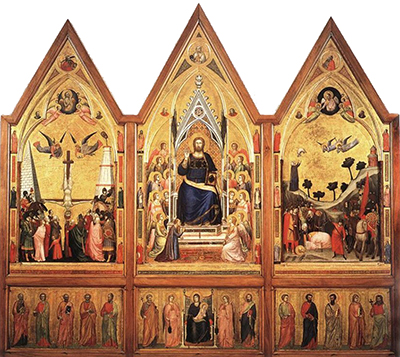
c.1320; 1315–20 (Vatican Museums); Giotto and workshop [16]Bardi Chapel — painted decoration
After 1317, usually the 1320s; disputed; Giotto and workshop / Giottesque painters; individual hands disputed [17] [18]Baroncelli Polyptych
After 1328; completion uncertain; band continues to axis edge; Giotto and workshop [19]Giotto’s Campanile — Florence Cathedral bell tower
Giotto’s phase 1334–37; completed 1359 by successors [20] [21] [22]Contents
- A painted room beside the high altar
- The Peruzzi family and the chapel’s purpose
- Why two Johns?
- The Annunciation to Zacharias
- The Birth and Naming of the Baptist
- The Feast of Herod
- The Vision on Patmos
- The Raising of Drusiana
- The Death and Ascension of the Evangelist
- Architecture and the spectator
A painted room beside the high altar
The Peruzzi Chapel stands in Santa Croce’s right transept, second from the high altar, beside the Bardi Chapel. Its patrons were a wealthy local banking family. The neighbouring chapels have distinct programmes: the Bardi paintings tell the life of Francis, while the Peruzzi walls belong to the two Johns. [3] The narrow interval between them makes their different narrative choices easy to compare.
Entering beneath the arch, the Baptist’s stories are on the left and the Evangelist’s on the right. On each side a curved upper field sits above two rectangular scenes. The sequence descends from the Annunciation to Zacharias, through the Baptist’s Birth and Naming, to the Feast of Herod; opposite it descends from the Vision on Patmos, through the Raising of Drusiana, to the Evangelist’s Death and Ascension. Painted architectural members, ornamental bands and imitation marble establish an enclosing order around these changing settings. [1]
The division into three levels gives each saint’s life a legible downward movement. Yet the facing walls encourage a second movement, across the room. The two upper scenes concern revelations granted to solitary recipients. The middle pictures place miraculous life within households and communities. At the lowest level, elaborate interiors frame two radically different endings. These connections emerge from the selection and arrangement; they do not require the scenes to be exact visual doubles.
Above them, Evangelist symbols occupy the vault and eight prophets appear in the entrance arch. A fragment of the Mystic Lamb remains on the rear wall. [1] The decoration therefore extends beyond the six famous pictures. Sacred history, prophecy and the altar’s liturgical setting surround the narratives, giving the little room a larger theological horizon.
The Peruzzi family and the chapel’s purpose
A document discussed by Schwarz takes the chapel’s history back before the paintings. On 21 November 1292, Donato di Arnaldo Peruzzi made a conditional bequest of 200 lire towards building a chapel if the Florentine Franciscans enlarged or rebuilt their church within ten years of his death. His brothers were to administer the provision. This is evidence for the foundation’s beginnings, rather than a dated commission for Giotto’s murals. One brother named among the witnesses was Giotto Peruzzi, a member of the banking family who must be distinguished from the painter. [23]
Founding and decorating the chapel involved successive decisions. A family could establish an enduring place within a church, then equip it over time with paintings, glass and an altarpiece. The saints’ stories would enter a setting already bound to family memory, prayer and commemoration. Schwarz reads the Evangelist’s three scenes especially in relation to these interests: visions of the world to come, a woman raised from death, and the saint’s own exceptional passage into heaven offered powerful material for a funerary chapel. [23]
Identifying one individual as the certain commissioner of the paintings is harder. Schwarz questions the traditional selection of Giovanni di Riniero Peruzzi, which rests on a much later family history without an identified supporting source. He instead considers responsibility across the family and its senior members. His reconstruction usefully keeps the undertaking collective, although it does not supply a surviving contract naming who chose every subject or paid every instalment. [23]
Charity also belongs to the chapel’s history. Schwarz discusses records of Peruzzi provision for feeding the poor at Santa Croce on the Evangelist’s feast in 1335–38. These practices connect family remembrance with a public religious obligation. They do not prove that the paintings were completed for the first recorded distribution, or that every early distribution took place inside the chapel. The distinction matters: an act of charity can illuminate the setting without becoming a missing painting contract. [24]
Why two Johns?
The dedication allows two different kinds of holy witness to share one room. The Baptist’s chosen scenes concentrate on his promised birth, the confirmation of his name, and the circumstances of his death. The Evangelist’s begin with visionary exile, then show his power to restore life and his reception into heaven. The resulting programme is highly selective. Neither wall attempts a complete biography.
For a Florentine audience, the Baptist also carried a civic association. He was the city’s patron, honoured at its Baptistery. Schwarz relates the Peruzzi narratives to that much larger field of imagery, including the Baptistery mosaics and Andrea Pisano’s bronze door. Within Santa Croce, he also considers Franciscan associations: the tradition that Francis had first been named John, and the understanding of his preaching through the Baptist’s example. These are possible interpretive connections within the institution, rather than instructions preserved from the chapel’s patrons. [25]
The surviving Lamb helps bind the saints together. In the Gospel of John, the Baptist identifies Christ as the Lamb of God; the Lamb is also central to the Apocalypse. Schwarz draws attention to the way that this shared image joins the two lives and connects them to the altar, where the Eucharist was celebrated. [23] The relationship is especially apt in a chapel concerned with death and salvation: individual stories open onto the sacrifice and promised life that give them their religious meaning.
The pairing remains effective at a simpler visual level. One wall ends in a court where a holy body is dismembered and its head displayed. The other ends in a church where a holy body rises beyond ordinary mortality. Between these endings lie two communities gathered around newly manifest life. The room lets viewers make such comparisons through the act of turning.
The Annunciation to Zacharias
The Baptist’s story begins high on the left wall. A columned sanctuary occupies the centre of the lunette, its triangular pediment and circular ornament fitting beneath the chapel’s arch. Inside, Zacharias confronts an angel across the altar. Groups to either side make the encounter part of a larger religious gathering, while the building rising behind the sanctuary adds depth on the right.
Luke’s Gospel provides the narrative. Zacharias, an elderly priest whose wife Elizabeth is also advanced in years, receives Gabriel’s announcement that they will have a son named John. He doubts the promise and loses the power of speech until its fulfilment. Outside, the people await him and recognise from his signs that he has seen a vision. [26]
Giotto gives the exchange a definite place without enclosing it beyond sight. The slender supports identify the sanctuary and leave its interior accessible to the spectator. Zacharias’s raised hand and the angel’s facing gesture carry the encounter across the altar. The architecture holds them apart while making their relationship unmistakable. Its measured uprights steady a moment whose consequences will unfold in the scene below.
There is also a striking difference between the building’s upper grandeur and the gathering along its base. The pediment, roof and adjoining block stretch into the lunette, whereas the people form a lower, closely spaced company. Their heads and hands create smaller exchanges around the principal meeting. At the left, a harp adds an unexpectedly specific object to the temple setting. Its curved outline contrasts with the straight supports and courses of masonry.
The worn surface now makes some figures almost transparent against the blue field. Even so, the division between sanctuary, company and rear building survives clearly. Rather than relying on tiny facial details, the scene can still be read through positions: the two central presences, the altar between them, and the witnesses distributed outside their immediate exchange. The promise begins in a public religious setting, although its fulfilment will take place within a household.
The Birth and Naming of the Baptist
The middle scene opens a house in section. At the right, Elizabeth lies in a bed attended by women; at the left, Zacharias sits writing as an attendant presents the infant. A vertical architectural division separates the two spaces, while their upper walls and projecting roofs bind them into one substantial dwelling. The picture makes successive events available in a single view.
In Luke, the naming occurs when relatives and neighbours gather for the child’s circumcision on the eighth day. Elizabeth insists upon John rather than his father’s name. Asked to confirm the choice, Zacharias writes the name, and his speech returns. [26] The painting joins childbirth to this decisive recognition. Its subject includes the establishment of the child’s identity, as well as the fact of his arrival.
Zacharias’s seated, forward-bending body makes writing a physical act. The tablet rests close to his lap; his attention is directed downwards while the people bringing the child approach from the centre. The infant’s small size sharpens the scale of the adults around him. Their large mantles, bent shoulders and overlapping bodies give the foreground a weight that the delicate child interrupts.
At the right, the bed extends across the room like a broad platform. A long reddish chest with visible fittings stands before it. The combination of chest, bedding, attendants and upper storey makes the house feel furnished and inhabited. These objects also establish the distance between the bed and the spectator. We look past something solid and useful into the space of care surrounding Elizabeth.
The direction of the story differs from a simple left-to-right reading. The birth takes place on the right, while its later consequence occupies the left. Architecture allows the moments to coexist without requiring the eye to confuse them. One can first recognise the bed, then follow the child into the adjacent gathering, or begin with the concentrated act of writing and look back towards its cause.
Schwarz reads the infant’s extended arm as an anticipation of his preaching, an unusually early declaration of the Baptist’s vocation. He connects it with the Franciscan associations of the saint’s name. [25] The gesture is visible; the full symbolic argument remains an interpretation. Either way, the child is already active within the composition. Held by an adult, he reaches into the exchange that will give his life its public name.
The Feast of Herod
The lowest Baptist scene brings a change of atmosphere. A richly articulated palace occupies almost the entire field. Its banquet hall stands open behind a column, an adjoining chamber is visible through an arch at the right, and a tower rises at the left. Small figures crown the roof. Within this elaborate setting, a musician plays, Salome performs, a soldier presents the Baptist’s head, and the head appears again as Salome offers it to Herodias.
Mark describes Herod’s imprisonment of John, the birthday feast, the daughter’s dance, her request prompted by her mother, and the execution ordered by the ruler. The soldier gives the head to the girl, who passes it to her mother. [27] Giotto’s arrangement brings several stages together. The actual act of beheading is absent from the principal action; its result enters the feast and then moves into the neighbouring room.
The same head therefore belongs to different moments within a shared architecture. In front of the banquet table it interrupts the company’s celebration. At the right, it becomes an offering placed before the seated Herodias. The arch does useful narrative work: it lets the second transaction remain visible while marking a different place. The palace is at once a convincing building and a means of connecting events that could not all occur simultaneously.
Salome’s dancing figure does relatively little with her feet. Her lifted hands and the space around them give the performance its delicate emphasis. Against that refinement, the dish bearing the head is brutally explicit. Both dance and murder take place within the ordered world of the court, among fabrics, a laid table and architectural ornaments. Their proximity is more unsettling than a separate execution scene would be.
The musician stands at the left edge of the hall, bow and instrument set across his body. His open mouth gives the performance a suggestion of sound as well as movement. That occupied figure helps distinguish the feast from the quieter household above. Here bodies entertain, watch, eat, carry and command. The picture distributes the consequences of power across a whole company.
Schwarz’s close reading goes further, interpreting particular guests, servants and the musician as commentators on the event. He also compares Herod’s hand above a bowl with Pilate’s gesture of disclaimed responsibility. These readings concern culpability and the difference between apparent regret and hypocrisy. They draw on a Tuscan John legend as well as Mark; the detour in which the head is brought before Herod is one important distinction from the Gospel’s sequence. [28]
The picture supports sustained attention to those gestures without allowing certainty about every person’s private thought. A guest’s lifted hand, a turned head or two figures leaning towards one another can suggest interruption, unease or discussion. Their ambiguity keeps the court from becoming a collection of simple emotional labels. The Baptist himself has been removed from conversation, yet the severed head makes his presence impossible to ignore.
At the far left, the tower’s dark grated opening raises a further question. Schwarz notes that copies of the painting show the Baptist’s decapitated body there, and considers the structure a possible prison. [29] That evidence belongs to the history of the image. The body should not be described as clearly visible in the worn painting today. The legible transfer of the head already establishes what has happened beyond the banquet’s open stage.
The Vision on Patmos
Across the chapel, the Evangelist’s cycle begins with a different kind of withdrawal. John sits on a rocky island surrounded by patterned water. The land is broad enough to hold him, yet small enough for the sea to enclose it visibly. Above, visionary figures and a dragon occupy the blue field beneath the arch. The image replaces the Baptist’s substantial temple with an exposed natural setting.
The opening chapter of Revelation places John on Patmos and describes the command to record what he sees. The Peruzzi programme follows the medieval identification of this visionary John with the Evangelist. [30] Its upper scene gathers an apocalyptic world around the seated saint rather than presenting the writing of a Gospel inside a study.
John’s pose is remarkably compact. One hand supports his head; the mantle gathers around his bent body. He occupies the middle of the island while the visions spread above and around him. The physical concentration of the saint provides a quiet centre against the animated creatures and appearances. Isolation becomes a visible condition of revelation.
The sea is important to that effect. Its repeated curling lines wrap around the irregular shore and separate the island from the lower edges of the painting. Seen from above, the land can be grasped as a whole. Yet John remains a large, weighty figure rather than a tiny inhabitant lost in a map. The image combines a surveying view of the setting with an intimate view of its principal occupant.
A dragon stretches through the upper blue, while another visionary figure reclines at the right. Their positions belong to a different order from the shoreline below. Giotto does not need a single continuous terrain to make the encounter intelligible. John’s stillness, the enclosing water and the charged upper space establish the difference between bodily location and visionary experience. The chapel’s curving arch gathers these otherwise dispersed presences into one field.
The Raising of Drusiana
The middle Evangelist scene returns to a populated world. John stands at the left, extending his right arm towards Drusiana, who has risen on her bier. Figures kneel near him; the funeral company gathers on the right. Behind them stretches a city wall, with a towered gate at one side and a large domed church at the other. The architecture continues across the full scene and makes the miracle feel like an event occurring before a city.
This is a story from the Evangelist’s later legend. In the Golden Legend, John returns from exile to Ephesus and encounters the funeral of Drusiana, a devoted follower who had longed to see him again. He orders the bier set down and the body unbound, then calls upon Christ to raise her. She returns to life and goes home to prepare food for him. [31] The medieval account supplies the story’s religious framework; it is distinct from the Gospel narratives of Jesus raising the dead.
The painting chooses the moment of restored encounter. Drusiana’s upright torso and lifted hands answer John’s extended arm across a narrow interval. Around them the company forms two uneven masses. The kneeling figures bring the saint’s gesture close to the foreground, while those behind the bier form a standing screen of heads and draped bodies. The space separating John and Drusiana becomes the scene’s most active passage.
It is also where the city wall changes direction. The bend behind the miracle interrupts a long horizontal run and brings architectural movement into relation with the figures’ exchange. At the left, the gate gives John’s arrival a setting. At the right, the church rises above the mourners. Buildings help organise the action without being reduced to small props placed immediately behind individual people.
The church’s domes, rounded openings, projecting apse and bands of ornament make it exceptionally specific. Its upper parts appear over the wall, while the crowd conceals much of its lower structure. The result resembles a view into a larger city whose buildings continue beyond the immediate ceremony. The wide blue sky between gate and church keeps the architecture from closing into a solid backdrop.
Schwarz argues that this setting draws on the church and topography of medieval Ephesus, adapting features familiar from Italian architecture. He discusses the resemblance to the Santo in Padua but resists treating that building as a sufficient explanation of the whole. His proposal is an interpretation of the painted architecture, not proof that Giotto travelled to Ephesus. He considers information reaching Florence through Peruzzi commercial contacts more plausible than an otherwise undocumented personal journey; Franciscan connections offer another possibility. [32]
The picture remains compelling without settling the source of every dome. Its panorama gives the sacred event a substantial urban world. There is enough specificity to invite recognition, and enough continuity to suggest that life carries on beyond the painted frame. Drusiana’s return to her household, described in the legend, can be imagined within such a city. The miracle concerns both a body restored to life and a person restored to a community.
The Death and Ascension of the Evangelist
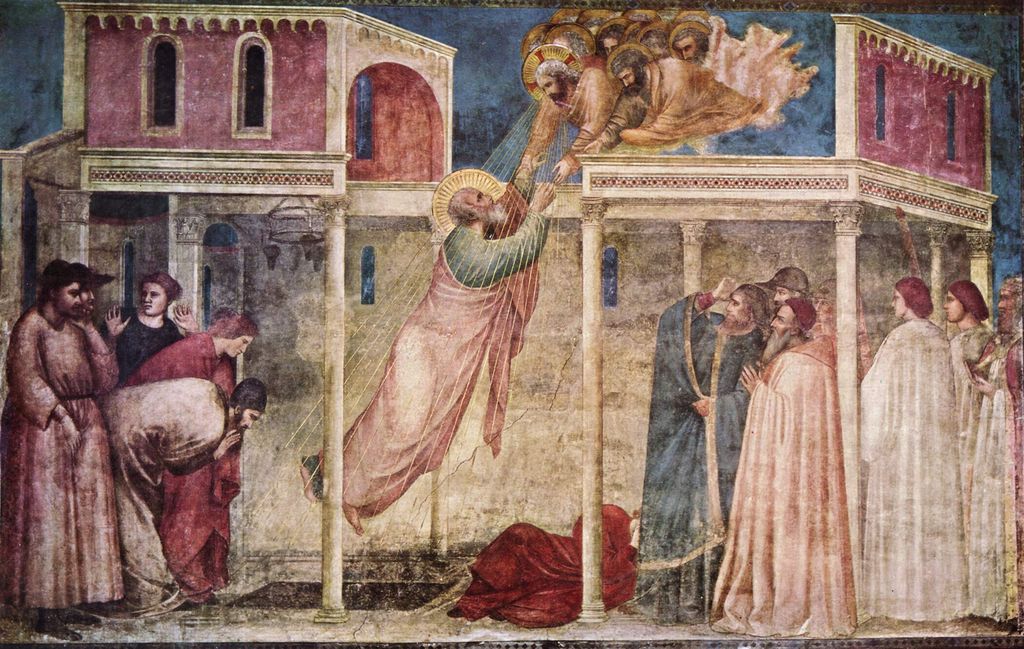
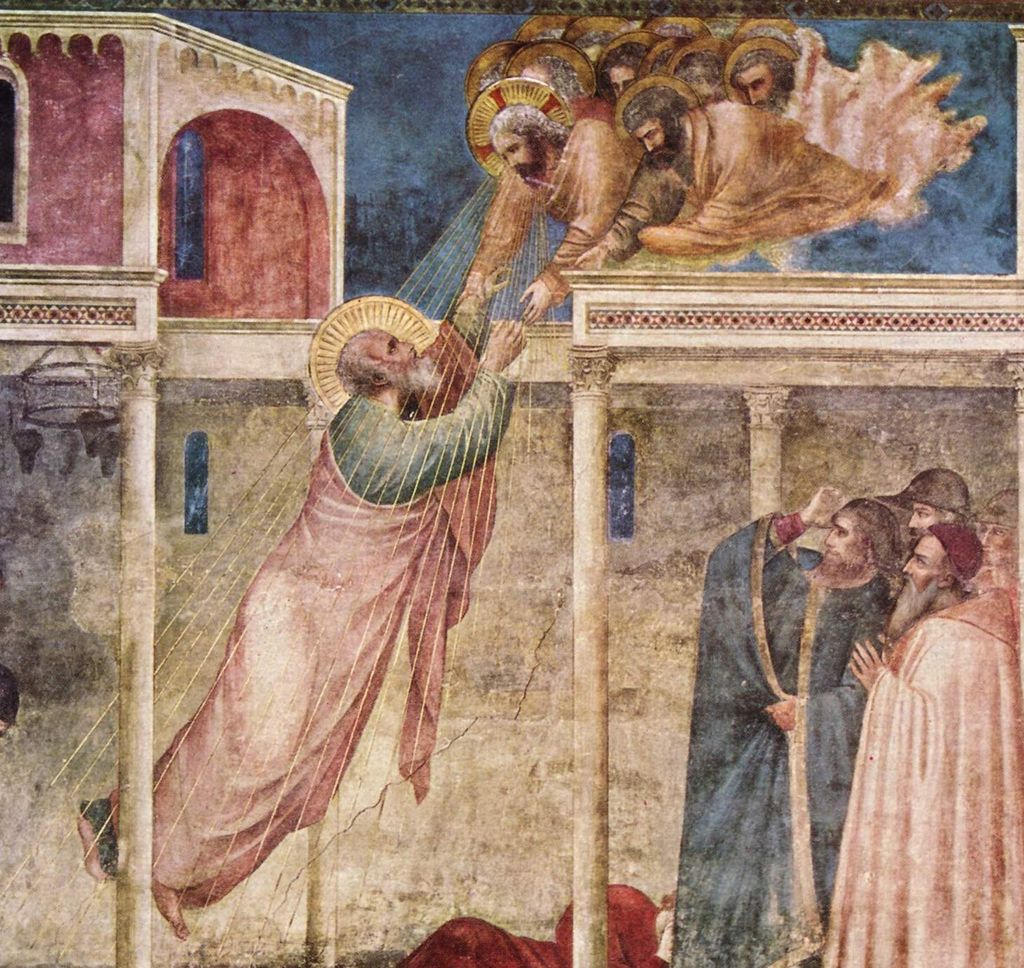
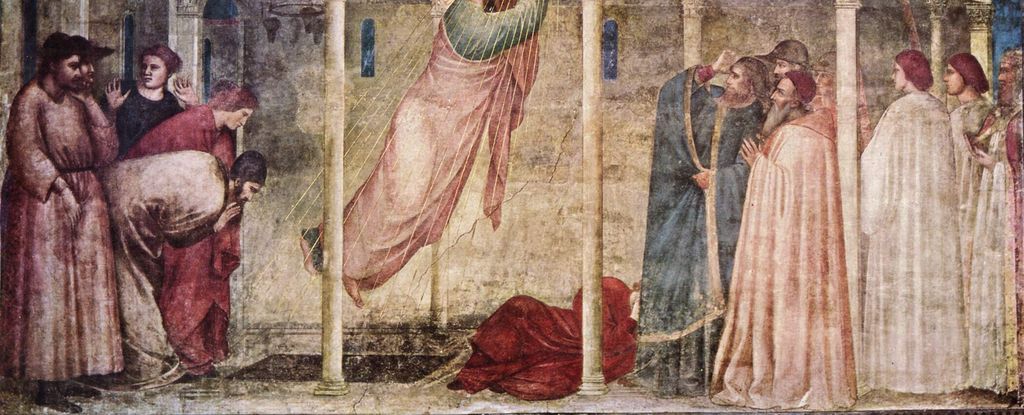
Below Drusiana, another church opens before us. Columns, upper walls and exposed roofless spaces arrange the witnesses around a central opening. John rises diagonally towards Christ, his hands lifted to meet those extending down to him. At the left, men bend towards the grave; at the right, a taller company looks towards the event. A crumpled red garment near the opening makes a low, earthly counterweight to the ascending body.
The Golden Legend describes Christ announcing John’s approaching death. After celebrating Mass, the saint enters a grave prepared before the altar and prays. A brilliant light prevents the people from seeing him, and afterwards the grave contains manna. The text reports the belief that he was carried bodily into heaven while reserving certainty to God. [31] Giotto gives that belief a direct pictorial form: the saint rises bodily towards a heavenly welcome.
The building is designed around the act of looking. Its columns make the interior accessible; its upper walls step aside around the route of ascent. An uninterrupted diagonal joins the grave, John and Christ. The architecture establishes weight and enclosure, then allows the saint’s body to pass through them. Compared with the broad city behind Drusiana, this is a closely organised interior built for a particular revelation.
The witnesses do not all look in the same direction. Bent bodies at the left attend to the grave, bringing absence into the story. Upright figures at the right face the ascending saint. Their different orientations divide the event into things that can be discovered and things that can be seen happening. The spectator has a more comprehensive view, able to connect the opening below with the reception above.
The heavenly company is now very faint in ordinary light. This loss can make the scene appear dominated by an isolated rising figure, although its action depends on a meeting. Modern ultraviolet photography has helped clarify the receiving group, including Christ and the apostles. [33] The visible remains still preserve the essential link of raised and extended arms. Across from the court where hands pass a severed head, these hands draw a whole body upwards.
Annotated Details from The Peruzzi Chapel
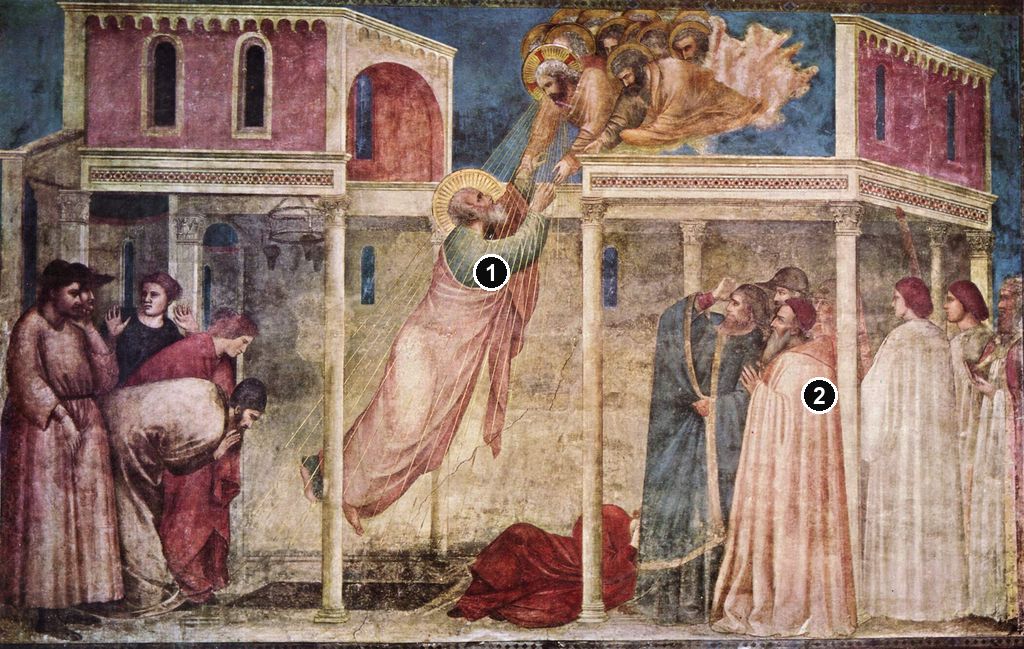
The numbered points identify visible features discussed in this article. Return from each detail to the numbered overview. Ascension of John the Evangelist, Peruzzi Chapel. Image source. Public domain. Numbers added to a separate resized overview; detail crops made from the unchanged native source. No upscaling, recolouring, retouching or reconstruction.
Details from THE PERUZZI CHAPEL
Compare each detail with the complete source overview. The article and captions retain the stated source, identity and attribution qualifications.
John rises towards Christ
Below Drusiana, another church opens before us. Columns, upper walls and exposed roofless spaces arrange the witnesses around a central opening. John rises diagonally towards Christ, his hands lifted to meet those extending down to him. At the left, men bend towards the grave; at the right, a taller company looks towards the event. A crumpled red garment near the opening makes a low, earthly counterweight to the ascending body. The building is designed around the act of looking. Its columns make the interior accessible; its upper walls step aside around the route of ascent. An uninterrupted diagonal joins the grave, John and Christ. The architecture establishes weight and enclosure, then allows the saint’s body to pass through them. Compared with the broad city behind Drusiana, this is a closely organised interior built for a particular revelation.
Witnesses at grave and ascent
The witnesses do not all look in the same direction. Bent bodies at the left attend to the grave, bringing absence into the story. Upright figures at the right face the ascending saint. Their different orientations divide the event into things that can be discovered and things that can be seen happening. The spectator has a more comprehensive view, able to connect the opening below with the reception above.
Architecture and the spectator
The six settings ask for different kinds of attention. Zacharias’s sanctuary presents a central exchange; the birth scene opens adjoining rooms; Herod’s palace connects successive acts; Patmos encloses a solitary figure in water; Drusiana’s city spreads behind a public miracle; the final church arranges itself around a passage into heaven. Buildings and landscape give each story a different relationship with the spectator.
Their relationship with the real room is equally important. A reproduction normally places a rectangular scene directly before the viewer. In the chapel, the facing walls stand too close together for that detached view to explain the whole experience. From the entrance, the pictures are approached obliquely. Their architectural edges, projecting roofs and columns can therefore answer the depth of the chapel itself.
Schwarz examines this effect particularly on the Baptist wall. Seen from outside the chapel, the corner column of Herod’s hall can appear to stand towards the spectator, while the building beside Zacharias’s sanctuary leads backwards with the real space. In the Birth and Naming, the projecting wall beside the seated father can seem to join the chapel wall. These are arguments about a picture’s adjustment to a particular viewing position. [29] They need not be turned into a claim that every painted orthogonal belongs to one mathematically unified perspective system.
The shifting spaces also govern access. We are shown interiors whose occupants can be seen without the obstacles that a real façade would impose. Yet columns, chests, tables and standing bodies preserve a sense of things lying between us and the action. The pictures offer entry while retaining intervals and thresholds. Their drama depends partly on seeing across those intervals: an altar, the distance from father to child, the width between John’s blessing hand and Drusiana’s answering palms.
Paint, damage and rediscovery
The present surface requires patience. Some passages preserve strongly modelled folds and substantial colour, while nearby faces have become pale or incomplete. The unevenness can make a single figure seem less solid than its outline promises. Schwarz’s discussion of surviving drapery and furnishings stresses how much material richness has been lost. His account is a reconstruction from remnants, not a description of an intact decorative surface. [29]
The chapel’s technique helps explain its vulnerability. The narrative scenes were painted on dry plaster. Cecilia Frosinini’s technical account also identifies fresco work in parts of the vault, preparatory areas and imitation marble, distinguishing these from the stories themselves. [33] Calling the whole ensemble simply a cycle of frescoes can obscure this variation. Pigment applied with a binding medium to a dry surface has a different relationship with the wall from colour incorporated into fresh lime plaster.
The condition also reflects later intervention. Eighteenth-century whitewashing concealed the paintings. Antonio Marini’s work in 1841–48 and the Pezzati campaign of 1861–63 exposed and repainted them, with cleaning causing irreversible damage. Leonetto Tintori removed later additions in 1958. The Opificio delle Pietre Dure worked on the paintings in 1983–85 and undertook diagnostics in 2009–10. [3] This history explains why rediscovery and loss can belong to the same episode: uncovering a medieval painting can damage the very surface being recovered.
Nineteenth-century repainting also changed how the pictures were understood. Schwarz compares the musician’s head before and after removal of overpaint, arguing that the added expression softened the more difficult original conception. [29] The issue extends beyond whether a restored face looked attractive. An altered glance or mouth can change a figure’s role in the story, and therefore the moral relationships among the people at the feast.
Frosinini’s report describes ultraviolet fluorescence photography revealing faint modelling, drapery and figures. It records a complete photographic campaign in November 2012. She leaves the unusually strong fluorescence’s cause unresolved, considering interactions among original materials and later treatments. [33] These images expand the evidence available for understanding Giotto’s forms. They do not mean that lost colour has been physically returned to the walls, or that the paintings now appear in ordinary light as they did when new.
The distinction encourages a double attention. The surviving paintings remain the works encountered in the chapel, with their interruptions and areas of silence. Technical photographs help establish that some apparent flatness belongs to damage rather than design. The solid shoulders, hanging fabric and carefully furnished rooms were originally more fully articulated. Their present incompleteness should neither erase that ambition nor invite an imaginary restoration of every missing detail.
A disputed place in Giotto’s career
The dating problem is unusually large. Santa Croce’s catalogue gives about 1310–11, while its discussion acknowledges competing placements before and after the Bardi murals. [1] Schwarz’s much later proposal, 1334–36, depends especially on relationships with Andrea Pisano’s Baptist narratives for the Florentine Baptistery. The bronze door’s documented production provides a chronological framework; the direction in which the two artists exchanged ideas remains contested. [2]
Shared poses alone cannot settle the matter. Schwarz notes that the seated, writing Zacharias has an earlier precedent in the Baptistery mosaics, and that the related musicians do not establish which artist supplied the other’s model. His stronger argument concerns narrative construction: he considers Giotto’s compressed Feast of Herod dependent upon the fuller sequence Andrea had developed. Accepting that argument moves the murals into Giotto’s final years; rejecting its direction leaves other chronologies open. [2]
The charity records do not independently close the gap. Schwarz conditionally narrows his proposal to 1334–35 if the distributions began in 1335 and already belonged to the chapel. Those assumptions are not secured merely by the existence of the accounts. [24] The foundation bequest of 1292, meanwhile, dates an intention to build, not the wall paintings. The family’s records and the paintings’ visual relationships cannot supply the same kind of date.
For the viewer, the unresolved chronology changes the larger career narrative rather than the identity of the scenes. Under an early dating, their spatial complexity follows relatively soon after Padua; under Schwarz’s reconstruction, it becomes part of a late phase of renewed experimentation and exchange with other painters. Schwarz’s larger account allows for stylistic variety within a late period: changed demands and exchange with Sienese painters could produce different solutions rather than a uniform final manner. [34] That interpretation challenges a simple progression from youthful discovery to settled old age. Its explanatory force remains connected to his disputed chronology. What the chapel itself establishes is a sustained willingness to change the scale of buildings, the handling of time and the relation between a painted scene and its spectator.
The chapel’s changing ensemble
The room has also changed through the movement of its furnishings. Santa Croce associates its original altarpiece with the painting now in the North Carolina Museum of Art, Raleigh. The museum presents the Peruzzi destination more cautiously, as a proposal supported by the saints depicted. The panel gathers Christ, Mary, the two Johns and Francis beneath pointed arches. [35] Its association is persuasive without being equivalent to a surviving commission document. The Peruzzi Altarpiece deserves to be considered alongside the murals as a distinct object with its own history.

The Raleigh Peruzzi Altarpiece, proposed as the chapel’s original altarpiece.
Today the replacement panel is by an anonymous painter close to Bernardo Daddi, and the window came from the Giugni Chapel and is attributed to Pacino di Bonaguida. The monument to Vincenzo Peruzzi on the right wall is nineteenth-century work by Odoardo Fantachiotti. [3] These furnishings belong to different moments in the room’s history. They should not all be mentally assembled into the setting Giotto knew.
The painted borders, too, deserve a glance beyond their framing function. Santa Croce cautiously suggests that small heads within the ornamental bands may represent members of the Peruzzi family. [1] The proposal leaves their identities open. What can be seen is the insertion of particular faces into an ordered decorative scheme, on a scale different from the saints’ monumental narratives.
Returning to the facing walls restores the chapel’s strongest unity. A child reaches towards a father who writes his name; Drusiana raises her hands towards the man who calls her back to life. Herod’s hall exposes the consequences of a ruler’s commands; the opposite church opens around an ascent that earthly architecture cannot contain. Despite the losses, Giotto’s painted room still makes these relationships legible through bodies, objects, openings and distances. Its stories gather their force across the small space that separates them.
Watch: Explore Giotto’s Art
Choose an overview or a closer look at three major works. These films provide wider Giotto context alongside this article.
Artworks directory
This directory brings together 209 records for paintings, ensembles, individual scenes and components, architectural work, an associated disputed design, and reported or lost projects connected with Giotto. Ensembles and their parts appear separately, so 209 is a count of records rather than independent paintings or commissions. Attributions and dates remain qualified where disputed; inclusion does not establish Giotto’s own hand throughout.
| Name | Date | Medium, attribution and status |
|---|---|---|
| Expulsion of Joachim from the Temple — Scrovegni Chapel, Padua | c.1303–05 (chapel campaign) | Fresco / wall painting. Giotto and workshop. Scene within a cycle. Padova Musei. Chapel overview. |
| Joachim among the Shepherds — Scrovegni Chapel, Padua | c.1303–05 (chapel campaign) | Fresco / wall painting. Giotto and workshop. Scene within a cycle. Padova Musei. Chapel overview. |
| Annunciation to Saint Anne — Scrovegni Chapel, Padua | c.1303–05 (chapel campaign) | Fresco / wall painting. Giotto and workshop. Scene within a cycle. Padova Musei. Chapel overview. |
| Sacrifice of Joachim — Scrovegni Chapel, Padua | c.1303–05 (chapel campaign) | Fresco / wall painting. Giotto and workshop. Scene within a cycle. Padova Musei. Chapel overview. |
| Joachim’s Dream — Scrovegni Chapel, Padua | c.1303–05 (chapel campaign) | Fresco / wall painting. Giotto and workshop. Scene within a cycle. Padova Musei. Padova Musei. Chapel overview. |
| Meeting at the Golden Gate — Scrovegni Chapel, Padua | c.1303–05 (chapel campaign) | Fresco / wall painting. Giotto and workshop. Scene within a cycle. Padova Musei. Chapel overview. |
| Birth of the Virgin — Scrovegni Chapel, Padua | c.1303–05 (chapel campaign) | Fresco / wall painting. Giotto and workshop. Scene within a cycle. Padova Musei. Padova Musei. Chapel overview. |
| Presentation of the Virgin in the Temple — Scrovegni Chapel, Padua | c.1303–05 (chapel campaign) | Fresco / wall painting. Giotto and workshop. Scene within a cycle. Padova Musei. Chapel overview. |
| Delivery of the Rods — Scrovegni Chapel, Padua | c.1303–05 (chapel campaign) | Fresco / wall painting. Giotto and workshop. Scene within a cycle. Padova Musei. Chapel overview. |
| Prayer of Joseph and the Suitors — Scrovegni Chapel, Padua | c.1303–05 (chapel campaign) | Fresco / wall painting. Giotto and workshop. Scene within a cycle. Padova Musei. Chapel overview. |
| Marriage of the Virgin — Scrovegni Chapel, Padua | c.1303–05 (chapel campaign) | Fresco / wall painting. Giotto and workshop. Scene within a cycle. Padova Musei. Chapel overview. |
| Wedding Procession of Mary — Scrovegni Chapel, Padua | c.1303–05 (chapel campaign) | Fresco / wall painting. Giotto and workshop. Scene within a cycle. Padova Musei. Chapel overview. |
| Annunciation on the triumphal arch — complete ensemble (Scrovegni Chapel, Padua) | c.1303–05 (chapel campaign) | Wall painting with a central painted wooden panel. Giotto and workshop. Ensemble. Includes the Mission of Gabriel and the lower Annunciation pair; the original central wooden panel is in the Musei Civici agli Eremitani, with a conservation copy in the chapel. Padova Musei. Padova Musei. Scholarly study. Chapel overview. |
| Visitation — Scrovegni Chapel, Padua | c.1303–05 (chapel campaign) | Fresco / wall painting. Giotto and workshop. Scene within a cycle. Padova Musei. Chapel overview. |
| Nativity — Scrovegni Chapel, Padua | c.1303–05 (chapel campaign) | Fresco / wall painting. Giotto and workshop. Scene within a cycle. Padova Musei. Chapel overview. |
| Adoration of the Magi — Scrovegni Chapel, Padua | c.1303–05 (chapel campaign) | Fresco / wall painting. Giotto and workshop. Scene within a cycle. Padova Musei. Chapel overview. |
| Presentation of Christ at the Temple — Scrovegni Chapel, Padua | c.1303–05 (chapel campaign) | Fresco / wall painting. Giotto and workshop. Scene within a cycle. Padova Musei. Chapel overview. |
| Flight into Egypt — Scrovegni Chapel, Padua | c.1303–05 (chapel campaign) | Fresco / wall painting. Giotto and workshop. Scene within a cycle. Padova Musei. Chapel overview. |
| Massacre of the Innocents — Scrovegni Chapel, Padua | c.1303–05 (chapel campaign) | Fresco / wall painting. Giotto and workshop. Scene within a cycle. Padova Musei. Chapel overview. |
| Christ among the Doctors — Scrovegni Chapel, Padua | c.1303–05 (chapel campaign) | Fresco / wall painting. Giotto and workshop. Scene within a cycle. Padova Musei. Chapel overview. |
| Baptism of Christ — Scrovegni Chapel, Padua | c.1303–05 (chapel campaign) | Fresco / wall painting. Giotto and workshop. Scene within a cycle. Padova Musei. Chapel overview. |
| Marriage at Cana — Scrovegni Chapel, Padua | c.1303–05 (chapel campaign) | Fresco / wall painting. Giotto and workshop. Scene within a cycle. Padova Musei. Padova Musei. Chapel overview. |
| Raising of Lazarus — Scrovegni Chapel, Padua | c.1303–05 (chapel campaign) | Fresco / wall painting. Giotto and workshop. Scene within a cycle. Padova Musei. Chapel overview. |
| Entry into Jerusalem — Scrovegni Chapel, Padua | c.1303–05 (chapel campaign) | Fresco / wall painting. Giotto and workshop. Scene within a cycle. Padova Musei. Chapel overview. |
| Expulsion of the Money Changers — Scrovegni Chapel, Padua | c.1303–05 (chapel campaign) | Fresco / wall painting. Giotto and workshop. Scene within a cycle. Padova Musei. Padova Musei. Chapel overview. |
| Judas Receiving the Payment — Scrovegni Chapel, Padua | c.1303–05 (chapel campaign) | Fresco / wall painting. Giotto and workshop. Scene within a cycle. Padova Musei. Chapel overview. |
| Last Supper — Scrovegni Chapel, Padua | c.1303–05 (chapel campaign) | Fresco / wall painting. Giotto and workshop. Scene within a cycle. Padova Musei. Chapel overview. |
| Washing of the Feet — Scrovegni Chapel, Padua | c.1303–05 (chapel campaign) | Fresco / wall painting. Giotto and workshop. Scene within a cycle. Padova Musei. Chapel overview. |
| Arrest of Christ — Scrovegni Chapel, Padua | c.1303–05 (chapel campaign) | Fresco / wall painting. Giotto and workshop. Scene within a cycle. Padova Musei. Chapel overview. |
| Christ before Annas and Caiaphas — Scrovegni Chapel, Padua | c.1303–05 (chapel campaign) | Fresco / wall painting. Giotto and workshop. Scene within a cycle. Padova Musei. Chapel overview. |
| Mocking of Christ and Flagellation — Scrovegni Chapel, Padua | c.1303–05 (chapel campaign) | Fresco / wall painting. Giotto and workshop. Scene within a cycle. Padova Musei. Chapel overview. |
| Road to Calvary — Scrovegni Chapel, Padua | c.1303–05 (chapel campaign) | Fresco / wall painting. Giotto and workshop. Scene within a cycle. Padova Musei. Chapel overview. |
| Crucifixion — Scrovegni Chapel, Padua | c.1303–05 (chapel campaign) | Fresco / wall painting. Giotto and workshop. Scene within a cycle. Padova Musei. Chapel overview. |
| Lamentation — Scrovegni Chapel, Padua | c.1303–05 (chapel campaign) | Fresco / wall painting. Giotto and workshop. Scene within a cycle. Padova Musei. Chapel overview. |
| Resurrection / Noli me tangere — Scrovegni Chapel, Padua | c.1303–05 (chapel campaign) | Fresco / wall painting. Giotto and workshop. Scene within a cycle. Padova Musei. Chapel overview. |
| Ascension — Scrovegni Chapel, Padua | c.1303–05 (chapel campaign) | Fresco / wall painting. Giotto and workshop. Scene within a cycle. Padova Musei. Chapel overview. |
| Pentecost — Scrovegni Chapel, Padua | c.1303–05 (chapel campaign) | Fresco / wall painting. Giotto and workshop. Scene within a cycle. Padova Musei. Padova Musei. Chapel overview. |
| Coretto — right painted recess (Scrovegni Chapel, Padua) | c.1303–05 (chapel campaign) | Fresco / painted fictive architecture. Giotto and workshop. Ensemble component. Padova Musei. Padova Musei. Scholarly study. Chapel overview. |
| Coretto — left painted recess (Scrovegni Chapel, Padua) | c.1303–05 (chapel campaign) | Fresco / painted fictive architecture. Giotto and workshop. Ensemble component. Padova Musei. Padova Musei. Scholarly study. Chapel overview. |
| Envy — Scrovegni Chapel, Padua | c.1303–05 (chapel campaign) | Grisaille fresco / wall painting. Giotto and workshop. Ensemble component. Padova Musei. Chapel overview. Scholarly study. Padova Musei. |
| Despair — Scrovegni Chapel, Padua | c.1303–05 (chapel campaign) | Grisaille fresco / wall painting. Giotto and workshop. Ensemble component. Padova Musei. Chapel overview. Scholarly study. Padova Musei. |
| Prudence — Scrovegni Chapel, Padua | c.1303–05 (chapel campaign) | Grisaille fresco / wall painting. Giotto and workshop. Ensemble component. Padova Musei. Chapel overview. Scholarly study. Padova Musei. |
| Fortitude — Scrovegni Chapel, Padua | c.1303–05 (chapel campaign) | Grisaille fresco / wall painting. Giotto and workshop. Ensemble component. Padova Musei. Chapel overview. Scholarly study. Padova Musei. |
| Temperance — Scrovegni Chapel, Padua | c.1303–05 (chapel campaign) | Grisaille fresco / wall painting. Giotto and workshop. Ensemble component. Padova Musei. Chapel overview. Scholarly study. Padova Musei. |
| Justice — Scrovegni Chapel, Padua | c.1303–05 (chapel campaign) | Grisaille fresco / wall painting. Giotto and workshop. Ensemble component. Padova Musei. Chapel overview. Scholarly study. Padova Musei. |
| Faith — Scrovegni Chapel, Padua | c.1303–05 (chapel campaign) | Grisaille fresco / wall painting. Giotto and workshop. Ensemble component. Padova Musei. Chapel overview. Scholarly study. Padova Musei. |
| Charity — Scrovegni Chapel, Padua | c.1303–05 (chapel campaign) | Grisaille fresco / wall painting. Giotto and workshop. Ensemble component. Padova Musei. Chapel overview. Scholarly study. Padova Musei. |
| Hope — Scrovegni Chapel, Padua | c.1303–05 (chapel campaign) | Grisaille fresco / wall painting. Giotto and workshop. Ensemble component. Padova Musei. Chapel overview. Scholarly study. Padova Musei. |
| Folly — Scrovegni Chapel, Padua | c.1303–05 (chapel campaign) | Grisaille fresco / wall painting. Giotto and workshop. Ensemble component. Padova Musei. Chapel overview. Scholarly study. Padova Musei. |
| Inconstancy — Scrovegni Chapel, Padua | c.1303–05 (chapel campaign) | Grisaille fresco / wall painting. Giotto and workshop. Ensemble component. Padova Musei. Chapel overview. Scholarly study. Padova Musei. |
| Wrath — Scrovegni Chapel, Padua | c.1303–05 (chapel campaign) | Grisaille fresco / wall painting. Giotto and workshop. Ensemble component. Padova Musei. Chapel overview. Scholarly study. Padova Musei. |
| Injustice — Scrovegni Chapel, Padua | c.1303–05 (chapel campaign) | Grisaille fresco / wall painting. Giotto and workshop. Ensemble component. Padova Musei. Chapel overview. Scholarly study. Padova Musei. |
| Infidelity / Idolatry — Scrovegni Chapel, Padua | c.1303–05 (chapel campaign) | Grisaille fresco / wall painting. Giotto and workshop. Ensemble component. Padova Musei. Chapel overview. Scholarly study. Padova Musei. |
| Starry vault — complete ensemble (Scrovegni Chapel, Padua) | c.1303–05 (chapel campaign) | Vault painting. Giotto and workshop. Ensemble. Padova Musei. Padova Musei. Chapel overview. |
| Last Judgement — Scrovegni Chapel, Padua | c.1303–05 (chapel campaign) | Fresco / wall painting. Giotto and workshop. Scene within a cycle. Padova Musei. Padova Musei. Chapel overview. Padova Musei. |
| Prophet Malachi — vault medallion — Scrovegni Chapel, Padua | c.1303–05 (chapel campaign) | Fresco / wall painting. Giotto and workshop. Ensemble component. Padova Musei. Padova Musei. Chapel overview. Padova Musei. |
| Prophet Baruch — vault medallion — Scrovegni Chapel, Padua | c.1303–05 (chapel campaign) | Fresco / wall painting. Giotto and workshop. Ensemble component. Padova Musei. Padova Musei. Chapel overview. Padova Musei. |
| Prophet Isaiah — vault medallion — Scrovegni Chapel, Padua | c.1303–05 (chapel campaign) | Fresco / wall painting. Giotto and workshop. Ensemble component. Padova Musei. Padova Musei. Chapel overview. Padova Musei. |
| Prophet Daniel — vault medallion — Scrovegni Chapel, Padua | c.1303–05 (chapel campaign) | Fresco / wall painting. Giotto and workshop. Ensemble component. Padova Musei. Padova Musei. Chapel overview. Padova Musei. |
| Christ Pantocrator — vault medallion — Scrovegni Chapel, Padua | c.1303–05 (chapel campaign) | Fresco / wall painting. Giotto and workshop. Ensemble component. Padova Musei. Padova Musei. Chapel overview. Padova Musei. |
| Virgin and Child — vault medallion — Scrovegni Chapel, Padua | c.1303–05 (chapel campaign) | Fresco / wall painting. Giotto and workshop. Ensemble component. Padova Musei. Padova Musei. Chapel overview. Padova Musei. |
| Prophet Ezekiel — vault medallion — Scrovegni Chapel, Padua | c.1303–05 (chapel campaign) | Fresco / wall painting. Giotto and workshop. Ensemble component. Padova Musei. Padova Musei. Chapel overview. Padova Musei. |
| Prophet Micah — vault medallion — Scrovegni Chapel, Padua | c.1303–05 (chapel campaign) | Fresco / wall painting. Giotto and workshop. Ensemble component. Padova Musei. Padova Musei. Chapel overview. Padova Musei. |
| Saint John the Baptist — vault medallion — Scrovegni Chapel, Padua | c.1303–05 (chapel campaign) | Fresco / wall painting. Giotto and workshop. Ensemble component. Padova Musei. Padova Musei. Chapel overview. Padova Musei. |
| Scrovegni Chapel — painted decoration | c.1303–05 (chapel campaign) | Fresco / wall painting, with a painted wooden panel. Giotto and workshop (painted decoration). Ensemble. Includes separately listed scenes and components. The original central God the Father panel is in the Musei Civici agli Eremitani; a conservation copy is in the chapel. Chapel overview. Padova Musei. Padova Musei. Source. Source. Source. Padova Musei. Scholarly study. |
| Vices and Virtues — complete fourteen-figure programme | c.1303–05 (chapel campaign) | Grisaille fresco / wall painting. Giotto and workshop. Ensemble. Fourteen figures: seven virtues and seven opposed vices. Padova Musei. Chapel overview. Scholarly study. |
| Coretti — paired fictive chapels | c.1303–05 (chapel campaign) | Fresco / painted fictive architecture. Giotto and workshop. Ensemble. Two separate painted recesses, also listed individually. Padova Musei. Padova Musei. Scholarly study. |
| Mission of Gabriel — heavenly assembly | c.1303–05 (chapel campaign) | Wall painting with central painted wooden image. Giotto and workshop. Ensemble component. Central wooden God the Father panel preserved at the Musei Civici agli Eremitani; conservation copy in the chapel. Chapel overview. Padova Musei. Scholarly study. Padova Musei. |
| Annunciation — Gabriel and Mary in facing chambers | c.1303–05 (chapel campaign) | Fresco / wall painting. Giotto and workshop. Ensemble component. Chapel overview. Scholarly study. Padova Musei. |
| God the Father — central wooden panel of the Mission of Gabriel | c.1303–05 (chapel campaign) | Painting on wood. Associated with Giotto. Ensemble component. Original at the Musei Civici agli Eremitani, Padua; conservation copy in the Scrovegni Chapel. Padova Musei. Padova Musei. Scholarly study. Source. |
| Life of Saint Francis — Upper Church cycle, Assisi | Late 13th–early 14th century; dating disputed | Fresco / wall-painting cycle. Traditionally associated with Giotto; Giotto, Roman-school and other attributions disputed. Ensemble. Twenty-eight-scene nave cycle; scenes also listed individually. Basilica catalogue. Scholarly study. Basilica catalogue. Source. Source. |
| Homage of a Simple Man — Upper Church, Assisi | Late 13th–early 14th century; dating disputed | Wall painting. Traditionally associated with Giotto; authorship and dating disputed. Scene within a cycle. Source. Scholarly study. Source. Source. Source. |
| Gift of the Mantle — Upper Church, Assisi | Late 13th–early 14th century; dating disputed | Wall painting. Traditionally associated with Giotto; authorship and dating disputed. Scene within a cycle. Basilica catalogue. Scholarly study. Source. Source. Source. |
| Dream of the Palace Full of Arms — Upper Church, Assisi | Late 13th–early 14th century; dating disputed | Wall painting. Traditionally associated with Giotto; authorship and dating disputed. Scene within a cycle. Basilica catalogue. Source. Scholarly study. Source. Source. Source. |
| Prayer before the Crucifix at San Damiano — Upper Church, Assisi | Late 13th–early 14th century; dating disputed | Wall painting. Traditionally associated with Giotto; authorship and dating disputed. Scene within a cycle. Source. Source. Source. Scholarly study. Source. Source. |
| Renunciation of Worldly Goods — Upper Church, Assisi | Late 13th–early 14th century; dating disputed | Wall painting. Traditionally associated with Giotto; authorship and dating disputed. Scene within a cycle. Source. Scholarly study. Source. Source. |
| Dream of Innocent III — Upper Church, Assisi | Late 13th–early 14th century; dating disputed | Wall painting. Traditionally associated with Giotto; authorship and dating disputed. Scene within a cycle. Source. Source. Scholarly study. Source. Source. |
| Confirmation of the Rule — Upper Church, Assisi | Late 13th–early 14th century; dating disputed | Wall painting. Traditionally associated with Giotto; authorship and dating disputed. Scene within a cycle. Source. Scholarly study. Source. Source. |
| Vision of the Flaming Chariot — Upper Church, Assisi | Late 13th–early 14th century; dating disputed | Wall painting. Traditionally associated with Giotto; authorship and dating disputed. Scene within a cycle. Source. Source. Scholarly study. Source. Source. |
| Vision of the Thrones — Upper Church, Assisi | Late 13th–early 14th century; dating disputed | Wall painting. Traditionally associated with Giotto; authorship and dating disputed. Scene within a cycle. Basilica catalogue. Scholarly study. Source. Source. Source. |
| Expulsion of Devils from Arezzo — Upper Church, Assisi | Late 13th–early 14th century; dating disputed | Wall painting. Traditionally associated with Giotto; authorship and dating disputed. Scene within a cycle. Source. Source. Scholarly study. Source. Source. Source. |
| Trial by Fire before the Sultan — Upper Church, Assisi | Late 13th–early 14th century; dating disputed | Wall painting. Traditionally associated with Giotto; authorship and dating disputed. Scene within a cycle. Source. Source. Scholarly study. Source. Source. |
| Ecstasy of Saint Francis — Upper Church, Assisi | Late 13th–early 14th century; dating disputed | Wall painting. Traditionally associated with Giotto; authorship and dating disputed. Scene within a cycle. Source. Source. Source. Scholarly study. Source. Source. |
| Nativity at Greccio — Upper Church, Assisi | Late 13th–early 14th century; dating disputed | Wall painting. Traditionally associated with Giotto; authorship and dating disputed. Scene within a cycle. Basilica catalogue. Scholarly study. Source. Source. Source. |
| Miracle of the Spring — Upper Church, Assisi | Late 13th–early 14th century; dating disputed | Wall painting. Traditionally associated with Giotto; authorship and dating disputed. Scene within a cycle. Source. Scholarly study. Source. Source. Source. |
| Sermon to the Birds — Upper Church, Assisi | Late 13th–early 14th century; dating disputed | Wall painting. Traditionally associated with Giotto; authorship and dating disputed. Scene within a cycle. Basilica catalogue. Scholarly study. Source. Source. Source. |
| Death of the Knight of Celano — Upper Church, Assisi | Late 13th–early 14th century; dating disputed | Wall painting. Traditionally associated with Giotto; authorship and dating disputed. Scene within a cycle. Source. Source. Scholarly study. Source. Source. |
| Sermon before Pope Honorius III — Upper Church, Assisi | Late 13th–early 14th century; dating disputed | Wall painting. Traditionally associated with Giotto; authorship and dating disputed. Scene within a cycle. Source. Source. Scholarly study. Source. |
| Apparition at the Chapter of Arles — Upper Church, Assisi | Late 13th–early 14th century; dating disputed | Wall painting. Traditionally associated with Giotto; authorship and dating disputed. Scene within a cycle. Basilica catalogue. Scholarly study. Source. Source. Source. |
| Stigmatisation — Upper Church, Assisi | Late 13th–early 14th century; dating disputed | Wall painting. Traditionally associated with Giotto; authorship and dating disputed. Scene within a cycle. Source. Scholarly study. Source. Source. |
| Death and Ascension of Saint Francis — Upper Church, Assisi | Late 13th–early 14th century; dating disputed | Wall painting. Traditionally associated with Giotto; authorship and dating disputed. Scene within a cycle. Basilica catalogue. Scholarly study. Source. Source. Source. |
| Apparition to Brother Augustine and Bishop Guido — Upper Church, Assisi | Late 13th–early 14th century; dating disputed | Wall painting. Traditionally associated with Giotto; authorship and dating disputed. Scene within a cycle. Zeri catalogue. Scholarly study. Source. Source. Source. |
| Verification of the Stigmata — Upper Church, Assisi | Late 13th–early 14th century; dating disputed | Wall painting. Traditionally associated with Giotto; authorship and dating disputed. Scene within a cycle. Source. Source. Scholarly study. Source. Source. |
| Mourning of the Poor Clares — Upper Church, Assisi | Late 13th–early 14th century; dating disputed | Wall painting. Traditionally associated with Giotto; authorship and dating disputed. Scene within a cycle. Basilica catalogue. Source. Scholarly study. Source. Source. |
| Canonisation of Saint Francis — Upper Church, Assisi | Late 13th–early 14th century; dating disputed | Wall painting. Traditionally associated with Giotto; authorship and dating disputed. Scene within a cycle. Source. Source. Scholarly study. Source. Source. Source. |
| Apparition to Pope Gregory IX — Upper Church, Assisi | Late 13th–early 14th century; dating disputed | Wall painting. Traditionally associated with Giotto; authorship and dating disputed. Scene within a cycle. Zeri catalogue. Scholarly study. Source. Source. Source. |
| Healing of John of Lerida — Upper Church, Assisi | Late 13th–early 14th century; dating disputed | Wall painting. Traditionally associated with Giotto; authorship and dating disputed. Scene within a cycle. Source. Source. Scholarly study. Source. Source. |
| Resurrection of a Woman — Upper Church, Assisi | Late 13th–early 14th century; dating disputed | Wall painting. Traditionally associated with Giotto; authorship and dating disputed. Scene within a cycle. Source. Scholarly study. Source. Source. Source. |
| Liberation of the Prisoner Peter — Upper Church, Assisi | Late 13th–early 14th century; dating disputed | Wall painting. Traditionally associated with Giotto; authorship and dating disputed. Scene within a cycle. Source. Source. Scholarly study. Source. Source. Source. |
| Santa Maria Novella Crucifix | Late 13th century; c.1288–89 or 1298–1301; disputed | Tempera and gold on a shaped wooden cross. Giotto. Source. |
| Death of the Virgin / Dormition — Berlin | c.1310 | Tempera and gold on poplar; gabled dossal. Giotto. Source. Source. |
| Peruzzi Altarpiece | c.1311–1315 (North Carolina Museum of Art) | Tempera and gold on panel. Giotto and workshop. Ensemble. Source. |
| Bologna Polyptych | c.1330 | Tempera and gold on panel. Giotto and workshop. Ensemble. Source. |
| Death of Saint Francis, Bardi Chapel | After 1317, usually the 1320s; disputed | Wall painting with wet-plaster and dry-applied passages. Giotto. Scene within a cycle. Source. |
| Bardi Chapel — painted decoration | After 1317, usually the 1320s; disputed | Wall painting with wet-plaster and dry-applied passages. Giotto and workshop / Giottesque painters; individual hands disputed. Ensemble. Scholarly study. Source. |
| Badia Polyptych | c.1300; proposed dates include 1295–1300 and 1301–02 | Tempera and gold on panel; five cusped compartments. Giotto. Ensemble. Scholarly study. Source. Source. |
| Baroncelli Polyptych | After 1328; detached pinnacle c.1328–35 | Tempera and gold on panel; later altered framing. Giotto and workshop. Ensemble. Detached central pinnacle in San Diego. Santa Croce. |
| Adoration of the Magi / Epiphany — Metropolitan Museum panel | Possibly c.1320; c.1310–18 also proposed for the group | Tempera and gold on wood. Giotto. Part of the dispersed seven-scene board; original function disputed. Met catalogue. Source. |
| Franciscan Allegories | Early 14th century, often c.1315; disputed | Vault wall painting. Giotto and workshop / Giottesque painters; individual hands disputed. Ensemble. Basilica catalogue. |
| Navicella — lost / reworked original mosaic | Late 13th–early 14th century; date disputed | Mosaic. Original attributed to Giotto. Original lost / reworked; fragments and later remakes survive. Scholarly study. |
| Pentecost — London panel | Possibly c.1310–18 (Gordon) | Egg tempera on poplar. Giotto and workshop. Part of the dispersed seven-scene board; original function disputed. National Gallery. Source. |
| Saint Stephen — Horne panel | c.1330–1335 (Museo Horne) | Tempera and gold on panel. Giotto. Proposed association with the Washington and Chaalis panels remains hypothetical. Source. |
| Saint Francis Receiving the Stigmata — Louvre altarpiece | 1300–25 (Louvre) | Tempera and gold on poplar. Giotto. Louvre catalogue. |
| Stefaneschi Triptych | c.1320; 1315–20 (Vatican Museums) | Tempera and gold on panel; painted on both sides. Giotto and workshop. Ensemble. Vatican Museums. |
| Crucifixion, Berlin | c.1315–1320 | Tempera and gold on poplar. Giotto. Source. |
| Madonna and Child — Washington / Goldman Madonna | c.1310–1315 (National Gallery of Art) | Tempera and gold on poplar. Giotto. Washington panel, distinct from San Giorgio alla Costa; proposed Horne/Chaalis companions remain hypothetical. NGA catalogue. |
| Ognissanti Madonna | c.1300–05 (Uffizi); c.1310 also proposed | Tempera and gold on panel. Giotto. Uffizi. |
| Madonna of Borgo San Lorenzo | c.1290–95; dating and attribution debated | Tempera and gold on a fragment of a wooden panel. Giotto. Fragmentary. Source. |
| Madonna of San Giorgio alla Costa | c.1288–95 (Opera del Duomo); later dates also proposed | Tempera and gold on panel; cut edges. Giotto. Damaged in 1993 and treated in 1995. Source. |
| Magdalene Chapel — painted decoration | c.1307–08 (basilica); disputed | Wall painting with wet-plaster and dry-applied passages. Giotto and workshop / Giottesque painters; individual hands disputed. Ensemble. Basilica catalogue. |
| Ognissanti Crucifix | c.1315–1320 (Opificio) | Painting on a shaped wooden cross. Giotto and workshop. Workshop participation and alternative attributions debated. Source. |
| Padua Crucifix | c.1303–05 (Zeri catalogue) | Tempera and gold on a shaped wooden cross. Giotto. Zeri catalogue. |
| Peruzzi Chapel — painted decoration | c.1310–11 (Santa Croce); 1334–36 proposed by Schwarz | Wall painting with substantial dry-applied work and loss. Giotto and workshop / Giottesque painters; individual hands disputed. Ensemble. Santa Croce. |
| Rimini Crucifix | c.1300; late 13th century also proposed | Tempera and gold on a shaped wooden cross. Giotto. Source. |
| Giotto’s Campanile — Florence Cathedral bell tower | Begun 1334; completed 1359 under successors | Marble-clad masonry bell tower. Begun under Giotto; continued by Andrea Pisano and Francesco Talenti. Successive building and sculptural campaigns. Source. Scholarly study. Scholarly study. |
| Tower elevation on parchment, Siena — disputed relation to Giotto | 14th century; date and design context disputed | Brown ink and coloured washes over incised construction on three parchment skins. Attribution disputed; possibly a Giotto design transmitted through another hand. Associated design; autograph attribution unestablished. Alternative attributions include Lando di Pietro. Scholarly study. Source. Source. |
| Seven scenes of Christ — dispersed painted board | Possibly c.1310–18 (Gordon); component dates vary | Tempera and gold on a single wooden board, subsequently divided. Giotto and workshop; individual attributions vary. Reconstructed dispersed ensemble. Common board supported by matching wood grain; predella or dossal function disputed. Source. Source. |
| Presentation of Christ at the Temple — Boston panel | Possibly c.1310–18 (Gordon’s group dating) | Tempera and gold on wood. Giotto and workshop; individual attribution varies within the group. Ensemble component. Source. Source. |
| Last Supper — Munich panel | Possibly c.1310–18 (Gordon’s group dating) | Tempera and gold on wood. Giotto and workshop; individual attribution varies within the group. Ensemble component. Source. Source. Source. |
| Crucifixion — Munich panel | Possibly c.1310–18 (Gordon’s group dating) | Tempera and gold on wood. Giotto and workshop; individual attribution varies within the group. Ensemble component. Source. Source. Source. |
| Descent into Limbo — Munich panel | Possibly c.1310–18 (Gordon’s group dating) | Tempera and gold on wood. Giotto and workshop; individual attribution varies within the group. Ensemble component. Source. Source. Source. |
| Entombment — Villa I Tatti panel | Possibly c.1310–18 (Gordon’s group dating) | Tempera and gold on wood. Giotto and workshop; individual attribution varies within the group. Ensemble component. Source. Source. |
| God the Father with Angels — detached Baroncelli pinnacle | c.1328–1335 (San Diego Museum of Art) | Tempera and gold on wood. Giotto and workshop. Ensemble component. Detached in later remodelling; collection home in San Diego. Source. Source. |
| Saint John the Evangelist — Chaalis panel | c.1320 (INHA/RETIF) | Painting on wood. Giotto (INHA/RETIF attribution). Collection: Musée Jacquemart-André, Fontaine-Chaalis. Chantilly’s exhibition announcement, as of 1 November 2026, gives temporary display from 24 January 2026 with no end date. Association with the Washington/Horne altarpiece remains hypothetical. NGA catalogue. Source. Source. Source. Source. |
| Saint Lawrence — Chaalis panel | c.1320 (INHA/RETIF) | Painting on poplar. Giotto; possible execution by a collaborator (INHA/RETIF). Collection: Musée Jacquemart-André, Fontaine-Chaalis. Chantilly’s exhibition announcement, as of 1 November 2026, gives temporary display from 24 January 2026 with no end date. Association with the Washington/Horne altarpiece remains hypothetical. NGA catalogue. Source. Source. Source. Source. |
| Allegory of Poverty — Lower Church crossing vault, Assisi | Early 14th century, often c.1315; disputed | Vault wall painting. Giotto’s workshop / Giottesque painters; alternatives include Stefano. Ensemble component. Basilica catalogue. Source. Scholarly study. |
| Allegory of Chastity — Lower Church crossing vault, Assisi | Early 14th century, often c.1315; disputed | Vault wall painting. Giotto’s workshop / Giottesque painters; alternatives include Stefano. Ensemble component. Basilica catalogue. Source. Scholarly study. |
| Allegory of Obedience — Lower Church crossing vault, Assisi | Early 14th century, often c.1315; disputed | Vault wall painting. Giotto’s workshop / Giottesque painters; alternatives include Stefano. Ensemble component. Basilica catalogue. Source. Scholarly study. |
| Saint Francis in Glory — Lower Church crossing vault, Assisi | Early 14th century, often c.1315; disputed | Vault wall painting. Giotto’s workshop / Giottesque painters; alternatives include Stefano. Ensemble component. Basilica catalogue. Source. Scholarly study. |
| Renunciation of Worldly Goods — Bardi Chapel, Florence | After 1317, usually the 1320s; disputed | Wall painting: fresco with extensive dry-applied passages. Giotto and workshop; individual hands uncertain. Scene within a cycle. Source. Santa Croce. Scholarly study. Source. |
| Confirmation of the Rule — Bardi Chapel, Florence | After 1317, usually the 1320s; disputed | Wall painting: fresco with extensive dry-applied passages. Giotto and workshop; individual hands uncertain. Scene within a cycle. Source. Santa Croce. Scholarly study. Source. |
| Apparition at the Chapter of Arles — Bardi Chapel, Florence | After 1317, usually the 1320s; disputed | Wall painting: fresco with extensive dry-applied passages. Giotto and workshop; individual hands uncertain. Scene within a cycle. Source. Santa Croce. Scholarly study. Source. |
| Trial by Fire before the Sultan — Bardi Chapel, Florence | After 1317, usually the 1320s; disputed | Wall painting: fresco with extensive dry-applied passages. Giotto and workshop; individual hands uncertain. Scene within a cycle. Source. Santa Croce. Scholarly study. Source. |
| Apparitions to Brother Augustine and Bishop Guido — Bardi Chapel, Florence | After 1317, usually the 1320s; disputed | Wall painting: fresco with extensive dry-applied passages. Giotto and workshop; individual hands uncertain. Scene within a cycle. Source. Santa Croce. Scholarly study. Source. |
| Saint Francis Receiving the Stigmata — Bardi Chapel, Florence | After 1317, usually the 1320s; disputed | Wall painting: fresco with extensive dry-applied passages. Giotto and workshop; individual hands uncertain. Scene within a cycle. Source. Santa Croce. Scholarly study. Source. |
| Saint Louis of Toulouse — Bardi Chapel niche | After 1317; campaign date disputed | Wall painting. Giotto and workshop. Ensemble component. Source. Scholarly study. |
| Saint Clare — Bardi Chapel niche | After 1317; campaign date disputed | Wall painting. Giotto and workshop. Ensemble component. Source. Scholarly study. |
| Saint Elizabeth of Hungary — Bardi Chapel niche | After 1317; campaign date disputed | Wall painting. Giotto and workshop. Ensemble component. Source. Scholarly study. |
| Franciscan virtues — Bardi Chapel vault programme | After 1317; campaign date disputed | Vault wall painting. Giotto and workshop. Group of ensemble components. Santa Croce. Source. |
| Annunciation to Zacharias — Peruzzi Chapel, Florence | c.1310–11 (Santa Croce); 1334–36 proposed by Schwarz | Wall painting with substantial dry-applied work. Giotto and workshop. Scene within a cycle. Santa Croce. Scholarly study. Santa Croce. |
| Birth and Naming of John the Baptist — Peruzzi Chapel, Florence | c.1310–11 (Santa Croce); 1334–36 proposed by Schwarz | Wall painting with substantial dry-applied work. Giotto and workshop. Scene within a cycle. Santa Croce. Scholarly study. Santa Croce. |
| Feast of Herod — Peruzzi Chapel, Florence | c.1310–11 (Santa Croce); 1334–36 proposed by Schwarz | Wall painting with substantial dry-applied work. Giotto and workshop. Scene within a cycle. Santa Croce. Scholarly study. Santa Croce. |
| Vision of John on Patmos — Peruzzi Chapel, Florence | c.1310–11 (Santa Croce); 1334–36 proposed by Schwarz | Wall painting with substantial dry-applied work. Giotto and workshop. Scene within a cycle. Santa Croce. Scholarly study. Santa Croce. |
| Raising of Drusiana — Peruzzi Chapel, Florence | c.1310–11 (Santa Croce); 1334–36 proposed by Schwarz | Wall painting with substantial dry-applied work. Giotto and workshop. Scene within a cycle. Santa Croce. Scholarly study. Santa Croce. |
| Death and Ascension of John the Evangelist — Peruzzi Chapel, Florence | c.1310–11 (Santa Croce); 1334–36 proposed by Schwarz | Wall painting with substantial dry-applied work. Giotto and workshop. Scene within a cycle. Santa Croce. Scholarly study. Santa Croce. |
| Evangelist symbols — Peruzzi Chapel vault | c.1310–11 (Santa Croce); 1334–36 proposed by Schwarz | Wall painting. Giotto and workshop. Group of ensemble components. Santa Croce. |
| Eight prophets — Peruzzi Chapel entrance arch | c.1310–11 (Santa Croce); 1334–36 proposed by Schwarz | Wall painting. Giotto and workshop. Group of ensemble components. Santa Croce. |
| Mystic Lamb — Peruzzi Chapel fragment | c.1310–11 (Santa Croce); 1334–36 proposed by Schwarz | Wall painting. Giotto and workshop. Ensemble component; fragmentary. Santa Croce. |
| Meal in the Pharisee’s House — Magdalene Chapel, Assisi | c.1307–08 (basilica); disputed | Fresco / wall painting. Giotto and workshop; individual hands debated. Scene within a cycle. Basilica catalogue. Scholarly study. |
| Raising of Lazarus — Magdalene Chapel, Assisi | c.1307–08 (basilica); disputed | Fresco / wall painting. Giotto and workshop; individual hands debated. Scene within a cycle. Basilica catalogue. Scholarly study. |
| Noli me tangere — Magdalene Chapel, Assisi | c.1307–08 (basilica); disputed | Fresco / wall painting. Giotto and workshop; individual hands debated. Scene within a cycle. Basilica catalogue. Scholarly study. |
| Miracle of the Ruler of Marseille — Magdalene Chapel, Assisi | c.1307–08 (basilica); disputed | Fresco / wall painting. Giotto and workshop; individual hands debated. Scene within a cycle. Basilica catalogue. Scholarly study. |
| Angelic Elevation of Mary Magdalene — Magdalene Chapel, Assisi | c.1307–08 (basilica); disputed | Fresco / wall painting. Giotto and workshop; individual hands debated. Scene within a cycle. Basilica catalogue. Scholarly study. |
| Mary Magdalene Clothed by a Hermit — Magdalene Chapel, Assisi | c.1307–08 (basilica); disputed | Fresco / wall painting. Giotto and workshop; individual hands debated. Scene within a cycle. Basilica catalogue. Scholarly study. |
| Last Communion and Ascent of the Magdalene’s Soul — Magdalene Chapel, Assisi | c.1307–08 (basilica); disputed | Fresco / wall painting. Giotto and workshop; individual hands debated. Scene within a cycle. Basilica catalogue. Scholarly study. |
| Christ — Magdalene Chapel vault medallion | c.1307–08 (basilica); disputed | Vault wall painting. Giotto and workshop. Ensemble component. Basilica catalogue. Scholarly study. |
| Mary Magdalene — Magdalene Chapel vault medallion | c.1307–08 (basilica); disputed | Vault wall painting. Giotto and workshop. Ensemble component. Basilica catalogue. Scholarly study. |
| Martha — Magdalene Chapel vault medallion | c.1307–08 (basilica); disputed | Vault wall painting. Giotto and workshop. Ensemble component. Basilica catalogue. Scholarly study. |
| Lazarus — Magdalene Chapel vault medallion | c.1307–08 (basilica); disputed | Vault wall painting. Giotto and workshop. Ensemble component. Basilica catalogue. Scholarly study. |
| Teobaldo Pontano before Saint Rufinus — Magdalene Chapel donor image | c.1307–08 (chapel campaign) | Wall painting. Giotto and workshop; donor identified by Schwarz. Ensemble component. Scholarly study. |
| Teobaldo Pontano before Mary Magdalene — Magdalene Chapel donor image | c.1307–08 (chapel campaign) | Wall painting. Giotto and workshop; donor identified by Schwarz. Ensemble component. Scholarly study. |
| Penitential saints — Magdalene Chapel entrance programme | Early 14th century; associated with the c.1307–08 campaign | Wall painting. Giotto and workshop / associated chapel programme. Group of ensemble components. Scholarly study. |
| Life of Mary Magdalene — stained-glass window | Early 14th century; exact date uncertain | Stained glass. Associated chapel programme; designer and maker uncertain. Associated programme. Eleven-episode stained-glass window, distinct from the wall paintings. Basilica catalogue. Scholarly study. |
| Childhood of Christ and Franciscan miracles — Lower Church north transept | Early 14th century, often c.1315; disputed | Fresco / wall painting. Giotto and workshop; Stefano proposed by Schwarz; individual hands disputed. Ensemble. Basilica catalogue. Scholarly study. Source. |
| Flight into Egypt — Lower Church north transept, Assisi | Early 14th century; c.1308–11 (Zeri); disputed | Fresco / wall painting. Giotto’s workshop / Giottesque painters; Stefano proposed by Schwarz. Scene within a cycle. Basilica catalogue. Scholarly study. Source. Zeri catalogue. |
| Adoration of the Magi — Lower Church north transept, Assisi | Early 14th century; c.1308–11 (Zeri); disputed | Fresco / wall painting. Giotto’s workshop / Giottesque painters; Stefano proposed by Schwarz. Scene within a cycle. Basilica catalogue. Scholarly study. Source. Zeri catalogue. |
| Angel medallion from the Navicella — Vatican | Late 13th–early 14th-century original; later restoration | Mosaic. Associated with Giotto’s Navicella; medieval material and later restoration. Fragmentary and restored. Scholarly study. |
| Angel medallion from the Navicella — Boville Ernica | Late 13th–early 14th-century original; later restoration | Mosaic. Associated with Giotto’s Navicella; medieval material and later restoration. Fragmentary and restored. Scholarly study. |
| Dream of Innocent III — Louvre Stigmatisation predella | 1300–25 (Louvre’s dating of the altarpiece) | Tempera and gold on wood. Part of the signed Giotto altarpiece; individual hand uncertain. Ensemble component. Louvre catalogue. Louvre catalogue. |
| Approval of the Rule — Louvre Stigmatisation predella | 1300–25 (Louvre’s dating of the altarpiece) | Tempera and gold on wood. Part of the signed Giotto altarpiece; individual hand uncertain. Ensemble component. Louvre catalogue. Louvre catalogue. |
| Saint Francis Preaching to the Birds — Louvre Stigmatisation predella | 1300–25 (Louvre’s dating of the altarpiece) | Tempera and gold on wood. Part of the signed Giotto altarpiece; individual hand uncertain. Ensemble component. Louvre catalogue. Louvre catalogue. |
| Possible wall decoration at San Francesco, Rimini — lost | c.1300; exact date uncertain | Possibly fresco / wall painting. Possible association with Giotto. Possible lost commission. Programme and extent unknown. Source. Scholarly study. |
| Works at the Basilica of Saint Anthony, Padua — reported, lost | By c.1313 (reported activity); exact date unknown | Painting; wall or panel support uncertain. Giotto’s activity reported by Riccobaldo. Lost works reported in historical accounts. Scholarly study. Scholarly study. |
| Painted heaven / celestial decoration, Palazzo della Ragione — lost | Early 14th century (Giovanni da Nono’s account) | Painting; wooden-vault tempera or wall fresco disputed. Associated with Giotto in historical accounts. Lost. Wooden-vault interpretation proposed by Schwarz; present astrological murals follow the 1420 fire. Scholarly study. |
| Great chapel decoration, Castel Nuovo — disputed / largely lost | Documented 20 May 1331; Neapolitan service 1328–33 | Wall painting with metal decoration and mixed materials. Giotto-led documented commission. Largely lost; attribution of fragments disputed. Other masters participated; surviving window fragments leave the programme uncertain. Scholarly study. Source. |
| Private chapel decoration, Castel Nuovo — documented, lost | Documented 20 May 1331; execution dates unknown | Wall painting / chapel decoration; technique uncertain. Giotto. Documented commission; lost. Separate from the great chapel; programme unknown. Scholarly study. |
| Royal cona made in Giotto’s house, Naples — documented, lost | Recorded 20 May 1331 | Panel painting (cona); exact technique uncertain. Documented in Giotto’s house. Documented object; lost. Movable panel; subject, dimensions and composition unknown. Scholarly study. |
| Calvary and Lamentation / decoration — Santa Chiara, disputed fragments | Late 1320s–early 1330s; exact date uncertain | Wall painting and painted architectural furnishings. Associated with Giotto and collaborators; individual attributions disputed. Fragmentary programme. Extent of surviving decoration disputed. Source. Scholarly study. |
| Apocalypse paintings, Naples — reported, lost | Undated; associated in later accounts with Naples | Painting; support unknown. Attributed to Giotto in later accounts. Lost works reported in historical accounts. Programme uncertain. Source. Scholarly study. |
| Gloria mondana / Worldly Glory — disputed identification | Undated; proposed Milanese context disputed | Painting; support and format unknown. Association with Giotto and identity disputed. Lost; identity and location disputed. Scholarly study. Source. Scholarly study. |
| Marian cycle, Tosinghi-Spinelli Chapel — lost interior | Undated; reported by Ghiberti and Vasari | Wall painting. Attributed to Giotto by Ghiberti and Vasari. Lost cycle reported in historical accounts. Interior cycle distinct from the damaged entrance Assumption. Scholarly study. Scholarly study. |
| Assumption of the Virgin — Tosinghi-Spinelli entrance, badly preserved | Undated; associated with the Santa Croce decoration | Wall painting. Associated with Giotto in scholarship; attribution uncertain. Badly preserved trace reported in scholarship. Trace distinguished from the lost interior cycle by Schwarz and Theis. Scholarly study. Scholarly study. |
| Apostolic histories, Giugni Chapel — reported, lost | Undated; described by Vasari | Wall painting. Attributed to Giotto by Vasari. Lost cycle reported in historical accounts. Scholarly study. |
| Life of John the Baptist, Santa Maria del Carmine — reported, lost | Undated; attributed by Vasari | Wall painting. Attributed to Giotto by Vasari. Lost cycle reported in historical accounts. Scholarly study. |
| Marian wall decoration — Badia Fiorentina, disputed fragments | Undated; attribution disputed | Wall painting. Association with Giotto disputed. Fragmentary programme. Separate from the Badia Polyptych. Source. Scholarly study. |
| Allegory of the Commune Being Robbed — reported, lost | Undated; reported by Ghiberti | Wall painting / civic allegory. Attributed to Giotto by Ghiberti. Lost work reported in historical accounts. Composition uncertain. Scholarly study. Source. |
| Chapel decoration, Castello di Galliera, Bologna — reported, lost | Before 1334; chapel traces reported in 1560 | Wall painting. Associated with Giotto in historical accounts. Lost cycle reported in historical accounts. The chapel survived the fortress’s 1334 demolition; traces reported in 1560; date of final loss unknown. Scholarly study. Source. |
| Crucifixion — Lower Church north transept, Assisi | Early 14th century; c.1308–11 (Zeri); disputed | Fresco / wall painting. Giotto’s workshop (Zeri); alternative attributions disputed. Scene within a cycle. Zeri catalogue. |
| Young Man of Sessa Recovered from the Ruins — Lower Church north transept, Assisi | Early 14th century; c.1308–11 (Zeri); disputed | Fresco / wall painting. Giotto’s workshop (Zeri); alternative attributions disputed. Scene within a cycle. Separate scene from the Resurrection of the Young Man of Sessa. Zeri catalogue. Source. |
| Saint Francis Revives a Child Fallen from a Palace Window — Lower Church north transept, Assisi | Early 14th century; c.1308–11 (Zeri); disputed | Fresco / wall painting. Giotto’s workshop (Zeri); alternative attributions disputed. Scene within a cycle. Revival in Zeri’s title; the child’s identity and alternative harmless-fall interpretation remain disputed. Zeri catalogue. |
| Resurrection of the Young Man of Sessa — Lower Church north transept, Assisi | Early 14th century; c.1308–11 (Zeri); disputed | Fresco / wall painting. Giotto’s workshop (Zeri); alternative attributions disputed. Scene within a cycle. Separate scene from the Recovery of the Young Man of Sessa from the Ruins. Zeri catalogue. Source. |
| Saint Francis with Death — Lower Church north transept, Assisi | Early 14th century; c.1308–11 (Zeri); disputed | Fresco / wall painting. Giotto’s workshop (Zeri); alternative attributions disputed. Ensemble component. Zeri catalogue. |
| Visitation — Lower Church north transept, Assisi | Early 14th century; c.1308–11 (Zeri); disputed | Fresco / wall painting. Giotto’s workshop (Zeri); alternative attributions disputed. Scene within a cycle. Zeri catalogue. |
| Nativity — Lower Church north transept, Assisi | Early 14th century; c.1308–11 (Zeri); disputed | Fresco / wall painting. Giotto’s workshop (Zeri); alternative attributions disputed. Scene within a cycle. Zeri catalogue. |
| Presentation of Christ at the Temple — Lower Church north transept, Assisi | Early 14th century; c.1308–11 (Zeri); disputed | Fresco / wall painting. Giotto’s workshop (Zeri); alternative attributions disputed. Scene within a cycle. Zeri catalogue. |
| Massacre of the Innocents — Lower Church north transept, Assisi | Early 14th century; c.1308–11 (Zeri); disputed | Fresco / wall painting. Giotto’s workshop (Zeri); alternative attributions disputed. Scene within a cycle. Zeri catalogue. |
| Return of the Holy Family after the Temple Episode — Lower Church north transept, Assisi | Early 14th century; c.1308–11 (Zeri); disputed | Fresco / wall painting. Giotto’s workshop (Zeri); alternative attributions disputed. Scene within a cycle. Also titled Return to Bethlehem or Return to Nazareth; one physical painting. Zeri catalogue. |
| Annunciation — Lower Church north transept, Assisi | c.1310 (basilica); disputed | Fresco / wall painting. Collaborator of Giotto (basilica attribution). Scene within a cycle. Basilica catalogue. Scholarly study. |
| Christ among the Doctors — Lower Church north transept, Assisi | Early 14th century; disputed | Fresco / wall painting. Giottesque workshop; Stefano proposed by Schwarz. Scene within a cycle. Scholarly study. |
Discussion
Look again at the images and ideas explored in The Peruzzi Chapel. These editorial prompts invite your observations.
Reader Insights
How do the facing stories of the two Johns invite comparison across the room?
How does the chapel’s narrowness change your encounter with its projecting architecture?
Join the Conversation
Share a detail, comparison or question about The Peruzzi Chapel below.
References
- Opera di Santa Croce, “Stories of St. John the Baptist and of St. John the Evangelist,” current institutional catalogue, object data, left/right wall descriptions, dating discussion and ornamental portraits, accessed 1 November 2026. Catalogue and six scene photographs. View source. (in English/Italian).
- Michael Viktor Schwarz, with Michaela Zöschg, Giottus Pictor, II: Giottos Werke (Vienna, Cologne and Weimar: Böhlau, 2008), pp. 549–554, comparisons with Andrea Pisano and the argument for 1334–36; pp. 550–552, limits of individual figure comparisons. Open-access volume. View source. (in German).
- Opera di Santa Croce, “Peruzzi Chapel,” current institutional account, location, patronage, conservation chronology and replacement furnishings, accessed 1 November 2026. Chapel history. View source.
- Opera per Santa Maria Novella, “The Crucifix by Giotto,” current church account, undated, accessed 31 October 2026, . Its early dating, colour symbolism and theological interpretation are identified here as the institution's account. View source.
- Basilica Papale di San Francesco in Assisi, “Chiesa Superiore,” institutional description, accessed 1 November 2026, . Building, decorative registers and explicitly competing Giotto/Roman-school attributions. View source. (in Italian).
- Michael Viktor Schwarz, with Michaela Zöschg, Giottus Pictor, vol. II, Giottos Werke (Vienna, Cologne and Weimar: Böhlau, 2008), pp. 331–344, especially pp. 333–334 on programme relationships, 335–337 on campaigns, 338–342 on comparisons and proposed borrowing, and 343–344 on work sequence and the proposed chronology; . Schwarz's reconstruction is presented as his argument. View source. (in German).
- Felice Autieri, OFMConv, “Il Presepe di Greccio nella Basilica superiore,” Basilica Papale di San Francesco in Assisi, accessed 1 November 2026, . Episode identity, institutional dating and discussion of represented liturgical furniture. View source. (in Italian).
- Miklós Boskovits, “Giotto di Bondone,” Dizionario Biografico degli Italiani, vol. 55 (2001), sections on the Upper Church biblical paintings, the twenty-eight Storie della leggenda di s. Francesco and the 1307–09 Assisi connection; . The account's attribution and chronology are distinguished from later alternatives. View source.
- Directorio Franciscano, “Vida de San Francisco de Asís: Textos de San Buenaventura e ilustraciones de Giotto,” complete twenty-eight-episode index with paired Legenda maior references, , accessed 1 November 2026; narrative details checked against the Salter edition cited in note 3. View source. (in Spanish).
- Daniela Parenti, “Virgin and Child enthroned, surrounded by angels and saints (Ognissanti Maestà),” Uffizi Galleries, current collection record, accessed 1 November 2026. View source.
- Comune di Padova, Cappella degli Scrovegni, “La Cappella di Giotto,” official overview, programme, dedication, vault and Giovanni Pisano sculpture. View source. (in Italian).
- Padova Musei Civici, Vita di Maria, collection inventory. View source. (in Italian).
- Padova Musei Civici, Dio Padre incarica l’arcangelo Gabriele di dare l’annuncio a Maria, collection record. View source. (in Italian).
- National Gallery of Art, Washington, “Madonna and Child,” Giotto, c. 1310/1315, accession 1939.1.256, current artwork overview and object details, accessed 1 November 2026. View source.
- Opera di Santa Croce, “Stories of St. John the Baptist and of St. John the Evangelist,” current institutional catalogue, object data, left/right wall descriptions, dating discussion and ornamental portraits, accessed 1 November 2026. View source. (in English/Italian).
- Vatican Museums, “Giotto di Bondone and assistants, Stefaneschi triptych,” Pinacoteca, Room II, current object description, consulted 1 November 2026; date 1315–1320, commission, two-sided arrangement and principal figures. View source.
- Michael Viktor Schwarz, with Michaela Zöschg, Giottus Pictor, vol. 2, Giottos Werke, Vienna, Cologne and Weimar: Böhlau, 2008, pp. 412–14, on the proposed chronology, and pp. 418–26: chapel status and liturgical memoria, pp. 418–19; Ridolfo, burial evidence and patronage, pp. 419–20; programme and memorial interpretation, pp. 420–26. View source. (in German).
- Opera di Santa Croce, , historical dossier, 11 September 2026, on programme, probable patron, post-1317 dating and the conservation history. View source.
- Opera di Santa Croce, “Incoronazione della Vergine tra angeli e santi (Polittico Baroncelli), Giotto,” current institutional catalogue, object information and introductory account, accessed 1 November 2026. View source. (in Italian).
- Opera di Santa Maria del Fiore, “Giotto's Bell Tower,” current institutional monument record, sections on structure, building chronology, sculpture and bells, consulted 1 November 2026. . The specialist museum records cited below control the early sculptors' names. View source.
- Michael Viktor Schwarz, with Michaela Zöschg, Giottus Pictor II: Giottos Werke (Vienna, Cologne and Weimar: Böhlau, 2008), “Der Campanile: Nachleben im Bau,” pp. 599–603 and 613–614: site sequence, design experience, structural breaks and sculptural attribution. View source. (in German).
- Michael Viktor Schwarz and Pia Theis, Giottus Pictor I: Giottos Leben (Vienna: Böhlau, 2004), pp. 58–62; appointment of 12 April 1334, pp. 267–269, transcribing Florence, Archivio di Stato, Provvisioni Registri 26, fols. 100v–101r. Foundation, 1335 witness and modern conversion of the death year: pp. 60–61. View source. (in German).
- Schwarz, Giottus Pictor, II (2008), pp. 538–541, Donato’s bequest, family reconstruction, original ensemble and Lamb; p. 544, memorial interpretation of the Evangelist’s cycle. The 1292 testament is discussed through Schwarz’s reproduced text and commentary, not an independent inspection of the original document. Open-access volume. View source. (in German).
- Schwarz, Giottus Pictor, II (2008), pp. 540 and 554, Peruzzi charitable distributions and the expressly conditional narrowing of the mural date. Open-access volume. View source. (in German).
- Schwarz, Giottus Pictor, II (2008), pp. 541 and 544–546, civic and Franciscan associations, scene selection and the infant Baptist’s gesture. Open-access volume. View source. (in German).
- Gospel according to Luke 1:5–22 and 1:57–66, announcement, loss of speech, birth and naming. Chapter with Greek, Latin and English texts. View source.
- Gospel according to Mark 6:17–29, imprisonment, feast, dance and execution of John the Baptist. Chapter with Greek, Latin and English texts. View source. (in Greek/Latin/English).
- Schwarz, Giottus Pictor, II (2008), pp. 546–549 and 554–555, the Tuscan narrative, Herod’s gesture, guests and musician. The Tuscan legend and its publication history are reported through Schwarz’s discussion. Open-access volume. View source. (in German).
- Schwarz, Giottus Pictor, II (2008), pp. 555–558, tower and copies, oblique viewing, surviving material detail and removal of nineteenth-century overpaint. Open-access volume. View source. (in German).
- Revelation 1:9–11, John on Patmos and the command to write his visions; the chapel’s identification and scene title are supplied by the Santa Croce catalogue cited above. Revelation 1. View source. (in Greek/Latin/English).
- Jacobus de Voragine, The Golden Legend, “St. John the Evangelist,” William Caxton’s English version, 1483, in the F. S. Ellis edition, electronic text reformatted by Richard Stracke: “The Raising of Drusiana,” PDF p. 2; “His Death,” PDF pp. 6–7. These are medieval hagiographic narratives. Readable chapter. View source. (in English/Latin).
- Schwarz, Giottus Pictor, II (2008), pp. 559–566, the Drusiana panorama, Ephesus proposal, Italian architectural features and possible channels of information; particularly pp. 564–565 on the unproved journey and commercial or Franciscan connections. Open-access volume. View source. (in German).
- Cecilia Frosinini, “The Peruzzi Chapel in Santa Croce. Giotto under the UV fluorescence,” in Lídia Font, ed., Conservar els Murals del Trecento / Preserving Trecento Mural Paintings: The Role of Pictorial Technique, MUHBA Documents 9 (Barcelona: Museu d’Història de Barcelona, 2014), pp. 7–17; technical distinctions pp. 9–10; analytical limits pp. 12–15; revealed figures and the November 2012 campaign pp. 15–16. Museum-hosted proceedings. View source. (in Catalan/English).
- Schwarz, Giottus Pictor, II (2008), p. 567, “Stilpluralismus,” expressly conditional on the author’s reconstruction of the late works. Open-access volume. View source. (in German).
- North Carolina Museum of Art, “Christ Blessing with Saint John the Evangelist, the Virgin Mary, Saint John the Baptist, and Saint Francis,” collection GL.60.17.7, current label discussing the proposed chapel origin; compare Opera di Santa Croce, “Peruzzi Chapel,” cited above. NCMA collection record. View source.
- Splash image, Ascension of John the Evangelist, Peruzzi Chapel Image source. Public domain. Proportionally reduced reproduction; no colour or content enhancement.
 Giotto.jpg)
 Giotto.jpg)