by Tom Gurney
Tom Gurney BSc (Hons) is an art history expert with over 20 years experience
Email: tomgurney1@gmail.com / Phone: +44 7429 011000
Giotto and the Assisi Frescoes: Introduction
At Assisi, a small act can fill an entire wall. Francis bends towards a gathering of birds; a thirsty man lowers himself to drink; a son returns his clothes to his father. Elsewhere, people crowd around a body, priests attend an altar and angels occupy the space above a religious community. Across these different kinds of encounter, painting makes the life of a saint available to people standing together in a church.
The frescoes associated with Giotto in the Basilica of Saint Francis belong to several programmes, in two very different interiors. The best known is the sequence of twenty-eight episodes from Francis's life and posthumous miracles in the Upper Church. The Lower Church contains a separate Magdalene Chapel, scenes from Christ's childhood and the Franciscan Allegories above the high altar. These works share subjects, artistic resources and a devotional setting, but their dates, painters and relationships have to be considered separately.
Giotto's name is inseparable from their history. Precisely what he designed, directed or painted remains disputed, especially in the Upper Church. The basilica's own description acknowledges the disagreement: some scholars attribute the Francis cycle to Giotto, while others associate it with a Roman school. [1] Looking closely at the paintings makes that uncertainty more intelligible. It also reveals how much there is to understand before any individual hand can be named.
At a Glance
- AuthorshipGiotto’s role in designing, directing or painting remains disputed, especially in the Upper Church. [1]
- Upper ChurchA tall nave with successive bands of painted narrative. [1] [2]
- Lower ChurchA lower, strongly ribbed interior extended by side chapels. [1] [2]
This work across Giotto’s career
Santa Maria Novella Crucifix
Late 13th century; c.1288–89 or 1298–1301; disputed; track: c.1288–89 [3]Life of Saint Francis — Upper Church cycle, Assisi (current article)
Traditionally Giotto; late 13th–early 14th century; authorship and date disputed; track: c.1290–95 convention [4] [5] [6] [7] [8]Ognissanti Madonna
c.1300–05 (Uffizi); c.1310 also proposed; track: c.1300–05 [9]Scrovegni Chapel — painted decoration
c.1303–05 (chapel campaign); Giotto and workshop (painted decoration) [10] [11] [12]Madonna and Child — Washington / Goldman Madonna
c.1310–1315 (National Gallery of Art) [13]Stefaneschi Triptych
c.1320; 1315–20 (Vatican Museums); Giotto and workshop [14]Bardi Chapel — painted decoration
After 1317, usually the 1320s; disputed; Giotto and workshop / Giottesque painters; individual hands disputed [15] [16]Baroncelli Polyptych
After 1328; completion uncertain; band continues to axis edge; Giotto and workshop [17]Giotto’s Campanile — Florence Cathedral bell tower
Giotto’s phase 1334–37; completed 1359 by successors [18] [19] [20]Contents
- Two churches, several histories
- How the Upper Church tells a life
- Buildings that make an action visible
- Greccio: the viewer on the other side of the screen
- Open ground, small creatures and bodily need
- Witnesses, wounds and the saint after death
- What can be said about Giotto's authorship?
- The Magdalene Chapel: another saint, another scale
- Christ's childhood and the vows above the altar
- Surviving paint, reconstruction and continuing care
Two churches, several histories
Begin with the building. The Lower Church is a comparatively low, strongly ribbed interior, extended by side chapels; the Upper Church opens into a tall nave whose walls offer successive bands of painted narrative. The institution dates the beginning of the Lower Church to 1228 and its completion to 1230, when Francis's body was transferred there. It gives 1253 for the completion of the Upper Church. [1] [2] These dates describe the architecture's early history. They do not date every layer of its decoration.
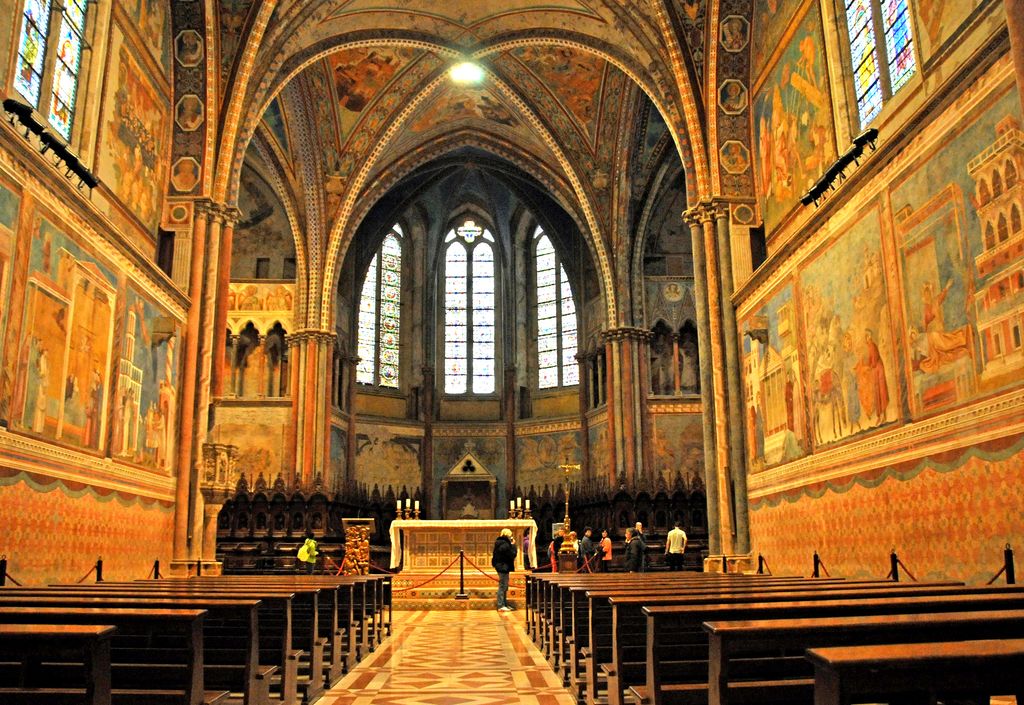
The nave of the Upper Church of San Francesco at Assisi, photographed in 2010. The Francis cycle occupies the lower narrative register; its authorship remains disputed. The photograph records the wider setting rather than an isolated scene. Dennis G. Jarvis. Image source. CC BY-SA 2.0. Proportionally reduced reproduction; original composition, colour and photographic lighting retained.
The distinction matters because the basilica accumulated paintings over generations. In the Upper Church, the Francis stories occupy the lower narrative band of the nave. Above them are Old and New Testament scenes, while the presbytery and transepts include work associated with Cimabue and the painter conventionally called the Oltremontano Master. Jacopo Torriti is among the artists connected with the upper nave decoration. [1] A visitor therefore encounters an ensemble of different projects rather than a room painted throughout by one person.
The long nave view helps explain the Francis cycle's particular presence. Painted columns and an emphatic horizontal cornice give its stories a continuous architectural setting. The episodes seem to unfold in openings along a shared structure. From across the church, that repeated framework can hold the sequence together even when individual faces and incidents are difficult to distinguish. Moving closer changes the experience: each compartment supplies its own streets, rooms, cliffs or crowds.
Downstairs, the scale and arrangement change again. A chapel devoted to Mary Magdalene asks the viewer to look around a small, irregularly interrupted space. The paintings of Christ's childhood spread through a transept. The Allegories rise over the high altar in four sections of a vault. Their positions affect their meaning: an image overhead gathers attention towards the altar, while a sequence along a nave invites movement, return and comparison. These are forms of religious attention shaped by architecture.
Francis died in 1226. His canonisation in 1228 and the transfer of his body in 1230 were subsequent, distinct events. [21] The basilica's paintings belong to the continuing construction of his public memory. They address a community already living with his example, his order and his cult. Their Francis is consequently more than the subject of an illustrated biography: he is a founder whose way of life requires interpretation and whose continuing intercession gives the shrine its purpose.
How the Upper Church tells a life
The twenty-eight scenes follow Francis from the anticipation of his vocation to miracles after his death. They begin with an Assisi citizen spreading a garment before the young man and finish with the freeing of a prisoner. Between these events come renunciation, papal approval, preaching, prayer, the stigmata, death and canonisation. The sequence carries the visitor from a saint still unrecognised by his neighbours to a figure whose power is represented as extending beyond his own lifetime.
Bonaventure's Legenda maior, or Major Legend, supplies the principal narrative framework. Its stories explain why an apparently small gesture matters. The man receiving Francis's mantle, for example, is described as a poor soldier of noble birth. Giving him clothing combines relief of poverty with the preservation of dignity. The dream of a palace full of arms then redirects the young Francis's military aspirations towards spiritual service. These adjoining episodes turn outward generosity into a sign of a vocation he has yet to understand. [21]
The paintings do not simply reproduce the book chapter by chapter. The spring miracle belongs to chapter VII, yet appears after Greccio, whose account comes in chapter X. Francis's apparition at Arles draws on chapter IV but stands late in the painted life. This arrangement allows related actions and changes of setting to produce a visual rhythm. A dream or ecstasy requires a different kind of looking from a public encounter; a scene of papal authority differs from a body pressed close to the earth.
The cycle runs around the nave rather than forming a row to be read from a single fixed position. The early episodes lead towards the entrance end, where Greccio and the spring miracle occupy the entrance wall; the birds scene continues the sequence on the return side. It is helpful to keep the episode numbers in mind, since the corners of the building interrupt the modern expectation of a continuous illustrated strip. The complete guide below follows the narrative order.
The biblical stories above establish a larger horizon for Francis's life. His poverty, preaching and wounded body invite comparison with Christ; Bonaventure also makes explicit comparisons with prophetic figures such as Moses and Elijah. [21] Yet the arrangement does not produce an uncomplicated pair of parallel biographies. Michael Viktor Schwarz stresses that the upper biblical sequences and the encircling Francis cycle do not consistently travel in the same direction. He therefore questions the assumption that the entire decorated church sprang from one unified plan. [22] The reader can recognise theological relationships without assuming that every panel has a securely established counterpart directly overhead.
Buildings that make an action visible
Architecture in the Francis scenes does more than identify an address. In the Prayer at San Damiano, the church is turned obliquely towards the viewer. Its exposed structure lets us see Francis praying inside; its broken upper portions make damage part of the image's immediate meaning. The building shelters an act of devotion while also requiring repair. The compact scene brings a kneeling body, a speaking crucifix and an endangered church into a legible relationship.
Bonaventure says that Francis initially understands the command to rebuild in a material sense, while the narrative gives it a larger meaning concerning the Church. [21] The painted ruin holds both possibilities together. A viewer can apprehend masonry and timber before considering the institution for which the building stands. The physical setting gives the theological claim something concrete to work through.
That method differs from the Renunciation of Worldly Goods, where buildings establish a public environment around a divided group. On the father's side, heads overlap and turn in different directions. The crowd's internal variety gives force to the confrontation: this is a withdrawal from possessions performed before other people. Francis's exposed body and the bishop's covering gesture then make the consequences of his decision visible. Property, family and ecclesiastical protection meet within one field.
Bonaventure's version includes the return of clothing and the renunciation of the father's inheritance before the bishop. It also gives Francis a change in the meaning of fatherhood, from earthly dependence to trust in the heavenly Father. [21] The painting's arrangement allows the legal and familial event to carry this spiritual interpretation. It does not require the viewer to imagine the young man's unrecorded private thoughts. His position, gesture and relation to the surrounding bodies do the work.
Schwarz uses such architecture and grouping in his attribution argument. He compares the ruined, opened church of San Damiano with the architectural invention of the Padua Pentecost, and the overlapping heads in the Renunciation with a group in the Padua Crucifixion. In his reading, these are signs that resources developed at Padua were being adapted at Assisi. [22] Under an earlier chronology, similar relationships can be read in the opposite direction, as stages towards Padua. The resemblance is a starting point; its historical direction is the difficult question.
This is also why the paintings should not be described as an invention of fully systematic linear perspective. Their spaces are carefully constructed to make selected actions intelligible. A room can open towards the spectator, a building can turn to accommodate a group, and the framing can suggest depth without obeying a single geometrical rule across every scene. What matters to the narrative is where a person stands, what becomes visible and how one body responds to another.
Greccio: the viewer on the other side of the screen
The Nativity at Greccio offers an unusually rich encounter between religious ceremony and pictured space. Francis kneels in the foreground beside the manger. Behind him, friars cluster around a tall bookstand, their lifted faces making collective singing a visible action. A canopy over the altar, a pulpit and the back of a painted cross occupy the upper part of the composition. The furnishings organise the bodies below them.
The cross deserves particular attention. We see its supporting structure from behind, as though standing within the choir and looking towards the area beyond the screen. An object normally encountered frontally in devotion becomes a piece of constructed wood with a particular position in a church. That reversal gives the pictured ceremony a convincing location. It also reminds us that medieval worship involved barriers, thresholds and different degrees of access.
At the doorway, women look into the scene from beyond the principal enclosed space. Their presence makes the division perceptible without cancelling their participation as witnesses. The arrangement invites the viewer to notice several kinds of attention at once: the singing friars attend to their book, Francis to the manger, the surrounding worshippers to the event. The image's coherence comes from a shared ceremony rather than from every face looking towards one point.
The basilica's detailed account identifies the scene as episode thirteen and discusses its furniture in relation to the Lower Church's historical liturgical setting. Some identifications, including the connection with a lost cross by Giunta Pisano, are scholarly reconstructions of what is represented. [23] The image offers evidence for how a late medieval church interior could be pictured, with furniture selected and combined to serve the represented ceremony.
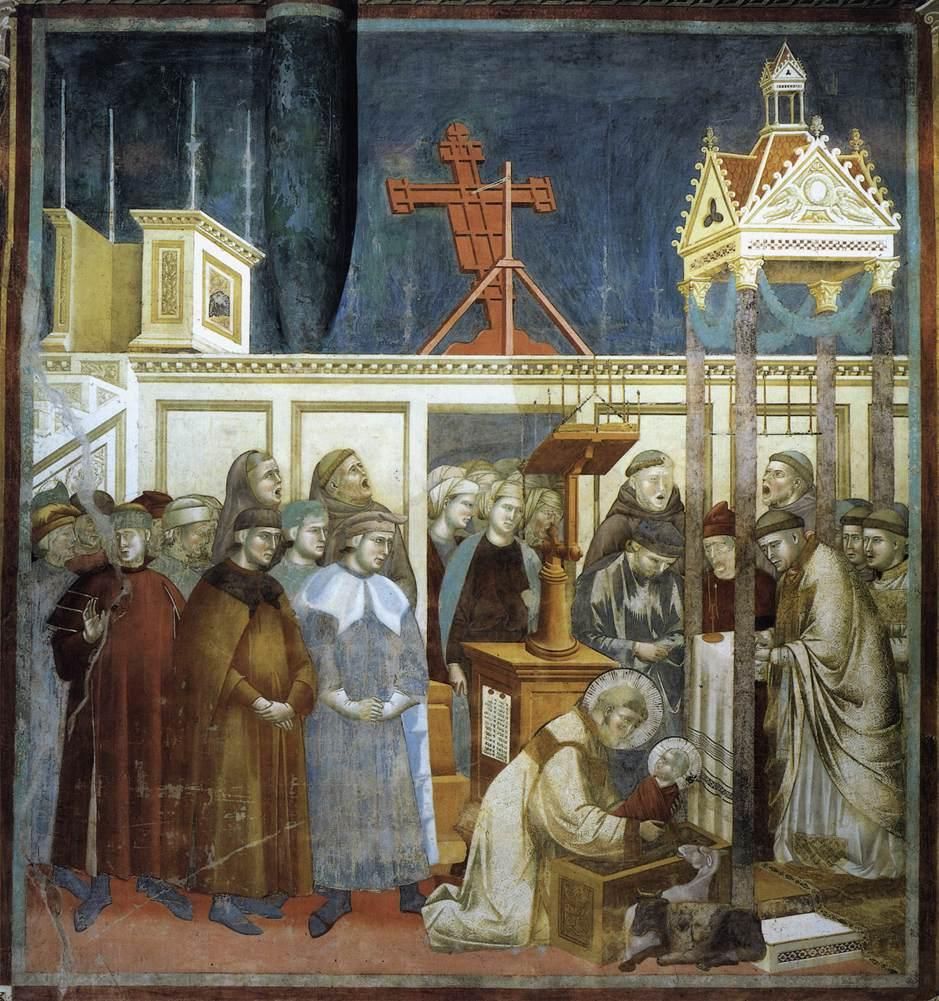
Nativity at Greccio, with the reverse of the painted cross and church furnishings. Image source. Public domain. Proportionally reduced reproduction; no colour or content enhancement.
Bonaventure describes the Christmas commemoration at Greccio through hay, manger, animals, Mass and Gospel proclamation. Francis serves as a deacon, and a knight's vision brings the Christ Child into the account. [21] The combination explains why the painting contains both an intensely focused action at the manger and the apparatus of a larger service. Calling the episode simply a Christmas play loses much of that liturgical structure.
The event also belongs within the cycle's account of Francis's devotion to the Incarnation: the humility of Christ's birth can be approached through material things, a gathered congregation and acts of worship. A modern crib may help a viewer recognise the subject, but the painted scene deserves to be read through its own choir, altar and book. These objects make the commemoration a corporate act, occurring within the religious life of the church.
Open ground, small creatures and bodily need
The Sermon to the Birds changes the scale of encounter. Francis leans forward from the left, one hand lifted towards the birds assembled near his feet. His companion stands behind him. A large tree closes the right side of the image, while open space separates the saint's gesture from the foliage above. A few birds are in flight; others form a scattered, attentive congregation on the ground.
The composition gives unusual importance to that open interval. In the papal and civic scenes, Francis must be located within a human group. Here, his bent posture, hands and downward gaze can carry the action almost alone. The birds remain small. They acquire narrative weight because his body acknowledges them. The image makes preaching recognisable without a pulpit, grand interior or audience of human dignitaries.
Bonaventure sets the episode after Francis considers whether to devote himself entirely to prayer or to go out preaching. Counsel from Clare and Silvester helps him choose the active ministry. His address to the birds concerns the gifts they receive from their Creator, and he blesses them. [21] Within that narrative, the scene joins contemplation to outward action. Its appeal to a modern concern for animals can coexist with its specific medieval account of providence and praise.
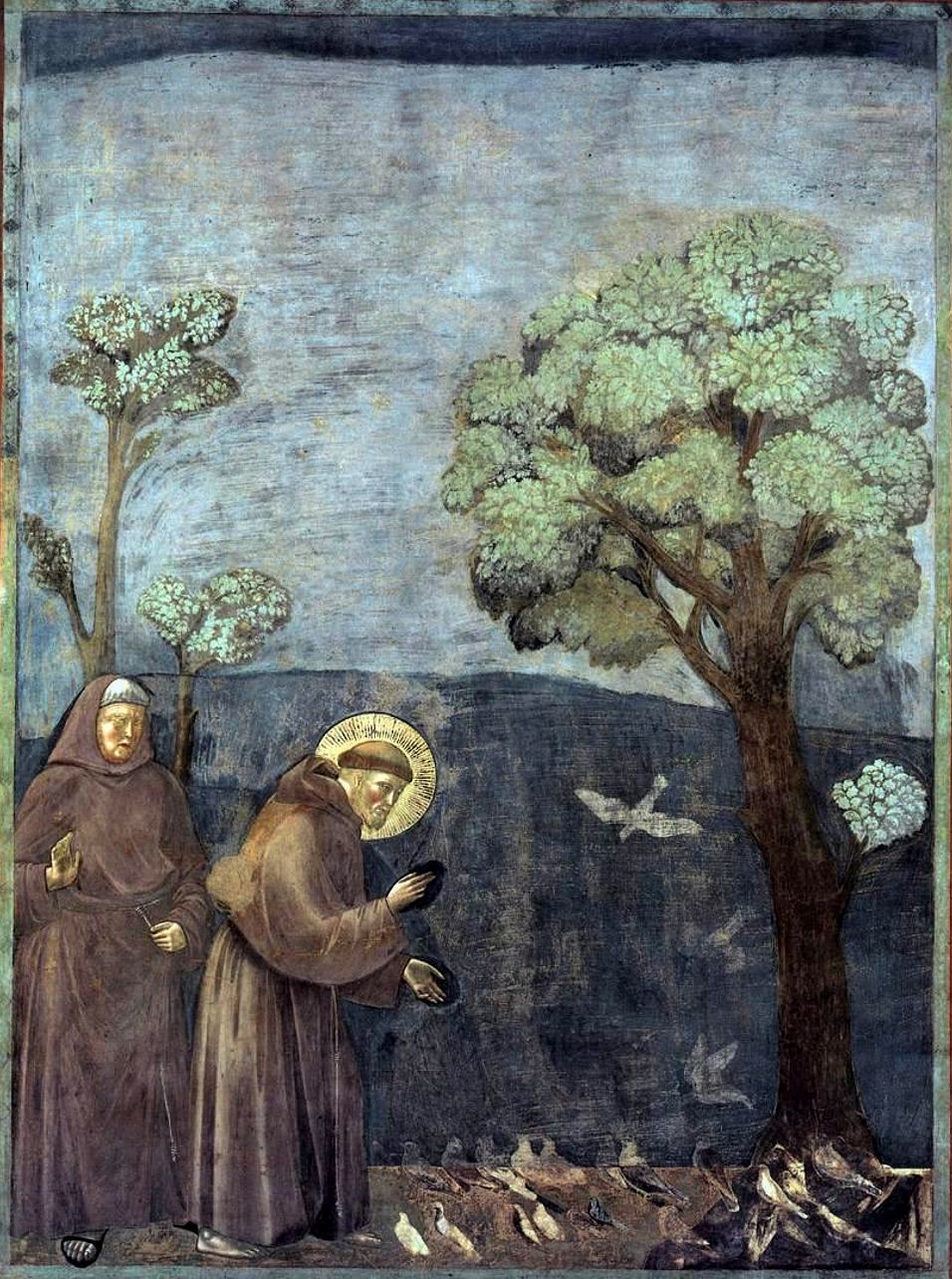
Francis preaching to the birds in Assisi’s Upper Church. Image source. Public domain. Proportionally reduced reproduction; no colour or content enhancement.
Nearby in the sequence, the Miracle of the Spring gives another kind of importance to a lowered body. The thirsty man bends close to the water at the foot of the rocks. Francis kneels above him in prayer, while companions and the cropped form of the donkey occupy the opposite side. The sharp rise of the rocky setting separates the upward appeal from the downward act of drinking. The two gestures communicate across that difference in height.
The man has lent his donkey to carry the weakened Francis. His thirst therefore belongs to a story of practical help and reciprocal care. Bonaventure explicitly compares the production of water from the rock with Moses. [21] The painted man still has to bend and drink: bodily necessity remains the means by which the miracle can be understood.
These landscapes are selective constructions. A few trees or a cleft between rocks can establish a place sufficiently for an action to unfold. The edges can crop an animal or a companion, suggesting a world continuing beyond the painted field. Their economy makes them especially useful to compare with the busier religious interiors. Across the cycle, the environment alternately gathers attention, divides witnesses or leaves a gesture room to be seen.
Witnesses, wounds and the saint after death
The final part of the cycle asks how holiness becomes known to others. Dreams and apparitions convey news across distances; bodies are inspected; crowds assemble; a pope declares sainthood. In Bonaventure's narrative, testimony is repeatedly used to defend claims about Francis. The frescoes give that concern a physical form by showing people seeing, approaching, touching or responding to what lies before them.
The Verification of the Stigmata is particularly revealing beside Greccio. Both scenes use a church interior, but the gathering around Francis's dead body is densely compressed. Heads accumulate behind the foreground action, while the body remains the centre towards which examination and attention converge. The viewer must work through a crowd rather than take in a single serenely ordered congregation.
Schwarz sees this comparison as evidence of a difference between the cycle's principal campaigns. For him, the purposeful congestion of the Verification marks a compositional approach distinct from Greccio's grouping. [22] Even without accepting his full division of painters, the comparison helps a viewer articulate what has changed. A familiar setting can support a different relationship between individuals and a mass of witnesses.
The examining knight in Bonaventure is Jerome, or Girolamo. The writer compares his previous doubt with that of Thomas, but he is not the apostle Thomas transported into Francis's story. [21] Preserving the distinction clarifies the image's argument. The saint's wounded body is being placed in relation to Christ's, and the knight's change from doubt to testimony strengthens that relation within the hagiography.
Death is also divided into several episodes. The Death and Ascension of Saint Francis represents the saint's passing and heavenly reception; the apparition to Brother Augustine and the bishop carries news beyond the deathbed; the Poor Clares' mourning belongs to the body's subsequent journey past San Damiano. These are different moments and kinds of presence. The Bardi Chapel's death scene in Florence is another painting, within another programme, and should be compared on those terms.
The posthumous miracles extend the cycle towards the needs of living believers. John of Lerida is healed after a violent attack. A woman returns from death long enough to confess and receive absolution. A prisoner is released from his bonds. These narratives concern damaged bodies, spiritual preparation and confinement. [21] Their position at the end of a life cycle explains something central about the shrine: Francis remains available as an intercessor after the historical story of his life has ended.
What can be said about Giotto's authorship?
Several different questions are often compressed into the phrase “by Giotto”. Did he conceive a programme, supply designs, organise a campaign, execute important figures or personally paint an entire scene? Could a local painter have worked from his model, or could a former collaborator have carried his methods to a new project? Each proposition requires its own evidence. Agreement that a painting is Giottesque does not settle all of them.
Early testimony gives Giotto a connection with Assisi. Riccobaldo of Ferrara, writing in the early fourteenth century, names works in the Franciscan churches of Assisi, Rimini and Padua. A 1309 record involving the Assisi painter Palmerino and a debt in Giotto's name supplies another connection. [24] [25] Neither source is a surviving contract that identifies the painter of each of the twenty-eight scenes. Their importance is real, but their precision has limits.
Later written accounts introduce further problems of interpretation. Boskovits notes that Riccobaldo's wording and Ghiberti's reference to the lower part of the church are not unambiguous identifications of the Francis cycle. Vasari explicitly names the life and deeds of Francis in the second edition of the Lives in 1568. [24] Such testimony belongs in the discussion, alongside the considerable time separating the later writers from the paintings.
The visual arguments involve connections with the upper biblical scenes at Assisi, the works at Padua and paintings associated with Roman traditions. The conventional name Isaac Master refers to an artistic personality reconstructed around the Isaac scenes in the Upper Church. Identifying that personality with the young Giotto is itself a scholarly position. It should not be used as an already proven signature from which every subsequent attribution automatically follows.
Boskovits's 2001 account defends Giotto's guiding role in the Francis cycle while recognising several painters and changes in participation. It places the principal work within a late thirteenth-century reconstruction of his career. The basilica's Greccio article gives 1290–95 for the cycle. [23] [24] These dates represent an influential early chronology, in which Assisi can precede the Scrovegni Chapel. They are useful orientation, provided the reader knows that other reconstructions challenge them.
Schwarz's 2008 argument changes the sequence substantially. Building on an earlier distinction between a more plastic and a more colourist approach, he proposes two broad campaigns, each involving several painters. He reads selected motifs as adaptations from Padua and, in the later campaign, from the orbit of Pietro Lorenzetti. He considers a first campaign around 1308, with either limited direction from Giotto or a former Padua collaborator transmitting his style; the later campaign follows on a different timetable. [22] This is a revisionist proposal, not a consensus date for all twenty-eight paintings.
The disagreement is consequential. A motif shared by Assisi and Padua might be an early invention developed later, a later adaptation of an established composition, or evidence that workshop designs circulated between projects. Merely placing the pictures side by side cannot determine which explanation is right. Technical observations about the sequence of work can help, but their interpretation must still be argued. The delayed execution of the opening scene, for instance, complicates the assumption that narrative order equals painting order.
Schwarz also distinguishes a bottega, organised around a master and training, from a cantiere, a group formed to carry out a particular project. He emphasises that actual groups could combine aspects of both. [22] At a major site such as Assisi, this distinction offers an alternative to picturing a solitary artist followed by an exactly countable set of assistants. Shared materials, local experience, designs and differing responsibilities can produce coherence without making every brushstroke the work of one person.
The Magdalene Chapel: another saint, another scale
The Magdalene Chapel lies in the Lower Church and was commissioned by Teobaldo Pontano, bishop of Assisi from 1296 to 1329. The basilica's account dates the painting to 1307–08 and associates it with Giotto and his pupils. [26] This separate campaign should not be folded into the twenty-eight scenes upstairs, even though questions of Giotto's presence, collaborators and the relationship with Padua recur.
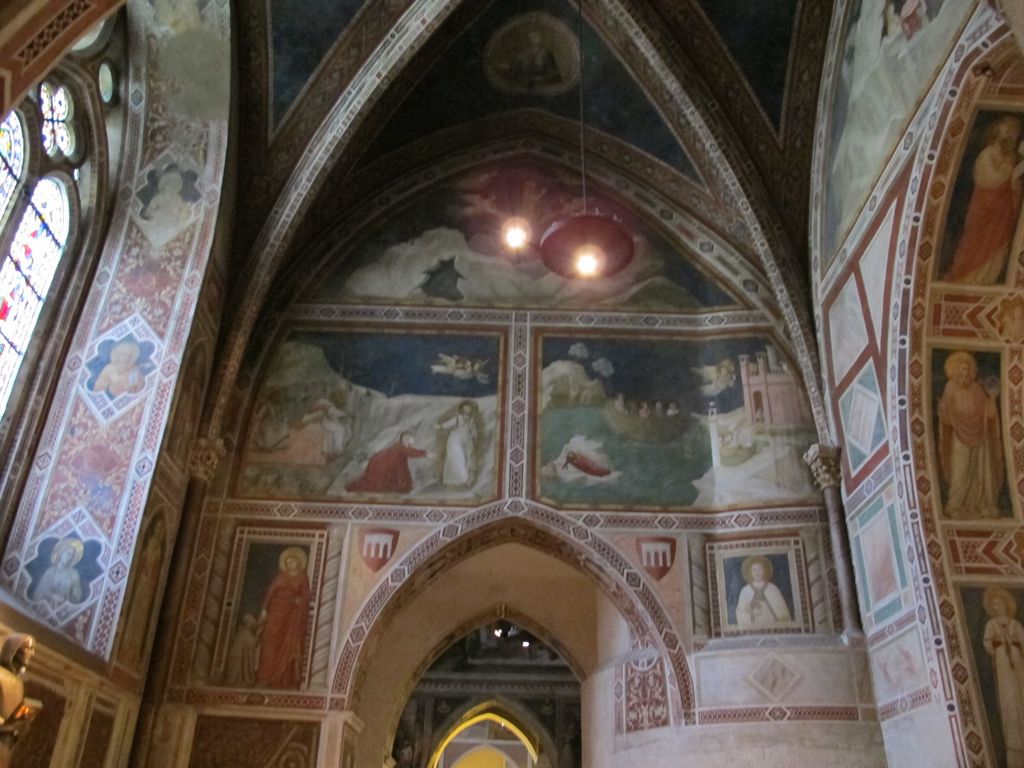
A partial Magdalene Chapel interior photographed in 2012, before its 2020–21 restoration. Sailko / Wikimedia Commons / CC BY-SA3.0. Image source. CC BY-SA 3.0. Proportionally reduced reproduction; no colour or content enhancement.
Its programme joins Gospel subjects, including the Raising of Lazarus and Noli me tangere, to the medieval legendary life of Mary Magdalene. The combination reflects the saint as understood in that devotional tradition; it is not a single continuous narrative supplied by one Gospel. The chapel's window, painted framing, saints and donor figures belong to the experience alongside the principal stories.
The architecture makes the act of looking unusually active. A doorway interrupts the wall beneath the narrative, the pointed upper fields narrow towards the vault, and painted ornament follows the ribs and openings. The figures occupy surfaces of different shapes rather than a uniform sequence of rectangular bays. A photograph taken in 2012, before the later conservation campaign, shows how Noli me tangere, the Marseille story and an upper eremitic scene share one wall around an opening. Its oblique view is especially helpful for understanding that arrangement, while remaining a record of an earlier condition.
The Raising of Lazarus gives a more focused comparison. Christ and his followers enter from the left; Lazarus stands at the right, still bound, with attendants nearby. Between them, the kneeling Magdalene brings the action towards the foreground. The spread of the figures across the field allows Christ, the supplicant and the restored brother to remain distinct centres of attention. The scene reads differently when it belongs to a chapel dedicated to Magdalene rather than solely to a life of Christ.
Schwarz develops exactly that distinction in comparing the Assisi and Padua versions. He reads the Assisi picture as giving Magdalene's appeal a particular prominence and relates it to her role as an intercessor. His broader interpretation connects pilgrimage, penitence and the bishop's memorial chapel. [27] That is a historically grounded reading of the programme's purpose; it does not require the claim that every visitor experienced the painting identically.
Schwarz also draws attention to the vault medallions of Christ, Magdalene, Martha and the risen Lazarus. Their return to the Lazarus story places resurrection above the surrounding scenes. In his reading, that choice answers the purpose of a burial chapel: the hope of being called from the grave gives the Gospel miracle a particular relevance to the donor's memorial. [27]
The donor's presence matters within this setting. A memorial chapel is a place where the living worship, the dead are remembered and saints are invoked. Images of Teobaldo before holy figures bring that relationship into view. The chapel therefore joins a public religious function with a particular person's hope for remembrance and salvation. Its carefully directed encounters between figures give those purposes a visible form.
Christ's childhood and the vows above the altar
The Lower Church's north transept introduces another substantial group associated with Giotto and his artistic environment. Scenes of Christ's childhood, the Crucifixion and Franciscan miracles occupy a programme distinct from the Magdalene Chapel. Across the sanctuary, the Passion paintings associated with Pietro Lorenzetti belong to another artistic contribution. Treating the whole area as a single uninterrupted Giotto cycle conceals the differences that make it rewarding to explore. [28]
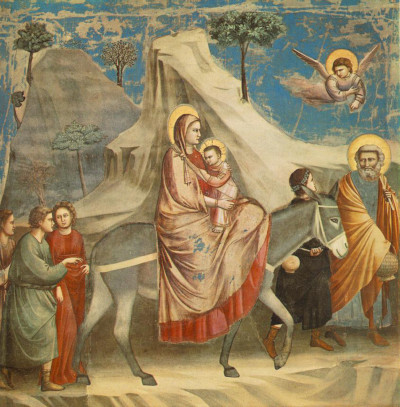
The Lower Church's Flight into Egypt is a useful example. Mary and the child occupy the donkey at the centre, with Joseph walking ahead and attendants behind. Small trees and plants punctuate a long pale ridge, while distant buildings rise at either side. The travellers extend across the breadth of the scene. Compared with the more tightly concentrated Padua version, the Assisi composition makes greater room for an inhabited landscape and the varied forms of vegetation.
Schwarz discusses these changes as part of a broad reworking of Padua's pictorial resources. He observes smaller figures in relation to the setting, an increase in detail and more extensive architectural constructions. He ultimately proposes the Giotto follower Stefano as the leading artist behind this Lower Church group and the vault paintings, while acknowledging the chain of attribution and chronological arguments involved. [28] That name is a hypothesis to weigh against other assignments, rather than a documented signature revealed by a resemblance.
Above the high altar, the Franciscan Allegories present Poverty, Chastity and Obedience, together with Francis in glory. The basilica associates the vault with Giotto and his workshop around 1315. [2] Their position gathers the order's way of life above a principal place of worship, close to the saint's burial setting. Here the viewer leaves the succession of earthly episodes for a concentrated account of vows, reward and religious identity.
The triangular vault fields ask for a different kind of composition. In Poverty, the central marriage group is surrounded by figures who occupy the widening base and the narrowing area above. Decorated ribs visibly divide the subjects, yet also bind them into a canopy. An individual panel photograph can help identify the participants, but it loses the bodily experience of looking upward at a shared vault.
The marriage of Francis and Poverty gives voluntary renunciation a memorable ceremonial image. Other figures and incidents amplify the allegory, so the scene rewards gradual reading. Schwarz relates its elaboration to the accompanying verses and to Franciscan literary traditions, while questioning a direct attribution to Giotto. [28] The painting can be read in relation to the order's values without assigning every element to an otherwise undocumented programme devised by one named adviser.
The contrast with the nave stories is instructive. The young Francis gives up clothes in a public encounter; the vault presents Poverty as a bride. The two images can illuminate one another, but they serve different formats and settings. One tells an event in a life; the other makes a chosen way of life visible through personification. Assisi's range emerges most clearly when those different forms of thinking are allowed to remain distinct.
Surviving paint, reconstruction and continuing care
The paintings encountered today have material histories as well as narrative ones. Abrasion, loss and past interventions affect the balance of colour, the legibility of faces and the relation between painted and missing areas. A faded surface can still preserve an exceptionally clear composition; a vivid reproduction can also make its colours seem more certain or uniform than the object warrants. Close looking therefore includes attention to the condition in which the work survives.
The Istituto Centrale per il Restauro has a long history of involvement at Assisi. Its institutional account records intervention on the Upper Church Francis cycle in 1941, followed by control and maintenance campaigns in 1989 and 1991. It separately records treatment of the Magdalene Chapel in 1967 and again in the 1990s. Photographs by Antonio Quattrone associated with the latter campaign preserve evidence of the painted surfaces at that stage. [29] These overlapping histories make it useful to ask when a photograph was taken, as well as which painting it shows.
The earthquake of 26 September 1997 caused collapses in parts of the Upper Church vault. Giuseppe Basile's account distinguishes the recovery and reassembly of original fragments from making replacement copies. He records the Upper Church's reopening on 29 November 1999. The hundreds of thousands of recovered fragments belong to collapsed vault areas; they should not be mistaken for the destruction of the entire twenty-eight-scene Francis cycle. [30]
Basile also discusses the impoverished surfaces of the Francis stories and sampled, non-destructive investigation undertaken with ENEA. His account of Fabio Fernetti's virtual restitution concerns hypothetical reconstructions developed from surviving traces, with unresolved areas left acknowledged. Digital work and subsequent manual finishing produced representations of a proposed earlier appearance, not conservation of the original paint. [30] Such distinctions are essential when comparing an existing fresco with an image that appears newly complete.
Care has continued through separate campaigns downstairs. In an interview published by the Sacro Convento on 22 June 2021, chief restorer Sergio Fusetti said that the Magdalene Chapel's restoration had been completed a few months earlier and that work was then underway on the presbytery vault. [31] This is a dated account of conservation history, not a statement about work currently in progress or access arrangements today.
The distinction between original surface, repair, documentary photograph and reconstruction also returns us to authorship. A face reproduced at small scale may seem decisive until its condition is understood. A broad composition may remain persuasive even where much finishing has been lost. At Assisi, both the eye and the historical record are necessary: looking can test an argument, while the record helps explain what it is possible to see.
For a first sustained reading, keep three relationships in mind. Notice how a body occupies its setting, how witnesses are gathered around an action, and how the painting's place in the church changes its purpose. The birds, the singing friars at Greccio, the crowded inspection of the wounds and the figures beneath the vault each offer a different answer. Together they make Assisi an unusually rich place to encounter the artistic world associated with Giotto, even while the identities and responsibilities of its painters remain open to debate.
The twenty-eight scenes: a complete linked guide
| No. | Scene | Narrative and point of orientation | Bonaventure locator [21] [32] |
|---|---|---|---|
| 1 | Homage of a Simple Man | An unnamed Assisi citizen spreads his garment before the young Francis, anticipating honour that Francis does not yet understand. | Major Legend I.1 |
| 2 | Gift of the Mantle | Francis clothes a poor soldier of noble birth. The act attends to both destitution and dignity. | I.2 |
| 3 | Dream of the Palace Full of Arms | A palace and cross-marked military equipment appear in a dream. Their promised service will acquire a spiritual meaning. | I.3 |
| 4 | Prayer at San Damiano | Francis hears the crucifix's command to repair the church. Physical rebuilding carries a larger ecclesial interpretation. | II.1 |
| 5 | Renunciation of Worldly Goods | Before the bishop, Francis returns property and clothing to his father. The bishop covers him. | II.4 |
| 6 | Dream of Innocent III | The pope dreams of the Lateran basilica threatened with collapse and supported by a poor man. | III.10 |
| 7 | Confirmation of the Rule | Innocent III approves Francis's way of life and preaching. This is distinct from Honorius III's later confirmation of the Rule. | III.10; compare IV.11 |
| 8 | Vision of the Flaming Chariot | Brothers see Francis in a fiery chariot while he is physically elsewhere. The narrative invokes Elijah and spiritual guidance. | IV.4 |
| 9 | Vision of the Thrones | A companion sees a heavenly throne reserved for Francis. The story contrasts the saint's humility with the pride of a fallen angel. | VI.6 |
| 10 | Expulsion of Devils from Arezzo | At Francis's command, Brother Silvester addresses the demons afflicting the city. Prayer and delegated action work together. | VI.9 |
| 11 | Trial by Fire before the Sultan | Francis proposes a test by fire. Bonaventure describes the proposal and its refusal, rather than a completed ordeal in which Francis emerges unhurt. | IX.8 |
| 12 | Ecstasy of Saint Francis | Prayer becomes visible through an uplifted body and light, with witnesses responding to a normally inward devotion. | X.4 |
| 13 | Nativity at Greccio | The Christmas commemoration brings manger, Mass, Gospel proclamation and a knight's vision into a shared liturgical event. | X.7 |
| 14 | Miracle of the Spring | The thirsty owner of the donkey carrying Francis receives water after the saint dismounts and prays. | VII.12 |
| 15 | Sermon to the Birds | Francis preaches to and blesses the birds. This is the Assisi scene; the comparative birds article also considers other versions. | XII.3 |
| 16 | Death of the Knight of Celano | Francis urges his host to prepare through confession before the knight dies at the meal. | XI.4 |
| 17 | Sermon before Pope Honorius III | A forgotten prepared sermon gives way to inspired speech before the pope and cardinals. | XII.7 |
| 18 | Apparition at the Chapter of Arles | During Anthony's preaching, Monaldo sees Francis appear with extended arms. The story describes visionary presence. | IV.10 |
| 19 | Stigmatisation at Assisi | The seraphic vision and the marks of Christ's wounds form the culmination of Francis's conformity to Christ. This is distinct from the Bardi and Louvre versions. | XIII.3 |
| 20 | Death and Ascension of Saint Francis | The deathbed and the soul's ascent belong to the Assisi cycle. The Bardi death scene is a separate Florentine work. | XIV.5–6 |
| 21 | Apparition to Brother Augustine and Bishop Guido | Two separate recipients learn of Francis's death: the dying Brother Augustine and the bishop, who is at Monte Gargano. | XIV.6 |
| 22 | Verification of the Stigmata | The doubting knight Jerome touches the wounds and becomes a witness. Bonaventure's analogy with Thomas does not make him Saint Thomas. | XV.4 |
| 23 | Mourning of the Poor Clares | The body pauses at San Damiano so that Clare and her sisters can take leave before the procession continues to Assisi. | XV.5 |
| 24 | Canonisation of Saint Francis | Gregory IX declares Francis a saint in 1228. The transfer of his body to the new basilica follows in 1230. | XV.7–8 |
| 25 | Apparition to Pope Gregory IX | A dream answers the pope's doubts about the side wound, with a vessel receiving blood. It is distinct from Innocent III's dream. | Miracles I.2 |
| 26 | Healing of John of Lerida | A man attacked through mistaken identity receives Francis's healing intervention at his bedside. | I.5 |
| 27 | Resurrection of a Woman | A woman returns long enough to confess and receive absolution, then dies again. The miracle concerns preparation for salvation. | II.1 |
| 28 | Liberation of the Prisoner Peter | A prisoner accused of heresy is released from his chains; the bishop witnesses the result. | V.4 |
Watch: Explore Giotto’s Art
Choose an overview or a closer look at three major works. These films provide wider Giotto context alongside this article.
Artworks directory
This directory brings together 209 records for paintings, ensembles, individual scenes and components, architectural work, an associated disputed design, and reported or lost projects connected with Giotto. Ensembles and their parts appear separately, so 209 is a count of records rather than independent paintings or commissions. Attributions and dates remain qualified where disputed; inclusion does not establish Giotto’s own hand throughout.
| Name | Date | Medium, attribution and status |
|---|---|---|
| Expulsion of Joachim from the Temple — Scrovegni Chapel, Padua | c.1303–05 (chapel campaign) | Fresco / wall painting. Giotto and workshop. Scene within a cycle. Padova Musei. Chapel overview. |
| Joachim among the Shepherds — Scrovegni Chapel, Padua | c.1303–05 (chapel campaign) | Fresco / wall painting. Giotto and workshop. Scene within a cycle. Padova Musei. Chapel overview. |
| Annunciation to Saint Anne — Scrovegni Chapel, Padua | c.1303–05 (chapel campaign) | Fresco / wall painting. Giotto and workshop. Scene within a cycle. Padova Musei. Chapel overview. |
| Sacrifice of Joachim — Scrovegni Chapel, Padua | c.1303–05 (chapel campaign) | Fresco / wall painting. Giotto and workshop. Scene within a cycle. Padova Musei. Chapel overview. |
| Joachim’s Dream — Scrovegni Chapel, Padua | c.1303–05 (chapel campaign) | Fresco / wall painting. Giotto and workshop. Scene within a cycle. Padova Musei. Padova Musei. Chapel overview. |
| Meeting at the Golden Gate — Scrovegni Chapel, Padua | c.1303–05 (chapel campaign) | Fresco / wall painting. Giotto and workshop. Scene within a cycle. Padova Musei. Chapel overview. |
| Birth of the Virgin — Scrovegni Chapel, Padua | c.1303–05 (chapel campaign) | Fresco / wall painting. Giotto and workshop. Scene within a cycle. Padova Musei. Padova Musei. Chapel overview. |
| Presentation of the Virgin in the Temple — Scrovegni Chapel, Padua | c.1303–05 (chapel campaign) | Fresco / wall painting. Giotto and workshop. Scene within a cycle. Padova Musei. Chapel overview. |
| Delivery of the Rods — Scrovegni Chapel, Padua | c.1303–05 (chapel campaign) | Fresco / wall painting. Giotto and workshop. Scene within a cycle. Padova Musei. Chapel overview. |
| Prayer of Joseph and the Suitors — Scrovegni Chapel, Padua | c.1303–05 (chapel campaign) | Fresco / wall painting. Giotto and workshop. Scene within a cycle. Padova Musei. Chapel overview. |
| Marriage of the Virgin — Scrovegni Chapel, Padua | c.1303–05 (chapel campaign) | Fresco / wall painting. Giotto and workshop. Scene within a cycle. Padova Musei. Chapel overview. |
| Wedding Procession of Mary — Scrovegni Chapel, Padua | c.1303–05 (chapel campaign) | Fresco / wall painting. Giotto and workshop. Scene within a cycle. Padova Musei. Chapel overview. |
| Annunciation on the triumphal arch — complete ensemble (Scrovegni Chapel, Padua) | c.1303–05 (chapel campaign) | Wall painting with a central painted wooden panel. Giotto and workshop. Ensemble. Includes the Mission of Gabriel and the lower Annunciation pair; the original central wooden panel is in the Musei Civici agli Eremitani, with a conservation copy in the chapel. Padova Musei. Padova Musei. Scholarly study. Chapel overview. |
| Visitation — Scrovegni Chapel, Padua | c.1303–05 (chapel campaign) | Fresco / wall painting. Giotto and workshop. Scene within a cycle. Padova Musei. Chapel overview. |
| Nativity — Scrovegni Chapel, Padua | c.1303–05 (chapel campaign) | Fresco / wall painting. Giotto and workshop. Scene within a cycle. Padova Musei. Chapel overview. |
| Adoration of the Magi — Scrovegni Chapel, Padua | c.1303–05 (chapel campaign) | Fresco / wall painting. Giotto and workshop. Scene within a cycle. Padova Musei. Chapel overview. |
| Presentation of Christ at the Temple — Scrovegni Chapel, Padua | c.1303–05 (chapel campaign) | Fresco / wall painting. Giotto and workshop. Scene within a cycle. Padova Musei. Chapel overview. |
| Flight into Egypt — Scrovegni Chapel, Padua | c.1303–05 (chapel campaign) | Fresco / wall painting. Giotto and workshop. Scene within a cycle. Padova Musei. Chapel overview. |
| Massacre of the Innocents — Scrovegni Chapel, Padua | c.1303–05 (chapel campaign) | Fresco / wall painting. Giotto and workshop. Scene within a cycle. Padova Musei. Chapel overview. |
| Christ among the Doctors — Scrovegni Chapel, Padua | c.1303–05 (chapel campaign) | Fresco / wall painting. Giotto and workshop. Scene within a cycle. Padova Musei. Chapel overview. |
| Baptism of Christ — Scrovegni Chapel, Padua | c.1303–05 (chapel campaign) | Fresco / wall painting. Giotto and workshop. Scene within a cycle. Padova Musei. Chapel overview. |
| Marriage at Cana — Scrovegni Chapel, Padua | c.1303–05 (chapel campaign) | Fresco / wall painting. Giotto and workshop. Scene within a cycle. Padova Musei. Padova Musei. Chapel overview. |
| Raising of Lazarus — Scrovegni Chapel, Padua | c.1303–05 (chapel campaign) | Fresco / wall painting. Giotto and workshop. Scene within a cycle. Padova Musei. Chapel overview. |
| Entry into Jerusalem — Scrovegni Chapel, Padua | c.1303–05 (chapel campaign) | Fresco / wall painting. Giotto and workshop. Scene within a cycle. Padova Musei. Chapel overview. |
| Expulsion of the Money Changers — Scrovegni Chapel, Padua | c.1303–05 (chapel campaign) | Fresco / wall painting. Giotto and workshop. Scene within a cycle. Padova Musei. Padova Musei. Chapel overview. |
| Judas Receiving the Payment — Scrovegni Chapel, Padua | c.1303–05 (chapel campaign) | Fresco / wall painting. Giotto and workshop. Scene within a cycle. Padova Musei. Chapel overview. |
| Last Supper — Scrovegni Chapel, Padua | c.1303–05 (chapel campaign) | Fresco / wall painting. Giotto and workshop. Scene within a cycle. Padova Musei. Chapel overview. |
| Washing of the Feet — Scrovegni Chapel, Padua | c.1303–05 (chapel campaign) | Fresco / wall painting. Giotto and workshop. Scene within a cycle. Padova Musei. Chapel overview. |
| Arrest of Christ — Scrovegni Chapel, Padua | c.1303–05 (chapel campaign) | Fresco / wall painting. Giotto and workshop. Scene within a cycle. Padova Musei. Chapel overview. |
| Christ before Annas and Caiaphas — Scrovegni Chapel, Padua | c.1303–05 (chapel campaign) | Fresco / wall painting. Giotto and workshop. Scene within a cycle. Padova Musei. Chapel overview. |
| Mocking of Christ and Flagellation — Scrovegni Chapel, Padua | c.1303–05 (chapel campaign) | Fresco / wall painting. Giotto and workshop. Scene within a cycle. Padova Musei. Chapel overview. |
| Road to Calvary — Scrovegni Chapel, Padua | c.1303–05 (chapel campaign) | Fresco / wall painting. Giotto and workshop. Scene within a cycle. Padova Musei. Chapel overview. |
| Crucifixion — Scrovegni Chapel, Padua | c.1303–05 (chapel campaign) | Fresco / wall painting. Giotto and workshop. Scene within a cycle. Padova Musei. Chapel overview. |
| Lamentation — Scrovegni Chapel, Padua | c.1303–05 (chapel campaign) | Fresco / wall painting. Giotto and workshop. Scene within a cycle. Padova Musei. Chapel overview. |
| Resurrection / Noli me tangere — Scrovegni Chapel, Padua | c.1303–05 (chapel campaign) | Fresco / wall painting. Giotto and workshop. Scene within a cycle. Padova Musei. Chapel overview. |
| Ascension — Scrovegni Chapel, Padua | c.1303–05 (chapel campaign) | Fresco / wall painting. Giotto and workshop. Scene within a cycle. Padova Musei. Chapel overview. |
| Pentecost — Scrovegni Chapel, Padua | c.1303–05 (chapel campaign) | Fresco / wall painting. Giotto and workshop. Scene within a cycle. Padova Musei. Padova Musei. Chapel overview. |
| Coretto — right painted recess (Scrovegni Chapel, Padua) | c.1303–05 (chapel campaign) | Fresco / painted fictive architecture. Giotto and workshop. Ensemble component. Padova Musei. Padova Musei. Scholarly study. Chapel overview. |
| Coretto — left painted recess (Scrovegni Chapel, Padua) | c.1303–05 (chapel campaign) | Fresco / painted fictive architecture. Giotto and workshop. Ensemble component. Padova Musei. Padova Musei. Scholarly study. Chapel overview. |
| Envy — Scrovegni Chapel, Padua | c.1303–05 (chapel campaign) | Grisaille fresco / wall painting. Giotto and workshop. Ensemble component. Padova Musei. Chapel overview. Scholarly study. Padova Musei. |
| Despair — Scrovegni Chapel, Padua | c.1303–05 (chapel campaign) | Grisaille fresco / wall painting. Giotto and workshop. Ensemble component. Padova Musei. Chapel overview. Scholarly study. Padova Musei. |
| Prudence — Scrovegni Chapel, Padua | c.1303–05 (chapel campaign) | Grisaille fresco / wall painting. Giotto and workshop. Ensemble component. Padova Musei. Chapel overview. Scholarly study. Padova Musei. |
| Fortitude — Scrovegni Chapel, Padua | c.1303–05 (chapel campaign) | Grisaille fresco / wall painting. Giotto and workshop. Ensemble component. Padova Musei. Chapel overview. Scholarly study. Padova Musei. |
| Temperance — Scrovegni Chapel, Padua | c.1303–05 (chapel campaign) | Grisaille fresco / wall painting. Giotto and workshop. Ensemble component. Padova Musei. Chapel overview. Scholarly study. Padova Musei. |
| Justice — Scrovegni Chapel, Padua | c.1303–05 (chapel campaign) | Grisaille fresco / wall painting. Giotto and workshop. Ensemble component. Padova Musei. Chapel overview. Scholarly study. Padova Musei. |
| Faith — Scrovegni Chapel, Padua | c.1303–05 (chapel campaign) | Grisaille fresco / wall painting. Giotto and workshop. Ensemble component. Padova Musei. Chapel overview. Scholarly study. Padova Musei. |
| Charity — Scrovegni Chapel, Padua | c.1303–05 (chapel campaign) | Grisaille fresco / wall painting. Giotto and workshop. Ensemble component. Padova Musei. Chapel overview. Scholarly study. Padova Musei. |
| Hope — Scrovegni Chapel, Padua | c.1303–05 (chapel campaign) | Grisaille fresco / wall painting. Giotto and workshop. Ensemble component. Padova Musei. Chapel overview. Scholarly study. Padova Musei. |
| Folly — Scrovegni Chapel, Padua | c.1303–05 (chapel campaign) | Grisaille fresco / wall painting. Giotto and workshop. Ensemble component. Padova Musei. Chapel overview. Scholarly study. Padova Musei. |
| Inconstancy — Scrovegni Chapel, Padua | c.1303–05 (chapel campaign) | Grisaille fresco / wall painting. Giotto and workshop. Ensemble component. Padova Musei. Chapel overview. Scholarly study. Padova Musei. |
| Wrath — Scrovegni Chapel, Padua | c.1303–05 (chapel campaign) | Grisaille fresco / wall painting. Giotto and workshop. Ensemble component. Padova Musei. Chapel overview. Scholarly study. Padova Musei. |
| Injustice — Scrovegni Chapel, Padua | c.1303–05 (chapel campaign) | Grisaille fresco / wall painting. Giotto and workshop. Ensemble component. Padova Musei. Chapel overview. Scholarly study. Padova Musei. |
| Infidelity / Idolatry — Scrovegni Chapel, Padua | c.1303–05 (chapel campaign) | Grisaille fresco / wall painting. Giotto and workshop. Ensemble component. Padova Musei. Chapel overview. Scholarly study. Padova Musei. |
| Starry vault — complete ensemble (Scrovegni Chapel, Padua) | c.1303–05 (chapel campaign) | Vault painting. Giotto and workshop. Ensemble. Padova Musei. Padova Musei. Chapel overview. |
| Last Judgement — Scrovegni Chapel, Padua | c.1303–05 (chapel campaign) | Fresco / wall painting. Giotto and workshop. Scene within a cycle. Padova Musei. Padova Musei. Chapel overview. Padova Musei. |
| Prophet Malachi — vault medallion — Scrovegni Chapel, Padua | c.1303–05 (chapel campaign) | Fresco / wall painting. Giotto and workshop. Ensemble component. Padova Musei. Padova Musei. Chapel overview. Padova Musei. |
| Prophet Baruch — vault medallion — Scrovegni Chapel, Padua | c.1303–05 (chapel campaign) | Fresco / wall painting. Giotto and workshop. Ensemble component. Padova Musei. Padova Musei. Chapel overview. Padova Musei. |
| Prophet Isaiah — vault medallion — Scrovegni Chapel, Padua | c.1303–05 (chapel campaign) | Fresco / wall painting. Giotto and workshop. Ensemble component. Padova Musei. Padova Musei. Chapel overview. Padova Musei. |
| Prophet Daniel — vault medallion — Scrovegni Chapel, Padua | c.1303–05 (chapel campaign) | Fresco / wall painting. Giotto and workshop. Ensemble component. Padova Musei. Padova Musei. Chapel overview. Padova Musei. |
| Christ Pantocrator — vault medallion — Scrovegni Chapel, Padua | c.1303–05 (chapel campaign) | Fresco / wall painting. Giotto and workshop. Ensemble component. Padova Musei. Padova Musei. Chapel overview. Padova Musei. |
| Virgin and Child — vault medallion — Scrovegni Chapel, Padua | c.1303–05 (chapel campaign) | Fresco / wall painting. Giotto and workshop. Ensemble component. Padova Musei. Padova Musei. Chapel overview. Padova Musei. |
| Prophet Ezekiel — vault medallion — Scrovegni Chapel, Padua | c.1303–05 (chapel campaign) | Fresco / wall painting. Giotto and workshop. Ensemble component. Padova Musei. Padova Musei. Chapel overview. Padova Musei. |
| Prophet Micah — vault medallion — Scrovegni Chapel, Padua | c.1303–05 (chapel campaign) | Fresco / wall painting. Giotto and workshop. Ensemble component. Padova Musei. Padova Musei. Chapel overview. Padova Musei. |
| Saint John the Baptist — vault medallion — Scrovegni Chapel, Padua | c.1303–05 (chapel campaign) | Fresco / wall painting. Giotto and workshop. Ensemble component. Padova Musei. Padova Musei. Chapel overview. Padova Musei. |
| Scrovegni Chapel — painted decoration | c.1303–05 (chapel campaign) | Fresco / wall painting, with a painted wooden panel. Giotto and workshop (painted decoration). Ensemble. Includes separately listed scenes and components. The original central God the Father panel is in the Musei Civici agli Eremitani; a conservation copy is in the chapel. Chapel overview. Padova Musei. Padova Musei. Source. Source. Source. Padova Musei. Scholarly study. |
| Vices and Virtues — complete fourteen-figure programme | c.1303–05 (chapel campaign) | Grisaille fresco / wall painting. Giotto and workshop. Ensemble. Fourteen figures: seven virtues and seven opposed vices. Padova Musei. Chapel overview. Scholarly study. |
| Coretti — paired fictive chapels | c.1303–05 (chapel campaign) | Fresco / painted fictive architecture. Giotto and workshop. Ensemble. Two separate painted recesses, also listed individually. Padova Musei. Padova Musei. Scholarly study. |
| Mission of Gabriel — heavenly assembly | c.1303–05 (chapel campaign) | Wall painting with central painted wooden image. Giotto and workshop. Ensemble component. Central wooden God the Father panel preserved at the Musei Civici agli Eremitani; conservation copy in the chapel. Chapel overview. Padova Musei. Scholarly study. Padova Musei. |
| Annunciation — Gabriel and Mary in facing chambers | c.1303–05 (chapel campaign) | Fresco / wall painting. Giotto and workshop. Ensemble component. Chapel overview. Scholarly study. Padova Musei. |
| God the Father — central wooden panel of the Mission of Gabriel | c.1303–05 (chapel campaign) | Painting on wood. Associated with Giotto. Ensemble component. Original at the Musei Civici agli Eremitani, Padua; conservation copy in the Scrovegni Chapel. Padova Musei. Padova Musei. Scholarly study. Source. |
| Life of Saint Francis — Upper Church cycle, Assisi | Late 13th–early 14th century; dating disputed | Fresco / wall-painting cycle. Traditionally associated with Giotto; Giotto, Roman-school and other attributions disputed. Ensemble. Twenty-eight-scene nave cycle; scenes also listed individually. Basilica catalogue. Scholarly study. Basilica catalogue. Source. Source. |
| Homage of a Simple Man — Upper Church, Assisi | Late 13th–early 14th century; dating disputed | Wall painting. Traditionally associated with Giotto; authorship and dating disputed. Scene within a cycle. Source. Scholarly study. Source. Source. Source. |
| Gift of the Mantle — Upper Church, Assisi | Late 13th–early 14th century; dating disputed | Wall painting. Traditionally associated with Giotto; authorship and dating disputed. Scene within a cycle. Basilica catalogue. Scholarly study. Source. Source. Source. |
| Dream of the Palace Full of Arms — Upper Church, Assisi | Late 13th–early 14th century; dating disputed | Wall painting. Traditionally associated with Giotto; authorship and dating disputed. Scene within a cycle. Basilica catalogue. Source. Scholarly study. Source. Source. Source. |
| Prayer before the Crucifix at San Damiano — Upper Church, Assisi | Late 13th–early 14th century; dating disputed | Wall painting. Traditionally associated with Giotto; authorship and dating disputed. Scene within a cycle. Source. Source. Source. Scholarly study. Source. Source. |
| Renunciation of Worldly Goods — Upper Church, Assisi | Late 13th–early 14th century; dating disputed | Wall painting. Traditionally associated with Giotto; authorship and dating disputed. Scene within a cycle. Source. Scholarly study. Source. Source. |
| Dream of Innocent III — Upper Church, Assisi | Late 13th–early 14th century; dating disputed | Wall painting. Traditionally associated with Giotto; authorship and dating disputed. Scene within a cycle. Source. Source. Scholarly study. Source. Source. |
| Confirmation of the Rule — Upper Church, Assisi | Late 13th–early 14th century; dating disputed | Wall painting. Traditionally associated with Giotto; authorship and dating disputed. Scene within a cycle. Source. Scholarly study. Source. Source. |
| Vision of the Flaming Chariot — Upper Church, Assisi | Late 13th–early 14th century; dating disputed | Wall painting. Traditionally associated with Giotto; authorship and dating disputed. Scene within a cycle. Source. Source. Scholarly study. Source. Source. |
| Vision of the Thrones — Upper Church, Assisi | Late 13th–early 14th century; dating disputed | Wall painting. Traditionally associated with Giotto; authorship and dating disputed. Scene within a cycle. Basilica catalogue. Scholarly study. Source. Source. Source. |
| Expulsion of Devils from Arezzo — Upper Church, Assisi | Late 13th–early 14th century; dating disputed | Wall painting. Traditionally associated with Giotto; authorship and dating disputed. Scene within a cycle. Source. Source. Scholarly study. Source. Source. Source. |
| Trial by Fire before the Sultan — Upper Church, Assisi | Late 13th–early 14th century; dating disputed | Wall painting. Traditionally associated with Giotto; authorship and dating disputed. Scene within a cycle. Source. Source. Scholarly study. Source. Source. |
| Ecstasy of Saint Francis — Upper Church, Assisi | Late 13th–early 14th century; dating disputed | Wall painting. Traditionally associated with Giotto; authorship and dating disputed. Scene within a cycle. Source. Source. Source. Scholarly study. Source. Source. |
| Nativity at Greccio — Upper Church, Assisi | Late 13th–early 14th century; dating disputed | Wall painting. Traditionally associated with Giotto; authorship and dating disputed. Scene within a cycle. Basilica catalogue. Scholarly study. Source. Source. Source. |
| Miracle of the Spring — Upper Church, Assisi | Late 13th–early 14th century; dating disputed | Wall painting. Traditionally associated with Giotto; authorship and dating disputed. Scene within a cycle. Source. Scholarly study. Source. Source. Source. |
| Sermon to the Birds — Upper Church, Assisi | Late 13th–early 14th century; dating disputed | Wall painting. Traditionally associated with Giotto; authorship and dating disputed. Scene within a cycle. Basilica catalogue. Scholarly study. Source. Source. Source. |
| Death of the Knight of Celano — Upper Church, Assisi | Late 13th–early 14th century; dating disputed | Wall painting. Traditionally associated with Giotto; authorship and dating disputed. Scene within a cycle. Source. Source. Scholarly study. Source. Source. |
| Sermon before Pope Honorius III — Upper Church, Assisi | Late 13th–early 14th century; dating disputed | Wall painting. Traditionally associated with Giotto; authorship and dating disputed. Scene within a cycle. Source. Source. Scholarly study. Source. |
| Apparition at the Chapter of Arles — Upper Church, Assisi | Late 13th–early 14th century; dating disputed | Wall painting. Traditionally associated with Giotto; authorship and dating disputed. Scene within a cycle. Basilica catalogue. Scholarly study. Source. Source. Source. |
| Stigmatisation — Upper Church, Assisi | Late 13th–early 14th century; dating disputed | Wall painting. Traditionally associated with Giotto; authorship and dating disputed. Scene within a cycle. Source. Scholarly study. Source. Source. |
| Death and Ascension of Saint Francis — Upper Church, Assisi | Late 13th–early 14th century; dating disputed | Wall painting. Traditionally associated with Giotto; authorship and dating disputed. Scene within a cycle. Basilica catalogue. Scholarly study. Source. Source. Source. |
| Apparition to Brother Augustine and Bishop Guido — Upper Church, Assisi | Late 13th–early 14th century; dating disputed | Wall painting. Traditionally associated with Giotto; authorship and dating disputed. Scene within a cycle. Zeri catalogue. Scholarly study. Source. Source. Source. |
| Verification of the Stigmata — Upper Church, Assisi | Late 13th–early 14th century; dating disputed | Wall painting. Traditionally associated with Giotto; authorship and dating disputed. Scene within a cycle. Source. Source. Scholarly study. Source. Source. |
| Mourning of the Poor Clares — Upper Church, Assisi | Late 13th–early 14th century; dating disputed | Wall painting. Traditionally associated with Giotto; authorship and dating disputed. Scene within a cycle. Basilica catalogue. Source. Scholarly study. Source. Source. |
| Canonisation of Saint Francis — Upper Church, Assisi | Late 13th–early 14th century; dating disputed | Wall painting. Traditionally associated with Giotto; authorship and dating disputed. Scene within a cycle. Source. Source. Scholarly study. Source. Source. Source. |
| Apparition to Pope Gregory IX — Upper Church, Assisi | Late 13th–early 14th century; dating disputed | Wall painting. Traditionally associated with Giotto; authorship and dating disputed. Scene within a cycle. Zeri catalogue. Scholarly study. Source. Source. Source. |
| Healing of John of Lerida — Upper Church, Assisi | Late 13th–early 14th century; dating disputed | Wall painting. Traditionally associated with Giotto; authorship and dating disputed. Scene within a cycle. Source. Source. Scholarly study. Source. Source. |
| Resurrection of a Woman — Upper Church, Assisi | Late 13th–early 14th century; dating disputed | Wall painting. Traditionally associated with Giotto; authorship and dating disputed. Scene within a cycle. Source. Scholarly study. Source. Source. Source. |
| Liberation of the Prisoner Peter — Upper Church, Assisi | Late 13th–early 14th century; dating disputed | Wall painting. Traditionally associated with Giotto; authorship and dating disputed. Scene within a cycle. Source. Source. Scholarly study. Source. Source. Source. |
| Santa Maria Novella Crucifix | Late 13th century; c.1288–89 or 1298–1301; disputed | Tempera and gold on a shaped wooden cross. Giotto. Source. |
| Death of the Virgin / Dormition — Berlin | c.1310 | Tempera and gold on poplar; gabled dossal. Giotto. Source. Source. |
| Peruzzi Altarpiece | c.1311–1315 (North Carolina Museum of Art) | Tempera and gold on panel. Giotto and workshop. Ensemble. Source. |
| Bologna Polyptych | c.1330 | Tempera and gold on panel. Giotto and workshop. Ensemble. Source. |
| Death of Saint Francis, Bardi Chapel | After 1317, usually the 1320s; disputed | Wall painting with wet-plaster and dry-applied passages. Giotto. Scene within a cycle. Source. |
| Bardi Chapel — painted decoration | After 1317, usually the 1320s; disputed | Wall painting with wet-plaster and dry-applied passages. Giotto and workshop / Giottesque painters; individual hands disputed. Ensemble. Scholarly study. Source. |
| Badia Polyptych | c.1300; proposed dates include 1295–1300 and 1301–02 | Tempera and gold on panel; five cusped compartments. Giotto. Ensemble. Scholarly study. Source. Source. |
| Baroncelli Polyptych | After 1328; detached pinnacle c.1328–35 | Tempera and gold on panel; later altered framing. Giotto and workshop. Ensemble. Detached central pinnacle in San Diego. Santa Croce. |
| Adoration of the Magi / Epiphany — Metropolitan Museum panel | Possibly c.1320; c.1310–18 also proposed for the group | Tempera and gold on wood. Giotto. Part of the dispersed seven-scene board; original function disputed. Met catalogue. Source. |
| Franciscan Allegories | Early 14th century, often c.1315; disputed | Vault wall painting. Giotto and workshop / Giottesque painters; individual hands disputed. Ensemble. Basilica catalogue. |
| Navicella — lost / reworked original mosaic | Late 13th–early 14th century; date disputed | Mosaic. Original attributed to Giotto. Original lost / reworked; fragments and later remakes survive. Scholarly study. |
| Pentecost — London panel | Possibly c.1310–18 (Gordon) | Egg tempera on poplar. Giotto and workshop. Part of the dispersed seven-scene board; original function disputed. National Gallery. Source. |
| Saint Stephen — Horne panel | c.1330–1335 (Museo Horne) | Tempera and gold on panel. Giotto. Proposed association with the Washington and Chaalis panels remains hypothetical. Source. |
| Saint Francis Receiving the Stigmata — Louvre altarpiece | 1300–25 (Louvre) | Tempera and gold on poplar. Giotto. Louvre catalogue. |
| Stefaneschi Triptych | c.1320; 1315–20 (Vatican Museums) | Tempera and gold on panel; painted on both sides. Giotto and workshop. Ensemble. Vatican Museums. |
| Crucifixion, Berlin | c.1315–1320 | Tempera and gold on poplar. Giotto. Source. |
| Madonna and Child — Washington / Goldman Madonna | c.1310–1315 (National Gallery of Art) | Tempera and gold on poplar. Giotto. Washington panel, distinct from San Giorgio alla Costa; proposed Horne/Chaalis companions remain hypothetical. NGA catalogue. |
| Ognissanti Madonna | c.1300–05 (Uffizi); c.1310 also proposed | Tempera and gold on panel. Giotto. Uffizi. |
| Madonna of Borgo San Lorenzo | c.1290–95; dating and attribution debated | Tempera and gold on a fragment of a wooden panel. Giotto. Fragmentary. Source. |
| Madonna of San Giorgio alla Costa | c.1288–95 (Opera del Duomo); later dates also proposed | Tempera and gold on panel; cut edges. Giotto. Damaged in 1993 and treated in 1995. Source. |
| Magdalene Chapel — painted decoration | c.1307–08 (basilica); disputed | Wall painting with wet-plaster and dry-applied passages. Giotto and workshop / Giottesque painters; individual hands disputed. Ensemble. Basilica catalogue. |
| Ognissanti Crucifix | c.1315–1320 (Opificio) | Painting on a shaped wooden cross. Giotto and workshop. Workshop participation and alternative attributions debated. Source. |
| Padua Crucifix | c.1303–05 (Zeri catalogue) | Tempera and gold on a shaped wooden cross. Giotto. Zeri catalogue. |
| Peruzzi Chapel — painted decoration | c.1310–11 (Santa Croce); 1334–36 proposed by Schwarz | Wall painting with substantial dry-applied work and loss. Giotto and workshop / Giottesque painters; individual hands disputed. Ensemble. Santa Croce. |
| Rimini Crucifix | c.1300; late 13th century also proposed | Tempera and gold on a shaped wooden cross. Giotto. Source. |
| Giotto’s Campanile — Florence Cathedral bell tower | Begun 1334; completed 1359 under successors | Marble-clad masonry bell tower. Begun under Giotto; continued by Andrea Pisano and Francesco Talenti. Successive building and sculptural campaigns. Source. Scholarly study. Scholarly study. |
| Tower elevation on parchment, Siena — disputed relation to Giotto | 14th century; date and design context disputed | Brown ink and coloured washes over incised construction on three parchment skins. Attribution disputed; possibly a Giotto design transmitted through another hand. Associated design; autograph attribution unestablished. Alternative attributions include Lando di Pietro. Scholarly study. Source. Source. |
| Seven scenes of Christ — dispersed painted board | Possibly c.1310–18 (Gordon); component dates vary | Tempera and gold on a single wooden board, subsequently divided. Giotto and workshop; individual attributions vary. Reconstructed dispersed ensemble. Common board supported by matching wood grain; predella or dossal function disputed. Source. Source. |
| Presentation of Christ at the Temple — Boston panel | Possibly c.1310–18 (Gordon’s group dating) | Tempera and gold on wood. Giotto and workshop; individual attribution varies within the group. Ensemble component. Source. Source. |
| Last Supper — Munich panel | Possibly c.1310–18 (Gordon’s group dating) | Tempera and gold on wood. Giotto and workshop; individual attribution varies within the group. Ensemble component. Source. Source. Source. |
| Crucifixion — Munich panel | Possibly c.1310–18 (Gordon’s group dating) | Tempera and gold on wood. Giotto and workshop; individual attribution varies within the group. Ensemble component. Source. Source. Source. |
| Descent into Limbo — Munich panel | Possibly c.1310–18 (Gordon’s group dating) | Tempera and gold on wood. Giotto and workshop; individual attribution varies within the group. Ensemble component. Source. Source. Source. |
| Entombment — Villa I Tatti panel | Possibly c.1310–18 (Gordon’s group dating) | Tempera and gold on wood. Giotto and workshop; individual attribution varies within the group. Ensemble component. Source. Source. |
| God the Father with Angels — detached Baroncelli pinnacle | c.1328–1335 (San Diego Museum of Art) | Tempera and gold on wood. Giotto and workshop. Ensemble component. Detached in later remodelling; collection home in San Diego. Source. Source. |
| Saint John the Evangelist — Chaalis panel | c.1320 (INHA/RETIF) | Painting on wood. Giotto (INHA/RETIF attribution). Collection: Musée Jacquemart-André, Fontaine-Chaalis. Chantilly’s exhibition announcement, as of 1 November 2026, gives temporary display from 24 January 2026 with no end date. Association with the Washington/Horne altarpiece remains hypothetical. NGA catalogue. Source. Source. Source. Source. |
| Saint Lawrence — Chaalis panel | c.1320 (INHA/RETIF) | Painting on poplar. Giotto; possible execution by a collaborator (INHA/RETIF). Collection: Musée Jacquemart-André, Fontaine-Chaalis. Chantilly’s exhibition announcement, as of 1 November 2026, gives temporary display from 24 January 2026 with no end date. Association with the Washington/Horne altarpiece remains hypothetical. NGA catalogue. Source. Source. Source. Source. |
| Allegory of Poverty — Lower Church crossing vault, Assisi | Early 14th century, often c.1315; disputed | Vault wall painting. Giotto’s workshop / Giottesque painters; alternatives include Stefano. Ensemble component. Basilica catalogue. Source. Scholarly study. |
| Allegory of Chastity — Lower Church crossing vault, Assisi | Early 14th century, often c.1315; disputed | Vault wall painting. Giotto’s workshop / Giottesque painters; alternatives include Stefano. Ensemble component. Basilica catalogue. Source. Scholarly study. |
| Allegory of Obedience — Lower Church crossing vault, Assisi | Early 14th century, often c.1315; disputed | Vault wall painting. Giotto’s workshop / Giottesque painters; alternatives include Stefano. Ensemble component. Basilica catalogue. Source. Scholarly study. |
| Saint Francis in Glory — Lower Church crossing vault, Assisi | Early 14th century, often c.1315; disputed | Vault wall painting. Giotto’s workshop / Giottesque painters; alternatives include Stefano. Ensemble component. Basilica catalogue. Source. Scholarly study. |
| Renunciation of Worldly Goods — Bardi Chapel, Florence | After 1317, usually the 1320s; disputed | Wall painting: fresco with extensive dry-applied passages. Giotto and workshop; individual hands uncertain. Scene within a cycle. Source. Santa Croce. Scholarly study. Source. |
| Confirmation of the Rule — Bardi Chapel, Florence | After 1317, usually the 1320s; disputed | Wall painting: fresco with extensive dry-applied passages. Giotto and workshop; individual hands uncertain. Scene within a cycle. Source. Santa Croce. Scholarly study. Source. |
| Apparition at the Chapter of Arles — Bardi Chapel, Florence | After 1317, usually the 1320s; disputed | Wall painting: fresco with extensive dry-applied passages. Giotto and workshop; individual hands uncertain. Scene within a cycle. Source. Santa Croce. Scholarly study. Source. |
| Trial by Fire before the Sultan — Bardi Chapel, Florence | After 1317, usually the 1320s; disputed | Wall painting: fresco with extensive dry-applied passages. Giotto and workshop; individual hands uncertain. Scene within a cycle. Source. Santa Croce. Scholarly study. Source. |
| Apparitions to Brother Augustine and Bishop Guido — Bardi Chapel, Florence | After 1317, usually the 1320s; disputed | Wall painting: fresco with extensive dry-applied passages. Giotto and workshop; individual hands uncertain. Scene within a cycle. Source. Santa Croce. Scholarly study. Source. |
| Saint Francis Receiving the Stigmata — Bardi Chapel, Florence | After 1317, usually the 1320s; disputed | Wall painting: fresco with extensive dry-applied passages. Giotto and workshop; individual hands uncertain. Scene within a cycle. Source. Santa Croce. Scholarly study. Source. |
| Saint Louis of Toulouse — Bardi Chapel niche | After 1317; campaign date disputed | Wall painting. Giotto and workshop. Ensemble component. Source. Scholarly study. |
| Saint Clare — Bardi Chapel niche | After 1317; campaign date disputed | Wall painting. Giotto and workshop. Ensemble component. Source. Scholarly study. |
| Saint Elizabeth of Hungary — Bardi Chapel niche | After 1317; campaign date disputed | Wall painting. Giotto and workshop. Ensemble component. Source. Scholarly study. |
| Franciscan virtues — Bardi Chapel vault programme | After 1317; campaign date disputed | Vault wall painting. Giotto and workshop. Group of ensemble components. Santa Croce. Source. |
| Annunciation to Zacharias — Peruzzi Chapel, Florence | c.1310–11 (Santa Croce); 1334–36 proposed by Schwarz | Wall painting with substantial dry-applied work. Giotto and workshop. Scene within a cycle. Santa Croce. Scholarly study. Santa Croce. |
| Birth and Naming of John the Baptist — Peruzzi Chapel, Florence | c.1310–11 (Santa Croce); 1334–36 proposed by Schwarz | Wall painting with substantial dry-applied work. Giotto and workshop. Scene within a cycle. Santa Croce. Scholarly study. Santa Croce. |
| Feast of Herod — Peruzzi Chapel, Florence | c.1310–11 (Santa Croce); 1334–36 proposed by Schwarz | Wall painting with substantial dry-applied work. Giotto and workshop. Scene within a cycle. Santa Croce. Scholarly study. Santa Croce. |
| Vision of John on Patmos — Peruzzi Chapel, Florence | c.1310–11 (Santa Croce); 1334–36 proposed by Schwarz | Wall painting with substantial dry-applied work. Giotto and workshop. Scene within a cycle. Santa Croce. Scholarly study. Santa Croce. |
| Raising of Drusiana — Peruzzi Chapel, Florence | c.1310–11 (Santa Croce); 1334–36 proposed by Schwarz | Wall painting with substantial dry-applied work. Giotto and workshop. Scene within a cycle. Santa Croce. Scholarly study. Santa Croce. |
| Death and Ascension of John the Evangelist — Peruzzi Chapel, Florence | c.1310–11 (Santa Croce); 1334–36 proposed by Schwarz | Wall painting with substantial dry-applied work. Giotto and workshop. Scene within a cycle. Santa Croce. Scholarly study. Santa Croce. |
| Evangelist symbols — Peruzzi Chapel vault | c.1310–11 (Santa Croce); 1334–36 proposed by Schwarz | Wall painting. Giotto and workshop. Group of ensemble components. Santa Croce. |
| Eight prophets — Peruzzi Chapel entrance arch | c.1310–11 (Santa Croce); 1334–36 proposed by Schwarz | Wall painting. Giotto and workshop. Group of ensemble components. Santa Croce. |
| Mystic Lamb — Peruzzi Chapel fragment | c.1310–11 (Santa Croce); 1334–36 proposed by Schwarz | Wall painting. Giotto and workshop. Ensemble component; fragmentary. Santa Croce. |
| Meal in the Pharisee’s House — Magdalene Chapel, Assisi | c.1307–08 (basilica); disputed | Fresco / wall painting. Giotto and workshop; individual hands debated. Scene within a cycle. Basilica catalogue. Scholarly study. |
| Raising of Lazarus — Magdalene Chapel, Assisi | c.1307–08 (basilica); disputed | Fresco / wall painting. Giotto and workshop; individual hands debated. Scene within a cycle. Basilica catalogue. Scholarly study. |
| Noli me tangere — Magdalene Chapel, Assisi | c.1307–08 (basilica); disputed | Fresco / wall painting. Giotto and workshop; individual hands debated. Scene within a cycle. Basilica catalogue. Scholarly study. |
| Miracle of the Ruler of Marseille — Magdalene Chapel, Assisi | c.1307–08 (basilica); disputed | Fresco / wall painting. Giotto and workshop; individual hands debated. Scene within a cycle. Basilica catalogue. Scholarly study. |
| Angelic Elevation of Mary Magdalene — Magdalene Chapel, Assisi | c.1307–08 (basilica); disputed | Fresco / wall painting. Giotto and workshop; individual hands debated. Scene within a cycle. Basilica catalogue. Scholarly study. |
| Mary Magdalene Clothed by a Hermit — Magdalene Chapel, Assisi | c.1307–08 (basilica); disputed | Fresco / wall painting. Giotto and workshop; individual hands debated. Scene within a cycle. Basilica catalogue. Scholarly study. |
| Last Communion and Ascent of the Magdalene’s Soul — Magdalene Chapel, Assisi | c.1307–08 (basilica); disputed | Fresco / wall painting. Giotto and workshop; individual hands debated. Scene within a cycle. Basilica catalogue. Scholarly study. |
| Christ — Magdalene Chapel vault medallion | c.1307–08 (basilica); disputed | Vault wall painting. Giotto and workshop. Ensemble component. Basilica catalogue. Scholarly study. |
| Mary Magdalene — Magdalene Chapel vault medallion | c.1307–08 (basilica); disputed | Vault wall painting. Giotto and workshop. Ensemble component. Basilica catalogue. Scholarly study. |
| Martha — Magdalene Chapel vault medallion | c.1307–08 (basilica); disputed | Vault wall painting. Giotto and workshop. Ensemble component. Basilica catalogue. Scholarly study. |
| Lazarus — Magdalene Chapel vault medallion | c.1307–08 (basilica); disputed | Vault wall painting. Giotto and workshop. Ensemble component. Basilica catalogue. Scholarly study. |
| Teobaldo Pontano before Saint Rufinus — Magdalene Chapel donor image | c.1307–08 (chapel campaign) | Wall painting. Giotto and workshop; donor identified by Schwarz. Ensemble component. Scholarly study. |
| Teobaldo Pontano before Mary Magdalene — Magdalene Chapel donor image | c.1307–08 (chapel campaign) | Wall painting. Giotto and workshop; donor identified by Schwarz. Ensemble component. Scholarly study. |
| Penitential saints — Magdalene Chapel entrance programme | Early 14th century; associated with the c.1307–08 campaign | Wall painting. Giotto and workshop / associated chapel programme. Group of ensemble components. Scholarly study. |
| Life of Mary Magdalene — stained-glass window | Early 14th century; exact date uncertain | Stained glass. Associated chapel programme; designer and maker uncertain. Associated programme. Eleven-episode stained-glass window, distinct from the wall paintings. Basilica catalogue. Scholarly study. |
| Childhood of Christ and Franciscan miracles — Lower Church north transept | Early 14th century, often c.1315; disputed | Fresco / wall painting. Giotto and workshop; Stefano proposed by Schwarz; individual hands disputed. Ensemble. Basilica catalogue. Scholarly study. Source. |
| Flight into Egypt — Lower Church north transept, Assisi | Early 14th century; c.1308–11 (Zeri); disputed | Fresco / wall painting. Giotto’s workshop / Giottesque painters; Stefano proposed by Schwarz. Scene within a cycle. Basilica catalogue. Scholarly study. Source. Zeri catalogue. |
| Adoration of the Magi — Lower Church north transept, Assisi | Early 14th century; c.1308–11 (Zeri); disputed | Fresco / wall painting. Giotto’s workshop / Giottesque painters; Stefano proposed by Schwarz. Scene within a cycle. Basilica catalogue. Scholarly study. Source. Zeri catalogue. |
| Angel medallion from the Navicella — Vatican | Late 13th–early 14th-century original; later restoration | Mosaic. Associated with Giotto’s Navicella; medieval material and later restoration. Fragmentary and restored. Scholarly study. |
| Angel medallion from the Navicella — Boville Ernica | Late 13th–early 14th-century original; later restoration | Mosaic. Associated with Giotto’s Navicella; medieval material and later restoration. Fragmentary and restored. Scholarly study. |
| Dream of Innocent III — Louvre Stigmatisation predella | 1300–25 (Louvre’s dating of the altarpiece) | Tempera and gold on wood. Part of the signed Giotto altarpiece; individual hand uncertain. Ensemble component. Louvre catalogue. Louvre catalogue. |
| Approval of the Rule — Louvre Stigmatisation predella | 1300–25 (Louvre’s dating of the altarpiece) | Tempera and gold on wood. Part of the signed Giotto altarpiece; individual hand uncertain. Ensemble component. Louvre catalogue. Louvre catalogue. |
| Saint Francis Preaching to the Birds — Louvre Stigmatisation predella | 1300–25 (Louvre’s dating of the altarpiece) | Tempera and gold on wood. Part of the signed Giotto altarpiece; individual hand uncertain. Ensemble component. Louvre catalogue. Louvre catalogue. |
| Possible wall decoration at San Francesco, Rimini — lost | c.1300; exact date uncertain | Possibly fresco / wall painting. Possible association with Giotto. Possible lost commission. Programme and extent unknown. Source. Scholarly study. |
| Works at the Basilica of Saint Anthony, Padua — reported, lost | By c.1313 (reported activity); exact date unknown | Painting; wall or panel support uncertain. Giotto’s activity reported by Riccobaldo. Lost works reported in historical accounts. Scholarly study. Scholarly study. |
| Painted heaven / celestial decoration, Palazzo della Ragione — lost | Early 14th century (Giovanni da Nono’s account) | Painting; wooden-vault tempera or wall fresco disputed. Associated with Giotto in historical accounts. Lost. Wooden-vault interpretation proposed by Schwarz; present astrological murals follow the 1420 fire. Scholarly study. |
| Great chapel decoration, Castel Nuovo — disputed / largely lost | Documented 20 May 1331; Neapolitan service 1328–33 | Wall painting with metal decoration and mixed materials. Giotto-led documented commission. Largely lost; attribution of fragments disputed. Other masters participated; surviving window fragments leave the programme uncertain. Scholarly study. Source. |
| Private chapel decoration, Castel Nuovo — documented, lost | Documented 20 May 1331; execution dates unknown | Wall painting / chapel decoration; technique uncertain. Giotto. Documented commission; lost. Separate from the great chapel; programme unknown. Scholarly study. |
| Royal cona made in Giotto’s house, Naples — documented, lost | Recorded 20 May 1331 | Panel painting (cona); exact technique uncertain. Documented in Giotto’s house. Documented object; lost. Movable panel; subject, dimensions and composition unknown. Scholarly study. |
| Calvary and Lamentation / decoration — Santa Chiara, disputed fragments | Late 1320s–early 1330s; exact date uncertain | Wall painting and painted architectural furnishings. Associated with Giotto and collaborators; individual attributions disputed. Fragmentary programme. Extent of surviving decoration disputed. Source. Scholarly study. |
| Apocalypse paintings, Naples — reported, lost | Undated; associated in later accounts with Naples | Painting; support unknown. Attributed to Giotto in later accounts. Lost works reported in historical accounts. Programme uncertain. Source. Scholarly study. |
| Gloria mondana / Worldly Glory — disputed identification | Undated; proposed Milanese context disputed | Painting; support and format unknown. Association with Giotto and identity disputed. Lost; identity and location disputed. Scholarly study. Source. Scholarly study. |
| Marian cycle, Tosinghi-Spinelli Chapel — lost interior | Undated; reported by Ghiberti and Vasari | Wall painting. Attributed to Giotto by Ghiberti and Vasari. Lost cycle reported in historical accounts. Interior cycle distinct from the damaged entrance Assumption. Scholarly study. Scholarly study. |
| Assumption of the Virgin — Tosinghi-Spinelli entrance, badly preserved | Undated; associated with the Santa Croce decoration | Wall painting. Associated with Giotto in scholarship; attribution uncertain. Badly preserved trace reported in scholarship. Trace distinguished from the lost interior cycle by Schwarz and Theis. Scholarly study. Scholarly study. |
| Apostolic histories, Giugni Chapel — reported, lost | Undated; described by Vasari | Wall painting. Attributed to Giotto by Vasari. Lost cycle reported in historical accounts. Scholarly study. |
| Life of John the Baptist, Santa Maria del Carmine — reported, lost | Undated; attributed by Vasari | Wall painting. Attributed to Giotto by Vasari. Lost cycle reported in historical accounts. Scholarly study. |
| Marian wall decoration — Badia Fiorentina, disputed fragments | Undated; attribution disputed | Wall painting. Association with Giotto disputed. Fragmentary programme. Separate from the Badia Polyptych. Source. Scholarly study. |
| Allegory of the Commune Being Robbed — reported, lost | Undated; reported by Ghiberti | Wall painting / civic allegory. Attributed to Giotto by Ghiberti. Lost work reported in historical accounts. Composition uncertain. Scholarly study. Source. |
| Chapel decoration, Castello di Galliera, Bologna — reported, lost | Before 1334; chapel traces reported in 1560 | Wall painting. Associated with Giotto in historical accounts. Lost cycle reported in historical accounts. The chapel survived the fortress’s 1334 demolition; traces reported in 1560; date of final loss unknown. Scholarly study. Source. |
| Crucifixion — Lower Church north transept, Assisi | Early 14th century; c.1308–11 (Zeri); disputed | Fresco / wall painting. Giotto’s workshop (Zeri); alternative attributions disputed. Scene within a cycle. Zeri catalogue. |
| Young Man of Sessa Recovered from the Ruins — Lower Church north transept, Assisi | Early 14th century; c.1308–11 (Zeri); disputed | Fresco / wall painting. Giotto’s workshop (Zeri); alternative attributions disputed. Scene within a cycle. Separate scene from the Resurrection of the Young Man of Sessa. Zeri catalogue. Source. |
| Saint Francis Revives a Child Fallen from a Palace Window — Lower Church north transept, Assisi | Early 14th century; c.1308–11 (Zeri); disputed | Fresco / wall painting. Giotto’s workshop (Zeri); alternative attributions disputed. Scene within a cycle. Revival in Zeri’s title; the child’s identity and alternative harmless-fall interpretation remain disputed. Zeri catalogue. |
| Resurrection of the Young Man of Sessa — Lower Church north transept, Assisi | Early 14th century; c.1308–11 (Zeri); disputed | Fresco / wall painting. Giotto’s workshop (Zeri); alternative attributions disputed. Scene within a cycle. Separate scene from the Recovery of the Young Man of Sessa from the Ruins. Zeri catalogue. Source. |
| Saint Francis with Death — Lower Church north transept, Assisi | Early 14th century; c.1308–11 (Zeri); disputed | Fresco / wall painting. Giotto’s workshop (Zeri); alternative attributions disputed. Ensemble component. Zeri catalogue. |
| Visitation — Lower Church north transept, Assisi | Early 14th century; c.1308–11 (Zeri); disputed | Fresco / wall painting. Giotto’s workshop (Zeri); alternative attributions disputed. Scene within a cycle. Zeri catalogue. |
| Nativity — Lower Church north transept, Assisi | Early 14th century; c.1308–11 (Zeri); disputed | Fresco / wall painting. Giotto’s workshop (Zeri); alternative attributions disputed. Scene within a cycle. Zeri catalogue. |
| Presentation of Christ at the Temple — Lower Church north transept, Assisi | Early 14th century; c.1308–11 (Zeri); disputed | Fresco / wall painting. Giotto’s workshop (Zeri); alternative attributions disputed. Scene within a cycle. Zeri catalogue. |
| Massacre of the Innocents — Lower Church north transept, Assisi | Early 14th century; c.1308–11 (Zeri); disputed | Fresco / wall painting. Giotto’s workshop (Zeri); alternative attributions disputed. Scene within a cycle. Zeri catalogue. |
| Return of the Holy Family after the Temple Episode — Lower Church north transept, Assisi | Early 14th century; c.1308–11 (Zeri); disputed | Fresco / wall painting. Giotto’s workshop (Zeri); alternative attributions disputed. Scene within a cycle. Also titled Return to Bethlehem or Return to Nazareth; one physical painting. Zeri catalogue. |
| Annunciation — Lower Church north transept, Assisi | c.1310 (basilica); disputed | Fresco / wall painting. Collaborator of Giotto (basilica attribution). Scene within a cycle. Basilica catalogue. Scholarly study. |
| Christ among the Doctors — Lower Church north transept, Assisi | Early 14th century; disputed | Fresco / wall painting. Giottesque workshop; Stefano proposed by Schwarz. Scene within a cycle. Scholarly study. |
Discussion
Look again at the images and ideas explored in Giotto and the Assisi Frescoes. These editorial prompts invite your observations.
Reader Insights
How do the different interiors of the Upper and Lower Churches change the paintings’ effects?
What is gained by discussing Giotto’s disputed role alongside the visible narrative inventions?
Join the Conversation
Share a detail, comparison or question about Giotto and the Assisi Frescoes below.
References
- Basilica Papale di San Francesco in Assisi, “Chiesa Superiore,” institutional description, accessed 1 November 2026, Upper Church. Building, decorative registers and explicitly competing Giotto/Roman-school attributions. View source. (in Italian).
- Basilica Papale di San Francesco in Assisi, “Chiesa Inferiore,” institutional description, accessed 1 November 2026, Lower Church. Construction and translation chronology; high-altar vault programme and institutional attribution/date. View source. (in Italian).
- Opera per Santa Maria Novella, “The Crucifix by Giotto,” current church account, undated, accessed 31 October 2026, . Its early dating, colour symbolism and theological interpretation are identified here as the institution's account. View source.
- Basilica Papale di San Francesco in Assisi, “Chiesa Superiore,” institutional description, accessed 1 November 2026, . Building, decorative registers and explicitly competing Giotto/Roman-school attributions. View source. (in Italian).
- Michael Viktor Schwarz, with Michaela Zöschg, Giottus Pictor, vol. II, Giottos Werke (Vienna, Cologne and Weimar: Böhlau, 2008), pp. 331–344, especially pp. 333–334 on programme relationships, 335–337 on campaigns, 338–342 on comparisons and proposed borrowing, and 343–344 on work sequence and the proposed chronology; . Schwarz's reconstruction is presented as his argument. View source. (in German).
- Felice Autieri, OFMConv, “Il Presepe di Greccio nella Basilica superiore,” Basilica Papale di San Francesco in Assisi, accessed 1 November 2026, . Episode identity, institutional dating and discussion of represented liturgical furniture. View source. (in Italian).
- Miklós Boskovits, “Giotto di Bondone,” Dizionario Biografico degli Italiani, vol. 55 (2001), sections on the Upper Church biblical paintings, the twenty-eight Storie della leggenda di s. Francesco and the 1307–09 Assisi connection; . The account's attribution and chronology are distinguished from later alternatives. View source.
- Directorio Franciscano, “Vida de San Francisco de Asís: Textos de San Buenaventura e ilustraciones de Giotto,” complete twenty-eight-episode index with paired Legenda maior references, , accessed 1 November 2026; narrative details checked against the Salter edition cited in note 3. View source. (in Spanish).
- Daniela Parenti, “Virgin and Child enthroned, surrounded by angels and saints (Ognissanti Maestà),” Uffizi Galleries, current collection record, accessed 1 November 2026. View source.
- Comune di Padova, Cappella degli Scrovegni, “La Cappella di Giotto,” official overview, programme, dedication, vault and Giovanni Pisano sculpture. View source. (in Italian).
- Padova Musei Civici, Vita di Maria, collection inventory. View source. (in Italian).
- Padova Musei Civici, Dio Padre incarica l’arcangelo Gabriele di dare l’annuncio a Maria, collection record. View source. (in Italian).
- National Gallery of Art, Washington, “Madonna and Child,” Giotto, c. 1310/1315, accession 1939.1.256, current artwork overview and object details, accessed 1 November 2026. View source.
- Vatican Museums, “Giotto di Bondone and assistants, Stefaneschi triptych,” Pinacoteca, Room II, current object description, consulted 1 November 2026; date 1315–1320, commission, two-sided arrangement and principal figures. View source.
- Michael Viktor Schwarz, with Michaela Zöschg, Giottus Pictor, vol. 2, Giottos Werke, Vienna, Cologne and Weimar: Böhlau, 2008, pp. 412–14, on the proposed chronology, and pp. 418–26: chapel status and liturgical memoria, pp. 418–19; Ridolfo, burial evidence and patronage, pp. 419–20; programme and memorial interpretation, pp. 420–26. View source. (in German).
- Opera di Santa Croce, , historical dossier, 11 September 2026, on programme, probable patron, post-1317 dating and the conservation history. View source.
- Opera di Santa Croce, “Incoronazione della Vergine tra angeli e santi (Polittico Baroncelli), Giotto,” current institutional catalogue, object information and introductory account, accessed 1 November 2026. View source. (in Italian).
- Opera di Santa Maria del Fiore, “Giotto's Bell Tower,” current institutional monument record, sections on structure, building chronology, sculpture and bells, consulted 1 November 2026. . The specialist museum records cited below control the early sculptors' names. View source.
- Michael Viktor Schwarz, with Michaela Zöschg, Giottus Pictor II: Giottos Werke (Vienna, Cologne and Weimar: Böhlau, 2008), “Der Campanile: Nachleben im Bau,” pp. 599–603 and 613–614: site sequence, design experience, structural breaks and sculptural attribution. View source. (in German).
- Michael Viktor Schwarz and Pia Theis, Giottus Pictor I: Giottos Leben (Vienna: Böhlau, 2004), pp. 58–62; appointment of 12 April 1334, pp. 267–269, transcribing Florence, Archivio di Stato, Provvisioni Registri 26, fols. 100v–101r. Foundation, 1335 witness and modern conversion of the death year: pp. 60–61. View source. (in German).
- Bonaventure, The Life of Saint Francis, translated by E. Gurney Salter (London: J. M. Dent, 1904), Major Legend, chapters I–XV, and Miracles after Death, chapters I, II and V, digitised edition. Specific chapter and section references are supplied in the scene guide. Especially I.1–3; II.1, 4; III.10; IV.4, 10–11; VII.12; IX.8; X.7; XII.3; XIV.5–6; XV.4–8; Miracles I.2, 5; II.1; V.4. Hagiographical testimony is used here as evidence for the represented narratives. View source.
- Michael Viktor Schwarz, with Michaela Zöschg, Giottus Pictor, vol. II, Giottos Werke (Vienna, Cologne and Weimar: Böhlau, 2008), pp. 331–344, especially pp. 333–334 on programme relationships, 335–337 on campaigns, 338–342 on comparisons and proposed borrowing, and 343–344 on work sequence and the proposed chronology; open scholarly edition. Schwarz's reconstruction is presented as his argument. View source. (in German).
- Felice Autieri, OFMConv, “Il Presepe di Greccio nella Basilica superiore,” Basilica Papale di San Francesco in Assisi, accessed 1 November 2026, institutional essay. Episode identity, institutional dating and discussion of represented liturgical furniture. View source. (in Italian).
- Miklós Boskovits, “Giotto di Bondone,” Dizionario Biografico degli Italiani, vol. 55 (2001), sections on the Upper Church biblical paintings, the twenty-eight Storie della leggenda di s. Francesco and the 1307–09 Assisi connection; Treccani. The account's attribution and chronology are distinguished from later alternatives. View source. (in Italian).
- Michael Viktor Schwarz and Pia Theis, Giottus Pictor, vol. I, Giottos Leben (Vienna: Böhlau, 2004), pp. 40–41, with references there to documents I a9 and II b1, open scholarly edition. Riccobaldo's testimony and the Assisi notarial connection are discussed as bounded evidence, rather than a scene-by-scene commission contract. View source. (in German).
- Basilica Papale di San Francesco in Assisi, “La Cappella della Maddalena nella Chiesa Inferiore,” accessed 1 November 2026, institutional chapel account. Dedication, donor, institutional 1307–08 date and principal subjects. View source. (in Italian).
- Schwarz, Giottus Pictor II (2008), pp. 366–376, especially pp. 368–370 on Teobaldo, memorial function and pilgrimage, and pp. 373–376 on Magdalene and the Raising of Lazarus; open edition. Interpretation of intercession is attributed to Schwarz; earlier sources cited in his notes have not been treated as independently consulted. View source. (in German).
- Schwarz, Giottus Pictor II (2008), pp. 355–359, 363–366 and 383–389, on the Lower Church transept and vault programmes, compositional comparisons, attribution to Stefano and the proposed sequence; open edition. See also the institutional account cited in note 2 for the different Giotto/workshop attribution and c. 1315 label. View source. (in German).
- Ministero della Cultura / Istituto Centrale per il Restauro, “#iorestoacasa. Giotto ad Assisi,” 22 June 2020, institutional conservation account. Francis-cycle intervention and monitoring history; separate Magdalene Chapel treatments and the historical Quattrone photographs. View source. (in Italian).
- Giuseppe Basile, “Giotto com'era. ‘Restituzione virtuale’ delle Storie Francescane nella Basilica Superiore di San Francesco in Assisi,” DigItalia 7, no. 1 (2012), pp. 129–137, especially pp. 129–130 on original fragments and reopening, 132–134 on surfaces and investigation, and 135–137 on digital/manual restitution; full article. View source. (in Italian).
- Sacro Convento di San Francesco in Assisi, “A custodire la bellezza,” interview with Sergio Fusetti, 22 June 2021, institutional interview. Conservation status is reported as of the interview's date. View source. (in Italian).
- Directorio Franciscano, “Vida de San Francisco de Asís: Textos de San Buenaventura e ilustraciones de Giotto,” complete twenty-eight-episode index with paired Legenda maior references, scene index, accessed 1 November 2026; narrative details checked against the Salter edition cited in note 3. View source. (in Spanish).
- Splash image, Upper Church Assisi sermon to the birds, complete supplied composition Image source. Public domain. Proportionally reduced reproduction; no colour or content enhancement.
 Giotto.jpg)
 Giotto.jpg)