 by Tom Gurney
Tom Gurney BSc (Hons) is an art history expert with over 20 years experience
Email: tomgurney1@gmail.com / Phone: +44 7429 011000
Giotto’s Style and Influence: Introduction
Giotto’s figures make their presence felt through small, convincing pressures: a child’s foot resting against his mother, a heavy mantle settling over a knee, a mourner bending until the whole body follows the face. His buildings give those actions somewhere to happen. A doorway separates two moments of a story; a column places one person in front of another; a rocky slope gathers attention around a dead man’s head. The resulting pictures can feel immediately intelligible, even when their subjects belong to unfamiliar religious traditions.
That clarity is an achievement of arrangement. Bodies, spaces and gestures acquire force through their relationships. A broad figure becomes imposing because another person is partly hidden behind it. An outstretched hand matters because someone across the scene answers it. Giotto’s painting offers unusually sustained opportunities to follow these connections, from the monumental painted crosses of Florence to the tightly ordered stories in the Scrovegni Chapel at Padua.
His influence also becomes clearer when considered at this level. Painters could learn ways of making a body substantial, directing a crowd or opening a building towards its spectators. They could adopt those devices while retaining gold backgrounds, elaborate ornament and local traditions. Some worked within a professional lineage that remembered Giotto as its founder; others encountered his pictures and adapted particular figures. The evidence supports several kinds of response, spread across different places and generations. It also reveals a Giotto who continued to respond to the art around him.
At a Glance
- Painted spaceConvincing rooms do not establish use of later mathematical single-point perspective. [1]
- Ognissanti datingDifferent Uffizi records give about 1300–05 and 1310–11, limiting a fixed stylistic sequence. [2]
- Later studyMichelangelo’s Louvre sheet of 1490–92 copies Peruzzi Chapel figures. [3]
Contents
- Weight: the body and its support
- Cloth and light: occupying a throne
- A child’s hand: intimacy within a sacred image
- Grief: a group becomes an action
- Buildings, borders and the spectator
- The Peruzzi Chapel: more than one Giotto
- How a pictorial language travels
- Reputation, study and renewed use
Weight: the body and its support
The Crucifix in Santa Maria Novella offers a particularly direct starting point. Christ’s arms stretch upwards towards the nailed hands while the torso sinks beneath them. His head falls forwards and sideways; the abdomen projects; the knees bend above the overlapping feet. The image asks the eye to connect the parts of a body under strain. Its weight seems to pull against the rigid geometry of the wooden cross.
Look first at the shoulders and then at the hips. The arms carry the upper body, but the trunk does not form an elegant, evenly bending curve. Changes in its direction suggest the uneven consequences of suspension. The outline widens and narrows around a volume, while light and shadow distinguish the chest from the flank. The loincloth both interrupts the naked body and allows its structure to remain intelligible beneath the folds. Flesh, cloth and support cooperate in making the figure seem heavy.
Comparison with Cimabue’s Crucifix in Santa Croce is revealing, provided its present condition is respected. The Santa Croce cross lost approximately sixty per cent of its painted surface after the Florence flood of 1966. Its surviving body still describes a pronounced lateral sweep, with the hips carried to one side and the head falling towards the other. The delicate cloth and surviving passages of modelling show how much physical sensitivity already existed within the earlier painting. Cimabue’s dead Christ belongs to the established Christus patiens tradition: Giotto did not introduce the very idea of a suffering or deceased Saviour. [4]
The distinction concerns the organisation of the body. In Cimabue the long curve gathers the figure into a continuous movement. In Giotto the pull through the arms, the forward abdomen and the bent legs distribute the burden through separate, connected masses. Both paintings give the faithful a monumental body to contemplate, flanked by mourners on the cross’s lateral terminals. Their shared format makes the different bodily solutions easier to recognise. It also guards against mistaking an altered pictorial language for the abandonment of religious tradition.
These are shaped objects made for churches. The Santa Maria Novella archive places the cross within the history of the ponte, the screen separating the congregation from the friars’ choir. Its modern suspension evokes that relationship without preserving an untouched medieval installation. Dating also remains open: the church’s visitor account proposes 1288–89, whereas its archival account allows a later date and identifies the secure boundary as before 15 June 1312. [5] Neither uncertainty prevents close comparison of the surviving paintings, but both discourage a story in which one exact year announces the birth of a new art.
Weight here serves devotion. The enormous body makes the Passion visible across a church; the bowed head and extended limbs give concentration to the congregation’s upward gaze. Physical credibility intensifies the sacred subject. It is one of the clearest examples of how Giotto’s formal choices work within a painting’s particular use.
Cloth and light: occupying a throne
The Ognissanti Madonna translates bodily presence into the very different setting of a gold-ground panel. Mary occupies a throne beneath a pointed canopy. Her dark mantle spreads over a broad lap, while the pale garment across her chest catches the light in large, relatively quiet areas. Changes of tone carry the eye around her body. Beneath the clothing, the figure appears capable of supporting the seated child.
The whole panel matters. Near its bottom, two kneeling angels turn towards the central pair, their flower vessels held at different angles. Higher up, the throne’s uprights divide the surrounding company. A saint’s face peers through an opening; another is partly covered by an angel’s halo. These interruptions suggest a gathering that continues behind what we can see. The central figure’s authority depends partly on this contrast between her broad visibility and the restricted glimpses of those around her.
Gold remains everywhere: in the ground, halos, borders and ornamental surfaces. The throne itself is densely decorated. Giotto concentrates broad modelling in selected passages while allowing other parts of the painting to proclaim their preciousness. Ornament and bodily volume therefore have different jobs. The mantle provides a large, enveloping mass; its gold edging traces a fine route around that mass. Neither effect requires the other to disappear.
The Uffizi identifies the work as tempera on panel, made for the Florentine church of Ognissanti, while acknowledging that its original position there is unknown. Its present object record dates it approximately 1300–05; the museum’s separate exhibition In the Light of Angels gives approximately 1310–11. The discrepancy is worth preserving because it affects how confidently the painting can be inserted into a step-by-step stylistic chronology. [2] Its visible solutions are more secure than an exact place in such a sequence.
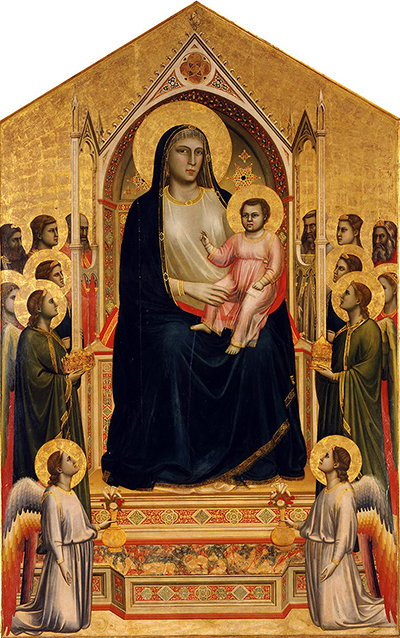
The Ognissanti Madonna’s throne and ranked company, kept in the full panel.
Set the complete painting beside Cimabue’s Santa Trinita Maestà, also in the Uffizi. Cimabue’s throne is already a formidable spatial invention. Its sides recede, its lower structure opens into compartments occupied by prophets, and its many ledges create a layered ascent towards the Virgin. The figures have modelling as well as patterned surfaces. This is an elaborate construction of sacred presence, rather than an artist’s unsuccessful attempt to make Giotto’s kind of picture. [6]
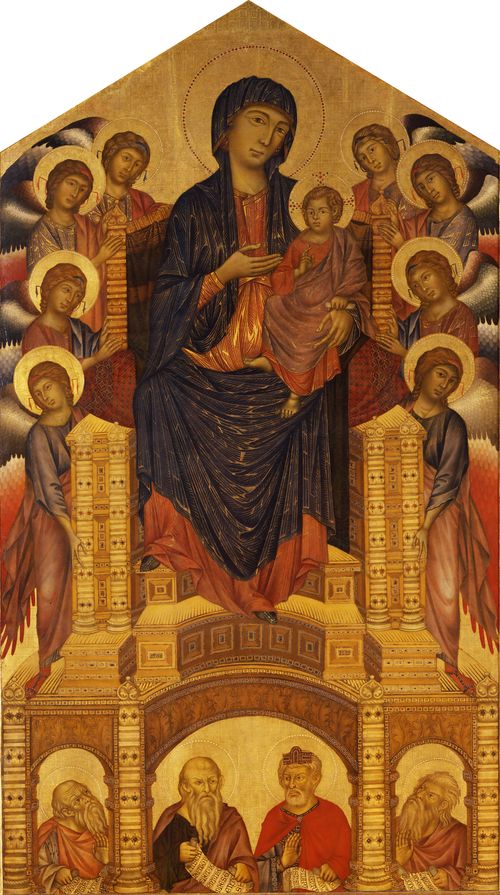
Cimabue’s Santa Trinita Maestà, now in the Uffizi. Compare the enthroned Virgin, ranked angels and gold ground with Giotto’s panel paintings; this work is by Cimabue. Image source. Public domain. Proportionally reduced reproduction; original composition, colour and photographic lighting retained.
The differing treatment of cloth sharpens the comparison. In Cimabue’s Virgin, numerous gold strokes articulate folds across the blue mantle. Their accumulated rhythms keep the garment’s surface active. In Giotto, fewer large divisions and wider transitions between light and dark establish the seated body. One can follow Cimabue’s glittering lines and Giotto’s heavier expanses without assigning intelligence or feeling exclusively to either painter.
Their angels also establish different relations with the spectator. Cimabue’s surrounding faces repeatedly turn outwards, keeping the sacred company available to our gaze. Many of Giotto’s angels look inwards towards Mary and Christ. Their attention helps define an event of veneration within the picture. We watch others looking, and that shared direction gives the composition its concentration. Bodily presence is being constructed through attention as well as through shading.
A child’s hand: intimacy within a sacred image
The National Gallery of Art’s Madonna and Child in Washington allows the same questions to be examined at a much smaller scale. Mary holds a white rose. Christ extends one hand towards the flower and closes the other around her forefinger. Her supporting hand opens beneath him, its long fingers spreading against the cloth. These contacts organise the entire group.
The child’s torso turns across Mary’s body, and one bare foot projects onto the dark mantle. His translucent wrapping gathers in substantial folds around the legs. The contrast is delicate: the cloth has weight, yet enough light passes through it for the underlying flesh to remain apparent. Against Mary’s encompassing blue, the exposed chest, rounded limbs and small, gripping hand become especially noticeable.
The painting’s gold ground prevents these observations from turning it into an ordinary domestic portrait. Halos retain the identities of the sacred figures; the borders ornament Mary’s clothing; the rose belongs to a religious language of Marian imagery. Miklós Boskovits’s catalogue discussion also treats the grasped forefinger as potentially symbolic as well as affectionate. A gesture can suggest infant behaviour and carry devotional meaning at the same time. [7]
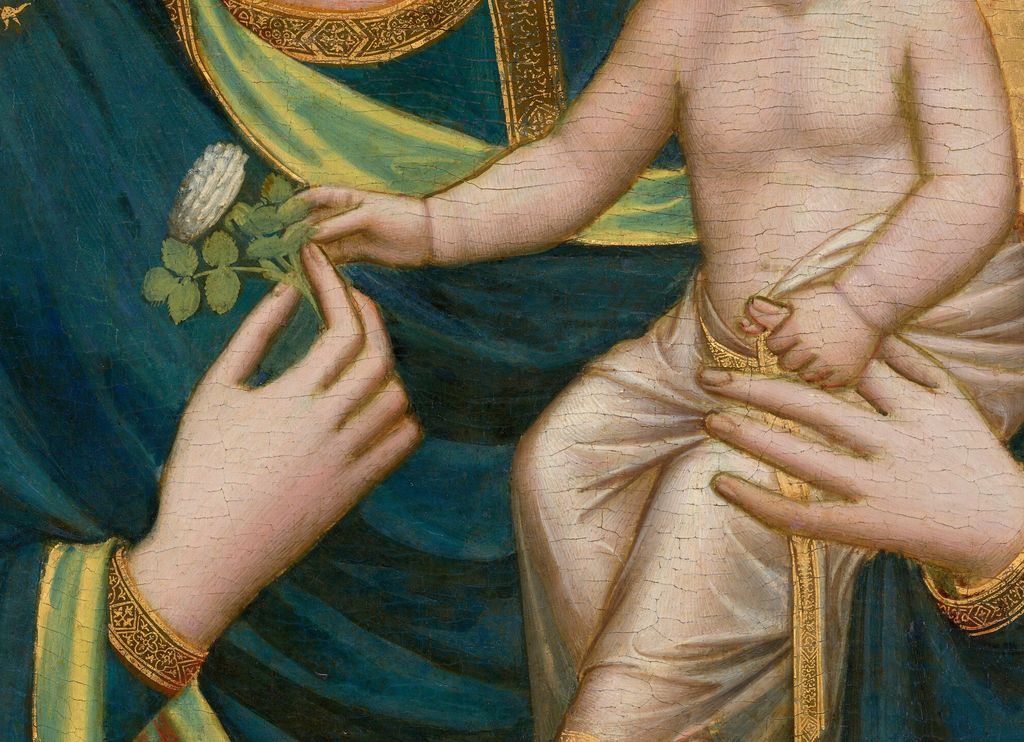
The Child gripping Mary’s finger and reaching for the rose in Washington. National Gallery of Art, Washington, Samuel H. Kress Collection,1939.1.256. Image source. Public domain. Proportionally reduced reproduction; no colour or content enhancement.
The National Gallery dates the panel approximately 1310–15 and identifies it as tempera on poplar. Its original destination remains unresolved, and the surviving panel was probably the centre of a larger altarpiece. Boskovits surveys earlier disagreements over its attribution and date before arguing for its place in Giotto’s work. [7] That history matters to a discussion of style: even a seemingly recognisable combination of modelling, faces and gestures has required argument, comparison and reassessment.
Within the image, the hands offer a more useful guide than a list of traits. Mary’s flower hand makes a small, upright shape; the child’s reaching arm creates a horizontal connection towards it; her other hand provides the necessary support. Our attention travels between these points and returns to the faces. The bodies acquire a relationship through the exact positions of their extremities.
It is also possible to see how little architectural depth the painting needs. The child overlaps Mary; his knee and foot advance over her mantle; her supporting fingers cross the cloth. These local relations are enough to establish a convincing order of nearer and farther surfaces. Giotto’s ability to make figures substantial cannot be reduced to his ability to paint rooms. A confined devotional panel can organise space through touch.
Grief: a group becomes an action
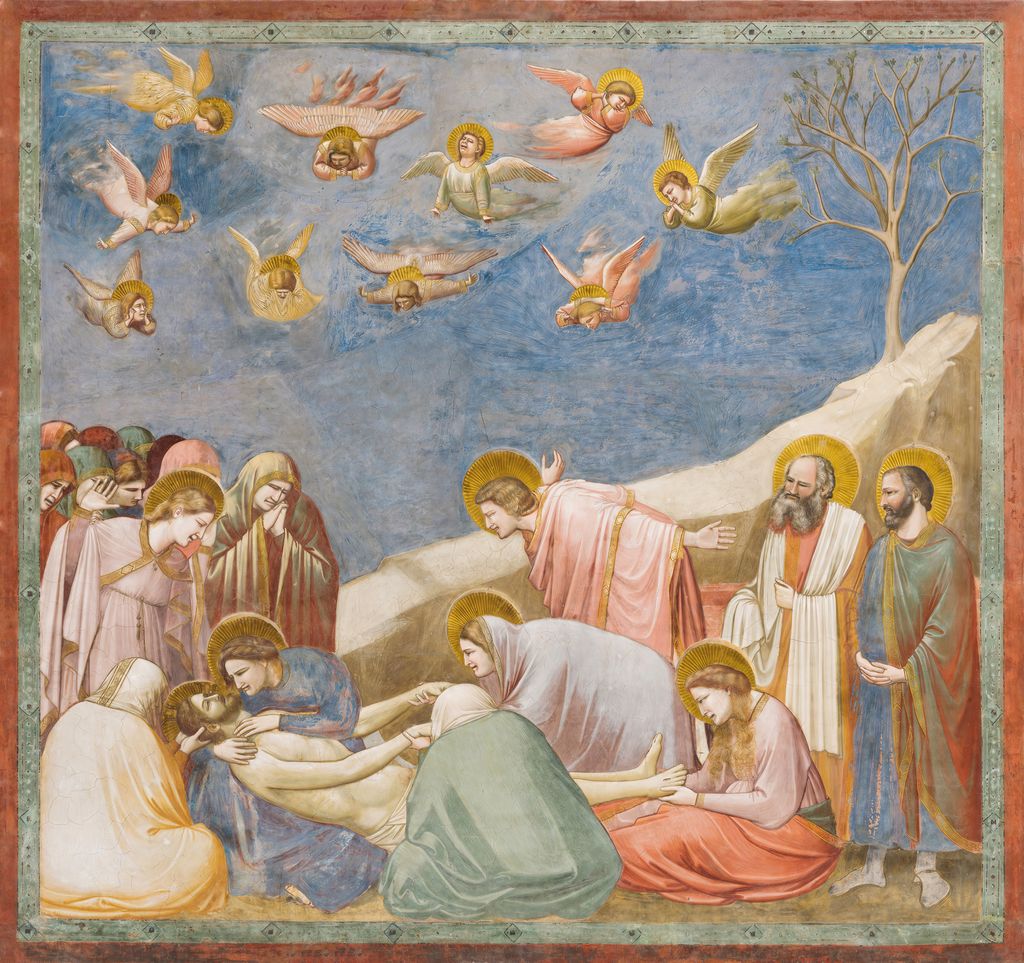
In Padua’s Lamentation, the body of Christ lies low across the composition. The Virgin bends over his head, bringing her living face close to the dead one. A woman supports a hand; Mary Magdalene sits at his feet. Around them stand, crouch and bend the other mourners. Above, angels move through the blue in a scattered company of grief. The subject belongs to a medieval devotional tradition, rather than recording a gathering described in this exact form by a single Gospel passage. [8]
The painting combines a strong overall direction with many separate responses. The rocky ridge descends from the upper right towards the heads of Christ and Mary. John leans forward above the group, his arms thrown backwards, extending the motion of his torso. At the left, clustered women contribute raised hands and bowed heads. On the right, two standing men hold themselves more quietly. Their restraint gives the agitated gestures elsewhere something against which to register.
The two large figures seen from behind are crucial. Their covered backs form rounded masses close to the lower edge. They partly block Christ’s body and the hands attending it, so that we must look around them. At the same time their positions help establish a ring of mourners. The picture presents the company as people gathered around someone, each occupying a place that another body cannot occupy.
This is an especially clear relationship between physical and emotional structure. The solid backs slow our access to the body. Mary’s inclination brings us to the faces. John’s open gesture makes the grief extend beyond the tight central contacts. The painting gives each movement an intelligible bodily cause without making every figure repeat one expressive formula.
The angels expand that variety. One presses hands to the face; another draws joined hands close to the body; others spread their arms or turn sharply in flight. Their diminutive scale and suspended positions distinguish them from the substantial human gathering below. Giotto can make bodies apparently heavy and bodies apparently airborne within the same scene. The distinction contributes to the meaning of the whole, joining earthly bereavement to a heavenly response.
Such observations explain why the familiar word naturalism needs precision. There is nothing casual about the distribution of the mourners or the slope’s arrival at the central encounter. The landscape is economical and the gestures carefully legible. The effect of truth arises through a composed relationship between actions, rather than through an equal description of everything that might have existed at the burial place.
Michael Viktor Schwarz’s account of the Padua paintings repeatedly attends to this relationship between narrative economy and an appearance of independent life. He argues that cropped figures, turned backs and incidental movements can make a represented world seem to continue beyond its immediate presentation to the spectator. His interpretation helps explain the force of such devices, while leaving room for differences between individual scenes. [1]
A striking counter-example to the Lamentation’s converging movements is the Arrest of Christ, commonly called the Kiss of Judas. Here upright weapons, torches and crossing arms fill the space around the two central faces. Judas’s broad yellow mantle enfolds much of Christ’s body, concentrating attention on their encounter. Elsewhere, a pointing hand enters from the right and an arm bearing a sword rises on the left. Overlap produces pressure and conflict.
At the centre, however, the faces remain separated. Schwarz discusses the disagreement between Bruce Cole’s reading of the instant after the kiss and Max Imdahl’s reading of the instant before it. The painted mouths do not make the chronology indisputable. [9] That uncertainty can sharpen the experience: around the protagonists a crowd acts, while their meeting seems held open for scrutiny. Giotto controls the pace of attention inside one image, making a small interval between faces compete with a whole field of movement.
Buildings, borders and the spectator
The Scrovegni Chapel places such scenes inside a larger painted order. Successive registers of stories extend along the walls, separated by ornamental bands. Below them, figures representing virtues and vices occupy a zone that imitates another kind of material and display. The decoration asks spectators to change their manner of looking as their eyes move between narrative, ornament and personification.
Near the chancel opening, the empty painted chambers often called coretti make the distinction particularly vivid. An arch, a ribbed vault, a window and a hanging lamp create an apparent recess in the wall. Their invitation to believe in a space differs from that of a narrative scene. There is no central human action to follow. The lamp’s rings and the chamber’s architectural divisions instead give the eye a series of depths to examine.
Schwarz discusses their orientation towards the chapel’s central axis and the empirical adjustments of their projection. He also develops an interpretation of the chambers as fictive tomb niches, following Ursula Schlegel, rather than treating them simply as extra architectural space. That funerary reading remains an interpretation; it is not required to recognise the illusion of recession. [10] A viewer can distinguish the visible spatial effect from the proposed purpose of that effect.
These passages make it difficult to describe all Giotto’s paintings as windows onto a single kind of reality. A narrative building may open towards us so that an action can be understood; a painted recess may seem to cut into the chapel wall; a frame may assert the division between a story and its surroundings. The same painter can make that division stronger in one place and more permeable in another.
Nor do convincing rooms establish that Giotto possessed the later system of mathematical, single-point perspective. Edges can converge, objects can diminish and architecture can orient a spectator without every part submitting to one geometrically consistent construction. Schwarz’s analysis of the Padua interiors follows changing solutions to presentation and storytelling, including buildings that combine an exterior description with an exposed room. [1] Their effectiveness depends on what each scene needs to show.
The spectator’s body matters too. A photograph places a wall conveniently in front of us; a person in a chapel may stand below it, approach it sideways or see another scene across the room. Pictorial space and the space of viewing interact. Giotto’s style includes the management of that encounter, as well as the shapes that can be isolated from a reproduction.
The Peruzzi Chapel: more than one Giotto
The Peruzzi Chapel in Florence complicates any expectation that Giotto always sought the same visual effect. Its paintings tell the lives of John the Baptist and John the Evangelist on facing walls. Their damaged surfaces require care: much was executed on dry plaster, and whitewashing, cleaning and restoration have changed what survives. Santa Croce’s institutional record names Giotto and workshop, gives approximately 1310–11 in its object label, and acknowledges a wider dating debate in its discussion. [11]
The Feast of Herod nonetheless retains a remarkably extensive architectural setting. At the left a tall tower rises above the musician. A loggia, its roofline furnished with small figures, extends across the central banquet. On the right an arched chamber holds Herodias receiving the Baptist’s head. Columns, steps and changes of enclosure distribute the participants through several connected spaces.
Time also spreads across the building. Salome appears beside the central banquet and again in the chamber at the right. The head is brought before the ruler and presented to Herodias within the same painted field. Architecture separates the actions sufficiently for us to read them, while its continuity makes them parts of one story. Giotto’s narrative intelligence includes the clear presentation of successive events, as well as the concentration of a scene into a charged instant.
The surviving figures are large within this inhabited structure, yet the building has interests beyond fitting tightly around them. Its tower, roof ornaments and receding chambers create the sense of an elaborate court. Schwarz relates the chapel’s expanding spaces to its narrow real setting: an oblique approach can make parts of the architecture appear to project towards the spectator. He also stresses how the loss of upper paint layers diminishes our ability to judge the original richness of bodies, cloth and furnishings. [12]
His chronology is consequential. Schwarz interprets the Peruzzi paintings as late works, placing them in 1334–36, after Giotto’s Neapolitan activity, and develops his argument within that reconstruction. This differs substantially from the early date on Santa Croce’s label. The paintings therefore cannot serve as a universally agreed final rung in Giotto’s development. They can demonstrate an important range within the work associated with him: more expansive settings, complex material effects and a narrative distributed through architecture. [12]
That range also changes how influence can be understood. In the Feast, Schwarz compares the pair of whispering observers with a group in Ambrogio Lorenzetti’s fresco of the episcopal investiture of Saint Louis of Toulouse. Under Schwarz’s late dating, Giotto adapts a Sienese motif; he notes that Eve Borsook, working with an earlier Peruzzi chronology, reverses the direction of dependence. He then argues that Ambrogio’s larger arrangement had itself drawn on Giotto’s Bardi paintings. [13]
The exchange, as Schwarz reconstructs it, runs in both directions. Its detailed chronology remains debatable, but its challenge to a one-way account is productive. The relationship between Florence and Siena need not consist of one innovator supplying ideas to passive recipients. Artists could absorb, alter and answer one another. Schwarz’s broader proposal of stylistic plurality in Giotto’s later work is explicitly conditional on his reconstruction; it offers a way of thinking about varied commissions and competitive circumstances, rather than a settled solution to every difference of hand or date. [13]
How a pictorial language travels
Rimini supplies a more immediate regional setting for Giotto’s influence. The city’s municipal account connects his work there around 1300 with the flourishing of local painting and identifies the surviving Crucifix in the former Franciscan church, now the Tempio Malatestiano. [14] A place where his work could be encountered provides a firmer starting point than a resemblance detached from geography and chronology.
Giovanni da Rimini’s small Scenes from the Lives of the Virgin and other Saints in London offers a useful response. The National Gallery dates it probably about 1300–05 and discusses Giotto’s influence in its substantial figures and spatial architecture. The connection with Rimini’s Sant’Agostino is proposed rather than documented, and the panel’s relationship with a companion in Rome is reconstructed with appropriate caution. [15]
Seen whole, Giovanni’s painting resists being treated as a miniature imitation of Padua. Its gold field carries several differently sized scenes. At the upper left, a small architectural shrine and the people leaning around it establish depth within an intricate devotional arrangement. At the upper right, the Coronation of the Virgin has a more concentrated, ceremonial symmetry. Below, Catherine’s gesture crosses the space towards a seated ruler. Bodies, buildings and acts of attention give local structure to a precious, patterned surface.
This is the value of a specific comparison. Giovanni could make figures bulkier, vary expressions or use receding architecture while maintaining a richly gilded pictorial world. The continued ornament is part of the painting’s purpose and appeal. Its combination of resources shows an artist selecting useful possibilities. Formal response does not, by itself, prove that Giovanni entered Giotto’s workshop or received instruction from him personally.
A professional lineage is a different kind of evidence. Writing around 1400, Cennino Cennini states that Agnolo Gaddi taught him, that Agnolo had learned from his father Taddeo, and that Taddeo had been Giotto’s pupil. Cennini repeats the chain when explaining the colouring of a youthful face in fresco. His account associates Giotto’s reputation with procedures that could be taught through successive generations. [16]
Cennini’s account moves from lineage into the distribution of colour across the face. He describes a green-earth preparation, touches of pink and graduated flesh tones; the placement and blending of these colours help produce relief. The passage preserves a claim about knowledge transmitted through practice. Its point is more specific than the continued appearance of recognisably Giottesque faces: later painters could inherit ways of building those faces out of successive colour relationships. Cennini also allows differences within the lineage, judging Agnolo’s colouring fresher than Taddeo’s. An inherited method could remain open to improvement. [16]
The practical context gives special interest to Cennini’s celebrated claim that Giotto turned painting from Greek into Latin and brought it into the modern manner. Those terms articulate a practitioner’s historical allegiance. They should not be expanded into proof that Byzantine painting lacked modelling, expressive bodies or narrative invention. The same treatise locates pictorial renewal in the patient work of colouring a face. Its grand claim about history and its small-scale attention to craft belong together.
The workshop also complicates the idea of a single personal style. Schwarz’s Padua discussion considers how design, execution, training and collaboration might have contributed to the chapel’s coherence, while acknowledging the difficulty of separating hands. His particular judgments about weaker passages remain judgments, not a recovered staff list. [17] Giotto’s name can identify an artistic enterprise whose visual consistency involved work by more than one painter.
Reputation, study and renewed use
Literary testimony records another route by which Giotto became influential. Dante’s Purgatorio, canto XI, places his fame beside Cimabue’s within Oderisi’s reflection on the instability of worldly renown. Giotto has the acclaim that had belonged to the older painter; the surrounding examples and the image of fame as shifting wind make the passage a meditation on pride. It witnesses Giotto’s reputation without documenting an apprenticeship, friendship with Dante or particular lesson in painting. [18]
Ghiberti’s fifteenth-century Commentaries and Vasari’s sixteenth-century Lives turn Giotto’s importance into accounts of the renewal of art. Ghiberti tells how Cimabue discovered the gifted boy drawing a sheep; Vasari develops the story and places the painter within a history of revival through nature and drawing. These narratives are valuable evidence for what later writers wanted Giotto to represent. Their distance from his childhood prevents the discovery scene from functioning as a contemporary record. [19]
The paintings could also be studied directly. Michelangelo’s Study of Two Figures after Giotto, now in the Louvre and dated there 1490–92, copies figures from the Ascension of John the Evangelist in the Peruzzi Chapel. The museum identifies the sheet as pen and brown inks over a preparatory stylus drawing, and describes the small alterations through which Michelangelo worked with the earlier models. [3]
The sheet makes an unusually concrete record of artistic attention. One standing man raises a hand to his face; another bends forwards, his body and mantle projecting across the paper. Michelangelo extracts these witnesses from their architecture and surrounding company. Hatching builds the cloth and the turns of the forms. The painted narrative has become material for studying separate bodily actions.
Return to the full Peruzzi scene and those actions recover their original relationships. The bent man looks towards the opening below John’s ascending figure; upright witnesses gather nearby; the architecture encloses the event. Michelangelo’s selection demonstrates both continuity and change. Giotto’s figures remained available for renewed work, but the later artist did not need to reproduce their whole devotional setting to find them useful.
A rewarding final comparison is to follow a hand through these different pictures. In the Washington Madonna it supports, grips or reaches. In the Lamentation it cradles the dead and extends grief through the group. In the Peruzzi Feast it directs attention between separate actions; in Michelangelo’s copy it helps define a figure worth studying apart. Beside the hands, watch the cloth: how it settles, covers, binds or amplifies movement. Giotto’s continuing force becomes visible in these exact connections between a body, an action and the space another person needs in order to understand it.
Watch: Explore Giotto’s Art
Choose an overview or a closer look at three major works. These films provide wider Giotto context alongside this article.
Artworks directory
This directory brings together 209 records for paintings, ensembles, individual scenes and components, architectural work, an associated disputed design, and reported or lost projects connected with Giotto. Ensembles and their parts appear separately, so 209 is a count of records rather than independent paintings or commissions. Attributions and dates remain qualified where disputed; inclusion does not establish Giotto’s own hand throughout.
| Name | Date | Medium, attribution and status |
|---|---|---|
| Expulsion of Joachim from the Temple — Scrovegni Chapel, Padua | c.1303–05 (chapel campaign) | Fresco / wall painting. Giotto and workshop. Scene within a cycle. Padova Musei. Chapel overview. |
| Joachim among the Shepherds — Scrovegni Chapel, Padua | c.1303–05 (chapel campaign) | Fresco / wall painting. Giotto and workshop. Scene within a cycle. Padova Musei. Chapel overview. |
| Annunciation to Saint Anne — Scrovegni Chapel, Padua | c.1303–05 (chapel campaign) | Fresco / wall painting. Giotto and workshop. Scene within a cycle. Padova Musei. Chapel overview. |
| Sacrifice of Joachim — Scrovegni Chapel, Padua | c.1303–05 (chapel campaign) | Fresco / wall painting. Giotto and workshop. Scene within a cycle. Padova Musei. Chapel overview. |
| Joachim’s Dream — Scrovegni Chapel, Padua | c.1303–05 (chapel campaign) | Fresco / wall painting. Giotto and workshop. Scene within a cycle. Padova Musei. Padova Musei. Chapel overview. |
| Meeting at the Golden Gate — Scrovegni Chapel, Padua | c.1303–05 (chapel campaign) | Fresco / wall painting. Giotto and workshop. Scene within a cycle. Padova Musei. Chapel overview. |
| Birth of the Virgin — Scrovegni Chapel, Padua | c.1303–05 (chapel campaign) | Fresco / wall painting. Giotto and workshop. Scene within a cycle. Padova Musei. Padova Musei. Chapel overview. |
| Presentation of the Virgin in the Temple — Scrovegni Chapel, Padua | c.1303–05 (chapel campaign) | Fresco / wall painting. Giotto and workshop. Scene within a cycle. Padova Musei. Chapel overview. |
| Delivery of the Rods — Scrovegni Chapel, Padua | c.1303–05 (chapel campaign) | Fresco / wall painting. Giotto and workshop. Scene within a cycle. Padova Musei. Chapel overview. |
| Prayer of Joseph and the Suitors — Scrovegni Chapel, Padua | c.1303–05 (chapel campaign) | Fresco / wall painting. Giotto and workshop. Scene within a cycle. Padova Musei. Chapel overview. |
| Marriage of the Virgin — Scrovegni Chapel, Padua | c.1303–05 (chapel campaign) | Fresco / wall painting. Giotto and workshop. Scene within a cycle. Padova Musei. Chapel overview. |
| Wedding Procession of Mary — Scrovegni Chapel, Padua | c.1303–05 (chapel campaign) | Fresco / wall painting. Giotto and workshop. Scene within a cycle. Padova Musei. Chapel overview. |
| Annunciation on the triumphal arch — complete ensemble (Scrovegni Chapel, Padua) | c.1303–05 (chapel campaign) | Wall painting with a central painted wooden panel. Giotto and workshop. Ensemble. Includes the Mission of Gabriel and the lower Annunciation pair; the original central wooden panel is in the Musei Civici agli Eremitani, with a conservation copy in the chapel. Padova Musei. Padova Musei. Scholarly study. Chapel overview. |
| Visitation — Scrovegni Chapel, Padua | c.1303–05 (chapel campaign) | Fresco / wall painting. Giotto and workshop. Scene within a cycle. Padova Musei. Chapel overview. |
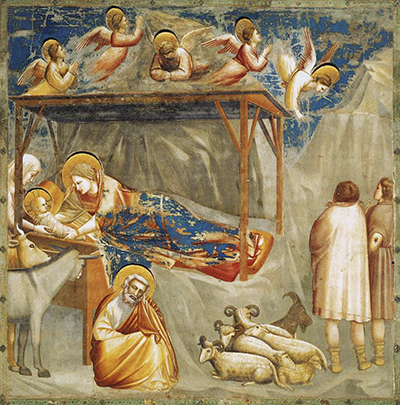
| Nativity — Scrovegni Chapel, Padua | c.1303–05 (chapel campaign) | Fresco / wall painting. Giotto and workshop. Scene within a cycle. Padova Musei. Chapel overview. |
| Adoration of the Magi — Scrovegni Chapel, Padua | c.1303–05 (chapel campaign) | Fresco / wall painting. Giotto and workshop. Scene within a cycle. Padova Musei. Chapel overview. |
| Presentation of Christ at the Temple — Scrovegni Chapel, Padua | c.1303–05 (chapel campaign) | Fresco / wall painting. Giotto and workshop. Scene within a cycle. Padova Musei. Chapel overview. |
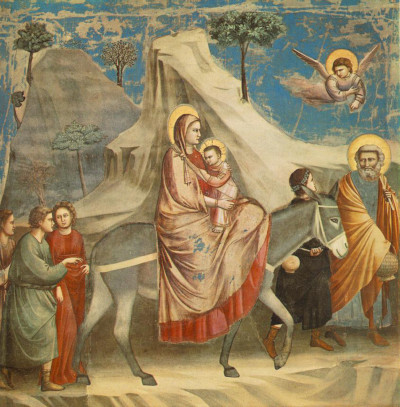
| Flight into Egypt — Scrovegni Chapel, Padua | c.1303–05 (chapel campaign) | Fresco / wall painting. Giotto and workshop. Scene within a cycle. Padova Musei. Chapel overview. |
| Massacre of the Innocents — Scrovegni Chapel, Padua | c.1303–05 (chapel campaign) | Fresco / wall painting. Giotto and workshop. Scene within a cycle. Padova Musei. Chapel overview. |
| Christ among the Doctors — Scrovegni Chapel, Padua | c.1303–05 (chapel campaign) | Fresco / wall painting. Giotto and workshop. Scene within a cycle. Padova Musei. Chapel overview. |
| Baptism of Christ — Scrovegni Chapel, Padua | c.1303–05 (chapel campaign) | Fresco / wall painting. Giotto and workshop. Scene within a cycle. Padova Musei. Chapel overview. |
| Marriage at Cana — Scrovegni Chapel, Padua | c.1303–05 (chapel campaign) | Fresco / wall painting. Giotto and workshop. Scene within a cycle. Padova Musei. Padova Musei. Chapel overview. |
| Raising of Lazarus — Scrovegni Chapel, Padua | c.1303–05 (chapel campaign) | Fresco / wall painting. Giotto and workshop. Scene within a cycle. Padova Musei. Chapel overview. |
| Entry into Jerusalem — Scrovegni Chapel, Padua | c.1303–05 (chapel campaign) | Fresco / wall painting. Giotto and workshop. Scene within a cycle. Padova Musei. Chapel overview. |
| Expulsion of the Money Changers — Scrovegni Chapel, Padua | c.1303–05 (chapel campaign) | Fresco / wall painting. Giotto and workshop. Scene within a cycle. Padova Musei. Padova Musei. Chapel overview. |
| Judas Receiving the Payment — Scrovegni Chapel, Padua | c.1303–05 (chapel campaign) | Fresco / wall painting. Giotto and workshop. Scene within a cycle. Padova Musei. Chapel overview. |
| Last Supper — Scrovegni Chapel, Padua | c.1303–05 (chapel campaign) | Fresco / wall painting. Giotto and workshop. Scene within a cycle. Padova Musei. Chapel overview. |
| Washing of the Feet — Scrovegni Chapel, Padua | c.1303–05 (chapel campaign) | Fresco / wall painting. Giotto and workshop. Scene within a cycle. Padova Musei. Chapel overview. |
| Arrest of Christ — Scrovegni Chapel, Padua | c.1303–05 (chapel campaign) | Fresco / wall painting. Giotto and workshop. Scene within a cycle. Padova Musei. Chapel overview. |
| Christ before Annas and Caiaphas — Scrovegni Chapel, Padua | c.1303–05 (chapel campaign) | Fresco / wall painting. Giotto and workshop. Scene within a cycle. Padova Musei. Chapel overview. |
| Mocking of Christ and Flagellation — Scrovegni Chapel, Padua | c.1303–05 (chapel campaign) | Fresco / wall painting. Giotto and workshop. Scene within a cycle. Padova Musei. Chapel overview. |
| Road to Calvary — Scrovegni Chapel, Padua | c.1303–05 (chapel campaign) | Fresco / wall painting. Giotto and workshop. Scene within a cycle. Padova Musei. Chapel overview. |
| Crucifixion — Scrovegni Chapel, Padua | c.1303–05 (chapel campaign) | Fresco / wall painting. Giotto and workshop. Scene within a cycle. Padova Musei. Chapel overview. |
| Lamentation — Scrovegni Chapel, Padua | c.1303–05 (chapel campaign) | Fresco / wall painting. Giotto and workshop. Scene within a cycle. Padova Musei. Chapel overview. |
| Resurrection / Noli me tangere — Scrovegni Chapel, Padua | c.1303–05 (chapel campaign) | Fresco / wall painting. Giotto and workshop. Scene within a cycle. Padova Musei. Chapel overview. |
| Ascension — Scrovegni Chapel, Padua | c.1303–05 (chapel campaign) | Fresco / wall painting. Giotto and workshop. Scene within a cycle. Padova Musei. Chapel overview. |
| Pentecost — Scrovegni Chapel, Padua | c.1303–05 (chapel campaign) | Fresco / wall painting. Giotto and workshop. Scene within a cycle. Padova Musei. Padova Musei. Chapel overview. |
| Coretto — right painted recess (Scrovegni Chapel, Padua) | c.1303–05 (chapel campaign) | Fresco / painted fictive architecture. Giotto and workshop. Ensemble component. Padova Musei. Padova Musei. Scholarly study. Chapel overview. |
| Coretto — left painted recess (Scrovegni Chapel, Padua) | c.1303–05 (chapel campaign) | Fresco / painted fictive architecture. Giotto and workshop. Ensemble component. Padova Musei. Padova Musei. Scholarly study. Chapel overview. |
| Envy — Scrovegni Chapel, Padua | c.1303–05 (chapel campaign) | Grisaille fresco / wall painting. Giotto and workshop. Ensemble component. Padova Musei. Chapel overview. Scholarly study. Padova Musei. |
| Despair — Scrovegni Chapel, Padua | c.1303–05 (chapel campaign) | Grisaille fresco / wall painting. Giotto and workshop. Ensemble component. Padova Musei. Chapel overview. Scholarly study. Padova Musei. |
| Prudence — Scrovegni Chapel, Padua | c.1303–05 (chapel campaign) | Grisaille fresco / wall painting. Giotto and workshop. Ensemble component. Padova Musei. Chapel overview. Scholarly study. Padova Musei. |
| Fortitude — Scrovegni Chapel, Padua | c.1303–05 (chapel campaign) | Grisaille fresco / wall painting. Giotto and workshop. Ensemble component. Padova Musei. Chapel overview. Scholarly study. Padova Musei. |
| Temperance — Scrovegni Chapel, Padua | c.1303–05 (chapel campaign) | Grisaille fresco / wall painting. Giotto and workshop. Ensemble component. Padova Musei. Chapel overview. Scholarly study. Padova Musei. |
| Justice — Scrovegni Chapel, Padua | c.1303–05 (chapel campaign) | Grisaille fresco / wall painting. Giotto and workshop. Ensemble component. Padova Musei. Chapel overview. Scholarly study. Padova Musei. |
| Faith — Scrovegni Chapel, Padua | c.1303–05 (chapel campaign) | Grisaille fresco / wall painting. Giotto and workshop. Ensemble component. Padova Musei. Chapel overview. Scholarly study. Padova Musei. |
| Charity — Scrovegni Chapel, Padua | c.1303–05 (chapel campaign) | Grisaille fresco / wall painting. Giotto and workshop. Ensemble component. Padova Musei. Chapel overview. Scholarly study. Padova Musei. |
| Hope — Scrovegni Chapel, Padua | c.1303–05 (chapel campaign) | Grisaille fresco / wall painting. Giotto and workshop. Ensemble component. Padova Musei. Chapel overview. Scholarly study. Padova Musei. |
| Folly — Scrovegni Chapel, Padua | c.1303–05 (chapel campaign) | Grisaille fresco / wall painting. Giotto and workshop. Ensemble component. Padova Musei. Chapel overview. Scholarly study. Padova Musei. |
| Inconstancy — Scrovegni Chapel, Padua | c.1303–05 (chapel campaign) | Grisaille fresco / wall painting. Giotto and workshop. Ensemble component. Padova Musei. Chapel overview. Scholarly study. Padova Musei. |
| Wrath — Scrovegni Chapel, Padua | c.1303–05 (chapel campaign) | Grisaille fresco / wall painting. Giotto and workshop. Ensemble component. Padova Musei. Chapel overview. Scholarly study. Padova Musei. |
| Injustice — Scrovegni Chapel, Padua | c.1303–05 (chapel campaign) | Grisaille fresco / wall painting. Giotto and workshop. Ensemble component. Padova Musei. Chapel overview. Scholarly study. Padova Musei. |
| Infidelity / Idolatry — Scrovegni Chapel, Padua | c.1303–05 (chapel campaign) | Grisaille fresco / wall painting. Giotto and workshop. Ensemble component. Padova Musei. Chapel overview. Scholarly study. Padova Musei. |
| Starry vault — complete ensemble (Scrovegni Chapel, Padua) | c.1303–05 (chapel campaign) | Vault painting. Giotto and workshop. Ensemble. Padova Musei. Padova Musei. Chapel overview. |
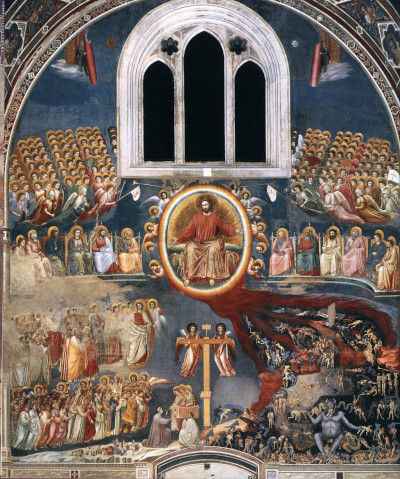
| Last Judgement — Scrovegni Chapel, Padua | c.1303–05 (chapel campaign) | Fresco / wall painting. Giotto and workshop. Scene within a cycle. Padova Musei. Padova Musei. Chapel overview. Padova Musei. |
| Prophet Malachi — vault medallion — Scrovegni Chapel, Padua | c.1303–05 (chapel campaign) | Fresco / wall painting. Giotto and workshop. Ensemble component. Padova Musei. Padova Musei. Chapel overview. Padova Musei. |
| Prophet Baruch — vault medallion — Scrovegni Chapel, Padua | c.1303–05 (chapel campaign) | Fresco / wall painting. Giotto and workshop. Ensemble component. Padova Musei. Padova Musei. Chapel overview. Padova Musei. |
| Prophet Isaiah — vault medallion — Scrovegni Chapel, Padua | c.1303–05 (chapel campaign) | Fresco / wall painting. Giotto and workshop. Ensemble component. Padova Musei. Padova Musei. Chapel overview. Padova Musei. |
| Prophet Daniel — vault medallion — Scrovegni Chapel, Padua | c.1303–05 (chapel campaign) | Fresco / wall painting. Giotto and workshop. Ensemble component. Padova Musei. Padova Musei. Chapel overview. Padova Musei. |
| Christ Pantocrator — vault medallion — Scrovegni Chapel, Padua | c.1303–05 (chapel campaign) | Fresco / wall painting. Giotto and workshop. Ensemble component. Padova Musei. Padova Musei. Chapel overview. Padova Musei. |
| Virgin and Child — vault medallion — Scrovegni Chapel, Padua | c.1303–05 (chapel campaign) | Fresco / wall painting. Giotto and workshop. Ensemble component. Padova Musei. Padova Musei. Chapel overview. Padova Musei. |
| Prophet Ezekiel — vault medallion — Scrovegni Chapel, Padua | c.1303–05 (chapel campaign) | Fresco / wall painting. Giotto and workshop. Ensemble component. Padova Musei. Padova Musei. Chapel overview. Padova Musei. |
| Prophet Micah — vault medallion — Scrovegni Chapel, Padua | c.1303–05 (chapel campaign) | Fresco / wall painting. Giotto and workshop. Ensemble component. Padova Musei. Padova Musei. Chapel overview. Padova Musei. |
| Saint John the Baptist — vault medallion — Scrovegni Chapel, Padua | c.1303–05 (chapel campaign) | Fresco / wall painting. Giotto and workshop. Ensemble component. Padova Musei. Padova Musei. Chapel overview. Padova Musei. |
| Scrovegni Chapel — painted decoration | c.1303–05 (chapel campaign) | Fresco / wall painting, with a painted wooden panel. Giotto and workshop (painted decoration). Ensemble. Includes separately listed scenes and components. The original central God the Father panel is in the Musei Civici agli Eremitani; a conservation copy is in the chapel. Chapel overview. Padova Musei. Padova Musei. Source. Source. Source. Padova Musei. Scholarly study. |
| Vices and Virtues — complete fourteen-figure programme | c.1303–05 (chapel campaign) | Grisaille fresco / wall painting. Giotto and workshop. Ensemble. Fourteen figures: seven virtues and seven opposed vices. Padova Musei. Chapel overview. Scholarly study. |
| Coretti — paired fictive chapels | c.1303–05 (chapel campaign) | Fresco / painted fictive architecture. Giotto and workshop. Ensemble. Two separate painted recesses, also listed individually. Padova Musei. Padova Musei. Scholarly study. |
| Mission of Gabriel — heavenly assembly | c.1303–05 (chapel campaign) | Wall painting with central painted wooden image. Giotto and workshop. Ensemble component. Central wooden God the Father panel preserved at the Musei Civici agli Eremitani; conservation copy in the chapel. Chapel overview. Padova Musei. Scholarly study. Padova Musei. |
| Annunciation — Gabriel and Mary in facing chambers | c.1303–05 (chapel campaign) | Fresco / wall painting. Giotto and workshop. Ensemble component. Chapel overview. Scholarly study. Padova Musei. |
| God the Father — central wooden panel of the Mission of Gabriel | c.1303–05 (chapel campaign) | Painting on wood. Associated with Giotto. Ensemble component. Original at the Musei Civici agli Eremitani, Padua; conservation copy in the Scrovegni Chapel. Padova Musei. Padova Musei. Scholarly study. Source. |
| Life of Saint Francis — Upper Church cycle, Assisi | Late 13th–early 14th century; dating disputed | Fresco / wall-painting cycle. Traditionally associated with Giotto; Giotto, Roman-school and other attributions disputed. Ensemble. Twenty-eight-scene nave cycle; scenes also listed individually. Basilica catalogue. Scholarly study. Basilica catalogue. Source. Source. |
| Homage of a Simple Man — Upper Church, Assisi | Late 13th–early 14th century; dating disputed | Wall painting. Traditionally associated with Giotto; authorship and dating disputed. Scene within a cycle. Source. Scholarly study. Source. Source. Source. |
| Gift of the Mantle — Upper Church, Assisi | Late 13th–early 14th century; dating disputed | Wall painting. Traditionally associated with Giotto; authorship and dating disputed. Scene within a cycle. Basilica catalogue. Scholarly study. Source. Source. Source. |
| Dream of the Palace Full of Arms — Upper Church, Assisi | Late 13th–early 14th century; dating disputed | Wall painting. Traditionally associated with Giotto; authorship and dating disputed. Scene within a cycle. Basilica catalogue. Source. Scholarly study. Source. Source. Source. |
| Prayer before the Crucifix at San Damiano — Upper Church, Assisi | Late 13th–early 14th century; dating disputed | Wall painting. Traditionally associated with Giotto; authorship and dating disputed. Scene within a cycle. Source. Source. Source. Scholarly study. Source. Source. |
| Renunciation of Worldly Goods — Upper Church, Assisi | Late 13th–early 14th century; dating disputed | Wall painting. Traditionally associated with Giotto; authorship and dating disputed. Scene within a cycle. Source. Scholarly study. Source. Source. |
| Dream of Innocent III — Upper Church, Assisi | Late 13th–early 14th century; dating disputed | Wall painting. Traditionally associated with Giotto; authorship and dating disputed. Scene within a cycle. Source. Source. Scholarly study. Source. Source. |
| Confirmation of the Rule — Upper Church, Assisi | Late 13th–early 14th century; dating disputed | Wall painting. Traditionally associated with Giotto; authorship and dating disputed. Scene within a cycle. Source. Scholarly study. Source. Source. |
| Vision of the Flaming Chariot — Upper Church, Assisi | Late 13th–early 14th century; dating disputed | Wall painting. Traditionally associated with Giotto; authorship and dating disputed. Scene within a cycle. Source. Source. Scholarly study. Source. Source. |
| Vision of the Thrones — Upper Church, Assisi | Late 13th–early 14th century; dating disputed | Wall painting. Traditionally associated with Giotto; authorship and dating disputed. Scene within a cycle. Basilica catalogue. Scholarly study. Source. Source. Source. |
| Expulsion of Devils from Arezzo — Upper Church, Assisi | Late 13th–early 14th century; dating disputed | Wall painting. Traditionally associated with Giotto; authorship and dating disputed. Scene within a cycle. Source. Source. Scholarly study. Source. Source. Source. |
| Trial by Fire before the Sultan — Upper Church, Assisi | Late 13th–early 14th century; dating disputed | Wall painting. Traditionally associated with Giotto; authorship and dating disputed. Scene within a cycle. Source. Source. Scholarly study. Source. Source. |
| Ecstasy of Saint Francis — Upper Church, Assisi | Late 13th–early 14th century; dating disputed | Wall painting. Traditionally associated with Giotto; authorship and dating disputed. Scene within a cycle. Source. Source. Source. Scholarly study. Source. Source. |
| Nativity at Greccio — Upper Church, Assisi | Late 13th–early 14th century; dating disputed | Wall painting. Traditionally associated with Giotto; authorship and dating disputed. Scene within a cycle. Basilica catalogue. Scholarly study. Source. Source. Source. |
| Miracle of the Spring — Upper Church, Assisi | Late 13th–early 14th century; dating disputed | Wall painting. Traditionally associated with Giotto; authorship and dating disputed. Scene within a cycle. Source. Scholarly study. Source. Source. Source. |
| Sermon to the Birds — Upper Church, Assisi | Late 13th–early 14th century; dating disputed | Wall painting. Traditionally associated with Giotto; authorship and dating disputed. Scene within a cycle. Basilica catalogue. Scholarly study. Source. Source. Source. |
| Death of the Knight of Celano — Upper Church, Assisi | Late 13th–early 14th century; dating disputed | Wall painting. Traditionally associated with Giotto; authorship and dating disputed. Scene within a cycle. Source. Source. Scholarly study. Source. Source. |
| Sermon before Pope Honorius III — Upper Church, Assisi | Late 13th–early 14th century; dating disputed | Wall painting. Traditionally associated with Giotto; authorship and dating disputed. Scene within a cycle. Source. Source. Scholarly study. Source. |
| Apparition at the Chapter of Arles — Upper Church, Assisi | Late 13th–early 14th century; dating disputed | Wall painting. Traditionally associated with Giotto; authorship and dating disputed. Scene within a cycle. Basilica catalogue. Scholarly study. Source. Source. Source. |
| Stigmatisation — Upper Church, Assisi | Late 13th–early 14th century; dating disputed | Wall painting. Traditionally associated with Giotto; authorship and dating disputed. Scene within a cycle. Source. Scholarly study. Source. Source. |
| Death and Ascension of Saint Francis — Upper Church, Assisi | Late 13th–early 14th century; dating disputed | Wall painting. Traditionally associated with Giotto; authorship and dating disputed. Scene within a cycle. Basilica catalogue. Scholarly study. Source. Source. Source. |
| Apparition to Brother Augustine and Bishop Guido — Upper Church, Assisi | Late 13th–early 14th century; dating disputed | Wall painting. Traditionally associated with Giotto; authorship and dating disputed. Scene within a cycle. Zeri catalogue. Scholarly study. Source. Source. Source. |
| Verification of the Stigmata — Upper Church, Assisi | Late 13th–early 14th century; dating disputed | Wall painting. Traditionally associated with Giotto; authorship and dating disputed. Scene within a cycle. Source. Source. Scholarly study. Source. Source. |
| Mourning of the Poor Clares — Upper Church, Assisi | Late 13th–early 14th century; dating disputed | Wall painting. Traditionally associated with Giotto; authorship and dating disputed. Scene within a cycle. Basilica catalogue. Source. Scholarly study. Source. Source. |
| Canonisation of Saint Francis — Upper Church, Assisi | Late 13th–early 14th century; dating disputed | Wall painting. Traditionally associated with Giotto; authorship and dating disputed. Scene within a cycle. Source. Source. Scholarly study. Source. Source. Source. |
| Apparition to Pope Gregory IX — Upper Church, Assisi | Late 13th–early 14th century; dating disputed | Wall painting. Traditionally associated with Giotto; authorship and dating disputed. Scene within a cycle. Zeri catalogue. Scholarly study. Source. Source. Source. |
| Healing of John of Lerida — Upper Church, Assisi | Late 13th–early 14th century; dating disputed | Wall painting. Traditionally associated with Giotto; authorship and dating disputed. Scene within a cycle. Source. Source. Scholarly study. Source. Source. |
| Resurrection of a Woman — Upper Church, Assisi | Late 13th–early 14th century; dating disputed | Wall painting. Traditionally associated with Giotto; authorship and dating disputed. Scene within a cycle. Source. Scholarly study. Source. Source. Source. |
| Liberation of the Prisoner Peter — Upper Church, Assisi | Late 13th–early 14th century; dating disputed | Wall painting. Traditionally associated with Giotto; authorship and dating disputed. Scene within a cycle. Source. Source. Scholarly study. Source. Source. Source. |
| Santa Maria Novella Crucifix | Late 13th century; c.1288–89 or 1298–1301; disputed | Tempera and gold on a shaped wooden cross. Giotto. Source. |
| Death of the Virgin / Dormition — Berlin | c.1310 | Tempera and gold on poplar; gabled dossal. Giotto. Source. Source. |
| Peruzzi Altarpiece | c.1311–1315 (North Carolina Museum of Art) | Tempera and gold on panel. Giotto and workshop. Ensemble. Source. |
| Bologna Polyptych | c.1330 | Tempera and gold on panel. Giotto and workshop. Ensemble. Source. |
| Death of Saint Francis, Bardi Chapel | After 1317, usually the 1320s; disputed | Wall painting with wet-plaster and dry-applied passages. Giotto. Scene within a cycle. Source. |
| Bardi Chapel — painted decoration | After 1317, usually the 1320s; disputed | Wall painting with wet-plaster and dry-applied passages. Giotto and workshop / Giottesque painters; individual hands disputed. Ensemble. Scholarly study. Source. |
| Badia Polyptych | c.1300; proposed dates include 1295–1300 and 1301–02 | Tempera and gold on panel; five cusped compartments. Giotto. Ensemble. Scholarly study. Source. Source. |
| Baroncelli Polyptych | After 1328; detached pinnacle c.1328–35 | Tempera and gold on panel; later altered framing. Giotto and workshop. Ensemble. Detached central pinnacle in San Diego. Santa Croce. |
| Adoration of the Magi / Epiphany — Metropolitan Museum panel | Possibly c.1320; c.1310–18 also proposed for the group | Tempera and gold on wood. Giotto. Part of the dispersed seven-scene board; original function disputed. Met catalogue. Source. |
| Franciscan Allegories | Early 14th century, often c.1315; disputed | Vault wall painting. Giotto and workshop / Giottesque painters; individual hands disputed. Ensemble. Basilica catalogue. |
| Navicella — lost / reworked original mosaic | Late 13th–early 14th century; date disputed | Mosaic. Original attributed to Giotto. Original lost / reworked; fragments and later remakes survive. Scholarly study. |
| Pentecost — London panel | Possibly c.1310–18 (Gordon) | Egg tempera on poplar. Giotto and workshop. Part of the dispersed seven-scene board; original function disputed. National Gallery. Source. |
| Saint Stephen — Horne panel | c.1330–1335 (Museo Horne) | Tempera and gold on panel. Giotto. Proposed association with the Washington and Chaalis panels remains hypothetical. Source. |
| Saint Francis Receiving the Stigmata — Louvre altarpiece | 1300–25 (Louvre) | Tempera and gold on poplar. Giotto. Louvre catalogue. |
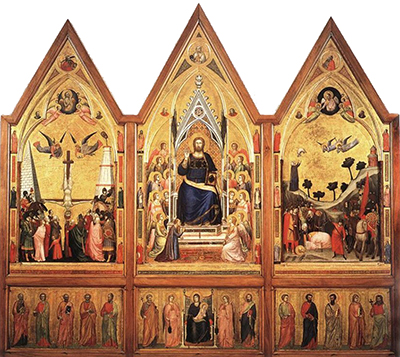
| Stefaneschi Triptych | c.1320; 1315–20 (Vatican Museums) | Tempera and gold on panel; painted on both sides. Giotto and workshop. Ensemble. Vatican Museums. |
| Crucifixion, Berlin | c.1315–1320 | Tempera and gold on poplar. Giotto. Source. |
| Madonna and Child — Washington / Goldman Madonna | c.1310–1315 (National Gallery of Art) | Tempera and gold on poplar. Giotto. Washington panel, distinct from San Giorgio alla Costa; proposed Horne/Chaalis companions remain hypothetical. NGA catalogue. |
| Ognissanti Madonna | c.1300–05 (Uffizi); c.1310 also proposed | Tempera and gold on panel. Giotto. Uffizi. |
| Madonna of Borgo San Lorenzo | c.1290–95; dating and attribution debated | Tempera and gold on a fragment of a wooden panel. Giotto. Fragmentary. Source. |
| Madonna of San Giorgio alla Costa | c.1288–95 (Opera del Duomo); later dates also proposed | Tempera and gold on panel; cut edges. Giotto. Damaged in 1993 and treated in 1995. Source. |
| Magdalene Chapel — painted decoration | c.1307–08 (basilica); disputed | Wall painting with wet-plaster and dry-applied passages. Giotto and workshop / Giottesque painters; individual hands disputed. Ensemble. Basilica catalogue. |
| Ognissanti Crucifix | c.1315–1320 (Opificio) | Painting on a shaped wooden cross. Giotto and workshop. Workshop participation and alternative attributions debated. Source. |
| Padua Crucifix | c.1303–05 (Zeri catalogue) | Tempera and gold on a shaped wooden cross. Giotto. Zeri catalogue. |
| Peruzzi Chapel — painted decoration | c.1310–11 (Santa Croce); 1334–36 proposed by Schwarz | Wall painting with substantial dry-applied work and loss. Giotto and workshop / Giottesque painters; individual hands disputed. Ensemble. Santa Croce. |
| Rimini Crucifix | c.1300; late 13th century also proposed | Tempera and gold on a shaped wooden cross. Giotto. Source. |
| Giotto’s Campanile — Florence Cathedral bell tower | Begun 1334; completed 1359 under successors | Marble-clad masonry bell tower. Begun under Giotto; continued by Andrea Pisano and Francesco Talenti. Successive building and sculptural campaigns. Source. Scholarly study. Scholarly study. |
| Tower elevation on parchment, Siena — disputed relation to Giotto | 14th century; date and design context disputed | Brown ink and coloured washes over incised construction on three parchment skins. Attribution disputed; possibly a Giotto design transmitted through another hand. Associated design; autograph attribution unestablished. Alternative attributions include Lando di Pietro. Scholarly study. Source. Source. |
| Seven scenes of Christ — dispersed painted board | Possibly c.1310–18 (Gordon); component dates vary | Tempera and gold on a single wooden board, subsequently divided. Giotto and workshop; individual attributions vary. Reconstructed dispersed ensemble. Common board supported by matching wood grain; predella or dossal function disputed. Source. Source. |
| Presentation of Christ at the Temple — Boston panel | Possibly c.1310–18 (Gordon’s group dating) | Tempera and gold on wood. Giotto and workshop; individual attribution varies within the group. Ensemble component. Source. Source. |
| Last Supper — Munich panel | Possibly c.1310–18 (Gordon’s group dating) | Tempera and gold on wood. Giotto and workshop; individual attribution varies within the group. Ensemble component. Source. Source. Source. |
| Crucifixion — Munich panel | Possibly c.1310–18 (Gordon’s group dating) | Tempera and gold on wood. Giotto and workshop; individual attribution varies within the group. Ensemble component. Source. Source. Source. |
| Descent into Limbo — Munich panel | Possibly c.1310–18 (Gordon’s group dating) | Tempera and gold on wood. Giotto and workshop; individual attribution varies within the group. Ensemble component. Source. Source. Source. |
| Entombment — Villa I Tatti panel | Possibly c.1310–18 (Gordon’s group dating) | Tempera and gold on wood. Giotto and workshop; individual attribution varies within the group. Ensemble component. Source. Source. |
| God the Father with Angels — detached Baroncelli pinnacle | c.1328–1335 (San Diego Museum of Art) | Tempera and gold on wood. Giotto and workshop. Ensemble component. Detached in later remodelling; collection home in San Diego. Source. Source. |
| Saint John the Evangelist — Chaalis panel | c.1320 (INHA/RETIF) | Painting on wood. Giotto (INHA/RETIF attribution). Collection: Musée Jacquemart-André, Fontaine-Chaalis. Chantilly’s exhibition announcement, as of 1 November 2026, gives temporary display from 24 January 2026 with no end date. Association with the Washington/Horne altarpiece remains hypothetical. NGA catalogue. Source. Source. Source. Source. |
| Saint Lawrence — Chaalis panel | c.1320 (INHA/RETIF) | Painting on poplar. Giotto; possible execution by a collaborator (INHA/RETIF). Collection: Musée Jacquemart-André, Fontaine-Chaalis. Chantilly’s exhibition announcement, as of 1 November 2026, gives temporary display from 24 January 2026 with no end date. Association with the Washington/Horne altarpiece remains hypothetical. NGA catalogue. Source. Source. Source. Source. |
| Allegory of Poverty — Lower Church crossing vault, Assisi | Early 14th century, often c.1315; disputed | Vault wall painting. Giotto’s workshop / Giottesque painters; alternatives include Stefano. Ensemble component. Basilica catalogue. Source. Scholarly study. |
| Allegory of Chastity — Lower Church crossing vault, Assisi | Early 14th century, often c.1315; disputed | Vault wall painting. Giotto’s workshop / Giottesque painters; alternatives include Stefano. Ensemble component. Basilica catalogue. Source. Scholarly study. |
| Allegory of Obedience — Lower Church crossing vault, Assisi | Early 14th century, often c.1315; disputed | Vault wall painting. Giotto’s workshop / Giottesque painters; alternatives include Stefano. Ensemble component. Basilica catalogue. Source. Scholarly study. |
| Saint Francis in Glory — Lower Church crossing vault, Assisi | Early 14th century, often c.1315; disputed | Vault wall painting. Giotto’s workshop / Giottesque painters; alternatives include Stefano. Ensemble component. Basilica catalogue. Source. Scholarly study. |
| Renunciation of Worldly Goods — Bardi Chapel, Florence | After 1317, usually the 1320s; disputed | Wall painting: fresco with extensive dry-applied passages. Giotto and workshop; individual hands uncertain. Scene within a cycle. Source. Santa Croce. Scholarly study. Source. |
| Confirmation of the Rule — Bardi Chapel, Florence | After 1317, usually the 1320s; disputed | Wall painting: fresco with extensive dry-applied passages. Giotto and workshop; individual hands uncertain. Scene within a cycle. Source. Santa Croce. Scholarly study. Source. |
| Apparition at the Chapter of Arles — Bardi Chapel, Florence | After 1317, usually the 1320s; disputed | Wall painting: fresco with extensive dry-applied passages. Giotto and workshop; individual hands uncertain. Scene within a cycle. Source. Santa Croce. Scholarly study. Source. |
| Trial by Fire before the Sultan — Bardi Chapel, Florence | After 1317, usually the 1320s; disputed | Wall painting: fresco with extensive dry-applied passages. Giotto and workshop; individual hands uncertain. Scene within a cycle. Source. Santa Croce. Scholarly study. Source. |
| Apparitions to Brother Augustine and Bishop Guido — Bardi Chapel, Florence | After 1317, usually the 1320s; disputed | Wall painting: fresco with extensive dry-applied passages. Giotto and workshop; individual hands uncertain. Scene within a cycle. Source. Santa Croce. Scholarly study. Source. |
| Saint Francis Receiving the Stigmata — Bardi Chapel, Florence | After 1317, usually the 1320s; disputed | Wall painting: fresco with extensive dry-applied passages. Giotto and workshop; individual hands uncertain. Scene within a cycle. Source. Santa Croce. Scholarly study. Source. |
| Saint Louis of Toulouse — Bardi Chapel niche | After 1317; campaign date disputed | Wall painting. Giotto and workshop. Ensemble component. Source. Scholarly study. |
| Saint Clare — Bardi Chapel niche | After 1317; campaign date disputed | Wall painting. Giotto and workshop. Ensemble component. Source. Scholarly study. |
| Saint Elizabeth of Hungary — Bardi Chapel niche | After 1317; campaign date disputed | Wall painting. Giotto and workshop. Ensemble component. Source. Scholarly study. |
| Franciscan virtues — Bardi Chapel vault programme | After 1317; campaign date disputed | Vault wall painting. Giotto and workshop. Group of ensemble components. Santa Croce. Source. |
| Annunciation to Zacharias — Peruzzi Chapel, Florence | c.1310–11 (Santa Croce); 1334–36 proposed by Schwarz | Wall painting with substantial dry-applied work. Giotto and workshop. Scene within a cycle. Santa Croce. Scholarly study. Santa Croce. |
| Birth and Naming of John the Baptist — Peruzzi Chapel, Florence | c.1310–11 (Santa Croce); 1334–36 proposed by Schwarz | Wall painting with substantial dry-applied work. Giotto and workshop. Scene within a cycle. Santa Croce. Scholarly study. Santa Croce. |
| Feast of Herod — Peruzzi Chapel, Florence | c.1310–11 (Santa Croce); 1334–36 proposed by Schwarz | Wall painting with substantial dry-applied work. Giotto and workshop. Scene within a cycle. Santa Croce. Scholarly study. Santa Croce. |
| Vision of John on Patmos — Peruzzi Chapel, Florence | c.1310–11 (Santa Croce); 1334–36 proposed by Schwarz | Wall painting with substantial dry-applied work. Giotto and workshop. Scene within a cycle. Santa Croce. Scholarly study. Santa Croce. |
| Raising of Drusiana — Peruzzi Chapel, Florence | c.1310–11 (Santa Croce); 1334–36 proposed by Schwarz | Wall painting with substantial dry-applied work. Giotto and workshop. Scene within a cycle. Santa Croce. Scholarly study. Santa Croce. |
| Death and Ascension of John the Evangelist — Peruzzi Chapel, Florence | c.1310–11 (Santa Croce); 1334–36 proposed by Schwarz | Wall painting with substantial dry-applied work. Giotto and workshop. Scene within a cycle. Santa Croce. Scholarly study. Santa Croce. |
| Evangelist symbols — Peruzzi Chapel vault | c.1310–11 (Santa Croce); 1334–36 proposed by Schwarz | Wall painting. Giotto and workshop. Group of ensemble components. Santa Croce. |
| Eight prophets — Peruzzi Chapel entrance arch | c.1310–11 (Santa Croce); 1334–36 proposed by Schwarz | Wall painting. Giotto and workshop. Group of ensemble components. Santa Croce. |
| Mystic Lamb — Peruzzi Chapel fragment | c.1310–11 (Santa Croce); 1334–36 proposed by Schwarz | Wall painting. Giotto and workshop. Ensemble component; fragmentary. Santa Croce. |
| Meal in the Pharisee’s House — Magdalene Chapel, Assisi | c.1307–08 (basilica); disputed | Fresco / wall painting. Giotto and workshop; individual hands debated. Scene within a cycle. Basilica catalogue. Scholarly study. |
| Raising of Lazarus — Magdalene Chapel, Assisi | c.1307–08 (basilica); disputed | Fresco / wall painting. Giotto and workshop; individual hands debated. Scene within a cycle. Basilica catalogue. Scholarly study. |
| Noli me tangere — Magdalene Chapel, Assisi | c.1307–08 (basilica); disputed | Fresco / wall painting. Giotto and workshop; individual hands debated. Scene within a cycle. Basilica catalogue. Scholarly study. |
| Miracle of the Ruler of Marseille — Magdalene Chapel, Assisi | c.1307–08 (basilica); disputed | Fresco / wall painting. Giotto and workshop; individual hands debated. Scene within a cycle. Basilica catalogue. Scholarly study. |
| Angelic Elevation of Mary Magdalene — Magdalene Chapel, Assisi | c.1307–08 (basilica); disputed | Fresco / wall painting. Giotto and workshop; individual hands debated. Scene within a cycle. Basilica catalogue. Scholarly study. |
| Mary Magdalene Clothed by a Hermit — Magdalene Chapel, Assisi | c.1307–08 (basilica); disputed | Fresco / wall painting. Giotto and workshop; individual hands debated. Scene within a cycle. Basilica catalogue. Scholarly study. |
| Last Communion and Ascent of the Magdalene’s Soul — Magdalene Chapel, Assisi | c.1307–08 (basilica); disputed | Fresco / wall painting. Giotto and workshop; individual hands debated. Scene within a cycle. Basilica catalogue. Scholarly study. |
| Christ — Magdalene Chapel vault medallion | c.1307–08 (basilica); disputed | Vault wall painting. Giotto and workshop. Ensemble component. Basilica catalogue. Scholarly study. |
| Mary Magdalene — Magdalene Chapel vault medallion | c.1307–08 (basilica); disputed | Vault wall painting. Giotto and workshop. Ensemble component. Basilica catalogue. Scholarly study. |
| Martha — Magdalene Chapel vault medallion | c.1307–08 (basilica); disputed | Vault wall painting. Giotto and workshop. Ensemble component. Basilica catalogue. Scholarly study. |
| Lazarus — Magdalene Chapel vault medallion | c.1307–08 (basilica); disputed | Vault wall painting. Giotto and workshop. Ensemble component. Basilica catalogue. Scholarly study. |
| Teobaldo Pontano before Saint Rufinus — Magdalene Chapel donor image | c.1307–08 (chapel campaign) | Wall painting. Giotto and workshop; donor identified by Schwarz. Ensemble component. Scholarly study. |
| Teobaldo Pontano before Mary Magdalene — Magdalene Chapel donor image | c.1307–08 (chapel campaign) | Wall painting. Giotto and workshop; donor identified by Schwarz. Ensemble component. Scholarly study. |
| Penitential saints — Magdalene Chapel entrance programme | Early 14th century; associated with the c.1307–08 campaign | Wall painting. Giotto and workshop / associated chapel programme. Group of ensemble components. Scholarly study. |
| Life of Mary Magdalene — stained-glass window | Early 14th century; exact date uncertain | Stained glass. Associated chapel programme; designer and maker uncertain. Associated programme. Eleven-episode stained-glass window, distinct from the wall paintings. Basilica catalogue. Scholarly study. |
| Childhood of Christ and Franciscan miracles — Lower Church north transept | Early 14th century, often c.1315; disputed | Fresco / wall painting. Giotto and workshop; Stefano proposed by Schwarz; individual hands disputed. Ensemble. Basilica catalogue. Scholarly study. Source. |
| Flight into Egypt — Lower Church north transept, Assisi | Early 14th century; c.1308–11 (Zeri); disputed | Fresco / wall painting. Giotto’s workshop / Giottesque painters; Stefano proposed by Schwarz. Scene within a cycle. Basilica catalogue. Scholarly study. Source. Zeri catalogue. |
| Adoration of the Magi — Lower Church north transept, Assisi | Early 14th century; c.1308–11 (Zeri); disputed | Fresco / wall painting. Giotto’s workshop / Giottesque painters; Stefano proposed by Schwarz. Scene within a cycle. Basilica catalogue. Scholarly study. Source. Zeri catalogue. |
| Angel medallion from the Navicella — Vatican | Late 13th–early 14th-century original; later restoration | Mosaic. Associated with Giotto’s Navicella; medieval material and later restoration. Fragmentary and restored. Scholarly study. |
| Angel medallion from the Navicella — Boville Ernica | Late 13th–early 14th-century original; later restoration | Mosaic. Associated with Giotto’s Navicella; medieval material and later restoration. Fragmentary and restored. Scholarly study. |
| Dream of Innocent III — Louvre Stigmatisation predella | 1300–25 (Louvre’s dating of the altarpiece) | Tempera and gold on wood. Part of the signed Giotto altarpiece; individual hand uncertain. Ensemble component. Louvre catalogue. Louvre catalogue. |
| Approval of the Rule — Louvre Stigmatisation predella | 1300–25 (Louvre’s dating of the altarpiece) | Tempera and gold on wood. Part of the signed Giotto altarpiece; individual hand uncertain. Ensemble component. Louvre catalogue. Louvre catalogue. |
| Saint Francis Preaching to the Birds — Louvre Stigmatisation predella | 1300–25 (Louvre’s dating of the altarpiece) | Tempera and gold on wood. Part of the signed Giotto altarpiece; individual hand uncertain. Ensemble component. Louvre catalogue. Louvre catalogue. |
| Possible wall decoration at San Francesco, Rimini — lost | c.1300; exact date uncertain | Possibly fresco / wall painting. Possible association with Giotto. Possible lost commission. Programme and extent unknown. Source. Scholarly study. |
| Works at the Basilica of Saint Anthony, Padua — reported, lost | By c.1313 (reported activity); exact date unknown | Painting; wall or panel support uncertain. Giotto’s activity reported by Riccobaldo. Lost works reported in historical accounts. Scholarly study. Scholarly study. |
| Painted heaven / celestial decoration, Palazzo della Ragione — lost | Early 14th century (Giovanni da Nono’s account) | Painting; wooden-vault tempera or wall fresco disputed. Associated with Giotto in historical accounts. Lost. Wooden-vault interpretation proposed by Schwarz; present astrological murals follow the 1420 fire. Scholarly study. |
| Great chapel decoration, Castel Nuovo — disputed / largely lost | Documented 20 May 1331; Neapolitan service 1328–33 | Wall painting with metal decoration and mixed materials. Giotto-led documented commission. Largely lost; attribution of fragments disputed. Other masters participated; surviving window fragments leave the programme uncertain. Scholarly study. Source. |
| Private chapel decoration, Castel Nuovo — documented, lost | Documented 20 May 1331; execution dates unknown | Wall painting / chapel decoration; technique uncertain. Giotto. Documented commission; lost. Separate from the great chapel; programme unknown. Scholarly study. |
| Royal cona made in Giotto’s house, Naples — documented, lost | Recorded 20 May 1331 | Panel painting (cona); exact technique uncertain. Documented in Giotto’s house. Documented object; lost. Movable panel; subject, dimensions and composition unknown. Scholarly study. |
| Calvary and Lamentation / decoration — Santa Chiara, disputed fragments | Late 1320s–early 1330s; exact date uncertain | Wall painting and painted architectural furnishings. Associated with Giotto and collaborators; individual attributions disputed. Fragmentary programme. Extent of surviving decoration disputed. Source. Scholarly study. |
| Apocalypse paintings, Naples — reported, lost | Undated; associated in later accounts with Naples | Painting; support unknown. Attributed to Giotto in later accounts. Lost works reported in historical accounts. Programme uncertain. Source. Scholarly study. |
| Gloria mondana / Worldly Glory — disputed identification | Undated; proposed Milanese context disputed | Painting; support and format unknown. Association with Giotto and identity disputed. Lost; identity and location disputed. Scholarly study. Source. Scholarly study. |
| Marian cycle, Tosinghi-Spinelli Chapel — lost interior | Undated; reported by Ghiberti and Vasari | Wall painting. Attributed to Giotto by Ghiberti and Vasari. Lost cycle reported in historical accounts. Interior cycle distinct from the damaged entrance Assumption. Scholarly study. Scholarly study. |
| Assumption of the Virgin — Tosinghi-Spinelli entrance, badly preserved | Undated; associated with the Santa Croce decoration | Wall painting. Associated with Giotto in scholarship; attribution uncertain. Badly preserved trace reported in scholarship. Trace distinguished from the lost interior cycle by Schwarz and Theis. Scholarly study. Scholarly study. |
| Apostolic histories, Giugni Chapel — reported, lost | Undated; described by Vasari | Wall painting. Attributed to Giotto by Vasari. Lost cycle reported in historical accounts. Scholarly study. |
| Life of John the Baptist, Santa Maria del Carmine — reported, lost | Undated; attributed by Vasari | Wall painting. Attributed to Giotto by Vasari. Lost cycle reported in historical accounts. Scholarly study. |
| Marian wall decoration — Badia Fiorentina, disputed fragments | Undated; attribution disputed | Wall painting. Association with Giotto disputed. Fragmentary programme. Separate from the Badia Polyptych. Source. Scholarly study. |
| Allegory of the Commune Being Robbed — reported, lost | Undated; reported by Ghiberti | Wall painting / civic allegory. Attributed to Giotto by Ghiberti. Lost work reported in historical accounts. Composition uncertain. Scholarly study. Source. |
| Chapel decoration, Castello di Galliera, Bologna — reported, lost | Before 1334; chapel traces reported in 1560 | Wall painting. Associated with Giotto in historical accounts. Lost cycle reported in historical accounts. The chapel survived the fortress’s 1334 demolition; traces reported in 1560; date of final loss unknown. Scholarly study. Source. |
| Crucifixion — Lower Church north transept, Assisi | Early 14th century; c.1308–11 (Zeri); disputed | Fresco / wall painting. Giotto’s workshop (Zeri); alternative attributions disputed. Scene within a cycle. Zeri catalogue. |
| Young Man of Sessa Recovered from the Ruins — Lower Church north transept, Assisi | Early 14th century; c.1308–11 (Zeri); disputed | Fresco / wall painting. Giotto’s workshop (Zeri); alternative attributions disputed. Scene within a cycle. Separate scene from the Resurrection of the Young Man of Sessa. Zeri catalogue. Source. |
| Saint Francis Revives a Child Fallen from a Palace Window — Lower Church north transept, Assisi | Early 14th century; c.1308–11 (Zeri); disputed | Fresco / wall painting. Giotto’s workshop (Zeri); alternative attributions disputed. Scene within a cycle. Revival in Zeri’s title; the child’s identity and alternative harmless-fall interpretation remain disputed. Zeri catalogue. |
| Resurrection of the Young Man of Sessa — Lower Church north transept, Assisi | Early 14th century; c.1308–11 (Zeri); disputed | Fresco / wall painting. Giotto’s workshop (Zeri); alternative attributions disputed. Scene within a cycle. Separate scene from the Recovery of the Young Man of Sessa from the Ruins. Zeri catalogue. Source. |
| Saint Francis with Death — Lower Church north transept, Assisi | Early 14th century; c.1308–11 (Zeri); disputed | Fresco / wall painting. Giotto’s workshop (Zeri); alternative attributions disputed. Ensemble component. Zeri catalogue. |
| Visitation — Lower Church north transept, Assisi | Early 14th century; c.1308–11 (Zeri); disputed | Fresco / wall painting. Giotto’s workshop (Zeri); alternative attributions disputed. Scene within a cycle. Zeri catalogue. |
| Nativity — Lower Church north transept, Assisi | Early 14th century; c.1308–11 (Zeri); disputed | Fresco / wall painting. Giotto’s workshop (Zeri); alternative attributions disputed. Scene within a cycle. Zeri catalogue. |
| Presentation of Christ at the Temple — Lower Church north transept, Assisi | Early 14th century; c.1308–11 (Zeri); disputed | Fresco / wall painting. Giotto’s workshop (Zeri); alternative attributions disputed. Scene within a cycle. Zeri catalogue. |
| Massacre of the Innocents — Lower Church north transept, Assisi | Early 14th century; c.1308–11 (Zeri); disputed | Fresco / wall painting. Giotto’s workshop (Zeri); alternative attributions disputed. Scene within a cycle. Zeri catalogue. |
| Return of the Holy Family after the Temple Episode — Lower Church north transept, Assisi | Early 14th century; c.1308–11 (Zeri); disputed | Fresco / wall painting. Giotto’s workshop (Zeri); alternative attributions disputed. Scene within a cycle. Also titled Return to Bethlehem or Return to Nazareth; one physical painting. Zeri catalogue. |
| Annunciation — Lower Church north transept, Assisi | c.1310 (basilica); disputed | Fresco / wall painting. Collaborator of Giotto (basilica attribution). Scene within a cycle. Basilica catalogue. Scholarly study. |
| Christ among the Doctors — Lower Church north transept, Assisi | Early 14th century; disputed | Fresco / wall painting. Giottesque workshop; Stefano proposed by Schwarz. Scene within a cycle. Scholarly study. |
Discussion
Look again at the images and ideas explored in Giotto’s Style and Influence. These editorial prompts invite your observations.
Reader Insights
How does a figure’s weight depend on the bodies and architecture beside it?
What is gained by tracing specific acts of study rather than a single story of artistic progress?
Join the Conversation
Share a detail, comparison or question about Giotto’s Style and Influence below.
References
- Michael Viktor Schwarz, with Michaela Zöschg, Giottus Pictor II: Giottos Werke (Vienna, Cologne and Weimar: Böhlau, 2008), pp. 90–106, especially pp. 90–91, 95–104 and 105–106, on narrative construction, the spectator and interiors. View source. (in German).
- Daniela Parenti, “Madonna col Bambino in trono, angeli e santi (Maestà di Ognissanti),” Uffizi Galleries, object record, inventory 1890 no. 8344, ; Uffizi Galleries, “In the Light of Angels,” slides 2–3, same inventory,. View source 1. View source 2. (in Italian).
- Musée du Louvre, “Étude de deux figures d’après Giotto,” Michelangelo, INV 706 recto, 1490–92, description and materials; commentary referring to Achim Gnann, 2011. View source.
- Opera di Santa Croce, “Crucifix,” Cimabue, before 1288, catalogue entry, especially the paragraphs on the 1966 flood, Christus patiens, modelling and loincloth. View source.
- Opera per Santa Maria Novella, “The Crucifix by Giotto,” opening and original-position paragraphs, ; Santa Maria Novella historical archive, “Croce corale di Giotto,” especially the dating before 15 June 1312, ponte discussion and return in March 2001,. View source 1. View source 2. (in Italian).
- Daniela Parenti, “Madonna col Bambino in trono e profeti (Maestà di Santa Trinita),” Uffizi Galleries, object record, inventory 1890 no. 8343, approximately 1290–1300. View source.
- Miklós Boskovits, “Madonna and Child, c. 1310/1315,” in Italian Paintings of the Thirteenth and Fourteenth Centuries, National Gallery of Art, Washington, 2016, printed pp. 462–467, especially pp. 462, 465 and 467; accession 1939.1.256. . Current object record:. View source 1. View source 2.
- Padova Musei, “Il compianto sul Cristo morto,” Scrovegni Chapel, object entry, opening paragraph on the medieval devotional tradition. View source.
- Schwarz, Giottus Pictor II (2008), pp. 119–122, especially p. 120, reporting and discussing Bruce Cole’s and Max Imdahl’s differing readings of the Arrest’s narrative instant. View source. (in German).
- Schwarz, Giottus Pictor II (2008), pp. 52–59, especially pp. 56–58, on pictorial modes at the chancel arch, the empty chambers, their projection and the interpretation as tomb niches. View source. (in German).
- Opera di Santa Croce, “Peruzzi Chapel,” condition and dating paragraphs, ; “Stories of St. John the Baptist and of St. John the Evangelist,” catalogue entry, scene list, Giotto-and-workshop attribution, c. 1310–11 label and discussion of competing chronologies,. View source 1. View source 2. (in English/Italian).
- Schwarz, Giottus Pictor II (2008), pp. 554–557 and 567, on the Peruzzi surfaces, architecture, viewing positions and the author’s late-work reconstruction. View source. (in German).
- Schwarz, Giottus Pictor II (2008), pp. 557–559, especially p. 558 and note 153 on Borsook’s reversed direction of borrowing; p. 567, “Stilpluralismus.”. View source. (in German).
- Comune di Rimini, Rimini Turismo, “Crocifisso di Giotto,” institutional account of Giotto’s presence around 1300, the surviving cross and the regional school. View source. (in Italian).
- National Gallery, London, “Giovanni da Rimini, Scenes from the Lives of the Virgin and other Saints,” NG6656, probably about 1300–1305, “In-depth” and “Key facts,” especially the discussion of Giotto, the proposed Sant’Agostino connection and the separate companion panel. View source.
- Cennino Cennini, Il libro dell’arte, chapters I and LXVII, Italian text and critical discussion in Michael Viktor Schwarz and Pia Theis, Giottus Pictor I: Giottos Leben (Vienna: Böhlau, 2004), pp. 336–337, based on Franco Brunello’s edition (Vicenza, 1982). View source. (in German).
- Schwarz, Giottus Pictor II (2008), pp. 126–130, “Die Paduaner Bottega.”. View source. (in German).
- Dante Alighieri, Purgatorio, canto XI, lines 79–102, particularly 94–99; Italian text and critical discussion in Schwarz and Theis, Giottus Pictor I (2004), pp. 359–360. View source. (in German).
- Lorenzo Ghiberti, I Commentarii, book II, Giotto passage, Italian text and apparatus in Schwarz and Theis, Giottus Pictor I (2004), pp. 291–294; Giorgio Vasari, Le vite, 1568, opening of “Vita di Giotto,” reproduced and identified there at p. 310. View source. (in German).
- Splash image, Complete painting and its painted border
 Giotto.jpg)
 Giotto.jpg)