by Tom Gurney
Tom Gurney BSc (Hons) is an art history expert with over 20 years experience
Email: tomgurney1@gmail.com / Phone: +44 7429 011000
Giotto Timeline: Life, Works and Commissions: Introduction
Giotto's career stretches from the great painted crosses of late thirteenth-century Italy to the foundation of Florence's cathedral bell tower in 1334. Between them stand the Scrovegni Chapel, ambitious altarpieces, family chapels, royal employment and a surprisingly substantial record of property and business. Some dates belong to surviving documents; others are estimates attached to paintings whose contracts have disappeared. Reading those kinds of evidence together gives a fuller picture than a sequence of masterpieces alone.
The timeline below keeps that distinction visible. Documented date identifies a dated record, Approximate date a proposed range, and Disputed dating a significant disagreement. Later account marks testimony written after the event it describes. A payment can establish employment without dating every brushstroke, while an appointment can precede the recipient's arrival. For the continuous life story, see the Giotto biography; for comparisons among the pictures, see Giotto's paintings.
At a Glance
- BirthConventional dates are approximate; no certified birthday survives. [1]
- NaplesA royal salary order is dated 8 December 1328, effective from 1 December. [2]
- FlorenceThe civic building appointment is documented on 12 April 1334. [3]
Contents
- Dates at a glance
- c.1265–1267: a birth estimate, followed by an undocumented apprenticeship
- Late thirteenth century: early panels and the Santa Maria Novella cross
- c.1290s, or a proposed later campaign: the Upper Church at Assisi
- Around 1300: Rimini and an early reputation across cities
- By 1301: a Florentine house
- c.1300–1305: the Ognissanti Madonna
- c.1303–1305: painting the Scrovegni Chapel; 1305: consecration
- 1309–1312: an Assisi debt, legal capacity and a rented loom
- c.1310–1320: small panels with separate catalogue dates
Dates at a glance
- c.1265–1267: uncertain birth and early training
- Late 1200s–c.1300: crosses, early panels and Assisi
- By 1301: Florentine property
- c.1300–1305: Ognissanti and Padua
- 1309–1312: debt, legal standing and a loom
- c.1310–1320: panels, Peruzzi and Roman commissions
- 1315–1326: land, guild and family
- After 1317: the Bardi Chapel
- 1328–1333: Baroncelli and royal employment in Naples
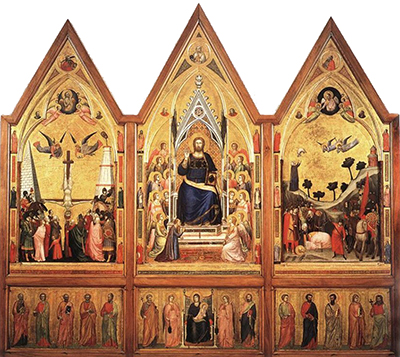
- c.1330–1335: Bologna and Saint Stephen
- 1334–1335: civic office and the Campanile
- Mid-1330s–1337: Milan, death and burial
- After 1337: completion, commemoration and conservation
c.1265–1267: a birth estimate, followed by an undocumented apprenticeship
Approximate date. Giotto's birth is usually placed around 1265 or 1267. Neither is a certified birthday. The familiar 1267 calculation depends on the Florentine poet Antonio Pucci's statement that Giotto died in his seventieth year. Pucci wrote within a few decades of the painter's death, making his testimony valuable, but seventy could also express a conventional full lifespan. Michael Viktor Schwarz and Pia Theis accordingly question whether it should be treated as precise arithmetic. Vasari's much later 1276 date presents a further difficulty rather than a second securely documented possibility. [1]
Vespignano in the Mugello belongs to the tradition of Giotto's origins, and his later property there is documented. That does not identify an authenticated birth house. The archival family evidence instead brings Florence into focus: his father Bondone was a blacksmith, and a brother, Martino, followed the same occupation. This gives the young painter a credible urban craftsman's background without supplying the missing details of his education. [1]
Later account. The child drawing sheep and attracting Cimabue's attention is an influential story, preserved in later biographical writing. It has no securely dated contemporary discovery record. A timeline therefore cannot responsibly give a year for that encounter, Giotto's entry into Cimabue's workshop, or his graduation to independent master. His relationship with earlier Florentine painting can be examined in the works; the childhood episode belongs to the history of his reputation. [4]
Late thirteenth century: early panels and the Santa Maria Novella cross
Approximate date. The Madonna from San Giorgio alla Costa is an important early reference point. Its current Opera del Duomo record gives approximately 1288–1295, while the accompanying description centres on about 1295. These are catalogue estimates, informed by the painting and its relationships with other works. They do not come from a surviving contract naming the day the panel was delivered. [5]

The Santa Maria Novella Crucifix; its execution date remains disputed.
Disputed dating. The Santa Maria Novella Crucifix makes the dating problem particularly clear. The church's public account proposes 1288–1289. Its historical archive note allows a first-decade-of-the-fourteenth-century date, with a secure boundary before 1312. Schwarz argues for 1298–1301 through comparisons and a reconstruction of the painter's early career. These positions should remain distinct; combining them into an apparently agreed date would conceal the question. [6]
The cross itself explains why this early phase matters. Christ's lowered head, bent legs and downward weight make the body seem suspended from its support. Small figures of Mary and John occupy the ends of the horizontal beam. Looking at the object gives substance to a discussion of Giotto's early achievement, even where a precise year remains elusive. Its large scale also belongs to a public church setting, quite different from a small panel intended for close inspection.
The firmer historical anchor comes later: a 1312 testament provided for a lamp associated with the cross, and a related 1314 account named Giotto as its maker. A bequest to illuminate an existing image establishes its presence and esteem; it need not identify the person who originally commissioned the painting. [6]
c.1290s, or a proposed later campaign: the Upper Church at Assisi
Disputed dating. The twenty-eight scenes of Francis's life in the Upper Church of San Francesco at Assisi are often placed in the 1290s. They have also generated unusually persistent arguments over both date and authorship. The basilica's own account acknowledges competing Giotto and Roman-school positions. Treating the whole sequence as twenty-eight unquestionably autograph paintings would suppress a central part of its history. [7]
Schwarz proposes a different sequence: a first campaign around 1308, with Paduan ideas transmitted either through Giotto's limited direction or through a former assistant, followed by further work. His proposal depends on the organisation of the paintings, their stylistic differences and the direction of relationships with other cycles. It is a named scholarly reconstruction, rather than a newly established consensus replacing the earlier chronology. [7]
The distinction has a large consequence. In one reconstruction, Assisi helps explain the development towards Padua; in another, knowledge of Padua helps explain Assisi. These are competing accounts of the relationship between the cycles. Neither establishes Giotto's continuous residence in a city throughout the proposed painting range.
Around 1300: Rimini and an early reputation across cities
Approximate date. Rimini's municipal account places Giotto's visit around 1300 and dates the surviving painted crucifix to the end of the thirteenth century. It remains in the church originally dedicated to San Francesco, later transformed into the Tempio Malatestiano. The surviving cross and the possibility of a lost fresco cycle are different kinds of evidence: one is an extant object; the other is a partially recoverable historical commission. [8]
An early-fourteenth-century writer, Riccobaldo of Ferrara, names Giotto's works at Assisi, Rimini and Padua, including the Arena Chapel and Padua's communal palace. His testimony shows that Giotto's name was already attached to work across several cities. It does not establish exact arrival and departure dates, identify the hand behind every surviving Assisi scene, or guarantee that all the works he knew remain intact. [9]
By 1301: a Florentine house
Documented date. Giotto is named as the owner of a house in the parish of Santa Maria Novella by 1301. Later records identify tenants and further references to his property. The painter who travelled for major commissions also had a financial and social connection with Florence that can be followed independently of the dates assigned to his pictures. [9]
Property records supply something that stylistic chronology often cannot: a particular legal relationship at a particular time. Even so, owning a house is different from occupying it every day. This evidence neither proves uninterrupted Florentine residence nor establishes a marriage date. It does make the familiar image of an artist wholly detached from business and ordinary urban affairs difficult to sustain.
c.1300–1305: the Ognissanti Madonna
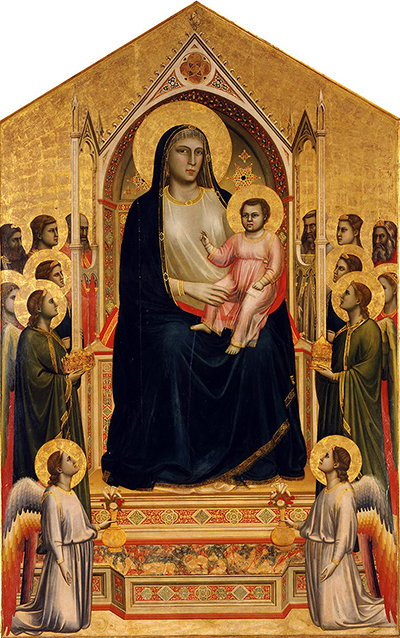
Approximate date. The Uffizi currently dates the Ognissanti Madonna to about 1300–1305. The frequently repeated date around 1310 belongs to a different chronological assessment. The museum's present range is useful because it identifies the position adopted by the current collection record; it should not be silently averaged with the later date. [10]
The picture is tempera on a gold-ground wooden panel. Its tall throne, the substantial body of Mary and the tiers of partly concealed saints give this traditional subject a powerful sense of occupied space. At the bottom, kneeling angels offer flowers. This is a different undertaking from decorating a chapel wall, even though the panel's proposed range overlaps the Paduan commission.
Its original position within Ognissanti remains uncertain. A possible side-altar or screen setting is not a documented installation. The chronological lesson is that overlapping ranges do not necessarily conflict: they may reflect limited precision in our knowledge, different phases of production, or the work of an organised workshop. They do not by themselves recover a day-by-day itinerary. [10]
c.1303–1305: painting the Scrovegni Chapel; 1305: consecration
Approximate date and documented ceremonial anchor. Padua's official account dates the principal decoration of the Scrovegni Chapel to 1303–1305. The chapel's history also records an initial dedication in 1303 and its consecration in 1305. Construction, the painting campaign and consecration concern related stages in the life of the building, rather than three interchangeable dates for the same event. [11]
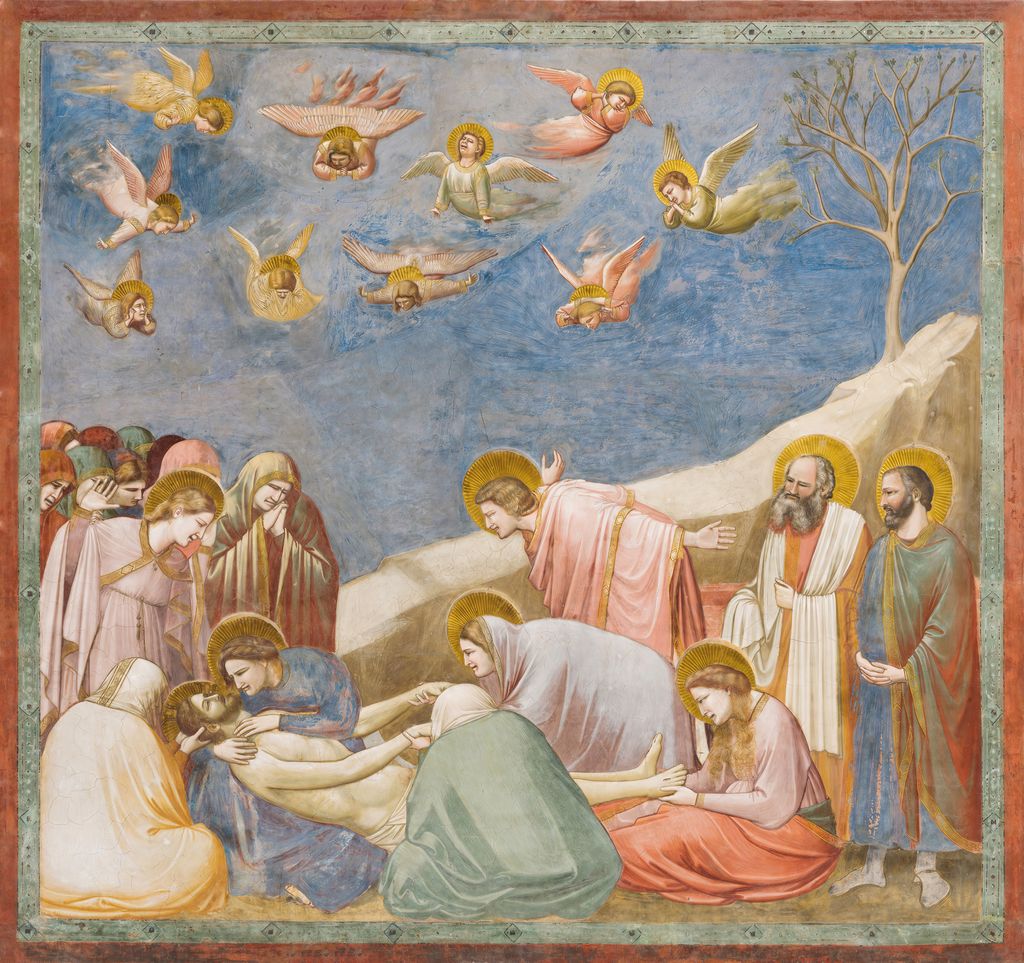
The Padua Lamentation within the chapel campaign conventionally dated 1303–05.
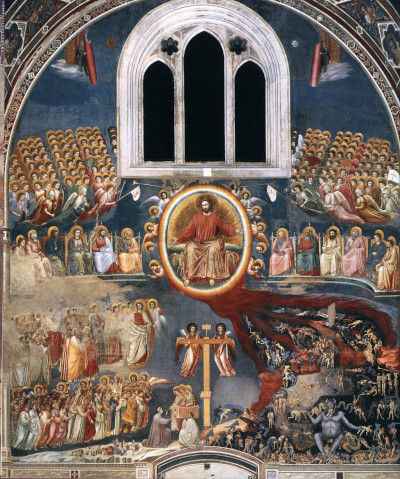
The programme covers the interior with the lives of Mary and Christ, a starry vault, opposing Virtues and Vices, and the Last Judgement. It is a particularly useful chronological anchor because much of the larger decorative setting survives. We can see how individual narratives belong to one room, while still allowing that different parts demanded different working methods and assistance.
In the Lamentation, a rocky slope directs attention towards Mary's encounter with the dead Christ. Back-turned mourners fill the foreground, John extends his arms, and grieving angels break across the blue sky. These details show the concentration of gesture and bodily presence achieved in this campaign. They cannot, however, assign a precise day to the scene or establish an assistant headcount.
The chapel's patron was Enrico Scrovegni. Its devotional purpose, family representation and concern for salvation belong together. Explanations centred entirely on repentance for usury have been challenged in scholarship; the dates of foundation and decoration do not independently prove a single motive or a securely identified theological adviser. [12]
1309–1312: an Assisi debt, legal capacity and a rented loom
Documented dates. A 1309 Assisi debt record connects Giotto with the painter Palmerino. It provides a valuable documentary link with the city. It is not a commission contract for the Upper Church's twenty-eight Franciscan scenes, and the existence of the debt does not resolve which surviving passages Giotto painted. [9]
In 1311 a Florentine notarial record identifies Giotto as an emancipated son of Bondone. The term concerns legal capacity within the family. It does not mean that Giotto had only just become an independent artist: his reputation and substantial commissions already preceded it. Medieval family law and the development of a painter's career ran on different timetables. [13]
The following year brings a notably concrete business transaction: Giotto rented a French loom to a worker named Bartolus Rinuccii. The document places him within the material economy of a textile-producing city, alongside his activity as a painter. It supports an account of investment beyond painting without requiring spectacular calculations of his profit or invented conclusions about the treatment of the worker. [13]
These modest records help explain the texture of the chronology. Painting commissions survive unevenly, while debt, rent and family obligations can leave a precise written trace. A year with a property transaction and no securely dated masterpiece is still part of the life.
c.1310–1320: small panels with separate catalogue dates
Approximate dates. The Washington National Gallery of Art dates its rose-bearing Madonna and Child, accession 1939.1.256, to c.1310/1315. This is the intimate image in which the child reaches for a flower and holds his mother's finger. It is distinct from both the early San Giorgio Madonna and the monumental Ognissanti panel. [14]
The London National Gallery's Pentecost, NG5360, is catalogued as Giotto and Workshop, probably about 1310–1318. Its compact architecture separates the gathered apostles from people listening outside. It belongs to a dispersed group of small Christ narratives, rather than being the fresco of the same subject in Padua. [15]
One associated panel, the Metropolitan Museum's Adoration of the Magi, accession 11.126.1, carries the museum's own qualified date, possibly about 1320. That small panel combines the reclining Mary and newborn child with the approaching kings. Its catalogue date should remain visible alongside London's broader, earlier range. A proposed common original ensemble does not make all modern catalogue dates identical. [16]
These are not the dates of the biblical events represented. They are estimates for the making of particular objects. Repeated subjects make that distinction essential: the Metropolitan panel and the Padua Adoration have different supports, settings and histories.
c.1311–1315, or a much later fresco campaign? The Peruzzi problem
Approximate date. The North Carolina Museum of Art dates the Peruzzi Altarpiece to about 1311–1315. Christ blessing occupies the centre, with Mary and saints beneath the other gables. The combination of John the Baptist, John the Evangelist and Francis supports a proposed origin in the Peruzzi family's chapel at Santa Croce. That destination is an argument from the ensemble, rather than a surviving commission contract. [17]
Disputed dating. The Peruzzi wall paintings are a separate work. Santa Croce's current account proposes c.1310–1311 for their paired stories of the two Johns. Schwarz instead argues for 1334–1336, chiefly through relationships with Andrea Pisano's Baptistery door and the character of Giotto's late work. [18]
These are rival dates for the same surviving cycle, rather than evidence of two separate painting campaigns. Schwarz's further suggestion that the range might narrow to 1334–1335 depends on assumptions about the beginning and location of Peruzzi devotional observances. The records of those observances do not themselves name a fresco completion date. [18]
The disagreement affects the shape of the whole career. An early date places the cycle near the aftermath of Padua; a late date makes it part of the final Florentine years. Its damaged, largely dry-ground painting also complicates visual comparison. A timeline can show the competing positions clearly without pretending that the absence of a contract has been overcome.
1315–1320: Mugello land and the painters' matriculation list
Documented dates. Landholding around Vespignano becomes particularly visible in records of 1315 and 1318. Giotto dealt with properties, debts and representatives; members of his family increasingly appear in the same local record. This rural connection is substantial, but it does not retrospectively certify Vespignano as his birthplace. [19]
Schwarz and Theis suggest that a period of acquisition might reflect the investment of a large painting fee, possibly associated with the Bardi Chapel. That is a plausible historical interpretation, not a payment document naming the chapel. The date of a purchase cannot simply be transferred to the frescoes as their documented completion. [19]
In 1320 Giotto heads a new list of painters within the Arte dei Medici e Speziali, the physicians' and apothecaries' guild. The position of his name suggests unusual prominence, although the list's ordering is not fully explained. A different register began in 1312 and later incorporated painters' names; its opening year is not proof that Giotto personally enrolled in 1312. The institutional change and his actual surviving entries need to be distinguished. [20]
1324–1326, with a further mention in 1331: family and ecclesiastical connections
Documented dates. In 1324 a papal provision benefited Giotto's son Bondone, also recorded as Donato. The alternative name belongs to the documents; it need not be explained through a speculative linguistic derivation. The provision reveals the family's access to ecclesiastical networks, including a Stefaneschi connection. It establishes such relationships by that date, without dating every painting made for the same patrons. [21]
The family evidence also changes how neatly a biographical timeline can be written. Seven children are documented: Bice, Bondone/Donato, Caterina, Chiara, Francesco, Lucia and Nicola. That means seven recoverable individuals, not necessarily every child ever born. Their later legal affairs reveal different activities and connections, including clerical careers and a painter son-in-law. [21]
Ciuta di Lapi Pele appears as Giotto's wife in documents of 1326 and 1331. Those mentions establish the marriage at those moments; they do not supply its beginning. An exact wedding year remains unknown. Ciuta's later involvement in the estate also shows why the painter's death does not end the family's documentary story. [21]
After 1317: the Bardi Chapel
Disputed dating, with a firm lower boundary. The Bardi Chapel paintings must follow 1317, the year Louis of Toulouse, represented on the rear wall, was canonised. Santa Croce's current historical dossier retains that boundary while acknowledging continuing disagreement over the exact date. Schwarz and Theis associate the commission with the period around 1320; Miklós Boskovits discusses a common placement around 1325. These remain scholarly positions within an unresolved chronology. [22]
Here Giotto and his workshop present Francis's life through six large side-wall scenes, with the Stigmatisation above the entrance and further figures on the rear wall and vault. This is a different ensemble from the Upper Church cycle at Assisi. Shared subjects cannot transfer the date, authorship or conservation history of one programme to the other.
The probable patron is Ridolfo de' Bardi. Both the family's patronage and the chapel's position within Santa Croce matter to its history, but an open dating range is more informative than an invented year of commencement. It allows the visible work, iconographic boundary and surviving documentary context to be considered together. [22]
Around 1320: the Stefaneschi Triptych and a less secure date for the Navicella
Approximate date. The Vatican Museums date the Stefaneschi Triptych to around 1320, with their description giving 1315–1320, and attribute it to Giotto with assistants. Cardinal Jacopo Stefaneschi commissioned the double-sided altarpiece for Old Saint Peter's. Its two faces accommodated different viewpoints; the patron is represented holding a model of the painting. [23]
The cardinal also commissioned the Navicella mosaic. The often cited 1298 date reaches us indirectly and remains problematic. The early commission, its later copies and the heavily reworked mosaic now seen at Saint Peter's require separate treatment. An image of the present mosaic cannot supply an untouched visual record of what Giotto made, and the triptych's date does not settle that of the mosaic. [24]
After 1328: the Baroncelli polyptych
Approximate date with an architectural boundary. Santa Croce dates the Baroncelli Polyptych after the chapel's foundation in 1328 and identifies Giotto and his workshop. Its signature, naming the work of Master Giotto, is important evidence of the commission's identity. It does not settle the allocation of every figure among the painters. [25]
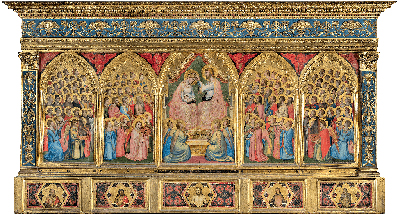
The Baroncelli Polyptych, dated by Santa Croce after the chapel’s 1328 foundation.
The crowded ranks of saints and musical angels spread across the panel divisions towards the central Coronation of the Virgin. The rectangular upper frame seen today belongs to later remodelling: the original pointed compartments were altered in the late fifteenth century, and the removed central pinnacle is now in San Diego. Dating the panel and dating its present framing are therefore different tasks. [25]
8 December 1328: a salary order in Naples
Documented date. A royal order of 8 December 1328 instructed payment of Giotto's monthly salary, effective from 1 December. The published documentary text reads December, resolving a September date repeated in some accounts. It establishes royal employment by the end of 1328 without recovering the precise date he entered Naples. [2]
The Neapolitan texts survive through their transmission and publication; they should not be imagined as newly inspected original parchments. Their practical detail nevertheless gives this part of the timeline a different character from an approximate panel date. Giotto was working within King Robert of Anjou's court and its machinery of salaries, supplies and accounting.
20 January 1330 and 20 May 1331: court standing and workshop expenditure
Documented dates. On 20 January 1330 Giotto was received as a royal familiar. This was a place within the king's household, accompanied by honours and privileges. It is not a record of knighthood. [2]
An account dated 20 May 1331 records expenditure involving decoration of the large and private chapels at Castel Nuovo, and a panel made in Giotto's lodging. Giotto appears as the leading master, alongside payments to other painters and manual workers. Gold, gilded tin and other materials make the work tangible even where the paintings themselves have largely disappeared. [2]
The document's final dating clause gives 1331. A conflicting 1330 reference in narrative summary should not override it. Nor does a single account date mean that every item was purchased or every painting completed on that day. It gathers expenses from a working enterprise, revealing organisation and collaboration more securely than the full appearance of the lost decorations. Further records carry Neapolitan payments into 1333, without filling every interval with a known location for the master. [26]
c.1330–1335: Bologna and the Horne Saint Stephen
Approximate dates. The Pinacoteca Nazionale di Bologna dates its signed Bologna Polyptych to about 1330 and describes production by Giotto and his workshop, probably in Florence. Its account proposes an original destination in the papal palace's great chapel near Porta Galliera. Schwarz favours a different context involving Santa Maria degli Angeli and the Pepoli family. These competing reconstructions affect how the painting is placed within Giotto's late commissions. [27]

Bologna Polyptych
The reverse of the central panel bears a graffito read as referring to 1326. Schwarz explicitly cautions against treating it as though Giotto had formally signed the front and dated the back. It cannot supply a certified execution year. A portable altarpiece might also travel without its maker: its destination alone does not establish a personal visit on a particular date. [27]
The Museo Horne dates its Saint Stephen to about 1330–1335 and proposes that the panel may have belonged to an altarpiece at Santa Croce. Attempts to associate it with the Washington Madonna remain a reconstruction problem. The differing current catalogue dates should remain attached to their respective objects, rather than being forced into one agreed ensemble chronology. [28]
12 April 1334: Florence appoints Giotto to civic building responsibilities
Documented date. The Florentine decision of 12 April 1334 appointed Giotto to responsibilities extending across Santa Reparata, the city's walls and fortifications, and other communal building works. This was broader than the bell tower alone. The document's praise also makes clear that the city valued the prestige and knowledge of the famous painter. [3]

The cathedral bell tower Giotto began, with its later completed elevation.
Its invitation wording treats Giotto as someone to be welcomed home. The appointment therefore does not independently prove that he stood in Florence on that exact day. Office, return and physical work on the building have related but separate chronologies.
The name Santa Reparata belongs to the cathedral context of the record. Giotto's appointment does not make him the author of the entire cathedral as it now stands. The later dome, later architectural phases and nineteenth-century facade fall outside his lifetime work. The cathedral history and the Campanile explain those distinctions in greater detail.
18 July 1334: the Campanile foundation, as reported by Villani
Contemporary chronicle account. Giovanni Villani reports that the new bell tower's foundation began on 18 July 1334, with a public ceremony involving bishop, clergy and civic authorities. His chronicle was written close to the events; it supplies a different kind of evidence from the April administrative decision. The two dates concern appointment and foundation respectively. [29]
Giotto began the tower, but the complete building visible today incorporates the work of successors. Its marble patterns, sculptural levels and large upper windows belong to a long construction history. Neither its enduring nickname nor a photograph of the completed tower proves that Giotto designed every visible feature or carved its reliefs.
12 December 1335: a witness in the cathedral workshop
Documented date. A notarial record made at Santa Reparata on 12 December 1335 names Giotto Bondonis, painter, as a witness. The transaction acknowledged a small pious bequest to the cathedral works. It supplies a fixed Florentine point in the final phase of his life. [30]
Its value is partly its modesty. A person identified in an ordinary transaction can locate the painter more firmly than a wide stylistic range assigned to a prestigious picture. It still leaves the surrounding months open: the record cannot turn an incompletely known late career into a continuous itinerary.
Mid-1330s: service in Milan
Near-contemporary account; precise itinerary uncertain. Villani says Florence sent Giotto to serve the lord of Milan and that the painter returned before his death. The Milanese ruler was Azzone Visconti, who should not be given the later title Duke of Milan. The chronicle establishes the episode more securely than its exact duration or the full appearance of the lost decoration. [29]
This service belongs near the end of the career, alongside the Florentine building office. It does not justify assigning Giotto an uninterrupted Milan residence between invented arrival and departure dates. The gaps remain real even in the best-documented final years.
8 January 1337: death in Florence
Near-contemporary account. Villani records Giotto's death on 8 January 1336 in Florentine year reckoning, corresponding to 8 January 1337 in modern dating. Florence began its year in March, so January belonged to the preceding numbered year. The apparent disagreement between 1336 and 1337 can therefore be a calendar difference rather than contradictory evidence of two death dates. [29]
Villani also reports burial with great civic honour in Santa Reparata. The burial, the later commemorative monument and the modern identification of excavated bones are separate questions. Schwarz and Theis caution that the proposed skeletal identification has not securely established Giotto's remains. It should not be used to give the timeline an authenticated physical portrait or medical conclusion. [31]
After 1337: the tower, the remembered artist and the surviving surfaces
1359: completion by successors. Andrea Pisano and Francesco Talenti continued the Campanile after Giotto's death. The Opera del Duomo dates its completion to 1359 under Talenti, whose crowning terrace varied the initial project. The tower's completed silhouette thus belongs to Giotto's legacy as well as to the history of later builders. [32]
Fourteenth and fifteenth centuries: literary fame. Giotto had already appeared in Dante's Purgatorio, where Oderisi speaks of the changing fame of Cimabue and Giotto within a meditation on pride. Later, Boccaccio and Ghiberti helped shape the painter's remembered character and origins. The dates of these literary witnesses belong to reception history; their stories do not become contemporary records of childhood merely because later writers repeated them. [4]
1490: a cathedral memorial. Benedetto da Maiano was paid in 1490 for the sculptural commemoration of Giotto in Florence Cathedral. Its inscription praises the revival of painting and the tower. The monument shows how strongly Florence had claimed him as an exemplary citizen and artist more than a century after his death. Its portrait is commemorative, rather than a securely documented likeness taken from life. [33]
1851 and 1957–1959: the Bardi paintings reappear and change again. Uncovering beneath limewash began in 1851, followed by Gaetano Bianchi's extensive restoration. In 1957–1959, Ugo Procacci and Leonetto Tintori removed nineteenth-century additions, exposing both original painting and major losses. The 2022–2026 campaign pursued preservation and improved legibility together. These dates explain why photographs made at different moments can show different versions of an apparently identical scene. [22]
2001–2002: conservation at Padua. The major Scrovegni campaign belongs to the modern history of the chapel, alongside subsequent monitoring and maintenance. It helps preserve the paintings as a connected environment rather than isolated famous images. [34] Following Giotto through time therefore also means following the later lives of his works: altered frames, rebuilt architecture, damaged surfaces and careful conservation all stand between their making and their appearance today.
Watch: Explore Giotto’s Art
Choose an overview or a closer look at three major works. These films provide wider Giotto context alongside this article.
Artworks directory
This directory brings together 209 records for paintings, ensembles, individual scenes and components, architectural work, an associated disputed design, and reported or lost projects connected with Giotto. Ensembles and their parts appear separately, so 209 is a count of records rather than independent paintings or commissions. Attributions and dates remain qualified where disputed; inclusion does not establish Giotto’s own hand throughout.
| Name | Date | Medium, attribution and status |
|---|---|---|
| Expulsion of Joachim from the Temple — Scrovegni Chapel, Padua | c.1303–05 (chapel campaign) | Fresco / wall painting. Giotto and workshop. Scene within a cycle. Padova Musei. Chapel overview. |
| Joachim among the Shepherds — Scrovegni Chapel, Padua | c.1303–05 (chapel campaign) | Fresco / wall painting. Giotto and workshop. Scene within a cycle. Padova Musei. Chapel overview. |
| Annunciation to Saint Anne — Scrovegni Chapel, Padua | c.1303–05 (chapel campaign) | Fresco / wall painting. Giotto and workshop. Scene within a cycle. Padova Musei. Chapel overview. |
| Sacrifice of Joachim — Scrovegni Chapel, Padua | c.1303–05 (chapel campaign) | Fresco / wall painting. Giotto and workshop. Scene within a cycle. Padova Musei. Chapel overview. |
| Joachim’s Dream — Scrovegni Chapel, Padua | c.1303–05 (chapel campaign) | Fresco / wall painting. Giotto and workshop. Scene within a cycle. Padova Musei. Padova Musei. Chapel overview. |
| Meeting at the Golden Gate — Scrovegni Chapel, Padua | c.1303–05 (chapel campaign) | Fresco / wall painting. Giotto and workshop. Scene within a cycle. Padova Musei. Chapel overview. |
| Birth of the Virgin — Scrovegni Chapel, Padua | c.1303–05 (chapel campaign) | Fresco / wall painting. Giotto and workshop. Scene within a cycle. Padova Musei. Padova Musei. Chapel overview. |
| Presentation of the Virgin in the Temple — Scrovegni Chapel, Padua | c.1303–05 (chapel campaign) | Fresco / wall painting. Giotto and workshop. Scene within a cycle. Padova Musei. Chapel overview. |
| Delivery of the Rods — Scrovegni Chapel, Padua | c.1303–05 (chapel campaign) | Fresco / wall painting. Giotto and workshop. Scene within a cycle. Padova Musei. Chapel overview. |
| Prayer of Joseph and the Suitors — Scrovegni Chapel, Padua | c.1303–05 (chapel campaign) | Fresco / wall painting. Giotto and workshop. Scene within a cycle. Padova Musei. Chapel overview. |
| Marriage of the Virgin — Scrovegni Chapel, Padua | c.1303–05 (chapel campaign) | Fresco / wall painting. Giotto and workshop. Scene within a cycle. Padova Musei. Chapel overview. |
| Wedding Procession of Mary — Scrovegni Chapel, Padua | c.1303–05 (chapel campaign) | Fresco / wall painting. Giotto and workshop. Scene within a cycle. Padova Musei. Chapel overview. |
| Annunciation on the triumphal arch — complete ensemble (Scrovegni Chapel, Padua) | c.1303–05 (chapel campaign) | Wall painting with a central painted wooden panel. Giotto and workshop. Ensemble. Includes the Mission of Gabriel and the lower Annunciation pair; the original central wooden panel is in the Musei Civici agli Eremitani, with a conservation copy in the chapel. Padova Musei. Padova Musei. Scholarly study. Chapel overview. |
| Visitation — Scrovegni Chapel, Padua | c.1303–05 (chapel campaign) | Fresco / wall painting. Giotto and workshop. Scene within a cycle. Padova Musei. Chapel overview. |
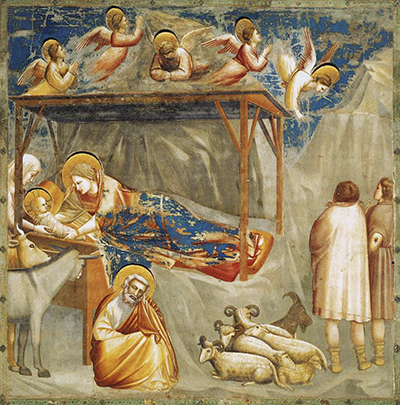
| Nativity — Scrovegni Chapel, Padua | c.1303–05 (chapel campaign) | Fresco / wall painting. Giotto and workshop. Scene within a cycle. Padova Musei. Chapel overview. |
| Adoration of the Magi — Scrovegni Chapel, Padua | c.1303–05 (chapel campaign) | Fresco / wall painting. Giotto and workshop. Scene within a cycle. Padova Musei. Chapel overview. |
| Presentation of Christ at the Temple — Scrovegni Chapel, Padua | c.1303–05 (chapel campaign) | Fresco / wall painting. Giotto and workshop. Scene within a cycle. Padova Musei. Chapel overview. |
| Flight into Egypt — Scrovegni Chapel, Padua | c.1303–05 (chapel campaign) | Fresco / wall painting. Giotto and workshop. Scene within a cycle. Padova Musei. Chapel overview. |
| Massacre of the Innocents — Scrovegni Chapel, Padua | c.1303–05 (chapel campaign) | Fresco / wall painting. Giotto and workshop. Scene within a cycle. Padova Musei. Chapel overview. |
| Christ among the Doctors — Scrovegni Chapel, Padua | c.1303–05 (chapel campaign) | Fresco / wall painting. Giotto and workshop. Scene within a cycle. Padova Musei. Chapel overview. |
| Baptism of Christ — Scrovegni Chapel, Padua | c.1303–05 (chapel campaign) | Fresco / wall painting. Giotto and workshop. Scene within a cycle. Padova Musei. Chapel overview. |
| Marriage at Cana — Scrovegni Chapel, Padua | c.1303–05 (chapel campaign) | Fresco / wall painting. Giotto and workshop. Scene within a cycle. Padova Musei. Padova Musei. Chapel overview. |
| Raising of Lazarus — Scrovegni Chapel, Padua | c.1303–05 (chapel campaign) | Fresco / wall painting. Giotto and workshop. Scene within a cycle. Padova Musei. Chapel overview. |
| Entry into Jerusalem — Scrovegni Chapel, Padua | c.1303–05 (chapel campaign) | Fresco / wall painting. Giotto and workshop. Scene within a cycle. Padova Musei. Chapel overview. |
| Expulsion of the Money Changers — Scrovegni Chapel, Padua | c.1303–05 (chapel campaign) | Fresco / wall painting. Giotto and workshop. Scene within a cycle. Padova Musei. Padova Musei. Chapel overview. |
| Judas Receiving the Payment — Scrovegni Chapel, Padua | c.1303–05 (chapel campaign) | Fresco / wall painting. Giotto and workshop. Scene within a cycle. Padova Musei. Chapel overview. |
| Last Supper — Scrovegni Chapel, Padua | c.1303–05 (chapel campaign) | Fresco / wall painting. Giotto and workshop. Scene within a cycle. Padova Musei. Chapel overview. |
| Washing of the Feet — Scrovegni Chapel, Padua | c.1303–05 (chapel campaign) | Fresco / wall painting. Giotto and workshop. Scene within a cycle. Padova Musei. Chapel overview. |
| Arrest of Christ — Scrovegni Chapel, Padua | c.1303–05 (chapel campaign) | Fresco / wall painting. Giotto and workshop. Scene within a cycle. Padova Musei. Chapel overview. |
| Christ before Annas and Caiaphas — Scrovegni Chapel, Padua | c.1303–05 (chapel campaign) | Fresco / wall painting. Giotto and workshop. Scene within a cycle. Padova Musei. Chapel overview. |
| Mocking of Christ and Flagellation — Scrovegni Chapel, Padua | c.1303–05 (chapel campaign) | Fresco / wall painting. Giotto and workshop. Scene within a cycle. Padova Musei. Chapel overview. |
| Road to Calvary — Scrovegni Chapel, Padua | c.1303–05 (chapel campaign) | Fresco / wall painting. Giotto and workshop. Scene within a cycle. Padova Musei. Chapel overview. |
| Crucifixion — Scrovegni Chapel, Padua | c.1303–05 (chapel campaign) | Fresco / wall painting. Giotto and workshop. Scene within a cycle. Padova Musei. Chapel overview. |
| Lamentation — Scrovegni Chapel, Padua | c.1303–05 (chapel campaign) | Fresco / wall painting. Giotto and workshop. Scene within a cycle. Padova Musei. Chapel overview. |
| Resurrection / Noli me tangere — Scrovegni Chapel, Padua | c.1303–05 (chapel campaign) | Fresco / wall painting. Giotto and workshop. Scene within a cycle. Padova Musei. Chapel overview. |
| Ascension — Scrovegni Chapel, Padua | c.1303–05 (chapel campaign) | Fresco / wall painting. Giotto and workshop. Scene within a cycle. Padova Musei. Chapel overview. |
| Pentecost — Scrovegni Chapel, Padua | c.1303–05 (chapel campaign) | Fresco / wall painting. Giotto and workshop. Scene within a cycle. Padova Musei. Padova Musei. Chapel overview. |
| Coretto — right painted recess (Scrovegni Chapel, Padua) | c.1303–05 (chapel campaign) | Fresco / painted fictive architecture. Giotto and workshop. Ensemble component. Padova Musei. Padova Musei. Scholarly study. Chapel overview. |
| Coretto — left painted recess (Scrovegni Chapel, Padua) | c.1303–05 (chapel campaign) | Fresco / painted fictive architecture. Giotto and workshop. Ensemble component. Padova Musei. Padova Musei. Scholarly study. Chapel overview. |
| Envy — Scrovegni Chapel, Padua | c.1303–05 (chapel campaign) | Grisaille fresco / wall painting. Giotto and workshop. Ensemble component. Padova Musei. Chapel overview. Scholarly study. Padova Musei. |
| Despair — Scrovegni Chapel, Padua | c.1303–05 (chapel campaign) | Grisaille fresco / wall painting. Giotto and workshop. Ensemble component. Padova Musei. Chapel overview. Scholarly study. Padova Musei. |
| Prudence — Scrovegni Chapel, Padua | c.1303–05 (chapel campaign) | Grisaille fresco / wall painting. Giotto and workshop. Ensemble component. Padova Musei. Chapel overview. Scholarly study. Padova Musei. |
| Fortitude — Scrovegni Chapel, Padua | c.1303–05 (chapel campaign) | Grisaille fresco / wall painting. Giotto and workshop. Ensemble component. Padova Musei. Chapel overview. Scholarly study. Padova Musei. |
| Temperance — Scrovegni Chapel, Padua | c.1303–05 (chapel campaign) | Grisaille fresco / wall painting. Giotto and workshop. Ensemble component. Padova Musei. Chapel overview. Scholarly study. Padova Musei. |
| Justice — Scrovegni Chapel, Padua | c.1303–05 (chapel campaign) | Grisaille fresco / wall painting. Giotto and workshop. Ensemble component. Padova Musei. Chapel overview. Scholarly study. Padova Musei. |
| Faith — Scrovegni Chapel, Padua | c.1303–05 (chapel campaign) | Grisaille fresco / wall painting. Giotto and workshop. Ensemble component. Padova Musei. Chapel overview. Scholarly study. Padova Musei. |
| Charity — Scrovegni Chapel, Padua | c.1303–05 (chapel campaign) | Grisaille fresco / wall painting. Giotto and workshop. Ensemble component. Padova Musei. Chapel overview. Scholarly study. Padova Musei. |
| Hope — Scrovegni Chapel, Padua | c.1303–05 (chapel campaign) | Grisaille fresco / wall painting. Giotto and workshop. Ensemble component. Padova Musei. Chapel overview. Scholarly study. Padova Musei. |
| Folly — Scrovegni Chapel, Padua | c.1303–05 (chapel campaign) | Grisaille fresco / wall painting. Giotto and workshop. Ensemble component. Padova Musei. Chapel overview. Scholarly study. Padova Musei. |
| Inconstancy — Scrovegni Chapel, Padua | c.1303–05 (chapel campaign) | Grisaille fresco / wall painting. Giotto and workshop. Ensemble component. Padova Musei. Chapel overview. Scholarly study. Padova Musei. |
| Wrath — Scrovegni Chapel, Padua | c.1303–05 (chapel campaign) | Grisaille fresco / wall painting. Giotto and workshop. Ensemble component. Padova Musei. Chapel overview. Scholarly study. Padova Musei. |
| Injustice — Scrovegni Chapel, Padua | c.1303–05 (chapel campaign) | Grisaille fresco / wall painting. Giotto and workshop. Ensemble component. Padova Musei. Chapel overview. Scholarly study. Padova Musei. |
| Infidelity / Idolatry — Scrovegni Chapel, Padua | c.1303–05 (chapel campaign) | Grisaille fresco / wall painting. Giotto and workshop. Ensemble component. Padova Musei. Chapel overview. Scholarly study. Padova Musei. |
| Starry vault — complete ensemble (Scrovegni Chapel, Padua) | c.1303–05 (chapel campaign) | Vault painting. Giotto and workshop. Ensemble. Padova Musei. Padova Musei. Chapel overview. |
| Last Judgement — Scrovegni Chapel, Padua | c.1303–05 (chapel campaign) | Fresco / wall painting. Giotto and workshop. Scene within a cycle. Padova Musei. Padova Musei. Chapel overview. Padova Musei. |
| Prophet Malachi — vault medallion — Scrovegni Chapel, Padua | c.1303–05 (chapel campaign) | Fresco / wall painting. Giotto and workshop. Ensemble component. Padova Musei. Padova Musei. Chapel overview. Padova Musei. |
| Prophet Baruch — vault medallion — Scrovegni Chapel, Padua | c.1303–05 (chapel campaign) | Fresco / wall painting. Giotto and workshop. Ensemble component. Padova Musei. Padova Musei. Chapel overview. Padova Musei. |
| Prophet Isaiah — vault medallion — Scrovegni Chapel, Padua | c.1303–05 (chapel campaign) | Fresco / wall painting. Giotto and workshop. Ensemble component. Padova Musei. Padova Musei. Chapel overview. Padova Musei. |
| Prophet Daniel — vault medallion — Scrovegni Chapel, Padua | c.1303–05 (chapel campaign) | Fresco / wall painting. Giotto and workshop. Ensemble component. Padova Musei. Padova Musei. Chapel overview. Padova Musei. |
| Christ Pantocrator — vault medallion — Scrovegni Chapel, Padua | c.1303–05 (chapel campaign) | Fresco / wall painting. Giotto and workshop. Ensemble component. Padova Musei. Padova Musei. Chapel overview. Padova Musei. |
| Virgin and Child — vault medallion — Scrovegni Chapel, Padua | c.1303–05 (chapel campaign) | Fresco / wall painting. Giotto and workshop. Ensemble component. Padova Musei. Padova Musei. Chapel overview. Padova Musei. |
| Prophet Ezekiel — vault medallion — Scrovegni Chapel, Padua | c.1303–05 (chapel campaign) | Fresco / wall painting. Giotto and workshop. Ensemble component. Padova Musei. Padova Musei. Chapel overview. Padova Musei. |
| Prophet Micah — vault medallion — Scrovegni Chapel, Padua | c.1303–05 (chapel campaign) | Fresco / wall painting. Giotto and workshop. Ensemble component. Padova Musei. Padova Musei. Chapel overview. Padova Musei. |
| Saint John the Baptist — vault medallion — Scrovegni Chapel, Padua | c.1303–05 (chapel campaign) | Fresco / wall painting. Giotto and workshop. Ensemble component. Padova Musei. Padova Musei. Chapel overview. Padova Musei. |
| Scrovegni Chapel — painted decoration | c.1303–05 (chapel campaign) | Fresco / wall painting, with a painted wooden panel. Giotto and workshop (painted decoration). Ensemble. Includes separately listed scenes and components. The original central God the Father panel is in the Musei Civici agli Eremitani; a conservation copy is in the chapel. Chapel overview. Padova Musei. Padova Musei. Source. Source. Source. Padova Musei. Scholarly study. |
| Vices and Virtues — complete fourteen-figure programme | c.1303–05 (chapel campaign) | Grisaille fresco / wall painting. Giotto and workshop. Ensemble. Fourteen figures: seven virtues and seven opposed vices. Padova Musei. Chapel overview. Scholarly study. |
| Coretti — paired fictive chapels | c.1303–05 (chapel campaign) | Fresco / painted fictive architecture. Giotto and workshop. Ensemble. Two separate painted recesses, also listed individually. Padova Musei. Padova Musei. Scholarly study. |
| Mission of Gabriel — heavenly assembly | c.1303–05 (chapel campaign) | Wall painting with central painted wooden image. Giotto and workshop. Ensemble component. Central wooden God the Father panel preserved at the Musei Civici agli Eremitani; conservation copy in the chapel. Chapel overview. Padova Musei. Scholarly study. Padova Musei. |
| Annunciation — Gabriel and Mary in facing chambers | c.1303–05 (chapel campaign) | Fresco / wall painting. Giotto and workshop. Ensemble component. Chapel overview. Scholarly study. Padova Musei. |
| God the Father — central wooden panel of the Mission of Gabriel | c.1303–05 (chapel campaign) | Painting on wood. Associated with Giotto. Ensemble component. Original at the Musei Civici agli Eremitani, Padua; conservation copy in the Scrovegni Chapel. Padova Musei. Padova Musei. Scholarly study. Source. |
| Life of Saint Francis — Upper Church cycle, Assisi | Late 13th–early 14th century; dating disputed | Fresco / wall-painting cycle. Traditionally associated with Giotto; Giotto, Roman-school and other attributions disputed. Ensemble. Twenty-eight-scene nave cycle; scenes also listed individually. Basilica catalogue. Scholarly study. Basilica catalogue. Source. Source. |
| Homage of a Simple Man — Upper Church, Assisi | Late 13th–early 14th century; dating disputed | Wall painting. Traditionally associated with Giotto; authorship and dating disputed. Scene within a cycle. Source. Scholarly study. Source. Source. Source. |
| Gift of the Mantle — Upper Church, Assisi | Late 13th–early 14th century; dating disputed | Wall painting. Traditionally associated with Giotto; authorship and dating disputed. Scene within a cycle. Basilica catalogue. Scholarly study. Source. Source. Source. |
| Dream of the Palace Full of Arms — Upper Church, Assisi | Late 13th–early 14th century; dating disputed | Wall painting. Traditionally associated with Giotto; authorship and dating disputed. Scene within a cycle. Basilica catalogue. Source. Scholarly study. Source. Source. Source. |
| Prayer before the Crucifix at San Damiano — Upper Church, Assisi | Late 13th–early 14th century; dating disputed | Wall painting. Traditionally associated with Giotto; authorship and dating disputed. Scene within a cycle. Source. Source. Source. Scholarly study. Source. Source. |
| Renunciation of Worldly Goods — Upper Church, Assisi | Late 13th–early 14th century; dating disputed | Wall painting. Traditionally associated with Giotto; authorship and dating disputed. Scene within a cycle. Source. Scholarly study. Source. Source. |
| Dream of Innocent III — Upper Church, Assisi | Late 13th–early 14th century; dating disputed | Wall painting. Traditionally associated with Giotto; authorship and dating disputed. Scene within a cycle. Source. Source. Scholarly study. Source. Source. |
| Confirmation of the Rule — Upper Church, Assisi | Late 13th–early 14th century; dating disputed | Wall painting. Traditionally associated with Giotto; authorship and dating disputed. Scene within a cycle. Source. Scholarly study. Source. Source. |
| Vision of the Flaming Chariot — Upper Church, Assisi | Late 13th–early 14th century; dating disputed | Wall painting. Traditionally associated with Giotto; authorship and dating disputed. Scene within a cycle. Source. Source. Scholarly study. Source. Source. |
| Vision of the Thrones — Upper Church, Assisi | Late 13th–early 14th century; dating disputed | Wall painting. Traditionally associated with Giotto; authorship and dating disputed. Scene within a cycle. Basilica catalogue. Scholarly study. Source. Source. Source. |
| Expulsion of Devils from Arezzo — Upper Church, Assisi | Late 13th–early 14th century; dating disputed | Wall painting. Traditionally associated with Giotto; authorship and dating disputed. Scene within a cycle. Source. Source. Scholarly study. Source. Source. Source. |
| Trial by Fire before the Sultan — Upper Church, Assisi | Late 13th–early 14th century; dating disputed | Wall painting. Traditionally associated with Giotto; authorship and dating disputed. Scene within a cycle. Source. Source. Scholarly study. Source. Source. |
| Ecstasy of Saint Francis — Upper Church, Assisi | Late 13th–early 14th century; dating disputed | Wall painting. Traditionally associated with Giotto; authorship and dating disputed. Scene within a cycle. Source. Source. Source. Scholarly study. Source. Source. |
| Nativity at Greccio — Upper Church, Assisi | Late 13th–early 14th century; dating disputed | Wall painting. Traditionally associated with Giotto; authorship and dating disputed. Scene within a cycle. Basilica catalogue. Scholarly study. Source. Source. Source. |
| Miracle of the Spring — Upper Church, Assisi | Late 13th–early 14th century; dating disputed | Wall painting. Traditionally associated with Giotto; authorship and dating disputed. Scene within a cycle. Source. Scholarly study. Source. Source. Source. |
| Sermon to the Birds — Upper Church, Assisi | Late 13th–early 14th century; dating disputed | Wall painting. Traditionally associated with Giotto; authorship and dating disputed. Scene within a cycle. Basilica catalogue. Scholarly study. Source. Source. Source. |
| Death of the Knight of Celano — Upper Church, Assisi | Late 13th–early 14th century; dating disputed | Wall painting. Traditionally associated with Giotto; authorship and dating disputed. Scene within a cycle. Source. Source. Scholarly study. Source. Source. |
| Sermon before Pope Honorius III — Upper Church, Assisi | Late 13th–early 14th century; dating disputed | Wall painting. Traditionally associated with Giotto; authorship and dating disputed. Scene within a cycle. Source. Source. Scholarly study. Source. |
| Apparition at the Chapter of Arles — Upper Church, Assisi | Late 13th–early 14th century; dating disputed | Wall painting. Traditionally associated with Giotto; authorship and dating disputed. Scene within a cycle. Basilica catalogue. Scholarly study. Source. Source. Source. |
| Stigmatisation — Upper Church, Assisi | Late 13th–early 14th century; dating disputed | Wall painting. Traditionally associated with Giotto; authorship and dating disputed. Scene within a cycle. Source. Scholarly study. Source. Source. |
| Death and Ascension of Saint Francis — Upper Church, Assisi | Late 13th–early 14th century; dating disputed | Wall painting. Traditionally associated with Giotto; authorship and dating disputed. Scene within a cycle. Basilica catalogue. Scholarly study. Source. Source. Source. |
| Apparition to Brother Augustine and Bishop Guido — Upper Church, Assisi | Late 13th–early 14th century; dating disputed | Wall painting. Traditionally associated with Giotto; authorship and dating disputed. Scene within a cycle. Zeri catalogue. Scholarly study. Source. Source. Source. |
| Verification of the Stigmata — Upper Church, Assisi | Late 13th–early 14th century; dating disputed | Wall painting. Traditionally associated with Giotto; authorship and dating disputed. Scene within a cycle. Source. Source. Scholarly study. Source. Source. |
| Mourning of the Poor Clares — Upper Church, Assisi | Late 13th–early 14th century; dating disputed | Wall painting. Traditionally associated with Giotto; authorship and dating disputed. Scene within a cycle. Basilica catalogue. Source. Scholarly study. Source. Source. |
| Canonisation of Saint Francis — Upper Church, Assisi | Late 13th–early 14th century; dating disputed | Wall painting. Traditionally associated with Giotto; authorship and dating disputed. Scene within a cycle. Source. Source. Scholarly study. Source. Source. Source. |
| Apparition to Pope Gregory IX — Upper Church, Assisi | Late 13th–early 14th century; dating disputed | Wall painting. Traditionally associated with Giotto; authorship and dating disputed. Scene within a cycle. Zeri catalogue. Scholarly study. Source. Source. Source. |
| Healing of John of Lerida — Upper Church, Assisi | Late 13th–early 14th century; dating disputed | Wall painting. Traditionally associated with Giotto; authorship and dating disputed. Scene within a cycle. Source. Source. Scholarly study. Source. Source. |
| Resurrection of a Woman — Upper Church, Assisi | Late 13th–early 14th century; dating disputed | Wall painting. Traditionally associated with Giotto; authorship and dating disputed. Scene within a cycle. Source. Scholarly study. Source. Source. Source. |
| Liberation of the Prisoner Peter — Upper Church, Assisi | Late 13th–early 14th century; dating disputed | Wall painting. Traditionally associated with Giotto; authorship and dating disputed. Scene within a cycle. Source. Source. Scholarly study. Source. Source. Source. |
| Santa Maria Novella Crucifix | Late 13th century; c.1288–89 or 1298–1301; disputed | Tempera and gold on a shaped wooden cross. Giotto. Source. |
| Death of the Virgin / Dormition — Berlin | c.1310 | Tempera and gold on poplar; gabled dossal. Giotto. Source. Source. |
| Peruzzi Altarpiece | c.1311–1315 (North Carolina Museum of Art) | Tempera and gold on panel. Giotto and workshop. Ensemble. Source. |
| Bologna Polyptych | c.1330 | Tempera and gold on panel. Giotto and workshop. Ensemble. Source. |
| Death of Saint Francis, Bardi Chapel | After 1317, usually the 1320s; disputed | Wall painting with wet-plaster and dry-applied passages. Giotto. Scene within a cycle. Source. |
| Bardi Chapel — painted decoration | After 1317, usually the 1320s; disputed | Wall painting with wet-plaster and dry-applied passages. Giotto and workshop / Giottesque painters; individual hands disputed. Ensemble. Scholarly study. Source. |
| Badia Polyptych | c.1300; proposed dates include 1295–1300 and 1301–02 | Tempera and gold on panel; five cusped compartments. Giotto. Ensemble. Scholarly study. Source. Source. |
| Baroncelli Polyptych | After 1328; detached pinnacle c.1328–35 | Tempera and gold on panel; later altered framing. Giotto and workshop. Ensemble. Detached central pinnacle in San Diego. Santa Croce. |
| Adoration of the Magi / Epiphany — Metropolitan Museum panel | Possibly c.1320; c.1310–18 also proposed for the group | Tempera and gold on wood. Giotto. Part of the dispersed seven-scene board; original function disputed. Met catalogue. Source. |
| Franciscan Allegories | Early 14th century, often c.1315; disputed | Vault wall painting. Giotto and workshop / Giottesque painters; individual hands disputed. Ensemble. Basilica catalogue. |
| Navicella — lost / reworked original mosaic | Late 13th–early 14th century; date disputed | Mosaic. Original attributed to Giotto. Original lost / reworked; fragments and later remakes survive. Scholarly study. |
| Pentecost — London panel | Possibly c.1310–18 (Gordon) | Egg tempera on poplar. Giotto and workshop. Part of the dispersed seven-scene board; original function disputed. National Gallery. Source. |
| Saint Stephen — Horne panel | c.1330–1335 (Museo Horne) | Tempera and gold on panel. Giotto. Proposed association with the Washington and Chaalis panels remains hypothetical. Source. |
| Saint Francis Receiving the Stigmata — Louvre altarpiece | 1300–25 (Louvre) | Tempera and gold on poplar. Giotto. Louvre catalogue. |
| Stefaneschi Triptych | c.1320; 1315–20 (Vatican Museums) | Tempera and gold on panel; painted on both sides. Giotto and workshop. Ensemble. Vatican Museums. |
| Crucifixion, Berlin | c.1315–1320 | Tempera and gold on poplar. Giotto. Source. |
| Madonna and Child — Washington / Goldman Madonna | c.1310–1315 (National Gallery of Art) | Tempera and gold on poplar. Giotto. Washington panel, distinct from San Giorgio alla Costa; proposed Horne/Chaalis companions remain hypothetical. NGA catalogue. |
| Ognissanti Madonna | c.1300–05 (Uffizi); c.1310 also proposed | Tempera and gold on panel. Giotto. Uffizi. |
| Madonna of Borgo San Lorenzo | c.1290–95; dating and attribution debated | Tempera and gold on a fragment of a wooden panel. Giotto. Fragmentary. Source. |
| Madonna of San Giorgio alla Costa | c.1288–95 (Opera del Duomo); later dates also proposed | Tempera and gold on panel; cut edges. Giotto. Damaged in 1993 and treated in 1995. Source. |
| Magdalene Chapel — painted decoration | c.1307–08 (basilica); disputed | Wall painting with wet-plaster and dry-applied passages. Giotto and workshop / Giottesque painters; individual hands disputed. Ensemble. Basilica catalogue. |
| Ognissanti Crucifix | c.1315–1320 (Opificio) | Painting on a shaped wooden cross. Giotto and workshop. Workshop participation and alternative attributions debated. Source. |
| Padua Crucifix | c.1303–05 (Zeri catalogue) | Tempera and gold on a shaped wooden cross. Giotto. Zeri catalogue. |
| Peruzzi Chapel — painted decoration | c.1310–11 (Santa Croce); 1334–36 proposed by Schwarz | Wall painting with substantial dry-applied work and loss. Giotto and workshop / Giottesque painters; individual hands disputed. Ensemble. Santa Croce. |
| Rimini Crucifix | c.1300; late 13th century also proposed | Tempera and gold on a shaped wooden cross. Giotto. Source. |
| Giotto’s Campanile — Florence Cathedral bell tower | Begun 1334; completed 1359 under successors | Marble-clad masonry bell tower. Begun under Giotto; continued by Andrea Pisano and Francesco Talenti. Successive building and sculptural campaigns. Source. Scholarly study. Scholarly study. |
| Tower elevation on parchment, Siena — disputed relation to Giotto | 14th century; date and design context disputed | Brown ink and coloured washes over incised construction on three parchment skins. Attribution disputed; possibly a Giotto design transmitted through another hand. Associated design; autograph attribution unestablished. Alternative attributions include Lando di Pietro. Scholarly study. Source. Source. |
| Seven scenes of Christ — dispersed painted board | Possibly c.1310–18 (Gordon); component dates vary | Tempera and gold on a single wooden board, subsequently divided. Giotto and workshop; individual attributions vary. Reconstructed dispersed ensemble. Common board supported by matching wood grain; predella or dossal function disputed. Source. Source. |
| Presentation of Christ at the Temple — Boston panel | Possibly c.1310–18 (Gordon’s group dating) | Tempera and gold on wood. Giotto and workshop; individual attribution varies within the group. Ensemble component. Source. Source. |
| Last Supper — Munich panel | Possibly c.1310–18 (Gordon’s group dating) | Tempera and gold on wood. Giotto and workshop; individual attribution varies within the group. Ensemble component. Source. Source. Source. |
| Crucifixion — Munich panel | Possibly c.1310–18 (Gordon’s group dating) | Tempera and gold on wood. Giotto and workshop; individual attribution varies within the group. Ensemble component. Source. Source. Source. |
| Descent into Limbo — Munich panel | Possibly c.1310–18 (Gordon’s group dating) | Tempera and gold on wood. Giotto and workshop; individual attribution varies within the group. Ensemble component. Source. Source. Source. |
| Entombment — Villa I Tatti panel | Possibly c.1310–18 (Gordon’s group dating) | Tempera and gold on wood. Giotto and workshop; individual attribution varies within the group. Ensemble component. Source. Source. |
| God the Father with Angels — detached Baroncelli pinnacle | c.1328–1335 (San Diego Museum of Art) | Tempera and gold on wood. Giotto and workshop. Ensemble component. Detached in later remodelling; collection home in San Diego. Source. Source. |
| Saint John the Evangelist — Chaalis panel | c.1320 (INHA/RETIF) | Painting on wood. Giotto (INHA/RETIF attribution). Collection: Musée Jacquemart-André, Fontaine-Chaalis. Chantilly’s exhibition announcement, as of 1 November 2026, gives temporary display from 24 January 2026 with no end date. Association with the Washington/Horne altarpiece remains hypothetical. NGA catalogue. Source. Source. Source. Source. |
| Saint Lawrence — Chaalis panel | c.1320 (INHA/RETIF) | Painting on poplar. Giotto; possible execution by a collaborator (INHA/RETIF). Collection: Musée Jacquemart-André, Fontaine-Chaalis. Chantilly’s exhibition announcement, as of 1 November 2026, gives temporary display from 24 January 2026 with no end date. Association with the Washington/Horne altarpiece remains hypothetical. NGA catalogue. Source. Source. Source. Source. |
| Allegory of Poverty — Lower Church crossing vault, Assisi | Early 14th century, often c.1315; disputed | Vault wall painting. Giotto’s workshop / Giottesque painters; alternatives include Stefano. Ensemble component. Basilica catalogue. Source. Scholarly study. |
| Allegory of Chastity — Lower Church crossing vault, Assisi | Early 14th century, often c.1315; disputed | Vault wall painting. Giotto’s workshop / Giottesque painters; alternatives include Stefano. Ensemble component. Basilica catalogue. Source. Scholarly study. |
| Allegory of Obedience — Lower Church crossing vault, Assisi | Early 14th century, often c.1315; disputed | Vault wall painting. Giotto’s workshop / Giottesque painters; alternatives include Stefano. Ensemble component. Basilica catalogue. Source. Scholarly study. |
| Saint Francis in Glory — Lower Church crossing vault, Assisi | Early 14th century, often c.1315; disputed | Vault wall painting. Giotto’s workshop / Giottesque painters; alternatives include Stefano. Ensemble component. Basilica catalogue. Source. Scholarly study. |
| Renunciation of Worldly Goods — Bardi Chapel, Florence | After 1317, usually the 1320s; disputed | Wall painting: fresco with extensive dry-applied passages. Giotto and workshop; individual hands uncertain. Scene within a cycle. Source. Santa Croce. Scholarly study. Source. |
| Confirmation of the Rule — Bardi Chapel, Florence | After 1317, usually the 1320s; disputed | Wall painting: fresco with extensive dry-applied passages. Giotto and workshop; individual hands uncertain. Scene within a cycle. Source. Santa Croce. Scholarly study. Source. |
| Apparition at the Chapter of Arles — Bardi Chapel, Florence | After 1317, usually the 1320s; disputed | Wall painting: fresco with extensive dry-applied passages. Giotto and workshop; individual hands uncertain. Scene within a cycle. Source. Santa Croce. Scholarly study. Source. |
| Trial by Fire before the Sultan — Bardi Chapel, Florence | After 1317, usually the 1320s; disputed | Wall painting: fresco with extensive dry-applied passages. Giotto and workshop; individual hands uncertain. Scene within a cycle. Source. Santa Croce. Scholarly study. Source. |
| Apparitions to Brother Augustine and Bishop Guido — Bardi Chapel, Florence | After 1317, usually the 1320s; disputed | Wall painting: fresco with extensive dry-applied passages. Giotto and workshop; individual hands uncertain. Scene within a cycle. Source. Santa Croce. Scholarly study. Source. |
| Saint Francis Receiving the Stigmata — Bardi Chapel, Florence | After 1317, usually the 1320s; disputed | Wall painting: fresco with extensive dry-applied passages. Giotto and workshop; individual hands uncertain. Scene within a cycle. Source. Santa Croce. Scholarly study. Source. |
| Saint Louis of Toulouse — Bardi Chapel niche | After 1317; campaign date disputed | Wall painting. Giotto and workshop. Ensemble component. Source. Scholarly study. |
| Saint Clare — Bardi Chapel niche | After 1317; campaign date disputed | Wall painting. Giotto and workshop. Ensemble component. Source. Scholarly study. |
| Saint Elizabeth of Hungary — Bardi Chapel niche | After 1317; campaign date disputed | Wall painting. Giotto and workshop. Ensemble component. Source. Scholarly study. |
| Franciscan virtues — Bardi Chapel vault programme | After 1317; campaign date disputed | Vault wall painting. Giotto and workshop. Group of ensemble components. Santa Croce. Source. |
| Annunciation to Zacharias — Peruzzi Chapel, Florence | c.1310–11 (Santa Croce); 1334–36 proposed by Schwarz | Wall painting with substantial dry-applied work. Giotto and workshop. Scene within a cycle. Santa Croce. Scholarly study. Santa Croce. |
| Birth and Naming of John the Baptist — Peruzzi Chapel, Florence | c.1310–11 (Santa Croce); 1334–36 proposed by Schwarz | Wall painting with substantial dry-applied work. Giotto and workshop. Scene within a cycle. Santa Croce. Scholarly study. Santa Croce. |
| Feast of Herod — Peruzzi Chapel, Florence | c.1310–11 (Santa Croce); 1334–36 proposed by Schwarz | Wall painting with substantial dry-applied work. Giotto and workshop. Scene within a cycle. Santa Croce. Scholarly study. Santa Croce. |
| Vision of John on Patmos — Peruzzi Chapel, Florence | c.1310–11 (Santa Croce); 1334–36 proposed by Schwarz | Wall painting with substantial dry-applied work. Giotto and workshop. Scene within a cycle. Santa Croce. Scholarly study. Santa Croce. |
| Raising of Drusiana — Peruzzi Chapel, Florence | c.1310–11 (Santa Croce); 1334–36 proposed by Schwarz | Wall painting with substantial dry-applied work. Giotto and workshop. Scene within a cycle. Santa Croce. Scholarly study. Santa Croce. |
| Death and Ascension of John the Evangelist — Peruzzi Chapel, Florence | c.1310–11 (Santa Croce); 1334–36 proposed by Schwarz | Wall painting with substantial dry-applied work. Giotto and workshop. Scene within a cycle. Santa Croce. Scholarly study. Santa Croce. |
| Evangelist symbols — Peruzzi Chapel vault | c.1310–11 (Santa Croce); 1334–36 proposed by Schwarz | Wall painting. Giotto and workshop. Group of ensemble components. Santa Croce. |
| Eight prophets — Peruzzi Chapel entrance arch | c.1310–11 (Santa Croce); 1334–36 proposed by Schwarz | Wall painting. Giotto and workshop. Group of ensemble components. Santa Croce. |
| Mystic Lamb — Peruzzi Chapel fragment | c.1310–11 (Santa Croce); 1334–36 proposed by Schwarz | Wall painting. Giotto and workshop. Ensemble component; fragmentary. Santa Croce. |
| Meal in the Pharisee’s House — Magdalene Chapel, Assisi | c.1307–08 (basilica); disputed | Fresco / wall painting. Giotto and workshop; individual hands debated. Scene within a cycle. Basilica catalogue. Scholarly study. |
| Raising of Lazarus — Magdalene Chapel, Assisi | c.1307–08 (basilica); disputed | Fresco / wall painting. Giotto and workshop; individual hands debated. Scene within a cycle. Basilica catalogue. Scholarly study. |
| Noli me tangere — Magdalene Chapel, Assisi | c.1307–08 (basilica); disputed | Fresco / wall painting. Giotto and workshop; individual hands debated. Scene within a cycle. Basilica catalogue. Scholarly study. |
| Miracle of the Ruler of Marseille — Magdalene Chapel, Assisi | c.1307–08 (basilica); disputed | Fresco / wall painting. Giotto and workshop; individual hands debated. Scene within a cycle. Basilica catalogue. Scholarly study. |
| Angelic Elevation of Mary Magdalene — Magdalene Chapel, Assisi | c.1307–08 (basilica); disputed | Fresco / wall painting. Giotto and workshop; individual hands debated. Scene within a cycle. Basilica catalogue. Scholarly study. |
| Mary Magdalene Clothed by a Hermit — Magdalene Chapel, Assisi | c.1307–08 (basilica); disputed | Fresco / wall painting. Giotto and workshop; individual hands debated. Scene within a cycle. Basilica catalogue. Scholarly study. |
| Last Communion and Ascent of the Magdalene’s Soul — Magdalene Chapel, Assisi | c.1307–08 (basilica); disputed | Fresco / wall painting. Giotto and workshop; individual hands debated. Scene within a cycle. Basilica catalogue. Scholarly study. |
| Christ — Magdalene Chapel vault medallion | c.1307–08 (basilica); disputed | Vault wall painting. Giotto and workshop. Ensemble component. Basilica catalogue. Scholarly study. |
| Mary Magdalene — Magdalene Chapel vault medallion | c.1307–08 (basilica); disputed | Vault wall painting. Giotto and workshop. Ensemble component. Basilica catalogue. Scholarly study. |
| Martha — Magdalene Chapel vault medallion | c.1307–08 (basilica); disputed | Vault wall painting. Giotto and workshop. Ensemble component. Basilica catalogue. Scholarly study. |
| Lazarus — Magdalene Chapel vault medallion | c.1307–08 (basilica); disputed | Vault wall painting. Giotto and workshop. Ensemble component. Basilica catalogue. Scholarly study. |
| Teobaldo Pontano before Saint Rufinus — Magdalene Chapel donor image | c.1307–08 (chapel campaign) | Wall painting. Giotto and workshop; donor identified by Schwarz. Ensemble component. Scholarly study. |
| Teobaldo Pontano before Mary Magdalene — Magdalene Chapel donor image | c.1307–08 (chapel campaign) | Wall painting. Giotto and workshop; donor identified by Schwarz. Ensemble component. Scholarly study. |
| Penitential saints — Magdalene Chapel entrance programme | Early 14th century; associated with the c.1307–08 campaign | Wall painting. Giotto and workshop / associated chapel programme. Group of ensemble components. Scholarly study. |
| Life of Mary Magdalene — stained-glass window | Early 14th century; exact date uncertain | Stained glass. Associated chapel programme; designer and maker uncertain. Associated programme. Eleven-episode stained-glass window, distinct from the wall paintings. Basilica catalogue. Scholarly study. |
| Childhood of Christ and Franciscan miracles — Lower Church north transept | Early 14th century, often c.1315; disputed | Fresco / wall painting. Giotto and workshop; Stefano proposed by Schwarz; individual hands disputed. Ensemble. Basilica catalogue. Scholarly study. Source. |
| Flight into Egypt — Lower Church north transept, Assisi | Early 14th century; c.1308–11 (Zeri); disputed | Fresco / wall painting. Giotto’s workshop / Giottesque painters; Stefano proposed by Schwarz. Scene within a cycle. Basilica catalogue. Scholarly study. Source. Zeri catalogue. |
| Adoration of the Magi — Lower Church north transept, Assisi | Early 14th century; c.1308–11 (Zeri); disputed | Fresco / wall painting. Giotto’s workshop / Giottesque painters; Stefano proposed by Schwarz. Scene within a cycle. Basilica catalogue. Scholarly study. Source. Zeri catalogue. |
| Angel medallion from the Navicella — Vatican | Late 13th–early 14th-century original; later restoration | Mosaic. Associated with Giotto’s Navicella; medieval material and later restoration. Fragmentary and restored. Scholarly study. |
| Angel medallion from the Navicella — Boville Ernica | Late 13th–early 14th-century original; later restoration | Mosaic. Associated with Giotto’s Navicella; medieval material and later restoration. Fragmentary and restored. Scholarly study. |
| Dream of Innocent III — Louvre Stigmatisation predella | 1300–25 (Louvre’s dating of the altarpiece) | Tempera and gold on wood. Part of the signed Giotto altarpiece; individual hand uncertain. Ensemble component. Louvre catalogue. Louvre catalogue. |
| Approval of the Rule — Louvre Stigmatisation predella | 1300–25 (Louvre’s dating of the altarpiece) | Tempera and gold on wood. Part of the signed Giotto altarpiece; individual hand uncertain. Ensemble component. Louvre catalogue. Louvre catalogue. |
| Saint Francis Preaching to the Birds — Louvre Stigmatisation predella | 1300–25 (Louvre’s dating of the altarpiece) | Tempera and gold on wood. Part of the signed Giotto altarpiece; individual hand uncertain. Ensemble component. Louvre catalogue. Louvre catalogue. |
| Possible wall decoration at San Francesco, Rimini — lost | c.1300; exact date uncertain | Possibly fresco / wall painting. Possible association with Giotto. Possible lost commission. Programme and extent unknown. Source. Scholarly study. |
| Works at the Basilica of Saint Anthony, Padua — reported, lost | By c.1313 (reported activity); exact date unknown | Painting; wall or panel support uncertain. Giotto’s activity reported by Riccobaldo. Lost works reported in historical accounts. Scholarly study. Scholarly study. |
| Painted heaven / celestial decoration, Palazzo della Ragione — lost | Early 14th century (Giovanni da Nono’s account) | Painting; wooden-vault tempera or wall fresco disputed. Associated with Giotto in historical accounts. Lost. Wooden-vault interpretation proposed by Schwarz; present astrological murals follow the 1420 fire. Scholarly study. |
| Great chapel decoration, Castel Nuovo — disputed / largely lost | Documented 20 May 1331; Neapolitan service 1328–33 | Wall painting with metal decoration and mixed materials. Giotto-led documented commission. Largely lost; attribution of fragments disputed. Other masters participated; surviving window fragments leave the programme uncertain. Scholarly study. Source. |
| Private chapel decoration, Castel Nuovo — documented, lost | Documented 20 May 1331; execution dates unknown | Wall painting / chapel decoration; technique uncertain. Giotto. Documented commission; lost. Separate from the great chapel; programme unknown. Scholarly study. |
| Royal cona made in Giotto’s house, Naples — documented, lost | Recorded 20 May 1331 | Panel painting (cona); exact technique uncertain. Documented in Giotto’s house. Documented object; lost. Movable panel; subject, dimensions and composition unknown. Scholarly study. |
| Calvary and Lamentation / decoration — Santa Chiara, disputed fragments | Late 1320s–early 1330s; exact date uncertain | Wall painting and painted architectural furnishings. Associated with Giotto and collaborators; individual attributions disputed. Fragmentary programme. Extent of surviving decoration disputed. Source. Scholarly study. |
| Apocalypse paintings, Naples — reported, lost | Undated; associated in later accounts with Naples | Painting; support unknown. Attributed to Giotto in later accounts. Lost works reported in historical accounts. Programme uncertain. Source. Scholarly study. |
| Gloria mondana / Worldly Glory — disputed identification | Undated; proposed Milanese context disputed | Painting; support and format unknown. Association with Giotto and identity disputed. Lost; identity and location disputed. Scholarly study. Source. Scholarly study. |
| Marian cycle, Tosinghi-Spinelli Chapel — lost interior | Undated; reported by Ghiberti and Vasari | Wall painting. Attributed to Giotto by Ghiberti and Vasari. Lost cycle reported in historical accounts. Interior cycle distinct from the damaged entrance Assumption. Scholarly study. Scholarly study. |
| Assumption of the Virgin — Tosinghi-Spinelli entrance, badly preserved | Undated; associated with the Santa Croce decoration | Wall painting. Associated with Giotto in scholarship; attribution uncertain. Badly preserved trace reported in scholarship. Trace distinguished from the lost interior cycle by Schwarz and Theis. Scholarly study. Scholarly study. |
| Apostolic histories, Giugni Chapel — reported, lost | Undated; described by Vasari | Wall painting. Attributed to Giotto by Vasari. Lost cycle reported in historical accounts. Scholarly study. |
| Life of John the Baptist, Santa Maria del Carmine — reported, lost | Undated; attributed by Vasari | Wall painting. Attributed to Giotto by Vasari. Lost cycle reported in historical accounts. Scholarly study. |
| Marian wall decoration — Badia Fiorentina, disputed fragments | Undated; attribution disputed | Wall painting. Association with Giotto disputed. Fragmentary programme. Separate from the Badia Polyptych. Source. Scholarly study. |
| Allegory of the Commune Being Robbed — reported, lost | Undated; reported by Ghiberti | Wall painting / civic allegory. Attributed to Giotto by Ghiberti. Lost work reported in historical accounts. Composition uncertain. Scholarly study. Source. |
| Chapel decoration, Castello di Galliera, Bologna — reported, lost | Before 1334; chapel traces reported in 1560 | Wall painting. Associated with Giotto in historical accounts. Lost cycle reported in historical accounts. The chapel survived the fortress’s 1334 demolition; traces reported in 1560; date of final loss unknown. Scholarly study. Source. |
| Crucifixion — Lower Church north transept, Assisi | Early 14th century; c.1308–11 (Zeri); disputed | Fresco / wall painting. Giotto’s workshop (Zeri); alternative attributions disputed. Scene within a cycle. Zeri catalogue. |
| Young Man of Sessa Recovered from the Ruins — Lower Church north transept, Assisi | Early 14th century; c.1308–11 (Zeri); disputed | Fresco / wall painting. Giotto’s workshop (Zeri); alternative attributions disputed. Scene within a cycle. Separate scene from the Resurrection of the Young Man of Sessa. Zeri catalogue. Source. |
| Saint Francis Revives a Child Fallen from a Palace Window — Lower Church north transept, Assisi | Early 14th century; c.1308–11 (Zeri); disputed | Fresco / wall painting. Giotto’s workshop (Zeri); alternative attributions disputed. Scene within a cycle. Revival in Zeri’s title; the child’s identity and alternative harmless-fall interpretation remain disputed. Zeri catalogue. |
| Resurrection of the Young Man of Sessa — Lower Church north transept, Assisi | Early 14th century; c.1308–11 (Zeri); disputed | Fresco / wall painting. Giotto’s workshop (Zeri); alternative attributions disputed. Scene within a cycle. Separate scene from the Recovery of the Young Man of Sessa from the Ruins. Zeri catalogue. Source. |
| Saint Francis with Death — Lower Church north transept, Assisi | Early 14th century; c.1308–11 (Zeri); disputed | Fresco / wall painting. Giotto’s workshop (Zeri); alternative attributions disputed. Ensemble component. Zeri catalogue. |
| Visitation — Lower Church north transept, Assisi | Early 14th century; c.1308–11 (Zeri); disputed | Fresco / wall painting. Giotto’s workshop (Zeri); alternative attributions disputed. Scene within a cycle. Zeri catalogue. |
| Nativity — Lower Church north transept, Assisi | Early 14th century; c.1308–11 (Zeri); disputed | Fresco / wall painting. Giotto’s workshop (Zeri); alternative attributions disputed. Scene within a cycle. Zeri catalogue. |
| Presentation of Christ at the Temple — Lower Church north transept, Assisi | Early 14th century; c.1308–11 (Zeri); disputed | Fresco / wall painting. Giotto’s workshop (Zeri); alternative attributions disputed. Scene within a cycle. Zeri catalogue. |
| Massacre of the Innocents — Lower Church north transept, Assisi | Early 14th century; c.1308–11 (Zeri); disputed | Fresco / wall painting. Giotto’s workshop (Zeri); alternative attributions disputed. Scene within a cycle. Zeri catalogue. |
| Return of the Holy Family after the Temple Episode — Lower Church north transept, Assisi | Early 14th century; c.1308–11 (Zeri); disputed | Fresco / wall painting. Giotto’s workshop (Zeri); alternative attributions disputed. Scene within a cycle. Also titled Return to Bethlehem or Return to Nazareth; one physical painting. Zeri catalogue. |
| Annunciation — Lower Church north transept, Assisi | c.1310 (basilica); disputed | Fresco / wall painting. Collaborator of Giotto (basilica attribution). Scene within a cycle. Basilica catalogue. Scholarly study. |
| Christ among the Doctors — Lower Church north transept, Assisi | Early 14th century; disputed | Fresco / wall painting. Giottesque workshop; Stefano proposed by Schwarz. Scene within a cycle. Scholarly study. |
Discussion
Look again at the images and ideas explored in Giotto Timeline: Life, Works and Commissions. These editorial prompts invite your observations.
Reader Insights
Which documented event most changes how you place the paintings in Giotto’s career?
How does separating approximate dates from later accounts alter the shape of his life story?
Join the Conversation
Share a detail, comparison or question about Giotto Timeline: Life, Works and Commissions below.
References
- Michael Viktor Schwarz and Pia Theis, Giottus Pictor, vol. I, Giottos Leben: Mit einer Sammlung der Urkunden und Texte bis Vasari (Vienna, Cologne and Weimar: Böhlau, 2004), pp. 35–39, especially pp. 37–38 on Pucci and the birth-date calculation. Open scholarly volume. For the c.1265 collection convention, see the artist-date metadata in the National Gallery Pentecost record. View source 1. View source 2. (in German).
- Schwarz and Theis, Giottus Pictor I (2004), Neapolitan documents I b 1–3, pp. 222–225: salary order 8 December 1328, familiar 20 January 1330, account 20 May 1331; the reproduced Latin dating clauses govern the dates. Critical documentary edition. View source. (in German).
- Schwarz and Theis, Giottus Pictor I (2004), document I e 2, pp. 267–269, Florentine decision of 12 April 1334, transcribing ASF, Provvisioni Registri26, 100 v–101 r; editorial commentary on the invitation and scope of the office. Critical edition. View source. (in German).
- Schwarz and Theis, Giottus Pictor I (2004), pp. 45–47 on Dante; Ghiberti testimony II a4, pp. 291–292; Boccaccio testimony II d3, pp. 348–349. Critical edition and discussion. Dante, Purgatorio, XI, lines 79–108, is the literary context discussed. View source. (in German).
- Opera di Santa Maria del Fiore, “Giotto, Madonna of San Giorgio alla Costa, ” object record, sections “Information” and description; c.1288–1295 and c.1295. Museum record. View source.
- Santa Maria Novella, “The Crucifix by Giotto, ” opening description, proposes 1288–1289, church account; Archivio di Santa Maria Novella, “Croce corale di Giotto, ” section 3 a, historical note; Michael Viktor Schwarz, with the collaboration of Michaela Zöschg, Giottus Pictor, vol. II, Giottos Werke (Vienna, Cologne and Weimar: Böhlau, 2008), pp. 280–283, 292–295, for documentary anchors and the proposed 1298–1301 date. Open scholarly volume. View source 1. View source 2. View source 3. (in Italian, German).
- Basilica di San Francesco in Assisi, “Chiesa superiore, ” authorship discussion, institutional account; Schwarz, Giottus Pictor II (2008), pp. 331–344, especially p. 344 for the proposed c.1308 first campaign. Scholarly volume. View source 1. View source 2. (in Italian, German).
- Comune di Rimini, Rimini Turismo, “Crocifisso di Giotto, ” account of the extant cross and possible lost frescoes. Municipal record. View source. (in Italian).
- Schwarz and Theis, Giottus Pictor I (2004), pp. 40–41, citing documentary entries I a 7–9 and Riccobaldo testimony II b 1. Scholarly volume. View source. (in German).
- Daniela Parenti, “Madonna col Bambino in trono, angeli e santi (Maestà di Ognissanti), ” Gallerie degli Uffizi, inventory 1890 n. 8344, date and description. Uffizi record. View source. (in Italian).
- Cappella degli Scrovegni, “La Cappella di Giotto, ” programme and 1303–1305 decoration, official overview; Padova Musei, “La storia della Cappella degli Scrovegni, ” dedication and consecration chronology, institutional history. View source 1. View source 2. (in Italian).
- Laura Jacobus, review of Anne Derbes and Mark Sandona, The Usurer's Heart: Giotto, Enrico Scrovegni, and the Arena Chapel in Padua, The Medieval Review, 09.07.18 (2009), discussion of penitence, usury and proposed programme advisers. Scholarly review. View source.
- Schwarz and Theis, Giottus Pictor I (2004), pp. 41–43, documentary entries I a 10–11, on emancipation and the 1312 loom transaction. Scholarly volume. View source. (in German).
- National Gallery of Art, Washington, Madonna and Child, 1939.1.256, c.1310/1315, current object metadata and description. Collection record. View source.
- National Gallery, London, Pentecost, Giotto and Workshop, NG5360, probably about 1310–1318, object record; Dillian Gordon, “Pentecost,” in The Italian Paintings before 1400 (London: National Gallery, 2011), online version 4, 29 October 2026, sections on companions, attribution and date. Object record; current online catalogue entry. View source 1. View source 2.
- Metropolitan Museum of Art, The Adoration of the Magi, 11.126.1, possibly c.1320, object metadata. Collection record. View source.
- North Carolina Museum of Art, Christ Blessing with Saint John the Evangelist, the Virgin Mary, Saint John the Baptist, and Saint Francis (known as The Peruzzi Altarpiece), GL.60.17.7, c.1311–1315, metadata and label text. Collection record. View source.
- Opera di Santa Croce, “Peruzzi Chapel, ” date and conservation sections, institutional account; Schwarz, Giottus Pictor II (2008), pp. 538–539, 554, for the rival late date and its conditional narrowing. Scholarly volume. View source 1. View source 2. (in German).
- Schwarz and Theis, Giottus Pictor I (2004), pp. 43, 48–54, especially pp. 48–49 on acquisitions and the proposed relationship with a painting fee. Scholarly volume. View source. (in German).
- Schwarz and Theis, Giottus Pictor I (2004), pp. 43–44, and document I c 4, on the painters' incorporation and surviving matriculation evidence. Scholarly volume. View source. (in German).
- Schwarz and Theis, Giottus Pictor I (2004), pp. 49–54, 62–63, with papal provision I e 1, pp. 265–267, for the children, Bondone/Donato, Ciuta and family transactions. Scholarly volume. View source. (in German).
- Opera di Santa Croce, “The painted cycle: from concealment to restoration, ” historical dossier, 11 September 2026, dating, probable patron and conservation chronology. Institutional dossier. For alternative proposals, Schwarz and Theis, Giottus Pictor I (2004), pp. 47–49, scholarly volume; Miklós Boskovits, “Giotto di Bondone,” Dizionario Biografico degli Italiani, vol. 55 (2001), Bardi Chapel discussion, Treccani entry. View source 1. View source 2. View source 3. (in German, Italian).
- Vatican Museums, “Giotto di Bondone and assistants, Stefaneschi triptych, ” inventory 40120, label and description. Vatican collection record. View source.
- Schwarz, Giottus Pictor II (2008), pp. 255–256, for the transmitted 1298 date, commission evidence and changed state of the Navicella. Scholarly volume. View source. (in German).
- Opera di Santa Croce, “Incoronazione della Vergine tra angeli e santi (Polittico Baroncelli), ” metadata, signature and remodelling sections. Institutional object record. View source. (in Italian).
- Schwarz and Theis, Giottus Pictor I (2004), pp. 55–57, account of Neapolitan service and later payments. Scholarly volume. View source. (in German).
- Pinacoteca Nazionale di Bologna, “Polittico, ” inventory 284, date, description and technical data, museum record; Schwarz, Giottus Pictor II (2008), pp. 531–533, especially p. 533 on the reverse graffito and chronology, scholarly volume. View source 1. View source 2. (in Italian, German).
- Museo Horne, “19 – Giotto, Santo Stefano, 1330–1335 ca., tempera su tavola, ” date and proposed altarpiece context, museum record; Miklós Boskovits, Italian Paintings of the Thirteenth and Fourteenth Centuries (Washington: National Gallery of Art, 2016), Washington Madonna entry, editorial notes 6 and 8, pp. 473–474, on technical evidence relevant to the proposed association, systematic catalogue. View source 1. View source 2. (in Italian).
- Giovanni Villani, Nuova Cronica, XI.12, written before 1348, reproduced in Schwarz and Theis, Giottus Pictor I (2004), testimony II a 1, p. 285; see also pp. 60–62 for discussion. Critical edition. View source. (in German).
- Schwarz and Theis, Giottus Pictor I (2004), document I a 112, p. 201, Florence, 12 December 1335, ASF, NA11389, 172 r, notary Lando d'Ubaldino. Critical edition. View source. (in German).
- Schwarz and Theis, Giottus Pictor I (2004), pp. 61–62, especially p. 62 note 90 on the proposed identification of remains. Scholarly volume. View source. (in German).
- Opera di Santa Maria del Fiore, “Giotto's Bell Tower, ” construction history, 1334–1359. Institutional monument history. View source.
- Schwarz and Theis, Giottus Pictor I (2004), testimony II h 2, p. 387, inscription and commentary on Benedetto da Maiano's 1490 payment and commemorative portrait. Critical edition. View source. (in German).
- Padova Musei, “Il restauro dal 2000 ad oggi, ” account of the 2001–2002 conservation campaign and maintenance. Institutional conservation history. View source. (in Italian).
- Splash image, Santa Maria Novella painted cross
 Giotto.jpg)
 Giotto.jpg)