 by Tom Gurney
Tom Gurney BSc (Hons) is an art history expert with over 20 years experience
Email: tomgurney1@gmail.com / Phone: +44 7429 011000
The Magdalene Chapel at Assisi: Introduction
Mary Magdalene reaches towards Christ, bends over his foot, kneels before a miracle and rises above a rocky wilderness. Across the walls of her chapel at Assisi, her body is continually changing its relationship to the ground and to other people. These movements give the paintings an unusually intimate character. Forgiveness and resurrection become visible through a lowered head, an outstretched arm or the small space between two hands.
The chapel occupies the third opening on the right of the nave in the Lower Church of the Basilica of Saint Francis, nearest the north transept. Its patron was Teobaldo Pontano, bishop of Assisi from 1296 to 1329. The basilica dates the decoration by Giotto and his assistants to about 1307–08. [1] Its seven principal narrative frescoes, surrounding saints, donor portraits, vault medallions and stained glass form a concentrated programme about penitence, intercession and the hope of life beyond death. Looking at them together reveals something that isolated reproductions easily conceal: the stories also explain what the chapel could offer its founder and the people who entered it.
At a Glance
- SettingThird opening on the right in the Lower Church nave at Assisi, near the north transept. [1]
- PatronTeobaldo Pontano, bishop of Assisi from 1296 to 1329. [1]
- Attribution and dateGiotto and assistants, about 1307–08 in the basilica’s account. [1]
This work across Giotto’s career
Santa Maria Novella Crucifix
Late 13th century; c.1288–89 or 1298–1301; disputed; track: c.1288–89 [2]Life of Saint Francis — Upper Church cycle, Assisi
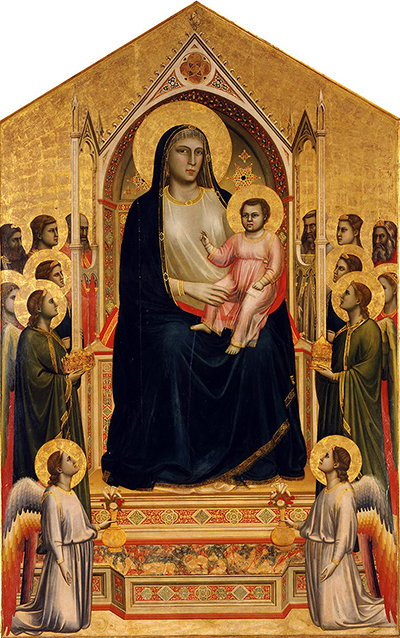
Traditionally Giotto; late 13th–early 14th century; authorship and date disputed; track: c.1290–95 convention [3] [4] [5] [6] [7]Ognissanti Madonna
c.1300–05 (Uffizi); c.1310 also proposed; track: c.1300–05 [8]Scrovegni Chapel — painted decoration
c.1303–05 (chapel campaign); Giotto and workshop (painted decoration) [9] [10] [11]Magdalene Chapel — painted decoration (current article)
c.1307–08 (basilica); disputed; Giotto and workshop / Giottesque painters; individual hands disputed [12]Madonna and Child — Washington / Goldman Madonna
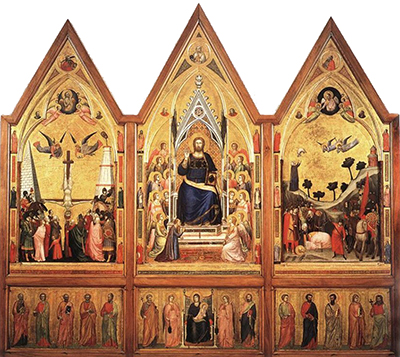
c.1310–1315 (National Gallery of Art) [13]Stefaneschi Triptych
c.1320; 1315–20 (Vatican Museums); Giotto and workshop [14]Bardi Chapel — painted decoration
After 1317, usually the 1320s; disputed; Giotto and workshop / Giottesque painters; individual hands disputed [15] [16]Baroncelli Polyptych
After 1328; completion uncertain; band continues to axis edge; Giotto and workshop [17]Giotto’s Campanile — Florence Cathedral bell tower
Giotto’s phase 1334–37; completed 1359 by successors [18] [19] [20]Contents
- A small room with several ways through
- Teobaldo Pontano and the hope of remembrance
- Which Mary appears in the stories?
- The meal in the Pharisee's house
- Lazarus: a miracle reorganised around his sister
- Noli me tangere: the space between hands
- Marseille: several events on one sea
- The upper lunettes: solitude, elevation and communion
- Saints, glass and the reach of the programme
- Giotto and the painters working with him
A small room with several ways through
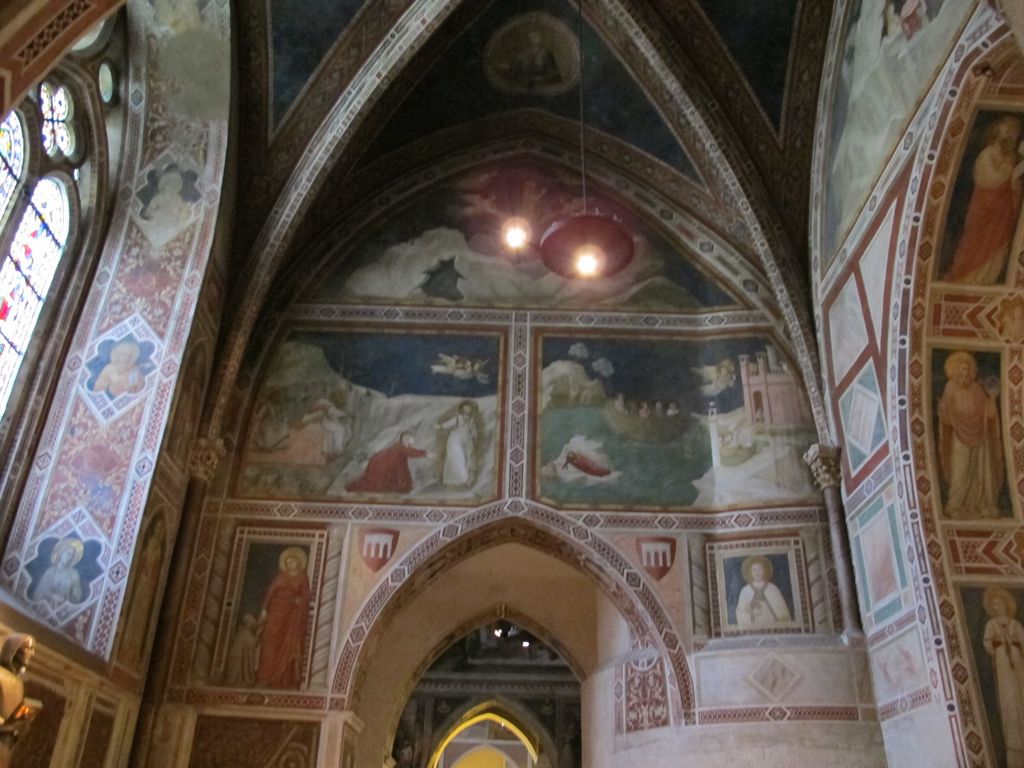
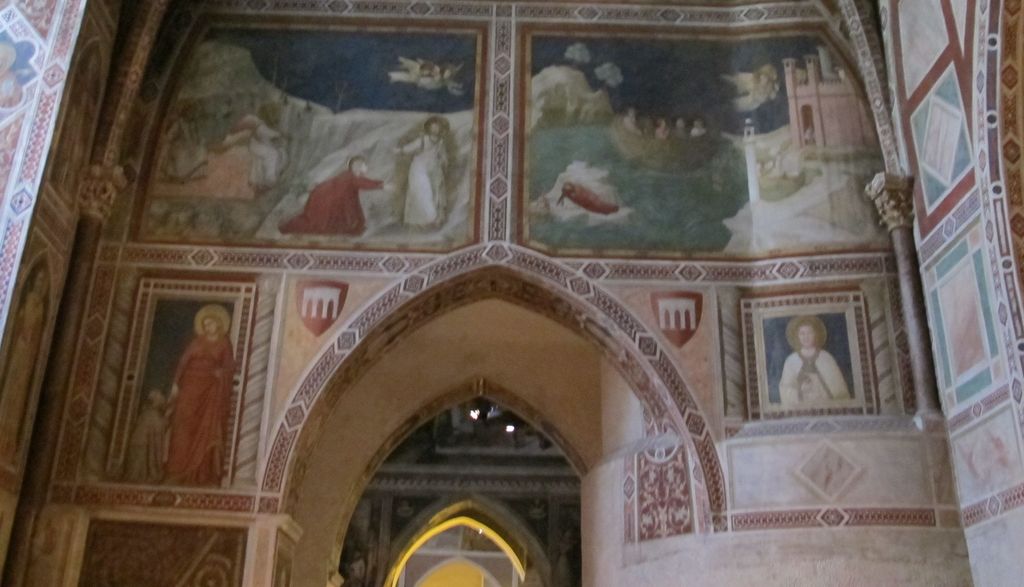
The architecture gives the painters a difficult surface. The entrance, the window and passages towards the transept and the neighbouring chapel interrupt the walls; the ribbed vault descends towards them. Large rectangular narratives have to share the room with pointed lunettes, narrow borders and openings. The decoration works with these changes of shape. Framed scenes occupy the broader middle areas, while the saint's solitary life fits into the tapering spaces above. Painted figures and ornamental bands make the intervening strips active parts of the ensemble. [21]
The sequence consequently requires some looking around. The four main scenes in the lower narrative tier precede the three upper episodes: the meal in the Pharisee's house, the raising of Lazarus, the encounter with the risen Christ and the maritime story associated with Marseille lead towards the Magdalene's life in solitude and her final communion. A viewer cannot simply follow one uninterrupted horizontal strip. Changes in height ask the eyes to move between public events, intimate encounters and heavenly appearances.
The setting also complicates the distinction between picture and room. The low donor images place kneeling worshippers and their saints within fictive architectural recesses. Above them, the narratives unfold in separate landscapes and houses. Around the entrance, individual holy figures occupy the thickness of the arch. Painting meets a visitor at several levels: as a distant story, an apparently nearby presence and an inhabited threshold.
Michael Viktor Schwarz connects the building of these side chapels with the changing liturgical organisation of the basilica. They made room for endowed worship and commemoration within the church surrounding Francis's burial place. He also identifies reused marble from the Upper Church's former choir enclosure in the Magdalene Chapel's lower wall decoration. [21] That material connection is a useful reminder that the chapel belongs to a developing complex. Its wall paintings were part of a larger rearrangement of sacred space, with practical consequences for where priests celebrated and benefactors were remembered.
Annotated Details from The Magdalene Chapel at Assisi
The numbered points identify visible features discussed in this article. Return from each detail to the numbered overview. Partial interior of the Magdalene Chapel, Assisi, photographed by Sailko on 1 April 2012, before the 2020 treatment discussed in 2021. Parts of the window, vault and adjoining walls are outside the view. Sailko / Wikimedia Commons / CC BY-SA3.0. Image source. CC BY-SA 3.0. Numbers added to a separate resized overview; detail crops made from the unchanged native source. No upscaling, recolouring, retouching or reconstruction. The overview and crop derivatives are licensed under CC BY-SA 3.0.
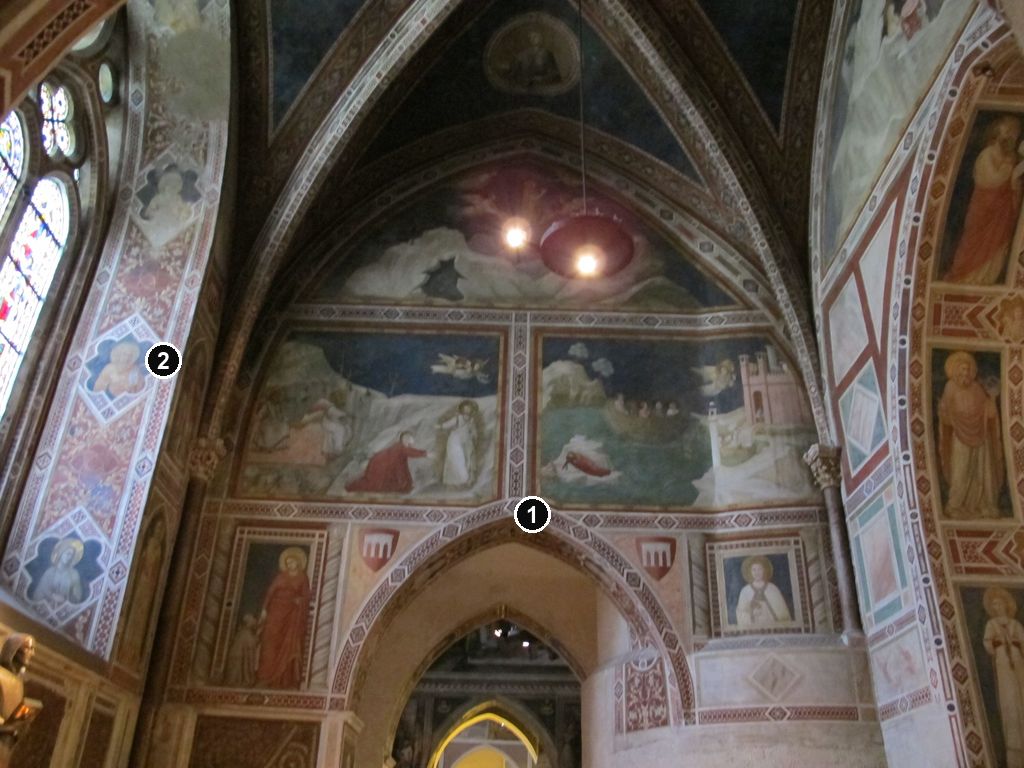
Details from THE MAGDALENE CHAPEL AT ASSISI
Compare the chapel’s real openings with its painted framing. This partial photograph was made in 2012, before the 2020 treatment discussed in 2021.
Narrative fields arranged above a real passage
Large rectangular narratives have to share the room with pointed lunettes, narrow borders and openings. The decoration works with these changes of shape.
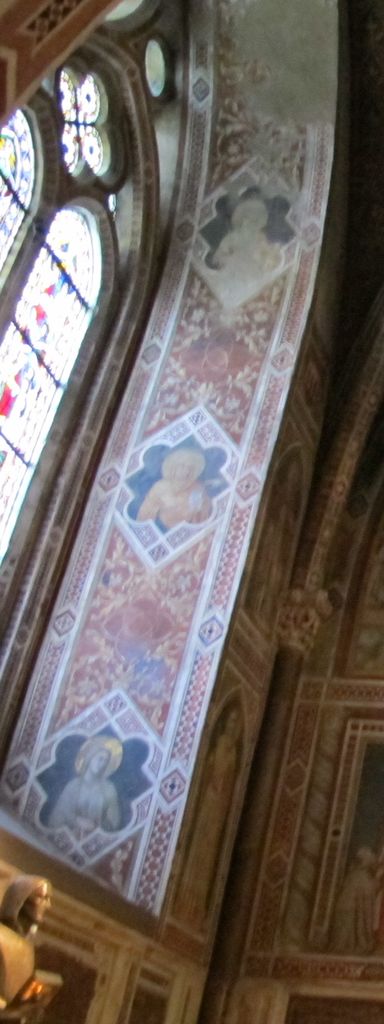
Partial window edge and adjoining painted border
The window interrupts the wall, while painted figures and ornamental bands occupy the neighbouring strip.
Teobaldo Pontano and the hope of remembrance
Teobaldo was a Franciscan as well as a bishop. His connection with the chapel is supported by the donor imagery, his bridge-bearing heraldry and papal correspondence discussed by Schwarz. A letter of 9 January 1330, after Teobaldo's death, identifies the chapel he had caused to be built in the Franciscan church as his chosen burial place. [22] These records give the decoration a particular human purpose: a bishop was preparing a setting in which his life would be remembered and prayers offered on his behalf.
The financial history makes that purpose more tangible. According to Schwarz's examination of the documents, the chapel involved a payment of 600 gold florins to the friars. Payments remained incomplete when Teobaldo died. In his final decade, demands from the papacy following the seizure of papal treasure at Assisi placed him under severe financial pressure. Schwarz uses this context to argue against an initial commission for the decoration after 1319, while acknowledging that the surviving records do not supply a precise contract date for the frescoes. [22] The documents constrain the possibilities; they do not identify the painter of every passage.
Teobaldo appears twice in the lower decoration, in two different relationships. Before Saint Rufinus, Assisi's episcopal patron, he wears episcopal vestments and kneels with his head lowered. Before Mary Magdalene, the kneeling Franciscan identified by Schwarz as the same patron looks upwards and joins hands with the saint. [23] The two images bring his public office and religious vocation into the same room. They also establish different forms of approach: formal deference before an episcopal predecessor and a more immediate physical bond with the chapel's patron saint.
The joined hands are especially consequential beside the stories above. A visitor has already seen the Magdalene approaching Christ through bodily gestures. Here a contemporary supplicant approaches her in turn. The saint who kneels for help in the narratives can stand as a source of help in the donor image. That reversal gives the chapel's account of intercession a clear visual form.
Schwarz reads the entire foundation as a meeting point for pilgrimage, confession and the bishop's commemoration. [24] This remains an interpretation of the programme's religious operation, rather than a surviving statement of every detail Teobaldo requested. It is persuasive because the paintings repeatedly connect a person's need with another person's response. The founder's hope is embedded in the same pattern as the stories: grief or contrition leads towards recognition, mercy and restored life.
Which Mary appears in the stories?
The chapel's heroine is the Magdalene understood through medieval Western Christian tradition. That tradition brought together Mary Magdalene, Mary of Bethany, and the unnamed woman who anoints Jesus in Luke 7. The Gospel passages retain distinctions that the painted cycle does not maintain. Luke's woman is unnamed; John identifies the sisters Mary and Martha with their brother Lazarus at Bethany, and describes Mary's anointing of Jesus in John 12. John 20 explicitly names Mary Magdalene in the encounter outside the empty tomb. [25]
Understanding the combination is essential to reading the chapel. The woman at the meal, the grieving sister beside Lazarus and the witness to the risen Christ form one continuous sacred biography here. It is a biography shaped by interpretation and devotion. No Gospel calls Mary Magdalene a prostitute, and that familiar description should not be treated as the biblical explanation of these paintings.
Later legends extend the biography beyond the Resurrection into missionary activity, miracles and solitary contemplation. The thirteenth-century Golden Legend, compiled by Jacobus de Voragine, offers an influential account of that expanded life. [26] The chapel's movement between Gospel episodes and legendary ones would have allowed its audience to follow the saint from her encounters with Christ into her continuing power as an intercessor.
The meal in the Pharisee's house
The cycle opens with a social occasion whose most important action happens near the floor. Within a house opened towards the viewer, guests sit behind a long table and attendants stand in front. The Magdalene bends low beside Christ at the left. Her halo and lowered face draw attention to a part of the gathering that the architecture and table might otherwise push into the margin.
The setting gives the episode a clear framework without shutting it away. Uprights divide the back wall, while the roof and projecting beams define the room above the diners. Below the table, folds of clothing and the standing attendants establish a second register of bodies. The Magdalene occupies a still lower position. Her gesture interrupts the ordered ranks of a meal: someone outside its seated company becomes the reason the event matters.
In Luke 7:36–50, the woman wets Jesus's feet with her tears, wipes them with her hair, kisses them and anoints them. Simon the Pharisee silently questions Jesus's acceptance of her; Jesus answers by contrasting her attention with the hospitality Simon has failed to provide. The passage ends with forgiveness and an assurance of peace. [25] The painted arrangement makes the contrast legible through posture. The diners possess their places at the table, but the woman who lowers herself before Christ becomes the central example of devotion.
Her face does not need a large patch of wall to carry the narrative. The inclination of the head towards the foot, and the body extending away from it, make attention itself visible. In later scenes her arms will reach into open air or her body will be lifted above the earth. Here bodily nearness is at its most concentrated. The cycle begins with touch and with the acceptance of a person whose presence has disturbed a gathering.
Schwarz relates the painted house to the architectural interiors of the Last Supper and Washing of the Feet at Padua. [27] The comparison helps explain how a familiar type of room could serve a different story. At Assisi, the architectural order gives particular force to the woman's position at its edge: the structure is regular, while her low and oblique movement draws the eye out of that regularity.
Lazarus: a miracle reorganised around his sister
The raising of Lazarus spreads its figures across a rocky landscape. Christ stands with his companions on the left, extending his arm towards the tomb. Lazarus stands upright on the right, still wrapped in burial cloths, with a living, responsive face. Between them, the kneeling woman looks upwards towards Christ. In front of the tomb, a bent figure manages the heavy stone slab. That steep diagonal sets practical labour beside the extraordinary command that has brought a dead man out.
John 11 describes the sisters' grief, Jesus's arrival after Lazarus has been buried for four days, the opening of the tomb and his call for Lazarus to emerge. Mary falls at Jesus's feet before he reaches the grave. [28] The fresco gathers related actions into one field. The kneeling figure, the speaking Christ, the standing Lazarus and the removal of the stone make the event readable across several bodily positions.
The Magdalene Chapel gives the story a different centre of gravity from its counterpart in the Scrovegni Chapel at Padua. Schwarz notes the wider spacing of the Assisi figures and the strong visual connection between Christ and the revived Lazarus. He also emphasises the importance of the kneeling woman, who becomes a third principal figure alongside them. [29] Her position prevents the miracle from becoming a simple exchange across an empty interval. Christ's hand passes above her; her upturned face links the person who needs consolation to the person who can act.
The inscription extending from Christ's mouth supplies the command addressed to Lazarus. Speech acquires a visible direction, while Lazarus's uncovered face supplies a response. The painting brings hearing and looking into the same encounter. Around that exchange, other gestures register the physical conditions of burial: cloth restrains the body, stone closes the opening, and hands must release both.
Schwarz proposes that the emotional emphasis owes something to the medieval Meditations on the Life of Christ, whose treatment of the episode heightens the relationship between Christ and the grieving sisters. He further connects the chapel's emphasis with a Magdalene feast-day prayer presenting her supplication as effective in Lazarus's return to life. [29] These are specific interpretive connections, rather than proof of a single illustrated text supplied to the painters. They help explain why the sister's grief has such prominence in a chapel dedicated to her.
The subject returns overhead. The basilica identifies the four vault medallions as Christ, Magdalene, Martha and Lazarus; the last is still in his burial wrapping but praying. [30] A story encountered on the wall is thus converted into a gathering of figures above the chapel. For a burial foundation, Lazarus offered an especially direct image of hope: the body marked by death could nevertheless answer Christ and live.
Noli me tangere: the space between hands
Across the chapel, Mary kneels before the risen Christ in the scene traditionally called Noli me tangere. The Latin title comes from Christ's words in John 20:17, often translated as an instruction not to touch or not to hold on to him. In the Gospel, Mary first mistakes Jesus for the gardener, recognises him when he speaks her name, and is sent to announce his return to the disciples. [31]
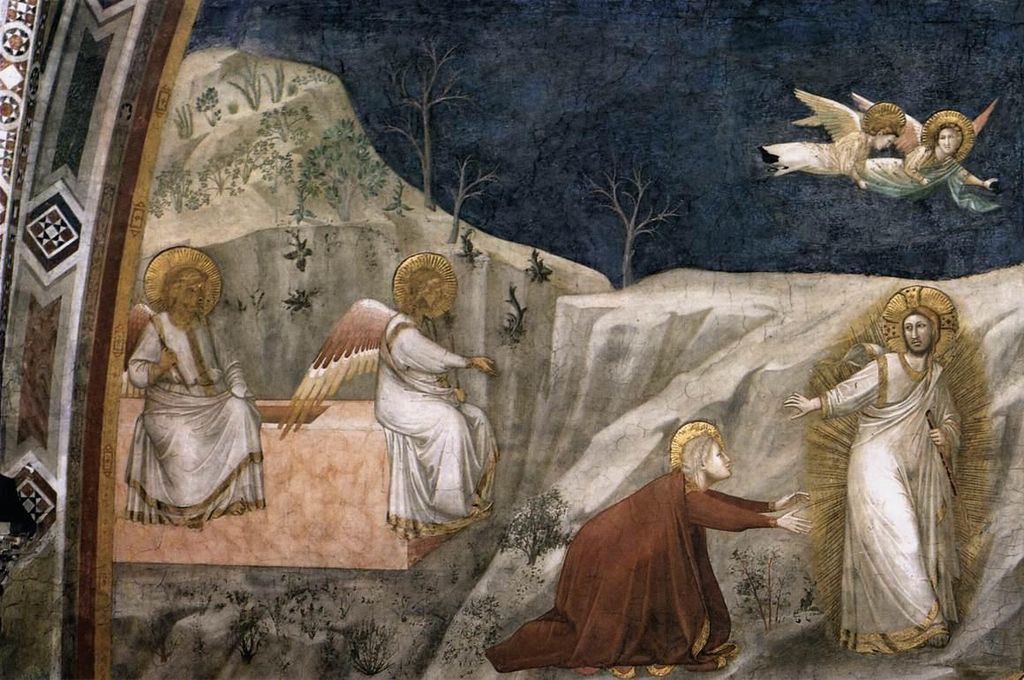
Noli me tangere in the Magdalene Chapel, Assisi’s Lower Church. This fresco belongs to the Giotto-associated workshop programme at Assisi, distinct from the related scene in Padua. Image source. Public domain. Proportionally reduced reproduction; original composition, colour and photographic lighting retained.
The painting separates the encounter from the seated angels at the tomb on the left. Mary leans forward from her knees, both arms extended. Christ turns towards her while his body carries him towards the right. Her reaching hands and his answering gesture nearly connect, but a narrow interval remains. That interval becomes the scene's most active space. The figures are close enough to acknowledge one another and too far apart to settle into an embrace.
Their movements have different foundations. Mary's kneeling body gathers weight close to the ground; the forward inclination makes the reach feel sustained and effortful. Christ's upright figure has room to move away. His pale garment stands out against the landscape, while her red mantle gives breadth to the mass below. Small plants and bare trees break the rocky setting into a series of vertical accents. Above, a flying angel adds a third direction of movement.
Schwarz compares this scene closely with the Padua version, tracing the adaptation of the kneeling Magdalene while questioning the execution of other parts of the Assisi painting. [32] It is a useful example of why visual relationship and authorship require separate consideration. A composition may draw on a Giotto invention and transform it effectively, while its individual figures still reveal differences in handling.
His discussion also records a material feature that ordinary reproductions can conceal: the flesh parts of the angels at the tomb were worked in raised stucco and gilded. [32] Their original effect involved projecting, reflective surfaces as well as painted modelling. That use of costly material complicates any impression of the cycle as a uniformly flat, sober exercise in fresco. Within the dim chapel, different surfaces could answer light differently.
The story belongs naturally with Lazarus across the room. Both scenes place the kneeling woman before Christ, but the outcome of her approach changes. One encounter concerns a return from a grave; the other begins beside an empty tomb and leads towards a mission. In each, Mary's posture makes an enormous religious event accessible through an individual human meeting.
Marseille: several events on one sea
The Marseille scene opens into an entirely different kind of space. A boat crosses water towards a fortified harbour on the right. A rocky island occupies the foreground, where a reclining woman and a child form a small, vulnerable group. The Magdalene appears above the sea. Land, harbour, ship and airborne figure distribute the narrative across the whole panel, requiring the viewer to connect actions happening in different places.
The Golden Legend supplies the background. After reaching Marseille, the Magdalene brings a local ruler and his wife towards Christianity. On a subsequent pilgrimage the wife dies in childbirth at sea and is left on an island with her baby. Returning later, the husband discovers the child preserved and his wife restored through the saint's aid. [26] The fresco condenses the story's journeys and miraculous protection into a shared maritime setting.
The low island is a powerful device. Its pale rock isolates the mother and child from the ship and city, giving abandonment a visible geography. The water that joins the destinations also holds people apart. Against the high, enclosed harbour, the island has little shelter and no substantial building. The composition allows a viewer to register the difference between a place of refuge and a place where ordinary help has become unavailable.
This panel asks more narrative knowledge of its audience than the encounter with Christ. Its small groups do not resolve into one exchange of glances. A figure seen from a distance on a boat, a body on a rock and a supernatural appearance must be understood together. Schwarz criticises the composition's crowded storytelling and attributes a substantial role to assistants here. [33] His judgment need not prevent a viewer from finding the scene absorbing. Its dispersed action is also what brings travel, peril and rescue into the chapel's account of the saint.
For pilgrims in Assisi, a story of protection on a dangerous journey had a particular relevance. The legendary Magdalene's authority extends beyond the places Christ had walked and beyond her own immediate bodily presence. Within the painted sea, she can reach people cut off from ordinary human assistance.
The upper lunettes: solitude, elevation and communion
The rocky settings of the upper scenes fit the rising and narrowing shapes of the lunettes. In the angelic elevation, pale ridges open around a dark central cleft. Above them the Magdalene rises among angels. Her slender vertical body occupies the point where the broken earth gives way to open space. The landscape makes withdrawal perceptible before the narrative is explained: the rocky divisions provide neither the company of a town nor the shelter of an inhabited house.
In the Golden Legend, her later life includes thirty years of solitary contemplation and repeated elevation by angels at the canonical hours. The text also recounts an encounter with a solitary priest, the provision of clothing in one version, and communion before her death. [26] These later traditions account for the chapel's eremitic episodes; they are distinct from the Gospel account of the Resurrection.
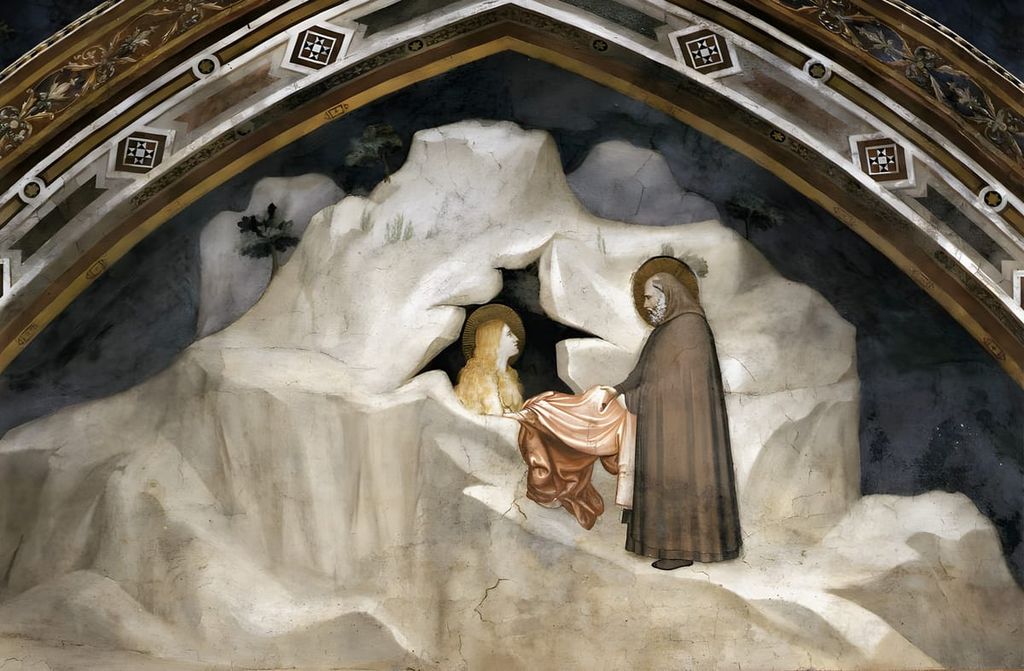
The Magdalene hermit lunette in Assisi’s Lower Church. Image source. Public domain. Proportionally reduced reproduction; no colour or content enhancement.
In the clothing scene above the entrance, the rock dominates. The saint appears within an opening, and the man outside extends a garment towards her. Their relatively small figures make the setting feel immense despite the limited wall area. Cloth becomes the connection between two lives otherwise separated by the wilderness. The composition gives an act of care considerable weight without surrounding it with a crowd.
The last communion brings the saint back into a liturgical setting. She kneels before a bishop, who extends his hand towards her mouth; a group of witnesses stands to the left, while an altar rises behind the bishop on the right. The sparse architecture leaves the central action unusually clear. Above, angels carry a small figure in a rounded enclosure. The simultaneous presence of the kneeling woman below and her soul above brings the final sacrament and its promised outcome into one field. The wall joins the actions that a narrative would recount in succession.
Schwarz identifies the upper sequence as including her angelic elevation, the clothing by a hermit, and communion with the ascent of her soul. [34] The distinction between the bodily elevation during her contemplative life and the final departure of the soul matters: images of the Magdalene carried by angels do not all represent one event, and none should be mistaken for Christ's Ascension.
The placing of these scenes above the more populous narratives changes the rhythm of looking. A table, a tomb and a harbour give way to rocks, angels and a sparse gathering. Mary repeatedly receives something that cannot be supplied by her own effort: a garment, heavenly support, the sacrament. The chapel's upward movement therefore remains connected to the acts of assistance and response that organise its lower stories.
Saints, glass and the reach of the programme
The principal scenes are surrounded by other holy people. Schwarz identifies figures associated with repentance and divine mercy around the entrance, including Peter, Paul, Matthew, David, Longinus and the Good Thief, as well as Augustine. His reading of this group reinforces the chapel's concern with the possibility of forgiveness. [24] The setting places the Magdalene among several examples of a changed life. Those entering the chapel pass through an assembly that broadens her story into a shared promise.
The stained-glass window adds another Magdalene cycle. Schwarz describes eleven episodes and distinguishes its sequence from the seven painted narratives. [30] The basilica likewise stresses the window's thematic relationship to the wall decoration. [1] The two accounts are compatible: related subject matter does not require identical compositions or a single securely identified designer. The glass should not simply be assigned to Giotto's personal hand because it belongs to the same room.
The window also changes how the chapel addresses the larger church. Schwarz points out that its narrative could be seen from the nave, whereas the fresco stories require a position inside the chapel to be followed properly. [30] The programme thus reaches different viewers at different distances. One person sees a luminous sequence within the north wall; another, closer in, follows the changing faces and hands of the frescoes. The chapel offers several degrees of approach, just as its painted encounters do.
Giotto and the painters working with him
The familiar attribution to Giotto and workshop preserves an essential distinction between the conception of an ensemble and the execution of every figure. The basilica's proposed date of around 1307–08 places the Magdalene paintings close to the period after Padua. A broader dating of workshop activity elsewhere in the Lower Church to around 1315 concerns other decoration and should not automatically be substituted for this chapel's chronology. [1] [35]
Schwarz makes a strong case for Giotto's personal involvement here, singling out the chapel among the Giottesque programmes at Assisi as a plausible work of 1308. His argument rests in part on the inventive development of Padua compositions and on the expressive treatment of the Magdalene. At the same time, he proposes a team that included painters with different experience and allows assistants considerable independence. [36] This is a scholarly reconstruction, not a unanimous allocation of the walls among named hands.
His comparisons show the kinds of evidence involved. The expressive Magdalene in Noli me tangere does not, in his judgment, require the Christ beside her to be equally successful or equally characteristic of Giotto. The Marseille painting poses different compositional and technical questions again. Repeated motifs, changes of scale, facial modelling, architectural organisation and surviving surface condition all enter the discussion. None supplies an automatic signature.
For the reader, these differences are most useful when they lead back to the paintings. The chapel maintains its religious purpose through several pictorial methods: the compressed touch at the meal, the broad confrontation at Lazarus's tomb, the unclosed gap before the risen Christ, the dispersed maritime miracle and the isolation of the lunettes. A collaborative production could sustain that coherence while allowing noticeably different solutions within it.
Restoration and the surfaces seen today
The chapel has a long history of intervention. The Italian Ministry of Culture's account, drawing on the Istituto Centrale per il Restauro's archive, records work by Sebastiano Ranghiasci in the late eighteenth century, by Domenico Brizi in the nineteenth, an ICR restoration in 1967, and another conservation campaign in the 1990s under Giuseppe Basile. Antonio Quattrone's photographs document that later campaign and preserve evidence of surface irregularities and execution. [37]
The basilica dates a further important restoration to 2020. An interview with chief restorer Sergio Fusetti published on 22 June 2021 states that the Magdalene Chapel's restoration had been completed a few months earlier. [1] [38] These accounts describe a completed intervention; they do not establish that the same work continues today. They also need to be distinguished from the restoration of the Upper Church following the 1997 earthquake, whose collapsed vault areas belong to another part of the basilica. [37]
Photographs carry their own dates within this history. A view made in 2012 can show how the scenes fit around the chapel's openings, but it predates the 2020 treatment. Differences between reproductions cannot by themselves establish what a medieval colour originally looked like or what a particular restorer changed. The surviving pictures ask for attention both to their imagined worlds and to the worked, altered walls that carry them.
The chapel’s religious argument repeatedly turns on the relation between a body and a presence: a woman at Christ's foot, a man emerging from burial cloths, a pilgrim protected across the sea, a patron reaching for a saint's hand. The stories surround the place chosen for Teobaldo's burial with successive images of response. At their most concentrated, they make that hope visible in the smallest movement towards another person.
Watch: Explore Giotto’s Art
Choose an overview or a closer look at three major works. These films provide wider Giotto context alongside this article.
Artworks directory
This directory brings together 209 records for paintings, ensembles, individual scenes and components, architectural work, an associated disputed design, and reported or lost projects connected with Giotto. Ensembles and their parts appear separately, so 209 is a count of records rather than independent paintings or commissions. Attributions and dates remain qualified where disputed; inclusion does not establish Giotto’s own hand throughout.
| Name | Date | Medium, attribution and status |
|---|---|---|
| Expulsion of Joachim from the Temple — Scrovegni Chapel, Padua | c.1303–05 (chapel campaign) | Fresco / wall painting. Giotto and workshop. Scene within a cycle. Padova Musei. Chapel overview. |
| Joachim among the Shepherds — Scrovegni Chapel, Padua | c.1303–05 (chapel campaign) | Fresco / wall painting. Giotto and workshop. Scene within a cycle. Padova Musei. Chapel overview. |
| Annunciation to Saint Anne — Scrovegni Chapel, Padua | c.1303–05 (chapel campaign) | Fresco / wall painting. Giotto and workshop. Scene within a cycle. Padova Musei. Chapel overview. |
| Sacrifice of Joachim — Scrovegni Chapel, Padua | c.1303–05 (chapel campaign) | Fresco / wall painting. Giotto and workshop. Scene within a cycle. Padova Musei. Chapel overview. |
| Joachim’s Dream — Scrovegni Chapel, Padua | c.1303–05 (chapel campaign) | Fresco / wall painting. Giotto and workshop. Scene within a cycle. Padova Musei. Padova Musei. Chapel overview. |
| Meeting at the Golden Gate — Scrovegni Chapel, Padua | c.1303–05 (chapel campaign) | Fresco / wall painting. Giotto and workshop. Scene within a cycle. Padova Musei. Chapel overview. |
| Birth of the Virgin — Scrovegni Chapel, Padua | c.1303–05 (chapel campaign) | Fresco / wall painting. Giotto and workshop. Scene within a cycle. Padova Musei. Padova Musei. Chapel overview. |
| Presentation of the Virgin in the Temple — Scrovegni Chapel, Padua | c.1303–05 (chapel campaign) | Fresco / wall painting. Giotto and workshop. Scene within a cycle. Padova Musei. Chapel overview. |
| Delivery of the Rods — Scrovegni Chapel, Padua | c.1303–05 (chapel campaign) | Fresco / wall painting. Giotto and workshop. Scene within a cycle. Padova Musei. Chapel overview. |
| Prayer of Joseph and the Suitors — Scrovegni Chapel, Padua | c.1303–05 (chapel campaign) | Fresco / wall painting. Giotto and workshop. Scene within a cycle. Padova Musei. Chapel overview. |
| Marriage of the Virgin — Scrovegni Chapel, Padua | c.1303–05 (chapel campaign) | Fresco / wall painting. Giotto and workshop. Scene within a cycle. Padova Musei. Chapel overview. |
| Wedding Procession of Mary — Scrovegni Chapel, Padua | c.1303–05 (chapel campaign) | Fresco / wall painting. Giotto and workshop. Scene within a cycle. Padova Musei. Chapel overview. |
| Annunciation on the triumphal arch — complete ensemble (Scrovegni Chapel, Padua) | c.1303–05 (chapel campaign) | Wall painting with a central painted wooden panel. Giotto and workshop. Ensemble. Includes the Mission of Gabriel and the lower Annunciation pair; the original central wooden panel is in the Musei Civici agli Eremitani, with a conservation copy in the chapel. Padova Musei. Padova Musei. Scholarly study. Chapel overview. |
| Visitation — Scrovegni Chapel, Padua | c.1303–05 (chapel campaign) | Fresco / wall painting. Giotto and workshop. Scene within a cycle. Padova Musei. Chapel overview. |
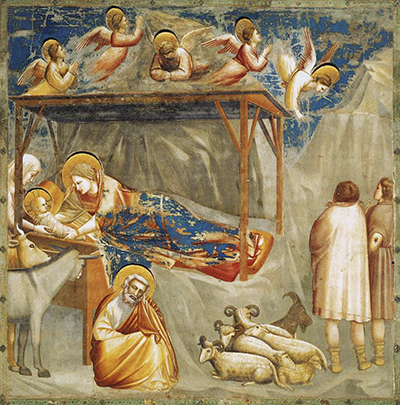
| Nativity — Scrovegni Chapel, Padua | c.1303–05 (chapel campaign) | Fresco / wall painting. Giotto and workshop. Scene within a cycle. Padova Musei. Chapel overview. |
| Adoration of the Magi — Scrovegni Chapel, Padua | c.1303–05 (chapel campaign) | Fresco / wall painting. Giotto and workshop. Scene within a cycle. Padova Musei. Chapel overview. |
| Presentation of Christ at the Temple — Scrovegni Chapel, Padua | c.1303–05 (chapel campaign) | Fresco / wall painting. Giotto and workshop. Scene within a cycle. Padova Musei. Chapel overview. |
| Flight into Egypt — Scrovegni Chapel, Padua | c.1303–05 (chapel campaign) | Fresco / wall painting. Giotto and workshop. Scene within a cycle. Padova Musei. Chapel overview. |
| Massacre of the Innocents — Scrovegni Chapel, Padua | c.1303–05 (chapel campaign) | Fresco / wall painting. Giotto and workshop. Scene within a cycle. Padova Musei. Chapel overview. |
| Christ among the Doctors — Scrovegni Chapel, Padua | c.1303–05 (chapel campaign) | Fresco / wall painting. Giotto and workshop. Scene within a cycle. Padova Musei. Chapel overview. |
| Baptism of Christ — Scrovegni Chapel, Padua | c.1303–05 (chapel campaign) | Fresco / wall painting. Giotto and workshop. Scene within a cycle. Padova Musei. Chapel overview. |
| Marriage at Cana — Scrovegni Chapel, Padua | c.1303–05 (chapel campaign) | Fresco / wall painting. Giotto and workshop. Scene within a cycle. Padova Musei. Padova Musei. Chapel overview. |
| Raising of Lazarus — Scrovegni Chapel, Padua | c.1303–05 (chapel campaign) | Fresco / wall painting. Giotto and workshop. Scene within a cycle. Padova Musei. Chapel overview. |
| Entry into Jerusalem — Scrovegni Chapel, Padua | c.1303–05 (chapel campaign) | Fresco / wall painting. Giotto and workshop. Scene within a cycle. Padova Musei. Chapel overview. |
| Expulsion of the Money Changers — Scrovegni Chapel, Padua | c.1303–05 (chapel campaign) | Fresco / wall painting. Giotto and workshop. Scene within a cycle. Padova Musei. Padova Musei. Chapel overview. |
| Judas Receiving the Payment — Scrovegni Chapel, Padua | c.1303–05 (chapel campaign) | Fresco / wall painting. Giotto and workshop. Scene within a cycle. Padova Musei. Chapel overview. |
| Last Supper — Scrovegni Chapel, Padua | c.1303–05 (chapel campaign) | Fresco / wall painting. Giotto and workshop. Scene within a cycle. Padova Musei. Chapel overview. |
| Washing of the Feet — Scrovegni Chapel, Padua | c.1303–05 (chapel campaign) | Fresco / wall painting. Giotto and workshop. Scene within a cycle. Padova Musei. Chapel overview. |
| Arrest of Christ — Scrovegni Chapel, Padua | c.1303–05 (chapel campaign) | Fresco / wall painting. Giotto and workshop. Scene within a cycle. Padova Musei. Chapel overview. |
| Christ before Annas and Caiaphas — Scrovegni Chapel, Padua | c.1303–05 (chapel campaign) | Fresco / wall painting. Giotto and workshop. Scene within a cycle. Padova Musei. Chapel overview. |
| Mocking of Christ and Flagellation — Scrovegni Chapel, Padua | c.1303–05 (chapel campaign) | Fresco / wall painting. Giotto and workshop. Scene within a cycle. Padova Musei. Chapel overview. |
| Road to Calvary — Scrovegni Chapel, Padua | c.1303–05 (chapel campaign) | Fresco / wall painting. Giotto and workshop. Scene within a cycle. Padova Musei. Chapel overview. |
| Crucifixion — Scrovegni Chapel, Padua | c.1303–05 (chapel campaign) | Fresco / wall painting. Giotto and workshop. Scene within a cycle. Padova Musei. Chapel overview. |
| Lamentation — Scrovegni Chapel, Padua | c.1303–05 (chapel campaign) | Fresco / wall painting. Giotto and workshop. Scene within a cycle. Padova Musei. Chapel overview. |
| Resurrection / Noli me tangere — Scrovegni Chapel, Padua | c.1303–05 (chapel campaign) | Fresco / wall painting. Giotto and workshop. Scene within a cycle. Padova Musei. Chapel overview. |
| Ascension — Scrovegni Chapel, Padua | c.1303–05 (chapel campaign) | Fresco / wall painting. Giotto and workshop. Scene within a cycle. Padova Musei. Chapel overview. |
| Pentecost — Scrovegni Chapel, Padua | c.1303–05 (chapel campaign) | Fresco / wall painting. Giotto and workshop. Scene within a cycle. Padova Musei. Padova Musei. Chapel overview. |
| Coretto — right painted recess (Scrovegni Chapel, Padua) | c.1303–05 (chapel campaign) | Fresco / painted fictive architecture. Giotto and workshop. Ensemble component. Padova Musei. Padova Musei. Scholarly study. Chapel overview. |
| Coretto — left painted recess (Scrovegni Chapel, Padua) | c.1303–05 (chapel campaign) | Fresco / painted fictive architecture. Giotto and workshop. Ensemble component. Padova Musei. Padova Musei. Scholarly study. Chapel overview. |
| Envy — Scrovegni Chapel, Padua | c.1303–05 (chapel campaign) | Grisaille fresco / wall painting. Giotto and workshop. Ensemble component. Padova Musei. Chapel overview. Scholarly study. Padova Musei. |
| Despair — Scrovegni Chapel, Padua | c.1303–05 (chapel campaign) | Grisaille fresco / wall painting. Giotto and workshop. Ensemble component. Padova Musei. Chapel overview. Scholarly study. Padova Musei. |
| Prudence — Scrovegni Chapel, Padua | c.1303–05 (chapel campaign) | Grisaille fresco / wall painting. Giotto and workshop. Ensemble component. Padova Musei. Chapel overview. Scholarly study. Padova Musei. |
| Fortitude — Scrovegni Chapel, Padua | c.1303–05 (chapel campaign) | Grisaille fresco / wall painting. Giotto and workshop. Ensemble component. Padova Musei. Chapel overview. Scholarly study. Padova Musei. |
| Temperance — Scrovegni Chapel, Padua | c.1303–05 (chapel campaign) | Grisaille fresco / wall painting. Giotto and workshop. Ensemble component. Padova Musei. Chapel overview. Scholarly study. Padova Musei. |
| Justice — Scrovegni Chapel, Padua | c.1303–05 (chapel campaign) | Grisaille fresco / wall painting. Giotto and workshop. Ensemble component. Padova Musei. Chapel overview. Scholarly study. Padova Musei. |
| Faith — Scrovegni Chapel, Padua | c.1303–05 (chapel campaign) | Grisaille fresco / wall painting. Giotto and workshop. Ensemble component. Padova Musei. Chapel overview. Scholarly study. Padova Musei. |
| Charity — Scrovegni Chapel, Padua | c.1303–05 (chapel campaign) | Grisaille fresco / wall painting. Giotto and workshop. Ensemble component. Padova Musei. Chapel overview. Scholarly study. Padova Musei. |
| Hope — Scrovegni Chapel, Padua | c.1303–05 (chapel campaign) | Grisaille fresco / wall painting. Giotto and workshop. Ensemble component. Padova Musei. Chapel overview. Scholarly study. Padova Musei. |
| Folly — Scrovegni Chapel, Padua | c.1303–05 (chapel campaign) | Grisaille fresco / wall painting. Giotto and workshop. Ensemble component. Padova Musei. Chapel overview. Scholarly study. Padova Musei. |
| Inconstancy — Scrovegni Chapel, Padua | c.1303–05 (chapel campaign) | Grisaille fresco / wall painting. Giotto and workshop. Ensemble component. Padova Musei. Chapel overview. Scholarly study. Padova Musei. |
| Wrath — Scrovegni Chapel, Padua | c.1303–05 (chapel campaign) | Grisaille fresco / wall painting. Giotto and workshop. Ensemble component. Padova Musei. Chapel overview. Scholarly study. Padova Musei. |
| Injustice — Scrovegni Chapel, Padua | c.1303–05 (chapel campaign) | Grisaille fresco / wall painting. Giotto and workshop. Ensemble component. Padova Musei. Chapel overview. Scholarly study. Padova Musei. |
| Infidelity / Idolatry — Scrovegni Chapel, Padua | c.1303–05 (chapel campaign) | Grisaille fresco / wall painting. Giotto and workshop. Ensemble component. Padova Musei. Chapel overview. Scholarly study. Padova Musei. |
| Starry vault — complete ensemble (Scrovegni Chapel, Padua) | c.1303–05 (chapel campaign) | Vault painting. Giotto and workshop. Ensemble. Padova Musei. Padova Musei. Chapel overview. |
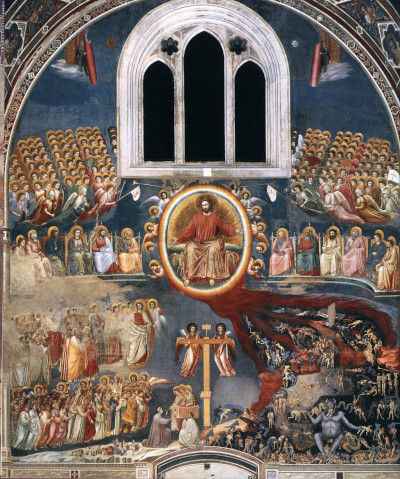
| Last Judgement — Scrovegni Chapel, Padua | c.1303–05 (chapel campaign) | Fresco / wall painting. Giotto and workshop. Scene within a cycle. Padova Musei. Padova Musei. Chapel overview. Padova Musei. |
| Prophet Malachi — vault medallion — Scrovegni Chapel, Padua | c.1303–05 (chapel campaign) | Fresco / wall painting. Giotto and workshop. Ensemble component. Padova Musei. Padova Musei. Chapel overview. Padova Musei. |
| Prophet Baruch — vault medallion — Scrovegni Chapel, Padua | c.1303–05 (chapel campaign) | Fresco / wall painting. Giotto and workshop. Ensemble component. Padova Musei. Padova Musei. Chapel overview. Padova Musei. |
| Prophet Isaiah — vault medallion — Scrovegni Chapel, Padua | c.1303–05 (chapel campaign) | Fresco / wall painting. Giotto and workshop. Ensemble component. Padova Musei. Padova Musei. Chapel overview. Padova Musei. |
| Prophet Daniel — vault medallion — Scrovegni Chapel, Padua | c.1303–05 (chapel campaign) | Fresco / wall painting. Giotto and workshop. Ensemble component. Padova Musei. Padova Musei. Chapel overview. Padova Musei. |
| Christ Pantocrator — vault medallion — Scrovegni Chapel, Padua | c.1303–05 (chapel campaign) | Fresco / wall painting. Giotto and workshop. Ensemble component. Padova Musei. Padova Musei. Chapel overview. Padova Musei. |
| Virgin and Child — vault medallion — Scrovegni Chapel, Padua | c.1303–05 (chapel campaign) | Fresco / wall painting. Giotto and workshop. Ensemble component. Padova Musei. Padova Musei. Chapel overview. Padova Musei. |
| Prophet Ezekiel — vault medallion — Scrovegni Chapel, Padua | c.1303–05 (chapel campaign) | Fresco / wall painting. Giotto and workshop. Ensemble component. Padova Musei. Padova Musei. Chapel overview. Padova Musei. |
| Prophet Micah — vault medallion — Scrovegni Chapel, Padua | c.1303–05 (chapel campaign) | Fresco / wall painting. Giotto and workshop. Ensemble component. Padova Musei. Padova Musei. Chapel overview. Padova Musei. |
| Saint John the Baptist — vault medallion — Scrovegni Chapel, Padua | c.1303–05 (chapel campaign) | Fresco / wall painting. Giotto and workshop. Ensemble component. Padova Musei. Padova Musei. Chapel overview. Padova Musei. |
| Scrovegni Chapel — painted decoration | c.1303–05 (chapel campaign) | Fresco / wall painting, with a painted wooden panel. Giotto and workshop (painted decoration). Ensemble. Includes separately listed scenes and components. The original central God the Father panel is in the Musei Civici agli Eremitani; a conservation copy is in the chapel. Chapel overview. Padova Musei. Padova Musei. Source. Source. Source. Padova Musei. Scholarly study. |
| Vices and Virtues — complete fourteen-figure programme | c.1303–05 (chapel campaign) | Grisaille fresco / wall painting. Giotto and workshop. Ensemble. Fourteen figures: seven virtues and seven opposed vices. Padova Musei. Chapel overview. Scholarly study. |
| Coretti — paired fictive chapels | c.1303–05 (chapel campaign) | Fresco / painted fictive architecture. Giotto and workshop. Ensemble. Two separate painted recesses, also listed individually. Padova Musei. Padova Musei. Scholarly study. |
| Mission of Gabriel — heavenly assembly | c.1303–05 (chapel campaign) | Wall painting with central painted wooden image. Giotto and workshop. Ensemble component. Central wooden God the Father panel preserved at the Musei Civici agli Eremitani; conservation copy in the chapel. Chapel overview. Padova Musei. Scholarly study. Padova Musei. |
| Annunciation — Gabriel and Mary in facing chambers | c.1303–05 (chapel campaign) | Fresco / wall painting. Giotto and workshop. Ensemble component. Chapel overview. Scholarly study. Padova Musei. |
| God the Father — central wooden panel of the Mission of Gabriel | c.1303–05 (chapel campaign) | Painting on wood. Associated with Giotto. Ensemble component. Original at the Musei Civici agli Eremitani, Padua; conservation copy in the Scrovegni Chapel. Padova Musei. Padova Musei. Scholarly study. Source. |
| Life of Saint Francis — Upper Church cycle, Assisi | Late 13th–early 14th century; dating disputed | Fresco / wall-painting cycle. Traditionally associated with Giotto; Giotto, Roman-school and other attributions disputed. Ensemble. Twenty-eight-scene nave cycle; scenes also listed individually. Basilica catalogue. Scholarly study. Basilica catalogue. Source. Source. |
| Homage of a Simple Man — Upper Church, Assisi | Late 13th–early 14th century; dating disputed | Wall painting. Traditionally associated with Giotto; authorship and dating disputed. Scene within a cycle. Source. Scholarly study. Source. Source. Source. |
| Gift of the Mantle — Upper Church, Assisi | Late 13th–early 14th century; dating disputed | Wall painting. Traditionally associated with Giotto; authorship and dating disputed. Scene within a cycle. Basilica catalogue. Scholarly study. Source. Source. Source. |
| Dream of the Palace Full of Arms — Upper Church, Assisi | Late 13th–early 14th century; dating disputed | Wall painting. Traditionally associated with Giotto; authorship and dating disputed. Scene within a cycle. Basilica catalogue. Source. Scholarly study. Source. Source. Source. |
| Prayer before the Crucifix at San Damiano — Upper Church, Assisi | Late 13th–early 14th century; dating disputed | Wall painting. Traditionally associated with Giotto; authorship and dating disputed. Scene within a cycle. Source. Source. Source. Scholarly study. Source. Source. |
| Renunciation of Worldly Goods — Upper Church, Assisi | Late 13th–early 14th century; dating disputed | Wall painting. Traditionally associated with Giotto; authorship and dating disputed. Scene within a cycle. Source. Scholarly study. Source. Source. |
| Dream of Innocent III — Upper Church, Assisi | Late 13th–early 14th century; dating disputed | Wall painting. Traditionally associated with Giotto; authorship and dating disputed. Scene within a cycle. Source. Source. Scholarly study. Source. Source. |
| Confirmation of the Rule — Upper Church, Assisi | Late 13th–early 14th century; dating disputed | Wall painting. Traditionally associated with Giotto; authorship and dating disputed. Scene within a cycle. Source. Scholarly study. Source. Source. |
| Vision of the Flaming Chariot — Upper Church, Assisi | Late 13th–early 14th century; dating disputed | Wall painting. Traditionally associated with Giotto; authorship and dating disputed. Scene within a cycle. Source. Source. Scholarly study. Source. Source. |
| Vision of the Thrones — Upper Church, Assisi | Late 13th–early 14th century; dating disputed | Wall painting. Traditionally associated with Giotto; authorship and dating disputed. Scene within a cycle. Basilica catalogue. Scholarly study. Source. Source. Source. |
| Expulsion of Devils from Arezzo — Upper Church, Assisi | Late 13th–early 14th century; dating disputed | Wall painting. Traditionally associated with Giotto; authorship and dating disputed. Scene within a cycle. Source. Source. Scholarly study. Source. Source. Source. |
| Trial by Fire before the Sultan — Upper Church, Assisi | Late 13th–early 14th century; dating disputed | Wall painting. Traditionally associated with Giotto; authorship and dating disputed. Scene within a cycle. Source. Source. Scholarly study. Source. Source. |
| Ecstasy of Saint Francis — Upper Church, Assisi | Late 13th–early 14th century; dating disputed | Wall painting. Traditionally associated with Giotto; authorship and dating disputed. Scene within a cycle. Source. Source. Source. Scholarly study. Source. Source. |
| Nativity at Greccio — Upper Church, Assisi | Late 13th–early 14th century; dating disputed | Wall painting. Traditionally associated with Giotto; authorship and dating disputed. Scene within a cycle. Basilica catalogue. Scholarly study. Source. Source. Source. |
| Miracle of the Spring — Upper Church, Assisi | Late 13th–early 14th century; dating disputed | Wall painting. Traditionally associated with Giotto; authorship and dating disputed. Scene within a cycle. Source. Scholarly study. Source. Source. Source. |
| Sermon to the Birds — Upper Church, Assisi | Late 13th–early 14th century; dating disputed | Wall painting. Traditionally associated with Giotto; authorship and dating disputed. Scene within a cycle. Basilica catalogue. Scholarly study. Source. Source. Source. |
| Death of the Knight of Celano — Upper Church, Assisi | Late 13th–early 14th century; dating disputed | Wall painting. Traditionally associated with Giotto; authorship and dating disputed. Scene within a cycle. Source. Source. Scholarly study. Source. Source. |
| Sermon before Pope Honorius III — Upper Church, Assisi | Late 13th–early 14th century; dating disputed | Wall painting. Traditionally associated with Giotto; authorship and dating disputed. Scene within a cycle. Source. Source. Scholarly study. Source. |
| Apparition at the Chapter of Arles — Upper Church, Assisi | Late 13th–early 14th century; dating disputed | Wall painting. Traditionally associated with Giotto; authorship and dating disputed. Scene within a cycle. Basilica catalogue. Scholarly study. Source. Source. Source. |
| Stigmatisation — Upper Church, Assisi | Late 13th–early 14th century; dating disputed | Wall painting. Traditionally associated with Giotto; authorship and dating disputed. Scene within a cycle. Source. Scholarly study. Source. Source. |
| Death and Ascension of Saint Francis — Upper Church, Assisi | Late 13th–early 14th century; dating disputed | Wall painting. Traditionally associated with Giotto; authorship and dating disputed. Scene within a cycle. Basilica catalogue. Scholarly study. Source. Source. Source. |
| Apparition to Brother Augustine and Bishop Guido — Upper Church, Assisi | Late 13th–early 14th century; dating disputed | Wall painting. Traditionally associated with Giotto; authorship and dating disputed. Scene within a cycle. Zeri catalogue. Scholarly study. Source. Source. Source. |
| Verification of the Stigmata — Upper Church, Assisi | Late 13th–early 14th century; dating disputed | Wall painting. Traditionally associated with Giotto; authorship and dating disputed. Scene within a cycle. Source. Source. Scholarly study. Source. Source. |
| Mourning of the Poor Clares — Upper Church, Assisi | Late 13th–early 14th century; dating disputed | Wall painting. Traditionally associated with Giotto; authorship and dating disputed. Scene within a cycle. Basilica catalogue. Source. Scholarly study. Source. Source. |
| Canonisation of Saint Francis — Upper Church, Assisi | Late 13th–early 14th century; dating disputed | Wall painting. Traditionally associated with Giotto; authorship and dating disputed. Scene within a cycle. Source. Source. Scholarly study. Source. Source. Source. |
| Apparition to Pope Gregory IX — Upper Church, Assisi | Late 13th–early 14th century; dating disputed | Wall painting. Traditionally associated with Giotto; authorship and dating disputed. Scene within a cycle. Zeri catalogue. Scholarly study. Source. Source. Source. |
| Healing of John of Lerida — Upper Church, Assisi | Late 13th–early 14th century; dating disputed | Wall painting. Traditionally associated with Giotto; authorship and dating disputed. Scene within a cycle. Source. Source. Scholarly study. Source. Source. |
| Resurrection of a Woman — Upper Church, Assisi | Late 13th–early 14th century; dating disputed | Wall painting. Traditionally associated with Giotto; authorship and dating disputed. Scene within a cycle. Source. Scholarly study. Source. Source. Source. |
| Liberation of the Prisoner Peter — Upper Church, Assisi | Late 13th–early 14th century; dating disputed | Wall painting. Traditionally associated with Giotto; authorship and dating disputed. Scene within a cycle. Source. Source. Scholarly study. Source. Source. Source. |
| Santa Maria Novella Crucifix | Late 13th century; c.1288–89 or 1298–1301; disputed | Tempera and gold on a shaped wooden cross. Giotto. Source. |
| Death of the Virgin / Dormition — Berlin | c.1310 | Tempera and gold on poplar; gabled dossal. Giotto. Source. Source. |
| Peruzzi Altarpiece | c.1311–1315 (North Carolina Museum of Art) | Tempera and gold on panel. Giotto and workshop. Ensemble. Source. |
| Bologna Polyptych | c.1330 | Tempera and gold on panel. Giotto and workshop. Ensemble. Source. |
| Death of Saint Francis, Bardi Chapel | After 1317, usually the 1320s; disputed | Wall painting with wet-plaster and dry-applied passages. Giotto. Scene within a cycle. Source. |
| Bardi Chapel — painted decoration | After 1317, usually the 1320s; disputed | Wall painting with wet-plaster and dry-applied passages. Giotto and workshop / Giottesque painters; individual hands disputed. Ensemble. Scholarly study. Source. |
| Badia Polyptych | c.1300; proposed dates include 1295–1300 and 1301–02 | Tempera and gold on panel; five cusped compartments. Giotto. Ensemble. Scholarly study. Source. Source. |
| Baroncelli Polyptych | After 1328; detached pinnacle c.1328–35 | Tempera and gold on panel; later altered framing. Giotto and workshop. Ensemble. Detached central pinnacle in San Diego. Santa Croce. |
| Adoration of the Magi / Epiphany — Metropolitan Museum panel | Possibly c.1320; c.1310–18 also proposed for the group | Tempera and gold on wood. Giotto. Part of the dispersed seven-scene board; original function disputed. Met catalogue. Source. |
| Franciscan Allegories | Early 14th century, often c.1315; disputed | Vault wall painting. Giotto and workshop / Giottesque painters; individual hands disputed. Ensemble. Basilica catalogue. |
| Navicella — lost / reworked original mosaic | Late 13th–early 14th century; date disputed | Mosaic. Original attributed to Giotto. Original lost / reworked; fragments and later remakes survive. Scholarly study. |
| Pentecost — London panel | Possibly c.1310–18 (Gordon) | Egg tempera on poplar. Giotto and workshop. Part of the dispersed seven-scene board; original function disputed. National Gallery. Source. |
| Saint Stephen — Horne panel | c.1330–1335 (Museo Horne) | Tempera and gold on panel. Giotto. Proposed association with the Washington and Chaalis panels remains hypothetical. Source. |
| Saint Francis Receiving the Stigmata — Louvre altarpiece | 1300–25 (Louvre) | Tempera and gold on poplar. Giotto. Louvre catalogue. |
| Stefaneschi Triptych | c.1320; 1315–20 (Vatican Museums) | Tempera and gold on panel; painted on both sides. Giotto and workshop. Ensemble. Vatican Museums. |
| Crucifixion, Berlin | c.1315–1320 | Tempera and gold on poplar. Giotto. Source. |
| Madonna and Child — Washington / Goldman Madonna | c.1310–1315 (National Gallery of Art) | Tempera and gold on poplar. Giotto. Washington panel, distinct from San Giorgio alla Costa; proposed Horne/Chaalis companions remain hypothetical. NGA catalogue. |
| Ognissanti Madonna | c.1300–05 (Uffizi); c.1310 also proposed | Tempera and gold on panel. Giotto. Uffizi. |
| Madonna of Borgo San Lorenzo | c.1290–95; dating and attribution debated | Tempera and gold on a fragment of a wooden panel. Giotto. Fragmentary. Source. |
| Madonna of San Giorgio alla Costa | c.1288–95 (Opera del Duomo); later dates also proposed | Tempera and gold on panel; cut edges. Giotto. Damaged in 1993 and treated in 1995. Source. |
| Magdalene Chapel — painted decoration | c.1307–08 (basilica); disputed | Wall painting with wet-plaster and dry-applied passages. Giotto and workshop / Giottesque painters; individual hands disputed. Ensemble. Basilica catalogue. |
| Ognissanti Crucifix | c.1315–1320 (Opificio) | Painting on a shaped wooden cross. Giotto and workshop. Workshop participation and alternative attributions debated. Source. |
| Padua Crucifix | c.1303–05 (Zeri catalogue) | Tempera and gold on a shaped wooden cross. Giotto. Zeri catalogue. |
| Peruzzi Chapel — painted decoration | c.1310–11 (Santa Croce); 1334–36 proposed by Schwarz | Wall painting with substantial dry-applied work and loss. Giotto and workshop / Giottesque painters; individual hands disputed. Ensemble. Santa Croce. |
| Rimini Crucifix | c.1300; late 13th century also proposed | Tempera and gold on a shaped wooden cross. Giotto. Source. |
| Giotto’s Campanile — Florence Cathedral bell tower | Begun 1334; completed 1359 under successors | Marble-clad masonry bell tower. Begun under Giotto; continued by Andrea Pisano and Francesco Talenti. Successive building and sculptural campaigns. Source. Scholarly study. Scholarly study. |
| Tower elevation on parchment, Siena — disputed relation to Giotto | 14th century; date and design context disputed | Brown ink and coloured washes over incised construction on three parchment skins. Attribution disputed; possibly a Giotto design transmitted through another hand. Associated design; autograph attribution unestablished. Alternative attributions include Lando di Pietro. Scholarly study. Source. Source. |
| Seven scenes of Christ — dispersed painted board | Possibly c.1310–18 (Gordon); component dates vary | Tempera and gold on a single wooden board, subsequently divided. Giotto and workshop; individual attributions vary. Reconstructed dispersed ensemble. Common board supported by matching wood grain; predella or dossal function disputed. Source. Source. |
| Presentation of Christ at the Temple — Boston panel | Possibly c.1310–18 (Gordon’s group dating) | Tempera and gold on wood. Giotto and workshop; individual attribution varies within the group. Ensemble component. Source. Source. |
| Last Supper — Munich panel | Possibly c.1310–18 (Gordon’s group dating) | Tempera and gold on wood. Giotto and workshop; individual attribution varies within the group. Ensemble component. Source. Source. Source. |
| Crucifixion — Munich panel | Possibly c.1310–18 (Gordon’s group dating) | Tempera and gold on wood. Giotto and workshop; individual attribution varies within the group. Ensemble component. Source. Source. Source. |
| Descent into Limbo — Munich panel | Possibly c.1310–18 (Gordon’s group dating) | Tempera and gold on wood. Giotto and workshop; individual attribution varies within the group. Ensemble component. Source. Source. Source. |
| Entombment — Villa I Tatti panel | Possibly c.1310–18 (Gordon’s group dating) | Tempera and gold on wood. Giotto and workshop; individual attribution varies within the group. Ensemble component. Source. Source. |
| God the Father with Angels — detached Baroncelli pinnacle | c.1328–1335 (San Diego Museum of Art) | Tempera and gold on wood. Giotto and workshop. Ensemble component. Detached in later remodelling; collection home in San Diego. Source. Source. |
| Saint John the Evangelist — Chaalis panel | c.1320 (INHA/RETIF) | Painting on wood. Giotto (INHA/RETIF attribution). Collection: Musée Jacquemart-André, Fontaine-Chaalis. Chantilly’s exhibition announcement, as of 1 November 2026, gives temporary display from 24 January 2026 with no end date. Association with the Washington/Horne altarpiece remains hypothetical. NGA catalogue. Source. Source. Source. Source. |
| Saint Lawrence — Chaalis panel | c.1320 (INHA/RETIF) | Painting on poplar. Giotto; possible execution by a collaborator (INHA/RETIF). Collection: Musée Jacquemart-André, Fontaine-Chaalis. Chantilly’s exhibition announcement, as of 1 November 2026, gives temporary display from 24 January 2026 with no end date. Association with the Washington/Horne altarpiece remains hypothetical. NGA catalogue. Source. Source. Source. Source. |
| Allegory of Poverty — Lower Church crossing vault, Assisi | Early 14th century, often c.1315; disputed | Vault wall painting. Giotto’s workshop / Giottesque painters; alternatives include Stefano. Ensemble component. Basilica catalogue. Source. Scholarly study. |
| Allegory of Chastity — Lower Church crossing vault, Assisi | Early 14th century, often c.1315; disputed | Vault wall painting. Giotto’s workshop / Giottesque painters; alternatives include Stefano. Ensemble component. Basilica catalogue. Source. Scholarly study. |
| Allegory of Obedience — Lower Church crossing vault, Assisi | Early 14th century, often c.1315; disputed | Vault wall painting. Giotto’s workshop / Giottesque painters; alternatives include Stefano. Ensemble component. Basilica catalogue. Source. Scholarly study. |
| Saint Francis in Glory — Lower Church crossing vault, Assisi | Early 14th century, often c.1315; disputed | Vault wall painting. Giotto’s workshop / Giottesque painters; alternatives include Stefano. Ensemble component. Basilica catalogue. Source. Scholarly study. |
| Renunciation of Worldly Goods — Bardi Chapel, Florence | After 1317, usually the 1320s; disputed | Wall painting: fresco with extensive dry-applied passages. Giotto and workshop; individual hands uncertain. Scene within a cycle. Source. Santa Croce. Scholarly study. Source. |
| Confirmation of the Rule — Bardi Chapel, Florence | After 1317, usually the 1320s; disputed | Wall painting: fresco with extensive dry-applied passages. Giotto and workshop; individual hands uncertain. Scene within a cycle. Source. Santa Croce. Scholarly study. Source. |
| Apparition at the Chapter of Arles — Bardi Chapel, Florence | After 1317, usually the 1320s; disputed | Wall painting: fresco with extensive dry-applied passages. Giotto and workshop; individual hands uncertain. Scene within a cycle. Source. Santa Croce. Scholarly study. Source. |
| Trial by Fire before the Sultan — Bardi Chapel, Florence | After 1317, usually the 1320s; disputed | Wall painting: fresco with extensive dry-applied passages. Giotto and workshop; individual hands uncertain. Scene within a cycle. Source. Santa Croce. Scholarly study. Source. |
| Apparitions to Brother Augustine and Bishop Guido — Bardi Chapel, Florence | After 1317, usually the 1320s; disputed | Wall painting: fresco with extensive dry-applied passages. Giotto and workshop; individual hands uncertain. Scene within a cycle. Source. Santa Croce. Scholarly study. Source. |
| Saint Francis Receiving the Stigmata — Bardi Chapel, Florence | After 1317, usually the 1320s; disputed | Wall painting: fresco with extensive dry-applied passages. Giotto and workshop; individual hands uncertain. Scene within a cycle. Source. Santa Croce. Scholarly study. Source. |
| Saint Louis of Toulouse — Bardi Chapel niche | After 1317; campaign date disputed | Wall painting. Giotto and workshop. Ensemble component. Source. Scholarly study. |
| Saint Clare — Bardi Chapel niche | After 1317; campaign date disputed | Wall painting. Giotto and workshop. Ensemble component. Source. Scholarly study. |
| Saint Elizabeth of Hungary — Bardi Chapel niche | After 1317; campaign date disputed | Wall painting. Giotto and workshop. Ensemble component. Source. Scholarly study. |
| Franciscan virtues — Bardi Chapel vault programme | After 1317; campaign date disputed | Vault wall painting. Giotto and workshop. Group of ensemble components. Santa Croce. Source. |
| Annunciation to Zacharias — Peruzzi Chapel, Florence | c.1310–11 (Santa Croce); 1334–36 proposed by Schwarz | Wall painting with substantial dry-applied work. Giotto and workshop. Scene within a cycle. Santa Croce. Scholarly study. Santa Croce. |
| Birth and Naming of John the Baptist — Peruzzi Chapel, Florence | c.1310–11 (Santa Croce); 1334–36 proposed by Schwarz | Wall painting with substantial dry-applied work. Giotto and workshop. Scene within a cycle. Santa Croce. Scholarly study. Santa Croce. |
| Feast of Herod — Peruzzi Chapel, Florence | c.1310–11 (Santa Croce); 1334–36 proposed by Schwarz | Wall painting with substantial dry-applied work. Giotto and workshop. Scene within a cycle. Santa Croce. Scholarly study. Santa Croce. |
| Vision of John on Patmos — Peruzzi Chapel, Florence | c.1310–11 (Santa Croce); 1334–36 proposed by Schwarz | Wall painting with substantial dry-applied work. Giotto and workshop. Scene within a cycle. Santa Croce. Scholarly study. Santa Croce. |
| Raising of Drusiana — Peruzzi Chapel, Florence | c.1310–11 (Santa Croce); 1334–36 proposed by Schwarz | Wall painting with substantial dry-applied work. Giotto and workshop. Scene within a cycle. Santa Croce. Scholarly study. Santa Croce. |
| Death and Ascension of John the Evangelist — Peruzzi Chapel, Florence | c.1310–11 (Santa Croce); 1334–36 proposed by Schwarz | Wall painting with substantial dry-applied work. Giotto and workshop. Scene within a cycle. Santa Croce. Scholarly study. Santa Croce. |
| Evangelist symbols — Peruzzi Chapel vault | c.1310–11 (Santa Croce); 1334–36 proposed by Schwarz | Wall painting. Giotto and workshop. Group of ensemble components. Santa Croce. |
| Eight prophets — Peruzzi Chapel entrance arch | c.1310–11 (Santa Croce); 1334–36 proposed by Schwarz | Wall painting. Giotto and workshop. Group of ensemble components. Santa Croce. |
| Mystic Lamb — Peruzzi Chapel fragment | c.1310–11 (Santa Croce); 1334–36 proposed by Schwarz | Wall painting. Giotto and workshop. Ensemble component; fragmentary. Santa Croce. |
| Meal in the Pharisee’s House — Magdalene Chapel, Assisi | c.1307–08 (basilica); disputed | Fresco / wall painting. Giotto and workshop; individual hands debated. Scene within a cycle. Basilica catalogue. Scholarly study. |
| Raising of Lazarus — Magdalene Chapel, Assisi | c.1307–08 (basilica); disputed | Fresco / wall painting. Giotto and workshop; individual hands debated. Scene within a cycle. Basilica catalogue. Scholarly study. |
| Noli me tangere — Magdalene Chapel, Assisi | c.1307–08 (basilica); disputed | Fresco / wall painting. Giotto and workshop; individual hands debated. Scene within a cycle. Basilica catalogue. Scholarly study. |
| Miracle of the Ruler of Marseille — Magdalene Chapel, Assisi | c.1307–08 (basilica); disputed | Fresco / wall painting. Giotto and workshop; individual hands debated. Scene within a cycle. Basilica catalogue. Scholarly study. |
| Angelic Elevation of Mary Magdalene — Magdalene Chapel, Assisi | c.1307–08 (basilica); disputed | Fresco / wall painting. Giotto and workshop; individual hands debated. Scene within a cycle. Basilica catalogue. Scholarly study. |
| Mary Magdalene Clothed by a Hermit — Magdalene Chapel, Assisi | c.1307–08 (basilica); disputed | Fresco / wall painting. Giotto and workshop; individual hands debated. Scene within a cycle. Basilica catalogue. Scholarly study. |
| Last Communion and Ascent of the Magdalene’s Soul — Magdalene Chapel, Assisi | c.1307–08 (basilica); disputed | Fresco / wall painting. Giotto and workshop; individual hands debated. Scene within a cycle. Basilica catalogue. Scholarly study. |
| Christ — Magdalene Chapel vault medallion | c.1307–08 (basilica); disputed | Vault wall painting. Giotto and workshop. Ensemble component. Basilica catalogue. Scholarly study. |
| Mary Magdalene — Magdalene Chapel vault medallion | c.1307–08 (basilica); disputed | Vault wall painting. Giotto and workshop. Ensemble component. Basilica catalogue. Scholarly study. |
| Martha — Magdalene Chapel vault medallion | c.1307–08 (basilica); disputed | Vault wall painting. Giotto and workshop. Ensemble component. Basilica catalogue. Scholarly study. |
| Lazarus — Magdalene Chapel vault medallion | c.1307–08 (basilica); disputed | Vault wall painting. Giotto and workshop. Ensemble component. Basilica catalogue. Scholarly study. |
| Teobaldo Pontano before Saint Rufinus — Magdalene Chapel donor image | c.1307–08 (chapel campaign) | Wall painting. Giotto and workshop; donor identified by Schwarz. Ensemble component. Scholarly study. |
| Teobaldo Pontano before Mary Magdalene — Magdalene Chapel donor image | c.1307–08 (chapel campaign) | Wall painting. Giotto and workshop; donor identified by Schwarz. Ensemble component. Scholarly study. |
| Penitential saints — Magdalene Chapel entrance programme | Early 14th century; associated with the c.1307–08 campaign | Wall painting. Giotto and workshop / associated chapel programme. Group of ensemble components. Scholarly study. |
| Life of Mary Magdalene — stained-glass window | Early 14th century; exact date uncertain | Stained glass. Associated chapel programme; designer and maker uncertain. Associated programme. Eleven-episode stained-glass window, distinct from the wall paintings. Basilica catalogue. Scholarly study. |
| Childhood of Christ and Franciscan miracles — Lower Church north transept | Early 14th century, often c.1315; disputed | Fresco / wall painting. Giotto and workshop; Stefano proposed by Schwarz; individual hands disputed. Ensemble. Basilica catalogue. Scholarly study. Source. |
| Flight into Egypt — Lower Church north transept, Assisi | Early 14th century; c.1308–11 (Zeri); disputed | Fresco / wall painting. Giotto’s workshop / Giottesque painters; Stefano proposed by Schwarz. Scene within a cycle. Basilica catalogue. Scholarly study. Source. Zeri catalogue. |
| Adoration of the Magi — Lower Church north transept, Assisi | Early 14th century; c.1308–11 (Zeri); disputed | Fresco / wall painting. Giotto’s workshop / Giottesque painters; Stefano proposed by Schwarz. Scene within a cycle. Basilica catalogue. Scholarly study. Source. Zeri catalogue. |
| Angel medallion from the Navicella — Vatican | Late 13th–early 14th-century original; later restoration | Mosaic. Associated with Giotto’s Navicella; medieval material and later restoration. Fragmentary and restored. Scholarly study. |
| Angel medallion from the Navicella — Boville Ernica | Late 13th–early 14th-century original; later restoration | Mosaic. Associated with Giotto’s Navicella; medieval material and later restoration. Fragmentary and restored. Scholarly study. |
| Dream of Innocent III — Louvre Stigmatisation predella | 1300–25 (Louvre’s dating of the altarpiece) | Tempera and gold on wood. Part of the signed Giotto altarpiece; individual hand uncertain. Ensemble component. Louvre catalogue. Louvre catalogue. |
| Approval of the Rule — Louvre Stigmatisation predella | 1300–25 (Louvre’s dating of the altarpiece) | Tempera and gold on wood. Part of the signed Giotto altarpiece; individual hand uncertain. Ensemble component. Louvre catalogue. Louvre catalogue. |
| Saint Francis Preaching to the Birds — Louvre Stigmatisation predella | 1300–25 (Louvre’s dating of the altarpiece) | Tempera and gold on wood. Part of the signed Giotto altarpiece; individual hand uncertain. Ensemble component. Louvre catalogue. Louvre catalogue. |
| Possible wall decoration at San Francesco, Rimini — lost | c.1300; exact date uncertain | Possibly fresco / wall painting. Possible association with Giotto. Possible lost commission. Programme and extent unknown. Source. Scholarly study. |
| Works at the Basilica of Saint Anthony, Padua — reported, lost | By c.1313 (reported activity); exact date unknown | Painting; wall or panel support uncertain. Giotto’s activity reported by Riccobaldo. Lost works reported in historical accounts. Scholarly study. Scholarly study. |
| Painted heaven / celestial decoration, Palazzo della Ragione — lost | Early 14th century (Giovanni da Nono’s account) | Painting; wooden-vault tempera or wall fresco disputed. Associated with Giotto in historical accounts. Lost. Wooden-vault interpretation proposed by Schwarz; present astrological murals follow the 1420 fire. Scholarly study. |
| Great chapel decoration, Castel Nuovo — disputed / largely lost | Documented 20 May 1331; Neapolitan service 1328–33 | Wall painting with metal decoration and mixed materials. Giotto-led documented commission. Largely lost; attribution of fragments disputed. Other masters participated; surviving window fragments leave the programme uncertain. Scholarly study. Source. |
| Private chapel decoration, Castel Nuovo — documented, lost | Documented 20 May 1331; execution dates unknown | Wall painting / chapel decoration; technique uncertain. Giotto. Documented commission; lost. Separate from the great chapel; programme unknown. Scholarly study. |
| Royal cona made in Giotto’s house, Naples — documented, lost | Recorded 20 May 1331 | Panel painting (cona); exact technique uncertain. Documented in Giotto’s house. Documented object; lost. Movable panel; subject, dimensions and composition unknown. Scholarly study. |
| Calvary and Lamentation / decoration — Santa Chiara, disputed fragments | Late 1320s–early 1330s; exact date uncertain | Wall painting and painted architectural furnishings. Associated with Giotto and collaborators; individual attributions disputed. Fragmentary programme. Extent of surviving decoration disputed. Source. Scholarly study. |
| Apocalypse paintings, Naples — reported, lost | Undated; associated in later accounts with Naples | Painting; support unknown. Attributed to Giotto in later accounts. Lost works reported in historical accounts. Programme uncertain. Source. Scholarly study. |
| Gloria mondana / Worldly Glory — disputed identification | Undated; proposed Milanese context disputed | Painting; support and format unknown. Association with Giotto and identity disputed. Lost; identity and location disputed. Scholarly study. Source. Scholarly study. |
| Marian cycle, Tosinghi-Spinelli Chapel — lost interior | Undated; reported by Ghiberti and Vasari | Wall painting. Attributed to Giotto by Ghiberti and Vasari. Lost cycle reported in historical accounts. Interior cycle distinct from the damaged entrance Assumption. Scholarly study. Scholarly study. |
| Assumption of the Virgin — Tosinghi-Spinelli entrance, badly preserved | Undated; associated with the Santa Croce decoration | Wall painting. Associated with Giotto in scholarship; attribution uncertain. Badly preserved trace reported in scholarship. Trace distinguished from the lost interior cycle by Schwarz and Theis. Scholarly study. Scholarly study. |
| Apostolic histories, Giugni Chapel — reported, lost | Undated; described by Vasari | Wall painting. Attributed to Giotto by Vasari. Lost cycle reported in historical accounts. Scholarly study. |
| Life of John the Baptist, Santa Maria del Carmine — reported, lost | Undated; attributed by Vasari | Wall painting. Attributed to Giotto by Vasari. Lost cycle reported in historical accounts. Scholarly study. |
| Marian wall decoration — Badia Fiorentina, disputed fragments | Undated; attribution disputed | Wall painting. Association with Giotto disputed. Fragmentary programme. Separate from the Badia Polyptych. Source. Scholarly study. |
| Allegory of the Commune Being Robbed — reported, lost | Undated; reported by Ghiberti | Wall painting / civic allegory. Attributed to Giotto by Ghiberti. Lost work reported in historical accounts. Composition uncertain. Scholarly study. Source. |
| Chapel decoration, Castello di Galliera, Bologna — reported, lost | Before 1334; chapel traces reported in 1560 | Wall painting. Associated with Giotto in historical accounts. Lost cycle reported in historical accounts. The chapel survived the fortress’s 1334 demolition; traces reported in 1560; date of final loss unknown. Scholarly study. Source. |
| Crucifixion — Lower Church north transept, Assisi | Early 14th century; c.1308–11 (Zeri); disputed | Fresco / wall painting. Giotto’s workshop (Zeri); alternative attributions disputed. Scene within a cycle. Zeri catalogue. |
| Young Man of Sessa Recovered from the Ruins — Lower Church north transept, Assisi | Early 14th century; c.1308–11 (Zeri); disputed | Fresco / wall painting. Giotto’s workshop (Zeri); alternative attributions disputed. Scene within a cycle. Separate scene from the Resurrection of the Young Man of Sessa. Zeri catalogue. Source. |
| Saint Francis Revives a Child Fallen from a Palace Window — Lower Church north transept, Assisi | Early 14th century; c.1308–11 (Zeri); disputed | Fresco / wall painting. Giotto’s workshop (Zeri); alternative attributions disputed. Scene within a cycle. Revival in Zeri’s title; the child’s identity and alternative harmless-fall interpretation remain disputed. Zeri catalogue. |
| Resurrection of the Young Man of Sessa — Lower Church north transept, Assisi | Early 14th century; c.1308–11 (Zeri); disputed | Fresco / wall painting. Giotto’s workshop (Zeri); alternative attributions disputed. Scene within a cycle. Separate scene from the Recovery of the Young Man of Sessa from the Ruins. Zeri catalogue. Source. |
| Saint Francis with Death — Lower Church north transept, Assisi | Early 14th century; c.1308–11 (Zeri); disputed | Fresco / wall painting. Giotto’s workshop (Zeri); alternative attributions disputed. Ensemble component. Zeri catalogue. |
| Visitation — Lower Church north transept, Assisi | Early 14th century; c.1308–11 (Zeri); disputed | Fresco / wall painting. Giotto’s workshop (Zeri); alternative attributions disputed. Scene within a cycle. Zeri catalogue. |
| Nativity — Lower Church north transept, Assisi | Early 14th century; c.1308–11 (Zeri); disputed | Fresco / wall painting. Giotto’s workshop (Zeri); alternative attributions disputed. Scene within a cycle. Zeri catalogue. |
| Presentation of Christ at the Temple — Lower Church north transept, Assisi | Early 14th century; c.1308–11 (Zeri); disputed | Fresco / wall painting. Giotto’s workshop (Zeri); alternative attributions disputed. Scene within a cycle. Zeri catalogue. |
| Massacre of the Innocents — Lower Church north transept, Assisi | Early 14th century; c.1308–11 (Zeri); disputed | Fresco / wall painting. Giotto’s workshop (Zeri); alternative attributions disputed. Scene within a cycle. Zeri catalogue. |
| Return of the Holy Family after the Temple Episode — Lower Church north transept, Assisi | Early 14th century; c.1308–11 (Zeri); disputed | Fresco / wall painting. Giotto’s workshop (Zeri); alternative attributions disputed. Scene within a cycle. Also titled Return to Bethlehem or Return to Nazareth; one physical painting. Zeri catalogue. |
| Annunciation — Lower Church north transept, Assisi | c.1310 (basilica); disputed | Fresco / wall painting. Collaborator of Giotto (basilica attribution). Scene within a cycle. Basilica catalogue. Scholarly study. |
| Christ among the Doctors — Lower Church north transept, Assisi | Early 14th century; disputed | Fresco / wall painting. Giottesque workshop; Stefano proposed by Schwarz. Scene within a cycle. Scholarly study. |
Discussion
Look again at the images and ideas explored in The Magdalene Chapel at Assisi. These editorial prompts invite your observations.
Reader Insights
How does the chapel reshape the Raising of Lazarus around Magdalene’s role?
How does the sea narrative gather several events into one painted field?
Join the Conversation
Share a detail, comparison or question about The Magdalene Chapel at Assisi below.
References
- Basilica Papale di San Francesco in Assisi, “La Cappella della Maddalena nella Chiesa Inferiore”, institutional chapel account, sections “Il ciclo pittorico,” “Arte e luce” and “L'ultimo restauro”; location, patron's episcopate, proposed 1307–08 dating and 2020 restoration. View source. (in Italian).
- Opera per Santa Maria Novella, “The Crucifix by Giotto,” current church account, undated, accessed 31 October 2026, . Its early dating, colour symbolism and theological interpretation are identified here as the institution's account. View source.
- Basilica Papale di San Francesco in Assisi, “Chiesa Superiore,” institutional description, accessed 1 November 2026, . Building, decorative registers and explicitly competing Giotto/Roman-school attributions. View source. (in Italian).
- Michael Viktor Schwarz, with Michaela Zöschg, Giottus Pictor, vol. II, Giottos Werke (Vienna, Cologne and Weimar: Böhlau, 2008), pp. 331–344, especially pp. 333–334 on programme relationships, 335–337 on campaigns, 338–342 on comparisons and proposed borrowing, and 343–344 on work sequence and the proposed chronology; . Schwarz's reconstruction is presented as his argument. View source. (in German).
- Felice Autieri, OFMConv, “Il Presepe di Greccio nella Basilica superiore,” Basilica Papale di San Francesco in Assisi, accessed 1 November 2026, . Episode identity, institutional dating and discussion of represented liturgical furniture. View source. (in Italian).
- Miklós Boskovits, “Giotto di Bondone,” Dizionario Biografico degli Italiani, vol. 55 (2001), sections on the Upper Church biblical paintings, the twenty-eight Storie della leggenda di s. Francesco and the 1307–09 Assisi connection; . The account's attribution and chronology are distinguished from later alternatives. View source.
- Directorio Franciscano, “Vida de San Francisco de Asís: Textos de San Buenaventura e ilustraciones de Giotto,” complete twenty-eight-episode index with paired Legenda maior references, , accessed 1 November 2026; narrative details checked against the Salter edition cited in note 3. View source. (in Spanish).
- Daniela Parenti, “Virgin and Child enthroned, surrounded by angels and saints (Ognissanti Maestà),” Uffizi Galleries, current collection record, accessed 1 November 2026. View source.
- Comune di Padova, Cappella degli Scrovegni, “La Cappella di Giotto,” official overview, programme, dedication, vault and Giovanni Pisano sculpture. View source. (in Italian).
- Padova Musei Civici, Vita di Maria, collection inventory. View source. (in Italian).
- Padova Musei Civici, Dio Padre incarica l’arcangelo Gabriele di dare l’annuncio a Maria, collection record. View source. (in Italian).
- Basilica Papale di San Francesco in Assisi, , institutional chapel account, sections “Il ciclo pittorico,” “Arte e luce” and “L'ultimo restauro”; location, patron's episcopate, proposed 1307–08 dating and 2020 restoration. View source. (in Italian).
- National Gallery of Art, Washington, “Madonna and Child,” Giotto, c. 1310/1315, accession 1939.1.256, current artwork overview and object details, accessed 1 November 2026. View source.
- Vatican Museums, “Giotto di Bondone and assistants, Stefaneschi triptych,” Pinacoteca, Room II, current object description, consulted 1 November 2026; date 1315–1320, commission, two-sided arrangement and principal figures. View source.
- Michael Viktor Schwarz, with Michaela Zöschg, Giottus Pictor, vol. 2, Giottos Werke, Vienna, Cologne and Weimar: Böhlau, 2008, pp. 412–14, on the proposed chronology, and pp. 418–26: chapel status and liturgical memoria, pp. 418–19; Ridolfo, burial evidence and patronage, pp. 419–20; programme and memorial interpretation, pp. 420–26. View source. (in German).
- Opera di Santa Croce, , historical dossier, 11 September 2026, on programme, probable patron, post-1317 dating and the conservation history. View source.
- Opera di Santa Croce, “Incoronazione della Vergine tra angeli e santi (Polittico Baroncelli), Giotto,” current institutional catalogue, object information and introductory account, accessed 1 November 2026. View source. (in Italian).
- Opera di Santa Maria del Fiore, “Giotto's Bell Tower,” current institutional monument record, sections on structure, building chronology, sculpture and bells, consulted 1 November 2026. . The specialist museum records cited below control the early sculptors' names. View source.
- Michael Viktor Schwarz, with Michaela Zöschg, Giottus Pictor II: Giottos Werke (Vienna, Cologne and Weimar: Böhlau, 2008), “Der Campanile: Nachleben im Bau,” pp. 599–603 and 613–614: site sequence, design experience, structural breaks and sculptural attribution. View source. (in German).
- Michael Viktor Schwarz and Pia Theis, Giottus Pictor I: Giottos Leben (Vienna: Böhlau, 2004), pp. 58–62; appointment of 12 April 1334, pp. 267–269, transcribing Florence, Archivio di Stato, Provvisioni Registri 26, fols. 100v–101r. Foundation, 1335 witness and modern conversion of the death year: pp. 60–61. View source. (in German).
- Michael Viktor Schwarz, with Michaela Zöschg, Giottus Pictor II: Giottos Werke (Vienna, Cologne and Weimar: Böhlau, 2008), pp. 366–368, 372–373, open-access book. View source. (in German).
- Schwarz, Giottus Pictor II (2008), pp. 368–369, especially the discussion of the papal letter of 9 January 1330 and the documents of 1322–1332, open-access book. Historical documents are used here through Schwarz's transcription and discussion. View source. (in German).
- Schwarz, Giottus Pictor II (2008), pp. 381–384, fig. 217 and colour plate XIV, open-access book; identification and interpretation of the two donor images. View source. (in German).
- Schwarz, Giottus Pictor II (2008), pp. 370–372, open-access book; interpretation of pilgrimage, confession and commemoration, and identification of the saints around the entrance. View source. (in German).
- Luke 7:36–50 and John 12:1–8, Greek and Latin texts with Ronald Knox translation, New Advent; compare John 11:1–2 and John 20:11–18, United States Conference of Catholic Bishops. The identities and narrative situations are distinguished in the Gospel texts. View source 1. View source 2. View source 3. View source 4.
- Jacobus de Voragine, The Golden Legend, “The Life of S. Mary Magdalen,” translated by William Caxton (1483), edited by F. S. Ellis, vol. IV (Temple Classics, 1900), Fordham University, Internet Medieval Sourcebook, chapter listed from p. 36; especially the Marseille ruler and his family, the contemplative life, the priest's garment and final communion. These are medieval hagiographical narratives. View source.
- Schwarz, Giottus Pictor II (2008), pp. 381–382, fig. 216, open-access book. View source. (in German).
- John 11:17–44, New American Bible, Revised Edition, United States Conference of Catholic Bishops; especially vv. 32–44 for Mary's approach, the opening of the tomb and Lazarus's emergence. View source.
- Schwarz, Giottus Pictor II (2008), pp. 373–377, figs. 205–207, open-access book. The Meditations comparison and interpretation of the Magdalene feast-day prayer are Schwarz's arguments. View source. (in German).
- Basilica Papale di San Francesco in Assisi, “La Cappella della Maddalena nella Chiesa Inferiore”, “Il ciclo pittorico,” identifies the vault figures as Christ, Magdalene, Lazarus and Martha. Schwarz, Giottus Pictor II (2008), p. 372 and fig. 208 on p. 376, open-access book, discusses the wrapped, praying Lazarus, the window sequence and different positions of viewing. View source 1. View source 2. (in Italian, German).
- John 20:11–18, New American Bible, Revised Edition, United States Conference of Catholic Bishops, especially vv. 15–18. View source.
- Schwarz, Giottus Pictor II (2008), pp. 377–379, figs. 209–211, open-access book; Padua comparison, differentiated evaluation of figures, and raised gilded stucco on the angels. View source. (in German).
- Schwarz, Giottus Pictor II (2008), pp. 385–386, fig. 218, open-access book; Marseille composition, pilgrimage interpretation and proposed workshop participation. View source. (in German).
- Schwarz, Giottus Pictor II (2008), pp. 379–381, figs. 212–215, open-access book; identification and visual discussion of the three upper narratives. View source. (in German).
- Basilica Papale di San Francesco in Assisi, “Chiesa Inferiore”, institutional overview; distinguish its broader Giotto-workshop chronology for Lower Church decoration from the dedicated Magdalene Chapel account. View source. (in Italian).
- Schwarz, Giottus Pictor II (2008), pp. 384–386, open-access book; proposed 1308 attribution, relation to Padua and a team drawn partly from the Assisi working environment. View source. (in German).
- Ministero della Cultura / Istituto Centrale per il Restauro, “#iorestoacasa. Giotto ad Assisi”, 22 June 2020; paragraphs on the Magdalene Chapel's eighteenth- and nineteenth-century interventions, 1967 treatment, 1990s conservation and Antonio Quattrone photographs. Its account of the 1997 vault losses concerns the Upper Church. View source. (in Italian).
- Sacro Convento di San Francesco in Assisi, “A custodire la bellezza”, interview with Sergio Fusetti, 22 June 2021, opening paragraphs and discussion of the restoration team. View source. (in Italian).
- Splash image, Partial chapel interior photographed in2012, before the2020–21 restoration Sailko / Wikimedia Commons / CC BY-SA3.0. Image source. CC BY-SA 3.0. Proportionally reduced reproduction; no colour or content enhancement.
 Giotto.jpg)
 Giotto.jpg)