 by Tom Gurney
Tom Gurney BSc (Hons) is an art history expert with over 20 years experience
Email: tomgurney1@gmail.com / Phone: +44 7429 011000
Giotto's Technique and Conservation: Introduction
Giotto's pictures are made of things that behave differently: wet plaster, dry paint, wooden boards, gold leaf and, in some works, glass. Their convincing bodies and rooms depend on the way these materials were prepared and combined. The same materials also help explain why one face remains beautifully modelled while a nearby robe looks thin, why a golden ray has disappeared, and why cleaning can change our understanding of an entire chapel.
There is no single material recipe that can be applied to everything bearing Giotto's name. The Scrovegni Chapel in Padua, the Bardi and Peruzzi chapels in Florence, and the surviving painted panels preserve different working decisions. Conservation makes those differences clearer. It brings us close to the sequence of making, from a carpenter's joint to a painter's adjustment, while also revealing how much later damage and intervention separate a medieval painting from its present appearance.
A useful starting point is to distinguish three questions. What can we see? What has examination established about the physical object? What do those findings suggest about the artist and workshop? A dark blue surface can be described by looking; naming its pigment requires other evidence. An incision can establish the position of a planned architectural line without identifying the person who cut it. A recovered face can strengthen a stylistic comparison without settling every question of attribution. The interest lies in bringing these kinds of knowledge together carefully.
At a Glance
- Buon frescoWater-dispersed pigment is applied to fresh lime plaster and bound as it carbonates. [1]
- Working unitA giornata is a portion of finishing plaster prepared for a painting interval. [1]
- Limits of evidenceCounts of giornate cannot be equated directly with elapsed days. [2]
Contents
- Painting on wet plaster at Padua
- Dry finishes, blue and the richness of a wall
- The Peruzzi Chapel: different techniques within one room
- The Bardi Chapel after the restoration completed in 2026
- What diagnostic images reveal—and what they do not
- Wooden paintings: construction before colour
- Gold, flesh and an adjustment in the Washington Madonna
- The London Pentecost: lost rays and a divided board
- Cleaning, integration and the next generation of care
Painting on wet plaster at Padua
In true fresco, or buon fresco, pigments dispersed in water are applied to a suitably fresh lime plaster. As the plaster carbonates, the colour becomes bound into its surface. The painter therefore works with a changing material. Plaster that is too wet resists the brush differently from plaster approaching the end of its useful working time; the colour of the drying wall also changes. Planning includes anticipating the finished appearance of a stroke made under quite different conditions. [1]
The wall is prepared in stages. A rougher underlying coat, the arriccio, provides a basis for establishing the composition. A smoother finishing plaster receives the painting. A giornata is a portion prepared for a working interval, its size adapted to what could be completed while it remained suitable. A relatively uncomplicated background might occupy a large area; a difficult face could require a much smaller one. These boundaries record practical choices, although they do not translate straightforwardly into a diary of the artist's movements. [1]
The distinction matters when imagining a large cycle in progress. We can follow a scene as a continuous event, moving from a face to an outstretched hand and then across an empty sky. The painters had to produce that continuity through separate operations. Plaster preparation, drawing, painting and later finishing needed to meet without making the picture look assembled. A small working area could contain something visually decisive, while a much larger area might establish the quiet space around it.
The Istituto Centrale per il Restauro's explanation of the Padua techniques warns against equating a count of giornate with a count of elapsed days. Complexity, conditions and the number of painters all affect the calculation; preparation and finishing add work that the plaster map alone cannot measure. [2] A boundary can help establish which portion came before another. It cannot, on its own, tell us whether Giotto stood at that point on a particular morning, or whether another painter was working elsewhere at the same time.
Drawing also has a material history. Snapped coloured cords could establish straight divisions; incisions could guide geometric forms; painted lines could set out figures. Such evidence makes the chapel's orderly spaces less mysterious without making them less impressive. The apparent ease of a building's placement comes after decisions about measurements, edges and the relation between one painted compartment and another. In a successful picture these decisions support the story so effectively that they tend to disappear from our attention.
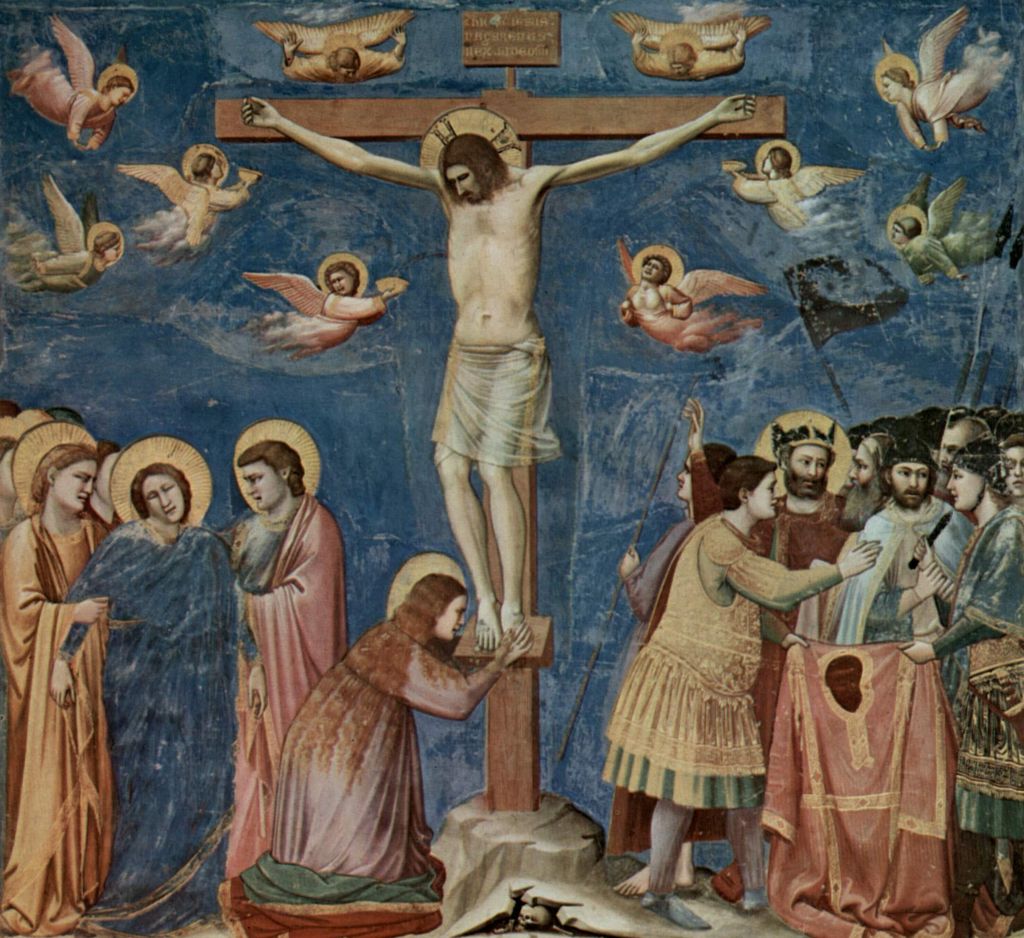
Looking at the Padua Crucifixion, the long horizontal cross and Christ's extended arms hold the upper field together. Below, the mourners cluster to one side while the figures around the garment form a different knot of action on the other. The blue between these groups is an active interval: it separates bodies, gives the flying angels room and makes their directions legible. Technical study asks how that blue was applied and preserved. Close looking asks what the interval does within this particular scene. Both questions are necessary, and neither can answer the other entirely.
Dry finishes, blue and the richness of a wall
Fresco painting did not end when the last fresh plaster dried. Some effects required further work on the surface. Painting a secco means painting on dry, or substantially dry, plaster, with an appropriate means of adhesion. At Padua, azurite blue and metal-leaf decoration belong to the account of these supplementary operations. A painted preparation could establish the tone beneath a later blue, while gilding supplied a kind of brightness different from a light-coloured pigment. [2]
The official report of the ICR programme describes a particularly varied technical ensemble: fresco alongside tempera using animal glue and egg, lime painting on a dry surface, the treatment of imitation marble, and oil where lead white was used. Its recorded dates for the principal mural campaign are 3 July 2001 to 18 March 2002. [3] These are findings about the Scrovegni decoration and its treatment, rather than a universal list to be attached to every work associated with Giotto.
They also change the way the chapel can be imagined. A wall that now reads principally as broad fields of colour could originally combine different surface effects. Light could be absorbed by one passage and caught by another. The definition of a halo might depend on the meeting of paint and metal rather than colour alone. A fictive marble panel invites comparison with stone, yet it remains part of a painted architectural setting. The materials take part in the chapel's movement between ordinary substances and represented splendour.
Blue is particularly vulnerable to loose description. The word names an appearance, not one mineral or one method. It is possible to see blue in the sky of a reproduction without knowing whether that photograph accurately records its present hue, how much finishing survives, or what preparation lies beneath it. Where a technical account identifies azurite or a dry application, the identification belongs to the examined passage. It should not spread automatically to every blue mantle, sky or cross in the painter's surviving work.
The same care is needed with exposed preparations. When an upper layer disappears, the remaining surface may display an earlier stage rather than a deliberately finished colour. Such a passage can be exceptionally informative about the order of work. It can also be misleading if treated as a complete statement of Giotto's intended palette. A preparatory tone had a job within a layered construction; its present prominence may be an accident of survival.
These distinctions give loss a visual consequence beyond the small area where paint is missing. If a richly finished robe becomes pale or patchy, its relation to the neighbouring face changes. If a luminous ornament disappears, the surrounding architecture may look quieter. Damage can alter the rhythm of attention across a scene even when the principal figures remain identifiable. Conservation history is therefore part of understanding composition, as well as part of caring for the wall.
The Peruzzi Chapel: different techniques within one room
The Peruzzi Chapel is an especially useful warning against describing an entire interior with one technical label. Cecilia Frosinini's conservation report explains that its narrative scenes were painted a secco, while the vault appears to have begun in buon fresco. The ribs and decorative bands, grey preparations for azurite, and imitation-marble dados provide further evidence of fresco work. Even within a single commission, method changed according to the area and task. [4]
Its plaster was applied in broad horizontal portions called pontate. These span the walls and divide individual scenes horizontally. Patches associated with the holes for scaffolding beams survive as another kind of evidence. Frosinini discusses the possibility of platforms allowing simultaneous work on opposing walls, but also acknowledges that the holes may have been inherited from the masonry campaign. Their alignment supports an investigation; it does not compel only one reconstruction of the scaffold. [4]
For a visitor, these distinctions help explain an uneven experience. Some architectural divisions are strongly legible while bodies and draperies can seem depleted. In the Ascension of Saint John the Evangelist, the saint rises diagonally through a carefully articulated enclosure. The stepped walls, upright columns and contrasting groups of witnesses still organise the scene, but much of the upper receiving company is difficult to follow in ordinary light. We can recognise the upward movement without possessing the full original richness of its destination.
The appearance of the worn surface does not prove that the picture was conceived as an austere arrangement of outlines. Frosinini's ultraviolet fluorescence investigation made modelling, folds, expressions and parts of the receiving group much clearer in photographs. The complete photographic campaign took place in November 2012. These images recover information about surviving material whose response differs under ultraviolet illumination. They do not physically return missing paint to the wall. [4]
That difference is easy to lose in the language of discovery. A figure can reappear in a scientific image while remaining faint to the visitor. Its improved visibility can transform interpretation: a gesture, a fold or a spatial relationship becomes available for study again. Yet the image remains a record made under particular conditions. Its colours should not be mistaken for the colours that a medieval spectator saw, and its clarity should not be read as the result of repainting the chapel.
Frosinini is equally explicit about limits. Later treatments and contamination complicated the analysis of original binding media. A proteinaceous binder was detected more generally, probably egg, while lipids appeared in some areas; explanations involving whitewash and chemical alteration remained hypotheses. The unusually strong ultraviolet response also had several possible causes, including interactions between original and later materials. [4] The report's qualifications are part of its value. They prevent a striking image from becoming an overconfident claim that every dry passage contains one securely identified binder.
The Peruzzi evidence encourages a particularly attentive kind of looking. Follow a figure's surviving silhouette, then notice how little modelling remains inside it. Compare that with a neighbouring area where a face or garment still carries more information. The difference may affect how forcefully a character occupies the room. Scientific images can help us understand that disparity, while the visible wall preserves the encounter with what has survived in place.
The Bardi Chapel after the restoration completed in 2026
Next door, the Bardi Chapel presents a different conservation history and a newly clarified appearance. The Opera di Santa Croce announced completion of its four-year restoration on 11 September 2026. Conservation addressed unstable plaster and paint, cracks, salts, deposits and altered materials, as well as the visual interruption caused by many small losses. The completed intervention also clarified the contribution of several painters working under Giotto's direction. [5]
The earlier Opificio examination had already established an important distinction: the giornate show a fresco basis adapted to backgrounds and figures, but ultraviolet examination revealed extensive dry work, including portions of buildings and whole garments. That record also states that accumulated restoration materials prevented a precise identification of the binder. [6] Its account belongs to an earlier investigative phase. Its references to a future restoration should not be read as the chapel's present status.
The most recent account of the working process adds a telling observation. Small tests of colour survive in areas that were destined to receive dry finishing; the loss of the covering paint has exposed marks that were not meant to remain visible. The same account describes work proceeding from upper levels downward, with finishing and metal leaf completed before the scaffold moved below. [7] These details make the workshop tangible: decisions about colour and access were embedded in the making of a coherent narrative environment.
They also explain why the surviving surface can be deceptive. An exposed test stroke might look abrupt beside a smoothly painted head because the two occupied different stages in the process. The rawness of the first is evidence of interruption by loss. It cannot be used as a fair measure of the finish the workshop intended. Equally, the fact that one passage is beautifully preserved does not allow the missing finish of another to be reconstructed with certainty.
The Bardi walls have passed through several kinds of alteration. Limewash concealed them before 1730. Nineteenth-century funerary monuments damaged the lower scenes; rediscovery in 1851 was followed by Gaetano Bianchi's extensive completion and unifying treatment. Procacci and Tintori removed nineteenth-century repainting in the campaign identified in the current history as 1957–59, preserving some additions separately as documents. The latest treatment keeps the large losses associated with the monuments recognisable while restoring essential architectural continuity through distinguishable integration. [8]
This history helps distinguish cleaning from reconstruction. Removing an altered coating can reveal surviving paint. Removing a nineteenth-century completion can reveal a loss. Filling a gap can support the surrounding material. Colouring that fill can reduce its visual dominance. These actions may all occur within a restoration, yet they have different effects on what the spectator sees. A newly continuous cornice may include an intelligible modern completion; a newly legible face may consist of paint that was already there beneath obscuring material.
The aim of legibility is especially consequential at Bardi because the scenes belong to an architectural ensemble. Painted framing connects one event with another and relates the walls to the vault. A scattered field of small bright losses can repeatedly interrupt that connection. Reducing their interference may let the eye follow a room or a group again, even while the losses themselves remain identifiable. The spectator gains a better sense of the whole without being offered an imaginary undamaged chapel.
What diagnostic images reveal—and what they do not
The Bardi investigations show why conservation uses several forms of examination. Diffuse light records the general surface; raking light brings out relief, incisions and irregularities. Ultraviolet examination helps distinguish materials and interventions. A three-dimensional model brings observations into a common spatial record, while investigations of the wall and plaster address hidden discontinuities. These are different questions asked of the same building. [9]
An especially vivid result concerns the Apparition at the Chapter of Arles. Mapping the distribution of lead with X-ray fluorescence made it possible to recognise the image of a crucifix on the chapter room's rear wall, no longer visible to the naked eye. [9] A scene whose setting had become visually impoverished consequently yields information about a lost element of its represented interior. The evidence is a distribution of material read in relation to the picture, rather than a new cross painted onto the wall.
This is distinct from an X-radiograph, which is also useful for understanding wooden structures, and from infrared reflectography, which can disclose certain kinds of drawing beneath paint. The name of a method matters because its image has a particular physical basis. A black-and-white technical image is not simply an exceptionally clear ordinary photograph. Different materials respond differently, and information absent from one type of examination may emerge through another.
The London Pentecost offers a useful caution. Its underdrawing is clearer under a microscope than in infrared reflectography, which Dillian Gordon relates to the possibility of a non-carbon drawing material such as iron-gall ink. [10] A weak infrared response therefore need not mean that the painter worked without a drawing. The question is what that particular examination can register in that particular object.
Scientific results are also used to revisit interpretation. On the Bardi vault, an object that Bianchi had made legible as a red-covered book in the allegory of Obedience has been identified after cleaning as a second yoke, corresponding to the one on the figure's shoulders. [7] The change affects the allegory's action: the figure offers something to the viewer. Conservation here alters an art-historical reading by clarifying the evidence on which the reading depended.
A changed interpretation is not a failure of looking. It is a reason to look again. Earlier spectators encountered a different surface, and earlier scholars worked with different photographs and technical information. The most responsible account makes those conditions visible. It distinguishes a documented finding from an explanation still under investigation, and a recovered detail from a complete reconstruction of the original scene.
Wooden paintings: construction before colour
A panel painting begins with a different set of physical decisions. Its support must carry a prepared painting surface while accommodating joints, attachments and the form of the object. A large cross is both an image and a substantial structure intended to be seen in an architectural setting. A small narrative panel may preserve clues to a much longer ensemble that has been divided among collections. The back and edges can be as informative as the picture's centre.
The white preparation is itself an important material. Gesso is gypsum combined with an animal-glue adhesive, worked to provide a smooth ground for painting and gilding on wood. It can be incised and can also carry relief decoration. [11] A panel painter therefore meets a prepared surface with its own qualities, rather than painting directly into the grain of the board. A sharp line in a halo or border may be cut into that preparation, beneath or through the metallic finish. Understanding which layer carries a mark helps distinguish the construction of the support from the construction of the image.
The Ognissanti Crucifix supplies a particularly clear example. The Opificio records seven-centimetre poplar boards, a carved limewood frame, fir and chestnut bracing and a total weight exceeding 400 kilograms. Linen and parchment strips intervene at vulnerable points beneath the gesso preparation. X-radiography established that Christ's halo was reduced and lowered after the fabric had been applied but before the gesso layers. [12]
That sequence places a change within the making of the object. It is more informative than simply observing that the halo looks carefully related to the head. The change preceded the visible painted finish, so it belongs to the workshop's construction and adjustment of the cross. It also reminds us that proportion could be reconsidered through the manipulation of real pieces of wood, as well as through a line drawn on a surface.
The finished cross makes its material complexity visually coherent. Christ's pale torso extends across a saturated blue field; around it, the gilded outline swells into the lobed terminals containing Mary, John and the blessing Christ. The decorated border does not feel like an incidental surround. Its repeated forms give the large object a rhythm, setting the long bodily curve against a more regular framework. The image has to hold together from below and at a distance, while offering smaller details to closer attention.
Here the relationship between naturalism and splendour is particularly direct. The chest, abdomen and bent knees suggest a body's weight, while the halo and framing establish another kind of presence around it. One surface can ask us to notice suffering flesh and precious ornament at once. Describing the object only as a realistic representation leaves out much of what it does as a suspended, shaped and decorated cross.
The Ognissanti account also identifies carbon drawing, incised and gilded decoration, layered blue and green flesh preparations, together with coloured glass and mirror material in the halo. [12] These findings explain the resources available to this particular workshop operation. They cannot be carried across without evidence to the Santa Maria Novella, Rimini or Padua crosses. Similar subjects and formats do not guarantee identical supports, paint layers or histories of treatment.
Gold, flesh and an adjustment in the Washington Madonna
The Washington Madonna and Child gives a smaller, more intimate example of the relation between material construction and visible form. Mary holds a white rose while the child reaches towards it and touches her hand. His body turns across the dark mantle; her long fingers connect the flower with the support of his weight. Gold frames the encounter, but the touches between hands direct attention into the figures.
The National Gallery of Art's technical summary records a single vertical-grained poplar board, fabric beneath the white gesso, and a green-earth layer followed by red bole under gilding. Figure outlines and decoration were incised. Green preparation and verdaccio helped develop the flesh, which was built in thin layers. Infrared examination disclosed an adjustment to the child's face, tilting it upward through shifts in the eyes and ear. [13]
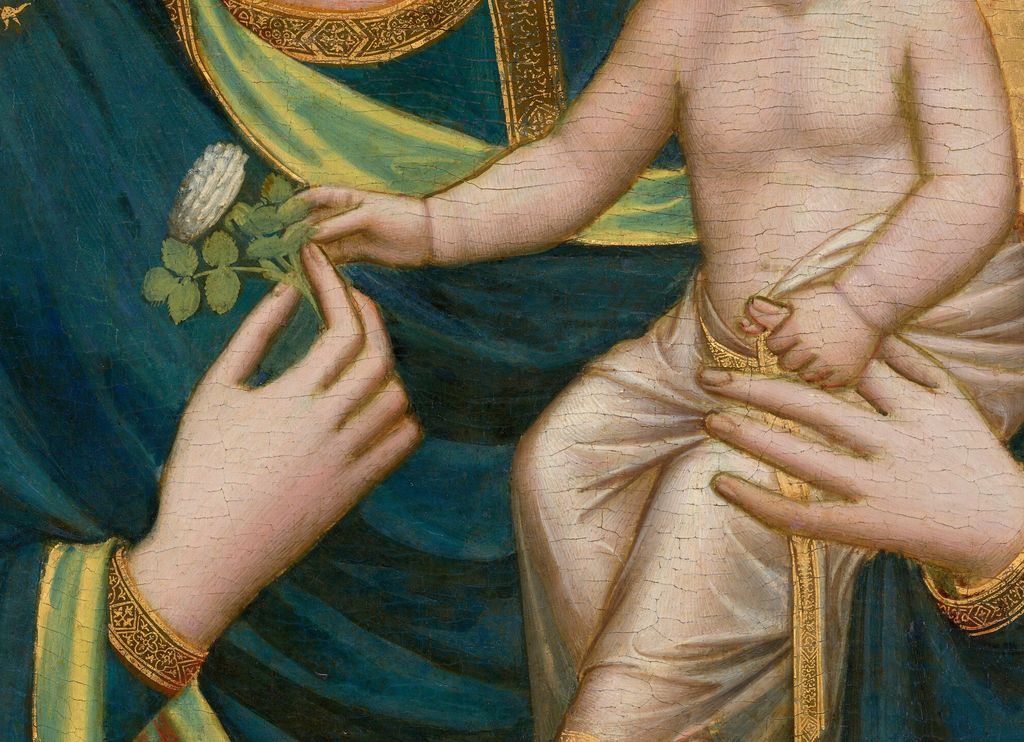
The Washington Madonna’s hands and rose in a normal photograph of the surviving painted surface. National Gallery of Art, Washington, Samuel H. Kress Collection,1939.1.256. Image source. Public domain. Proportionally reduced reproduction; no colour or content enhancement.
The visible result encourages us to see that adjustment in relation to the exchange. A slight change in the angle of a child's face can affect how firmly he addresses the space beside him, how his head sits on the torso, and how the two figures relate. Technical examination identifies the alteration; interpretation explores its consequence. We cannot recover every reason for the decision, but we can recognise that the image emerged through choices rather than arriving fully fixed at the first drawn stage.
Bole, the term used in the catalogue, names a clay layer beneath gold leaf. Red bole is common, and its warmth affects the appearance of the thin metal above it. [14] It is one more reason why a golden surface cannot be understood from the gold alone. In Washington the recorded sequence includes green earth below red bole; the order matters as much as the names.
Gold and flesh also involve different kinds of work. The patterned halos organise circular zones behind the heads, while fine tonal transitions give the cheeks their turning form. Their meeting is sharply visible, but the layers responsible are largely concealed. A description based only on the final colour would miss the distinction between an incised boundary, a prepared gilded surface and paint built through successive applications.
This example makes comparison especially useful. The green flesh preparation documented in Washington should be held beside the London Pentecost, where Gordon records thin flesh painting without green underpaint. [10] The variation matters more than a neat universal formula. To identify a work with Giotto or his workshop is not to claim that every face beneath that name was constructed with the same materials in the same order.
The London Pentecost: lost rays and a divided board
The Pentecost in London is a small egg-tempera painting on poplar, catalogued by the National Gallery as Giotto and Workshop. It is a separate physical work from the Pentecost at Padua, despite their shared subject. In London, the gathered heads rise above an ornamental barrier and a closed gate. The upper architecture offers a sequence of three gables and a patterned ceiling, turning a compact square into an unusually elaborate interior. [10]

The London Pentecost panel, NG5360, in its visible present surface.
The medium label is equally specific. In egg tempera, egg yolk binds the pigment. The broader historical word tempera can refer to more than this one binding medium, so a catalogue that identifies egg tempera supplies information beyond a general label of tempera painting. [15] The London panel belongs to a different physical category from a fresco wall, even where the painter faces a related problem of arranging heads, architecture and heavenly light.
Gordon's examination distinguishes the present rays from traces of an earlier system. Original rays of gilded tin have largely disappeared; their incised guides and scattered material traces survive. The more conspicuous later rays were applied over cracks. The distinction changes the imagined surface: the original metal strips would have stood above the painting and gold halos, giving the descent of the Spirit a physical prominence. [10]
The damage is therefore bound up with the subject. An almost vanished material once helped articulate the connection between the dove and the apostles. The narrative remains readable, but part of its original visual emphasis has been diminished. A modern diagram can indicate that lost arrangement, provided it is understood as explanatory documentation. It does not make the ordinary surface an untouched record of the first painted scheme.
The panel's reverse opens a further history. Marks of a former batten, traces of preparation and the remnants of fictive porphyry suggest an object with a considered back as well as a front. More decisively, comparison of wood grain in X-radiographs connects it with six other narrative panels, originally painted on a continuous board approximately 308 centimetres long. London and the New York Nativity and Epiphany occupied opposite ends. [10]
That is stronger evidence for physical association than a resemblance between faces or buildings alone. It gives the separated pictures a common material history. Their exact original function remains a further question: Gordon favours an autonomous dossal, whereas a predella has also been proposed. A reconstructed long arrangement can be persuasive without supplying the missing medieval location or resolving the division of labour among painters.
Cleaning, integration and the next generation of care
Cleaning brings unusually immediate changes, but it is an exercise in discrimination. At Ognissanti, the dark non-original coating contained plant gum and calcium oxalates. Removing it was difficult because the underlying preparation was highly water-sensitive. Controlled emulsions and microscopic observation permitted selective treatment while retaining a thin varnish considered probably original. Differentiated reintegration and a new supporting structure addressed appearance and display as well as preservation. [12]
The distinction between an unwanted dark coating and a potentially original varnish is crucial. Age alone does not tell the conservator what a layer is or what to do with it. The surface has to be understood as a sequence. Nor can a darker historical photograph be treated as proof that Giotto intended a subdued palette. It records an appearance at a particular stage in that sequence, under particular conditions of photography.
The Santa Maria Novella Crucifix has its own treatment history. The church archive records its return in March 2001 after prolonged conservation at the Opificio. A subsequent custodial account describes maintenance in December 2017: the cross was lowered for examination, lifting colour around board joints was secured, dust was removed, and small losses were toned with watercolour. [16] These are separate events from the Ognissanti treatment, with their own object and purpose.

Giotto's Crucifix in Santa Maria Novella
The modest scale of that maintenance is instructive. A restored work continues to inhabit a building, collect deposits and respond to its environment. Accessible examination and secure suspension make future care possible. At Padua, the official chapel account describes annual checks and programmed maintenance following the 2001–02 campaign. [17] The dramatic public moment of a restoration's completion belongs within a much longer responsibility to observe, compare and intervene when needed.
Conservation changes the questions we can ask of Giotto. We can follow an adjustment made before gesso covered a cross, recognise dry finishing where a wall has lost its richness, or reconnect panels through the grain of a sawn board. We can also understand why an apparently clear detail once led viewers astray. Returning to the painting with that knowledge makes the encounter more specific: this body, this halo, this room, made through particular decisions and surviving through a particular history.
Watch: Explore Giotto’s Art
Choose an overview or a closer look at three major works. These films provide wider Giotto context alongside this article.
Artworks directory
This directory brings together 209 records for paintings, ensembles, individual scenes and components, architectural work, an associated disputed design, and reported or lost projects connected with Giotto. Ensembles and their parts appear separately, so 209 is a count of records rather than independent paintings or commissions. Attributions and dates remain qualified where disputed; inclusion does not establish Giotto’s own hand throughout.
| Name | Date | Medium, attribution and status |
|---|---|---|
| Expulsion of Joachim from the Temple — Scrovegni Chapel, Padua | c.1303–05 (chapel campaign) | Fresco / wall painting. Giotto and workshop. Scene within a cycle. Padova Musei. Chapel overview. |
| Joachim among the Shepherds — Scrovegni Chapel, Padua | c.1303–05 (chapel campaign) | Fresco / wall painting. Giotto and workshop. Scene within a cycle. Padova Musei. Chapel overview. |
| Annunciation to Saint Anne — Scrovegni Chapel, Padua | c.1303–05 (chapel campaign) | Fresco / wall painting. Giotto and workshop. Scene within a cycle. Padova Musei. Chapel overview. |
| Sacrifice of Joachim — Scrovegni Chapel, Padua | c.1303–05 (chapel campaign) | Fresco / wall painting. Giotto and workshop. Scene within a cycle. Padova Musei. Chapel overview. |
| Joachim’s Dream — Scrovegni Chapel, Padua | c.1303–05 (chapel campaign) | Fresco / wall painting. Giotto and workshop. Scene within a cycle. Padova Musei. Padova Musei. Chapel overview. |
| Meeting at the Golden Gate — Scrovegni Chapel, Padua | c.1303–05 (chapel campaign) | Fresco / wall painting. Giotto and workshop. Scene within a cycle. Padova Musei. Chapel overview. |
| Birth of the Virgin — Scrovegni Chapel, Padua | c.1303–05 (chapel campaign) | Fresco / wall painting. Giotto and workshop. Scene within a cycle. Padova Musei. Padova Musei. Chapel overview. |
| Presentation of the Virgin in the Temple — Scrovegni Chapel, Padua | c.1303–05 (chapel campaign) | Fresco / wall painting. Giotto and workshop. Scene within a cycle. Padova Musei. Chapel overview. |
| Delivery of the Rods — Scrovegni Chapel, Padua | c.1303–05 (chapel campaign) | Fresco / wall painting. Giotto and workshop. Scene within a cycle. Padova Musei. Chapel overview. |
| Prayer of Joseph and the Suitors — Scrovegni Chapel, Padua | c.1303–05 (chapel campaign) | Fresco / wall painting. Giotto and workshop. Scene within a cycle. Padova Musei. Chapel overview. |
| Marriage of the Virgin — Scrovegni Chapel, Padua | c.1303–05 (chapel campaign) | Fresco / wall painting. Giotto and workshop. Scene within a cycle. Padova Musei. Chapel overview. |
| Wedding Procession of Mary — Scrovegni Chapel, Padua | c.1303–05 (chapel campaign) | Fresco / wall painting. Giotto and workshop. Scene within a cycle. Padova Musei. Chapel overview. |
| Annunciation on the triumphal arch — complete ensemble (Scrovegni Chapel, Padua) | c.1303–05 (chapel campaign) | Wall painting with a central painted wooden panel. Giotto and workshop. Ensemble. Includes the Mission of Gabriel and the lower Annunciation pair; the original central wooden panel is in the Musei Civici agli Eremitani, with a conservation copy in the chapel. Padova Musei. Padova Musei. Scholarly study. Chapel overview. |
| Visitation — Scrovegni Chapel, Padua | c.1303–05 (chapel campaign) | Fresco / wall painting. Giotto and workshop. Scene within a cycle. Padova Musei. Chapel overview. |
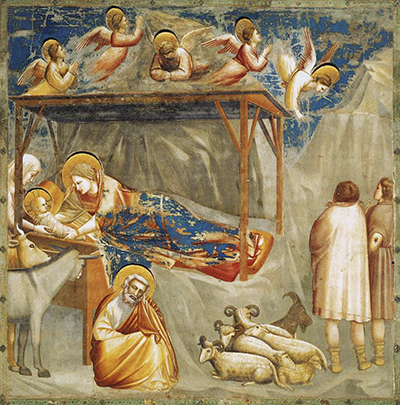
| Nativity — Scrovegni Chapel, Padua | c.1303–05 (chapel campaign) | Fresco / wall painting. Giotto and workshop. Scene within a cycle. Padova Musei. Chapel overview. |
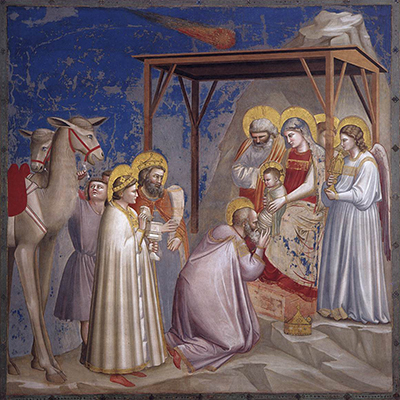
| Adoration of the Magi — Scrovegni Chapel, Padua | c.1303–05 (chapel campaign) | Fresco / wall painting. Giotto and workshop. Scene within a cycle. Padova Musei. Chapel overview. |
| Presentation of Christ at the Temple — Scrovegni Chapel, Padua | c.1303–05 (chapel campaign) | Fresco / wall painting. Giotto and workshop. Scene within a cycle. Padova Musei. Chapel overview. |
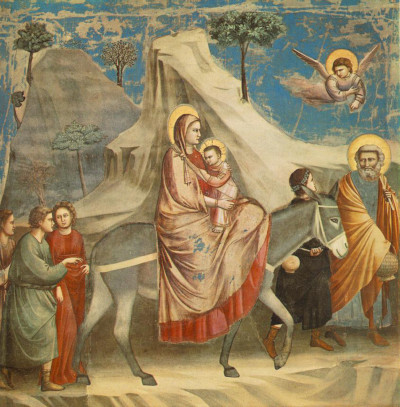
| Flight into Egypt — Scrovegni Chapel, Padua | c.1303–05 (chapel campaign) | Fresco / wall painting. Giotto and workshop. Scene within a cycle. Padova Musei. Chapel overview. |
| Massacre of the Innocents — Scrovegni Chapel, Padua | c.1303–05 (chapel campaign) | Fresco / wall painting. Giotto and workshop. Scene within a cycle. Padova Musei. Chapel overview. |
| Christ among the Doctors — Scrovegni Chapel, Padua | c.1303–05 (chapel campaign) | Fresco / wall painting. Giotto and workshop. Scene within a cycle. Padova Musei. Chapel overview. |
| Baptism of Christ — Scrovegni Chapel, Padua | c.1303–05 (chapel campaign) | Fresco / wall painting. Giotto and workshop. Scene within a cycle. Padova Musei. Chapel overview. |
| Marriage at Cana — Scrovegni Chapel, Padua | c.1303–05 (chapel campaign) | Fresco / wall painting. Giotto and workshop. Scene within a cycle. Padova Musei. Padova Musei. Chapel overview. |
| Raising of Lazarus — Scrovegni Chapel, Padua | c.1303–05 (chapel campaign) | Fresco / wall painting. Giotto and workshop. Scene within a cycle. Padova Musei. Chapel overview. |
| Entry into Jerusalem — Scrovegni Chapel, Padua | c.1303–05 (chapel campaign) | Fresco / wall painting. Giotto and workshop. Scene within a cycle. Padova Musei. Chapel overview. |
| Expulsion of the Money Changers — Scrovegni Chapel, Padua | c.1303–05 (chapel campaign) | Fresco / wall painting. Giotto and workshop. Scene within a cycle. Padova Musei. Padova Musei. Chapel overview. |
| Judas Receiving the Payment — Scrovegni Chapel, Padua | c.1303–05 (chapel campaign) | Fresco / wall painting. Giotto and workshop. Scene within a cycle. Padova Musei. Chapel overview. |
| Last Supper — Scrovegni Chapel, Padua | c.1303–05 (chapel campaign) | Fresco / wall painting. Giotto and workshop. Scene within a cycle. Padova Musei. Chapel overview. |
| Washing of the Feet — Scrovegni Chapel, Padua | c.1303–05 (chapel campaign) | Fresco / wall painting. Giotto and workshop. Scene within a cycle. Padova Musei. Chapel overview. |
| Arrest of Christ — Scrovegni Chapel, Padua | c.1303–05 (chapel campaign) | Fresco / wall painting. Giotto and workshop. Scene within a cycle. Padova Musei. Chapel overview. |
| Christ before Annas and Caiaphas — Scrovegni Chapel, Padua | c.1303–05 (chapel campaign) | Fresco / wall painting. Giotto and workshop. Scene within a cycle. Padova Musei. Chapel overview. |
| Mocking of Christ and Flagellation — Scrovegni Chapel, Padua | c.1303–05 (chapel campaign) | Fresco / wall painting. Giotto and workshop. Scene within a cycle. Padova Musei. Chapel overview. |
| Road to Calvary — Scrovegni Chapel, Padua | c.1303–05 (chapel campaign) | Fresco / wall painting. Giotto and workshop. Scene within a cycle. Padova Musei. Chapel overview. |
| Crucifixion — Scrovegni Chapel, Padua | c.1303–05 (chapel campaign) | Fresco / wall painting. Giotto and workshop. Scene within a cycle. Padova Musei. Chapel overview. |
| Lamentation — Scrovegni Chapel, Padua | c.1303–05 (chapel campaign) | Fresco / wall painting. Giotto and workshop. Scene within a cycle. Padova Musei. Chapel overview. |
| Resurrection / Noli me tangere — Scrovegni Chapel, Padua | c.1303–05 (chapel campaign) | Fresco / wall painting. Giotto and workshop. Scene within a cycle. Padova Musei. Chapel overview. |
| Ascension — Scrovegni Chapel, Padua | c.1303–05 (chapel campaign) | Fresco / wall painting. Giotto and workshop. Scene within a cycle. Padova Musei. Chapel overview. |
| Pentecost — Scrovegni Chapel, Padua | c.1303–05 (chapel campaign) | Fresco / wall painting. Giotto and workshop. Scene within a cycle. Padova Musei. Padova Musei. Chapel overview. |
| Coretto — right painted recess (Scrovegni Chapel, Padua) | c.1303–05 (chapel campaign) | Fresco / painted fictive architecture. Giotto and workshop. Ensemble component. Padova Musei. Padova Musei. Scholarly study. Chapel overview. |
| Coretto — left painted recess (Scrovegni Chapel, Padua) | c.1303–05 (chapel campaign) | Fresco / painted fictive architecture. Giotto and workshop. Ensemble component. Padova Musei. Padova Musei. Scholarly study. Chapel overview. |
| Envy — Scrovegni Chapel, Padua | c.1303–05 (chapel campaign) | Grisaille fresco / wall painting. Giotto and workshop. Ensemble component. Padova Musei. Chapel overview. Scholarly study. Padova Musei. |
| Despair — Scrovegni Chapel, Padua | c.1303–05 (chapel campaign) | Grisaille fresco / wall painting. Giotto and workshop. Ensemble component. Padova Musei. Chapel overview. Scholarly study. Padova Musei. |
| Prudence — Scrovegni Chapel, Padua | c.1303–05 (chapel campaign) | Grisaille fresco / wall painting. Giotto and workshop. Ensemble component. Padova Musei. Chapel overview. Scholarly study. Padova Musei. |
| Fortitude — Scrovegni Chapel, Padua | c.1303–05 (chapel campaign) | Grisaille fresco / wall painting. Giotto and workshop. Ensemble component. Padova Musei. Chapel overview. Scholarly study. Padova Musei. |
| Temperance — Scrovegni Chapel, Padua | c.1303–05 (chapel campaign) | Grisaille fresco / wall painting. Giotto and workshop. Ensemble component. Padova Musei. Chapel overview. Scholarly study. Padova Musei. |
| Justice — Scrovegni Chapel, Padua | c.1303–05 (chapel campaign) | Grisaille fresco / wall painting. Giotto and workshop. Ensemble component. Padova Musei. Chapel overview. Scholarly study. Padova Musei. |
| Faith — Scrovegni Chapel, Padua | c.1303–05 (chapel campaign) | Grisaille fresco / wall painting. Giotto and workshop. Ensemble component. Padova Musei. Chapel overview. Scholarly study. Padova Musei. |
| Charity — Scrovegni Chapel, Padua | c.1303–05 (chapel campaign) | Grisaille fresco / wall painting. Giotto and workshop. Ensemble component. Padova Musei. Chapel overview. Scholarly study. Padova Musei. |
| Hope — Scrovegni Chapel, Padua | c.1303–05 (chapel campaign) | Grisaille fresco / wall painting. Giotto and workshop. Ensemble component. Padova Musei. Chapel overview. Scholarly study. Padova Musei. |
| Folly — Scrovegni Chapel, Padua | c.1303–05 (chapel campaign) | Grisaille fresco / wall painting. Giotto and workshop. Ensemble component. Padova Musei. Chapel overview. Scholarly study. Padova Musei. |
| Inconstancy — Scrovegni Chapel, Padua | c.1303–05 (chapel campaign) | Grisaille fresco / wall painting. Giotto and workshop. Ensemble component. Padova Musei. Chapel overview. Scholarly study. Padova Musei. |
| Wrath — Scrovegni Chapel, Padua | c.1303–05 (chapel campaign) | Grisaille fresco / wall painting. Giotto and workshop. Ensemble component. Padova Musei. Chapel overview. Scholarly study. Padova Musei. |
| Injustice — Scrovegni Chapel, Padua | c.1303–05 (chapel campaign) | Grisaille fresco / wall painting. Giotto and workshop. Ensemble component. Padova Musei. Chapel overview. Scholarly study. Padova Musei. |
| Infidelity / Idolatry — Scrovegni Chapel, Padua | c.1303–05 (chapel campaign) | Grisaille fresco / wall painting. Giotto and workshop. Ensemble component. Padova Musei. Chapel overview. Scholarly study. Padova Musei. |
| Starry vault — complete ensemble (Scrovegni Chapel, Padua) | c.1303–05 (chapel campaign) | Vault painting. Giotto and workshop. Ensemble. Padova Musei. Padova Musei. Chapel overview. |
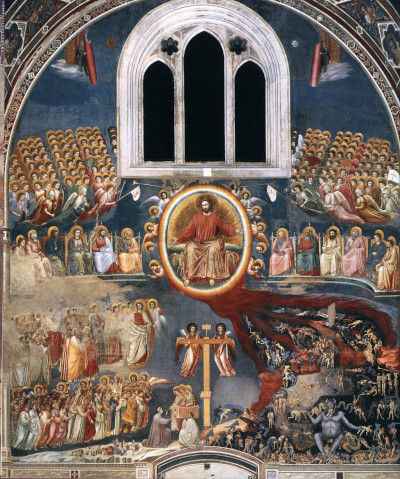
| Last Judgement — Scrovegni Chapel, Padua | c.1303–05 (chapel campaign) | Fresco / wall painting. Giotto and workshop. Scene within a cycle. Padova Musei. Padova Musei. Chapel overview. Padova Musei. |
| Prophet Malachi — vault medallion — Scrovegni Chapel, Padua | c.1303–05 (chapel campaign) | Fresco / wall painting. Giotto and workshop. Ensemble component. Padova Musei. Padova Musei. Chapel overview. Padova Musei. |
| Prophet Baruch — vault medallion — Scrovegni Chapel, Padua | c.1303–05 (chapel campaign) | Fresco / wall painting. Giotto and workshop. Ensemble component. Padova Musei. Padova Musei. Chapel overview. Padova Musei. |
| Prophet Isaiah — vault medallion — Scrovegni Chapel, Padua | c.1303–05 (chapel campaign) | Fresco / wall painting. Giotto and workshop. Ensemble component. Padova Musei. Padova Musei. Chapel overview. Padova Musei. |
| Prophet Daniel — vault medallion — Scrovegni Chapel, Padua | c.1303–05 (chapel campaign) | Fresco / wall painting. Giotto and workshop. Ensemble component. Padova Musei. Padova Musei. Chapel overview. Padova Musei. |
| Christ Pantocrator — vault medallion — Scrovegni Chapel, Padua | c.1303–05 (chapel campaign) | Fresco / wall painting. Giotto and workshop. Ensemble component. Padova Musei. Padova Musei. Chapel overview. Padova Musei. |
| Virgin and Child — vault medallion — Scrovegni Chapel, Padua | c.1303–05 (chapel campaign) | Fresco / wall painting. Giotto and workshop. Ensemble component. Padova Musei. Padova Musei. Chapel overview. Padova Musei. |
| Prophet Ezekiel — vault medallion — Scrovegni Chapel, Padua | c.1303–05 (chapel campaign) | Fresco / wall painting. Giotto and workshop. Ensemble component. Padova Musei. Padova Musei. Chapel overview. Padova Musei. |
| Prophet Micah — vault medallion — Scrovegni Chapel, Padua | c.1303–05 (chapel campaign) | Fresco / wall painting. Giotto and workshop. Ensemble component. Padova Musei. Padova Musei. Chapel overview. Padova Musei. |
| Saint John the Baptist — vault medallion — Scrovegni Chapel, Padua | c.1303–05 (chapel campaign) | Fresco / wall painting. Giotto and workshop. Ensemble component. Padova Musei. Padova Musei. Chapel overview. Padova Musei. |
| Scrovegni Chapel — painted decoration | c.1303–05 (chapel campaign) | Fresco / wall painting, with a painted wooden panel. Giotto and workshop (painted decoration). Ensemble. Includes separately listed scenes and components. The original central God the Father panel is in the Musei Civici agli Eremitani; a conservation copy is in the chapel. Chapel overview. Padova Musei. Padova Musei. Source. Source. Source. Padova Musei. Scholarly study. |
| Vices and Virtues — complete fourteen-figure programme | c.1303–05 (chapel campaign) | Grisaille fresco / wall painting. Giotto and workshop. Ensemble. Fourteen figures: seven virtues and seven opposed vices. Padova Musei. Chapel overview. Scholarly study. |
| Coretti — paired fictive chapels | c.1303–05 (chapel campaign) | Fresco / painted fictive architecture. Giotto and workshop. Ensemble. Two separate painted recesses, also listed individually. Padova Musei. Padova Musei. Scholarly study. |
| Mission of Gabriel — heavenly assembly | c.1303–05 (chapel campaign) | Wall painting with central painted wooden image. Giotto and workshop. Ensemble component. Central wooden God the Father panel preserved at the Musei Civici agli Eremitani; conservation copy in the chapel. Chapel overview. Padova Musei. Scholarly study. Padova Musei. |
| Annunciation — Gabriel and Mary in facing chambers | c.1303–05 (chapel campaign) | Fresco / wall painting. Giotto and workshop. Ensemble component. Chapel overview. Scholarly study. Padova Musei. |
| God the Father — central wooden panel of the Mission of Gabriel | c.1303–05 (chapel campaign) | Painting on wood. Associated with Giotto. Ensemble component. Original at the Musei Civici agli Eremitani, Padua; conservation copy in the Scrovegni Chapel. Padova Musei. Padova Musei. Scholarly study. Source. |
| Life of Saint Francis — Upper Church cycle, Assisi | Late 13th–early 14th century; dating disputed | Fresco / wall-painting cycle. Traditionally associated with Giotto; Giotto, Roman-school and other attributions disputed. Ensemble. Twenty-eight-scene nave cycle; scenes also listed individually. Basilica catalogue. Scholarly study. Basilica catalogue. Source. Source. |
| Homage of a Simple Man — Upper Church, Assisi | Late 13th–early 14th century; dating disputed | Wall painting. Traditionally associated with Giotto; authorship and dating disputed. Scene within a cycle. Source. Scholarly study. Source. Source. Source. |
| Gift of the Mantle — Upper Church, Assisi | Late 13th–early 14th century; dating disputed | Wall painting. Traditionally associated with Giotto; authorship and dating disputed. Scene within a cycle. Basilica catalogue. Scholarly study. Source. Source. Source. |
| Dream of the Palace Full of Arms — Upper Church, Assisi | Late 13th–early 14th century; dating disputed | Wall painting. Traditionally associated with Giotto; authorship and dating disputed. Scene within a cycle. Basilica catalogue. Source. Scholarly study. Source. Source. Source. |
| Prayer before the Crucifix at San Damiano — Upper Church, Assisi | Late 13th–early 14th century; dating disputed | Wall painting. Traditionally associated with Giotto; authorship and dating disputed. Scene within a cycle. Source. Source. Source. Scholarly study. Source. Source. |
| Renunciation of Worldly Goods — Upper Church, Assisi | Late 13th–early 14th century; dating disputed | Wall painting. Traditionally associated with Giotto; authorship and dating disputed. Scene within a cycle. Source. Scholarly study. Source. Source. |
| Dream of Innocent III — Upper Church, Assisi | Late 13th–early 14th century; dating disputed | Wall painting. Traditionally associated with Giotto; authorship and dating disputed. Scene within a cycle. Source. Source. Scholarly study. Source. Source. |
| Confirmation of the Rule — Upper Church, Assisi | Late 13th–early 14th century; dating disputed | Wall painting. Traditionally associated with Giotto; authorship and dating disputed. Scene within a cycle. Source. Scholarly study. Source. Source. |
| Vision of the Flaming Chariot — Upper Church, Assisi | Late 13th–early 14th century; dating disputed | Wall painting. Traditionally associated with Giotto; authorship and dating disputed. Scene within a cycle. Source. Source. Scholarly study. Source. Source. |
| Vision of the Thrones — Upper Church, Assisi | Late 13th–early 14th century; dating disputed | Wall painting. Traditionally associated with Giotto; authorship and dating disputed. Scene within a cycle. Basilica catalogue. Scholarly study. Source. Source. Source. |
| Expulsion of Devils from Arezzo — Upper Church, Assisi | Late 13th–early 14th century; dating disputed | Wall painting. Traditionally associated with Giotto; authorship and dating disputed. Scene within a cycle. Source. Source. Scholarly study. Source. Source. Source. |
| Trial by Fire before the Sultan — Upper Church, Assisi | Late 13th–early 14th century; dating disputed | Wall painting. Traditionally associated with Giotto; authorship and dating disputed. Scene within a cycle. Source. Source. Scholarly study. Source. Source. |
| Ecstasy of Saint Francis — Upper Church, Assisi | Late 13th–early 14th century; dating disputed | Wall painting. Traditionally associated with Giotto; authorship and dating disputed. Scene within a cycle. Source. Source. Source. Scholarly study. Source. Source. |
| Nativity at Greccio — Upper Church, Assisi | Late 13th–early 14th century; dating disputed | Wall painting. Traditionally associated with Giotto; authorship and dating disputed. Scene within a cycle. Basilica catalogue. Scholarly study. Source. Source. Source. |
| Miracle of the Spring — Upper Church, Assisi | Late 13th–early 14th century; dating disputed | Wall painting. Traditionally associated with Giotto; authorship and dating disputed. Scene within a cycle. Source. Scholarly study. Source. Source. Source. |
| Sermon to the Birds — Upper Church, Assisi | Late 13th–early 14th century; dating disputed | Wall painting. Traditionally associated with Giotto; authorship and dating disputed. Scene within a cycle. Basilica catalogue. Scholarly study. Source. Source. Source. |
| Death of the Knight of Celano — Upper Church, Assisi | Late 13th–early 14th century; dating disputed | Wall painting. Traditionally associated with Giotto; authorship and dating disputed. Scene within a cycle. Source. Source. Scholarly study. Source. Source. |
| Sermon before Pope Honorius III — Upper Church, Assisi | Late 13th–early 14th century; dating disputed | Wall painting. Traditionally associated with Giotto; authorship and dating disputed. Scene within a cycle. Source. Source. Scholarly study. Source. |
| Apparition at the Chapter of Arles — Upper Church, Assisi | Late 13th–early 14th century; dating disputed | Wall painting. Traditionally associated with Giotto; authorship and dating disputed. Scene within a cycle. Basilica catalogue. Scholarly study. Source. Source. Source. |
| Stigmatisation — Upper Church, Assisi | Late 13th–early 14th century; dating disputed | Wall painting. Traditionally associated with Giotto; authorship and dating disputed. Scene within a cycle. Source. Scholarly study. Source. Source. |
| Death and Ascension of Saint Francis — Upper Church, Assisi | Late 13th–early 14th century; dating disputed | Wall painting. Traditionally associated with Giotto; authorship and dating disputed. Scene within a cycle. Basilica catalogue. Scholarly study. Source. Source. Source. |
| Apparition to Brother Augustine and Bishop Guido — Upper Church, Assisi | Late 13th–early 14th century; dating disputed | Wall painting. Traditionally associated with Giotto; authorship and dating disputed. Scene within a cycle. Zeri catalogue. Scholarly study. Source. Source. Source. |
| Verification of the Stigmata — Upper Church, Assisi | Late 13th–early 14th century; dating disputed | Wall painting. Traditionally associated with Giotto; authorship and dating disputed. Scene within a cycle. Source. Source. Scholarly study. Source. Source. |
| Mourning of the Poor Clares — Upper Church, Assisi | Late 13th–early 14th century; dating disputed | Wall painting. Traditionally associated with Giotto; authorship and dating disputed. Scene within a cycle. Basilica catalogue. Source. Scholarly study. Source. Source. |
| Canonisation of Saint Francis — Upper Church, Assisi | Late 13th–early 14th century; dating disputed | Wall painting. Traditionally associated with Giotto; authorship and dating disputed. Scene within a cycle. Source. Source. Scholarly study. Source. Source. Source. |
| Apparition to Pope Gregory IX — Upper Church, Assisi | Late 13th–early 14th century; dating disputed | Wall painting. Traditionally associated with Giotto; authorship and dating disputed. Scene within a cycle. Zeri catalogue. Scholarly study. Source. Source. Source. |
| Healing of John of Lerida — Upper Church, Assisi | Late 13th–early 14th century; dating disputed | Wall painting. Traditionally associated with Giotto; authorship and dating disputed. Scene within a cycle. Source. Source. Scholarly study. Source. Source. |
| Resurrection of a Woman — Upper Church, Assisi | Late 13th–early 14th century; dating disputed | Wall painting. Traditionally associated with Giotto; authorship and dating disputed. Scene within a cycle. Source. Scholarly study. Source. Source. Source. |
| Liberation of the Prisoner Peter — Upper Church, Assisi | Late 13th–early 14th century; dating disputed | Wall painting. Traditionally associated with Giotto; authorship and dating disputed. Scene within a cycle. Source. Source. Scholarly study. Source. Source. Source. |
| Santa Maria Novella Crucifix | Late 13th century; c.1288–89 or 1298–1301; disputed | Tempera and gold on a shaped wooden cross. Giotto. Source. |
| Death of the Virgin / Dormition — Berlin | c.1310 | Tempera and gold on poplar; gabled dossal. Giotto. Source. Source. |
| Peruzzi Altarpiece | c.1311–1315 (North Carolina Museum of Art) | Tempera and gold on panel. Giotto and workshop. Ensemble. Source. |
| Bologna Polyptych | c.1330 | Tempera and gold on panel. Giotto and workshop. Ensemble. Source. |
| Death of Saint Francis, Bardi Chapel | After 1317, usually the 1320s; disputed | Wall painting with wet-plaster and dry-applied passages. Giotto. Scene within a cycle. Source. |
| Bardi Chapel — painted decoration | After 1317, usually the 1320s; disputed | Wall painting with wet-plaster and dry-applied passages. Giotto and workshop / Giottesque painters; individual hands disputed. Ensemble. Scholarly study. Source. |
| Badia Polyptych | c.1300; proposed dates include 1295–1300 and 1301–02 | Tempera and gold on panel; five cusped compartments. Giotto. Ensemble. Scholarly study. Source. Source. |
| Baroncelli Polyptych | After 1328; detached pinnacle c.1328–35 | Tempera and gold on panel; later altered framing. Giotto and workshop. Ensemble. Detached central pinnacle in San Diego. Santa Croce. |
| Adoration of the Magi / Epiphany — Metropolitan Museum panel | Possibly c.1320; c.1310–18 also proposed for the group | Tempera and gold on wood. Giotto. Part of the dispersed seven-scene board; original function disputed. Met catalogue. Source. |
| Franciscan Allegories | Early 14th century, often c.1315; disputed | Vault wall painting. Giotto and workshop / Giottesque painters; individual hands disputed. Ensemble. Basilica catalogue. |
| Navicella — lost / reworked original mosaic | Late 13th–early 14th century; date disputed | Mosaic. Original attributed to Giotto. Original lost / reworked; fragments and later remakes survive. Scholarly study. |
| Pentecost — London panel | Possibly c.1310–18 (Gordon) | Egg tempera on poplar. Giotto and workshop. Part of the dispersed seven-scene board; original function disputed. National Gallery. Source. |
| Saint Stephen — Horne panel | c.1330–1335 (Museo Horne) | Tempera and gold on panel. Giotto. Proposed association with the Washington and Chaalis panels remains hypothetical. Source. |
| Saint Francis Receiving the Stigmata — Louvre altarpiece | 1300–25 (Louvre) | Tempera and gold on poplar. Giotto. Louvre catalogue. |
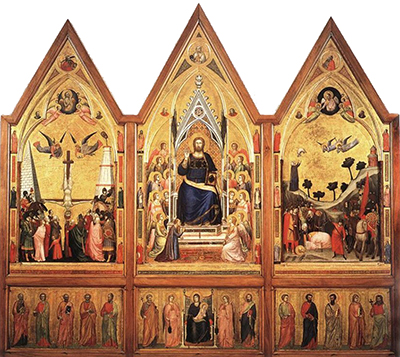
| Stefaneschi Triptych | c.1320; 1315–20 (Vatican Museums) | Tempera and gold on panel; painted on both sides. Giotto and workshop. Ensemble. Vatican Museums. |
| Crucifixion, Berlin | c.1315–1320 | Tempera and gold on poplar. Giotto. Source. |
| Madonna and Child — Washington / Goldman Madonna | c.1310–1315 (National Gallery of Art) | Tempera and gold on poplar. Giotto. Washington panel, distinct from San Giorgio alla Costa; proposed Horne/Chaalis companions remain hypothetical. NGA catalogue. |
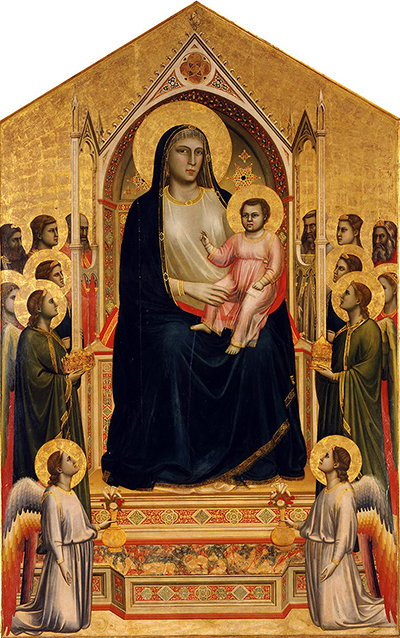
| Ognissanti Madonna | c.1300–05 (Uffizi); c.1310 also proposed | Tempera and gold on panel. Giotto. Uffizi. |
| Madonna of Borgo San Lorenzo | c.1290–95; dating and attribution debated | Tempera and gold on a fragment of a wooden panel. Giotto. Fragmentary. Source. |
| Madonna of San Giorgio alla Costa | c.1288–95 (Opera del Duomo); later dates also proposed | Tempera and gold on panel; cut edges. Giotto. Damaged in 1993 and treated in 1995. Source. |
| Magdalene Chapel — painted decoration | c.1307–08 (basilica); disputed | Wall painting with wet-plaster and dry-applied passages. Giotto and workshop / Giottesque painters; individual hands disputed. Ensemble. Basilica catalogue. |
| Ognissanti Crucifix | c.1315–1320 (Opificio) | Painting on a shaped wooden cross. Giotto and workshop. Workshop participation and alternative attributions debated. Source. |
| Padua Crucifix | c.1303–05 (Zeri catalogue) | Tempera and gold on a shaped wooden cross. Giotto. Zeri catalogue. |
| Peruzzi Chapel — painted decoration | c.1310–11 (Santa Croce); 1334–36 proposed by Schwarz | Wall painting with substantial dry-applied work and loss. Giotto and workshop / Giottesque painters; individual hands disputed. Ensemble. Santa Croce. |
| Rimini Crucifix | c.1300; late 13th century also proposed | Tempera and gold on a shaped wooden cross. Giotto. Source. |
| Giotto’s Campanile — Florence Cathedral bell tower | Begun 1334; completed 1359 under successors | Marble-clad masonry bell tower. Begun under Giotto; continued by Andrea Pisano and Francesco Talenti. Successive building and sculptural campaigns. Source. Scholarly study. Scholarly study. |
| Tower elevation on parchment, Siena — disputed relation to Giotto | 14th century; date and design context disputed | Brown ink and coloured washes over incised construction on three parchment skins. Attribution disputed; possibly a Giotto design transmitted through another hand. Associated design; autograph attribution unestablished. Alternative attributions include Lando di Pietro. Scholarly study. Source. Source. |
| Seven scenes of Christ — dispersed painted board | Possibly c.1310–18 (Gordon); component dates vary | Tempera and gold on a single wooden board, subsequently divided. Giotto and workshop; individual attributions vary. Reconstructed dispersed ensemble. Common board supported by matching wood grain; predella or dossal function disputed. Source. Source. |
| Presentation of Christ at the Temple — Boston panel | Possibly c.1310–18 (Gordon’s group dating) | Tempera and gold on wood. Giotto and workshop; individual attribution varies within the group. Ensemble component. Source. Source. |
| Last Supper — Munich panel | Possibly c.1310–18 (Gordon’s group dating) | Tempera and gold on wood. Giotto and workshop; individual attribution varies within the group. Ensemble component. Source. Source. Source. |
| Crucifixion — Munich panel | Possibly c.1310–18 (Gordon’s group dating) | Tempera and gold on wood. Giotto and workshop; individual attribution varies within the group. Ensemble component. Source. Source. Source. |
| Descent into Limbo — Munich panel | Possibly c.1310–18 (Gordon’s group dating) | Tempera and gold on wood. Giotto and workshop; individual attribution varies within the group. Ensemble component. Source. Source. Source. |
| Entombment — Villa I Tatti panel | Possibly c.1310–18 (Gordon’s group dating) | Tempera and gold on wood. Giotto and workshop; individual attribution varies within the group. Ensemble component. Source. Source. |
| God the Father with Angels — detached Baroncelli pinnacle | c.1328–1335 (San Diego Museum of Art) | Tempera and gold on wood. Giotto and workshop. Ensemble component. Detached in later remodelling; collection home in San Diego. Source. Source. |
| Saint John the Evangelist — Chaalis panel | c.1320 (INHA/RETIF) | Painting on wood. Giotto (INHA/RETIF attribution). Collection: Musée Jacquemart-André, Fontaine-Chaalis. Chantilly’s exhibition announcement, as of 1 November 2026, gives temporary display from 24 January 2026 with no end date. Association with the Washington/Horne altarpiece remains hypothetical. NGA catalogue. Source. Source. Source. Source. |
| Saint Lawrence — Chaalis panel | c.1320 (INHA/RETIF) | Painting on poplar. Giotto; possible execution by a collaborator (INHA/RETIF). Collection: Musée Jacquemart-André, Fontaine-Chaalis. Chantilly’s exhibition announcement, as of 1 November 2026, gives temporary display from 24 January 2026 with no end date. Association with the Washington/Horne altarpiece remains hypothetical. NGA catalogue. Source. Source. Source. Source. |
| Allegory of Poverty — Lower Church crossing vault, Assisi | Early 14th century, often c.1315; disputed | Vault wall painting. Giotto’s workshop / Giottesque painters; alternatives include Stefano. Ensemble component. Basilica catalogue. Source. Scholarly study. |
| Allegory of Chastity — Lower Church crossing vault, Assisi | Early 14th century, often c.1315; disputed | Vault wall painting. Giotto’s workshop / Giottesque painters; alternatives include Stefano. Ensemble component. Basilica catalogue. Source. Scholarly study. |
| Allegory of Obedience — Lower Church crossing vault, Assisi | Early 14th century, often c.1315; disputed | Vault wall painting. Giotto’s workshop / Giottesque painters; alternatives include Stefano. Ensemble component. Basilica catalogue. Source. Scholarly study. |
| Saint Francis in Glory — Lower Church crossing vault, Assisi | Early 14th century, often c.1315; disputed | Vault wall painting. Giotto’s workshop / Giottesque painters; alternatives include Stefano. Ensemble component. Basilica catalogue. Source. Scholarly study. |
| Renunciation of Worldly Goods — Bardi Chapel, Florence | After 1317, usually the 1320s; disputed | Wall painting: fresco with extensive dry-applied passages. Giotto and workshop; individual hands uncertain. Scene within a cycle. Source. Santa Croce. Scholarly study. Source. |
| Confirmation of the Rule — Bardi Chapel, Florence | After 1317, usually the 1320s; disputed | Wall painting: fresco with extensive dry-applied passages. Giotto and workshop; individual hands uncertain. Scene within a cycle. Source. Santa Croce. Scholarly study. Source. |
| Apparition at the Chapter of Arles — Bardi Chapel, Florence | After 1317, usually the 1320s; disputed | Wall painting: fresco with extensive dry-applied passages. Giotto and workshop; individual hands uncertain. Scene within a cycle. Source. Santa Croce. Scholarly study. Source. |
| Trial by Fire before the Sultan — Bardi Chapel, Florence | After 1317, usually the 1320s; disputed | Wall painting: fresco with extensive dry-applied passages. Giotto and workshop; individual hands uncertain. Scene within a cycle. Source. Santa Croce. Scholarly study. Source. |
| Apparitions to Brother Augustine and Bishop Guido — Bardi Chapel, Florence | After 1317, usually the 1320s; disputed | Wall painting: fresco with extensive dry-applied passages. Giotto and workshop; individual hands uncertain. Scene within a cycle. Source. Santa Croce. Scholarly study. Source. |
| Saint Francis Receiving the Stigmata — Bardi Chapel, Florence | After 1317, usually the 1320s; disputed | Wall painting: fresco with extensive dry-applied passages. Giotto and workshop; individual hands uncertain. Scene within a cycle. Source. Santa Croce. Scholarly study. Source. |
| Saint Louis of Toulouse — Bardi Chapel niche | After 1317; campaign date disputed | Wall painting. Giotto and workshop. Ensemble component. Source. Scholarly study. |
| Saint Clare — Bardi Chapel niche | After 1317; campaign date disputed | Wall painting. Giotto and workshop. Ensemble component. Source. Scholarly study. |
| Saint Elizabeth of Hungary — Bardi Chapel niche | After 1317; campaign date disputed | Wall painting. Giotto and workshop. Ensemble component. Source. Scholarly study. |
| Franciscan virtues — Bardi Chapel vault programme | After 1317; campaign date disputed | Vault wall painting. Giotto and workshop. Group of ensemble components. Santa Croce. Source. |
| Annunciation to Zacharias — Peruzzi Chapel, Florence | c.1310–11 (Santa Croce); 1334–36 proposed by Schwarz | Wall painting with substantial dry-applied work. Giotto and workshop. Scene within a cycle. Santa Croce. Scholarly study. Santa Croce. |
| Birth and Naming of John the Baptist — Peruzzi Chapel, Florence | c.1310–11 (Santa Croce); 1334–36 proposed by Schwarz | Wall painting with substantial dry-applied work. Giotto and workshop. Scene within a cycle. Santa Croce. Scholarly study. Santa Croce. |
| Feast of Herod — Peruzzi Chapel, Florence | c.1310–11 (Santa Croce); 1334–36 proposed by Schwarz | Wall painting with substantial dry-applied work. Giotto and workshop. Scene within a cycle. Santa Croce. Scholarly study. Santa Croce. |
| Vision of John on Patmos — Peruzzi Chapel, Florence | c.1310–11 (Santa Croce); 1334–36 proposed by Schwarz | Wall painting with substantial dry-applied work. Giotto and workshop. Scene within a cycle. Santa Croce. Scholarly study. Santa Croce. |
| Raising of Drusiana — Peruzzi Chapel, Florence | c.1310–11 (Santa Croce); 1334–36 proposed by Schwarz | Wall painting with substantial dry-applied work. Giotto and workshop. Scene within a cycle. Santa Croce. Scholarly study. Santa Croce. |
| Death and Ascension of John the Evangelist — Peruzzi Chapel, Florence | c.1310–11 (Santa Croce); 1334–36 proposed by Schwarz | Wall painting with substantial dry-applied work. Giotto and workshop. Scene within a cycle. Santa Croce. Scholarly study. Santa Croce. |
| Evangelist symbols — Peruzzi Chapel vault | c.1310–11 (Santa Croce); 1334–36 proposed by Schwarz | Wall painting. Giotto and workshop. Group of ensemble components. Santa Croce. |
| Eight prophets — Peruzzi Chapel entrance arch | c.1310–11 (Santa Croce); 1334–36 proposed by Schwarz | Wall painting. Giotto and workshop. Group of ensemble components. Santa Croce. |
| Mystic Lamb — Peruzzi Chapel fragment | c.1310–11 (Santa Croce); 1334–36 proposed by Schwarz | Wall painting. Giotto and workshop. Ensemble component; fragmentary. Santa Croce. |
| Meal in the Pharisee’s House — Magdalene Chapel, Assisi | c.1307–08 (basilica); disputed | Fresco / wall painting. Giotto and workshop; individual hands debated. Scene within a cycle. Basilica catalogue. Scholarly study. |
| Raising of Lazarus — Magdalene Chapel, Assisi | c.1307–08 (basilica); disputed | Fresco / wall painting. Giotto and workshop; individual hands debated. Scene within a cycle. Basilica catalogue. Scholarly study. |
| Noli me tangere — Magdalene Chapel, Assisi | c.1307–08 (basilica); disputed | Fresco / wall painting. Giotto and workshop; individual hands debated. Scene within a cycle. Basilica catalogue. Scholarly study. |
| Miracle of the Ruler of Marseille — Magdalene Chapel, Assisi | c.1307–08 (basilica); disputed | Fresco / wall painting. Giotto and workshop; individual hands debated. Scene within a cycle. Basilica catalogue. Scholarly study. |
| Angelic Elevation of Mary Magdalene — Magdalene Chapel, Assisi | c.1307–08 (basilica); disputed | Fresco / wall painting. Giotto and workshop; individual hands debated. Scene within a cycle. Basilica catalogue. Scholarly study. |
| Mary Magdalene Clothed by a Hermit — Magdalene Chapel, Assisi | c.1307–08 (basilica); disputed | Fresco / wall painting. Giotto and workshop; individual hands debated. Scene within a cycle. Basilica catalogue. Scholarly study. |
| Last Communion and Ascent of the Magdalene’s Soul — Magdalene Chapel, Assisi | c.1307–08 (basilica); disputed | Fresco / wall painting. Giotto and workshop; individual hands debated. Scene within a cycle. Basilica catalogue. Scholarly study. |
| Christ — Magdalene Chapel vault medallion | c.1307–08 (basilica); disputed | Vault wall painting. Giotto and workshop. Ensemble component. Basilica catalogue. Scholarly study. |
| Mary Magdalene — Magdalene Chapel vault medallion | c.1307–08 (basilica); disputed | Vault wall painting. Giotto and workshop. Ensemble component. Basilica catalogue. Scholarly study. |
| Martha — Magdalene Chapel vault medallion | c.1307–08 (basilica); disputed | Vault wall painting. Giotto and workshop. Ensemble component. Basilica catalogue. Scholarly study. |
| Lazarus — Magdalene Chapel vault medallion | c.1307–08 (basilica); disputed | Vault wall painting. Giotto and workshop. Ensemble component. Basilica catalogue. Scholarly study. |
| Teobaldo Pontano before Saint Rufinus — Magdalene Chapel donor image | c.1307–08 (chapel campaign) | Wall painting. Giotto and workshop; donor identified by Schwarz. Ensemble component. Scholarly study. |
| Teobaldo Pontano before Mary Magdalene — Magdalene Chapel donor image | c.1307–08 (chapel campaign) | Wall painting. Giotto and workshop; donor identified by Schwarz. Ensemble component. Scholarly study. |
| Penitential saints — Magdalene Chapel entrance programme | Early 14th century; associated with the c.1307–08 campaign | Wall painting. Giotto and workshop / associated chapel programme. Group of ensemble components. Scholarly study. |
| Life of Mary Magdalene — stained-glass window | Early 14th century; exact date uncertain | Stained glass. Associated chapel programme; designer and maker uncertain. Associated programme. Eleven-episode stained-glass window, distinct from the wall paintings. Basilica catalogue. Scholarly study. |
| Childhood of Christ and Franciscan miracles — Lower Church north transept | Early 14th century, often c.1315; disputed | Fresco / wall painting. Giotto and workshop; Stefano proposed by Schwarz; individual hands disputed. Ensemble. Basilica catalogue. Scholarly study. Source. |
| Flight into Egypt — Lower Church north transept, Assisi | Early 14th century; c.1308–11 (Zeri); disputed | Fresco / wall painting. Giotto’s workshop / Giottesque painters; Stefano proposed by Schwarz. Scene within a cycle. Basilica catalogue. Scholarly study. Source. Zeri catalogue. |
| Adoration of the Magi — Lower Church north transept, Assisi | Early 14th century; c.1308–11 (Zeri); disputed | Fresco / wall painting. Giotto’s workshop / Giottesque painters; Stefano proposed by Schwarz. Scene within a cycle. Basilica catalogue. Scholarly study. Source. Zeri catalogue. |
| Angel medallion from the Navicella — Vatican | Late 13th–early 14th-century original; later restoration | Mosaic. Associated with Giotto’s Navicella; medieval material and later restoration. Fragmentary and restored. Scholarly study. |
| Angel medallion from the Navicella — Boville Ernica | Late 13th–early 14th-century original; later restoration | Mosaic. Associated with Giotto’s Navicella; medieval material and later restoration. Fragmentary and restored. Scholarly study. |
| Dream of Innocent III — Louvre Stigmatisation predella | 1300–25 (Louvre’s dating of the altarpiece) | Tempera and gold on wood. Part of the signed Giotto altarpiece; individual hand uncertain. Ensemble component. Louvre catalogue. Louvre catalogue. |
| Approval of the Rule — Louvre Stigmatisation predella | 1300–25 (Louvre’s dating of the altarpiece) | Tempera and gold on wood. Part of the signed Giotto altarpiece; individual hand uncertain. Ensemble component. Louvre catalogue. Louvre catalogue. |
| Saint Francis Preaching to the Birds — Louvre Stigmatisation predella | 1300–25 (Louvre’s dating of the altarpiece) | Tempera and gold on wood. Part of the signed Giotto altarpiece; individual hand uncertain. Ensemble component. Louvre catalogue. Louvre catalogue. |
| Possible wall decoration at San Francesco, Rimini — lost | c.1300; exact date uncertain | Possibly fresco / wall painting. Possible association with Giotto. Possible lost commission. Programme and extent unknown. Source. Scholarly study. |
| Works at the Basilica of Saint Anthony, Padua — reported, lost | By c.1313 (reported activity); exact date unknown | Painting; wall or panel support uncertain. Giotto’s activity reported by Riccobaldo. Lost works reported in historical accounts. Scholarly study. Scholarly study. |
| Painted heaven / celestial decoration, Palazzo della Ragione — lost | Early 14th century (Giovanni da Nono’s account) | Painting; wooden-vault tempera or wall fresco disputed. Associated with Giotto in historical accounts. Lost. Wooden-vault interpretation proposed by Schwarz; present astrological murals follow the 1420 fire. Scholarly study. |
| Great chapel decoration, Castel Nuovo — disputed / largely lost | Documented 20 May 1331; Neapolitan service 1328–33 | Wall painting with metal decoration and mixed materials. Giotto-led documented commission. Largely lost; attribution of fragments disputed. Other masters participated; surviving window fragments leave the programme uncertain. Scholarly study. Source. |
| Private chapel decoration, Castel Nuovo — documented, lost | Documented 20 May 1331; execution dates unknown | Wall painting / chapel decoration; technique uncertain. Giotto. Documented commission; lost. Separate from the great chapel; programme unknown. Scholarly study. |
| Royal cona made in Giotto’s house, Naples — documented, lost | Recorded 20 May 1331 | Panel painting (cona); exact technique uncertain. Documented in Giotto’s house. Documented object; lost. Movable panel; subject, dimensions and composition unknown. Scholarly study. |
| Calvary and Lamentation / decoration — Santa Chiara, disputed fragments | Late 1320s–early 1330s; exact date uncertain | Wall painting and painted architectural furnishings. Associated with Giotto and collaborators; individual attributions disputed. Fragmentary programme. Extent of surviving decoration disputed. Source. Scholarly study. |
| Apocalypse paintings, Naples — reported, lost | Undated; associated in later accounts with Naples | Painting; support unknown. Attributed to Giotto in later accounts. Lost works reported in historical accounts. Programme uncertain. Source. Scholarly study. |
| Gloria mondana / Worldly Glory — disputed identification | Undated; proposed Milanese context disputed | Painting; support and format unknown. Association with Giotto and identity disputed. Lost; identity and location disputed. Scholarly study. Source. Scholarly study. |
| Marian cycle, Tosinghi-Spinelli Chapel — lost interior | Undated; reported by Ghiberti and Vasari | Wall painting. Attributed to Giotto by Ghiberti and Vasari. Lost cycle reported in historical accounts. Interior cycle distinct from the damaged entrance Assumption. Scholarly study. Scholarly study. |
| Assumption of the Virgin — Tosinghi-Spinelli entrance, badly preserved | Undated; associated with the Santa Croce decoration | Wall painting. Associated with Giotto in scholarship; attribution uncertain. Badly preserved trace reported in scholarship. Trace distinguished from the lost interior cycle by Schwarz and Theis. Scholarly study. Scholarly study. |
| Apostolic histories, Giugni Chapel — reported, lost | Undated; described by Vasari | Wall painting. Attributed to Giotto by Vasari. Lost cycle reported in historical accounts. Scholarly study. |
| Life of John the Baptist, Santa Maria del Carmine — reported, lost | Undated; attributed by Vasari | Wall painting. Attributed to Giotto by Vasari. Lost cycle reported in historical accounts. Scholarly study. |
| Marian wall decoration — Badia Fiorentina, disputed fragments | Undated; attribution disputed | Wall painting. Association with Giotto disputed. Fragmentary programme. Separate from the Badia Polyptych. Source. Scholarly study. |
| Allegory of the Commune Being Robbed — reported, lost | Undated; reported by Ghiberti | Wall painting / civic allegory. Attributed to Giotto by Ghiberti. Lost work reported in historical accounts. Composition uncertain. Scholarly study. Source. |
| Chapel decoration, Castello di Galliera, Bologna — reported, lost | Before 1334; chapel traces reported in 1560 | Wall painting. Associated with Giotto in historical accounts. Lost cycle reported in historical accounts. The chapel survived the fortress’s 1334 demolition; traces reported in 1560; date of final loss unknown. Scholarly study. Source. |
| Crucifixion — Lower Church north transept, Assisi | Early 14th century; c.1308–11 (Zeri); disputed | Fresco / wall painting. Giotto’s workshop (Zeri); alternative attributions disputed. Scene within a cycle. Zeri catalogue. |
| Young Man of Sessa Recovered from the Ruins — Lower Church north transept, Assisi | Early 14th century; c.1308–11 (Zeri); disputed | Fresco / wall painting. Giotto’s workshop (Zeri); alternative attributions disputed. Scene within a cycle. Separate scene from the Resurrection of the Young Man of Sessa. Zeri catalogue. Source. |
| Saint Francis Revives a Child Fallen from a Palace Window — Lower Church north transept, Assisi | Early 14th century; c.1308–11 (Zeri); disputed | Fresco / wall painting. Giotto’s workshop (Zeri); alternative attributions disputed. Scene within a cycle. Revival in Zeri’s title; the child’s identity and alternative harmless-fall interpretation remain disputed. Zeri catalogue. |
| Resurrection of the Young Man of Sessa — Lower Church north transept, Assisi | Early 14th century; c.1308–11 (Zeri); disputed | Fresco / wall painting. Giotto’s workshop (Zeri); alternative attributions disputed. Scene within a cycle. Separate scene from the Recovery of the Young Man of Sessa from the Ruins. Zeri catalogue. Source. |
| Saint Francis with Death — Lower Church north transept, Assisi | Early 14th century; c.1308–11 (Zeri); disputed | Fresco / wall painting. Giotto’s workshop (Zeri); alternative attributions disputed. Ensemble component. Zeri catalogue. |
| Visitation — Lower Church north transept, Assisi | Early 14th century; c.1308–11 (Zeri); disputed | Fresco / wall painting. Giotto’s workshop (Zeri); alternative attributions disputed. Scene within a cycle. Zeri catalogue. |
| Nativity — Lower Church north transept, Assisi | Early 14th century; c.1308–11 (Zeri); disputed | Fresco / wall painting. Giotto’s workshop (Zeri); alternative attributions disputed. Scene within a cycle. Zeri catalogue. |
| Presentation of Christ at the Temple — Lower Church north transept, Assisi | Early 14th century; c.1308–11 (Zeri); disputed | Fresco / wall painting. Giotto’s workshop (Zeri); alternative attributions disputed. Scene within a cycle. Zeri catalogue. |
| Massacre of the Innocents — Lower Church north transept, Assisi | Early 14th century; c.1308–11 (Zeri); disputed | Fresco / wall painting. Giotto’s workshop (Zeri); alternative attributions disputed. Scene within a cycle. Zeri catalogue. |
| Return of the Holy Family after the Temple Episode — Lower Church north transept, Assisi | Early 14th century; c.1308–11 (Zeri); disputed | Fresco / wall painting. Giotto’s workshop (Zeri); alternative attributions disputed. Scene within a cycle. Also titled Return to Bethlehem or Return to Nazareth; one physical painting. Zeri catalogue. |
| Annunciation — Lower Church north transept, Assisi | c.1310 (basilica); disputed | Fresco / wall painting. Collaborator of Giotto (basilica attribution). Scene within a cycle. Basilica catalogue. Scholarly study. |
| Christ among the Doctors — Lower Church north transept, Assisi | Early 14th century; disputed | Fresco / wall painting. Giottesque workshop; Stefano proposed by Schwarz. Scene within a cycle. Scholarly study. |
Discussion
Look again at the images and ideas explored in Giotto's Technique and Conservation. These editorial prompts invite your observations.
Reader Insights
How does knowing the difference between wet-plaster painting and dry finishes change what you see?
Why might technical evidence establish a relationship between panels without identifying a particular painter?
Join the Conversation
Share a detail, comparison or question about Giotto's Technique and Conservation below.
References
- Giuseppe Basile portal, “La cappella degli Scrovegni: materiali e tecnica esecutiva,” sections on carbonation, arriccio, intonaco and dry finishing, full explanatory text. The general account includes procedures from later periods; those later transfer methods are not assigned here to Giotto. View source.
- Istituto Centrale per il Restauro, “The techniques used,” Giotto agli Scrovegni, historical restoration website, 2001–02, especially the paragraphs on giornate, dry applications, preparatory operations and estimating working time; preserved copy on the Giuseppe Basile portal. View source.
- Ministero della Cultura / Istituto Centrale per il Restauro, “Giotto e la Cappella Scrovegni: restauro dei dipinti murali,” official programme report, originally published 11 December 2009, migrated record dated 27 October 2020, opening technical summary and “restauri e documentazione,” programme and treatment dates. View source. (in Italian).
- Cecilia Frosinini, “The Peruzzi Chapel in Santa Croce. Giotto under the UV fluorescence,” in Lídia Font, ed., Conserving Trecento Mural Paintings: The Role of Painting Technique, MUHBA Documents 9 (Barcelona: Museu d'Història de Barcelona, 2014), pp. 7–17; specifically English text pp. 9–10 on plaster and technique, p. 12 on binders and contamination, pp. 14–15 on fluorescence and interpretation, and pp. 15–16 on recovered detail and November 2012 photography. Bilingual museum PDF, physical PDF pages one higher than printed pages. View source. (in Catalan/English).
- Opera di Santa Croce, “Giotto Returns to the Bardi Chapel: Restoration of the Stories of Saint Francis Completed,” 11 September 2026, “Four years of research and conservation” and workshop discussion, completion announcement. View source.
- Opificio delle Pietre Dure, “Giotto, Storie di San Francesco, anni Venti del XIV sec., Basilica di Santa Croce, Firenze,” investigation record covering 2009–13, “Tecnica esecutiva,” technical account. Its forward-looking treatment passages describe that earlier phase. View source. (in Italian).
- Opera di Santa Croce, “Nel cantiere di Giotto,” current account of the restoration completed in 2026, “Il ponteggio di Giotto,” “Dipingere a fresco e a secco,” and “Le riscoperte della volta,” working process and vault findings. View source. (in Italian).
- Opera di Santa Croce, “La conservazione degli affreschi attraverso i secoli,” current 2026 history, “Dall'occultamento settecentesco al restauro concluso nel 2026,” Bardi conservation history. View source. (in Italian).
- Opera di Santa Croce, “Indagini diagnostiche,” current 2026 account, “Una mappa della cappella” and “Le immagini nascoste,” diagnostic methods and the Arles crucifix. View source. (in Italian).
- Dillian Gordon, “Giotto di Bondone and Workshop: Pentecost, NG 5360,” in The Italian Paintings Before 1400 (London: National Gallery Company and Yale University Press, 2011), pp. 231–35, especially “Technical Notes,” figs. 1–4 and 12a–g, “Companion Panels” and “Function,” complete online catalogue entry. View source.
- National Gallery, London, “Gesso,” Glossary, full entry, definition and preparation. View source.
- Opificio delle Pietre Dure, “Giotto, Croce, 1315–1320 ca., Chiesa di San Salvatore a Ognissanti, Firenze,” conservation record, archive GR 11053, intervention 2002–10, “Tecnica esecutiva,” “Stato di conservazione” and “Descrizione intervento,” full object and treatment account. View source. (in Italian).
- Miklós Boskovits and National Gallery of Art editors, Italian Paintings of the Thirteenth and Fourteenth Centuries, NGA Online Editions (Washington, 21 March 2016), “Giotto, Madonna and Child,” accession 1939.1.256, “Technical Summary,” printed pp. 486–87, catalogue PDF, physical pp. 492–93. View source.
- National Gallery, London, “Bole,” Glossary, full entry, clay beneath gilding. View source.
- National Gallery, London, “Tempera,” Glossary, full entry, medium terminology. View source.
- Archivio di Santa Maria Novella, “Croce corale di Giotto,” paragraph recording the March 2001 return, archival account; Opera per Santa Maria Novella, “Giotto ha avuto un piccolo intervento, ma sta bene!”, 5 December 2017, description of maintenance on 1 December, custodial treatment report. View source 1. View source 2. (in Italian).
- Padova Musei Civici, “Il restauro dal 2000 ad oggi,” paragraphs on the July 2001–March 2002 campaign, annual checks and programmed maintenance, official chapel record. View source. (in Italian).
- Splash image, Complete supplied Crucifixion composition at Padua, from the older Yorck reproduction The Yorck Project2002. Image source. Public domain. Proportionally reduced reproduction; no colour or content enhancement.
 Giotto.jpg)
 Giotto.jpg)