 by Tom Gurney
Tom Gurney BSc (Hons) is an art history expert with over 20 years experience
Email: tomgurney1@gmail.com / Phone: +44 7429 011000
Giotto's Workshop and Attribution: Introduction
Giotto's name can appear beneath a painting for several different reasons. It may be written on the object itself, attached to a medieval description, or supported by a modern comparison with another painting. A museum may use the name while explicitly including assistants. Each statement answers a different question: who accepted responsibility for the commission, who devised its images, who painted its surfaces, and what evidence survives for connecting those activities.
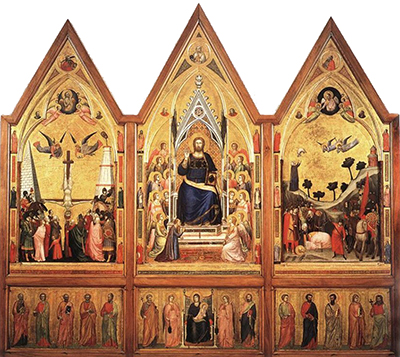
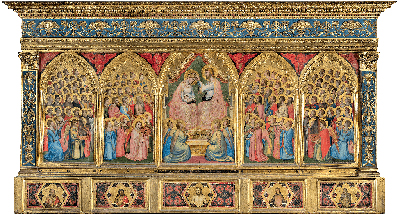
The distinction becomes visible in the Baroncelli Polyptych at Santa Croce. Christ crowns Mary at the quiet centre of a crowded heaven. Across the side panels, small heads, overlapping haloes and musicians make an intricate, continuous gathering. Below the principal paintings, the artist's name runs through a sequence of small medallions. Yet Santa Croce's present catalogue describes the work as Giotto and workshop. The signature and the collaborative attribution coexist on the same object. [1]
Understanding that coexistence makes attribution more interesting. It draws attention to the construction of a painting and to the organisation needed to produce it. It also explains why responsible accounts sometimes disagree. The evidence for Giotto includes powerful anchors, but it does not produce a universally accepted catalogue in which every picture, date and individual hand has been settled.
At a Glance
- Signature and workshopThe Baroncelli Polyptych bears Giotto’s name and is catalogued as Giotto and workshop. [1]
- Vatican labelThe Stefaneschi Triptych is attributed to Giotto di Bondone and assistants. [2]
- London labelThe National Gallery calls its Pentecost Giotto and Workshop. [3]
Contents
- What a name on a label means
- Three signatures, three objects
- Documents, witnesses and remembered masters
- Designing, teaching and painting
- Why Assisi remains a real dispute
- What the wood and paint can establish
- Condition can hide a workshop
- The Bardi findings of 2026
- Current attributions and useful uncertainty
What a name on a label means
An attribution to Giotto usually proposes a substantial connection with the historical artist. The explanation matters as much as the name. An author may mean that Giotto designed and largely painted a work, that he directed its production while delegating passages, or that several members of his workshop worked under his authority. These possibilities overlap, especially in a large mural cycle. The word autograph, when used by art historians, concerns execution by the artist's own hand; it should not be confused with a signature.
A workshop attribution places a painting within a working relationship. A follower attribution can be looser: an artist might adopt Giotto's compositions or methods without having worked beside him. A conventional name for an anonymous painter is a further kind of statement. It groups works around a perceived artistic personality while acknowledging that the person's historical identity is unknown. None of these descriptions can safely be expanded into a biography merely because the images look related.
The Vatican Museums make the collaborative meaning unusually plain in their title, Giotto di Bondone and assistants, Stefaneschi triptych. The museum describes a work painted on both sides for the old St Peter's, intended to address people on either side of the altar. Its Christ, saints, martyrdoms and subsidiary panels belonged to a demanding ensemble. The attribution recognises Giotto's responsibility and the participation of others; it does not identify every assistant or assign every figure. [2]
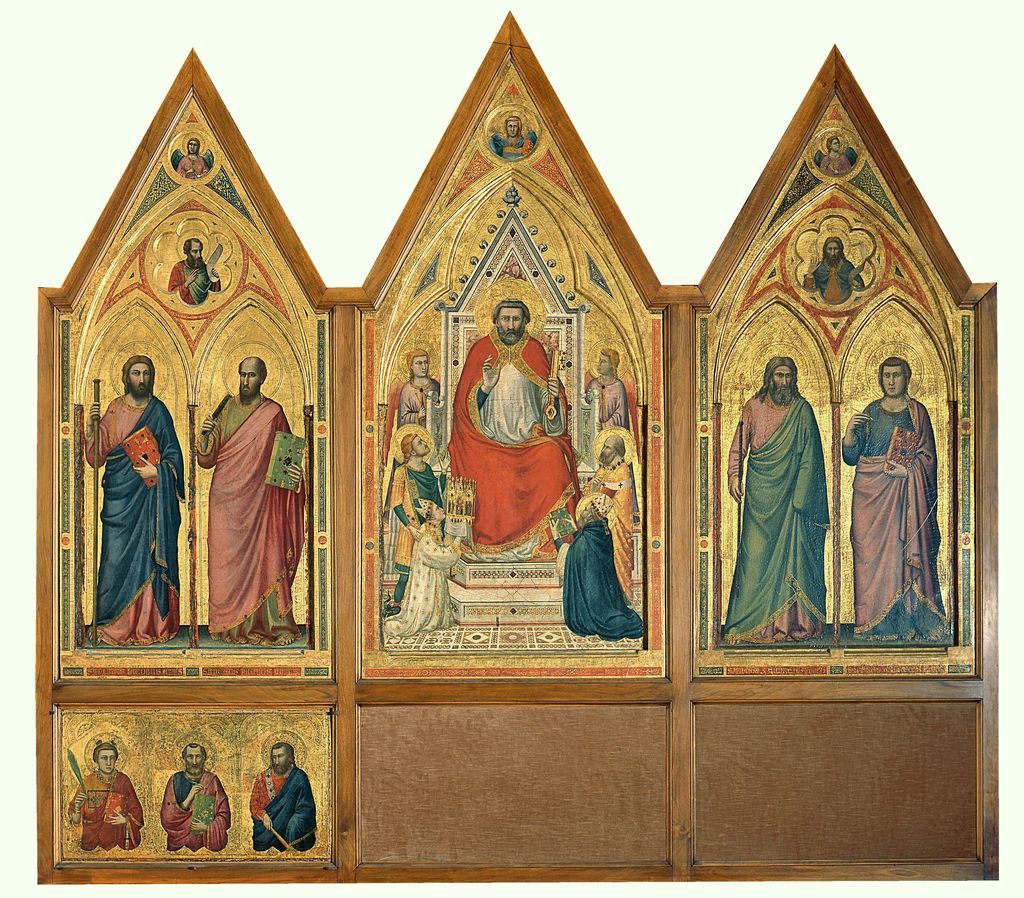
The Stefaneschi Triptych’s Peter and donor face, catalogued as Giotto di Bondone and assistants. Self-scanned reproduction, Commons uploader Eugene a. Image source. Public domain. Proportionally reduced reproduction; no colour or content enhancement.
London's National Gallery similarly calls its small Pentecost Giotto and Workshop. Here the qualification accompanies a closely argued account of the object's materials and painting. These labels are useful starting points, provided they are read with the catalogue behind them. They should not be treated as interchangeable grades on a single scale running from masterpiece to failure. [3]
Three signatures, three objects
The surviving signatures have a shared language of authorship. The Louvre's Saint Francis Receiving the Stigmata bears OPUS IOCTI FLORENTINI, the work of Giotto the Florentine. The Bologna polyptych has OPUS MAGISTRI IOCTI DE FLORENTIA, the work of Master Giotto of Florence. The Baroncelli inscription reads OPUS MAGISTRI IOCTI. Michael Viktor Schwarz and Pia Theis transcribe all three in their critical collection of evidence, recording where each appears and explaining that abbreviations in the Bologna inscription have been expanded. [4]

The Bologna Polyptych, inventory 284, attributed to Giotto and workshop.
Their physical settings differ. In Bologna the signature belongs to the step of Mary's throne. In the Baroncelli work its seventeen letters occupy seventeen medallions along the foot of the five main panels. On the Louvre painting the words sit centrally on the lower frame. A photograph cropped to Francis and the seraph can therefore omit the very feature that establishes the panel's signed status. Reading the whole object and consulting a checked transcription are complementary acts. [4]
The Louvre picture also shows why the identity of a signed work must remain precise. It is a large painting on poplar, with a pointed top and three narrative scenes below the main Stigmatisation. Francis kneels in a rocky landscape while the winged, crucified figure appears above him. The lower episodes show the dream of Innocent III, the confirmation of the Franciscan rule and the preaching to the birds. It is a panel from Pisa, not a detached section of the Assisi frescoes. Its relationship to those frescoes is an argument based on images and history, rather than a shared physical origin. [5]
Bologna's current catalogue is particularly helpful because it calls its polyptych a production of Giotto and his workshop while identifying the gold-lettered signature. Its separate saints and the central Virgin and Child are coordinated by gilding, scale and the architecture of the throne. The catalogue places the picture around 1330 and associates its intended destination with the Cappella Magna of the Apostolic Palace in Bologna. The catalogue therefore recognises both the named master and collaborators. [6]
The Baroncelli painting has an additional complication: its appearance records later intervention as well as fourteenth-century production. Santa Croce explains that the original pointed compartments were squared off in the late fifteenth century, with a new rectangular arrangement and cherubim added in the spaces above the panels. A present-day comparison must distinguish that alteration from the earlier painting. Neither the later frame nor the survival of the signature licenses treating every visible component as the work of one fourteenth-century hand. [1]
A signature gives exceptionally important evidence of claimed authorship, but the wording does not say how labour was divided. Conversely, its presence should not be explained away whenever a passage seems unfamiliar. Schwarz and Theis also reject using the title magister as a simple dating device tied to Giotto's appointment as cathedral master: the artist was called master earlier. The inscription anchors responsibility more firmly than it fixes a date or itemises the painters involved. [4]
Documents, witnesses and remembered masters
A payment record can establish something different from a signature. In the Neapolitan documents edited by Schwarz and Theis, an account dated 20 May 1331 describes expenditure on work in Castel Nuovo, including painting in its chapels and a panel made in Giotto's dwelling. It names him as the leading master of the painting and records payments for other painters and workers. Materials and labour appear together. This is direct evidence that Giotto's activity could involve an organised group, rather than an inference drawn solely from uneven faces. [7]
Even such evidence has boundaries. It establishes a documented undertaking and a relationship between people, place and work. It does not provide a surviving chart assigning individual brushstrokes. The editors also explain how the Neapolitan material has been transmitted through copies and earlier publications: reading it in a critical edition is not the same as examining an original medieval parchment. The source's survival history forms part of its authority. [7]
A smaller Florentine record connects a name with an identifiable object more closely. An entry dated 16 February 1314 in the accounts of the Laudesi at Santa Maria Novella records oil for the lamp at the great crucifix made by Giotto, in fulfilment of Riccuccio di Puccio's bequest. It is evidence of attribution and use after the cross existed. It does not date the painting's execution to the year of the oil payment. A document can give a firm boundary without supplying the complete chronology. [7]

Giotto's Crucifix in Santa Maria Novella
An early writer can be close in date and still imprecise about objects. Riccobaldo da Ferrara's testimony associates Giotto with works at Assisi, Rimini and Padua, including the Arena Chapel and Padua's communal palace. That is valuable evidence for places and reputation. An attribution of a particular Assisi scene, however, requires another step. A reference to work in a great Franciscan church does not automatically identify the modern group of frescoes a reader has in mind. [8]
Dante's celebrated comparison of Cimabue and Giotto belongs to another setting again. In Purgatorio XI, the painter Oderisi speaks about the instability of earthly fame; the succession of famous painters leads into a comparison involving poets. Schwarz and Theis emphasise the speaking character and the poem's purpose. The passage is an extraordinary witness to Giotto's fame, but it supplies neither an apprenticeship contract nor a technical judgement on an identified picture. It cannot document a private meeting between Dante and Giotto. [8]
Cennino Cennini offers more explicitly workshop-based testimony. At the beginning of Il libro dell'arte, written around 1400, he presents a chain of instruction: he learnt from Agnolo Gaddi, who learnt from his father Taddeo, who had been Giotto's pupil. In chapter 67 he invokes that descent while explaining how to build up a young face in fresco. His text makes instruction, inherited practice and professional authority inseparable. It is important evidence for the way painters understood their tradition, though it is later than Giotto and cannot certify that every work using a similar flesh technique was painted by him. [9]
Lorenzo Ghiberti's account, completed in the mid-fifteenth century, and Giorgio Vasari's lives of 1550 and 1568 stand at greater distances. Their work lists preserve valuable information, but their larger stories also give Giotto the role of artistic renewer. The famous child drawing a sheep belongs to this literary history. Schwarz and Theis show how the account constructs a naturally gifted artist and how Vasari elaborates inherited material. Treating the episode as a recorded childhood event would give a narrative the authority of a contemporary document. [10]
The same care is needed with lists of pupils. Cennini's specified chain has a different evidential standing from a modern grouping by style or a later biographer's account of family and training. Names such as Maso di Banco, Stefano or Giottino do not turn an anonymous face into an identified painter. A proposed association needs its own argument. The attractive picture of a master surrounded by a securely known cast of assistants exceeds what the surviving evidence can consistently sustain.
Designing, teaching and painting
The scale of Giotto's undertakings makes cooperation understandable, but size alone cannot reveal its structure. A team might include people trained by the master, experienced painters joining for a commission, workers preparing supports, and craftspeople carrying out specialised tasks. These relationships could change between cities and projects. It would be misleading to transplant the organisation of a much later artist's studio wholesale into an early-fourteenth-century chapel.
In Giottus Pictor II, Schwarz uses bottega for an ideal workshop shaped by the master's instruction and cantiere for a group assembled around an undertaking. He expressly calls both concepts abstractions and allows actual groups to combine elements of each. His account of Padua explores the formation of a closely integrated workshop; his discussion of Assisi considers a more locally assembled team. These are analytical models, not recovered staff regulations. [11]
The distinction between design and execution becomes useful when attached to an exact painting. Schwarz contrasts Joachim's Sacrifice in the Arena Chapel with the Entry into Jerusalem. He finds difficulties in the former's coordination of figures and action, while recognising the careful painting of rocks and draperies and the convincing fire. In the latter he distinguishes the strength of the composition from what he regards as weaker handling in parts of the crowd. He therefore considers different kinds of delegation, rather than assigning every perceived weakness to a person employed only to paint accessories. [11]
This is a named scholar's judgement, open to examination and disagreement. The reader can look at Joachim kneeling on the projecting rock, the altar above him, the standing figures and the animals below; then ask how clearly those elements communicate the event. The design can be judged separately from the modelling of a sleeve or the rendering of flame. A successful passage might reflect an assistant's skill, the master's intervention, or a shared method. Quality alone does not supply a signed answer.
Schwarz's treatment of the chapel's framing system makes another useful point. Repeated ornament offered scope for delegated work, yet the smaller figures set within that framework vary in invention and execution. Decorative position does not establish lesser authorship. A workshop can distribute work in ways that cross the modern division between important narrative pictures and supposedly routine surroundings. [11]
Why Assisi remains a real dispute
The Franciscan cycle in the Upper Church at Assisi tests almost every kind of evidence at once. It has a long attribution history, a complex physical setting and strong relationships with other paintings. The basilica's current account acknowledges the division directly: some scholars identify the cycle with Giotto, while others assign it to a Roman school. An explanation of attribution must preserve that disagreement. [12]
Miklós Boskovits's Dizionario Biografico entry argues for Giotto's guiding role and substantial early participation. It considers proposals placing the work in the early 1290s, alongside reasons for a beginning after Boniface VIII's accession in 1294. Its account of execution identifies an assistant becoming prominent from the sixteenth scene, the Death of the Knight of Celano, and later taking greater responsibility. Boskovits reads changes within a substantially coherent undertaking; he does not make collaboration incompatible with Giotto's authorship. [13]
Schwarz's 2008 reconstruction takes a materially different direction. Building on Erik Moltesen's distinction between a more plastic and a more colour-oriented manner, he considers two campaigns or teams. He finds relations with Padua in the earlier group and tentatively considers a date around 1308. For a later group, he discusses comparisons with Pietro Lorenzetti's painting in the Lower Church and experimentally proposes a date after 1317. The argument depends on the direction in which designs and motifs travelled. [14]
Those dates cannot be spliced into Boskovits's account as if both authors supplied missing stages of one agreed chronology. One interpretation reads the frescoes through Giotto's earlier development; the other sees post-Padua knowledge and later Sienese comparisons. Schwarz himself leaves alternatives: Giotto may have influenced the earlier campaign without painting much of it, or a former member of his Padua workshop may have carried that visual language to Assisi. Conditional conclusions remain conditional. [14]
The comparisons are concrete enough to make the disagreement intelligible. Schwarz contrasts the grouping of the congregation in Christmas at Greccio with the pressing crowd around the body in the Verification of the Stigmata. In the latter he singles out the framing soldiers and their bodily turns, comparing them with Pietro Lorenzetti's figures. The question is not simply whether both pictures contain recognisably Giottesque people. It concerns how the group is organised, how an individual occupies space, and whether one artist borrowed from another or both used circulating models. [14]
Technical repetition adds evidence without resolving all those questions. Schwarz discusses Bruno Zanardi's observations of repeated head proportions and shared procedures for flesh painting. Such findings can demonstrate the use of transferable patterns or continuity of practice. They do not in themselves identify one painter working on every head. In an explicit criticism, Schwarz questions dividing execution according to templates that could have been taken from already finished paintings, and questions an overly rational reconstruction of the team's organisation. This is a specific response within a debate, rather than a reason to dismiss technical study. [14]
The paintings remain available to comparison even while their authorship is contested. Their framing, the distribution of figures, the arrangement of architecture and the movement of narrative across walls can be studied carefully without announcing a final victory for one reconstruction. Visual coherence is something to explain; it is not a certificate naming a single executor.
What the wood and paint can establish
Small panels offer a particularly clear example of the difference between establishing an ensemble and identifying a hand. London's Pentecost belongs to a dispersed group of seven narratives. Dillian Gordon's catalogue brings together their dimensions, paint preparation and wood structure. X-radiographs show corresponding grain patterns that establish the scenes as sections of one long board. The surviving edges and traces of framing help recover the sequence. [3]
This is stronger evidence for their material connection than a general resemblance in faces. Their shared green preparation beneath the gilding adds another link. Yet the finding does not settle the group's original use. Gordon argues for an independent, low narrative altarpiece, discussing earlier proposals for a predella and other arrangements. Her preferred reconstruction should retain her name; it should not silently become the only possible original setting. [3]
The Pentecost itself rewards close looking. Apostles sit behind a low, patterned barrier; three people outside lean or turn towards the gathering. The compressed space joins a coffered ceiling to a row of pointed gables above. Gordon admires the strong drawing and subtle treatment of features and hair while suggesting that weaker passages, including thin hands, may involve assistants. That is the reasoning behind a collaborative label, rather than a verdict imposed before the object was examined. [3]
Condition also complicates what appears to be an individual manner. Gordon identifies a substantially reconstructed facial profile on the right and repainting of the dove. The present rays below it differ from the original raised rays of gilded tin, which have largely disappeared. A comparison based on today's contours and highlights must therefore know which features are original, altered or lost. Technical examination helps the eye avoid attributing a restorer's decisions to a medieval painter. [3]
The Washington Madonna and Child, the panel in which Mary holds a rose, provides another example. The National Gallery of Art's technical summary records green underpainting and the gradual construction of flesh in thin layers. Infrared examination reveals an adjustment in the Child's face, shifting eyes and ear to tilt it upward. This opens a view of the painting's development that an ordinary photograph cannot supply. It strengthens a detailed account of artistic decisions without functioning as an automatic test for Giotto's hand. [15]
The catalogue's editorial notes also demonstrate how evidence can change an argument after an author's death. Boskovits had treated a supposed difference in the preparation beneath the gold as an obstacle to connecting the Washington Madonna with the Horne Museum's Saint Stephen. Later examination found red bole above a green-earth layer in Saint Stephen. The editors preserve his essay while explicitly updating the material evidence. Repeating the earlier exclusion without that note would conceal a significant change. [15]
The result still demands judgement. A shared material sequence can support a relationship, but materials and procedures can be shared across a workshop. A change during painting is evidence of revision, but it does not announce the reviser's name. Useful attribution draws these observations into an argument with composition, handling, history and comparison.
Condition can hide a workshop
The Peruzzi Chapel shows how dangerous it is to compare surfaces without understanding their survival. Cecilia Frosinini's conservation study distinguishes its narrative scenes, painted on dry plaster, from parts executed in fresco, including the vault's initial work, ribs, decorative bands, grey preparation for blue areas and imitation-marble dados. The chapel cannot be reduced to a single undifferentiated technique. [16]
Her account also separates observation from explanation. Analysis detected a protein binder, probably egg, but damage and contamination from restoration impeded definitive conclusions. The exceptional response to ultraviolet light could involve the original materials, their interaction over time and subsequent treatments. Several hypotheses remain in play. Neither an especially strong fluorescence nor a particular colour response can be read as Giotto's personal signature. [16]
The ultraviolet photographs made in November 2012 helped recover the legibility of modelling, folds and figures that were barely discernible in ordinary light. They clarified, for example, the heavenly group receiving John the Evangelist. This recovery changes the evidence available to an art historian. It does not mean lost paint has physically returned, or that an earlier judgement made from a depleted surface can simply be carried forward unchanged. [16]
Elsewhere, damage has a sharply documented historical cause. The Madonna of San Giorgio alla Costa suffered in the 1993 bombing near the Uffizi; the Opera del Duomo records the injury caused by a fragment to an angel's garment. Such a lesion belongs to the object's modern history. Its disruption of a painted passage cannot be evidence of a different medieval hand. [17]
The Bardi findings of 2026
The restoration completed in 2026 has made the Bardi Chapel an especially timely case. Santa Croce's historical account explains the consequences of whitewashing, nineteenth-century recovery and repainting, and the removal of those additions in 1957–59. The latest treatment has retained recognisable evidence of irreversible losses while improving the continuity and readability of the surviving painting. These changing conditions affect the basis on which earlier comparisons were made. [18]
The restoration team's current workshop account identifies several ways of constructing faces: softly graduated transitions, broad red contours with stronger contrasts, and small ochre and oxide touches over greenish preparation with black and red lines. The account interprets these differences as the work of several painters closely coordinated by Giotto within a unified design. Its published Death of Saint Francis details let the reader inspect both differing faces and the effect of cleaning on a single face. The variations are observations; the reconstruction of collaboration is the team's stated inference. [19]
Digital recording of incisions, reference lines and divisions across the chapel gives a fuller picture of planning. Diagnostic work supplies further information: mapping the distribution of lead has virtually recovered a lost crucifix on the back wall in the Apparition at Arles. That finding changes the reconstruction of the scene. It does not identify the person who painted the crucifix or physically reinstate the image. [20]
These results expand the evidence for a coordinated undertaking. They also show why analysis must be directed to a particular question. A map of construction lines helps explain planning; a comparison of flesh painting helps investigate execution; a history of abrasion helps assess apparent difference. None can, alone, name every member of the team. The wider account of Giotto's technique and conservation follows the materials and treatments in greater detail.
Current attributions and useful uncertainty
Attribution history is sometimes presented only as a sequence of downgrades. Berlin's Crucifixion, inventory 1074A, demonstrates movement in another direction. Its current museum record names Giotto and recounts earlier assignments to other artists and to his workshop. Wilhelm Bode championed the attribution in 1884; the painting still travelled to the 1937 Florentine exhibition as a workshop work. The present institution's account supports Giotto's authorship. Repeating the old workshop label as the current verdict would misrepresent the object. [21]
The image itself offers abundant material for the comparison: angels spread around the cross, while mourners and soldiers crowd below. The museum's confidence belongs to its assessment of this particular painting and its history. It cannot be transferred automatically to another Crucifixion sharing the same subject. A current label should be reported accurately while the reasoning and date of the record remain visible. [21]
A place-name can also disguise a hypothesis. North Carolina's five-panel altarpiece is commonly called the Peruzzi Altarpiece. Its museum label explains that the selection of saints suggests a commission for the Peruzzi family's chapel at Santa Croce. That proposed origin is distinct from a surviving commission document. It should remain a proposal even when the familiar short title makes the association feel settled. [22]
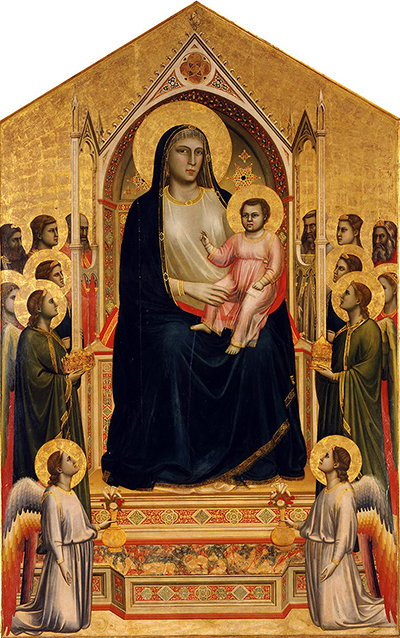
Finally, the Parente di Giotto illustrates how readily an explanatory name acquires a misleading solidity. The Opificio delle Pietre Dure's account of the Ognissanti cross describes debate ranging from Giotto's direct authorship to the participation of an anonymous leading collaborator. Giovanni Previtali gave that reconstructed personality the conventional name meaning Giotto's relative. The label does not make the unknown painter an identified family member, and the proposed body of work remains an art-historical construction. [23]
A productive way to read an attribution is therefore to keep several questions alive. Is the evidence a physical inscription, a transmitted document, an early description, a stylistic comparison or a technical observation? Does it establish responsibility, design, execution, original location or only a relationship? Has the painting changed through cutting, loss, repainting or cleaning? Is the conclusion the custodian's current position, a particular scholar's proposal, or a point on which disagreement persists?
These questions bring the viewer closer to the work. The signature becomes part of the object, the underdrawing part of its making, the altered face part of its history. Giotto's achievement can include invention, painting, teaching and the coordination of other skilled people. Understanding those activities together allows a clearer appreciation of the paintings while preserving the differences between what can be seen, what can be documented and what must still be argued.
Watch: Explore Giotto’s Art
Choose an overview or a closer look at three major works. These films provide wider Giotto context alongside this article.
Artworks directory
This directory brings together 209 records for paintings, ensembles, individual scenes and components, architectural work, an associated disputed design, and reported or lost projects connected with Giotto. Ensembles and their parts appear separately, so 209 is a count of records rather than independent paintings or commissions. Attributions and dates remain qualified where disputed; inclusion does not establish Giotto’s own hand throughout.
| Name | Date | Medium, attribution and status |
|---|---|---|
| Expulsion of Joachim from the Temple — Scrovegni Chapel, Padua | c.1303–05 (chapel campaign) | Fresco / wall painting. Giotto and workshop. Scene within a cycle. Padova Musei. Chapel overview. |
| Joachim among the Shepherds — Scrovegni Chapel, Padua | c.1303–05 (chapel campaign) | Fresco / wall painting. Giotto and workshop. Scene within a cycle. Padova Musei. Chapel overview. |
| Annunciation to Saint Anne — Scrovegni Chapel, Padua | c.1303–05 (chapel campaign) | Fresco / wall painting. Giotto and workshop. Scene within a cycle. Padova Musei. Chapel overview. |
| Sacrifice of Joachim — Scrovegni Chapel, Padua | c.1303–05 (chapel campaign) | Fresco / wall painting. Giotto and workshop. Scene within a cycle. Padova Musei. Chapel overview. |
| Joachim’s Dream — Scrovegni Chapel, Padua | c.1303–05 (chapel campaign) | Fresco / wall painting. Giotto and workshop. Scene within a cycle. Padova Musei. Padova Musei. Chapel overview. |
| Meeting at the Golden Gate — Scrovegni Chapel, Padua | c.1303–05 (chapel campaign) | Fresco / wall painting. Giotto and workshop. Scene within a cycle. Padova Musei. Chapel overview. |
| Birth of the Virgin — Scrovegni Chapel, Padua | c.1303–05 (chapel campaign) | Fresco / wall painting. Giotto and workshop. Scene within a cycle. Padova Musei. Padova Musei. Chapel overview. |
| Presentation of the Virgin in the Temple — Scrovegni Chapel, Padua | c.1303–05 (chapel campaign) | Fresco / wall painting. Giotto and workshop. Scene within a cycle. Padova Musei. Chapel overview. |
| Delivery of the Rods — Scrovegni Chapel, Padua | c.1303–05 (chapel campaign) | Fresco / wall painting. Giotto and workshop. Scene within a cycle. Padova Musei. Chapel overview. |
| Prayer of Joseph and the Suitors — Scrovegni Chapel, Padua | c.1303–05 (chapel campaign) | Fresco / wall painting. Giotto and workshop. Scene within a cycle. Padova Musei. Chapel overview. |
| Marriage of the Virgin — Scrovegni Chapel, Padua | c.1303–05 (chapel campaign) | Fresco / wall painting. Giotto and workshop. Scene within a cycle. Padova Musei. Chapel overview. |
| Wedding Procession of Mary — Scrovegni Chapel, Padua | c.1303–05 (chapel campaign) | Fresco / wall painting. Giotto and workshop. Scene within a cycle. Padova Musei. Chapel overview. |
| Annunciation on the triumphal arch — complete ensemble (Scrovegni Chapel, Padua) | c.1303–05 (chapel campaign) | Wall painting with a central painted wooden panel. Giotto and workshop. Ensemble. Includes the Mission of Gabriel and the lower Annunciation pair; the original central wooden panel is in the Musei Civici agli Eremitani, with a conservation copy in the chapel. Padova Musei. Padova Musei. Scholarly study. Chapel overview. |
| Visitation — Scrovegni Chapel, Padua | c.1303–05 (chapel campaign) | Fresco / wall painting. Giotto and workshop. Scene within a cycle. Padova Musei. Chapel overview. |
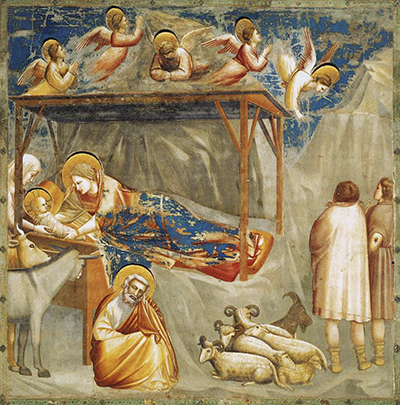
| Nativity — Scrovegni Chapel, Padua | c.1303–05 (chapel campaign) | Fresco / wall painting. Giotto and workshop. Scene within a cycle. Padova Musei. Chapel overview. |
| Adoration of the Magi — Scrovegni Chapel, Padua | c.1303–05 (chapel campaign) | Fresco / wall painting. Giotto and workshop. Scene within a cycle. Padova Musei. Chapel overview. |
| Presentation of Christ at the Temple — Scrovegni Chapel, Padua | c.1303–05 (chapel campaign) | Fresco / wall painting. Giotto and workshop. Scene within a cycle. Padova Musei. Chapel overview. |
| Flight into Egypt — Scrovegni Chapel, Padua | c.1303–05 (chapel campaign) | Fresco / wall painting. Giotto and workshop. Scene within a cycle. Padova Musei. Chapel overview. |
| Massacre of the Innocents — Scrovegni Chapel, Padua | c.1303–05 (chapel campaign) | Fresco / wall painting. Giotto and workshop. Scene within a cycle. Padova Musei. Chapel overview. |
| Christ among the Doctors — Scrovegni Chapel, Padua | c.1303–05 (chapel campaign) | Fresco / wall painting. Giotto and workshop. Scene within a cycle. Padova Musei. Chapel overview. |
| Baptism of Christ — Scrovegni Chapel, Padua | c.1303–05 (chapel campaign) | Fresco / wall painting. Giotto and workshop. Scene within a cycle. Padova Musei. Chapel overview. |
| Marriage at Cana — Scrovegni Chapel, Padua | c.1303–05 (chapel campaign) | Fresco / wall painting. Giotto and workshop. Scene within a cycle. Padova Musei. Padova Musei. Chapel overview. |
| Raising of Lazarus — Scrovegni Chapel, Padua | c.1303–05 (chapel campaign) | Fresco / wall painting. Giotto and workshop. Scene within a cycle. Padova Musei. Chapel overview. |
| Entry into Jerusalem — Scrovegni Chapel, Padua | c.1303–05 (chapel campaign) | Fresco / wall painting. Giotto and workshop. Scene within a cycle. Padova Musei. Chapel overview. |
| Expulsion of the Money Changers — Scrovegni Chapel, Padua | c.1303–05 (chapel campaign) | Fresco / wall painting. Giotto and workshop. Scene within a cycle. Padova Musei. Padova Musei. Chapel overview. |
| Judas Receiving the Payment — Scrovegni Chapel, Padua | c.1303–05 (chapel campaign) | Fresco / wall painting. Giotto and workshop. Scene within a cycle. Padova Musei. Chapel overview. |
| Last Supper — Scrovegni Chapel, Padua | c.1303–05 (chapel campaign) | Fresco / wall painting. Giotto and workshop. Scene within a cycle. Padova Musei. Chapel overview. |
| Washing of the Feet — Scrovegni Chapel, Padua | c.1303–05 (chapel campaign) | Fresco / wall painting. Giotto and workshop. Scene within a cycle. Padova Musei. Chapel overview. |
| Arrest of Christ — Scrovegni Chapel, Padua | c.1303–05 (chapel campaign) | Fresco / wall painting. Giotto and workshop. Scene within a cycle. Padova Musei. Chapel overview. |
| Christ before Annas and Caiaphas — Scrovegni Chapel, Padua | c.1303–05 (chapel campaign) | Fresco / wall painting. Giotto and workshop. Scene within a cycle. Padova Musei. Chapel overview. |
| Mocking of Christ and Flagellation — Scrovegni Chapel, Padua | c.1303–05 (chapel campaign) | Fresco / wall painting. Giotto and workshop. Scene within a cycle. Padova Musei. Chapel overview. |
| Road to Calvary — Scrovegni Chapel, Padua | c.1303–05 (chapel campaign) | Fresco / wall painting. Giotto and workshop. Scene within a cycle. Padova Musei. Chapel overview. |
| Crucifixion — Scrovegni Chapel, Padua | c.1303–05 (chapel campaign) | Fresco / wall painting. Giotto and workshop. Scene within a cycle. Padova Musei. Chapel overview. |
| Lamentation — Scrovegni Chapel, Padua | c.1303–05 (chapel campaign) | Fresco / wall painting. Giotto and workshop. Scene within a cycle. Padova Musei. Chapel overview. |
| Resurrection / Noli me tangere — Scrovegni Chapel, Padua | c.1303–05 (chapel campaign) | Fresco / wall painting. Giotto and workshop. Scene within a cycle. Padova Musei. Chapel overview. |
| Ascension — Scrovegni Chapel, Padua | c.1303–05 (chapel campaign) | Fresco / wall painting. Giotto and workshop. Scene within a cycle. Padova Musei. Chapel overview. |
| Pentecost — Scrovegni Chapel, Padua | c.1303–05 (chapel campaign) | Fresco / wall painting. Giotto and workshop. Scene within a cycle. Padova Musei. Padova Musei. Chapel overview. |
| Coretto — right painted recess (Scrovegni Chapel, Padua) | c.1303–05 (chapel campaign) | Fresco / painted fictive architecture. Giotto and workshop. Ensemble component. Padova Musei. Padova Musei. Scholarly study. Chapel overview. |
| Coretto — left painted recess (Scrovegni Chapel, Padua) | c.1303–05 (chapel campaign) | Fresco / painted fictive architecture. Giotto and workshop. Ensemble component. Padova Musei. Padova Musei. Scholarly study. Chapel overview. |
| Envy — Scrovegni Chapel, Padua | c.1303–05 (chapel campaign) | Grisaille fresco / wall painting. Giotto and workshop. Ensemble component. Padova Musei. Chapel overview. Scholarly study. Padova Musei. |
| Despair — Scrovegni Chapel, Padua | c.1303–05 (chapel campaign) | Grisaille fresco / wall painting. Giotto and workshop. Ensemble component. Padova Musei. Chapel overview. Scholarly study. Padova Musei. |
| Prudence — Scrovegni Chapel, Padua | c.1303–05 (chapel campaign) | Grisaille fresco / wall painting. Giotto and workshop. Ensemble component. Padova Musei. Chapel overview. Scholarly study. Padova Musei. |
| Fortitude — Scrovegni Chapel, Padua | c.1303–05 (chapel campaign) | Grisaille fresco / wall painting. Giotto and workshop. Ensemble component. Padova Musei. Chapel overview. Scholarly study. Padova Musei. |
| Temperance — Scrovegni Chapel, Padua | c.1303–05 (chapel campaign) | Grisaille fresco / wall painting. Giotto and workshop. Ensemble component. Padova Musei. Chapel overview. Scholarly study. Padova Musei. |
| Justice — Scrovegni Chapel, Padua | c.1303–05 (chapel campaign) | Grisaille fresco / wall painting. Giotto and workshop. Ensemble component. Padova Musei. Chapel overview. Scholarly study. Padova Musei. |
| Faith — Scrovegni Chapel, Padua | c.1303–05 (chapel campaign) | Grisaille fresco / wall painting. Giotto and workshop. Ensemble component. Padova Musei. Chapel overview. Scholarly study. Padova Musei. |
| Charity — Scrovegni Chapel, Padua | c.1303–05 (chapel campaign) | Grisaille fresco / wall painting. Giotto and workshop. Ensemble component. Padova Musei. Chapel overview. Scholarly study. Padova Musei. |
| Hope — Scrovegni Chapel, Padua | c.1303–05 (chapel campaign) | Grisaille fresco / wall painting. Giotto and workshop. Ensemble component. Padova Musei. Chapel overview. Scholarly study. Padova Musei. |
| Folly — Scrovegni Chapel, Padua | c.1303–05 (chapel campaign) | Grisaille fresco / wall painting. Giotto and workshop. Ensemble component. Padova Musei. Chapel overview. Scholarly study. Padova Musei. |
| Inconstancy — Scrovegni Chapel, Padua | c.1303–05 (chapel campaign) | Grisaille fresco / wall painting. Giotto and workshop. Ensemble component. Padova Musei. Chapel overview. Scholarly study. Padova Musei. |
| Wrath — Scrovegni Chapel, Padua | c.1303–05 (chapel campaign) | Grisaille fresco / wall painting. Giotto and workshop. Ensemble component. Padova Musei. Chapel overview. Scholarly study. Padova Musei. |
| Injustice — Scrovegni Chapel, Padua | c.1303–05 (chapel campaign) | Grisaille fresco / wall painting. Giotto and workshop. Ensemble component. Padova Musei. Chapel overview. Scholarly study. Padova Musei. |
| Infidelity / Idolatry — Scrovegni Chapel, Padua | c.1303–05 (chapel campaign) | Grisaille fresco / wall painting. Giotto and workshop. Ensemble component. Padova Musei. Chapel overview. Scholarly study. Padova Musei. |
| Starry vault — complete ensemble (Scrovegni Chapel, Padua) | c.1303–05 (chapel campaign) | Vault painting. Giotto and workshop. Ensemble. Padova Musei. Padova Musei. Chapel overview. |
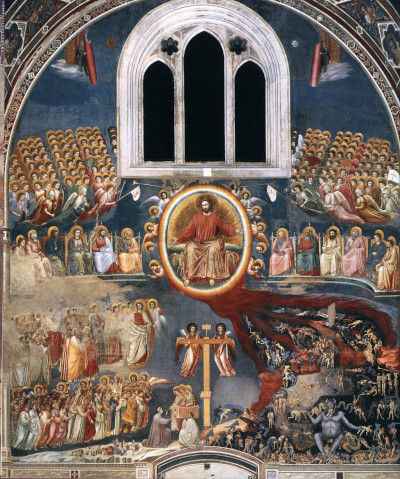
| Last Judgement — Scrovegni Chapel, Padua | c.1303–05 (chapel campaign) | Fresco / wall painting. Giotto and workshop. Scene within a cycle. Padova Musei. Padova Musei. Chapel overview. Padova Musei. |
| Prophet Malachi — vault medallion — Scrovegni Chapel, Padua | c.1303–05 (chapel campaign) | Fresco / wall painting. Giotto and workshop. Ensemble component. Padova Musei. Padova Musei. Chapel overview. Padova Musei. |
| Prophet Baruch — vault medallion — Scrovegni Chapel, Padua | c.1303–05 (chapel campaign) | Fresco / wall painting. Giotto and workshop. Ensemble component. Padova Musei. Padova Musei. Chapel overview. Padova Musei. |
| Prophet Isaiah — vault medallion — Scrovegni Chapel, Padua | c.1303–05 (chapel campaign) | Fresco / wall painting. Giotto and workshop. Ensemble component. Padova Musei. Padova Musei. Chapel overview. Padova Musei. |
| Prophet Daniel — vault medallion — Scrovegni Chapel, Padua | c.1303–05 (chapel campaign) | Fresco / wall painting. Giotto and workshop. Ensemble component. Padova Musei. Padova Musei. Chapel overview. Padova Musei. |
| Christ Pantocrator — vault medallion — Scrovegni Chapel, Padua | c.1303–05 (chapel campaign) | Fresco / wall painting. Giotto and workshop. Ensemble component. Padova Musei. Padova Musei. Chapel overview. Padova Musei. |
| Virgin and Child — vault medallion — Scrovegni Chapel, Padua | c.1303–05 (chapel campaign) | Fresco / wall painting. Giotto and workshop. Ensemble component. Padova Musei. Padova Musei. Chapel overview. Padova Musei. |
| Prophet Ezekiel — vault medallion — Scrovegni Chapel, Padua | c.1303–05 (chapel campaign) | Fresco / wall painting. Giotto and workshop. Ensemble component. Padova Musei. Padova Musei. Chapel overview. Padova Musei. |
| Prophet Micah — vault medallion — Scrovegni Chapel, Padua | c.1303–05 (chapel campaign) | Fresco / wall painting. Giotto and workshop. Ensemble component. Padova Musei. Padova Musei. Chapel overview. Padova Musei. |
| Saint John the Baptist — vault medallion — Scrovegni Chapel, Padua | c.1303–05 (chapel campaign) | Fresco / wall painting. Giotto and workshop. Ensemble component. Padova Musei. Padova Musei. Chapel overview. Padova Musei. |
| Scrovegni Chapel — painted decoration | c.1303–05 (chapel campaign) | Fresco / wall painting, with a painted wooden panel. Giotto and workshop (painted decoration). Ensemble. Includes separately listed scenes and components. The original central God the Father panel is in the Musei Civici agli Eremitani; a conservation copy is in the chapel. Chapel overview. Padova Musei. Padova Musei. Source. Source. Source. Padova Musei. Scholarly study. |
| Vices and Virtues — complete fourteen-figure programme | c.1303–05 (chapel campaign) | Grisaille fresco / wall painting. Giotto and workshop. Ensemble. Fourteen figures: seven virtues and seven opposed vices. Padova Musei. Chapel overview. Scholarly study. |
| Coretti — paired fictive chapels | c.1303–05 (chapel campaign) | Fresco / painted fictive architecture. Giotto and workshop. Ensemble. Two separate painted recesses, also listed individually. Padova Musei. Padova Musei. Scholarly study. |
| Mission of Gabriel — heavenly assembly | c.1303–05 (chapel campaign) | Wall painting with central painted wooden image. Giotto and workshop. Ensemble component. Central wooden God the Father panel preserved at the Musei Civici agli Eremitani; conservation copy in the chapel. Chapel overview. Padova Musei. Scholarly study. Padova Musei. |
| Annunciation — Gabriel and Mary in facing chambers | c.1303–05 (chapel campaign) | Fresco / wall painting. Giotto and workshop. Ensemble component. Chapel overview. Scholarly study. Padova Musei. |
| God the Father — central wooden panel of the Mission of Gabriel | c.1303–05 (chapel campaign) | Painting on wood. Associated with Giotto. Ensemble component. Original at the Musei Civici agli Eremitani, Padua; conservation copy in the Scrovegni Chapel. Padova Musei. Padova Musei. Scholarly study. Source. |
| Life of Saint Francis — Upper Church cycle, Assisi | Late 13th–early 14th century; dating disputed | Fresco / wall-painting cycle. Traditionally associated with Giotto; Giotto, Roman-school and other attributions disputed. Ensemble. Twenty-eight-scene nave cycle; scenes also listed individually. Basilica catalogue. Scholarly study. Basilica catalogue. Source. Source. |
| Homage of a Simple Man — Upper Church, Assisi | Late 13th–early 14th century; dating disputed | Wall painting. Traditionally associated with Giotto; authorship and dating disputed. Scene within a cycle. Source. Scholarly study. Source. Source. Source. |
| Gift of the Mantle — Upper Church, Assisi | Late 13th–early 14th century; dating disputed | Wall painting. Traditionally associated with Giotto; authorship and dating disputed. Scene within a cycle. Basilica catalogue. Scholarly study. Source. Source. Source. |
| Dream of the Palace Full of Arms — Upper Church, Assisi | Late 13th–early 14th century; dating disputed | Wall painting. Traditionally associated with Giotto; authorship and dating disputed. Scene within a cycle. Basilica catalogue. Source. Scholarly study. Source. Source. Source. |
| Prayer before the Crucifix at San Damiano — Upper Church, Assisi | Late 13th–early 14th century; dating disputed | Wall painting. Traditionally associated with Giotto; authorship and dating disputed. Scene within a cycle. Source. Source. Source. Scholarly study. Source. Source. |
| Renunciation of Worldly Goods — Upper Church, Assisi | Late 13th–early 14th century; dating disputed | Wall painting. Traditionally associated with Giotto; authorship and dating disputed. Scene within a cycle. Source. Scholarly study. Source. Source. |
| Dream of Innocent III — Upper Church, Assisi | Late 13th–early 14th century; dating disputed | Wall painting. Traditionally associated with Giotto; authorship and dating disputed. Scene within a cycle. Source. Source. Scholarly study. Source. Source. |
| Confirmation of the Rule — Upper Church, Assisi | Late 13th–early 14th century; dating disputed | Wall painting. Traditionally associated with Giotto; authorship and dating disputed. Scene within a cycle. Source. Scholarly study. Source. Source. |
| Vision of the Flaming Chariot — Upper Church, Assisi | Late 13th–early 14th century; dating disputed | Wall painting. Traditionally associated with Giotto; authorship and dating disputed. Scene within a cycle. Source. Source. Scholarly study. Source. Source. |
| Vision of the Thrones — Upper Church, Assisi | Late 13th–early 14th century; dating disputed | Wall painting. Traditionally associated with Giotto; authorship and dating disputed. Scene within a cycle. Basilica catalogue. Scholarly study. Source. Source. Source. |
| Expulsion of Devils from Arezzo — Upper Church, Assisi | Late 13th–early 14th century; dating disputed | Wall painting. Traditionally associated with Giotto; authorship and dating disputed. Scene within a cycle. Source. Source. Scholarly study. Source. Source. Source. |
| Trial by Fire before the Sultan — Upper Church, Assisi | Late 13th–early 14th century; dating disputed | Wall painting. Traditionally associated with Giotto; authorship and dating disputed. Scene within a cycle. Source. Source. Scholarly study. Source. Source. |
| Ecstasy of Saint Francis — Upper Church, Assisi | Late 13th–early 14th century; dating disputed | Wall painting. Traditionally associated with Giotto; authorship and dating disputed. Scene within a cycle. Source. Source. Source. Scholarly study. Source. Source. |
| Nativity at Greccio — Upper Church, Assisi | Late 13th–early 14th century; dating disputed | Wall painting. Traditionally associated with Giotto; authorship and dating disputed. Scene within a cycle. Basilica catalogue. Scholarly study. Source. Source. Source. |
| Miracle of the Spring — Upper Church, Assisi | Late 13th–early 14th century; dating disputed | Wall painting. Traditionally associated with Giotto; authorship and dating disputed. Scene within a cycle. Source. Scholarly study. Source. Source. Source. |
| Sermon to the Birds — Upper Church, Assisi | Late 13th–early 14th century; dating disputed | Wall painting. Traditionally associated with Giotto; authorship and dating disputed. Scene within a cycle. Basilica catalogue. Scholarly study. Source. Source. Source. |
| Death of the Knight of Celano — Upper Church, Assisi | Late 13th–early 14th century; dating disputed | Wall painting. Traditionally associated with Giotto; authorship and dating disputed. Scene within a cycle. Source. Source. Scholarly study. Source. Source. |
| Sermon before Pope Honorius III — Upper Church, Assisi | Late 13th–early 14th century; dating disputed | Wall painting. Traditionally associated with Giotto; authorship and dating disputed. Scene within a cycle. Source. Source. Scholarly study. Source. |
| Apparition at the Chapter of Arles — Upper Church, Assisi | Late 13th–early 14th century; dating disputed | Wall painting. Traditionally associated with Giotto; authorship and dating disputed. Scene within a cycle. Basilica catalogue. Scholarly study. Source. Source. Source. |
| Stigmatisation — Upper Church, Assisi | Late 13th–early 14th century; dating disputed | Wall painting. Traditionally associated with Giotto; authorship and dating disputed. Scene within a cycle. Source. Scholarly study. Source. Source. |
| Death and Ascension of Saint Francis — Upper Church, Assisi | Late 13th–early 14th century; dating disputed | Wall painting. Traditionally associated with Giotto; authorship and dating disputed. Scene within a cycle. Basilica catalogue. Scholarly study. Source. Source. Source. |
| Apparition to Brother Augustine and Bishop Guido — Upper Church, Assisi | Late 13th–early 14th century; dating disputed | Wall painting. Traditionally associated with Giotto; authorship and dating disputed. Scene within a cycle. Zeri catalogue. Scholarly study. Source. Source. Source. |
| Verification of the Stigmata — Upper Church, Assisi | Late 13th–early 14th century; dating disputed | Wall painting. Traditionally associated with Giotto; authorship and dating disputed. Scene within a cycle. Source. Source. Scholarly study. Source. Source. |
| Mourning of the Poor Clares — Upper Church, Assisi | Late 13th–early 14th century; dating disputed | Wall painting. Traditionally associated with Giotto; authorship and dating disputed. Scene within a cycle. Basilica catalogue. Source. Scholarly study. Source. Source. |
| Canonisation of Saint Francis — Upper Church, Assisi | Late 13th–early 14th century; dating disputed | Wall painting. Traditionally associated with Giotto; authorship and dating disputed. Scene within a cycle. Source. Source. Scholarly study. Source. Source. Source. |
| Apparition to Pope Gregory IX — Upper Church, Assisi | Late 13th–early 14th century; dating disputed | Wall painting. Traditionally associated with Giotto; authorship and dating disputed. Scene within a cycle. Zeri catalogue. Scholarly study. Source. Source. Source. |
| Healing of John of Lerida — Upper Church, Assisi | Late 13th–early 14th century; dating disputed | Wall painting. Traditionally associated with Giotto; authorship and dating disputed. Scene within a cycle. Source. Source. Scholarly study. Source. Source. |
| Resurrection of a Woman — Upper Church, Assisi | Late 13th–early 14th century; dating disputed | Wall painting. Traditionally associated with Giotto; authorship and dating disputed. Scene within a cycle. Source. Scholarly study. Source. Source. Source. |
| Liberation of the Prisoner Peter — Upper Church, Assisi | Late 13th–early 14th century; dating disputed | Wall painting. Traditionally associated with Giotto; authorship and dating disputed. Scene within a cycle. Source. Source. Scholarly study. Source. Source. Source. |
| Santa Maria Novella Crucifix | Late 13th century; c.1288–89 or 1298–1301; disputed | Tempera and gold on a shaped wooden cross. Giotto. Source. |
| Death of the Virgin / Dormition — Berlin | c.1310 | Tempera and gold on poplar; gabled dossal. Giotto. Source. Source. |
| Peruzzi Altarpiece | c.1311–1315 (North Carolina Museum of Art) | Tempera and gold on panel. Giotto and workshop. Ensemble. Source. |
| Bologna Polyptych | c.1330 | Tempera and gold on panel. Giotto and workshop. Ensemble. Source. |
| Death of Saint Francis, Bardi Chapel | After 1317, usually the 1320s; disputed | Wall painting with wet-plaster and dry-applied passages. Giotto. Scene within a cycle. Source. |
| Bardi Chapel — painted decoration | After 1317, usually the 1320s; disputed | Wall painting with wet-plaster and dry-applied passages. Giotto and workshop / Giottesque painters; individual hands disputed. Ensemble. Scholarly study. Source. |
| Badia Polyptych | c.1300; proposed dates include 1295–1300 and 1301–02 | Tempera and gold on panel; five cusped compartments. Giotto. Ensemble. Scholarly study. Source. Source. |
| Baroncelli Polyptych | After 1328; detached pinnacle c.1328–35 | Tempera and gold on panel; later altered framing. Giotto and workshop. Ensemble. Detached central pinnacle in San Diego. Santa Croce. |
| Adoration of the Magi / Epiphany — Metropolitan Museum panel | Possibly c.1320; c.1310–18 also proposed for the group | Tempera and gold on wood. Giotto. Part of the dispersed seven-scene board; original function disputed. Met catalogue. Source. |
| Franciscan Allegories | Early 14th century, often c.1315; disputed | Vault wall painting. Giotto and workshop / Giottesque painters; individual hands disputed. Ensemble. Basilica catalogue. |
| Navicella — lost / reworked original mosaic | Late 13th–early 14th century; date disputed | Mosaic. Original attributed to Giotto. Original lost / reworked; fragments and later remakes survive. Scholarly study. |
| Pentecost — London panel | Possibly c.1310–18 (Gordon) | Egg tempera on poplar. Giotto and workshop. Part of the dispersed seven-scene board; original function disputed. National Gallery. Source. |
| Saint Stephen — Horne panel | c.1330–1335 (Museo Horne) | Tempera and gold on panel. Giotto. Proposed association with the Washington and Chaalis panels remains hypothetical. Source. |
| Saint Francis Receiving the Stigmata — Louvre altarpiece | 1300–25 (Louvre) | Tempera and gold on poplar. Giotto. Louvre catalogue. |
| Stefaneschi Triptych | c.1320; 1315–20 (Vatican Museums) | Tempera and gold on panel; painted on both sides. Giotto and workshop. Ensemble. Vatican Museums. |
| Crucifixion, Berlin | c.1315–1320 | Tempera and gold on poplar. Giotto. Source. |
| Madonna and Child — Washington / Goldman Madonna | c.1310–1315 (National Gallery of Art) | Tempera and gold on poplar. Giotto. Washington panel, distinct from San Giorgio alla Costa; proposed Horne/Chaalis companions remain hypothetical. NGA catalogue. |
| Ognissanti Madonna | c.1300–05 (Uffizi); c.1310 also proposed | Tempera and gold on panel. Giotto. Uffizi. |
| Madonna of Borgo San Lorenzo | c.1290–95; dating and attribution debated | Tempera and gold on a fragment of a wooden panel. Giotto. Fragmentary. Source. |
| Madonna of San Giorgio alla Costa | c.1288–95 (Opera del Duomo); later dates also proposed | Tempera and gold on panel; cut edges. Giotto. Damaged in 1993 and treated in 1995. Source. |
| Magdalene Chapel — painted decoration | c.1307–08 (basilica); disputed | Wall painting with wet-plaster and dry-applied passages. Giotto and workshop / Giottesque painters; individual hands disputed. Ensemble. Basilica catalogue. |
| Ognissanti Crucifix | c.1315–1320 (Opificio) | Painting on a shaped wooden cross. Giotto and workshop. Workshop participation and alternative attributions debated. Source. |
| Padua Crucifix | c.1303–05 (Zeri catalogue) | Tempera and gold on a shaped wooden cross. Giotto. Zeri catalogue. |
| Peruzzi Chapel — painted decoration | c.1310–11 (Santa Croce); 1334–36 proposed by Schwarz | Wall painting with substantial dry-applied work and loss. Giotto and workshop / Giottesque painters; individual hands disputed. Ensemble. Santa Croce. |
| Rimini Crucifix | c.1300; late 13th century also proposed | Tempera and gold on a shaped wooden cross. Giotto. Source. |
| Giotto’s Campanile — Florence Cathedral bell tower | Begun 1334; completed 1359 under successors | Marble-clad masonry bell tower. Begun under Giotto; continued by Andrea Pisano and Francesco Talenti. Successive building and sculptural campaigns. Source. Scholarly study. Scholarly study. |
| Tower elevation on parchment, Siena — disputed relation to Giotto | 14th century; date and design context disputed | Brown ink and coloured washes over incised construction on three parchment skins. Attribution disputed; possibly a Giotto design transmitted through another hand. Associated design; autograph attribution unestablished. Alternative attributions include Lando di Pietro. Scholarly study. Source. Source. |
| Seven scenes of Christ — dispersed painted board | Possibly c.1310–18 (Gordon); component dates vary | Tempera and gold on a single wooden board, subsequently divided. Giotto and workshop; individual attributions vary. Reconstructed dispersed ensemble. Common board supported by matching wood grain; predella or dossal function disputed. Source. Source. |
| Presentation of Christ at the Temple — Boston panel | Possibly c.1310–18 (Gordon’s group dating) | Tempera and gold on wood. Giotto and workshop; individual attribution varies within the group. Ensemble component. Source. Source. |
| Last Supper — Munich panel | Possibly c.1310–18 (Gordon’s group dating) | Tempera and gold on wood. Giotto and workshop; individual attribution varies within the group. Ensemble component. Source. Source. Source. |
| Crucifixion — Munich panel | Possibly c.1310–18 (Gordon’s group dating) | Tempera and gold on wood. Giotto and workshop; individual attribution varies within the group. Ensemble component. Source. Source. Source. |
| Descent into Limbo — Munich panel | Possibly c.1310–18 (Gordon’s group dating) | Tempera and gold on wood. Giotto and workshop; individual attribution varies within the group. Ensemble component. Source. Source. Source. |
| Entombment — Villa I Tatti panel | Possibly c.1310–18 (Gordon’s group dating) | Tempera and gold on wood. Giotto and workshop; individual attribution varies within the group. Ensemble component. Source. Source. |
| God the Father with Angels — detached Baroncelli pinnacle | c.1328–1335 (San Diego Museum of Art) | Tempera and gold on wood. Giotto and workshop. Ensemble component. Detached in later remodelling; collection home in San Diego. Source. Source. |
| Saint John the Evangelist — Chaalis panel | c.1320 (INHA/RETIF) | Painting on wood. Giotto (INHA/RETIF attribution). Collection: Musée Jacquemart-André, Fontaine-Chaalis. Chantilly’s exhibition announcement, as of 1 November 2026, gives temporary display from 24 January 2026 with no end date. Association with the Washington/Horne altarpiece remains hypothetical. NGA catalogue. Source. Source. Source. Source. |
| Saint Lawrence — Chaalis panel | c.1320 (INHA/RETIF) | Painting on poplar. Giotto; possible execution by a collaborator (INHA/RETIF). Collection: Musée Jacquemart-André, Fontaine-Chaalis. Chantilly’s exhibition announcement, as of 1 November 2026, gives temporary display from 24 January 2026 with no end date. Association with the Washington/Horne altarpiece remains hypothetical. NGA catalogue. Source. Source. Source. Source. |
| Allegory of Poverty — Lower Church crossing vault, Assisi | Early 14th century, often c.1315; disputed | Vault wall painting. Giotto’s workshop / Giottesque painters; alternatives include Stefano. Ensemble component. Basilica catalogue. Source. Scholarly study. |
| Allegory of Chastity — Lower Church crossing vault, Assisi | Early 14th century, often c.1315; disputed | Vault wall painting. Giotto’s workshop / Giottesque painters; alternatives include Stefano. Ensemble component. Basilica catalogue. Source. Scholarly study. |
| Allegory of Obedience — Lower Church crossing vault, Assisi | Early 14th century, often c.1315; disputed | Vault wall painting. Giotto’s workshop / Giottesque painters; alternatives include Stefano. Ensemble component. Basilica catalogue. Source. Scholarly study. |
| Saint Francis in Glory — Lower Church crossing vault, Assisi | Early 14th century, often c.1315; disputed | Vault wall painting. Giotto’s workshop / Giottesque painters; alternatives include Stefano. Ensemble component. Basilica catalogue. Source. Scholarly study. |
| Renunciation of Worldly Goods — Bardi Chapel, Florence | After 1317, usually the 1320s; disputed | Wall painting: fresco with extensive dry-applied passages. Giotto and workshop; individual hands uncertain. Scene within a cycle. Source. Santa Croce. Scholarly study. Source. |
| Confirmation of the Rule — Bardi Chapel, Florence | After 1317, usually the 1320s; disputed | Wall painting: fresco with extensive dry-applied passages. Giotto and workshop; individual hands uncertain. Scene within a cycle. Source. Santa Croce. Scholarly study. Source. |
| Apparition at the Chapter of Arles — Bardi Chapel, Florence | After 1317, usually the 1320s; disputed | Wall painting: fresco with extensive dry-applied passages. Giotto and workshop; individual hands uncertain. Scene within a cycle. Source. Santa Croce. Scholarly study. Source. |
| Trial by Fire before the Sultan — Bardi Chapel, Florence | After 1317, usually the 1320s; disputed | Wall painting: fresco with extensive dry-applied passages. Giotto and workshop; individual hands uncertain. Scene within a cycle. Source. Santa Croce. Scholarly study. Source. |
| Apparitions to Brother Augustine and Bishop Guido — Bardi Chapel, Florence | After 1317, usually the 1320s; disputed | Wall painting: fresco with extensive dry-applied passages. Giotto and workshop; individual hands uncertain. Scene within a cycle. Source. Santa Croce. Scholarly study. Source. |
| Saint Francis Receiving the Stigmata — Bardi Chapel, Florence | After 1317, usually the 1320s; disputed | Wall painting: fresco with extensive dry-applied passages. Giotto and workshop; individual hands uncertain. Scene within a cycle. Source. Santa Croce. Scholarly study. Source. |
| Saint Louis of Toulouse — Bardi Chapel niche | After 1317; campaign date disputed | Wall painting. Giotto and workshop. Ensemble component. Source. Scholarly study. |
| Saint Clare — Bardi Chapel niche | After 1317; campaign date disputed | Wall painting. Giotto and workshop. Ensemble component. Source. Scholarly study. |
| Saint Elizabeth of Hungary — Bardi Chapel niche | After 1317; campaign date disputed | Wall painting. Giotto and workshop. Ensemble component. Source. Scholarly study. |
| Franciscan virtues — Bardi Chapel vault programme | After 1317; campaign date disputed | Vault wall painting. Giotto and workshop. Group of ensemble components. Santa Croce. Source. |
| Annunciation to Zacharias — Peruzzi Chapel, Florence | c.1310–11 (Santa Croce); 1334–36 proposed by Schwarz | Wall painting with substantial dry-applied work. Giotto and workshop. Scene within a cycle. Santa Croce. Scholarly study. Santa Croce. |
| Birth and Naming of John the Baptist — Peruzzi Chapel, Florence | c.1310–11 (Santa Croce); 1334–36 proposed by Schwarz | Wall painting with substantial dry-applied work. Giotto and workshop. Scene within a cycle. Santa Croce. Scholarly study. Santa Croce. |
| Feast of Herod — Peruzzi Chapel, Florence | c.1310–11 (Santa Croce); 1334–36 proposed by Schwarz | Wall painting with substantial dry-applied work. Giotto and workshop. Scene within a cycle. Santa Croce. Scholarly study. Santa Croce. |
| Vision of John on Patmos — Peruzzi Chapel, Florence | c.1310–11 (Santa Croce); 1334–36 proposed by Schwarz | Wall painting with substantial dry-applied work. Giotto and workshop. Scene within a cycle. Santa Croce. Scholarly study. Santa Croce. |
| Raising of Drusiana — Peruzzi Chapel, Florence | c.1310–11 (Santa Croce); 1334–36 proposed by Schwarz | Wall painting with substantial dry-applied work. Giotto and workshop. Scene within a cycle. Santa Croce. Scholarly study. Santa Croce. |
| Death and Ascension of John the Evangelist — Peruzzi Chapel, Florence | c.1310–11 (Santa Croce); 1334–36 proposed by Schwarz | Wall painting with substantial dry-applied work. Giotto and workshop. Scene within a cycle. Santa Croce. Scholarly study. Santa Croce. |
| Evangelist symbols — Peruzzi Chapel vault | c.1310–11 (Santa Croce); 1334–36 proposed by Schwarz | Wall painting. Giotto and workshop. Group of ensemble components. Santa Croce. |
| Eight prophets — Peruzzi Chapel entrance arch | c.1310–11 (Santa Croce); 1334–36 proposed by Schwarz | Wall painting. Giotto and workshop. Group of ensemble components. Santa Croce. |
| Mystic Lamb — Peruzzi Chapel fragment | c.1310–11 (Santa Croce); 1334–36 proposed by Schwarz | Wall painting. Giotto and workshop. Ensemble component; fragmentary. Santa Croce. |
| Meal in the Pharisee’s House — Magdalene Chapel, Assisi | c.1307–08 (basilica); disputed | Fresco / wall painting. Giotto and workshop; individual hands debated. Scene within a cycle. Basilica catalogue. Scholarly study. |
| Raising of Lazarus — Magdalene Chapel, Assisi | c.1307–08 (basilica); disputed | Fresco / wall painting. Giotto and workshop; individual hands debated. Scene within a cycle. Basilica catalogue. Scholarly study. |
| Noli me tangere — Magdalene Chapel, Assisi | c.1307–08 (basilica); disputed | Fresco / wall painting. Giotto and workshop; individual hands debated. Scene within a cycle. Basilica catalogue. Scholarly study. |
| Miracle of the Ruler of Marseille — Magdalene Chapel, Assisi | c.1307–08 (basilica); disputed | Fresco / wall painting. Giotto and workshop; individual hands debated. Scene within a cycle. Basilica catalogue. Scholarly study. |
| Angelic Elevation of Mary Magdalene — Magdalene Chapel, Assisi | c.1307–08 (basilica); disputed | Fresco / wall painting. Giotto and workshop; individual hands debated. Scene within a cycle. Basilica catalogue. Scholarly study. |
| Mary Magdalene Clothed by a Hermit — Magdalene Chapel, Assisi | c.1307–08 (basilica); disputed | Fresco / wall painting. Giotto and workshop; individual hands debated. Scene within a cycle. Basilica catalogue. Scholarly study. |
| Last Communion and Ascent of the Magdalene’s Soul — Magdalene Chapel, Assisi | c.1307–08 (basilica); disputed | Fresco / wall painting. Giotto and workshop; individual hands debated. Scene within a cycle. Basilica catalogue. Scholarly study. |
| Christ — Magdalene Chapel vault medallion | c.1307–08 (basilica); disputed | Vault wall painting. Giotto and workshop. Ensemble component. Basilica catalogue. Scholarly study. |
| Mary Magdalene — Magdalene Chapel vault medallion | c.1307–08 (basilica); disputed | Vault wall painting. Giotto and workshop. Ensemble component. Basilica catalogue. Scholarly study. |
| Martha — Magdalene Chapel vault medallion | c.1307–08 (basilica); disputed | Vault wall painting. Giotto and workshop. Ensemble component. Basilica catalogue. Scholarly study. |
| Lazarus — Magdalene Chapel vault medallion | c.1307–08 (basilica); disputed | Vault wall painting. Giotto and workshop. Ensemble component. Basilica catalogue. Scholarly study. |
| Teobaldo Pontano before Saint Rufinus — Magdalene Chapel donor image | c.1307–08 (chapel campaign) | Wall painting. Giotto and workshop; donor identified by Schwarz. Ensemble component. Scholarly study. |
| Teobaldo Pontano before Mary Magdalene — Magdalene Chapel donor image | c.1307–08 (chapel campaign) | Wall painting. Giotto and workshop; donor identified by Schwarz. Ensemble component. Scholarly study. |
| Penitential saints — Magdalene Chapel entrance programme | Early 14th century; associated with the c.1307–08 campaign | Wall painting. Giotto and workshop / associated chapel programme. Group of ensemble components. Scholarly study. |
| Life of Mary Magdalene — stained-glass window | Early 14th century; exact date uncertain | Stained glass. Associated chapel programme; designer and maker uncertain. Associated programme. Eleven-episode stained-glass window, distinct from the wall paintings. Basilica catalogue. Scholarly study. |
| Childhood of Christ and Franciscan miracles — Lower Church north transept | Early 14th century, often c.1315; disputed | Fresco / wall painting. Giotto and workshop; Stefano proposed by Schwarz; individual hands disputed. Ensemble. Basilica catalogue. Scholarly study. Source. |
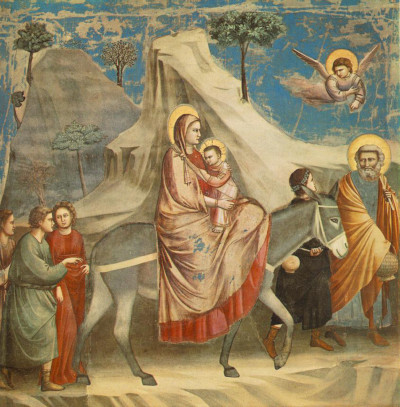
| Flight into Egypt — Lower Church north transept, Assisi | Early 14th century; c.1308–11 (Zeri); disputed | Fresco / wall painting. Giotto’s workshop / Giottesque painters; Stefano proposed by Schwarz. Scene within a cycle. Basilica catalogue. Scholarly study. Source. Zeri catalogue. |
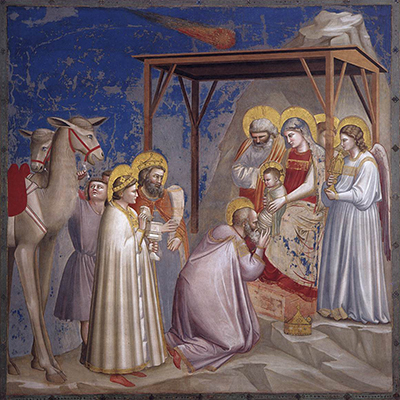
| Adoration of the Magi — Lower Church north transept, Assisi | Early 14th century; c.1308–11 (Zeri); disputed | Fresco / wall painting. Giotto’s workshop / Giottesque painters; Stefano proposed by Schwarz. Scene within a cycle. Basilica catalogue. Scholarly study. Source. Zeri catalogue. |
| Angel medallion from the Navicella — Vatican | Late 13th–early 14th-century original; later restoration | Mosaic. Associated with Giotto’s Navicella; medieval material and later restoration. Fragmentary and restored. Scholarly study. |
| Angel medallion from the Navicella — Boville Ernica | Late 13th–early 14th-century original; later restoration | Mosaic. Associated with Giotto’s Navicella; medieval material and later restoration. Fragmentary and restored. Scholarly study. |
| Dream of Innocent III — Louvre Stigmatisation predella | 1300–25 (Louvre’s dating of the altarpiece) | Tempera and gold on wood. Part of the signed Giotto altarpiece; individual hand uncertain. Ensemble component. Louvre catalogue. Louvre catalogue. |
| Approval of the Rule — Louvre Stigmatisation predella | 1300–25 (Louvre’s dating of the altarpiece) | Tempera and gold on wood. Part of the signed Giotto altarpiece; individual hand uncertain. Ensemble component. Louvre catalogue. Louvre catalogue. |
| Saint Francis Preaching to the Birds — Louvre Stigmatisation predella | 1300–25 (Louvre’s dating of the altarpiece) | Tempera and gold on wood. Part of the signed Giotto altarpiece; individual hand uncertain. Ensemble component. Louvre catalogue. Louvre catalogue. |
| Possible wall decoration at San Francesco, Rimini — lost | c.1300; exact date uncertain | Possibly fresco / wall painting. Possible association with Giotto. Possible lost commission. Programme and extent unknown. Source. Scholarly study. |
| Works at the Basilica of Saint Anthony, Padua — reported, lost | By c.1313 (reported activity); exact date unknown | Painting; wall or panel support uncertain. Giotto’s activity reported by Riccobaldo. Lost works reported in historical accounts. Scholarly study. Scholarly study. |
| Painted heaven / celestial decoration, Palazzo della Ragione — lost | Early 14th century (Giovanni da Nono’s account) | Painting; wooden-vault tempera or wall fresco disputed. Associated with Giotto in historical accounts. Lost. Wooden-vault interpretation proposed by Schwarz; present astrological murals follow the 1420 fire. Scholarly study. |
| Great chapel decoration, Castel Nuovo — disputed / largely lost | Documented 20 May 1331; Neapolitan service 1328–33 | Wall painting with metal decoration and mixed materials. Giotto-led documented commission. Largely lost; attribution of fragments disputed. Other masters participated; surviving window fragments leave the programme uncertain. Scholarly study. Source. |
| Private chapel decoration, Castel Nuovo — documented, lost | Documented 20 May 1331; execution dates unknown | Wall painting / chapel decoration; technique uncertain. Giotto. Documented commission; lost. Separate from the great chapel; programme unknown. Scholarly study. |
| Royal cona made in Giotto’s house, Naples — documented, lost | Recorded 20 May 1331 | Panel painting (cona); exact technique uncertain. Documented in Giotto’s house. Documented object; lost. Movable panel; subject, dimensions and composition unknown. Scholarly study. |
| Calvary and Lamentation / decoration — Santa Chiara, disputed fragments | Late 1320s–early 1330s; exact date uncertain | Wall painting and painted architectural furnishings. Associated with Giotto and collaborators; individual attributions disputed. Fragmentary programme. Extent of surviving decoration disputed. Source. Scholarly study. |
| Apocalypse paintings, Naples — reported, lost | Undated; associated in later accounts with Naples | Painting; support unknown. Attributed to Giotto in later accounts. Lost works reported in historical accounts. Programme uncertain. Source. Scholarly study. |
| Gloria mondana / Worldly Glory — disputed identification | Undated; proposed Milanese context disputed | Painting; support and format unknown. Association with Giotto and identity disputed. Lost; identity and location disputed. Scholarly study. Source. Scholarly study. |
| Marian cycle, Tosinghi-Spinelli Chapel — lost interior | Undated; reported by Ghiberti and Vasari | Wall painting. Attributed to Giotto by Ghiberti and Vasari. Lost cycle reported in historical accounts. Interior cycle distinct from the damaged entrance Assumption. Scholarly study. Scholarly study. |
| Assumption of the Virgin — Tosinghi-Spinelli entrance, badly preserved | Undated; associated with the Santa Croce decoration | Wall painting. Associated with Giotto in scholarship; attribution uncertain. Badly preserved trace reported in scholarship. Trace distinguished from the lost interior cycle by Schwarz and Theis. Scholarly study. Scholarly study. |
| Apostolic histories, Giugni Chapel — reported, lost | Undated; described by Vasari | Wall painting. Attributed to Giotto by Vasari. Lost cycle reported in historical accounts. Scholarly study. |
| Life of John the Baptist, Santa Maria del Carmine — reported, lost | Undated; attributed by Vasari | Wall painting. Attributed to Giotto by Vasari. Lost cycle reported in historical accounts. Scholarly study. |
| Marian wall decoration — Badia Fiorentina, disputed fragments | Undated; attribution disputed | Wall painting. Association with Giotto disputed. Fragmentary programme. Separate from the Badia Polyptych. Source. Scholarly study. |
| Allegory of the Commune Being Robbed — reported, lost | Undated; reported by Ghiberti | Wall painting / civic allegory. Attributed to Giotto by Ghiberti. Lost work reported in historical accounts. Composition uncertain. Scholarly study. Source. |
| Chapel decoration, Castello di Galliera, Bologna — reported, lost | Before 1334; chapel traces reported in 1560 | Wall painting. Associated with Giotto in historical accounts. Lost cycle reported in historical accounts. The chapel survived the fortress’s 1334 demolition; traces reported in 1560; date of final loss unknown. Scholarly study. Source. |
| Crucifixion — Lower Church north transept, Assisi | Early 14th century; c.1308–11 (Zeri); disputed | Fresco / wall painting. Giotto’s workshop (Zeri); alternative attributions disputed. Scene within a cycle. Zeri catalogue. |
| Young Man of Sessa Recovered from the Ruins — Lower Church north transept, Assisi | Early 14th century; c.1308–11 (Zeri); disputed | Fresco / wall painting. Giotto’s workshop (Zeri); alternative attributions disputed. Scene within a cycle. Separate scene from the Resurrection of the Young Man of Sessa. Zeri catalogue. Source. |
| Saint Francis Revives a Child Fallen from a Palace Window — Lower Church north transept, Assisi | Early 14th century; c.1308–11 (Zeri); disputed | Fresco / wall painting. Giotto’s workshop (Zeri); alternative attributions disputed. Scene within a cycle. Revival in Zeri’s title; the child’s identity and alternative harmless-fall interpretation remain disputed. Zeri catalogue. |
| Resurrection of the Young Man of Sessa — Lower Church north transept, Assisi | Early 14th century; c.1308–11 (Zeri); disputed | Fresco / wall painting. Giotto’s workshop (Zeri); alternative attributions disputed. Scene within a cycle. Separate scene from the Recovery of the Young Man of Sessa from the Ruins. Zeri catalogue. Source. |
| Saint Francis with Death — Lower Church north transept, Assisi | Early 14th century; c.1308–11 (Zeri); disputed | Fresco / wall painting. Giotto’s workshop (Zeri); alternative attributions disputed. Ensemble component. Zeri catalogue. |
| Visitation — Lower Church north transept, Assisi | Early 14th century; c.1308–11 (Zeri); disputed | Fresco / wall painting. Giotto’s workshop (Zeri); alternative attributions disputed. Scene within a cycle. Zeri catalogue. |
| Nativity — Lower Church north transept, Assisi | Early 14th century; c.1308–11 (Zeri); disputed | Fresco / wall painting. Giotto’s workshop (Zeri); alternative attributions disputed. Scene within a cycle. Zeri catalogue. |
| Presentation of Christ at the Temple — Lower Church north transept, Assisi | Early 14th century; c.1308–11 (Zeri); disputed | Fresco / wall painting. Giotto’s workshop (Zeri); alternative attributions disputed. Scene within a cycle. Zeri catalogue. |
| Massacre of the Innocents — Lower Church north transept, Assisi | Early 14th century; c.1308–11 (Zeri); disputed | Fresco / wall painting. Giotto’s workshop (Zeri); alternative attributions disputed. Scene within a cycle. Zeri catalogue. |
| Return of the Holy Family after the Temple Episode — Lower Church north transept, Assisi | Early 14th century; c.1308–11 (Zeri); disputed | Fresco / wall painting. Giotto’s workshop (Zeri); alternative attributions disputed. Scene within a cycle. Also titled Return to Bethlehem or Return to Nazareth; one physical painting. Zeri catalogue. |
| Annunciation — Lower Church north transept, Assisi | c.1310 (basilica); disputed | Fresco / wall painting. Collaborator of Giotto (basilica attribution). Scene within a cycle. Basilica catalogue. Scholarly study. |
| Christ among the Doctors — Lower Church north transept, Assisi | Early 14th century; disputed | Fresco / wall painting. Giottesque workshop; Stefano proposed by Schwarz. Scene within a cycle. Scholarly study. |
Discussion
Look again at the images and ideas explored in Giotto's Workshop and Attribution. These editorial prompts invite your observations.
Reader Insights
What can a signature establish without proving that one painter executed every passage?
How do workshop labels at Bologna, London and the Vatican help you compare different kinds of responsibility?
Join the Conversation
Share a detail, comparison or question about Giotto's Workshop and Attribution below.
References
- Opera di Santa Croce, “Incoronazione della Vergine tra angeli e santi (Polittico Baroncelli)”, current catalogue, sections “Autore,” “Iscrizione” and account of the late-fifteenth-century alteration; consulted 1 November 2026. View source. (in Italian).
- Vatican Museums, “Giotto di Bondone and assistants, Stefaneschi triptych”, Pinacoteca, room II, inventory 40120, current object account. View source.
- Dillian Gordon, “Pentecost,” NG5360, in The Italian Paintings Before 1400 (London: National Gallery Company and Yale University Press, 2011), pp. 231–237, especially “Technical Notes,” “Companion Panels,” “Function,” and “Attribution and Date.” View source.
- Michael Viktor Schwarz and Pia Theis, Giottus Pictor I: Giottos Leben (Vienna: Böhlau, 2004), pp. 273–274, I f 2, “Signaturen”; see also p. 48. View source. (in German).
- Musée du Louvre, “Saint François d'Assise recevant les stigmates,” INV309, current collection record, “Description,” “Inscriptions,” “Physical characteristics” and “History,” updated 28 May 2025. View source.
- Pinacoteca Nazionale di Bologna, “Polittico,” inventory 284, current object record, “Descrizione opera” and “Scheda tecnica”; consulted 1 November 2026. View source. (in Italian).
- Schwarz and Theis, Giottus Pictor I, pp. 222–225, I b 1–3, especially the account of 20 May 1331 and the editorial discussion of documentary transmission; p. 255, I d 2, for the Laudesi entry of 16 February 1314. View source. (in German).
- Schwarz and Theis, Giottus Pictor I, pp. 40–41 on Riccobaldo; pp. 45–47 on Dante, Purgatorio XI, especially lines 94–99 and their speaking context. View source. (in German).
- Cennino Cennini, Il libro dell'arte, chapters 1 and 67, Italian text and commentary in Schwarz and Theis, Giottus Pictor I, pp. 336–337, II c 5; the editors follow Franco Brunello's edition (Vicenza, 1982), pp. 4–5 and 78–79. View source. (in German).
- Schwarz and Theis, Giottus Pictor I, pp. 13–22, “Giottos Leben und Werk bei Ghiberti und Vasari,” especially the translated Ghiberti account on p. 14 and source criticism on pp. 15–18. View source. (in German).
- Michael Viktor Schwarz, with Michaela Zöschg, Giottus Pictor II: Giottos Werke (Vienna, Cologne and Weimar: Böhlau, 2008), pp. 126–133, especially “Die Paduaner Bottega,” pp. 127–130, and p. 331 on bottega and cantiere as abstractions. View source. (in German).
- Basilica Papale di San Francesco in Assisi, “Chiesa Superiore”, current institutional description, paragraph on the upper and lower registers of the nave. View source. (in Italian).
- Miklós Boskovits, “Giotto di Bondone”, Dizionario Biografico degli Italiani, vol. 55 (2001), section beginning “Le ventotto Storie della leggenda di s. Francesco,” especially paragraphs on dating and execution from the sixteenth scene. View source. (in Italian).
- Schwarz, Giottus Pictor II, pp. 331–344, “Giotteskes in Assisi: Die Franzlegende,” especially pp. 335–337 on Moltesen, templates and Zanardi; pp. 340–343 on crowd construction and Sienese comparisons; p. 344 on the conditional c.1308 reconstruction. View source. (in German).
- Miklós Boskovits, with technical summary and editorial additions, “Madonna and Child,” 1939.1.256, Italian Paintings of the Thirteenth and Fourteenth Centuries (Washington: National Gallery of Art, 2016), pp. 462–467, 473–474 notes 6 and 8, and 486–487, “Technical Summary.” View source.
- Cecilia Frosinini, “The Peruzzi Chapel in Santa Croce. Giotto under the UV fluorescence”, MUHBA Documents 9 (Barcelona, 2014), pp. 7–17; English text on pp. 9–10 for plaster and execution, p. 12 for binder and analytical limits, pp. 14–16 for fluorescence, recovered legibility and the November 2012 photographic campaign. View source. (in Catalan/English).
- Opera di Santa Maria del Fiore, “Un capolavoro di Giotto accolto al Museo dell'Opera del Duomo”, 10 February 2018, paragraph on the 1993 bombing and the angel's garment. View source. (in Italian).
- Opera di Santa Croce, “La conservazione degli affreschi attraverso i secoli”, 2026, section “Dall'occultamento settecentesco al restauro concluso nel 2026.” View source. (in Italian).
- Opera di Santa Croce, “Nel cantiere di Giotto”, 2026, sections “Giotto e la sua bottega” and “Un'architettura dipinta,” with the published Transito di San Francesco details. View source. (in Italian).
- Opera di Santa Croce, “Indagini diagnostiche”, 2026, sections “Una mappa della cappella” and “Le immagini nascoste.” View source. (in Italian).
- Staatliche Museen zu Berlin, Gemäldegalerie, “Die Kreuzigung Christi,” 1074A, current collection record, “Objektbeschreibung,” attribution history and present judgement; updated 29 July 2026. View source.
- North Carolina Museum of Art, “Christ Blessing with Saint John the Evangelist, the Virgin Mary, Saint John the Baptist, and Saint Francis (known as The Peruzzi Altarpiece),” GL.60.17.7, current collection record, “Label Text.” View source.
- Opificio delle Pietre Dure, “Giotto, Croce, 1315–1320 ca., Chiesa di San Salvatore a Ognissanti, Firenze”, conservation record, “Informazioni storico-descrittive,” paragraph on Cavalcaselle, Tartuferi, Boskovits and Previtali's Parente di Giotto. View source. (in Italian).
- Splash image, Baroncelli main assembly in later framing
 Giotto.jpg)
 Giotto.jpg)