by Tom Gurney
Tom Gurney BSc (Hons) is an art history expert with over 20 years experience
Published on June 19, 2020 / Updated on November 1, 2026
Email: tomgurney1@gmail.com / Phone: +44 7429 011000
Sermon to the Birds: Introduction
Sermon to the Birds, also known as St Francis Preaching to the Birds , is a religiously inspired artwork by Giotto di Bondone.
The title belongs to more than one image. In the Upper Church of San Francesco at Assisi, Francis's encounter with the birds forms the fifteenth episode of a twenty-eight-scene life. In the Louvre, the same subject occupies the right-hand compartment of the predella, the strip of smaller narratives below the principal scene of Saint Francis Receiving the Stigmata. The familiar detail with a gold background, a forward-leaning Francis and a leafy tree comes from this Louvre panel. The wall painting at Assisi opens into a blue-grey landscape. Comparing the two reveals how a few shared ingredients can serve very different viewing situations. The dedicated account of St Francis Preaching to the Birds at Assisi examines the mural itself; here the changing shape and purpose of the story are the focus.
At a Glance
- Narrative sourceBonaventure’s Life of Saint Francis, chapter XII, section 3. [1]
- Louvre comparisonThe bird sermon is one of three predella subjects beneath the Stigmata panel. [2]
- In the storyThe birds remain until Francis blesses and dismisses them with the sign of the cross. [1]
This work across Giotto’s career
Santa Maria Novella Crucifix
Late 13th century; c.1288–89 or 1298–1301; disputed; track: c.1288–89 [8]Life of Saint Francis — Upper Church cycle, Assisi
Traditionally Giotto; late 13th–early 14th century; authorship and date disputed; track: c.1290–95 convention [9] [4] [10] [5] [6]Sermon to the Birds — Upper Church, Assisi
Traditionally Giotto; late 13th–early 14th century; authorship and date disputed; track: c.1290–95 convention [3] [4] [5] [6]Ognissanti Madonna
c.1300–05 (Uffizi); c.1310 also proposed; track: c.1300–05 [11]Saint Francis Receiving the Stigmata — Louvre altarpiece
1300–25 (Louvre) [7]Scrovegni Chapel — painted decoration
c.1303–05 (chapel campaign); Giotto and workshop (painted decoration) [12] [13] [14]Madonna and Child — Washington / Goldman Madonna
c.1310–1315 (National Gallery of Art) [15]Stefaneschi Triptych
c.1320; 1315–20 (Vatican Museums); Giotto and workshop [16]Bardi Chapel — painted decoration
After 1317, usually the 1320s; disputed; Giotto and workshop / Giottesque painters; individual hands disputed [17] [18]Baroncelli Polyptych
After 1328; completion uncertain; band continues to axis edge; Giotto and workshop [19]Giotto’s Campanile — Florence Cathedral bell tower
Giotto’s phase 1334–37; completed 1359 by successors [20] [21] [22]Contents
Story behind the Sermon
St Francis delivers this sermon to the birds, and reminds them to speak proudly and positively about the lord. The birds swoop in to listen to his words, attentively grouped close-by.
Oh birds, my brothers and sisters, you have a great obligation to praise your Creator, who clothed you in feathers and gave you wings to fly with, provided you with pure air and cares for you without any worry on your part.
These words convey the substance of the address in Bonaventure's Life of Saint Francis, XII.3, but their modern English wording is not an authenticated transcript of Francis speaking. They are also not an exact quotation from E. Gurney Salter's 1904 translation: that version addresses the birds as brothers, and its phrasing differs throughout. Bonaventure presents the sermon within a saint's life, with the birds' extraordinary understanding and obedience demonstrating Francis's holiness. The passage gives us a narrative that painters could represent, rather than independent evidence of animal behaviour. Its emphasis is praise for the Creator's providential care: feathers, flight, air and sustenance are gifts for which the birds are called to give thanks. [1]
From this sermon onwards, St Francis would speak to other birds, animals and more to teach them to be grateful for their creation, and to thank the lord for this. Narratives such as this remind us that God did not only create humanity, but also everything else in the world.
Within Bonaventure's account, Francis returns to his companions reproaching himself for having neglected to preach to birds before. That ending explains the story's expansive view of preaching. The creatures are brought within an act of praise which a human audience can recognise and imitate. Bonaventure describes their stretching necks, opening beaks and spreading wings; he also says that they remain until Francis makes the sign of the cross and dismisses them. Their eventual flight belongs to the blessing at the end of the encounter. A painting may combine gathered and airborne birds within one field without providing a moment-by-moment diagram of the text. [1]
The preceding sections make this gentle episode part of a larger decision. In XII.1–2 Francis wonders whether he should devote himself to prayer or go out preaching. He seeks counsel through Silvester and Clare, and the answer directs him towards public ministry. The encounter near Bevagna follows immediately. Read in that sequence, the birds are an unexpected first congregation after a renewed commitment to preach. The story joins contemplation to action: Francis's attention to creatures grows from his religious vocation and carries its teaching beyond an exclusively human gathering. [23]
Commissions in Assisi
Sermon to the Birds was part of Giotto’s work in Assisi, where he focused on scenes from the life of St Francis. He constructed twenty five in total, of the twenty eight dedicated to this saint, though he also worked on other projects within the same church.
The precise allocation of twenty-five scenes to Giotto should be treated cautiously. The Upper Church programme involved a substantial collaborative undertaking, and its attribution remains disputed. The basilica's own description acknowledges both the Giotto attribution supported by some scholars and the Roman-school attribution favoured by others. A numerical division of the cycle does not establish how many scenes an individual painter personally executed. [24]
Giotto had two clear periods of work in Assisi, taking on both the upper and lower churches at different points in his career - there was a gap of several decades between the two projects. Many of the subjects that he covered here would also re-appear in other work elsewhere in Italy, where donors were impressed with his previous versions and wanted something similar for themselves.
The separation into two clear periods, divided by decades, is likewise a simplified chronology rather than an established timetable. The Upper and Lower Churches contain distinct programmes, and their dates, workshops and relationships have to be examined separately. Nor does the recurrence of a subject by itself document a donor asking for a copy. Shared Franciscan narratives, access to related designs and the requirements of different commissions all belong to the comparison; their relative importance cannot be settled by resemblance alone. [24] [2]
The artist’s work in Assisi remains amongst the highlights of his entire career, with both series of works being highly regarded.
The Louvre panel makes the problem particularly interesting because all three of its predella subjects also appear in the Assisi cycle: Innocent III's dream, the approval of the Franciscan way of life, and the sermon to the birds. The relationship is more substantial than two pictures merely including a tree and a saint. Yet agreement about a relationship need not produce agreement about its direction. Michael Viktor Schwarz discusses the corresponding compositions in his study of Giotto's works and proposes his own account of their development. His comparison is useful; its chronology is an argument, not a licence to label the Louvre scene a settled copy of the Assisi mural, or the mural a settled copy of the panel. [2]
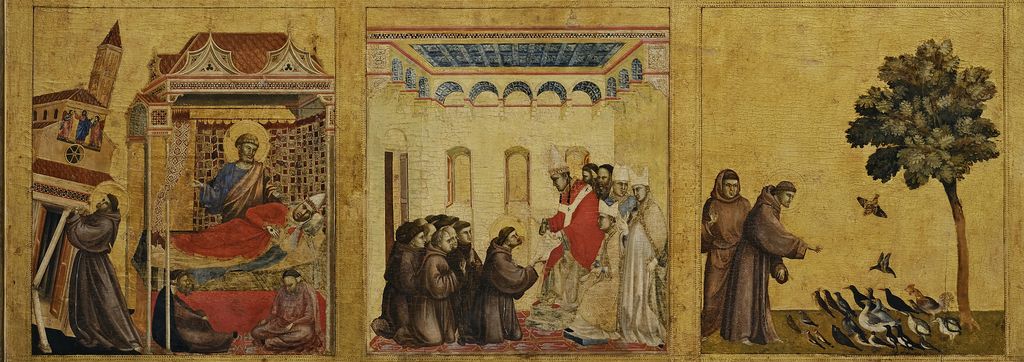
The Louvre altarpiece’s three predella scenes, with the bird sermon at the right. Shonagon / Wikimedia Commons / Public Domain Mark1.0. Image source. Public domain. Proportionally reduced reproduction; no colour or content enhancement.
Composition
The composition of Sermon to the Birds featuring Saint Francis with an outstretched arm, pointing directly towards the birds who gather close-by. They are mainly focused on his words, standing beneath a healthy looking tree which overhangs above from the right hand side.
A colleague of the saint stands besides him, perhaps in awe at proceedings as he sees Saint Francis enchant these birds with his words. This important story reminds us of the importance of birds and animals to God, and that we should continue to care for them as well as appreciating their existence.
The companion's presence is visible in both versions, while his precise inner response remains an interpretation. Bonaventure supplies companions who witness the event from the road, but the image does not name this particular friar or tell us what he thinks. Similarly, the birds' attentiveness is the miracle as the saint's life presents it. The painting's effectiveness comes from making that exceptional exchange understandable through ordinary bodily actions: a person approaches, extends a hand, and finds an audience apparently turning towards him. [1]
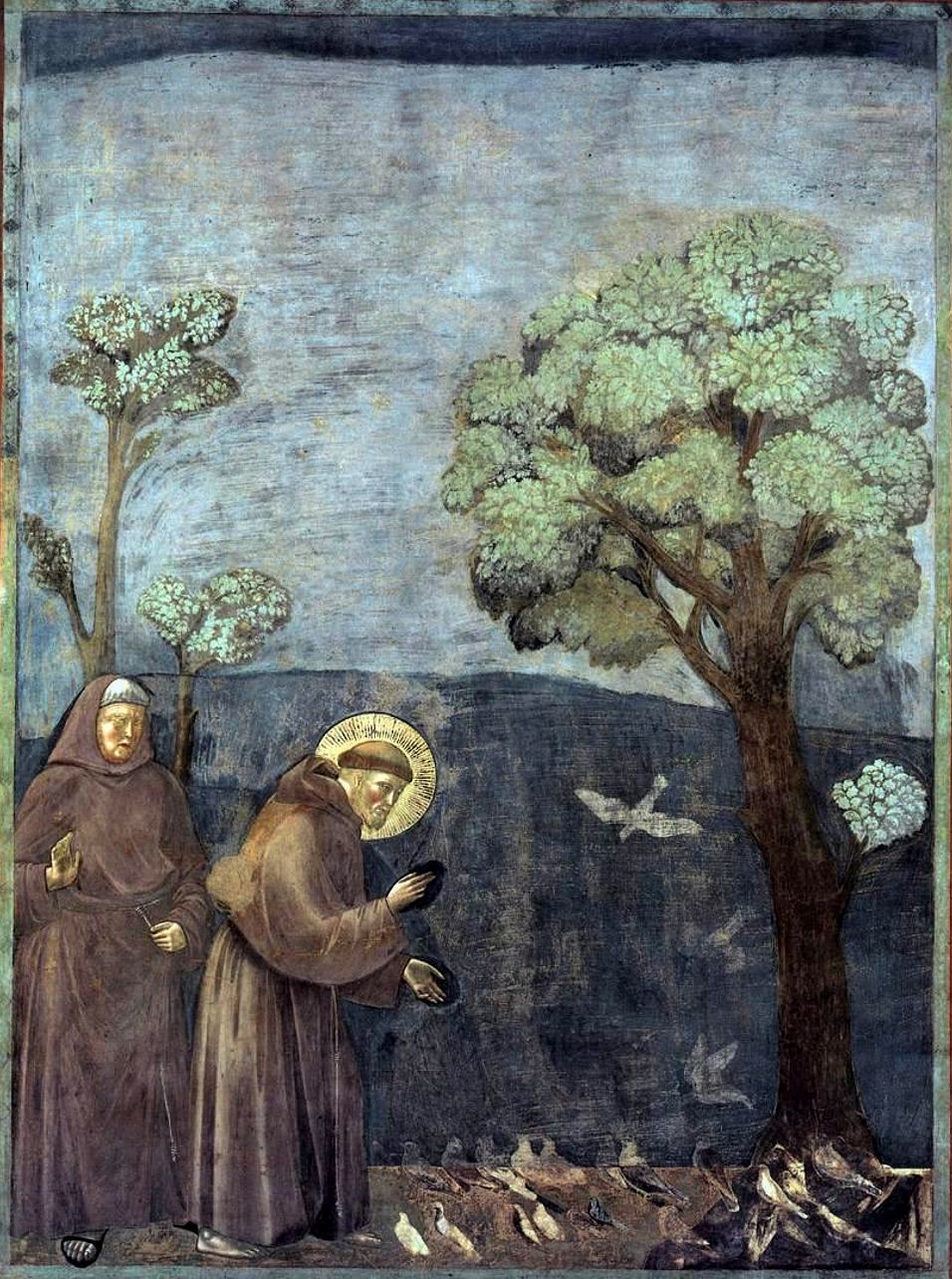
The bird sermon in Assisi’s Upper Church, a separate wall painting from the Louvre predella. Image source. Public domain. Proportionally reduced reproduction; no colour or content enhancement.
The foliage around the tree is also healthy and green, with bushy leaves which is noticeably different to some of his other versions, such as in Lamentation. Giotto would adapt the condition of his foliage to match the mood of the painting, and in this example we find a relatively upbeat work in which the birds are taught by St Francis to appreciate all that they have, and to thank the lord for it.
That comparison benefits from a qualification. The tree in the Padua Lamentation has small green shoots, so it cannot be described simply as wholly dead or made the opposite pole of a universal healthy-tree/happy-scene code. Foliage can contribute to a viewer's reading of a setting without every tree carrying a fixed emotional label. In the birds scenes, the right-hand tree also performs an immediate compositional task: it rises above the low congregation, balances the friars on the left, and gives the encounter a recognisable outdoor setting.
Bodies, hands and the listening space
Both representations incline Francis towards the birds. Their difference is more subtle than an upright saint opposed to a bending one. In the Louvre predella, the long forward movement of his upper body continues into an extended sleeve and hand. The line is especially clear against the gold. His other hand remains lower, close to his body, while the companion stands behind him. A broad mass of habit has been turned into an unmistakable act of address. Even when the whole altarpiece is viewed from a distance, the small preacher can be understood through the direction of that movement.
At Assisi, Francis's gesture is more compact. His head bows towards the congregation, but his nearer forearm lifts in front of him instead of stretching as far into the space above it. His other hand hangs lower and opens towards the birds. The two hands give a measured rhythm to the encounter, with the face and halo drawing attention back towards the speaker. Schwarz similarly distinguishes the more emphatic gesture of the panel from the quieter Francis of the fresco, relating the difference partly to the demands of the two formats. [25]
In each version, empty space helps the gesture speak. The saint and the birds do not need to touch. The interval between hand and congregation becomes the place across which the address travels. Airborne birds interrupt it without filling it completely. The viewer can follow a movement from the friar's body to his hand and onward to the gathering below the tree. The companion provides a second human response to this exchange, placing an observer inside the picture as well as outside it.
A landscape and a gold field
The Assisi image surrounds the figures with a larger landscape. Slender trees rise behind the friars on the left, answering the much fuller tree on the right. The darkened ground and cooler field behind the encounter give the birds and brown habits a different setting from the warm gold of the panel. These contrasts should be read through the paintings' present surfaces; reproductions and the condition of a mural can affect colour, contrast and legibility. The secure comparison is the arrangement of landscape and figures, rather than a claim to recover precisely how every colour appeared when first painted.
The Louvre compartment compresses the setting. A narrow green ground carries the friars, the birds and the tree, while gold fills the surrounding field. The tree's dense crown gives the upper right considerable weight; beneath it, dark and light bird bodies form a lively cluster. Two airborne shapes help lead the eye through the open area between the saint and the tree. The gold makes their silhouettes readily visible, and allows a scene of outdoor preaching to remain visually continuous with the altarpiece's devotional splendour.
Differences of body size, plumage colour and posture make the birds look like a varied assembly. Identifying individual species is unnecessary to understand the scene, and small reproductions do not support confident ornithological catalogues. The important distinction is between the birds as a group and their separate responses. Some stand close together, some lift their heads, and others are shown in the air. This gives the congregation a collective presence without making it a single repeated shape. The same balance between unity and variety helps a human crowd seem attentive in other narrative paintings.
Twenty-eight episodes and three small scenes
At Assisi, the sermon belongs to an extended public account of Francis's life. It can be understood alongside acts of renunciation, papal recognition, prayer, preaching, death and posthumous miracles. The twenty-eight-scene cycle supplies time and accumulation. The birds encounter becomes one aspect of a founder whose authority and sanctity are demonstrated repeatedly. Its relative compositional simplicity gives a pause within a much more populous and architecturally varied sequence.
The Louvre predella has to do something more concentrated. Its three compartments offer a short selection beneath a dominant image. On the left, the sleeping Innocent III dreams of Francis supporting the endangered Lateran basilica. In the centre, the pope approves the Franciscan way of life. On the right, Francis addresses the birds. Architectural interiors and human assemblies give way to an outdoor congregation. The change is striking precisely because the three scenes share one narrow register: the last little picture opens the teaching activity beyond the institutional settings of the first two. [26]
This juxtaposition allows several kinds of authority to reinforce one another. The dream associates Francis with the support of the Church; papal approval locates his mission within it; the sermon shows the reach of his preaching. Such a reading follows the subjects placed together, without requiring us to recover a patron's exact instructions. Above them, the principal Stigmatisation presents his bodily conformity to the crucified Christ on a monumental scale. The viewer encounters both an overwhelming sacred vision and smaller stories through which the saint's vocation can be followed. The separate article on Saint Francis Receiving the Stigmata considers that principal image in detail.
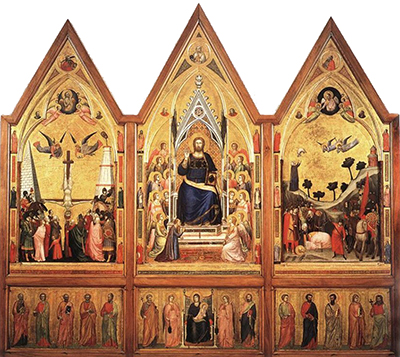
The panel's physical identity matters to this reading. It is a large, gabled altarpiece, 313 by 163 centimetres, with painting and a gold ground on poplar; the small birds scene is only one part of that object. Its frame bears the signature Opus Iocti florentini, identifying the work with Giotto of Florence. The Louvre currently gives the broad date 1300–1325. Its record traces the work from San Francesco in Pisa through subsequent Pisan locations to its removal during the Napoleonic period and arrival at the Louvre in 1813. It is therefore a panel with a Pisan history, not a detached Assisi fresco. [27]
The coats of arms on the frame have received competing identifications, including the Ughi and Cinquini families. Those alternatives limit confident claims about a particular donor. The signature is an important point of reference when discussing related pictures, but it does not establish the authorship of every Assisi passage or solve the chronological relationship between the two sermons. What the pictures do show is the same encounter reshaped for a broad wall narrative and a small compartment beneath a commanding devotional image. [27]
Conclusion
We can conclude that Sermon to the Birds is a relatively simple composition by the standards of Giotto within his work in Assisi, but still nonetheless significant. The connection between human and bird is enchanting, and Giotto works hard to bring the life of Saint Francis to us all, by carefully choosing key moments from his influential life.
The motif also invites a modern concern for creatures and the world they inhabit. That response can be valuable while remaining distinct from the pictures' original Franciscan setting. Bonaventure's sermon concerns the praise owed to a Creator who provides for his creatures. The paintings show a saint exercising a ministry that even birds are said to recognise; they do not set out a modern environmental programme. Their continuing appeal comes partly from the way that theological claim becomes a small, legible encounter. A bowed head, an open hand, a waiting companion and a gathering under a tree make the distance between human speech and animal life seem momentarily crossable. On the wall and in the predella, the encounter remains recognisable, while its place within a larger painted structure changes what the viewer is invited to remember.
Watch: Explore Giotto’s Art
Choose an overview or a closer look at three major works. These films provide wider Giotto context alongside this article.
Artworks directory
This directory brings together 209 records for paintings, ensembles, individual scenes and components, architectural work, an associated disputed design, and reported or lost projects connected with Giotto. Ensembles and their parts appear separately, so 209 is a count of records rather than independent paintings or commissions. Attributions and dates remain qualified where disputed; inclusion does not establish Giotto’s own hand throughout.
| Name | Date | Medium, attribution and status |
|---|---|---|
| Expulsion of Joachim from the Temple — Scrovegni Chapel, Padua | c.1303–05 (chapel campaign) | Fresco / wall painting. Giotto and workshop. Scene within a cycle. Padova Musei. Chapel overview. |
| Joachim among the Shepherds — Scrovegni Chapel, Padua | c.1303–05 (chapel campaign) | Fresco / wall painting. Giotto and workshop. Scene within a cycle. Padova Musei. Chapel overview. |
| Annunciation to Saint Anne — Scrovegni Chapel, Padua | c.1303–05 (chapel campaign) | Fresco / wall painting. Giotto and workshop. Scene within a cycle. Padova Musei. Chapel overview. |
| Sacrifice of Joachim — Scrovegni Chapel, Padua | c.1303–05 (chapel campaign) | Fresco / wall painting. Giotto and workshop. Scene within a cycle. Padova Musei. Chapel overview. |
| Joachim’s Dream — Scrovegni Chapel, Padua | c.1303–05 (chapel campaign) | Fresco / wall painting. Giotto and workshop. Scene within a cycle. Padova Musei. Padova Musei. Chapel overview. |
| Meeting at the Golden Gate — Scrovegni Chapel, Padua | c.1303–05 (chapel campaign) | Fresco / wall painting. Giotto and workshop. Scene within a cycle. Padova Musei. Chapel overview. |
| Birth of the Virgin — Scrovegni Chapel, Padua | c.1303–05 (chapel campaign) | Fresco / wall painting. Giotto and workshop. Scene within a cycle. Padova Musei. Padova Musei. Chapel overview. |
| Presentation of the Virgin in the Temple — Scrovegni Chapel, Padua | c.1303–05 (chapel campaign) | Fresco / wall painting. Giotto and workshop. Scene within a cycle. Padova Musei. Chapel overview. |
| Delivery of the Rods — Scrovegni Chapel, Padua | c.1303–05 (chapel campaign) | Fresco / wall painting. Giotto and workshop. Scene within a cycle. Padova Musei. Chapel overview. |
| Prayer of Joseph and the Suitors — Scrovegni Chapel, Padua | c.1303–05 (chapel campaign) | Fresco / wall painting. Giotto and workshop. Scene within a cycle. Padova Musei. Chapel overview. |
| Marriage of the Virgin — Scrovegni Chapel, Padua | c.1303–05 (chapel campaign) | Fresco / wall painting. Giotto and workshop. Scene within a cycle. Padova Musei. Chapel overview. |
| Wedding Procession of Mary — Scrovegni Chapel, Padua | c.1303–05 (chapel campaign) | Fresco / wall painting. Giotto and workshop. Scene within a cycle. Padova Musei. Chapel overview. |
| Annunciation on the triumphal arch — complete ensemble (Scrovegni Chapel, Padua) | c.1303–05 (chapel campaign) | Wall painting with a central painted wooden panel. Giotto and workshop. Ensemble. Includes the Mission of Gabriel and the lower Annunciation pair; the original central wooden panel is in the Musei Civici agli Eremitani, with a conservation copy in the chapel. Padova Musei. Padova Musei. Scholarly study. Chapel overview. |
| Visitation — Scrovegni Chapel, Padua | c.1303–05 (chapel campaign) | Fresco / wall painting. Giotto and workshop. Scene within a cycle. Padova Musei. Chapel overview. |
| Nativity — Scrovegni Chapel, Padua | c.1303–05 (chapel campaign) | Fresco / wall painting. Giotto and workshop. Scene within a cycle. Padova Musei. Chapel overview. |
| Adoration of the Magi — Scrovegni Chapel, Padua | c.1303–05 (chapel campaign) | Fresco / wall painting. Giotto and workshop. Scene within a cycle. Padova Musei. Chapel overview. |
| Presentation of Christ at the Temple — Scrovegni Chapel, Padua | c.1303–05 (chapel campaign) | Fresco / wall painting. Giotto and workshop. Scene within a cycle. Padova Musei. Chapel overview. |
| Flight into Egypt — Scrovegni Chapel, Padua | c.1303–05 (chapel campaign) | Fresco / wall painting. Giotto and workshop. Scene within a cycle. Padova Musei. Chapel overview. |
| Massacre of the Innocents — Scrovegni Chapel, Padua | c.1303–05 (chapel campaign) | Fresco / wall painting. Giotto and workshop. Scene within a cycle. Padova Musei. Chapel overview. |
| Christ among the Doctors — Scrovegni Chapel, Padua | c.1303–05 (chapel campaign) | Fresco / wall painting. Giotto and workshop. Scene within a cycle. Padova Musei. Chapel overview. |
| Baptism of Christ — Scrovegni Chapel, Padua | c.1303–05 (chapel campaign) | Fresco / wall painting. Giotto and workshop. Scene within a cycle. Padova Musei. Chapel overview. |
| Marriage at Cana — Scrovegni Chapel, Padua | c.1303–05 (chapel campaign) | Fresco / wall painting. Giotto and workshop. Scene within a cycle. Padova Musei. Padova Musei. Chapel overview. |
| Raising of Lazarus — Scrovegni Chapel, Padua | c.1303–05 (chapel campaign) | Fresco / wall painting. Giotto and workshop. Scene within a cycle. Padova Musei. Chapel overview. |
| Entry into Jerusalem — Scrovegni Chapel, Padua | c.1303–05 (chapel campaign) | Fresco / wall painting. Giotto and workshop. Scene within a cycle. Padova Musei. Chapel overview. |
| Expulsion of the Money Changers — Scrovegni Chapel, Padua | c.1303–05 (chapel campaign) | Fresco / wall painting. Giotto and workshop. Scene within a cycle. Padova Musei. Padova Musei. Chapel overview. |
| Judas Receiving the Payment — Scrovegni Chapel, Padua | c.1303–05 (chapel campaign) | Fresco / wall painting. Giotto and workshop. Scene within a cycle. Padova Musei. Chapel overview. |
| Last Supper — Scrovegni Chapel, Padua | c.1303–05 (chapel campaign) | Fresco / wall painting. Giotto and workshop. Scene within a cycle. Padova Musei. Chapel overview. |
| Washing of the Feet — Scrovegni Chapel, Padua | c.1303–05 (chapel campaign) | Fresco / wall painting. Giotto and workshop. Scene within a cycle. Padova Musei. Chapel overview. |
| Arrest of Christ — Scrovegni Chapel, Padua | c.1303–05 (chapel campaign) | Fresco / wall painting. Giotto and workshop. Scene within a cycle. Padova Musei. Chapel overview. |
| Christ before Annas and Caiaphas — Scrovegni Chapel, Padua | c.1303–05 (chapel campaign) | Fresco / wall painting. Giotto and workshop. Scene within a cycle. Padova Musei. Chapel overview. |
| Mocking of Christ and Flagellation — Scrovegni Chapel, Padua | c.1303–05 (chapel campaign) | Fresco / wall painting. Giotto and workshop. Scene within a cycle. Padova Musei. Chapel overview. |
| Road to Calvary — Scrovegni Chapel, Padua | c.1303–05 (chapel campaign) | Fresco / wall painting. Giotto and workshop. Scene within a cycle. Padova Musei. Chapel overview. |
| Crucifixion — Scrovegni Chapel, Padua | c.1303–05 (chapel campaign) | Fresco / wall painting. Giotto and workshop. Scene within a cycle. Padova Musei. Chapel overview. |
| Lamentation — Scrovegni Chapel, Padua | c.1303–05 (chapel campaign) | Fresco / wall painting. Giotto and workshop. Scene within a cycle. Padova Musei. Chapel overview. |
| Resurrection / Noli me tangere — Scrovegni Chapel, Padua | c.1303–05 (chapel campaign) | Fresco / wall painting. Giotto and workshop. Scene within a cycle. Padova Musei. Chapel overview. |
| Ascension — Scrovegni Chapel, Padua | c.1303–05 (chapel campaign) | Fresco / wall painting. Giotto and workshop. Scene within a cycle. Padova Musei. Chapel overview. |
| Pentecost — Scrovegni Chapel, Padua | c.1303–05 (chapel campaign) | Fresco / wall painting. Giotto and workshop. Scene within a cycle. Padova Musei. Padova Musei. Chapel overview. |
| Coretto — right painted recess (Scrovegni Chapel, Padua) | c.1303–05 (chapel campaign) | Fresco / painted fictive architecture. Giotto and workshop. Ensemble component. Padova Musei. Padova Musei. Scholarly study. Chapel overview. |
| Coretto — left painted recess (Scrovegni Chapel, Padua) | c.1303–05 (chapel campaign) | Fresco / painted fictive architecture. Giotto and workshop. Ensemble component. Padova Musei. Padova Musei. Scholarly study. Chapel overview. |
| Envy — Scrovegni Chapel, Padua | c.1303–05 (chapel campaign) | Grisaille fresco / wall painting. Giotto and workshop. Ensemble component. Padova Musei. Chapel overview. Scholarly study. Padova Musei. |
| Despair — Scrovegni Chapel, Padua | c.1303–05 (chapel campaign) | Grisaille fresco / wall painting. Giotto and workshop. Ensemble component. Padova Musei. Chapel overview. Scholarly study. Padova Musei. |
| Prudence — Scrovegni Chapel, Padua | c.1303–05 (chapel campaign) | Grisaille fresco / wall painting. Giotto and workshop. Ensemble component. Padova Musei. Chapel overview. Scholarly study. Padova Musei. |
| Fortitude — Scrovegni Chapel, Padua | c.1303–05 (chapel campaign) | Grisaille fresco / wall painting. Giotto and workshop. Ensemble component. Padova Musei. Chapel overview. Scholarly study. Padova Musei. |
| Temperance — Scrovegni Chapel, Padua | c.1303–05 (chapel campaign) | Grisaille fresco / wall painting. Giotto and workshop. Ensemble component. Padova Musei. Chapel overview. Scholarly study. Padova Musei. |
| Justice — Scrovegni Chapel, Padua | c.1303–05 (chapel campaign) | Grisaille fresco / wall painting. Giotto and workshop. Ensemble component. Padova Musei. Chapel overview. Scholarly study. Padova Musei. |
| Faith — Scrovegni Chapel, Padua | c.1303–05 (chapel campaign) | Grisaille fresco / wall painting. Giotto and workshop. Ensemble component. Padova Musei. Chapel overview. Scholarly study. Padova Musei. |
| Charity — Scrovegni Chapel, Padua | c.1303–05 (chapel campaign) | Grisaille fresco / wall painting. Giotto and workshop. Ensemble component. Padova Musei. Chapel overview. Scholarly study. Padova Musei. |
| Hope — Scrovegni Chapel, Padua | c.1303–05 (chapel campaign) | Grisaille fresco / wall painting. Giotto and workshop. Ensemble component. Padova Musei. Chapel overview. Scholarly study. Padova Musei. |
| Folly — Scrovegni Chapel, Padua | c.1303–05 (chapel campaign) | Grisaille fresco / wall painting. Giotto and workshop. Ensemble component. Padova Musei. Chapel overview. Scholarly study. Padova Musei. |
| Inconstancy — Scrovegni Chapel, Padua | c.1303–05 (chapel campaign) | Grisaille fresco / wall painting. Giotto and workshop. Ensemble component. Padova Musei. Chapel overview. Scholarly study. Padova Musei. |
| Wrath — Scrovegni Chapel, Padua | c.1303–05 (chapel campaign) | Grisaille fresco / wall painting. Giotto and workshop. Ensemble component. Padova Musei. Chapel overview. Scholarly study. Padova Musei. |
| Injustice — Scrovegni Chapel, Padua | c.1303–05 (chapel campaign) | Grisaille fresco / wall painting. Giotto and workshop. Ensemble component. Padova Musei. Chapel overview. Scholarly study. Padova Musei. |
| Infidelity / Idolatry — Scrovegni Chapel, Padua | c.1303–05 (chapel campaign) | Grisaille fresco / wall painting. Giotto and workshop. Ensemble component. Padova Musei. Chapel overview. Scholarly study. Padova Musei. |
| Starry vault — complete ensemble (Scrovegni Chapel, Padua) | c.1303–05 (chapel campaign) | Vault painting. Giotto and workshop. Ensemble. Padova Musei. Padova Musei. Chapel overview. |
| Last Judgement — Scrovegni Chapel, Padua | c.1303–05 (chapel campaign) | Fresco / wall painting. Giotto and workshop. Scene within a cycle. Padova Musei. Padova Musei. Chapel overview. Padova Musei. |
| Prophet Malachi — vault medallion — Scrovegni Chapel, Padua | c.1303–05 (chapel campaign) | Fresco / wall painting. Giotto and workshop. Ensemble component. Padova Musei. Padova Musei. Chapel overview. Padova Musei. |
| Prophet Baruch — vault medallion — Scrovegni Chapel, Padua | c.1303–05 (chapel campaign) | Fresco / wall painting. Giotto and workshop. Ensemble component. Padova Musei. Padova Musei. Chapel overview. Padova Musei. |
| Prophet Isaiah — vault medallion — Scrovegni Chapel, Padua | c.1303–05 (chapel campaign) | Fresco / wall painting. Giotto and workshop. Ensemble component. Padova Musei. Padova Musei. Chapel overview. Padova Musei. |
| Prophet Daniel — vault medallion — Scrovegni Chapel, Padua | c.1303–05 (chapel campaign) | Fresco / wall painting. Giotto and workshop. Ensemble component. Padova Musei. Padova Musei. Chapel overview. Padova Musei. |
| Christ Pantocrator — vault medallion — Scrovegni Chapel, Padua | c.1303–05 (chapel campaign) | Fresco / wall painting. Giotto and workshop. Ensemble component. Padova Musei. Padova Musei. Chapel overview. Padova Musei. |
| Virgin and Child — vault medallion — Scrovegni Chapel, Padua | c.1303–05 (chapel campaign) | Fresco / wall painting. Giotto and workshop. Ensemble component. Padova Musei. Padova Musei. Chapel overview. Padova Musei. |
| Prophet Ezekiel — vault medallion — Scrovegni Chapel, Padua | c.1303–05 (chapel campaign) | Fresco / wall painting. Giotto and workshop. Ensemble component. Padova Musei. Padova Musei. Chapel overview. Padova Musei. |
| Prophet Micah — vault medallion — Scrovegni Chapel, Padua | c.1303–05 (chapel campaign) | Fresco / wall painting. Giotto and workshop. Ensemble component. Padova Musei. Padova Musei. Chapel overview. Padova Musei. |
| Saint John the Baptist — vault medallion — Scrovegni Chapel, Padua | c.1303–05 (chapel campaign) | Fresco / wall painting. Giotto and workshop. Ensemble component. Padova Musei. Padova Musei. Chapel overview. Padova Musei. |
| Scrovegni Chapel — painted decoration | c.1303–05 (chapel campaign) | Fresco / wall painting, with a painted wooden panel. Giotto and workshop (painted decoration). Ensemble. Includes separately listed scenes and components. The original central God the Father panel is in the Musei Civici agli Eremitani; a conservation copy is in the chapel. Chapel overview. Padova Musei. Padova Musei. Source. Source. Source. Padova Musei. Scholarly study. |
| Vices and Virtues — complete fourteen-figure programme | c.1303–05 (chapel campaign) | Grisaille fresco / wall painting. Giotto and workshop. Ensemble. Fourteen figures: seven virtues and seven opposed vices. Padova Musei. Chapel overview. Scholarly study. |
| Coretti — paired fictive chapels | c.1303–05 (chapel campaign) | Fresco / painted fictive architecture. Giotto and workshop. Ensemble. Two separate painted recesses, also listed individually. Padova Musei. Padova Musei. Scholarly study. |
| Mission of Gabriel — heavenly assembly | c.1303–05 (chapel campaign) | Wall painting with central painted wooden image. Giotto and workshop. Ensemble component. Central wooden God the Father panel preserved at the Musei Civici agli Eremitani; conservation copy in the chapel. Chapel overview. Padova Musei. Scholarly study. Padova Musei. |
| Annunciation — Gabriel and Mary in facing chambers | c.1303–05 (chapel campaign) | Fresco / wall painting. Giotto and workshop. Ensemble component. Chapel overview. Scholarly study. Padova Musei. |
| God the Father — central wooden panel of the Mission of Gabriel | c.1303–05 (chapel campaign) | Painting on wood. Associated with Giotto. Ensemble component. Original at the Musei Civici agli Eremitani, Padua; conservation copy in the Scrovegni Chapel. Padova Musei. Padova Musei. Scholarly study. Source. |
| Life of Saint Francis — Upper Church cycle, Assisi | Late 13th–early 14th century; dating disputed | Fresco / wall-painting cycle. Traditionally associated with Giotto; Giotto, Roman-school and other attributions disputed. Ensemble. Twenty-eight-scene nave cycle; scenes also listed individually. Basilica catalogue. Scholarly study. Basilica catalogue. Source. Source. |
| Homage of a Simple Man — Upper Church, Assisi | Late 13th–early 14th century; dating disputed | Wall painting. Traditionally associated with Giotto; authorship and dating disputed. Scene within a cycle. Source. Scholarly study. Source. Source. Source. |
| Gift of the Mantle — Upper Church, Assisi | Late 13th–early 14th century; dating disputed | Wall painting. Traditionally associated with Giotto; authorship and dating disputed. Scene within a cycle. Basilica catalogue. Scholarly study. Source. Source. Source. |
| Dream of the Palace Full of Arms — Upper Church, Assisi | Late 13th–early 14th century; dating disputed | Wall painting. Traditionally associated with Giotto; authorship and dating disputed. Scene within a cycle. Basilica catalogue. Source. Scholarly study. Source. Source. Source. |
| Prayer before the Crucifix at San Damiano — Upper Church, Assisi | Late 13th–early 14th century; dating disputed | Wall painting. Traditionally associated with Giotto; authorship and dating disputed. Scene within a cycle. Source. Source. Source. Scholarly study. Source. Source. |
| Renunciation of Worldly Goods — Upper Church, Assisi | Late 13th–early 14th century; dating disputed | Wall painting. Traditionally associated with Giotto; authorship and dating disputed. Scene within a cycle. Source. Scholarly study. Source. Source. |
| Dream of Innocent III — Upper Church, Assisi | Late 13th–early 14th century; dating disputed | Wall painting. Traditionally associated with Giotto; authorship and dating disputed. Scene within a cycle. Source. Source. Scholarly study. Source. Source. |
| Confirmation of the Rule — Upper Church, Assisi | Late 13th–early 14th century; dating disputed | Wall painting. Traditionally associated with Giotto; authorship and dating disputed. Scene within a cycle. Source. Scholarly study. Source. Source. |
| Vision of the Flaming Chariot — Upper Church, Assisi | Late 13th–early 14th century; dating disputed | Wall painting. Traditionally associated with Giotto; authorship and dating disputed. Scene within a cycle. Source. Source. Scholarly study. Source. Source. |
| Vision of the Thrones — Upper Church, Assisi | Late 13th–early 14th century; dating disputed | Wall painting. Traditionally associated with Giotto; authorship and dating disputed. Scene within a cycle. Basilica catalogue. Scholarly study. Source. Source. Source. |
| Expulsion of Devils from Arezzo — Upper Church, Assisi | Late 13th–early 14th century; dating disputed | Wall painting. Traditionally associated with Giotto; authorship and dating disputed. Scene within a cycle. Source. Source. Scholarly study. Source. Source. Source. |
| Trial by Fire before the Sultan — Upper Church, Assisi | Late 13th–early 14th century; dating disputed | Wall painting. Traditionally associated with Giotto; authorship and dating disputed. Scene within a cycle. Source. Source. Scholarly study. Source. Source. |
| Ecstasy of Saint Francis — Upper Church, Assisi | Late 13th–early 14th century; dating disputed | Wall painting. Traditionally associated with Giotto; authorship and dating disputed. Scene within a cycle. Source. Source. Source. Scholarly study. Source. Source. |
| Nativity at Greccio — Upper Church, Assisi | Late 13th–early 14th century; dating disputed | Wall painting. Traditionally associated with Giotto; authorship and dating disputed. Scene within a cycle. Basilica catalogue. Scholarly study. Source. Source. Source. |
| Miracle of the Spring — Upper Church, Assisi | Late 13th–early 14th century; dating disputed | Wall painting. Traditionally associated with Giotto; authorship and dating disputed. Scene within a cycle. Source. Scholarly study. Source. Source. Source. |
| Sermon to the Birds — Upper Church, Assisi | Late 13th–early 14th century; dating disputed | Wall painting. Traditionally associated with Giotto; authorship and dating disputed. Scene within a cycle. Basilica catalogue. Scholarly study. Source. Source. Source. |
| Death of the Knight of Celano — Upper Church, Assisi | Late 13th–early 14th century; dating disputed | Wall painting. Traditionally associated with Giotto; authorship and dating disputed. Scene within a cycle. Source. Source. Scholarly study. Source. Source. |
| Sermon before Pope Honorius III — Upper Church, Assisi | Late 13th–early 14th century; dating disputed | Wall painting. Traditionally associated with Giotto; authorship and dating disputed. Scene within a cycle. Source. Source. Scholarly study. Source. |
| Apparition at the Chapter of Arles — Upper Church, Assisi | Late 13th–early 14th century; dating disputed | Wall painting. Traditionally associated with Giotto; authorship and dating disputed. Scene within a cycle. Basilica catalogue. Scholarly study. Source. Source. Source. |
| Stigmatisation — Upper Church, Assisi | Late 13th–early 14th century; dating disputed | Wall painting. Traditionally associated with Giotto; authorship and dating disputed. Scene within a cycle. Source. Scholarly study. Source. Source. |
| Death and Ascension of Saint Francis — Upper Church, Assisi | Late 13th–early 14th century; dating disputed | Wall painting. Traditionally associated with Giotto; authorship and dating disputed. Scene within a cycle. Basilica catalogue. Scholarly study. Source. Source. Source. |
| Apparition to Brother Augustine and Bishop Guido — Upper Church, Assisi | Late 13th–early 14th century; dating disputed | Wall painting. Traditionally associated with Giotto; authorship and dating disputed. Scene within a cycle. Zeri catalogue. Scholarly study. Source. Source. Source. |
| Verification of the Stigmata — Upper Church, Assisi | Late 13th–early 14th century; dating disputed | Wall painting. Traditionally associated with Giotto; authorship and dating disputed. Scene within a cycle. Source. Source. Scholarly study. Source. Source. |
| Mourning of the Poor Clares — Upper Church, Assisi | Late 13th–early 14th century; dating disputed | Wall painting. Traditionally associated with Giotto; authorship and dating disputed. Scene within a cycle. Basilica catalogue. Source. Scholarly study. Source. Source. |
| Canonisation of Saint Francis — Upper Church, Assisi | Late 13th–early 14th century; dating disputed | Wall painting. Traditionally associated with Giotto; authorship and dating disputed. Scene within a cycle. Source. Source. Scholarly study. Source. Source. Source. |
| Apparition to Pope Gregory IX — Upper Church, Assisi | Late 13th–early 14th century; dating disputed | Wall painting. Traditionally associated with Giotto; authorship and dating disputed. Scene within a cycle. Zeri catalogue. Scholarly study. Source. Source. Source. |
| Healing of John of Lerida — Upper Church, Assisi | Late 13th–early 14th century; dating disputed | Wall painting. Traditionally associated with Giotto; authorship and dating disputed. Scene within a cycle. Source. Source. Scholarly study. Source. Source. |
| Resurrection of a Woman — Upper Church, Assisi | Late 13th–early 14th century; dating disputed | Wall painting. Traditionally associated with Giotto; authorship and dating disputed. Scene within a cycle. Source. Scholarly study. Source. Source. Source. |
| Liberation of the Prisoner Peter — Upper Church, Assisi | Late 13th–early 14th century; dating disputed | Wall painting. Traditionally associated with Giotto; authorship and dating disputed. Scene within a cycle. Source. Source. Scholarly study. Source. Source. Source. |
| Santa Maria Novella Crucifix | Late 13th century; c.1288–89 or 1298–1301; disputed | Tempera and gold on a shaped wooden cross. Giotto. Source. |
| Death of the Virgin / Dormition — Berlin | c.1310 | Tempera and gold on poplar; gabled dossal. Giotto. Source. Source. |
| Peruzzi Altarpiece | c.1311–1315 (North Carolina Museum of Art) | Tempera and gold on panel. Giotto and workshop. Ensemble. Source. |
| Bologna Polyptych | c.1330 | Tempera and gold on panel. Giotto and workshop. Ensemble. Source. |
| Death of Saint Francis, Bardi Chapel | After 1317, usually the 1320s; disputed | Wall painting with wet-plaster and dry-applied passages. Giotto. Scene within a cycle. Source. |
| Bardi Chapel — painted decoration | After 1317, usually the 1320s; disputed | Wall painting with wet-plaster and dry-applied passages. Giotto and workshop / Giottesque painters; individual hands disputed. Ensemble. Scholarly study. Source. |
| Badia Polyptych | c.1300; proposed dates include 1295–1300 and 1301–02 | Tempera and gold on panel; five cusped compartments. Giotto. Ensemble. Scholarly study. Source. Source. |
| Baroncelli Polyptych | After 1328; detached pinnacle c.1328–35 | Tempera and gold on panel; later altered framing. Giotto and workshop. Ensemble. Detached central pinnacle in San Diego. Santa Croce. |
| Adoration of the Magi / Epiphany — Metropolitan Museum panel | Possibly c.1320; c.1310–18 also proposed for the group | Tempera and gold on wood. Giotto. Part of the dispersed seven-scene board; original function disputed. Met catalogue. Source. |
| Franciscan Allegories | Early 14th century, often c.1315; disputed | Vault wall painting. Giotto and workshop / Giottesque painters; individual hands disputed. Ensemble. Basilica catalogue. |
| Navicella — lost / reworked original mosaic | Late 13th–early 14th century; date disputed | Mosaic. Original attributed to Giotto. Original lost / reworked; fragments and later remakes survive. Scholarly study. |
| Pentecost — London panel | Possibly c.1310–18 (Gordon) | Egg tempera on poplar. Giotto and workshop. Part of the dispersed seven-scene board; original function disputed. National Gallery. Source. |
| Saint Stephen — Horne panel | c.1330–1335 (Museo Horne) | Tempera and gold on panel. Giotto. Proposed association with the Washington and Chaalis panels remains hypothetical. Source. |
| Saint Francis Receiving the Stigmata — Louvre altarpiece | 1300–25 (Louvre) | Tempera and gold on poplar. Giotto. Louvre catalogue. |
| Stefaneschi Triptych | c.1320; 1315–20 (Vatican Museums) | Tempera and gold on panel; painted on both sides. Giotto and workshop. Ensemble. Vatican Museums. |
| Crucifixion, Berlin | c.1315–1320 | Tempera and gold on poplar. Giotto. Source. |
| Madonna and Child — Washington / Goldman Madonna | c.1310–1315 (National Gallery of Art) | Tempera and gold on poplar. Giotto. Washington panel, distinct from San Giorgio alla Costa; proposed Horne/Chaalis companions remain hypothetical. NGA catalogue. |
| Ognissanti Madonna | c.1300–05 (Uffizi); c.1310 also proposed | Tempera and gold on panel. Giotto. Uffizi. |
| Madonna of Borgo San Lorenzo | c.1290–95; dating and attribution debated | Tempera and gold on a fragment of a wooden panel. Giotto. Fragmentary. Source. |
| Madonna of San Giorgio alla Costa | c.1288–95 (Opera del Duomo); later dates also proposed | Tempera and gold on panel; cut edges. Giotto. Damaged in 1993 and treated in 1995. Source. |
| Magdalene Chapel — painted decoration | c.1307–08 (basilica); disputed | Wall painting with wet-plaster and dry-applied passages. Giotto and workshop / Giottesque painters; individual hands disputed. Ensemble. Basilica catalogue. |
| Ognissanti Crucifix | c.1315–1320 (Opificio) | Painting on a shaped wooden cross. Giotto and workshop. Workshop participation and alternative attributions debated. Source. |
| Padua Crucifix | c.1303–05 (Zeri catalogue) | Tempera and gold on a shaped wooden cross. Giotto. Zeri catalogue. |
| Peruzzi Chapel — painted decoration | c.1310–11 (Santa Croce); 1334–36 proposed by Schwarz | Wall painting with substantial dry-applied work and loss. Giotto and workshop / Giottesque painters; individual hands disputed. Ensemble. Santa Croce. |
| Rimini Crucifix | c.1300; late 13th century also proposed | Tempera and gold on a shaped wooden cross. Giotto. Source. |
| Giotto’s Campanile — Florence Cathedral bell tower | Begun 1334; completed 1359 under successors | Marble-clad masonry bell tower. Begun under Giotto; continued by Andrea Pisano and Francesco Talenti. Successive building and sculptural campaigns. Source. Scholarly study. Scholarly study. |
| Tower elevation on parchment, Siena — disputed relation to Giotto | 14th century; date and design context disputed | Brown ink and coloured washes over incised construction on three parchment skins. Attribution disputed; possibly a Giotto design transmitted through another hand. Associated design; autograph attribution unestablished. Alternative attributions include Lando di Pietro. Scholarly study. Source. Source. |
| Seven scenes of Christ — dispersed painted board | Possibly c.1310–18 (Gordon); component dates vary | Tempera and gold on a single wooden board, subsequently divided. Giotto and workshop; individual attributions vary. Reconstructed dispersed ensemble. Common board supported by matching wood grain; predella or dossal function disputed. Source. Source. |
| Presentation of Christ at the Temple — Boston panel | Possibly c.1310–18 (Gordon’s group dating) | Tempera and gold on wood. Giotto and workshop; individual attribution varies within the group. Ensemble component. Source. Source. |
| Last Supper — Munich panel | Possibly c.1310–18 (Gordon’s group dating) | Tempera and gold on wood. Giotto and workshop; individual attribution varies within the group. Ensemble component. Source. Source. Source. |
| Crucifixion — Munich panel | Possibly c.1310–18 (Gordon’s group dating) | Tempera and gold on wood. Giotto and workshop; individual attribution varies within the group. Ensemble component. Source. Source. Source. |
| Descent into Limbo — Munich panel | Possibly c.1310–18 (Gordon’s group dating) | Tempera and gold on wood. Giotto and workshop; individual attribution varies within the group. Ensemble component. Source. Source. Source. |
| Entombment — Villa I Tatti panel | Possibly c.1310–18 (Gordon’s group dating) | Tempera and gold on wood. Giotto and workshop; individual attribution varies within the group. Ensemble component. Source. Source. |
| God the Father with Angels — detached Baroncelli pinnacle | c.1328–1335 (San Diego Museum of Art) | Tempera and gold on wood. Giotto and workshop. Ensemble component. Detached in later remodelling; collection home in San Diego. Source. Source. |
| Saint John the Evangelist — Chaalis panel | c.1320 (INHA/RETIF) | Painting on wood. Giotto (INHA/RETIF attribution). Collection: Musée Jacquemart-André, Fontaine-Chaalis. Chantilly’s exhibition announcement, as of 1 November 2026, gives temporary display from 24 January 2026 with no end date. Association with the Washington/Horne altarpiece remains hypothetical. NGA catalogue. Source. Source. Source. Source. |
| Saint Lawrence — Chaalis panel | c.1320 (INHA/RETIF) | Painting on poplar. Giotto; possible execution by a collaborator (INHA/RETIF). Collection: Musée Jacquemart-André, Fontaine-Chaalis. Chantilly’s exhibition announcement, as of 1 November 2026, gives temporary display from 24 January 2026 with no end date. Association with the Washington/Horne altarpiece remains hypothetical. NGA catalogue. Source. Source. Source. Source. |
| Allegory of Poverty — Lower Church crossing vault, Assisi | Early 14th century, often c.1315; disputed | Vault wall painting. Giotto’s workshop / Giottesque painters; alternatives include Stefano. Ensemble component. Basilica catalogue. Source. Scholarly study. |
| Allegory of Chastity — Lower Church crossing vault, Assisi | Early 14th century, often c.1315; disputed | Vault wall painting. Giotto’s workshop / Giottesque painters; alternatives include Stefano. Ensemble component. Basilica catalogue. Source. Scholarly study. |
| Allegory of Obedience — Lower Church crossing vault, Assisi | Early 14th century, often c.1315; disputed | Vault wall painting. Giotto’s workshop / Giottesque painters; alternatives include Stefano. Ensemble component. Basilica catalogue. Source. Scholarly study. |
| Saint Francis in Glory — Lower Church crossing vault, Assisi | Early 14th century, often c.1315; disputed | Vault wall painting. Giotto’s workshop / Giottesque painters; alternatives include Stefano. Ensemble component. Basilica catalogue. Source. Scholarly study. |
| Renunciation of Worldly Goods — Bardi Chapel, Florence | After 1317, usually the 1320s; disputed | Wall painting: fresco with extensive dry-applied passages. Giotto and workshop; individual hands uncertain. Scene within a cycle. Source. Santa Croce. Scholarly study. Source. |
| Confirmation of the Rule — Bardi Chapel, Florence | After 1317, usually the 1320s; disputed | Wall painting: fresco with extensive dry-applied passages. Giotto and workshop; individual hands uncertain. Scene within a cycle. Source. Santa Croce. Scholarly study. Source. |
| Apparition at the Chapter of Arles — Bardi Chapel, Florence | After 1317, usually the 1320s; disputed | Wall painting: fresco with extensive dry-applied passages. Giotto and workshop; individual hands uncertain. Scene within a cycle. Source. Santa Croce. Scholarly study. Source. |
| Trial by Fire before the Sultan — Bardi Chapel, Florence | After 1317, usually the 1320s; disputed | Wall painting: fresco with extensive dry-applied passages. Giotto and workshop; individual hands uncertain. Scene within a cycle. Source. Santa Croce. Scholarly study. Source. |
| Apparitions to Brother Augustine and Bishop Guido — Bardi Chapel, Florence | After 1317, usually the 1320s; disputed | Wall painting: fresco with extensive dry-applied passages. Giotto and workshop; individual hands uncertain. Scene within a cycle. Source. Santa Croce. Scholarly study. Source. |
| Saint Francis Receiving the Stigmata — Bardi Chapel, Florence | After 1317, usually the 1320s; disputed | Wall painting: fresco with extensive dry-applied passages. Giotto and workshop; individual hands uncertain. Scene within a cycle. Source. Santa Croce. Scholarly study. Source. |
| Saint Louis of Toulouse — Bardi Chapel niche | After 1317; campaign date disputed | Wall painting. Giotto and workshop. Ensemble component. Source. Scholarly study. |
| Saint Clare — Bardi Chapel niche | After 1317; campaign date disputed | Wall painting. Giotto and workshop. Ensemble component. Source. Scholarly study. |
| Saint Elizabeth of Hungary — Bardi Chapel niche | After 1317; campaign date disputed | Wall painting. Giotto and workshop. Ensemble component. Source. Scholarly study. |
| Franciscan virtues — Bardi Chapel vault programme | After 1317; campaign date disputed | Vault wall painting. Giotto and workshop. Group of ensemble components. Santa Croce. Source. |
| Annunciation to Zacharias — Peruzzi Chapel, Florence | c.1310–11 (Santa Croce); 1334–36 proposed by Schwarz | Wall painting with substantial dry-applied work. Giotto and workshop. Scene within a cycle. Santa Croce. Scholarly study. Santa Croce. |
| Birth and Naming of John the Baptist — Peruzzi Chapel, Florence | c.1310–11 (Santa Croce); 1334–36 proposed by Schwarz | Wall painting with substantial dry-applied work. Giotto and workshop. Scene within a cycle. Santa Croce. Scholarly study. Santa Croce. |
| Feast of Herod — Peruzzi Chapel, Florence | c.1310–11 (Santa Croce); 1334–36 proposed by Schwarz | Wall painting with substantial dry-applied work. Giotto and workshop. Scene within a cycle. Santa Croce. Scholarly study. Santa Croce. |
| Vision of John on Patmos — Peruzzi Chapel, Florence | c.1310–11 (Santa Croce); 1334–36 proposed by Schwarz | Wall painting with substantial dry-applied work. Giotto and workshop. Scene within a cycle. Santa Croce. Scholarly study. Santa Croce. |
| Raising of Drusiana — Peruzzi Chapel, Florence | c.1310–11 (Santa Croce); 1334–36 proposed by Schwarz | Wall painting with substantial dry-applied work. Giotto and workshop. Scene within a cycle. Santa Croce. Scholarly study. Santa Croce. |
| Death and Ascension of John the Evangelist — Peruzzi Chapel, Florence | c.1310–11 (Santa Croce); 1334–36 proposed by Schwarz | Wall painting with substantial dry-applied work. Giotto and workshop. Scene within a cycle. Santa Croce. Scholarly study. Santa Croce. |
| Evangelist symbols — Peruzzi Chapel vault | c.1310–11 (Santa Croce); 1334–36 proposed by Schwarz | Wall painting. Giotto and workshop. Group of ensemble components. Santa Croce. |
| Eight prophets — Peruzzi Chapel entrance arch | c.1310–11 (Santa Croce); 1334–36 proposed by Schwarz | Wall painting. Giotto and workshop. Group of ensemble components. Santa Croce. |
| Mystic Lamb — Peruzzi Chapel fragment | c.1310–11 (Santa Croce); 1334–36 proposed by Schwarz | Wall painting. Giotto and workshop. Ensemble component; fragmentary. Santa Croce. |
| Meal in the Pharisee’s House — Magdalene Chapel, Assisi | c.1307–08 (basilica); disputed | Fresco / wall painting. Giotto and workshop; individual hands debated. Scene within a cycle. Basilica catalogue. Scholarly study. |
| Raising of Lazarus — Magdalene Chapel, Assisi | c.1307–08 (basilica); disputed | Fresco / wall painting. Giotto and workshop; individual hands debated. Scene within a cycle. Basilica catalogue. Scholarly study. |
| Noli me tangere — Magdalene Chapel, Assisi | c.1307–08 (basilica); disputed | Fresco / wall painting. Giotto and workshop; individual hands debated. Scene within a cycle. Basilica catalogue. Scholarly study. |
| Miracle of the Ruler of Marseille — Magdalene Chapel, Assisi | c.1307–08 (basilica); disputed | Fresco / wall painting. Giotto and workshop; individual hands debated. Scene within a cycle. Basilica catalogue. Scholarly study. |
| Angelic Elevation of Mary Magdalene — Magdalene Chapel, Assisi | c.1307–08 (basilica); disputed | Fresco / wall painting. Giotto and workshop; individual hands debated. Scene within a cycle. Basilica catalogue. Scholarly study. |
| Mary Magdalene Clothed by a Hermit — Magdalene Chapel, Assisi | c.1307–08 (basilica); disputed | Fresco / wall painting. Giotto and workshop; individual hands debated. Scene within a cycle. Basilica catalogue. Scholarly study. |
| Last Communion and Ascent of the Magdalene’s Soul — Magdalene Chapel, Assisi | c.1307–08 (basilica); disputed | Fresco / wall painting. Giotto and workshop; individual hands debated. Scene within a cycle. Basilica catalogue. Scholarly study. |
| Christ — Magdalene Chapel vault medallion | c.1307–08 (basilica); disputed | Vault wall painting. Giotto and workshop. Ensemble component. Basilica catalogue. Scholarly study. |
| Mary Magdalene — Magdalene Chapel vault medallion | c.1307–08 (basilica); disputed | Vault wall painting. Giotto and workshop. Ensemble component. Basilica catalogue. Scholarly study. |
| Martha — Magdalene Chapel vault medallion | c.1307–08 (basilica); disputed | Vault wall painting. Giotto and workshop. Ensemble component. Basilica catalogue. Scholarly study. |
| Lazarus — Magdalene Chapel vault medallion | c.1307–08 (basilica); disputed | Vault wall painting. Giotto and workshop. Ensemble component. Basilica catalogue. Scholarly study. |
| Teobaldo Pontano before Saint Rufinus — Magdalene Chapel donor image | c.1307–08 (chapel campaign) | Wall painting. Giotto and workshop; donor identified by Schwarz. Ensemble component. Scholarly study. |
| Teobaldo Pontano before Mary Magdalene — Magdalene Chapel donor image | c.1307–08 (chapel campaign) | Wall painting. Giotto and workshop; donor identified by Schwarz. Ensemble component. Scholarly study. |
| Penitential saints — Magdalene Chapel entrance programme | Early 14th century; associated with the c.1307–08 campaign | Wall painting. Giotto and workshop / associated chapel programme. Group of ensemble components. Scholarly study. |
| Life of Mary Magdalene — stained-glass window | Early 14th century; exact date uncertain | Stained glass. Associated chapel programme; designer and maker uncertain. Associated programme. Eleven-episode stained-glass window, distinct from the wall paintings. Basilica catalogue. Scholarly study. |
| Childhood of Christ and Franciscan miracles — Lower Church north transept | Early 14th century, often c.1315; disputed | Fresco / wall painting. Giotto and workshop; Stefano proposed by Schwarz; individual hands disputed. Ensemble. Basilica catalogue. Scholarly study. Source. |
| Flight into Egypt — Lower Church north transept, Assisi | Early 14th century; c.1308–11 (Zeri); disputed | Fresco / wall painting. Giotto’s workshop / Giottesque painters; Stefano proposed by Schwarz. Scene within a cycle. Basilica catalogue. Scholarly study. Source. Zeri catalogue. |
| Adoration of the Magi — Lower Church north transept, Assisi | Early 14th century; c.1308–11 (Zeri); disputed | Fresco / wall painting. Giotto’s workshop / Giottesque painters; Stefano proposed by Schwarz. Scene within a cycle. Basilica catalogue. Scholarly study. Source. Zeri catalogue. |
| Angel medallion from the Navicella — Vatican | Late 13th–early 14th-century original; later restoration | Mosaic. Associated with Giotto’s Navicella; medieval material and later restoration. Fragmentary and restored. Scholarly study. |
| Angel medallion from the Navicella — Boville Ernica | Late 13th–early 14th-century original; later restoration | Mosaic. Associated with Giotto’s Navicella; medieval material and later restoration. Fragmentary and restored. Scholarly study. |
| Dream of Innocent III — Louvre Stigmatisation predella | 1300–25 (Louvre’s dating of the altarpiece) | Tempera and gold on wood. Part of the signed Giotto altarpiece; individual hand uncertain. Ensemble component. Louvre catalogue. Louvre catalogue. |
| Approval of the Rule — Louvre Stigmatisation predella | 1300–25 (Louvre’s dating of the altarpiece) | Tempera and gold on wood. Part of the signed Giotto altarpiece; individual hand uncertain. Ensemble component. Louvre catalogue. Louvre catalogue. |
| Saint Francis Preaching to the Birds — Louvre Stigmatisation predella | 1300–25 (Louvre’s dating of the altarpiece) | Tempera and gold on wood. Part of the signed Giotto altarpiece; individual hand uncertain. Ensemble component. Louvre catalogue. Louvre catalogue. |
| Possible wall decoration at San Francesco, Rimini — lost | c.1300; exact date uncertain | Possibly fresco / wall painting. Possible association with Giotto. Possible lost commission. Programme and extent unknown. Source. Scholarly study. |
| Works at the Basilica of Saint Anthony, Padua — reported, lost | By c.1313 (reported activity); exact date unknown | Painting; wall or panel support uncertain. Giotto’s activity reported by Riccobaldo. Lost works reported in historical accounts. Scholarly study. Scholarly study. |
| Painted heaven / celestial decoration, Palazzo della Ragione — lost | Early 14th century (Giovanni da Nono’s account) | Painting; wooden-vault tempera or wall fresco disputed. Associated with Giotto in historical accounts. Lost. Wooden-vault interpretation proposed by Schwarz; present astrological murals follow the 1420 fire. Scholarly study. |
| Great chapel decoration, Castel Nuovo — disputed / largely lost | Documented 20 May 1331; Neapolitan service 1328–33 | Wall painting with metal decoration and mixed materials. Giotto-led documented commission. Largely lost; attribution of fragments disputed. Other masters participated; surviving window fragments leave the programme uncertain. Scholarly study. Source. |
| Private chapel decoration, Castel Nuovo — documented, lost | Documented 20 May 1331; execution dates unknown | Wall painting / chapel decoration; technique uncertain. Giotto. Documented commission; lost. Separate from the great chapel; programme unknown. Scholarly study. |
| Royal cona made in Giotto’s house, Naples — documented, lost | Recorded 20 May 1331 | Panel painting (cona); exact technique uncertain. Documented in Giotto’s house. Documented object; lost. Movable panel; subject, dimensions and composition unknown. Scholarly study. |
| Calvary and Lamentation / decoration — Santa Chiara, disputed fragments | Late 1320s–early 1330s; exact date uncertain | Wall painting and painted architectural furnishings. Associated with Giotto and collaborators; individual attributions disputed. Fragmentary programme. Extent of surviving decoration disputed. Source. Scholarly study. |
| Apocalypse paintings, Naples — reported, lost | Undated; associated in later accounts with Naples | Painting; support unknown. Attributed to Giotto in later accounts. Lost works reported in historical accounts. Programme uncertain. Source. Scholarly study. |
| Gloria mondana / Worldly Glory — disputed identification | Undated; proposed Milanese context disputed | Painting; support and format unknown. Association with Giotto and identity disputed. Lost; identity and location disputed. Scholarly study. Source. Scholarly study. |
| Marian cycle, Tosinghi-Spinelli Chapel — lost interior | Undated; reported by Ghiberti and Vasari | Wall painting. Attributed to Giotto by Ghiberti and Vasari. Lost cycle reported in historical accounts. Interior cycle distinct from the damaged entrance Assumption. Scholarly study. Scholarly study. |
| Assumption of the Virgin — Tosinghi-Spinelli entrance, badly preserved | Undated; associated with the Santa Croce decoration | Wall painting. Associated with Giotto in scholarship; attribution uncertain. Badly preserved trace reported in scholarship. Trace distinguished from the lost interior cycle by Schwarz and Theis. Scholarly study. Scholarly study. |
| Apostolic histories, Giugni Chapel — reported, lost | Undated; described by Vasari | Wall painting. Attributed to Giotto by Vasari. Lost cycle reported in historical accounts. Scholarly study. |
| Life of John the Baptist, Santa Maria del Carmine — reported, lost | Undated; attributed by Vasari | Wall painting. Attributed to Giotto by Vasari. Lost cycle reported in historical accounts. Scholarly study. |
| Marian wall decoration — Badia Fiorentina, disputed fragments | Undated; attribution disputed | Wall painting. Association with Giotto disputed. Fragmentary programme. Separate from the Badia Polyptych. Source. Scholarly study. |
| Allegory of the Commune Being Robbed — reported, lost | Undated; reported by Ghiberti | Wall painting / civic allegory. Attributed to Giotto by Ghiberti. Lost work reported in historical accounts. Composition uncertain. Scholarly study. Source. |
| Chapel decoration, Castello di Galliera, Bologna — reported, lost | Before 1334; chapel traces reported in 1560 | Wall painting. Associated with Giotto in historical accounts. Lost cycle reported in historical accounts. The chapel survived the fortress’s 1334 demolition; traces reported in 1560; date of final loss unknown. Scholarly study. Source. |
| Crucifixion — Lower Church north transept, Assisi | Early 14th century; c.1308–11 (Zeri); disputed | Fresco / wall painting. Giotto’s workshop (Zeri); alternative attributions disputed. Scene within a cycle. Zeri catalogue. |
| Young Man of Sessa Recovered from the Ruins — Lower Church north transept, Assisi | Early 14th century; c.1308–11 (Zeri); disputed | Fresco / wall painting. Giotto’s workshop (Zeri); alternative attributions disputed. Scene within a cycle. Separate scene from the Resurrection of the Young Man of Sessa. Zeri catalogue. Source. |
| Saint Francis Revives a Child Fallen from a Palace Window — Lower Church north transept, Assisi | Early 14th century; c.1308–11 (Zeri); disputed | Fresco / wall painting. Giotto’s workshop (Zeri); alternative attributions disputed. Scene within a cycle. Revival in Zeri’s title; the child’s identity and alternative harmless-fall interpretation remain disputed. Zeri catalogue. |
| Resurrection of the Young Man of Sessa — Lower Church north transept, Assisi | Early 14th century; c.1308–11 (Zeri); disputed | Fresco / wall painting. Giotto’s workshop (Zeri); alternative attributions disputed. Scene within a cycle. Separate scene from the Recovery of the Young Man of Sessa from the Ruins. Zeri catalogue. Source. |
| Saint Francis with Death — Lower Church north transept, Assisi | Early 14th century; c.1308–11 (Zeri); disputed | Fresco / wall painting. Giotto’s workshop (Zeri); alternative attributions disputed. Ensemble component. Zeri catalogue. |
| Visitation — Lower Church north transept, Assisi | Early 14th century; c.1308–11 (Zeri); disputed | Fresco / wall painting. Giotto’s workshop (Zeri); alternative attributions disputed. Scene within a cycle. Zeri catalogue. |
| Nativity — Lower Church north transept, Assisi | Early 14th century; c.1308–11 (Zeri); disputed | Fresco / wall painting. Giotto’s workshop (Zeri); alternative attributions disputed. Scene within a cycle. Zeri catalogue. |
| Presentation of Christ at the Temple — Lower Church north transept, Assisi | Early 14th century; c.1308–11 (Zeri); disputed | Fresco / wall painting. Giotto’s workshop (Zeri); alternative attributions disputed. Scene within a cycle. Zeri catalogue. |
| Massacre of the Innocents — Lower Church north transept, Assisi | Early 14th century; c.1308–11 (Zeri); disputed | Fresco / wall painting. Giotto’s workshop (Zeri); alternative attributions disputed. Scene within a cycle. Zeri catalogue. |
| Return of the Holy Family after the Temple Episode — Lower Church north transept, Assisi | Early 14th century; c.1308–11 (Zeri); disputed | Fresco / wall painting. Giotto’s workshop (Zeri); alternative attributions disputed. Scene within a cycle. Also titled Return to Bethlehem or Return to Nazareth; one physical painting. Zeri catalogue. |
| Annunciation — Lower Church north transept, Assisi | c.1310 (basilica); disputed | Fresco / wall painting. Collaborator of Giotto (basilica attribution). Scene within a cycle. Basilica catalogue. Scholarly study. |
| Christ among the Doctors — Lower Church north transept, Assisi | Early 14th century; disputed | Fresco / wall painting. Giottesque workshop; Stefano proposed by Schwarz. Scene within a cycle. Scholarly study. |
Discussion
Look again at the images and ideas explored in Sermon to the Birds. These editorial prompts invite your observations.
Reader Insights
What changes when the bird sermon becomes one small compartment beneath a larger panel?
How do the gold background and the open Assisi landscape alter the encounter?
Join the Conversation
Share a detail, comparison or question about Sermon to the Birds below.
References
- Bonaventure, The Life of Saint Francis, translated by E. Gurney Salter (London: J. M. Dent & Co., 1904), chapter XII, section 3, printed pp. 127–128, especially p. 128; digital scan pp. 142–143. Internet Archive digitisation. The English sermon preserved here closely renders this passage, but its modern wording has no established translator attribution and is not Salter's exact wording. View source.
- Michael Viktor Schwarz, with Michaela Zöschg, Giottus pictor, vol. 2, Giottos Werke (Vienna, Cologne and Weimar: Böhlau, 2008), pp. 331–344, especially p. 339, on the Upper Church cycle, competing chronology and the three corresponding Louvre subjects. Open-access edition, Austrian Science Fund. View source. (in German).
- Custodia Generale del Sacro Convento di San Francesco, “Chiesa Superiore,” Basilica Papale di San Francesco in Assisi, undated, description of the Upper Church and its painted programmes. View source. (in Italian).
- Michael Viktor Schwarz, with Michaela Zöschg, Giottus Pictor, vol. II, Giottos Werke (Vienna, Cologne and Weimar: Böhlau, 2008), pp. 331–344, especially pp. 333–334 on programme relationships, 335–337 on campaigns, 338–342 on comparisons and proposed borrowing, and 343–344 on work sequence and the proposed chronology; . Schwarz's reconstruction is presented as his argument. View source. (in German).
- Miklós Boskovits, “Giotto di Bondone,” Dizionario Biografico degli Italiani, vol. 55 (2001), sections on the Upper Church biblical paintings, the twenty-eight Storie della leggenda di s. Francesco and the 1307–09 Assisi connection; . The account's attribution and chronology are distinguished from later alternatives. View source.
- Directorio Franciscano, “Vida de San Francisco de Asís: Textos de San Buenaventura e ilustraciones de Giotto,” complete twenty-eight-episode index with paired Legenda maior references, , accessed 1 November 2026; narrative details checked against the Salter edition cited in note 3. View source. (in Spanish).
- Musée du Louvre, Department of Paintings, “Saint François d’Assise recevant les stigmates,” INV 309 / MR 253, collection record updated 28 May 2025, sections “Date,” “Inscriptions” and “Object history.”. View source.
- Opera per Santa Maria Novella, “The Crucifix by Giotto,” current church account, undated, accessed 31 October 2026, . Its early dating, colour symbolism and theological interpretation are identified here as the institution's account. View source.
- Basilica Papale di San Francesco in Assisi, “Chiesa Superiore,” institutional description, accessed 1 November 2026, . Building, decorative registers and explicitly competing Giotto/Roman-school attributions. View source. (in Italian).
- Felice Autieri, OFMConv, “Il Presepe di Greccio nella Basilica superiore,” Basilica Papale di San Francesco in Assisi, accessed 1 November 2026, . Episode identity, institutional dating and discussion of represented liturgical furniture. View source. (in Italian).
- Daniela Parenti, “Virgin and Child enthroned, surrounded by angels and saints (Ognissanti Maestà),” Uffizi Galleries, current collection record, accessed 1 November 2026. View source.
- Comune di Padova, Cappella degli Scrovegni, “La Cappella di Giotto,” official overview, programme, dedication, vault and Giovanni Pisano sculpture. View source. (in Italian).
- Padova Musei Civici, Vita di Maria, collection inventory. View source. (in Italian).
- Padova Musei Civici, Dio Padre incarica l’arcangelo Gabriele di dare l’annuncio a Maria, collection record. View source. (in Italian).
- National Gallery of Art, Washington, “Madonna and Child,” Giotto, c. 1310/1315, accession 1939.1.256, current artwork overview and object details, accessed 1 November 2026. View source.
- Vatican Museums, “Giotto di Bondone and assistants, Stefaneschi triptych,” Pinacoteca, Room II, current object description, consulted 1 November 2026; date 1315–1320, commission, two-sided arrangement and principal figures. View source.
- Michael Viktor Schwarz, with Michaela Zöschg, Giottus Pictor, vol. 2, Giottos Werke, Vienna, Cologne and Weimar: Böhlau, 2008, pp. 412–14, on the proposed chronology, and pp. 418–26: chapel status and liturgical memoria, pp. 418–19; Ridolfo, burial evidence and patronage, pp. 419–20; programme and memorial interpretation, pp. 420–26. View source. (in German).
- Opera di Santa Croce, , historical dossier, 11 September 2026, on programme, probable patron, post-1317 dating and the conservation history. View source.
- Opera di Santa Croce, “Incoronazione della Vergine tra angeli e santi (Polittico Baroncelli), Giotto,” current institutional catalogue, object information and introductory account, accessed 1 November 2026. View source. (in Italian).
- Opera di Santa Maria del Fiore, “Giotto's Bell Tower,” current institutional monument record, sections on structure, building chronology, sculpture and bells, consulted 1 November 2026. . The specialist museum records cited below control the early sculptors' names. View source.
- Michael Viktor Schwarz, with Michaela Zöschg, Giottus Pictor II: Giottos Werke (Vienna, Cologne and Weimar: Böhlau, 2008), “Der Campanile: Nachleben im Bau,” pp. 599–603 and 613–614: site sequence, design experience, structural breaks and sculptural attribution. View source. (in German).
- Michael Viktor Schwarz and Pia Theis, Giottus Pictor I: Giottos Leben (Vienna: Böhlau, 2004), pp. 58–62; appointment of 12 April 1334, pp. 267–269, transcribing Florence, Archivio di Stato, Provvisioni Registri 26, fols. 100v–101r. Foundation, 1335 witness and modern conversion of the death year: pp. 60–61. View source. (in German).
- Bonaventure, The Life of Saint Francis, Salter translation, 1904, chapter XII, sections 1–2, printed pp. 125–127. Internet Archive digitisation. View source.
- Custodia Generale del Sacro Convento di San Francesco, Assisi, “Chiesa Superiore,” institutional description, especially the paragraph on the nave's biblical and Franciscan registers. Basilica of Saint Francis. View source. (in Italian).
- Schwarz, Giottus pictor, vol. 2, 2008, p. 399, comparison of the Francis figures in the Louvre birds predella and Assisi fresco. The author's account of borrowing forms part of his interpretation of the relationship. Open-access edition, Austrian Science Fund. View source. (in German).
- Musée du Louvre, Département des Peintures, “Saint François d'Assise recevant les stigmates,” INV 309 / MR 253, “Description/Features,” for the three predella subjects. For the Lateran dream and papal approval, see also Bonaventure, The Life of Saint Francis, 1904, III.10, printed pp. 30–32. Louvre collection record; Bonaventure digitisation. View source 1. View source 2.
- Musée du Louvre, Département des Peintures, “Saint François d'Assise recevant les stigmates,” INV 309 / MR 253, collection record updated 28 May 2025, sections “Inscriptions,” “Physical characteristics,” “Places and dates” and “History.” The record gives competing Ughi and Cinquini heraldic identifications. Louvre collection record. View source.
- Splash image, Francis preaching to the birds in the Louvre altarpiece’s predella; this is a separate work from the Assisi fresco.
 Giotto.jpg)
 Giotto.jpg)