


 by Tom Gurney
Tom Gurney BSc (Hons) is an art history expert with over 20 years experience
Published on June 19, 2020 / Updated on October 23, 2026
Email: tomgurney1@gmail.com / Phone: +44 7429 011000
An independent pencil composition
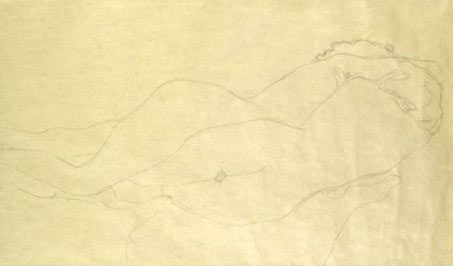
Gustav Klimt's Two Women Reclining, also catalogued as Zwei Frauen, liegend, is a pencil drawing associated with his reclining nudes of circa 1914–15. The sheet measures 35 by 55 centimetres. Its identity is secured by the photograph and description of Sotheby's 2007 lot 120, rather than by the English title alone. Two closely grouped heads at the right and bodies extending leftwards give the composition its distinctive horizontal shape.[1]
The drawing does not depend on an elaborate setting. There is no carefully furnished room, distant landscape or dense ornamental background to organize the encounter. The figures themselves supply the major divisions. Their proximity, the changes between broad bodily curves and smaller details, and the pale lines connecting those forms carry almost the entire visual experience.
This economy makes the sheet rewarding to examine slowly. At first, the bodies may seem to merge into one broad, undulating shape. Looking again, separate contours and local accents let the viewer distinguish overlapping forms without losing the impression of closeness. The composition relies on both responses: the pair as a connected whole and the particular bodies within it.
Overlapping bodies and the width of the sheet
The right-hand grouping of heads anchors the image. It is more compact than the bodies stretching away from it, and the contours around hair, neck and shoulder give the eye a place to pause. The two figures do not address the viewer as a pair of formal portrait sitters. Their arrangement directs attention into the relationship of the forms rather than outwards towards a public audience.
Across the middle, large curves describe the breadth of the figures. One rounded contour rises behind another, while the foreground torso establishes a lower, extended movement. These lines are not simply parallel. Their varying heights create intervals through which the eye can distinguish one body from the other, even where the forms remain closely associated.
The limbs continuing towards the left change the pace of looking. Their longer, narrower shapes contrast with the broad central areas. The eye can travel along them quickly, then return towards the more concentrated articulation near the heads. In this way, the width of the paper becomes an active part of the design rather than spare space beyond a centrally placed subject.
The lower edge contains a few additional curves and folds. They suggest material or support around the bodies without defining a complete piece of furniture. Those relatively open indications help the pair occupy the page while leaving their surroundings secondary. Naming an exact bed or studio arrangement would give the lightly described setting a certainty that the drawing does not supply.
Much of the interest lies in how overlap is made legible with so little modelling. The viewer follows a contour until it meets another, then decides whether that line continues around a form or disappears behind it. Such encounters keep the drawing active. The anatomy is not presented as an isolated demonstration; it is organized through the meeting and partial concealment of bodies.
What the light pencil line can do
The lines are delicate, but they are not without emphasis. Smaller accents around the chest, face and joints interrupt the broad arcs. Their relative darkness matters because the rest of the drawing is so restrained. A short mark can attract attention that a more heavily shaded image would have to secure through a much larger contrast.
There is little continuous shading across the bodies. Instead, the pale paper contributes to the impression of their surfaces. The boundary of a torso can be enough to make an extended area read as flesh, even when its interior remains almost untouched. This is a different kind of description from a fully modelled academic figure, whose volume is continuously explained through light and shadow.
The difference between a faint contour and a blank area is especially important in reproduction. The eye needs time to adjust to the drawing's narrow range of tones. Enlarging a small image can help reveal the arrangement, but it cannot recover every quality of the original pencil. The softness of a digital reproduction should not be confused with an absence of structure in the work itself.
Sotheby's historical condition report describes cream wove paper that was not laid down.[1] That identifies a physical support, not a painted ground or a canvas. The paper's warmth and the pencil's relative lightness should therefore be considered separately from the colours and metallic surfaces familiar in Klimt's paintings. The drawing achieves its effect without reproducing their decorative apparatus.
Nor can the line tell us the precise duration of the session. A sparse drawing may look immediate while still depending on sustained observation and selection. What can be judged is the resulting distribution: broad curves remain open, a few details receive emphasis, and the pair occupies the sheet without a competing background.
Intimacy without an invented biography
The closeness of two nude bodies gives the drawing a sensual character. That observation concerns what is represented, rather than a claim about the people who posed. Their names, private relationship and sexual identities cannot be recovered from this arrangement. The image does not need those biographical additions for its treatment of proximity to be understood.
The Klimt Foundation places autonomous nude drawings alongside preparatory work in its account of the artist's later years.[2] This distinction allows an erotic subject to be considered as a complete artistic investigation, not merely as a private confession or an unfinished step towards a painting. Here, the balance between the two bodies provides a compositional purpose of its own.
Closeness is also a formal relationship. The heads gather into one area; the bodies create linked movements; overlapping contours make the figures difficult to separate completely. These qualities can suggest intimacy without illustrating a named episode or an explicit action. The drawing's reserve leaves room for the viewer to attend to the arrangement rather than supply a story about the models.
This is why descriptions that concentrate only on provocation miss much of the work. They overlook how carefully the breadth of the bodies is balanced against the narrowing limbs, or how small facial and anatomical details function within an otherwise quiet surface. Sensuality is not an alternative to composition. It is experienced through the forms Klimt has chosen to bring together.
A drawing rather than a missing painting study
The auction catalogue treats this sheet as an independent composition, not preparation for a particular oil. It mentions Water Serpents II as an earlier thematic parallel, rather than identifying the drawing as a study for that painting.[1] A shared interest in horizontally arranged female bodies does not establish a direct preparatory relationship.
That difference is useful when exploring Klimt's drawings. Some sheets have a closely documented role in a commission, while others work through a subject without a specified painted destination. The absence of such a destination does not make this drawing incomplete. Its paired arrangement can be understood on the paper, without searching for a lost final canvas to justify it.
The comparison with Water Serpents II should remain equally precise. The older painting has its own setting, figures and decorative construction. This sheet offers a more reduced encounter, in which the relationship between a few contours carries much of the effect. It belongs within Klimt's continuing interest in the reclining body, but not within every painted scene that contains one.
The same title can identify another sheet
The Metropolitan Museum of Art owns a different Two Women Reclining, accession 1984.433.200. That graphite drawing is dated around 1905–06 and measures 34.9 by 55.2 centimetres. It entered through the Scofield Thayer bequest.[3] The similar English name and comparable dimensions are not enough to equate it with the sheet photographed for the 2007 auction.
Comparing the images makes the distinction clear. The Met drawing has a different configuration of bent legs, bodies and heads. The composition considered here is governed instead by the close right-hand heads and the long forms moving towards the left. Transferring the Met's accession or ownership history would replace the identity of one drawing with another, even though both titles sound equally plausible.
The same care applies to Two Studies of a Floating Draped Figure. That page concerns alternative clothed poses for the Beethoven Frieze. Here, the overlapping nudes form a paired composition. A resemblance in bodily direction does not erase the difference between two working variants and two figures brought together within one image.
The limited ownership record
The 2007 catalogue gives a private Austrian collection followed by acquisition by the consignor around 2000.[1] Sotheby's offered the sheet in London on 20 June 2007.[4] These are dated ownership and market references, not a complete history from Klimt's studio to the present. The catalogue's phrase “present owner” belongs to that auction, not automatically to today.
As of 23 October 2026, the sources cited here do not establish a current owner or public display. The reproduction nevertheless preserves the composition's central relationship: two bodies made both distinct and interconnected through a remarkably restrained pencil vocabulary. Looking at how the lines meet, separate and resume reveals more than an invented account of the models or a search for a painting the drawing was never documented to prepare.
References
- Sotheby's, “Zwei Frauen, liegend (Two Women, Reclining),” Impressionist & Modern Works on Paper, L07009, lot 120; description, historical condition report, provenance and catalogue note. . Accessed 23 October 2026. View source.
- Klimt Foundation, “The Final Years,” Drawings section; autonomous nude drawings distinguished from preparatory work. . Accessed 23 October 2026. View source.
- The Metropolitan Museum of Art, “Two Women Reclining,” circa 1905–06, accession 1984.433.200; the separate same-title graphite drawing. . Accessed 23 October 2026. View source.
- Sotheby's, Impressionist & Modern Works On Paper, L07009, London, 20 June 2007; dated sale archive. . Accessed 23 October 2026. View source.