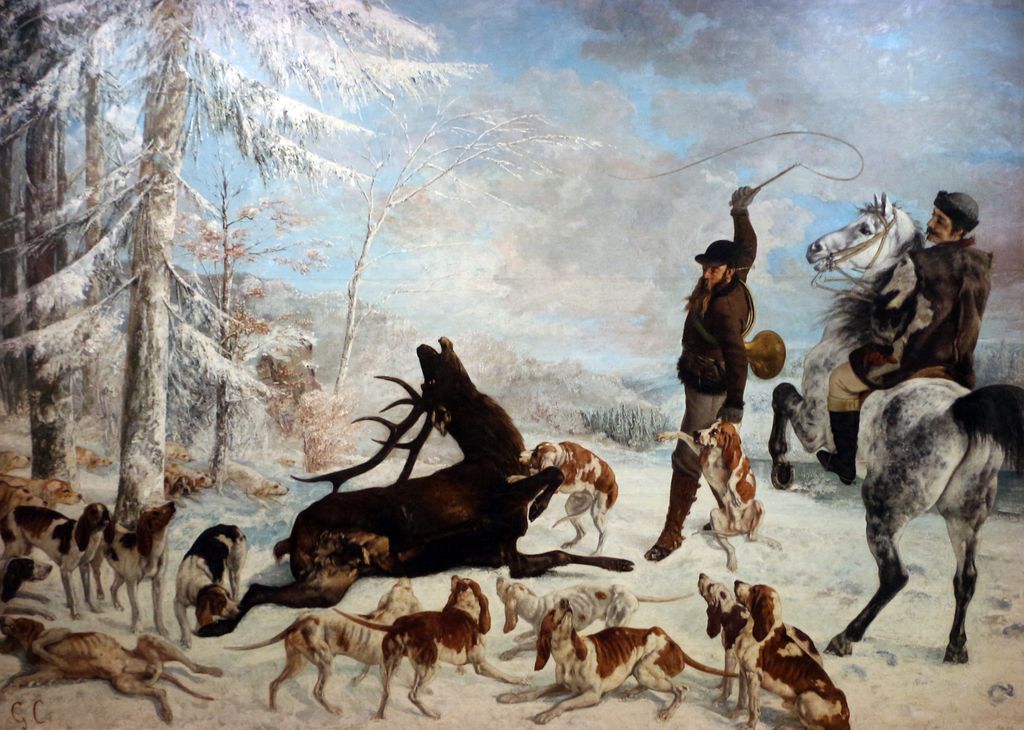
The Death of the Stag by Gustave Courbet, RF 327 Photograph by Sailko. Image source. CC BY 3.0. Cropped to the painted canvas.
 by Tom Gurney
Tom Gurney BSc (Hons) is an art history expert with over 20 years experience
Email: tomgurney1@gmail.com / Phone: +44 7429 011000
Gustave Courbet’s Hunting and Animal Paintings: Introduction
In one of Gustave Courbet’s forests, it takes a moment to find the roe deer. A trunk hides part of a standing animal and the coat of a resting doe comes close to the colour of the bank. In another painting, a stag lies in full view on the snow. Its antlers are raised and hounds approach from both sides. The difference begins with where Courbet puts the viewer. At the stream we stand at a distance and discover the animals as our eyes adjust to the shade. In the snow there is room to follow the pack across a wide stretch of ground, but nearly every movement brings us back to the fallen stag. Courbet could make the same act of looking feel like coming upon an animal or being drawn into its pursuit. [1] [2]
At a Glance
- SubjectsStags, roe deer, foxes and trout
- Works discussedThe Death of the Stag, Fox Caught in a Trap, The Trout
Contents
The hunt reaches the Salon
Courbet exhibited The Quarry at the Paris Salon of 1857 under a title that placed the hunt in the forests of the high Jura. It was among his first public submissions in the genre. The Met’s retrospective describes the hunting pictures as both a critical and a commercial success and connects them with Courbet’s own experience as a hunter. It also identifies the features of the man leaning against the tree in The Quarry as Courbet’s. The likeness gives the painter a place in the scene. His pose is worth a look. With his weight against the trunk, the hunter has time to stand still while the hounds attend to the quarry. What the painting makes public is as much the disposition of the bodies after the chase as the painter’s association with the sport. [3] [4] [5]
The Boston painting presents the aftermath in a tall format. The deer hangs at the left, its body drawn out by its own weight. One dog stands with its nose raised towards it. The man against the tree occupies an upright space near the centre, and a second man, with a horn, sits farther back. That separation makes different kinds of attention visible at once. The hounds register the carcass with their whole bodies. The standing man can lean, the seated man can sound the horn, and both have a place within the scene that extends beyond the deer itself. The title La Curée refers to the portions of the kill given to the hounds and, by extension, to the moment they receive them. The painting holds the participants in the interval around that ritual, when the dogs still have something to wait for. [4] [5] [6]
In the Met’s Hunting Dogs with Dead Hare, dated 1857, the two hounds recur beside a hare on the ground. The museum identifies the dogs as a repetition from The Quarry. Taking away the people changes what the pair can do in the picture. They face one another across the space where the hare lies, and a viewer searching for an explanation has only the animals and the wooded setting to go on. In Boston the hanging deer gives the dogs a reason to look up and the hunter’s body gives their upward movement a visual counterweight. In New York the important interval is low and narrow. It lies between the hounds’ muzzles and the hare. The shift brings the prey nearer to the centre of the viewer’s attention, even though the hare takes up much less room than the suspended deer. [5] [7]
An encounter at the stream
Courbet exhibited Roe Deer at the Stream of Plaisir-Fontaine at the Salon of 1866. The Musée d’Orsay records the painting as RF 583, a canvas just over two metres wide. A deer in the shallow water turns its head back, one leg extended among the stones. To the left, a trunk partly screens another animal and a doe lies close to the ground. Farther across the stream a fourth deer stands in the shadow. Because they are placed at different depths, there is no single outline by which to grasp the group. The distance from the resting doe to the deer across the water gives us a way to judge the breadth of the stream and the shelter of the banks. [1]
The water catches the light in short passages among darker stones, and the tree trunks divide the forest into places that reveal or conceal a body. Following a deer’s legs or ears can take the eye farther into the foliage than it would go if it were reading the landscape alone. The turned head in the stream briefly suggests that something has been noticed. The doe’s resting position keeps that suggestion local. No rush spreads through the group, and Courbet gives each animal enough space to carry on with what it is doing. The stillness comes partly from how much of the action we have to look for, as though the next movement might be small enough to miss. [1]
A roe deer has a different relation to its surroundings in Le Chevreuil chassé aux écoutes, printemps, an oil painting of 1867 that the Orsay records as RF 514. Its title gives the situation away before the viewer sees a pursuer. The roe deer is being hunted and has stopped to listen. Its raised head and upright ears make a pause feel like part of a chase, with whatever comes next still outside the picture. At Plaisir-Fontaine, the deer that turns its head remains one animal among several. In the later picture, the single animal carries the full weight of the pause. A viewer can recognise the readiness in its posture without being told what sound it has heard. [1] [8]
Two five-metre canvases
At the 1861 Salon, Courbet showed Le Rut du printemps. Combat de cerfs, the Orsay painting commonly called Spring Rut or The Battle of the Stags. It measures 355 × 507 centimetres. The fighting animals supply a drama of their own. The antlers converge and the legs brace, letting a viewer follow the pressure from the heads into the ground under their feet. Around the struggle the landscape has room to extend, so the conflict can be seen as a particular event within a much larger place. The metre-wide fox paintings keep a viewer’s attention close to one body. Here there is room for the eye to move out from the combat and return to it across several metres of painted space. [3] [9]
In an 1861 letter to the writer Francis Wey, Courbet said he had gone to Germany to observe such battles. He stressed the force of the blows and the difficulty of seeing the animals’ muscles at work. The letter gives us his account of what he observed and what he thought worth carrying into paint. The Orsay points out that the spring of the title is the wrong season for the rut and identifies the painted setting with Courbet’s familiar Franche-Comté. The title, setting and action are therefore best read as different parts of a composition. An observation about how two bodies bear against one another can survive a move from the place where Courbet said he watched them into a landscape he knew from home. [9]
Courbet expected the battle to have an impact comparable to that of A Burial at Ornans, as the Met notes. The comparison helps explain what is at stake in the size. A painting over five metres wide gives an encounter between animals the physical presence that a Salon visitor might expect from a scene of public or historical consequence. The forest occupies enough of the canvas to remain a place in its own right. The fight draws our attention through that space in much the way the arrangement of the mourners leads us towards the grave in the earlier painting. The moment matters to a viewer partly because of how much there is to see around it. [3] [9] [10]
The 1867 Death of the Stag, or L’Hallali du cerf, is nearly the same size, at 355 × 505 centimetres. The Besançon museum records it as D.882.2.1. In this picture the hunters and dogs supply the pressure. Snow sets apart the dark weight of the stag, and its raised head interrupts the low movement of the pack. To the right a standing man lifts a whip, and the horse and rider draw the eye higher still. Follow the horse’s turn and the eye comes down again towards the animal on the ground. The breadth of the canvas lets the figures occupy very different positions while keeping them all involved in the same instant. The French title names the cry that announces the stag is near its end. The horn at the standing man’s hip recalls the sound, but the raised whip and the stag’s open mouth suggest that it would be one among several. [2] [3] [11]
Courbet put both big stag pictures in his independent exhibition of 1867. The Institut Gustave Courbet identifies L’Hallali as a centrepiece of that show and records its appearance at the official Salon in 1869. At the independent exhibition, a visitor could compare the struggle of two animals in Spring Rut with the many bodies converging on one in L’Hallali. Courbet could take up the same amount of wall and make the space feel open to contest in one painting and close in around the stag in the other. [9] [12]
Étienne Carjat’s 1867 photograph of Courbet beside the canvas shows the stag already clearly formed while much of the scene was still sketched, according to the Petit Palais. The photograph gives us a stage in the painting’s making. It also supplies a human measure of the height that disappears when the picture is reproduced on a page. In the finished work, the animals nearest the stag crowd into a comparatively small area. At gallery scale the interval from that knot of bodies to the mounted figure has enough length to make the converging movements legible. In the combat painting, the surrounding forest gives the two opponents room. In L’Hallali, the surrounding space is where the rest of the hunt is still arriving. [2] [9] [13]
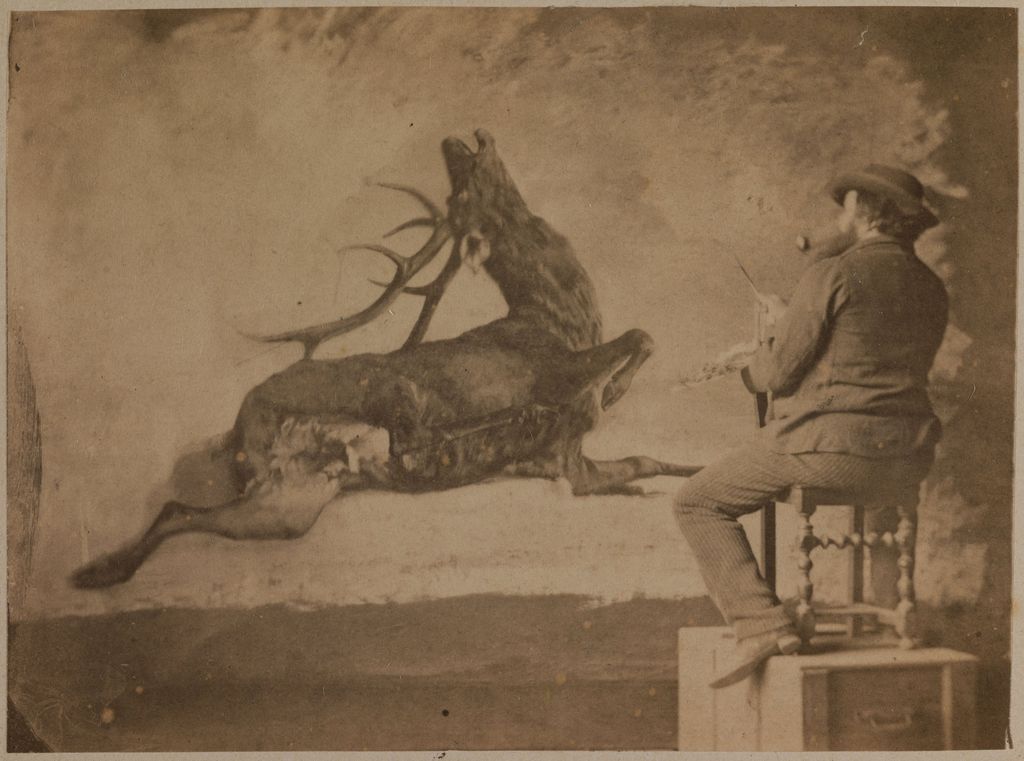
Étienne Carjat, Courbet painting The Death of the Stag, 1867. Paris Musées. Image source. CC0 / Public domain. Resized from the complete source image.
A fox held in place
In Fox Caught in a Trap, the 1860 canvas at the National Museum of Western Art in Tokyo, a single piece of iron explains why the animal stays in the middle of the clearing. The fox twists its head back and reaches a forepaw into the snow. The lifted back is easier to see at first than the device below it, where dark limbs and metal overlap. Tokyo’s record identifies this painting as P.1959-0061, a canvas 81.5 × 100.5 centimetres, and credits Courbet’s use of a palette knife for the snow’s uneven surface. In the gaps between the pale passages, bits of earth and grass help us read the ground as a place a paw can press against. The picture can suggest a considerable effort through the relation between one planted paw and a patch of snow. [14]
The Musée Courbet in Ornans has a separate Le Renard pris au piège, inventory 1990.1.1, dated around 1860 in the French national collections record. In that picture the head is low at the left and the legs are spread, giving the body a longer diagonal across the snow. Tokyo’s fox gathers much of its weight into a high curve over the trap. The Ornans fox seems to have been turned onto its side, making the extension of its limbs and the pale area below them especially apparent. Courbet can give the predicament a different look simply by changing how much of the animal seems able to support itself. The device and pose are visible evidence. The sense of desperation a viewer may find in either comes from how those details work together. [14] [15] [16]
In the Orsay’s 1873 The Trout, RF 1978 15, a fine line leads from the fish’s open mouth into shadow. The fish itself lies on the bank. Its pale flank catches the light against the browns and greens of a bank that fills nearly all the space around it. The Orsay reads the caught fish as a possible image of Courbet’s own circumstances. The painting also repays a look alongside the foxes, where an account of the animal’s predicament comes down to what a few inches of paint make visible. The doe beside the stream can rest on the bank and the deer farther off can leave it. The line and the iron make us look back at the bodies they hold and see how much the animals’ freedom to move has changed. [1] [14] [15] [17]
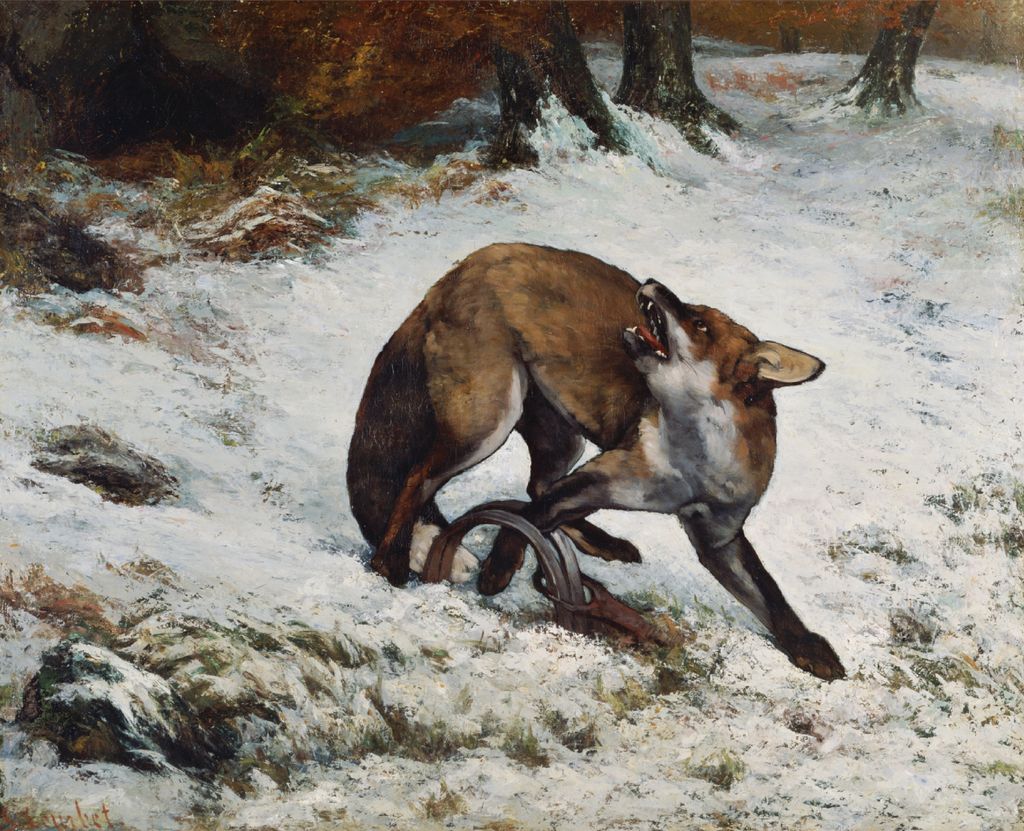
Fox Caught in a Trap, Tokyo P.1959-0061. Image source. Public domain. Resized from the complete source image.
Courbet artworks directory
Browse the paintings covered in this guide. Dates identify the specific versions discussed.
Discussion
Look again at the images and ideas explored in Gustave Courbet’s Hunting and Animal Paintings. These editorial prompts invite your observations.
Reader Insights
How does the scale of a stag hunt change where your eye starts?
Which marks connect an animal to its surroundings?
What changes between the deer beside the stream and the stag surrounded by dogs?
Join the Conversation
Share a detail, comparison or question about Gustave Courbet’s Hunting and Animal Paintings below.
References
- Musée d’Orsay, Gustave Courbet, Remise de chevreuils au ruisseau de Plaisir-Fontaine, 1866, collection record RF 583. View source.
- Musées d’arts & du temps, Besançon, Gustave Courbet, L’Hallali du cerf, 1867, collection record D.882.2.1. View source.
- The Metropolitan Museum of Art, Gustave Courbet, 2008 retrospective, especially “The Painter as Hunter”. View source.
- Musée d’Orsay, Base Salons, Chasse au chevreuil dans les forêts du grand Jura ; la curée, Salon of 1857 catalogue entry. View source.
- Museum of Fine Arts, Boston, Gustave Courbet, The Quarry (La Curée), 18.620, object illustration from Impressions of Light: The French Landscape from Corot to Monet. View source.
- Académie française, Dictionnaire de l’Académie française, sixth edition, 1835, entry for curée. View source.
- The Metropolitan Museum of Art, Gustave Courbet, Hunting Dogs with Dead Hare, 1857. View source.
- Musée d’Orsay, Gustave Courbet, Le Chevreuil chassé aux écoutes, printemps, 1867, collection record RF 514. View source.
- Musée d’Orsay, Gustave Courbet, Le Rut du printemps. Combat de cerfs, 1861, collection record RF 326, including excerpts of Courbet’s letter to Francis Wey. View source.
- Musée d’Orsay, Gustave Courbet, Un enterrement à Ornans, collection record RF 325. View source.
- Académie française, Dictionnaire de l’Académie française, sixth edition, 1835, entry for hallali. View source.
- Institut Gustave Courbet, Les chasses de Monsieur Courbet, Musée Courbet exhibition overview. View source.
- Paris Musées, Petit Palais, Étienne Carjat, Gustave Courbet peignant « L’Hallali du Cerf », 1867, PPPH00701. View source.
- National Museum of Western Art, Tokyo, Gustave Courbet, Fox Caught in a Trap, 1860, collection record P.1959-0061. View source.
- Ministère de la Culture, POP/Joconde, Gustave Courbet, Le renard pris au piège, Musée Courbet inventory 1990.1.1. View source.
- Musée Courbet, La représentation de l’animal chez Courbet, p. 2, reproduction of Le Renard pris au piège. View source.
- Musée d’Orsay, Gustave Courbet, La Truite, 1873, collection record RF 1978 15. View source.