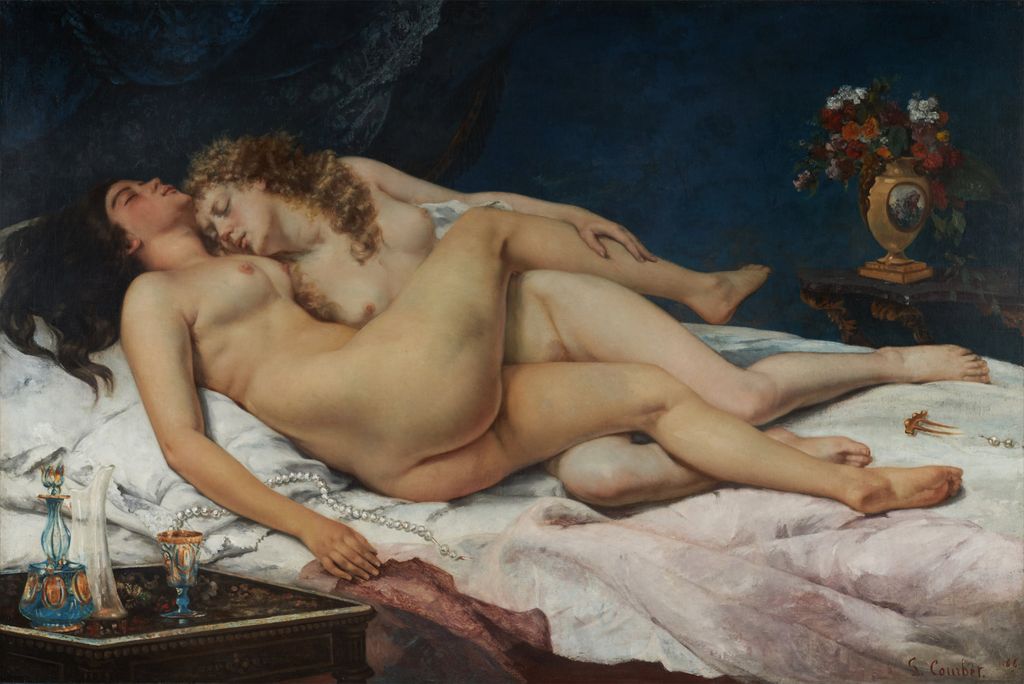
The Sleepers by Gustave Courbet Paris Musées / Petit Palais. Image source. CC0 / Public domain.
 by Tom Gurney
Tom Gurney BSc (Hons) is an art history expert with over 20 years experience
Email: tomgurney1@gmail.com / Phone: +44 7429 011000
Gustave Courbet’s Nudes: Introduction
In 1866 Gustave Courbet painted two pictures of reclining figures on canvases nearly two metres wide. One went to the Paris Salon, where visitors could see a woman stretch an arm towards a parrot. The other was commissioned by the diplomat and collector Khalil-Bey. It shows two women asleep in each other’s arms. At the same date, Courbet painted a closely cropped nude on a canvas only 55 centimetres wide that also went to Khalil-Bey. Its title, The Origin of the World, gives the small picture a scope far beyond the part of the body that fills it. [1] [2] [3] [4]
These pictures ask for different kinds of looking. The parrot supplies a point of interest shared by the woman and the spectator. The sleepers have withdrawn into each other’s company, leaving anyone outside the bed to make sense of the scene through the sheets, the objects and the women’s positions. In The Origin of the World, the composition places the body so close that there is scarcely room for a setting. Scale, the position of a figure and the amount of information around it all help determine what a viewer can see. The Salon jury and the collector had a more literal power over access. [1] [2] [3] [4]
At a Glance
- SettingsSalon exhibitions and private collections
- Works discussedThe Bathers, Woman with a Parrot, The Sleepers, The Origin of the World
Contents
- The Bathers at the Salon of 1853
- A reclining nude the jury accepted
- A private commission on the scale of a Salon painting
- The small picture Khalil-Bey owned
- A woman in the sea and a goddess on it
- Photographs and the painter’s decisions
The Bathers at the Salon of 1853
The first thing to reckon with in The Bathers is the height of the standing woman. Courbet made the canvas 227 centimetres tall. The pale expanse of her back comes forward against the woods while the seated woman occupies the lower part of the scene. The companion has one stocking partly down, and discarded clothing lies nearby. The standing bather lifts one hand and the seated woman turns towards her. It looks as if there might be a conversation under way, but the picture leaves its substance out. The gestures are unusually conspicuous for an encounter with so little explanation. [5] [6]
Bathing had long offered painters a reason to show an unclothed figure in a landscape. In this painting the stocking, the cloth and the uneven ground give bathing the practical character of an activity that requires people to dress and undress somewhere. The contrast between the two figures makes the process particularly apparent. One body is largely exposed and stands with its back to us, while the other woman is still recognisably in the middle of dealing with her clothes. The standing woman’s raised hand pulls attention back into the encounter. A large format that could have made a familiar story easier to read instead gives more weight to a scene that leaves the women’s business between themselves. [5] [6]
When the work appeared in the 1853 Salon, critics turned features of the painting into judgements about the women it depicted. Théophile Gautier’s review, excerpted by the Musée Fabre, asked what justified choosing this kind of body for a picture. His comparison between a cabbage and a rose granted each an equal claim to being real and treated their desirability as subjects as another question altogether. The comparison reveals how much weight he placed on a painter’s choice of what deserved attention. In a letter to his parents that May, Courbet reported adding cloth to the standing figure. The letter establishes a change to the picture before its public reception. The fabric still leaves the back broad and uninterrupted. [5] [6] [7]
The Montpellier collector Alfred Bruyas bought the painting. It appeared at Courbet’s independent exhibition in 1855 and entered the Musée Fabre through Bruyas’s gift of 1868. In 1853, a correspondent had urged him to forgo the purchase, commenting both on the reputation of the canvas and on the difficulty of judging it from a photograph. The letter offers a glimpse of how a painting could be discussed away from the Salon, through a reproduction and other people’s reports. Bruyas’s purchase carried the canvas into a collection concerned with the work of living artists. It also gave the public painting another setting in which its unconventional scale and figures could be seen as reasons to value it. [5] [6] [8]
A reclining nude the jury accepted
The Metropolitan Museum of Art’s retrospective records that a nude Courbet sent to the Salon of 1864 was rejected on grounds of indecency. Woman with a Parrot was shown at the Salon two years later. The woman lies across a sheet, her face tipped back towards the raised hand on which the bird is alighting. Her lifted arm gives the eye a route through the upper part of the composition and back to the face. Where the bathers’ hands suggest a conversation the spectator can only guess at, the woman and the bird give the spectator an exchange to follow. [1] [2]
The pose and carefully modelled flesh draw on ways of painting the reclining nude that a Salon audience would have recognised. Courbet gives that figure loose hair that trails across the bedding and leaves discarded clothes in the scene. The sheets catch the light in different ways from the body. One crease takes a sharp turn while the arm runs up in a long, continuous curve. The bird gathers colour into a small area high in the painting, making the gesture legible even when the whole body is seen at a distance. Looking closer makes the hair and cloth more insistent. They suggest the ordinary circumstances of undressing in a picture with the scale and sweep of a formal nude. [1] [2]
Acceptance brought the painting before a varied public. Some reviewers objected to the pose and hair, and the French state briefly considered buying it. These responses can coexist because admission to the Salon gave the work an audience with several kinds of authority and interest. A juror decided whether it could hang, a reviewer could try to shape its reputation and a prospective buyer had to decide whether to keep it in view. Courbet’s account of his continuing struggle with official taste, quoted by the Met, shows how he understood the moment. It leaves room for the evidence of the painting itself, in which a familiar pose and the details of an occupied room depend on one another. [1] [2]
A private commission on the scale of a Salon painting
Khalil-Bey commissioned The Sleepers in 1866. The Petit Palais records that he had also acquired Ingres’s The Turkish Bath. That purchase places Courbet’s commission in a collection with an established interest in ambitious paintings of the nude. At 135 by 200 centimetres, The Sleepers is slightly larger than Woman with a Parrot. Its scale therefore tells us little by itself about how many people were meant to see it. The Met’s retrospective distinguishes it from the Salon painting by its destination and identifies the commission as a work intended for private viewing. [1] [3] [7]
Courbet arranges the sleepers across a bed that nearly spans the frame. Where the raised arm in Woman with a Parrot lifts attention away from the body, the limbs here bend back into the group. Dark and copper hair help the eye separate the two heads, while the pale linen makes the outlines of the overlapping arms easier to follow. A comb and scattered pearls lie in the bedding. A bedside surface holds vessels, and flowers appear towards the back. Those objects give the room substance and imply movement before the instant the painter has chosen. The women are asleep, but the disordered bed and loosened jewellery leave some of the scene’s action to be reconstructed by a viewer. [1] [3]
The Petit Palais relates the painting to eighteenth-century erotic prints and literature about love between women. A canvas of this size gives two lovers a physical presence that a print held in the hand would give in a different way. It also admits a degree of scrutiny the sleeping women cannot return. The contrast with the Salon picture is especially sharp in the use of accessories. The parrot engages the woman’s attention in a visible action. The pearls are traces of an action already past, and the spectator is free to examine them while the two women remain absorbed in sleep. The Met records that by 1872 the painting figured in Courbet’s police dossier. Its intended privacy and its later visibility to the authorities belong to different moments in its history. [1] [3] [7]
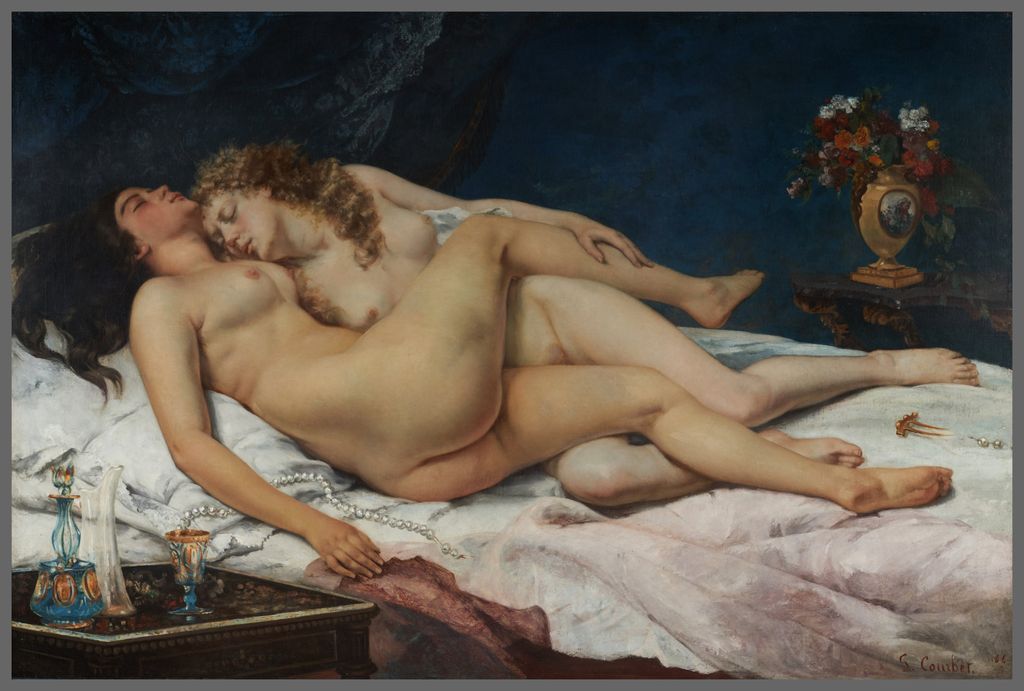
Le Sommeil, Petit Palais PPP3130. Image source. CC0 / Public domain. Resized from the complete source image.
The small picture Khalil-Bey owned
The Origin of the World measures 46.3 by 55.4 centimetres. The Musée d’Orsay identifies Khalil-Bey as its first owner and probable commissioner. It also reports the tradition that he kept the painting behind a curtain and revealed it to selected visitors. Such an arrangement would make the moment of seeing the picture part of the encounter. As the museum presents it, the curtain is a reported practice. The 1866 date, dimensions and first ownership have a firmer place in the object’s record. [4]
Courbet cropped the figure so that there is no face to tell the viewer where the woman is looking or how she is responding. The folds of cloth frame the body rather than laying out a room for it. In The Sleepers, the vessels and comb allow the eye to move between the bed and its surroundings. In this painting attention repeatedly returns from the pale cloth to the skin. Orsay draws a connection between its amber tones and full brushwork and the Venetian painting Courbet admired. That reading gives the colour a history alongside the cropping. The painting brings an unusually direct anatomical view into a tradition of painting flesh through variations of warmth and light. [3] [4]
The work appeared in Courbet Reconsidered at the Brooklyn Museum in 1988–89 and entered the Musée d’Orsay in 1995. It subsequently became a focus of the Fondation Beyeler’s 2014 Courbet exhibition and catalogue. Those later contexts made it possible to compare the small painting publicly with work that Courbet had always expected to be scrutinised in exhibition rooms. The size of the canvas still rewards close viewing. What changed was who could approach it and what other pictures might be available to look at alongside it. [4] [9]
A woman in the sea and a goddess on it
Alexandre Cabanel’s The Birth of Venus was a success at the Salon of 1863, where Napoleon III acquired it. Its canvas is 225 centimetres wide. The goddess lies along the surface of the sea, and the airborne figures above her help establish the mythological setting. The shape of the canvas lets the eye follow the curve of her body along the water before looking up. Here the story and the pictorial format work together to give a nude reclining in an extraordinary place a readily recognisable identity. [10]
The Met’s The Woman in the Waves of 1868 is a vertical canvas a little over 65 centimetres high. Its bather rises amid the water, with arms lifted near her head and much of her body below the surface. The water marks the limit of what is visible. The title gives the figure an ordinary description while the combination of woman and sea is enough to recall Venus. The museum calls attention to Courbet’s inclusion of underarm hair. It is a small mark that the raised arms make plainly visible, in a picture that gives a viewer very little of the body to see. This comparison rests on the pictures and Cabanel’s documented Salon success. The paintings themselves leave open how consciously Courbet had this particular Venus in mind. [10] [11]
The smaller painting also reached viewers through a different exhibition route. The Musée du Luxembourg traces its journey to the Brussels Salon in 1872 and then to the gallery of the dealer Paul Durand-Ruel, whose firm included an etched reproduction in a publication in 1874. The picture could therefore be encountered at a public exhibition and in print. Its comparison with Cabanel rests on a shared pictorial subject. Its documented circulation points to another set of places where a painting of a nude could be seen. [11] [12]
Photographs and the painter’s decisions
Courbet kept photographs of nudes in his studio and used them as studies. Julien Vallou de Villeneuve marketed small paper photographs as artists’ models in the 1850s. The Met points to the close resemblance between the standing woman in The Bathers and a pose in one of Vallou’s photographs, while leaving open which image came first. Its account of Vallou’s work also distinguishes broad similarities across the two artists’ nudes from evidence of a direct match. A photograph could make a pose available for prolonged study. In The Bathers, the relation between the raised hand, the companion’s turn and the expanse of the landscape is something the painting has to make work at its own scale. [2] [7] [13]
A photograph could also be a way of seeing the finished painting at a remove, as the letter warning Bruyas against buying The Bathers illustrates. At each end of the process it changes the distance between an image and its viewer. A small study can put the disposition of a model’s weight within easy reach. A small reproduction can carry a vast Salon canvas to a correspondent while giving only a limited sense of the canvas’s size and effect. The distinction matters for Courbet’s nudes because so many of their differences come from the amount of room allowed to the body and the part of the setting that can be taken in with it. [5] [6] [7] [13]
The two large paintings of 1866 make that difference especially clear. The bird gives people standing before a Salon wall an action to follow across a reclining figure. In the private commission, a bed spanning a slightly wider canvas directs attention inward, towards the sleepers and the small objects around them. The close crop of The Origin of the World achieves an intimacy of distance on a canvas much smaller than either. When those pictures became available to museum audiences, they brought with them the ways of looking built into each composition, even though the conditions that had once governed access had changed. [1] [3] [4]
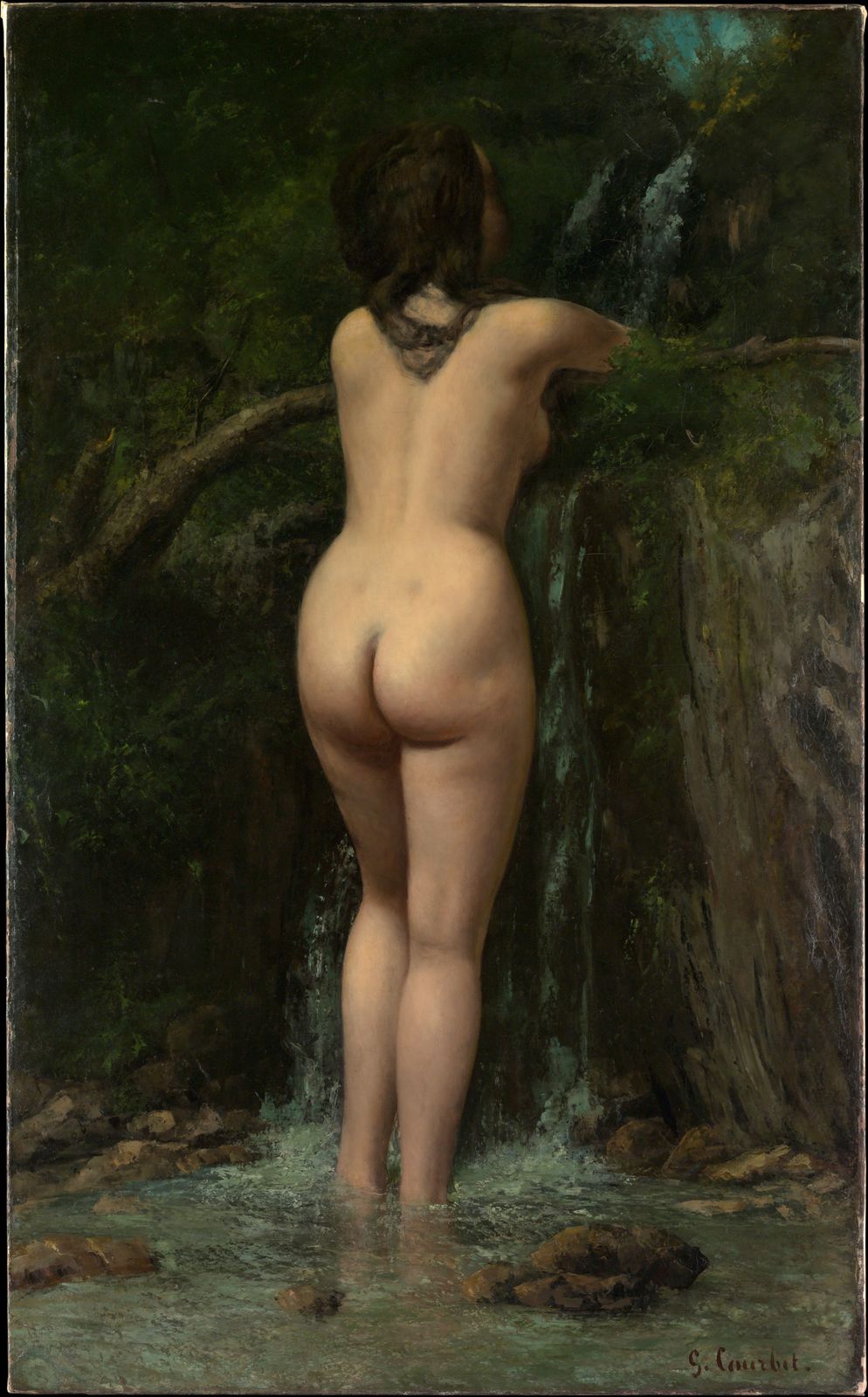
Gustave Courbet, The Source, 1862. The Metropolitan Museum of Art. Image source. CC0 / Public domain. Resized from the complete source image.
Courbet artworks directory
Browse the paintings covered in this guide. Dates identify the specific versions discussed.
Discussion
Look again at the images and ideas explored in Gustave Courbet’s Nudes. These editorial prompts invite your observations.
Reader Insights
How do pose and viewpoint change across the paintings?
What might a private commission allow that an exhibition submission would make difficult?
How do fabrics and landscape affect the way the figures occupy each painting?
Join the Conversation
Share a detail, comparison or question about Gustave Courbet’s Nudes below.
References
- Metropolitan Museum of Art, Woman with a Parrot, 1866, 29.100.57. View source.
- Metropolitan Museum of Art, Gustave Courbet, 2008 retrospective, “The Modern Nude”. View source.
- Paris Musées and Petit Palais, Le Sommeil, 1866, PPP3130. View source.
- Musée d’Orsay, L’Origine du monde, 1866, RF 1995 10. View source.
- Musée Fabre, Les Baigneuses, 1853, 868.1.19. View source.
- Musée Fabre, Les Baigneuses educational dossier, with excerpts from Théophile Gautier and the Courbet and Bruyas correspondence. View source.
- Metropolitan Museum of Art, Gustave Courbet exhibition gallery, entries for The Bathers and Sleep. View source.
- Musée Fabre, La solution d’Alfred Bruyas. View source.
- Fondation Beyeler, Gustave Courbet, 2014 exhibition and catalogue. View source.
- Musée d’Orsay, Alexandre Cabanel, Naissance de Vénus, 1863, RF 273. View source.
- Metropolitan Museum of Art, The Woman in the Waves, 1868, 29.100.62. View source.
- Musée du Luxembourg, Femme à la vague, dealer and exhibition history. View source.
- Metropolitan Museum of Art, Julien Vallou de Villeneuve, Standing Female Nude, ca. 1853, 1993.69.2. View source.