Young Ladies of the Village by Gustave Courbet, The Metropolitan Museum of Art Image source. CC0 / Public domain.
 by Tom Gurney
Tom Gurney BSc (Hons) is an art history expert with over 20 years experience
Email: tomgurney1@gmail.com / Phone: +44 7429 011000
Gustave Courbet and Realism: Introduction
In A Burial at Ornans, a grave opens at the bottom of a canvas almost seven metres wide. The people behind it are recognisable inhabitants of Courbet’s town. A dog stands at the edge of the gathering, and the limestone cliffs run along the horizon behind the mourners. To see the whole company at once, you have to stand back. Step forward and the painting brings you close to individual faces, the red cloth of the church attendants and the earth beside the pit. Courbet made a local funeral occupy the amount of wall a visitor to the Paris Salon might have expected to see given to a national, religious or mythological subject. [1]
That transfer of scale helps explain what made Courbet’s Realism controversial. He asked viewers to spend time with people and places that prestigious public painting seldom treated on such terms. In 1855 he set out his aims in a catalogue preface, saying he wanted to render the customs, ideas and appearance of his own time according to his own judgement. The second part of that proposition matters as much as the first. A town supplied the people and terrain for A Burial at Ornans. Courbet decided where the figures stood, how close the grave came to the edge and how much room the gathering would take up. The picture gives the viewer a particular position within an event that could have been painted in many ways. [1] [2] [3]
At a Glance
- Independent exhibitionPavilion of Realism, Paris, 1855
- ExamplesA Burial at Ornans, Young Ladies of the Village, The Painter’s Studio
Contents
- The scale of ordinary life
- The public dispute over what counted as real
- The 1855 preface and the painter’s studio
- The 1861 letter and a particular place
- Courbet within French Realism
The scale of ordinary life
Courbet had already tested the standing of everyday subjects with After Dinner at Ornans. Four men remain at a table after a meal while one plays the violin. The cloth and the musician catch the light, while much of the room falls back into brown shadow. One man, seen largely from behind, cuts across the table’s near edge. His chair and shoulders block the easy view into the gathering that a more formally arranged group might offer. The violin is enough to explain why the men have stayed at the table. It gives the picture duration without requiring a dramatic incident. The canvas is just under two metres high, and the 1849 Salon awarded Courbet a medal for it. That recognition came from the institution whose conventions he would go on to strain. [1] [4]
At the Salon of 1850–51, A Burial at Ornans gave that approach a public subject. The picture’s extended title described it as a historical painting of human figures at a burial in Ornans. The claim to history was conspicuous. The priest, crucifix and pallbearers establish the ceremony, but the people in the long row keep their own expressions and turn their heads in different directions. Even the open grave sits so low that a viewer standing close can lose sight of much of the ceremony while looking into it. The arrangement gives room for individual attention to wander within a collective act. The Musée d’Orsay records that critics complained of vulgarity and triviality. Their response tells us what was at stake in the assignment of scale. A picture of this size gave townspeople the sustained scrutiny and prominence that established conventions granted to a more restricted set of subjects. [1]
The Stone Breakers, painted in 1849 and shown at the same Salon, gives comparable weight to two men at work. The original was lost during the Second World War, so the composition is known through records and reproductions. One man kneels with a hammer, his face lowered and shaded by his hat. The other carries a load with his back turned. The bank rises behind them, closing off much of the distance, and the two bodies are separated by a space full of the stones on which their work depends. The men’s ages are easier to distinguish than their faces. Those choices let a viewer infer a repeated task from two different movements. The image holds the weight of the load and the poised hammer in the same frame. [5] [6]
Writing privately to Francis and Marie Wey in November 1849, Courbet said he met the workers by the road and asked them to come to his studio. He already understood the difference in their ages as a way to show what a lifetime of such labour could mean. The letter ties his choice of subject to an encounter and places the composition in the studio, where he could decide how the two men’s actions would read together. [7]
In 1865 the political thinker Pierre-Joseph Proudhon read The Stone Breakers as an indictment of a civilisation that still left the poorest people to do its most punishing work. That reading follows from details the picture makes available, including the difference in the men’s ages and the effort written into both poses. It is Proudhon’s published interpretation, made years after the painting, and carries its own argument about what art should do in society. The scene itself gives no account of who employs the workers or of the circumstances that brought them there. Its political force can lie in the attention it demands for work whose social arrangements remain beyond the edge of the canvas. [5] [6] [8]
Young Ladies of the Village, Met 40.175. Image source. CC0 / Public domain. Resized from the complete source image.
The public dispute over what counted as real
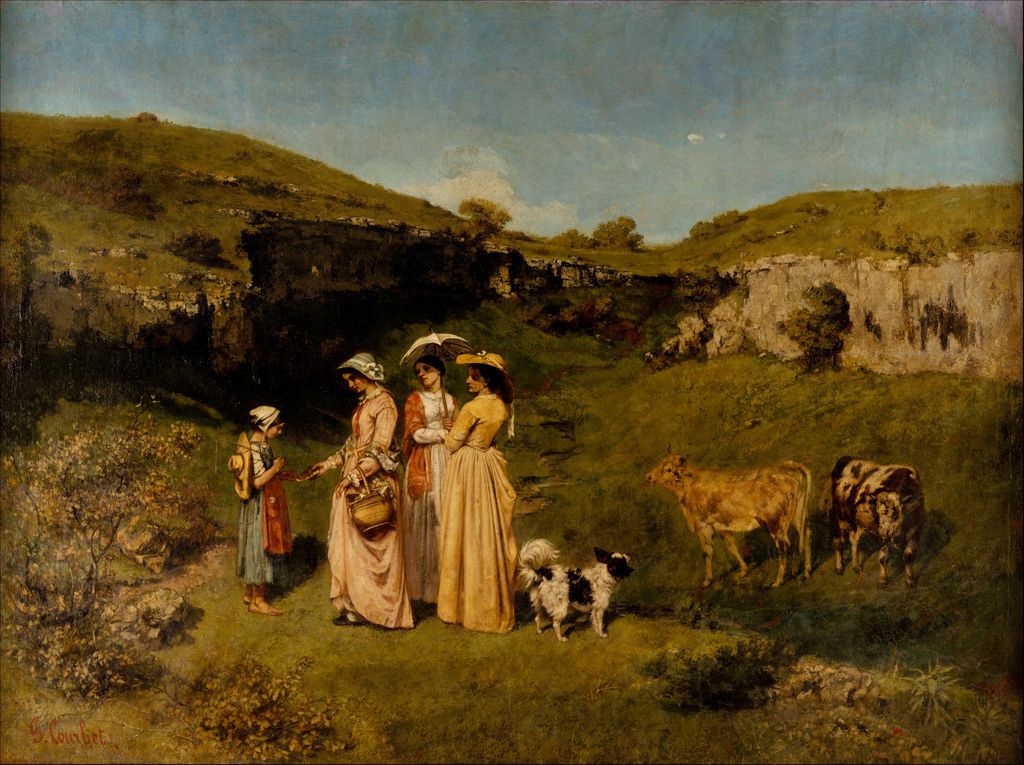
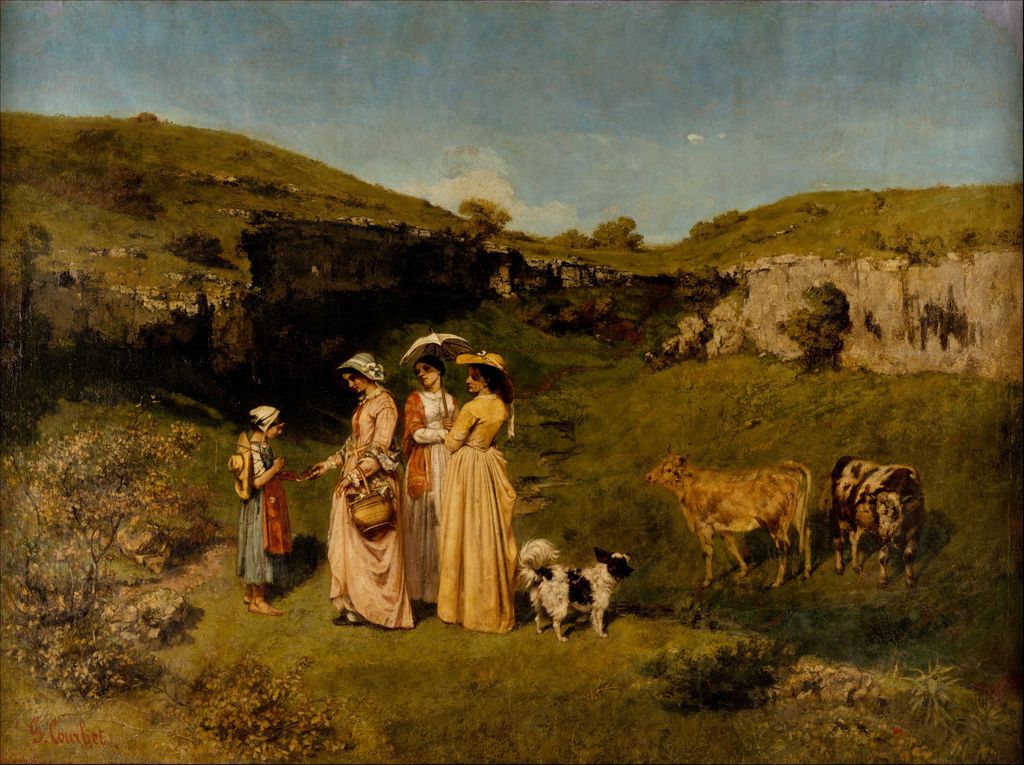
Young Ladies of the Village shows how quickly a dispute over painting could become a dispute over social conduct. Courbet painted his three sisters in a valley near Ornans, with one reaching out to offer alms to a young cowherd. Their dresses and accessories distinguish them from the girl, even as their small group brings them into the same space. At the 1852 Salon, critics objected to the sisters’ looks and dress and to the apparent awkwardness of the dog, the cattle and the perspective. The Metropolitan Museum of Art’s account connects those reactions with expectations about how country women should look and dress. The criticism ranged from how the painter had arranged the scene to how the people in it were thought entitled to present themselves. [9]
The cattle are a particularly useful detail. Their small size struck critics as a fault in the organisation of the picture. An X-ray examination described by the Met’s conservator Charlotte Hale shows that Courbet had made them larger during a revision. The examination establishes the change in size. It leaves the reason and timing of the adjustment open. With the three women commanding so much of the foreground, the relation between people and animals remains slightly unsettling to the eye even in the revised state. There is room to take the landscape seriously as a place Courbet knew and to ask what he did to it in paint. [9]
In 1853 the argument shifted to the nude. In The Bathers, a woman steps out of a pool and raises her hand while a seated companion turns towards her. The wide back of the standing figure is one of the lightest passages in the painting. The seated woman’s loose stocking and the clothes on the bank keep the encounter close to familiar life. Writing about the Salon, Théophile Gautier argued that a cabbage was as real as a rose. His comparison put a precise challenge to Courbet. Both existed, so the decision to paint one of them had to be explained by something beyond fidelity to nature. Courbet’s own letter to his parents reports that he had added a cloth to the standing figure since they last saw the work. Critic and painter had different purposes in writing, but each account directs attention to a deliberate choice about what the public would see. [10]
The Montpellier collector Alfred Bruyas bought The Bathers. His purchase shows that even an emphatically adverse response from a prominent critic could coexist with support for the same canvas. The Musée Fabre traces Bruyas’s interest in contemporary art across a range of painters that also included Delacroix. What a critic judged an improper use of a large canvas could be valuable to a collector who wanted to assemble the work of living artists. In 1855 Courbet gave visitors another occasion to make up their own minds when he included The Bathers in his independent exhibition. [10] [11]
The 1855 preface and the painter’s studio
Courbet put the word Réalisme on his own exhibition at the time of the 1855 Universal Exhibition in Paris. The official jury had declined A Burial at Ornans and The Painter’s Studio. Both appeared in Courbet’s independent pavilion. Other submissions were accepted for the official exhibition, where Alfred Bruyas lent The Meeting. In the pavilion, Courbet could set the terms of the encounter with the two large pictures and present them in the company of work he had chosen. An exhibition catalogue was part of that effort. In its preface he said the name Realist had been imposed on him, comparing it to the name Romantic applied to the generation of 1830. The heading turned a contested public label into the title under which he could explain his practice. [1] [2] [3] [6] [11] [12]
The preface treats knowledge of tradition as a condition of independence. Courbet describes studying old and modern art and says that study enabled him to form a considered sense of his own artistic individuality. His aim was to make art vivant, living art. In the context of the preface, living art meant being able to translate the look and habits of his time into painting according to his own assessment. After Dinner at Ornans gives a concrete example of what such a translation could involve. A painter familiar with the dark interiors and carefully lit figures of earlier art could use those resources to make a musician and a group of listeners from Ornans hold a Salon audience’s attention. The tradition supplied pictorial means, and the choice of occasion gave those means a fresh purpose. [2] [4]
The Painter’s Studio makes the scope of that ambition difficult to reduce to a single rule about subject matter. Courbet depicts himself painting a landscape. A child watches from close by, a nude model stands behind him and a white cat stands near the child’s feet. On either side are groups that differ in dress, pose and their relation to the painter. Recognisable associates and patrons occupy the right, while the identities and functions of several figures on the left remain debated. Courbet’s subtitle calls the picture a real allegory and describes it as marking a phase of seven years in his artistic life. The wording invites the viewer to read some figures as more than portraits, even as the scene keeps drawing the eye back to the materials and people a painter might encounter. [12]
The centre gives the viewer a way into that puzzle. The model is available to be painted, yet the painter’s attention is directed at a landscape. The boy watches the making of a picture rather than the scene that the finished landscape will depict. An onlooker can follow the boy’s gaze and become aware of the distance between the room and the countryside appearing on the easel. The objects and people are credible in themselves, but their assembly makes an argument about who and what enters the painter’s work. The tension in the subtitle belongs to the image, too. Observation supplies the individual terms of a scene that Courbet has put together for the occasion. [12]
The 1861 letter and a particular place
A letter dated 25 December 1861 and published in the Courrier du dimanche sets out a more explicit position on painting and teaching. Young artists had invited Courbet to direct a studio. The Institut Gustave Courbet, which preserves the manuscript, notes that the critic Jules-Antoine Castagnary is generally credited with drafting it and Courbet signed it. The letter therefore records a position Courbet publicly endorsed. It describes painting as a concrete art whose subject is things that actually exist. In its discussion of historical painting, it argues that a period can be represented by artists who have lived in it. The target is a painter’s claim to give a faithful account of another age. [13]
The letter’s discussion of teaching follows from this premise. It offers to share a working method with fellow artists and leaves each of them responsible for developing an individual way of seeing and painting. It also treats beauty as something found in the world by a particular observer, with the capacity to recognise it varying from artist to artist. Read alongside the 1855 preface, the letter helps explain why observation and strong individual decisions could belong together in Courbet’s practice. A common rule for producing a finished picture would have made little sense in a studio where the artist was expected to exercise that judgement. [2] [13]
A useful instance comes from landscape. In 1864 Courbet told the dealer Luquet he had painted four large views of the source of the Loue. The Met considers its Source of the Loue probably one of them. Its grotto fills much of the view, with the pale flow of water picking out the lower edge of the dark opening. A structure beside the water registers human use of the place in a picture otherwise dominated by rock. The letter to Luquet and the Met’s identification give the painting a geographical and commercial setting. The choice to return repeatedly also gives the place pictorial possibilities. The relative size of the dark opening, how much of the outer rock is visible and the amount of attention given to the waterworks could change with each view. A named site could support a series precisely because the painter had these choices to make. [14]
Courbet within French Realism
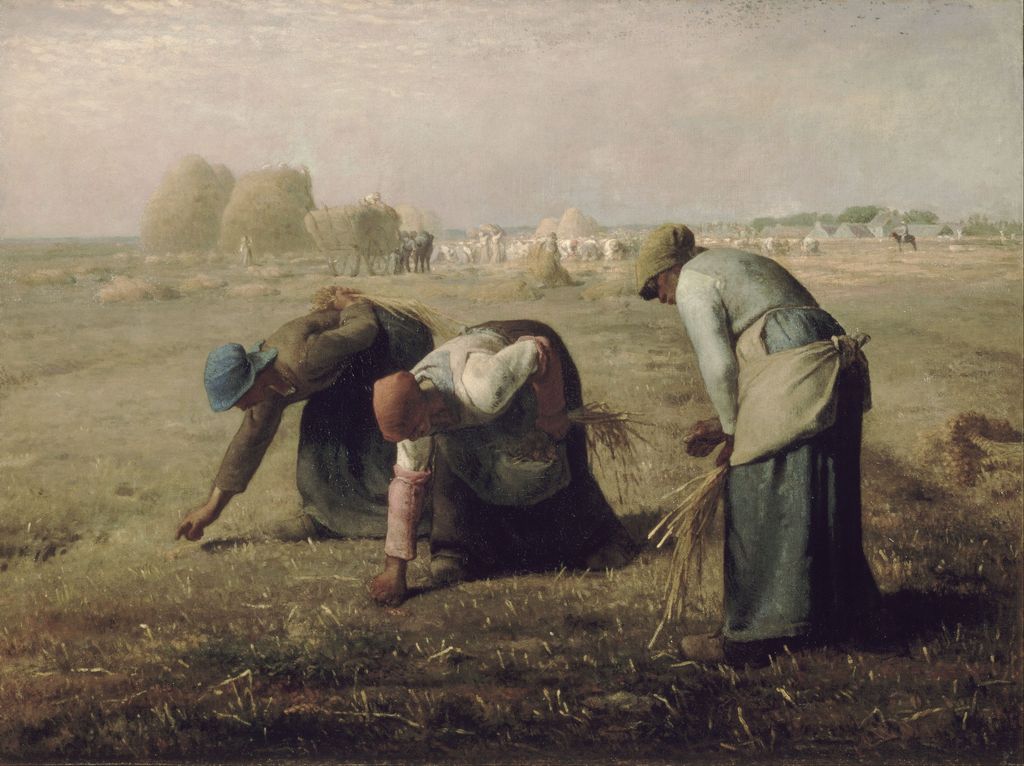
Art historians use French Realism for a broader development than the public position Courbet took in his preface and the letter he signed. The Met’s account places the movement in the political and social changes around the Revolution of 1848 and the Second Empire. It includes Jean-François Millet’s representations of agricultural labour and Honoré Daumier’s attention to city life and modern transport. Millet’s field workers, Daumier’s railway passengers and Courbet’s two men on a roadside all make present-day people the centre of a painting. They distribute attention differently. In Millet’s The Gleaners the repeated action of stooping connects the figures across the field. Daumier’s The Third-Class Carriage makes the closeness of bodies on a railway bench part of the viewer’s experience. Courbet turns the workers away from a face-to-face encounter and gives separate weight to carrying and striking. Those are three uses of pictorial space, each asking viewers to look at familiar activity in a particular way. [5] [6] [15] [16]
The broader label helps trace that change in the standing of contemporary subjects. Courbet’s own pictures also show how much variation a single painter could find within it. The funeral places many people in public view and leaves the grave open before them. In the dinner scene, a few people give their attention to music inside a dark room. At the source of the Loue, human activity appears chiefly through what has been built beside the water. The scale, the interval between figures and the decision to put a working structure at the margin of a landscape are all ways to decide what a viewer gets to see. Courbet’s preface gives those decisions a historical purpose. What his time looked like in paint would depend, in part, on where he asked people to stand and look. [1] [2] [4] [14]
Jean-François Millet, The Gleaners, 1857. Musée d’Orsay. Image source. Public domain. Resized from the complete source image.
Courbet artworks directory
Browse the paintings covered in this guide. Dates identify the specific versions discussed.
Discussion
Look again at the images and ideas explored in Gustave Courbet and Realism. These editorial prompts invite your observations.
Reader Insights
What changes when a provincial funeral is painted on this scale?
Where do you see choices about scale and arrangement in Young Ladies of the Village?
What connects the landscape of the Loue with Courbet’s figure painting?
Join the Conversation
Share a detail, comparison or question about Gustave Courbet and Realism below.
References
- Musée d’Orsay, Gustave Courbet, Un enterrement à Ornans, collection record RF 325. View source.
- Gustave Courbet, 1855 independent exhibition catalogue, preface. Read the transcription in the Musée Fabre’s Le Réalisme dossier. View source.
- Bibliothèque nationale de France, Exhibition et vente de 38 tableaux et 4 dessins de l’œuvre de M. Gustave Courbet, Paris, Morris, 1855, catalogue record FRBNF30279450. View source.
- Palais des Beaux-Arts de Lille, Gustave Courbet, Un après-dîner à Ornans, collection record P 522 and object dossier. View collection record and object dossier. View source 1. View source 2.
- Gemäldegalerie Dresden, Album der Dresdner Galerie. Gemälde des XIX. Jahrhunderts und der Gegenwart, Leipzig, E. A. Seemann, 1920, plate 3 and accompanying entry for Die Steinklopfer. View digitised album. View source.
- Ross Finocchio, The Metropolitan Museum of Art, Nineteenth-Century French Realism, Heilbrunn Timeline of Art History, October 2004. View essay. See also the museum’s 2008 Courbet retrospective and the Dresden collection history in The Splendor of Dresden for the lost original of The Stone Breakers. View source 1. View source 2. View source 3.
- Gustave Courbet, letter to Francis and Marie Wey, 26 November 1849, no. 49-8 in Petra ten-Doesschate Chu, ed. and trans., Letters of Gustave Courbet, University of Chicago Press, 1992, pp. 87–90. View edition. View source.
- Pierre-Joseph Proudhon, Du principe de l’art et de sa destination sociale, Garnier Frères, 1865, chapter XV. Read the chapter. View source.
- The Metropolitan Museum of Art, Gustave Courbet, Young Ladies of the Village, collection record 40.175 and audio transcript with Charlotte Hale and Keith Christiansen. View source.
- Musée Fabre, Les Baigneuses, object dossier, with extracts from Théophile Gautier’s 1853 review and Courbet’s letter to his parents of 13 May 1853. View source.
- Musée Fabre, La « Solution » d’Alfred Bruyas, account of his collecting and relationship with Courbet. View source.
- Musée d’Orsay, Gustave Courbet, L’Atelier du peintre, collection record RF 2257. View source.
- Institut Gustave Courbet, manuscript and transcription of the letter to young artists of Paris, signed by Gustave Courbet and dated 25 December 1861. View source.
- The Metropolitan Museum of Art, Gustave Courbet, The Source of the Loue, collection record 29.100.122, with extract from the 1864 letter to Luquet. View source.
- Musée d’Orsay, Jean-François Millet, Des glaneuses, collection record RF 592. View source.
- The Metropolitan Museum of Art, Honoré Daumier, The Third-Class Carriage, collection record 29.100.129. View source.