 by Tom Gurney
Tom Gurney BSc (Hons) is an art history expert with over 20 years experience
Published on June 19, 2020 / Updated on October 2, 2026
Email: tomgurney1@gmail.com / Phone: +44 7429 011000
Introduction
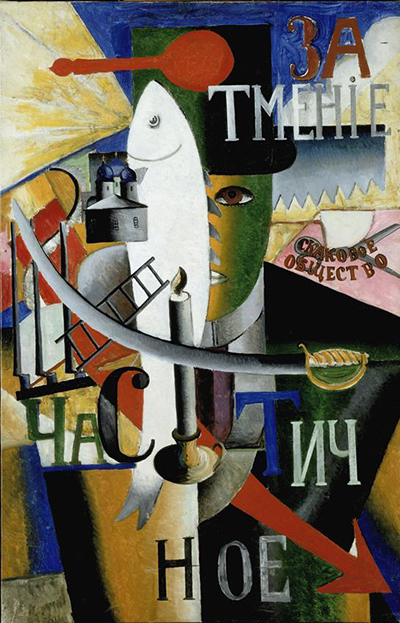
Half a man's face peers from beneath a tall black hat. A large white fish, a small church, a candle, a red spoon, a curving blade, a ladder and interrupted Cyrillic words crowd the same narrow canvas. Kazimir Malevich called the painting An Englishman in Moscow; its Stedelijk Museum title is Een Engelsman in Moskou. Made in 1914, it is an example of the artist's alogical work, in which recognizable things are placed together without a conventional scene to explain their scale or relationship. The canvas is in the Stedelijk Museum Amsterdam, catalogued as A 7656. [1], [2], [3]
A 2017 discovery makes the painting particularly rewarding to study. During an inventory of the Khardzhiev Collection, the Stedelijk found a small 1914 drawing that it explicitly identifies as a sketch for this painting. The museum notes that “partial eclipse” appears in both drawing and canvas. That is firmer evidence for a compositional link than a loose claim that the painted objects merely look like a dream. It does not, however, reveal the identity of a real English visitor or turn every fish, spoon and letter into a documented symbol. [2]
At a Glance
- ArtistKazimir Malevich (1879–1935)
- English titleAn Englishman in Moscow
- Stedelijk titleEen Engelsman in Moskou
- Date1914
- MediumOil on canvas
- Published painted dimensions88 × 57 cm; see measurement note below
- CollectionStedelijk Museum Amsterdam; object A 7656
- PeriodAlogical painting, before the 1915 public presentation of Suprematism
- Related drawing1914 sketch on squared paper, 14 × 10 cm, identified by the Stedelijk in 2017
- Image hereSharper 2016 revision of the exact-work Commons reproduction, full canvas, public-domain marked
Contents
- What is actually in the picture?
- What do the words say, and what do they mean?
- The 2017 drawing discovery
- Who is the Englishman?
- From alogical images to nonobjective painting
- Object, measurements and image record
Where this work sits in Malevich’s career
The Knife Grinder
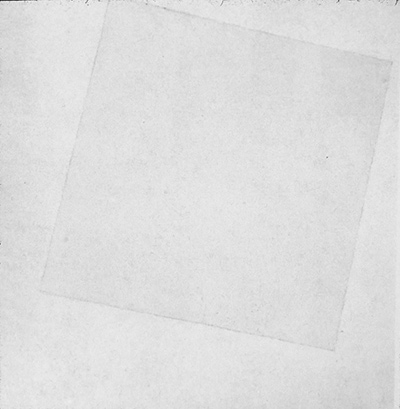
1912–13White on White
1918Sportsmen (Russian Museum canvas)
1928–1932Girl with a Comb in Her Hair
1932–33Girl with a Red Staff
1932–33Watch: Kazimir Malevich
Three short films place Black Square, the 1915 exhibition and Malevich’s later work in context.
Kazimir Malevich | TateShots
A curator introduces Black Square, the 0.10 exhibition and Malevich’s later work.
Watch on YouTubeWhat is actually in the picture?
The painting's format is tall and narrow, an important part of its visual pressure. There is little quiet background. Objects, letters and colour blocks meet the sides of the canvas, and the giant fish stretches alongside the barely visible figure. One eye looks out from the centre-right, under a large black top hat. The man's face is divided into green and yellow zones and partly hidden behind the fish. The title promises a person in a city, but the person is almost swallowed by the other parts of the image. The Stedelijk's visitor guide describes the Englishman as barely recognizable and offers that as a deliberate aspect of the work. [1], [3], [4]
The white fish is one of the largest shapes. It rises through the upper-left middle with a small eye and curved mouth, a rather legible creature in a field of stranger overlaps. Nearby, a miniature church with dark domes occupies only a small patch of the canvas. The fish is enormously larger than the church. Neither object is scaled according to a consistent viewpoint, and no river or town square unites them. The contrast is a concise example of what “alogical” means here: both things can be identified, but their combined pictorial logic is unstable. [2], [3], [5]
A red spoon-like shape sits near the top. A broad curved blade crosses the painting lower down, passing in front of fish, figure and other forms. The blade's pale arc cuts a route across the vertical composition. A candle rises near the centre-left, its small flame surrounded by other signs of light, dark and interruption. A ladder tilts behind the blade. At the lower right a red arrow runs toward the edge. Each object seems deliberately particular, but their sizes and contact points prevent the eye from reading them as ordinary possessions of one traveller. [3], [5]
The colours matter as much as the inventory of objects. Deep blue runs across the upper field, black contains portions of the hat and lower area, and green divides the face and background. Red repeats in the spoon and diagonal arrow; yellow appears in a large fan-like shape at upper left and in fields near the lower edge. The crisp white fish stands out against those dark colours. Instead of the many shaded cones in The Knife Grinder, the picture relies heavily on adjacent flat areas and abrupt changes of scale. The visible brushwork in the reproduction cautions against describing these areas as digitally uniform. [3], [6]
The eye moves in several competing directions. Follow the fish upward and you encounter the spoon and separated letters. Follow the sabre-like curve from left to right and it crosses the nearly hidden face. Follow the red arrow and you are pulled away from the vertical figure toward the canvas's lower edge. The work thus organizes attention through collisions. Its oddity comes from how clearly some fragments are painted and how little they clarify one another. That reading is grounded in the reproduced image; it is not a recovered script for a story Malevich meant everyone to tell in the same way. [3], [4]
What do the words say, and what do they mean?
Letters and partial words cross the painted forms. The most securely documented phrase is “partial eclipse”: the Stedelijk identifies it in both this painting and the preparatory drawing found in 2017. Cyrillic letters do not sit on a neutral caption strip; they float among fish, face, blade and colour. Some are split by the composition, so they act at once as language and as large graphic shapes. A reader can register the phrase without claiming that the rest of the painting has a single grammatical sentence behind it. [2], [3]
The idea of an eclipse has an obvious visual attraction in a picture that hides part of a man's face and places light, dark and overlapping shapes across one another. The Stedelijk's 2017 account goes further: it interprets the motif within Malevich's wish to eclipse traditional aesthetics and treats the painting as a step toward his later nonrepresentational language. That is the museum's historical reading, not proof that a particular black area in this canvas is already the 1915 Black Square in disguise. The date, object and style remain distinct. [2], [7]
Another group of letters has been read as “racing society,” and the longer painting contains scattered Cyrillic fragments beyond the eclipse wording. Their presence evokes public notices, labels or the texture of urban language, but a precise real-life organization or event has not been established in the sources checked here. The Stedelijk's more recent visitor guide makes the uncertainty plain: it points to letters and numbers as if they were a secret message, then says no one knows exactly what they mean. A responsible interpretation can translate a documented phrase and describe its visual role while leaving the larger “message” open. [3], [4], [5]
Alogical painting relates to the wider Russian avant-garde interest in zaum, often described as language beyond ordinary reason. Malevich and his poet collaborators were interested in breaking customary connections among words, things and pictures. The Malevich Society describes this painting as a combination of recognizable objects in illogical relation and connects the lettering to zaum. That context explains why a viewer may not find a stable story even after naming every object. It does not entitle us to invent a precise dialogue spoken by the Englishman. [5]
The 2017 drawing discovery
The Stedelijk's discovery gives a rare view into the painting's making. While examining Nikolai Khardzhiev's library, former Head of Collections Geurt Imanse found a 14 × 10 centimetre Malevich drawing tucked among the pages of a monograph Khardzhiev had written on Pavel Fedotov. The museum dates the drawing to 1914 and describes it as a sketch for An Englishman in Moscow. Both the drawing and painting contain the phrase “partial eclipse.” This is an object-specific link published by the holding museum, stronger than a comparison based on resemblance alone. [2]
The drawing was on squared paper, a concrete detail that makes the find particularly interesting. A grid may help an artist place forms, but the announcement does not say exactly how Malevich transferred its contents to the canvas, or whether the drawing is the first or final plan. “Preparatory sketch” is the museum's identification of the relationship; it should not be enlarged into a complete account of every compositional decision. The painting can be closely related to a sketch and still change in colour, scale and emphasis as it is made. [2]
The find occurred during study of the Khardzhiev Collection, a group of Russian avant-garde works and historical materials entrusted to the Stedelijk's care. The library setting is important: the drawing was not newly excavated from the back of the painted canvas. It had survived within a book and became known through inventory research. The Stedelijk's 2017 notice reports that it would display the drawing with the painting at the time. That is a historical exhibition fact, not a promise that the two objects are still hanging together now. [2]
The painting's status and the drawing's status should also be kept separate. The painted An Englishman in Moscow is Stedelijk object A 7656. The drawing belongs to the Khardzhiev-related research story and has its own identity. A visitor looking at a reproduction of one should not assume it is a detail cut from the other. The page uses the painting's exact-work reproduction as its main image and cites the museum's research announcement for the drawing rather than silently substituting a drawing image. [1], [2], [3]
Who is the Englishman?
The title names an Englishman, but the painting gives only a partial face under a top hat. It supplies no verified name, date of travel or documented sitter in the sources used here. The man can be discussed as a figure of encounter, a visitor in an unfamiliar city, or a visual anchor for contradictory objects, but those are possible readings rather than an identified biography. The Stedelijk's visitor guide likewise treats the figure as scarcely recognizable, focusing on the painting's departure from ordinary depiction. [1], [4]
The fish and little church have sometimes encouraged stories about East and West, religion, commerce or a tourist's bewilderment. These interpretations are worth considering as interpretations; the image does not automatically certify any one of them. The small church placed against a huge fish is one juxtaposition the Malevich Society singles out as alogical. That observation works without requiring the church to name a specific building or the fish to stand for a unique nationality. [3], [5]
The red spoon has a more grounded context. The Malevich Society notes that Malevich used a red wooden spoon as a public Futurist emblem in 1914 and points to its appearance in this painting. That makes the painted spoon more than an arbitrary red silhouette. It still does not prove that the Englishman carries the spoon in a literal Moscow scene, nor that every other object has a comparable one-to-one reference to a documented event. [5]
From alogical images to nonobjective painting
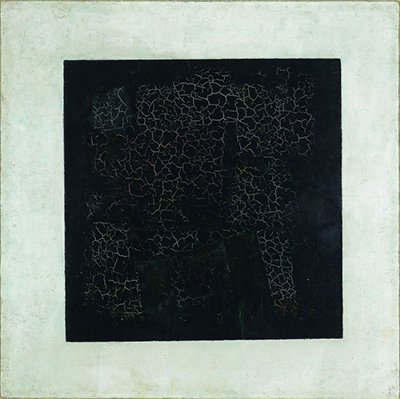
The 1914 work sits between Malevich's earlier densely fragmented figures and his later nonobjective Suprematism. In Woman with Pails: Dynamic Arrangement, a human activity is difficult but still possible to assemble from repeated forms. In An Englishman in Moscow, recognizable pieces are easier to name individually, yet their relationships resist ordinary scene-making. In 1915 Black Square, a still more radical picture refuses such named objects altogether. This sequence is a useful comparison across distinct works, not a claim that the artist followed a single inevitable path with no reversals or parallel experiments. [2], [3], [6], [7]
Reservist of the First Division offers another 1914 comparison. There too Malevich brings words and fragments into a composition that does not behave like a traditional portrait. But the MoMA reservist is a separate mixed-media work with its own object history. Comparing the two can clarify how text and recognizable signs disrupted picture-making in this period while preserving the very different visual arrangements of each canvas. [3], [8]
The Stedelijk describes its painting as a first step toward the new nonrepresentational style, and its 2017 “partial eclipse” interpretation makes the relation to Black Square vivid. The wording “first step” should be read as a curatorial interpretation of development, not as a technical fact that the 1914 canvas was originally planned to become a square painting. The Englishman, fish, church, spoon and candle all remain visibly present. That continued attachment to objects is exactly what makes the later removal of them so consequential. [2], [3], [7]
The contrast also helps answer why the painting is so crowded. Its density gives recognizable things enough presence to collide. If the fish, face or words were stripped out, its alogical force would diminish. By 1915 Malevich found ways to make a picture tense with very few forms. Here the tension comes from an excess of possible associations and from the refusal to join them into a settled plot. Both strategies test what a painting can do beyond illustration, but they do so with different materials of meaning. [2], [3], [7]
Object, measurements and image record
The Stedelijk Museum Amsterdam owns the painting under object number A 7656. The commonly published painted dimensions are 88 × 57 centimetres. A later database-derived listing gives 90.5 × 59 × 3.5 centimetres, apparently measuring a physical object with depth, but the accessible record does not explain precisely how these figures were taken. The page therefore uses the familiar 88 × 57 image-area measurement in its main identification and records the alternative rather than falsely harmonizing them. Readers needing an exact current conservation measurement should consult the Stedelijk's own object record. [1], [3], [9]
The main image comes from a Commons file identified as this exact Stedelijk work. Its 2017 current revision is 546 × 850 pixels, while a 2016 historical revision is 1,000 × 1,541 pixels and visibly preserves sharper detail. The page uses that earlier full-canvas revision, resized down to 665 × 1,024 pixels. It has not been enlarged, cropped to an isolated symbol or digitally recoloured. Commons marks the faithful two-dimensional reproduction as public domain, which is a Commons status statement rather than a separate Stedelijk licence. The image ledger records the source, dimensions and changes. [3]
A 2018 photograph of the painting displayed at the museum exists on Commons under a different licence, CC BY-SA 4.0. It is useful evidence that a visitor photographed the work at a particular moment, but it is a separate photographic asset with its own credit terms and potential perspective effects. The page does not swap it in for the selected faithful reproduction or imply that a historic installation photograph shows the current gallery. The museum's own visitor guide is dated; check the live collection record before a visit. [3], [4], [10]
Documented Malevich collection records
Explore 665 catalogued source objects from museums and archives, including 87 exact links to local artwork pages. Records include works, print impressions, book components and archival items; they are not a deduplicated or complete oeuvre. Medium labels are grouped into broad English categories. Titles link to local artwork pages where available.
| Artwork title | Date | Medium |
|---|---|---|
| "Front line soldier" (Ratnik 1-go razriada) | Δεκαετία 1920 | Photograph |
| [Le Cheval blanc] | [circa 1930 - 1931] | Painting |
| [Sensation du danger] | [1930 - 1931] | Painting |
| A Game in Hell, Petrograd, 1913 (2nd expanded edition) | 1913 | Book |
| A Game in Hell: A Poem (Igra v adu: Poema) | 1914 | Book |
| A Peasant Woman Goes for Water | 1913 | |
| A pork-butcher came around to Lodz and we said "Good day." From Lodz to neighboring Radom he passed, and left behind one sorry ass. (Podoshel kolbasnik k Lodzi / my skazali : 'Pan dobrodzi!' Nu, a s Lodz'iu riadom Radom / i ushel s podbitym zadom.) | c. 1914 | |
| Alogisme 1. Portret Moskovskoy Damy (Alogisme 1. Portret van een Moskouse dame) | 1914 | Drawing |
| Alogisme 2. Vis, zaag, lepel, telegraafpaal | 1914 | Drawing |
| Alogisme 22. Malorossiyanin (Alogisme 22. Een kleine Rus) | 1915 | Drawing |
| Alogisme 23. Sobol, koshka (Alogisme 23. Sabel, kat) | 1915 | Drawing |
| Alogisme 29. Derevnya | 1915 | Drawing |
| Alogisme 3. Chastichnoe zatmenie (Alogisme 3. Gedeeltelijke eclips) | 1914 | Drawing |
| Alogisme 4. Apteka (Alogisme 4. Apotheek) | 1914 | Drawing |
| Alpha | 1923 / 1978 | Sculpture or object |
| An Austrian was going to Radzivily | 1914 | |
| An Austrian was going to Radzivily | 1914 | |
| Analytical Chart | 1924–27 | Drawing |
| Analytical Chart | 1924–27 | Drawing |
| Analytical Chart | 1924–27 | Drawing |
| Analytical Chart | 1924–27 | Drawing |
| Analytical Chart | 1924–27 | Drawing |
| Announcement for Malevich's lecture in Orenburg | 1917-1920 | |
| Apple Tree in Blossom | c. 1930 | Painting |
| Architecton Alpha | 1920 | Sculpture or object |
| Architecton Gota | 1923 (?) | Sculpture or object |
| Architectonische constructie | 1917 (versie ca. 1925) | Drawing |
| Architectons and Figurines | Späte 1920er Jahre | Sculpture or object |
| Architecturaal-kosmische compositie | 1920 (latere versie (1927?)) | Drawing |
| Architectural construction | ca. 1917 | Drawing |
| Aritmetica | 1913 | Drawing |
| Aritmetica | 1913 | Drawing |
| Arkhitekton Zeta | 1926 | Photograph |
| At Harvesting (Marfa and Vanka) | 1928-1929 | Painting |
| Aveniriens | vers 1931 - 1932 | Drawing |
| Aviator | 1914 | Painting |
| Aviator v Pobede nad solntsem (Vliegenier in Overwinning op de zon) | 1913 (versie ca. 1929) | Drawing |
| Baadsters op de rug gezien | 1910 | Painting |
| Back cover from Igra v adu (A Game in Hell) | 1913–14, published 1914 | Book |
| Back cover from Vzorval' (Explodity) | 1913 | Book |
| Bader | 1911 | Drawing |
| Betende Bäuerin | 1933 | Drawing |
| Biddende figuur | motief ca 1922, versie voor 1927 | Drawing |
| Birkenhain | um 1905 - 06 | Painting |
| Black Circle | c. 1923 | Painting |
| Black Cross | c. 1923 | Painting |
| Black quadrilateral | 1915 | Painting |
| Black Square | c. 1923 | Painting |
| Black Square and Circle | 1920-1921 | Drawing |
| Black Square and White Cylindrical Form | 1915 | Drawing |
| Black Square, Second State | 1915/20 | Drawing |
| Blacksmith | Study. 1933 | Painting |
| Blestifze (Pencils) | 1917–1918 | Drawing |
| Boer met baard | ca 1930 | Drawing |
| Boerenvrouw in het veld | ca. 1929-1930 | Drawing |
| Boerenvrouw met emmers | 1912 | Painting |
| Book of Selected Poems (Kniga izbrannykh Stikhotvorenii) | 1930 | Book |
| Boy (Vanka) | 1928–1929 | Painting |
| Boy wuth knapsack / Mal'chyk s rantsem | 1915 | |
| Brooch | 1920 | Sculpture or object |
| Brooch | 1920 | Sculpture or object |
| Bubnovy Valet 21. Boerenvrouw met kind | 1911-1912 (latere versie) | Drawing |
| Bubnovy Valet 40. Portret (van M.F. Larionov?) | 1910 | Drawing |
| Bubnovy Valet 41. Na uglu stoit apteka, lyubov sushit tseloveka (De drogist is op de hoek, van liefde droogt een man uit) | 1910-1911 (versie ca. 1930) | Drawing |
| Bubnovy Valet 42. Portret moei rodstvennitsy (Bubnovy Valet 42. Portret van mijn familielid) | 1911 | Drawing |
| Bubnovy Valet 43. Kop van een boer | 1912 (latere versie) | Drawing |
| Bubnovy Valet 44. Dansend paar | 1912 | Drawing |
| Bubnovy Valet 57. Lopende man | 1911 | Drawing |
| Bubnovy valet 8. Kop van een boer | 1912 | Drawing |
| Budetliyansky silach (Futuristische sterke man) | 1913 (versie 1915) | Drawing |
| Bêta | avant 1926 / 1978 | Sculpture or object |
| Car and Lady | Photograph | |
| Carpenter | 1928–1929 | Painting |
| Carré noir | [1923 - 1930] | Sculpture or object |
| Chelovek v ochkakh (Man met bril) | ca 1929 | Drawing |
| Compositie 1 z (Supremus nr. 67) | 1916 (versie jaren 1920) | Drawing |
| Compositie 10 t (Suprematisme: constructief moment) | 1917 | Drawing |
| Compositie 11 t (Supremus nr.18: constructievorming afhankelijk van de beweging naar een bol ) | 1916 | Drawing |
| Compositie 13 t (Supremus nr 38) | 1915-1916 | Drawing |
| Compositie 13 t (Supremus nr 38) | 1915-1916 (gedrukt 1920, annotaties jaren 1920) | |
| Compositie 14 t Oshchushchenie elektrichestva (Compositie 14 t Gevoel van electriciteit) | 1915 | Drawing |
| Compositie 15 k (Suprematisme) | 1916 (versie begin jaren 1920) | Drawing |
| Compositie 15 q (Supremus nr. 118) | 1918 | Drawing |
| Compositie 16 t (Suprematisme: groot zwart trapezium en vierkant tussen rechthoeken en lijnen) | 1915 | Drawing |
| Compositie 2 i (Suprematisme: gecombineerd gevoel: cirkel en vierkant) | 1916 (latere versie) | Drawing |
| Compositie 2 t (Verlengd vierkant met elementen overdwars) | 1915 (versie ca. 1920) | Drawing |
| Compositie 2 z Obshchushchenie magnita (Compositie 2 z Gevoel van een magneet) | 1916 (hernomen in 1919, versie jaren 1920) | Drawing |
| Compositie 3 t | 1916 | Drawing |
| Compositie 4 l Suprematisme van de geest | 1919 | Drawing |
| Compositie 4 t (Suprematisme: cirkel tussen rechthoeken en driehoeken) | 1916 | Drawing |
| Compositie 4 z (Supremus nr. 84) | 1916 (latere versie) | Drawing |
| Compositie 5 l Suprematisme van de geest | 1919 | Drawing |
| Compositie 6 d (Tekening verwant aan ‘Huis in aanbouw’) | 1915 | Drawing |
| Compositie 6 t Obshchushchenie vremeni (Compositie 6 t Gevoel van tijd) | 1916 | Drawing |
| Compositie 9 b. Fevralizm kak emotionizm (Compositie 9 b. Februarisme als emotionisme) | 1915 | Drawing |
| Compositie 9 h (Suprematisme: kruis en drie rechthoeken) | 1916 (versie 1920) | Drawing |
| Compositie 9 k (Suprematisme: zeven rechthoeken) | 1915 | Drawing |
| Compositie 9 t (Suprematisme: vier ruimtelijke elementen tegen een zwart trapezium) | 1915 | Drawing |
| Composition 1 e (Suprematisme: vierkant op diagonaal vlak) | 1915 | Drawing |
| Composition 1 t | [1916 / vers 1920] | Drawing |
| Composition 14 f | [1918] | Drawing |
| Composition 15 t | 1916 | Drawing |
| Composition 2 a | [1917 - 1918] | Drawing |
| Composition 3 z | [1919 / avant 1930] | Drawing |
| Composition 5 x | [été 1915] | Drawing |
| Composition 5 x | [été 1915] | Drawing |
| Composition alogique | [1915] | Drawing |
| Composition with La Gioconda (Partial Eclipse) | 1914 | Painting |
| Compositions 11 R | circa 1915–16 | Drawing |
| Construction 5 h | 1916 | Drawing |
| Costume study for the Budetlyan Athlete in Victory over the Sun | 1913 | Drawing |
| Cow and Violin | 1913 | Painting |
| Cow and Violin from On New Systems in Art (O Novykh Sistemakh Visk Usstve) | 1911–19 | |
| Croix [noire] | [1915] | Painting |
| Croix noire | [vers 1923 - 1926] | Sculpture or object |
| Dame | 1915 | Drawing |
| Dame an der Straßenbahnhaltestelle | 1913 | Drawing |
| Dame bij reclamezuil | 1914 | Painting |
| De gardist | 1913-1914 | Other |
| De houthakker (recto) / Boerenvrouwen in kerk (verso) | 1912 | Painting |
| De likdoornsnijder | 1911 | Drawing |
| De likdoornsnijder | 1911 | Drawing |
| De provincie | 1910 | Painting |
| De tuinman | 1911 | Painting |
| De vloerboeners | 1911 | Drawing |
| Der Häftling | 1930 | Drawing |
| Der Tod eines Menschen, gleichzeitig im Flugzeug und der Eisenbahn | um 1913 | |
| Desk and Room (legacy site: Bureau and Room) | 1913 | Painting |
| Dessin de Lissitzky d'après "Supremus n° 58, composition dynamique jaune et noire", 1916, de Malevitch | [1924] | Drawing |
| Deux plans de villes | [1916 / avant 1930] | Drawing |
| Deux plans en extension | [1916 - 1919] | Drawing |
| Diagramm | around 1917/1918 | Drawing |
| Die Hochzeit | 1903 | Other |
| Die Waschfrau | 1911 | Painting |
| Dorp | ca. 1906 | Other |
| Dorpje | 1908 | Drawing |
| Drei Köpfe | after 1930 | Drawing |
| Drie boerenvrouwen | 1917-1919 of eind jaren 1920 | Drawing |
| Drie figuren in een landschap | ca. 1928-1930 | Drawing |
| Drie naakte vrouwen en een kind, peren plukkend | 1909 | Drawing |
| Drie staande vrouwen | 1930 | Drawing |
| Drie vrouwenfiguren | ca 1905-1906 | Drawing |
| Druckstock für Holzschnitt | 1920 | |
| Dynamic Construction | 1923 | Photograph |
| Dynamic Figure from On New Systems in Art (O Novykh Sistemakh V Iskusstve) | 1911 | |
| Dynamic Suprematism | 1915/16 | Painting |
| Dynamisch suprematisme | 1917-1918 | Drawing |
| Een Engelsman in Moskou | 1914 | Painting |
| Een paar onder bomen | ca 1929 | Drawing |
| Elegant gezelschap in een park | ca 1908 | Drawing |
| Elementarer Suprematismus | 1917 | Drawing |
| Eléments d'architectone | [après 1924] | Drawing |
| Eléments non identifiés | [1923 - 1935] | Sculpture or object |
| Engelsman in Moskou | 1913-1914 | Drawing |
| Entwurf für das Gemälde 'Die roten Häuser' | 1910 | Drawing |
| Entwurf für die Bemalung der Pfeiler aus der Serie von Entwürfen für die Ausgestaltung des Roten Theaters in Leningrad | 1931 | Drawing |
| Entwurf für eine Deckenmalerei im Roten Theater in Leningrad | 1931 | Drawing |
| Eskiz k portretu Roslavtsa. Pesn golubym oblakam (Schets voor portret van de componist Roslavets. Lied van de blauwe wolken) | 1907-1908 | Drawing |
| Etude de paysan | fin 1911 | Drawing |
| Etyud suprematis 52 sistema A 4 | 1916-1917 (versie 1920-1927) | Drawing |
| Explodity (Vzorval') | 1913 | Book |
| Explodity (Vzorval') | 1913 | Book |
| Explodity (Vzorval) | 1913 | Book |
| Female Figure | 1928–1929 | Painting |
| Female portrait | ca. 1910-1911 | Painting |
| Female Torso | 1928–1929 | Painting |
| Female Torso | 1928-1929 | Painting |
| Figur mit ausgebreiteten Armen, ein Kreuz bildend | 1933 | Drawing |
| Figuren in Schwarz und Weiß | 1928/1930 | Drawing |
| Flower Seller | 1930 | Painting |
| Folio 1 from Igra v adu (A Game in Hell) | 1913–14, published 1914 | Book |
| Folio 15 from Igra v adu (A Game in Hell) | 1913–14, published 1914 | Book |
| Folio 17 verso from Igra v adu (A Game in Hell) | 1913–14, published 1914 | Book |
| Folio 18 from Igra v adu (A Game in Hell) | 1913–14, published 1914 | Book |
| Folio 19 from Igra v adu (A Game in Hell) | 1913–14, published 1914 | Book |
| Folio 19 from Vzorval' (Explodity) | 1913 | Book |
| Folio 20 from Igra v adu (A Game in Hell) | 1913–14, published 1914 | Book |
| Folio 23 from Vzorval' (Explodity) | 1913 | Book |
| Folio 25 from Igra v adu (A Game in Hell) | 1913–14, published 1914 | Book |
| Folio 27 from Igra v adu (A Game in Hell) | 1913–14, published 1914 | Book |
| Folio 27 from Vzorval' (Explodity) | 1913 | Book |
| Folio 29 from Igra v adu (A Game in Hell) | 1913–14, published 1914 | Book |
| Folio 31 from Vzorval' (Explodity) | 1913 | Book |
| Folio 32 verso from Igra v adu (A Game in Hell) | 1913–14, published 1914 | Book |
| Folio 34 verso from Igra v adu (A Game in Hell) | 1913–14, published 1914 | Book |
| Folio 37 from Igra v adu (A Game in Hell) | 1913–14, published 1914 | Book |
| Folio 4 verso from Igra v adu (A Game in Hell) | 1913–14, published 1914 | Book |
| Folio 7 from Igra v adu (A Game in Hell) | 1913–14, published 1914 | Book |
| Folio 9 from Igra v adu (A Game in Hell) | 1913–14, published 1914 | Book |
| Footballer / Futbolist | 1915 | |
| Four Squares | 1915 | Painting |
| Fragmenten van een tekst over het suprematisme | 1927 | Other |
| From Cubism and Futurism to Suprematism (Ot kubizma i futurizma k suprematizmu) | 1916 | Book |
| Front cover from Igra v adu (A Game in Hell) | 1913–14, published 1914 | Book |
| Fruit plukken / Overvloed | 1909 | Painting |
| Fuhrleute | 1909-1910 | Drawing |
| Full portrait of Malevich | 1931 | Photograph |
| Futuristische draak | 1913 | |
| Futurizm: dvizhenie cheloveka po lestnitse (Futurisme: beweging van een man op een trap) | 1919 | Drawing |
| Gebet II | um 1913 | |
| Gesellschaft in Zylindern | 1907 | Drawing |
| Girl in the Countryside | 1928–1929 | Painting |
| Girls in a Field | 1928-1929 | Painting |
| Gliad', pogliad' uzh blizko Visly. Nemtsev puchit, znachit kislo. | 1914/1918? | |
| Glyad, poglyad, uzh blizko Visly | 1914 | |
| Golgatha | around 1911 | Drawing |
| Gota | 1923 / 1978 | Sculpture or object |
| Gota 2-a | 1923 / 1978 | Sculpture or object |
| Grafik ... | ca. 1923 | Other |
| Grafik dvizheniya tvorcheskikh edinits v beskonechnosti | ca. 1923 | Other |
| Grammatica | 1913 | Drawing |
| Harvesting | Study for a painting. 1928–1929 | Painting |
| Head of a Peasant | Early 1930s | Painting |
| Head of a Peasant | 1928-1929 | Painting |
| Head of a Peasant | 1928–1929 | Painting |
| Hiëratisch suprematistisch kruis (groot kruis in zwart over rood op wit) | 1920-1921 | Painting |
| Houses of the Future Leningrad: Pilot's House | 1924 | Drawing |
| Huis, man, ladder | 1930-1931 | Drawing |
| Huit dessins suprématistes | [1917 / avant 1930] | Drawing |
| Huizen op het platteland | ca. 1906 | Other |
| Häuser und Kreuze (Golgatha) | 1930 | Drawing |
| I yu mane tor | ca. 1915 | Drawing |
| Igra v adu | 1914 | Other |
| Igra v adu (A Game in Hell) | 1914 | Book |
| Igra v adu (A Game in Hell) | 1914 | Book |
| Igra v adu (A Game in Hell) | 1914 | Book |
| Igra v adu (A Game in Hell) | 1913–14, published 1914 | Book |
| II | 1913 | Drawing |
| Illustration for the book by Aleksei Kruchenykh and Velimir Khlebnikov "Igra v Adu»" (2nd edition, Moscow 1914) | 1914 | |
| Ils vont à l'église | 1928 - 1932 | Drawing |
| Into Wagons of the French, German Corpses Were Tightly Wrenched; Their English Brothers Carried Kegs Stuffed with Germans Who Lost Their Legs | c. 1914 | |
| Izbornik stikhov s poslesloviem rechiaria. 1907–1914 gg. (A Selection of Poems with an Afterword by the Wordsmith: 1907–1914) | 1914 | Book |
| Jnitsa | 1913 | Drawing |
| K.Malevich, M.Matiushin, A.Kruchenykh, St.Petersburg, December 1913 | 1913 | Photograph |
| K.Malevich, M.Matiushin, A.Kruchenykh, St.Petersburg, December 1913 | 1913 | Photograph |
| K.Malevich, M.Matiushin, A.Kruchenykh, St.Petersburg, December 1913 | 1913 | Photograph |
| Kabarett | 1930 | Drawing |
| Kazimir Malevich lying seriously ill in his bed, shortly before he died | 1935 | Photograph |
| Kettle with lid | 1923 | Sculpture or object |
| Komposition mit einer Figur | after 1930 | Drawing |
| Konstruktion | around 1915 | Drawing |
| Kop van een boer, kruis, en landschap | 1928-1929 | Drawing |
| Kop van een boerenmeisje | 1912 | Painting |
| Kop van een boerenvrouw | 1913 | Drawing |
| Kopf | 1930 | Drawing |
| Kopf | around 1930 | Drawing |
| Kostüm für das Stück 'Maskenball' | 1913 | Drawing |
| Krestyanka (Boerenvrouw) | 1913 | |
| Krestyanka idet po vodu (Boerin haalt water) | 1913 | |
| Kubisme 25. Avtoportret (Kubisme 25. Zelfportret) | 1913 | Drawing |
| Kubisme 6. Wandklok | 1913 | Drawing |
| Kubisme 9. Molitva (Kubisme 9. Gebed) | 1913 | Drawing |
| Kubistische compositie | ca 1925 | Drawing |
| Kubistische figuur staand op de rug gezien | 1912-1913 (versie ca. 1925) | Drawing |
| Kubofuturistische compositie met piano | 1913-1914 | Painting |
| Kubosuprematismus | 1916/1920 | Drawing |
| Kuppel des Volkshauses in Leningrad | 1931 | Drawing |
| Lamp - Musical Instruments | Δεκαετία 1920 | Photograph |
| Lamp / Muziekinstrumenten | 1913 | Painting |
| Landscape | 1911 | Painting |
| Landscape | c. 1906 | Painting |
| Landscape with a White House | 1928–1929 in Gasper-Hulvat 2012; Christie’s groups work with early-1930s landscapes | Painting |
| Landscape with a Yellow House (Winter Landscape) | c. 1906 | Painting |
| Landscape with Five Houses | 1928–1929 | Painting |
| Landscape with house | c. 1905-1906 | Painting |
| Landschaft | around 1933/34 | Other |
| Landschaft (Der Winter) (Landscape (Winter)) | after 1927 | Painting |
| Lauf | 1917 | Drawing |
| Let's Grumble (Vozropshchem) | 1913 | Book |
| Liggende naakte vrouw met twee spelende kinderen | 1908 | Drawing |
| Lopende man met zaag onder de arm | ca. 1928-1929 | Drawing |
| Maaiende vrouw | 1913 | Drawing |
| Maaiende vrouw | 1913 | Drawing |
| Maaiende vrouw | 1913 | Drawing |
| Maaiende vrouw | 1912-1913 | Drawing |
| Magnetic construction | Drawing | |
| Magnetisch architectonische compositie | ca. 1920 (versie 1925-1926) | Drawing |
| Magnetischer Suprematismus | 1916 | Drawing |
| Male Portrait | 1933–1934 | Painting |
| Malevich archief | 1913-1927 | Other |
| Malevich with his students (UNOVIS) | Μάιος 1922 | Photograph |
| Man met zak | 1910-1911 | Painting |
| Manifesto handbill for the 0.10 exhibition | 1915 | Book |
| Mann in suprematistischer Landschaft | um 1930 - 31 | Painting |
| Mann mit Pferd | 1933 | Drawing |
| Manuscript with drawings, Page 27, 1 July 1916 | 1916 | Other |
| Maternity. Woman in Birth | 1908 | Drawing |
| Moederschap / Overvloed | 1910 | Painting |
| Morning in the Village after Snowstorm | 1912 | Painting |
| Muziekinstrument | 1913 | Drawing |
| Muziekinstrumenten | 1913-1914 | Drawing |
| Mystic Suprematism (Black Cross on Red Oval) | 1920–22 | Painting |
| Mysticus | 1930 | Drawing |
| Mystiek suprematisme (rood kruis op zwarte cirkel) | 1920-1922 | Other |
| Naakt met geheven handen | 1908 | Drawing |
| Nachtwandeling | 1909-1910 | Drawing |
| Nu i tresk-zhe, nu i grom-zhe byl ot niemtsev podlie Lomzhi. | 1914/1918? | |
| O Novykh Sistemakh V Iskusstve (On New Systems in Art) | 1919. (Prints executed 1910-1919). | Book |
| O novykh sistemakh v iskusstve. Statika i skorost' | 1919 | Other |
| O novykh systemakh v iskusstve. Statika i skorost' ( On New Systems in Art: Statics and Speed ) | 1919 | Book |
| O novykh systemakh v iskusstve: Statika i skorost’ (On New Systems in Art: Statics and Speed), Vitebsk | 1919 | Book |
| Ohne Titel | around 1904-1908 | Drawing |
| Ohne Titel | 1916 | Drawing |
| Ohne Titel | around 1931 | Drawing |
| Ohne Titel | 1916 | Drawing |
| Ohne Titel | around 1916 | Drawing |
| Ohne Titel (Untitled) | 1917–1930 | Drawing |
| Omslag van A. Kruchenykh en V. Khlebnikov, Igra v adu (Een spel in de hel) | 1913-1914 | |
| Omslag van Sezd Komitetov Derevenskoi Bednoty (Congres van Comités van Armoede op het Platteland) | 1918 | |
| Omslag van Troe (Het drietal) | 1913 | |
| Omslagontwerp voor Internatsional iskusstva (Internationale van de kunst) | 1918 | |
| Omslagontwerp voor N.N. Punin, Pervy tsikl lektsii (Eerste cyclus van lezingen) | 1920 | Drawing |
| Omslagontwerp voor Troe (Het drietal) | 1913 | Drawing |
| Ontwerp voor een architecton type 'Alfa' | ca 1925-1926 | Drawing |
| Ontwerp voor een architecton type Alfa | 1925-1929 | Drawing |
| Ontwerp voor een monument | ca. 1932-1933 | Drawing |
| Ontwerp voor een monument | ca. 1932-1933 | Drawing |
| Ontwerp voor een monument | ca. 1932-1933 | Drawing |
| Oogstende vrouwen/Het binnenhalen van de rogge II | 1912 | Other |
| Op de boulevard | 1910 | Painting |
| Opdoemende kruisvorm | 1917-1918 | Drawing |
| Ornements suprématistes | 1927 / 1978 | Sculpture or object |
| Ot kubizma i futurizma k suprematizmu. Novyi zhivopisnyi realizm (From Cubism and Futurism to Suprematism: New Painterly Realism) | 1916 | Book |
| Ot kubizma k suprematizmu. Novy zhivopisny realizm | 1916 | Other |
| Ot Sezanna do Suprematizma. Kritichesky ocherk | 1920 | Book |
| Ot Sezanna do Suprematizma. Kritichesky ocherk. | 1920 | Other |
| Paard en koets in beweging | 1913 | Drawing |
| Painterly Realism of a Boy with a Knapsack - Color Masses in the Fourth Dimension | 1915 | Painting |
| Painterly Realism of a Football Player—Color Masses in the 4th Dimension | Summer/fall 1915 | Painting |
| Patriotic poster against the Germans | 1914 | |
| Patriotic Poster Against the Germans | 1914 | |
| Patriotic Poster Against the Germans | 1914 | |
| Patriotic Poster Against the Germans | ||
| Patriotic propaganda postcard with verse by Vladimir Mayakovsky | 1914 | Book |
| Patriotic propaganda postcard with verse by Vladimir Mayakovsky | 1914 | Book |
| Patriotic propaganda postcard with verse by Vladimir Mayakovsky | 1914 | Book |
| Patriotic propaganda postcard with verse by Vladimir Mayakovsky | 1914 | Book |
| Patriotic propaganda postcard with verse by Vladimir Mayakovsky | 1914 | Book |
| Patriotic propaganda postcard with verse by Vladimir Mayakovsky | 1914 | Book |
| Patriotic propaganda postcard with verse by Vladimir Mayakovsky | 1914 | Book |
| Patriotic propaganda postcard with verse by Vladimir Mayakovsky | 1914 | Book |
| Patriotic propaganda postcard with verse by Vladimir Mayakovsky | 1914 | Book |
| Patriotic propaganda postcard with verse by Vladimir Mayakovsky | 1914 | Book |
| Patriotic propaganda postcard with verse by Vladimir Mayakovsky | 1914 | Book |
| Patriotic propaganda postcards with verse by Vladimir Mayakovsky | 1914 | Book |
| Paysanne | [1912 / 1932] | Drawing |
| Paysanne et deux enfants | [1911 / avant 1930] | Drawing |
| Peasant | Between 1930–1932 | Painting |
| Peasant bringing Water | 1912 (Thema), 1920er Jahre (Ausführung) | Drawing |
| Peasant in a Field | 1928–1929 | Painting |
| Peasant Woman | Early 1930s | Painting |
| Peasants | c. 1930 | Painting |
| Peasants | circa 1928 (NGA); 1928–1929 (Gasper-Hulvat) | Painting |
| Perfected Portrait of Ivan Kliun | 1913 | Painting |
| Peruyi Tsikl Lektsii | 1920 | Book |
| Pervyi tsikl lektsii chitannykh na kratkosrochnykh kursakh dlia uchitelei risovaniia (First Series of Lectures, Given at a Short-Term Course for Teachers of Drawing) | 1920 | Book |
| Plan d'éléments d'architectone | [après 1924] | Drawing |
| Planetaire constructie (magnetische kruisvorm) | 1916-1917 (ontwikkeld 1920-1922, latere versie (voor 1927)) | Drawing |
| Planetary-Architectural Suprematism | 1919-1920 | Drawing |
| Plate (folio 17) from Vzorval' (Explodity) | 1913 | Book |
| Plate (folio 21) from Igra v adu (A Game in Hell) | 1913–14, published 1914 | Book |
| Plate (folio 22) from Vzorval' (Explodity) | 1913 | Book |
| Po utru iz Lvova vyshli | 1914 | |
| Pobeda nad solntsem. Opera (Victory over the Sun: An Opera) | 1913 | Book |
| Podoshel kolbasnik k Lodzi | 1914 | Drawing |
| Pokhoronnoe byuro (Begrafeniskantoor) | 1914-1915 | Drawing |
| Porosiata | Saint Petersburg: 1913 | Book |
| Porosiata (Piglets) | 1913 | Book |
| Portrait of a Youth | 1933 | Painting |
| Portrait of M. V. Matyushin | 1913 in gallery-magazine object record; 1913–14 in Tretyakov education page | Painting |
| Portrait of the Artist’s Wife | 1933 | Painting |
| Portret M.V. Matyushina (Portret van M.V. Matyushin) | 1913 | Drawing |
| Portret stroitelya usovershenstvovan (Verbeterd portret van een bouwer) | 1913 | Drawing |
| Portret van de vader van de kunstenaar | ca 1902-1903 | Painting |
| Portret van een jonge vrouw (waarschijnlijk Sofia Rafalovitch) | 1908-1909 | Drawing |
| Portret van een man (Aleksei Morgunov?) | 1912 | Other |
| Portret van M.V. Matyushin | 1913 | Drawing |
| Prayer | 1913 | Drawing |
| Prayer | 1913 | |
| Prayer | Study for a fresco painting. 1907 | Painting |
| Prayer (plate, folio 19) from Vzorval' (Explodity) | 1913–14, published 1914 | Book |
| Primitiv (Schuhmacher) | 1910 | Drawing |
| Prografachnik | 1916 | Drawing |
| Projekt einer kosmischen Anlage | around 1917 | Drawing |
| Quadrat und Oval | 1915/1916 | Drawing |
| Quadrat und Viereck | 1914-1915 | Drawing |
| Red Cavalry | c. 1932 | Painting |
| Red House | 1932 | Painting |
| Red Square | Undated | Drawing |
| Red Square. Painterly Realism of a Peasant Woman in Two Dimensions | 1915 | Painting |
| Reicher Mann | around 1910 | Drawing |
| Relaxing (Society in Top Hats) | 1908 | Drawing |
| Reservist of the First Division | fall-winter 1914 | Painting |
| Roar!: Gauntlets of 1908-1914 (Riav!: Perchatki 1908-1914) | 1914 | Book |
| Rotes Quadrat auf Schwarz | around 1922 | Other |
| Samovar | 1913 | Painting |
| Schema I: Construction of Axes of a Model; Schema II: Cubist Structure (Construction); Schema III: Cubist Constructed Drawing from On New Systems in Art (O Novykh Sistemakh Visk Usstve) | 1919 | |
| Schets vooor de opera Voyna (Oorlog): Topor molodets ne brekhal (de jongeman Topor heeft niet gelogen) | 1918 | Drawing |
| Schets voor de opera Voyna (Oorlog): Bas, day stakan (Bas, geef me een glas) | 1918 | Drawing |
| Schets voor de opera Voyna (Oorlog): gekruisigde tegen een lichte achtergrond | 1918 | Drawing |
| Schets voor de opera Voyna (Oorlog): gekruisigde tegen een zwarte achtergrond | 1918 | Drawing |
| Schets voor de opera Voyna (Oorlog): interieur met figuur en hangend kruisbeeld | 1918 | Drawing |
| Schets voor de opera Voyna (Oorlog): Odin tikho (een stille) | 1918 | Drawing |
| Schets voor een architectonische structuur | 1920-1921 (versie 1923-1924) | Drawing |
| Schetsboekomslag | Drawing | |
| Schneider, Allogismus, Aushang | around 1915 | Drawing |
| Schnitter | 1909-1910 | Drawing |
| Schnitterinnen | 1909-1910 | Drawing |
| Schnitterinnen (Reapers) | 1909–1910 | Drawing |
| Schwarzes Viereck | 1914-1915 | Drawing |
| Scène uit Anathema | 1909-1910 | |
| Segodnyashnye sooruzheniya | 1920 (versie 1923-1924) | Drawing |
| Segodnyashnye sooruzheniya | 1923-1924 / 2010 | Other |
| Selected Verse, 1907–1914 (Izbornik stikhov, 1907-1914) | 1915 | Book |
| Self-Portrait | Study for a fresco painting. 1907 | Painting |
| Self-Portrait | 1910–1911 | Drawing |
| Self-Portrait (Artist) | 1933 | Painting |
| Shel avstriec v Radzivily | 1914 | |
| Sieg über die Sonne 1913-1973 | 1973 | |
| Sieg über die Sonne 1913-1973 | 1973 / 2010 | Other |
| Simultaneous Death in an Airplane and at the Railway | (1913) | |
| Simultaneous Death of a Man in an Airplane and on the Railroad (plate, folio 15) from Vzorval' (Explodity) | 1913–14, published 1914 | Book |
| Sketch for "Vertical Suprematist Construction»" | Undated | Drawing |
| Sketch for a Stage Curtain for the Opera Victory over the Sun | 1928 | Drawing |
| Sketch for Agit-Train | περ. 1918 | Drawing |
| Slovo Kak Takavoe (The Word as Such) | 1913 | Book |
| Slovo kak takovoe (The Word as Such) | 1913 | Book |
| Smert cheloveka odnovremmeno na aeroplane i zhel. doroge (De gelijktijdige dood van een man in een vliegtuig en op de spoorlijn) | 1913 | |
| Sportsmen | 1928–1932 | Painting |
| Square and Cone | 1915 | Drawing |
| Staande boer | 1928-1929 | Drawing |
| Staande boer met emmer | 1930-1932 | Drawing |
| Staande boer met zeis bij het hooien | 1928-1929 | Drawing |
| Staande duivel | 1913-1914 | |
| Staande figuur | 1927 | Drawing |
| Staande mannenfiguur | 1930-1931 | Drawing |
| Staande vrouw en man Kop en schouders Vijf figuren met twee suprematistische elementen | 1918 (latere versie) | Drawing |
| Staande vrouw met de armen over elkaar | ca 1930 | Drawing |
| Standing Figure | 1913 | Drawing |
| Standing Woman | circa 1930 | Drawing |
| Stikhi V. Maiakovskogo. Vypyt (The Poetry of V. Mayakovsky. [Vypyt]) | 1914 | Book |
| Still Life | c. 1910 | Drawing |
| Stroyuschiysya dom [House under construction] | 1915–16 (museum); reverse inscription 1914 distinguished from execution date | Painting |
| Studie für das Gemälde 'Die Rote Kavallerie' | 1930 | Drawing |
| Studie nach Picasso. Entwurf für das Bauhausbuch 'Die Gegenstandslose Welt' | 1926/1927 | Drawing |
| Studie nach Picasso. Entwurf für das Bauhausbuch 'Die Gegenstandslose Welt' | 1926/1927 | Drawing |
| Study for the rear curtain for Victory over the Sun | 1913 | Drawing |
| Study for the rear curtain for Victory over the Sun | 1913 | Drawing |
| Summer Landscape (Zomerlandschap) | circa 1929 | Painting |
| Suprematicheskoe postroenie N 118 (Suprematistische constructie nr. 118) | 1917-1918 (versie 1920) | Drawing |
| Suprematisch kruis (klein kruis in zwart over rood op wit) | 1920-1927 | Other |
| Suprematism | 1915 | Drawing |
| Suprematism | 1915 | Painting |
| Suprematism | 1915–1916 | Painting |
| Suprematism (Supremus No. 56) | 1915-16 | Painting |
| Suprematism (Supremus No. 58) | 1916 | Painting |
| Suprematism, 18th Construction | 1915 (artist's reverse inscription reads 1914) | Painting |
| Suprematisme | 1917-1918 | Drawing |
| Suprematisme van de geest | 1919 | Other |
| Suprematisme. Oplossende constructie, vorm 78 | 1918 (latere versie (1927)) | Drawing |
| Suprematisme: Compositie 5 c | 1915-1917 | Drawing |
| Suprematisme: drie overlappende rechthoeken | 1916-1917 (latere versie) | Drawing |
| Suprematisme: drie snijdende vlakken, vervagend | 1917-1918 | Drawing |
| Suprematisme: elementen in wisselwerking, vervagend | 1917-1918 | Drawing |
| Suprematisme: formatie van rechthoeken | 1916 (latere versie) | Drawing |
| Suprematisme: formatie van rechthoeken en vierkanten van verschillende grootte | 1916 (latere versie) | Drawing |
| Suprematisme: formatie van rechthoeken van verschillende grootte | 1916 (latere versie) | Drawing |
| Suprematisme: gevoelens van angst | 1917-1919 | Drawing |
| Suprematisme: in tweeën | 1917-1919 | Drawing |
| Suprematisme: krommingen en bogen | 1917-1918 | Drawing |
| Suprematisme: magnetische rechthoeken in stervorm Vier kaderlijnen | 1917-1919 | Drawing |
| Suprematisme: magnetische staven | 1917 | Drawing |
| Suprematisme: ovaal en rechthoek Twee staande vrouwen in een landschap Man met hoed (zogenaamd portret van Larionov?) Boer Vier figuren | 1916-1917 (latere versie) | Drawing |
| Suprematisme: Ovaal, boog en rechthoeken | 1917 | Drawing |
| Suprematisme: twee snijdende vlakken, vervagend | 1917-1918 | Drawing |
| Suprematisme: twee snijdende vlakken, vervagend Suprematisme: drie snijdende vlakken, vervagend | 1917-1918 | Drawing |
| Suprematisme: zwart vierkant en witte rechthoek met rode strepen | 1917-1919 | Drawing |
| Suprematismus | 1912-1913 | Drawing |
| Suprematist Composition | 1915 | Drawing |
| Suprematist composition | c. 1916 | Drawing |
| Suprematist Composition | 1916 | Photograph |
| Suprematist Composition | 1916 | Painting |
| Suprematist Composition with Plane in Projection | 1915 | Painting |
| Suprematist Composition: Airplane Flying | 1915 (dated on reverse 1914) | Painting |
| Suprematist Composition: White on White | 1918 | Painting |
| Suprematist Diagonal Construction 79 | 1917 | Drawing |
| Suprematist Drawing | (c. 1916-17) | Drawing |
| Suprematist Drawing | (c. 1916-17) | Drawing |
| Suprematist Element: Circle | (1923) | Drawing |
| Suprematist Elements: Squares | 1923 | Drawing |
| Suprematist interior decoration | 1920-1921 | Drawing |
| Suprematist Painting | 1916-17 | Painting |
| Suprematistisch schilderij (met zwart trapezium en rood vierkant) | 1915 | Other |
| Suprematistische compositie | 1915 (versie 1920-1927) | Drawing |
| Suprematistische compositie (met acht rode rechthoeken) | 1915 | Painting |
| Suprematistische compositie (met blauwe driehoek en zwarte rechthoek) | 1915 | Painting |
| Suprematistische compositie (met gele, oranje en groene rechthoek) | 1915-1916 | Other |
| Suprematistische Elemente im Raum | 1914-1915 | Drawing |
| Suprematistische Komposition | 1915-1916 | Drawing |
| Suprematistische Komposition | 1915/1916 | Drawing |
| Suprematistische Komposition (Suprematist Composition) | 1915 | Painting |
| Suprematistische schets | 1915-1920 | Drawing |
| Suprematistische Zeichnung (Plan eines Erdflugplatzes) | 1927 | Drawing |
| Suprematistisches Architekton | around 1926 | Sculpture or object |
| Suprematizm. 34 risunka | 1920 | |
| Suprematizm. 34 risunka (Suprematism: 34 Drawings) | 1920 | Book |
| Supremus No. 18 | 1916–1917 | Drawing |
| Supremus nr 51 | 1916 (versie 1920-1927) | Drawing |
| Supremus Nr. 38 | 1916 | Other |
| Supremus nr. 50 | 1915 | Other |
| Supremus nr. 58 | 1916 (versie begin jaren 1920) | Drawing |
| Sushchestvuet énergiya v sushchestve kot | ca. 1923 | Other |
| Sämann | 1910/1912 | Drawing |
| Tenhemelopneming van een heilige | 1907-1908 | Drawing |
| The Triumph of Heaven | 1907 | Painting |
| The UNOVIS way (Put' Unovisa) | Ιανουάριος 1921 | |
| The Word As Such (Slovo kak takovoe) | 1913 | Book |
| Third State of Being | designed in 1915, made in the 1920s | Drawing |
| Three Female Figures | Early 1930s | Painting |
| Threesome (Troe) | 1913 | Book |
| Thèmes pour des monuments architecturaux dans des parcs et sur des places | 1927 / 1978 | Sculpture or object |
| Tizian | around 1930 | Drawing |
| Tochil’schik Printsip Mel’kaniia (The Knife Grinder or Principle of Glittering) | 1912–13 | Painting |
| Toekomstige planits voor Leningrad. Het huis van de vliegenier | 1924 | Drawing |
| Toekomstige planits, huizen voor aardbewoners | 1920-1921 (versie 1923-1924) | Drawing |
| Toneelontwerp voor akte 1, scène 4 van Overwinning op de zon | 1913 | Drawing |
| Toneelontwerp voor Overwinning op de zon | 1913 (versie 1915) | Drawing |
| Torse féminin | [1908 / avant 1930] | Drawing |
| Torso (Figure with a Pink Face) | 1928–1929 | Painting |
| Torso (Prototype of a New Image) | 1928–1929 | Painting |
| Torso in a Yellow Shirt (Complicated Premonition) | c. 1932 | Painting |
| Transrationele compositie: geluiden | 1913 | Drawing |
| Trees | circa 1904 | Painting |
| Triple Portrait | Study for Socialist City (unexecuted). 1933 | Painting |
| Troe (The Three) | 1913 | Book |
| Troe (The Three) | 1913 | Book |
| Trois croix | vers 1930 - 1932 | Drawing |
| Trois dessins : tête de femme, buste et visage | [1908 / avant 1930] | Drawing |
| Troye | 1913 | Other |
| Tvorchestvo ne mozhet byt' svobodno | ca. 1923 | Other |
| Tvorchestvo ne mozhet byt' svobodno | ca. 1923 | Other |
| Twee duivels die een vrouw doormidden zagen | 1913-1914 | |
| Twee mannen in beweging | 1917-1918 of ca. 1930 | Drawing |
| Twee naakte vrouwen peren plukkend | 1909 | Painting |
| Twee vrouwen en een man tegen een lage horizon | 1930 | Drawing |
| Two figures with a stretcher | ca. 1930-1931 | Drawing |
| Two Male Figures | Early 1930s | Painting |
| Tête noire | vers 1930 | Drawing |
| Universal Landscape | 1913 | |
| UNOVIS Questionnaire | 1920 | |
| Untitled | 1920 | Drawing |
| Untitled | c. 1920 | |
| Untitled | αχρονολόγητο | |
| Untitled | Undated | Drawing |
| Untitled | Undated | Drawing |
| Untitled | 1913? | Drawing |
| Untitled (Suprematist Composition) | circa 1919–1926 | Drawing |
| Untitled (Suprematist Composition) | circa 1919–1926 | Drawing |
| Untitled (Suprematist Cross) | 1920, printed 1973 | |
| Untitled, Illustration for the book by Aleksei Kruchenykh and Velimir Khlebnikov "Igra v Adu»" (2nd edition, Moscow 1914) | 1913 | |
| Verdwijnend geel vlak | 1917-1918 | Painting |
| Verdwijnende constructie (diagonale balk met drie bogen in wit) | ca. 1917 | Other |
| Verdwijnende witte vlakken | 1917-1918 | Other |
| Verklarende kaarten over de theorie van het additionele of toegevoegde element in de schilderkunst | 1927 | Drawing |
| Verticale constructie, suprematisme | 1919-1920 (versie 1920-1925) | Drawing |
| Vier figuren in een landschap | ca. 1928-1930 | Drawing |
| Vijf geketende figuren op de rug gezien, geflankeerd door twee bewakers | 1910-1911 | Drawing |
| Vil'gel'mova Karusel' (Wilhelm's Carousel) | 1914 | |
| Vloerboeners | 1911 | Drawing |
| Voorstudie voor het omslag van het programma van het Congres van Comités van Armoede op het Platteland | 1918 | Drawing |
| Voorstudie voor het omslag van het programma van het Congres van Comités van Armoede op het Platteland | 1918 | Drawing |
| Voorstudie voor het omslag van Sezd Komitetov Derevenskoi Bednoty (Congres van Comités van Armoede op het Platteland) | 1918 | Drawing |
| Voorstudie voor het omslag van Sezd Komitetov Derevenskoi Bednoty (Congres van Comités van Armoede op het Platteland) | 1918 | Drawing |
| Voyna (Oorlog) | 1914 | Drawing |
| Vozropshchem (Let's Grumble) | 1913 | Book |
| Vrouw bij tramhalte | 1913-1914 | Other |
| Vrouw in lange jurk met kind | 1930 | Drawing |
| Vrouw met de armen over elkaar | 1931-1932 | Drawing |
| Vrouw met krant op schoot | 1904 | Other |
| Vrouw omgeven door vruchten | 1909 | Painting |
| Vrouwelijke figuur met uitgespreide armen | 1930? | Drawing |
| Vrouwenfiguur | 1909 | Drawing |
| Vrouwenfiguur met gespreide armen | 1930-1931 | Drawing |
| Vrouwenfiguur, vis, cirkel, kruis | ca. 1928-1930 | Drawing |
| Vsemirny peyzazh (Universeel landschap) | 1913 | Drawing |
| Vzorval | 1913 | Book |
| Vzorval' (Explodity) | 1913 | Book |
| Vzorval' (Explodity) | 1913 | Book |
| Vzorval' (Explodity) | 1913–14, published 1914 | Book |
| Wachthuisje, drie kruisen | ca 1930-1931 | Drawing |
| What a Rattle | 1914 | |
| Wilhelm Carousel | 1914 | |
| Windmills | ca. 1909-1910 | Painting |
| Wit suprematistisch kruis | 1920-1921 | Painting |
| Woman Reaper (front cover) from Slovo Kak Takavoe (The Word as Such) | 1913 | Book |
| Woman with Pails: Dynamic Arrangement | 1912-13 (dated on reverse 1912) | Painting |
| Woman Worker | 1933 | Painting |
| Women Bathers | Circa 1930 | Painting |
| Women Reapers (The Reapers) | 1928–1929; 1905 inscription separately documented by Gasper-Hulvat 2012 | Painting |
| Wraparound cover for the program S'ezd komitetov derevenskoi bednoty (Congress of Committees of Peasant Poverty) | 1918 | Book |
| Wäscherin | 1909-1910 | Drawing |
| Ya apostol novykh ponyaty b iskusstve (Ik, de apostel van nieuwe begrippen in de kunst | 1916 | Drawing |
| Zelfportret in twee dimensies | 1915 | Painting |
| Zeta | 1923 / 1978 | Sculpture or object |
| Zhnitsa (Maaiende vrouw) | 1913 | Drawing |
| Zittend naakt op de rug gezien | 1907-1908 | Drawing |
| Zwei Schwestern | around 1904-1906 | Drawing |
| «Живо заняли мы Галич...». | 1914 | |
| «Ну и треск же, ну и гром же...» | 1914 | |
| «Подошел колбасник к Лодзи...» | 1914 | |
| Весна – цветущий сад | 1928–1929 | Painting |
| Вильгельмова карусель | 1914 | |
| Голова крестьянина | Конец 1920-х | Drawing |
| Девочка под деревом. Этюд | 1932–1933 | Painting |
| Девушка с гребнем в волосах | 1932–1933 | Painting |
| Девушка с красным древком | 1932–1933 | Painting |
| Деревня. Три рисунка | 1928-1929 | Drawing |
| Динамический супрематизм | 1920 | Drawing |
| Динамический супрематизм. Аэроплан летит | 1920 | |
| Доктор Мабузо. Образец киноплаката | 1925–1926 | Painting |
| Ескіз розпису конференц-залу ВУАН в Києві (Sketch for the painting of the conference hall of the All-Ukrainian Academy of Sciences, Kyiv) | 1930 | Drawing |
| Женщина с граблями | 1930-1931 | Painting |
| Композиция с двумя прямоугольниками | 1920 | Drawing |
| Крестьянка | 1928-1929 | Drawing |
| Кубофутуризм. Динамическое ощущение натурщика. Авторская реплика композиций 1911 и 1919 года | Вторая половина 1920-х | Drawing |
| Кубофутуристический пейзаж | 1913 | Drawing |
| Лубок. «Вильгельмова карусель» | 1914 | |
| Лубок. «Глядь, поглядь, уж близко Висла» | 1914 | |
| Лубок. «Подошел колбасник к Лодзи» | 1914 | |
| Лубок. «Шел австриец в Радзивиллы» | 1914 | |
| На сенокосе | 1928-1929 | Painting |
| Пейзаж под Киевом | 1930 | Painting |
| Плащаница | 1908 | Drawing |
| Портрет А.А. Лепорской | Около 1933 | Painting |
| Портрет В.А. Павлова | 1933 | Painting |
| Портрет жены | 1934 | Painting |
| Портрет Н. Н. Пунина | 1933 | Painting |
| Портрет ударника (Краснознаменец Жарновский) | 1932 | Painting |
| Почтовая карточка «По утру из Львова вышли...» | 1914 | |
| Почтовая карточка. «Ах ты, милый город Люблин...» | 1914 | |
| Почтовая карточка. «Выезжали мы за Млаву...» | 1914 | |
| Почтовая карточка. «Выезжали мы из Ковны...» | 1914 | |
| Почтовая карточка. «Глядь, по глядь, уж близко Висла...» | 1914 | |
| Почтовая карточка. «Как заехали за Лык..» | 1914 | |
| Почтовая карточка. «Не ходи австриец плутом...» | 1914 | |
| Почтовая карточка. «Ну и треск, да ну и гром же...» | 1914 | |
| Почтовая карточка. «Скоро, скоро будем в Краков...» | 1914 | |
| Почтовая карточка. «Шел австриец в Радзивилы...» | 1914 | |
| Почтовые карточки | 1914 | |
| Принцип росписи стены | 1919 | Drawing |
| Сестры | 1930 | Painting |
| Смерть конного генерала | 1914 | Drawing |
| Станция без остановки. Кунцево | 1913-1914 | Painting |
| Супрематизм | 1920 | Drawing |
| Супрематизм | 1919 | Drawing |
| Супрематизм. Композиция с кругом | 1917-1918 | Drawing |
| Супрематическая композиция | 1917-1918 | Drawing |
| Три супрематических композиции | Начало 1920-х | Drawing |
| Туалетная шкатулка | 1913-1914 | Painting |
| Чашка (получашка) | 1923 | Sculpture or object |
| Чашка (получашка) «Супрематизм» | 1923 | Sculpture or object |
| Черный квадрат | 1929 | Painting |
| Черный квадрат (Black Square) | 1913 / circa 1932 in formal field; circa 1930–32 in museum essay | Painting |
| Черный супрематический квадрат | 1915 | Painting |
| ‘aF’ forma obema (‘aF’ vorm van volume) | 1915, versie 1924 of 1926 | Drawing |
Frequently asked questions
Is there a real Englishman in the painting?
What does “partial eclipse” refer to?
Why is a fish bigger than a church?
Was the drawing found behind the painting?
No. The Stedelijk found a 14 × 10 cm drawing on squared paper inside a Khardzhiev-library book during inventory work. The museum identifies it as a sketch for the painting. [2]
Is this already Suprematism?
Where is the original?
It is in the Stedelijk Museum Amsterdam, object A 7656. Check the museum's current object record for display information before planning a visit. [1]
Discussion
Which visible object interrupts your attempt to read the painting as a single scene?
Does knowing the Stedelijk found a preparatory drawing change how you read the words partial eclipse?
Reader Insights
Compare the scale of the white fish and small church.
Trace the curved blade across the figure, then the red arrow toward the bottom edge.
Which parts of the Englishman remain visible beneath the hat and surrounding signs?
Join the Conversation
Share a close observation about the figure, words, colour or conflicting scales in this exact Stedelijk painting.
References
- Stedelijk Museum Amsterdam, collection object 178, Een Engelsman in Moskou: exact institutional object anchor and current collection page; automated direct reading was restricted during this research. View source.
- Stedelijk Museum Amsterdam, “Unique Malevich drawing discovered during Stedelijk inventory of the Khardzhiev Collection,” 2017: museum's detailed account of the 14 × 10 cm 1914 sketch, discovery circumstances, “partial eclipse” wording and alogical interpretation; indexed official text was available, while direct page reading required browser verification. View source.
- Wikimedia Commons, exact-work An Englishman in Moscow file: Stedelijk A 7656 identity, oil and 88 × 57 cm listing, image history and public-domain mark; the 2016 historical revision was selected for the main image. View source.
- Stedelijk Museum Amsterdam, Essentials Tour PDF, 2025, p. 17: directly inspected museum guide on the partially hidden figure, letters and uncertainty of their meaning; dated gallery placement is not promised as current. View source.
- The Malevich Society, “About the Artist”: institutional overview of the 1914 alogical picture, zaum context, small church and large fish, “partial eclipse” text and red spoon; indexed text was available, while direct page reading timed out. View source.
- Yale University Art Gallery, The Knife Grinder: distinct 1912–13 Cubo-Futurist work for stylistic comparison; object page direct automated access was restricted. View source.
- Tretyakov Gallery, first Black Square: separate 1915 nonobjective canvas for comparison. View source.
- MoMA, Reservist of the First Division, 814.1935: distinct 1914 mixed-media work for comparison. View source.
- Sartle object listing for Stedelijk A 7656: reports the larger 90.5 × 59 × 3.5 cm dimensions; used only to disclose a conflict, not to override the museum object page. View source.
- Wikimedia Commons, 2018 visitor photograph of Stedelijk A 7656: distinct CC BY-SA 4.0 photograph used for image-choice comparison, not the page's main image. View source.
- Splash image: Kazimir Malevich, An Englishman in Moscow (Een Engelsman in Moskou), 1914. Oil on canvas, commonly published as 88 × 57 cm. Stedelijk Museum Amsterdam (A 7656). Image: Wikimedia Commons, public-domain marked faithful reproduction; the sharper 2016 file revision was resized full-frame for this page. See the article for a differing later dimensions listing.