by Tom Gurney
Tom Gurney BSc (Hons) is an art history expert with over 20 years experience
Published on June 19, 2020 / Updated on October 2, 2026
Email: tomgurney1@gmail.com / Phone: +44 7429 011000
Malevich's paintings can look as though a figure or shape arrived fully formed: a grinder turning a wheel, a black quadrilateral against white, a few coloured planes held in space. Close study tells a more physical story. He drew, revised, changed the size of forms, selected different supports and grounds, and varied how light catches a painted surface. A simple-looking image can preserve a complicated sequence of decisions. The strongest evidence comes from examinations of particular works; it cannot be extended to every canvas simply because the works share his name. [1], [2]
This guide follows the visual changes from early figures to Suprematism and later painting, then asks what conservators have actually found beneath and on the surface. It distinguishes what anyone can observe in a reproduction from what ultraviolet light, X-rays, infrared imaging and material analysis can establish. The theory and writings page explains Malevich's arguments for objectless art; here the focus is on how identified works were made and how their appearance has changed. [1], [2]
At a glance
- Main visual shiftsRural figures and machine-age fragmentation; alogical combinations; nonobjective coloured planes; pale-on-pale compositions; later figures
- Supports in examined worksVaried fabrics, wood and cardboard; both primed and unprimed canvas
- What a ground doesPrepares a support and affects absorbency, texture, tone and the apparent gloss of oil paint
- Documented working methodsDrawing, changes of outline and placement, layering, scratching, card-assisted edges and selective surface effects
- Key exact-work technical studiesRed Square in Ann Hoenigswald's NGA essay; Painterly Realism of a Football Player in the 2016 Smithsonian study
- Main cautionPigment and layer claims belong to the objects tested; a photograph cannot establish them for a different painting
Contents
- From bodies and labour to planes and colour
- What “Suprematist style” looks like in a physical painting
- Support: more than a neutral rectangle
- Ground, absorbency and the painted field
- The hand behind a straight edge
- Colour is material, not just a screen value
- White on white: tone, gloss and touch
- Revisions, cracks and hidden compositions
- Matte, gloss and later figures
- How to look closely without overclaiming
Watch: Kazimir Malevich
Three short films place Black Square, the 1915 exhibition and Malevich’s later work in context.
Kazimir Malevich | TateShots
A curator introduces Black Square, the 0.10 exhibition and Malevich’s later work.
Watch on YouTubeFrom bodies and labour to planes and colour
The changes in Malevich's style did not begin with a square in 1915. Early rural subjects often give a body, tool or task a prominent place, while simplifying form and heightening colour. In Woman with Pails: Dynamic Arrangement the person and burden remain legible, yet repeated conical volumes make the movement of carrying as important as the individual's portrait. MoMA dates its canvas 1912–13 and notes a 1912 inscription on the reverse. Conservator Ann Hoenigswald describes its refined, almost silklike surface in contrast to the deliberately rough handling of several related works; her suggested use of a short, stiff brush is a possibility, not a documented purchase or tool. [1], [9]
The Knife Grinder converts the worker and wheel into repeating fragments. One can still reconstruct a task, but no single still viewpoint contains all the apparent movement. This is a useful way into Malevich's Cubo-Futurist language: recognisable subjects are reorganised through rhythm and interlocking parts. The object held by Yale is a specific canvas, not evidence that every painting of this moment has the same surface preparation. The Woodcutter provides a different reminder of material complexity: the Stedelijk's canvas is painted on both sides. Hoenigswald notes that one reused support alone does not prove why materials were chosen or whether shortage governed a career. [1], [10], [11]
In An Englishman in Moscow, objects and words remain recognisable but refuse to settle into a conventional shared room. A face, fish, blade and signs compete at incompatible scales. The move toward objectless painting was therefore preceded by an experiment in how much a pictured object could be displaced before the image ceased to behave as an ordinary scene. The painting's visual disorder is deliberate composition, not evidence that its materials were applied casually. [12]
What “Suprematist style” looks like in a physical painting
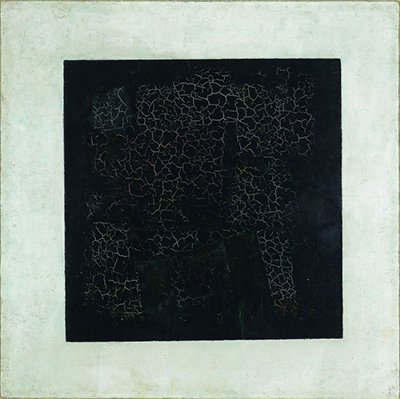
Malevich's first Suprematist exhibition in 1915 brought black forms, coloured planes and light fields into a new relationship. On the first Black Square, the black area is neither a perfect printed symbol nor a window onto a depicted dark object. The pale margin, painted edge, surface and original 0.10 installation all matter. The painting's present cracking makes its material age obvious, but those cracks cannot be assumed to have looked the same to a visitor in 1915. A technical finding about an underlayer must be attributed to the specific examination that produced it. [6]
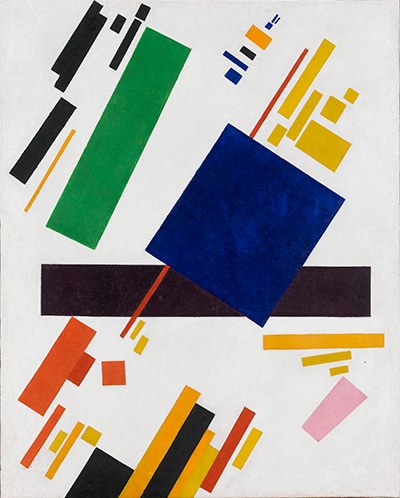
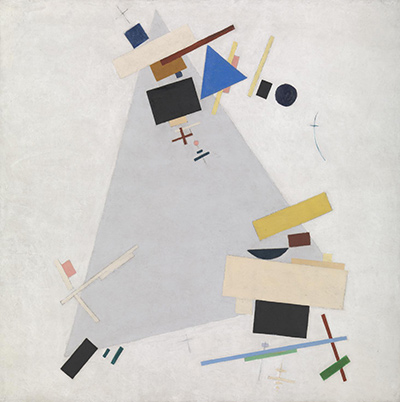
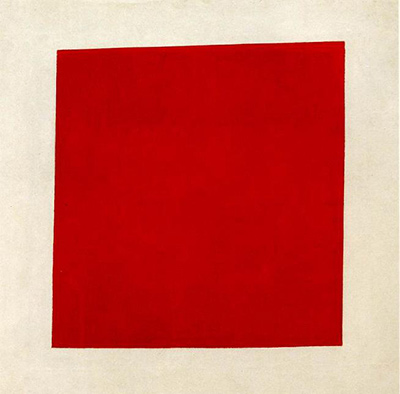
Other Suprematist works show that the style was not a single black-on-white formula. Red Square pushes a warm quadrilateral off strict regularity. Suprematist Composition uses differently sized colour masses and long axes; the 1916 S-97 canvas is a separate object from many other works bearing similar titles. In Painterly Realism of a Football Player a spread of coloured shapes can be read as a dynamic system rather than a drawn athlete. The later study of that exact Art Institute canvas shows that the apparent economy of forms was reached through adjustments. [1], [2], [3], [4]
The light area is part of the composition, not an automatic blank. Spacing changes the weight of each plane; a white band may seem to hold or separate forms. Yet white ground, white paint, unprimed fabric and a pale pixel in a JPEG are different things. A reader can see the intervals in a good reproduction, but whether the surface is exposed preparation or a later white paint layer requires object-specific inspection. This distinction becomes especially important for the pale-on-pale paintings. [1], [2]
Support: more than a neutral rectangle
Hoenigswald examined paintings in the 1990–91 Malevich exhibition. Among the works she studied she distinguished at least ten to fifteen fabric types, from commercially prepared canvas to coarse cloth, and she also notes wood and cardboard supports. That range is evidence about her examined group. It is not a census of every Malevich painting. She explicitly leaves open how much of the variety reflected preference and how much reflected supply. A confident story that every rough canvas was forced on him by political shortage goes beyond the evidence. [1]
The support could be visible in the finished image. In Peasant Women at Church of 1911, exposed unprimed fabric separates forms. In a specifically identified 1917–18 Suprematist Painting discussed by Hoenigswald, unprimed cloth separates a white background from a yellow wedge. Malevich could use the colour and texture of the material itself as a pictorial interval. These examples make “white space” more complicated than a uniformly painted void. They also show why a catalogue row should name the actual support whenever a museum record supplies it. [1]
In the 1913 Vanity Case, the wood grain becomes part of the visual construction. Hoenigswald describes paint that exaggerates the panel's natural texture and distinguishes the case's planes by scratching and varied strokes rather than by smooth tonal shading alone. The point is not that every geometric plane was made this way; it is that Malevich had already used the physical surface to organise a picture before the Suprematist canvases. [1]
Ground, absorbency and the painted field
A ground is the layer prepared on a support before the visible paint is built up. Hoenigswald found both primed and unprimed canvas in her study. Absorbent grounds can draw oil from paint and leave a more matte appearance; denser ones can help paint look richer. She identifies mainly white, off-white or slightly grey grounds among the works examined, alongside an unusual absorbent brown one in certain late paintings. Her suggested composition for that brown ground is provisional. [1]
On Peasants of about 1928, areas of brown ground and underdrawing remain visible. That does not make the work unfinished by default. It indicates that a visible preparatory layer can participate in the final image. Another late painting, Complex Premonition (Half Figure in a Yellow Shirt), contrasts matte exposed ground with selected coated paint areas. The two works show a continued interest in the meeting of support preparation and painted form after the nonobjective period. [1]
The 2016 technical study of the Art Institute's Football Player gives a more closely defined sequence for one 1915 canvas. Its authors found a fine linen support and thin lead-white/chalk ground, with the fabric's texture still perceptible. They found charcoal planning, a painted white layer and coloured forms adjusted on top of or beside it. Their analysis differentiates the lead-white ground from zinc-white paint in the visible field. Those identifications are supported by a combination of imaging and material tests on that painting; they do not identify the ground beneath the Tretyakov Black Square or the MoMA White on White. [2], [3]
The hand behind a straight edge
A straight-looking boundary need not come from mechanical printing or masking tape. Hoenigswald describes edges made by placing a card beside a form and brushing paint across or away from it. On the Football Player canvas, Kokkori and her co-authors found card impressions and raised paint where a guide met still-wet white. Their study also records brush marks and fingerprints in white paint above a black square within that composition. These traces are valuable because they connect visible geometry to a sequence of movements and corrections. They must not be relocated to the separate painting titled Black Square. [1], [2]
Infrared reflectography and X-rays reveal more changes on Football Player: reworked lines, shifted forms and a black square enlarged by more than a centimetre in each direction. The red rectangle was extended, and adjacent blue ends were repainted to align with the adjusted black shape. The green form appears to have been placed directly on the ground early in the sequence. The researchers infer some steps from the pattern of materials, so their account is a reconstruction of the making, not a time-lapse film of it. [2]
Hoenigswald's exact-object examination of Red Square is an equally revealing case. Pencil planning and infrared study show a more regular initial quadrilateral. Malevich then extended the upper-right corner; under magnification, the added part differs in brush handling from the long diagonal strokes elsewhere. A distorted edge was worked into the painting, not produced by an inaccurate digital crop. The title's plain geometry and the physical canvas's shaped irregularity are both true. [1], [4]
Colour is material, not just a screen value
Malevich's coloured planes can be described visually: the weight of a red field, a green counterform, a violet plane, a yellow interruption. The Football Player research goes further because analysts examined the object. They identified or inferred specific materials including zinc white in the field, a lead-white ground, vermilion red, lead chromate yellow, ultramarine blue, ivory or bone black and cobalt violet in their tested areas. The green was consistent with a copper-arsenite pigment such as emerald green, with a named alternative not completely excluded. Extenders and possible resin additions further complicate any idea of “one pure colour” per shape. [2]
That palette belongs to the Art Institute painting. It cannot be copied into a caption for Airplane Flying or Suprematist Composition without a study of those physical works. The 2016 authors also note that the transparent cobalt-violet area was laid with controlled parallel strokes and may include resin contributing to its depth and gloss. Their proposed sequence joins a visual question—why that violet has a different presence from an adjacent flat field—to test results. It is more precise than either treating the canvas as a mere diagram or claiming to know how every Malevich purple was mixed. [2]
Hoenigswald also records instances where one colour overlays another. In the later Haymaking, blue emerges from beneath green where the artist scratched the upper layer, and a sliver of red shows at the edge of a blue pail. These are object-specific ways that underpaint, physical depth and colour interaction can work together. A reproduction may reduce them to colour patches; in front of the canvas, paint has thickness and sequence. [1]
White on white: tone, gloss and touch
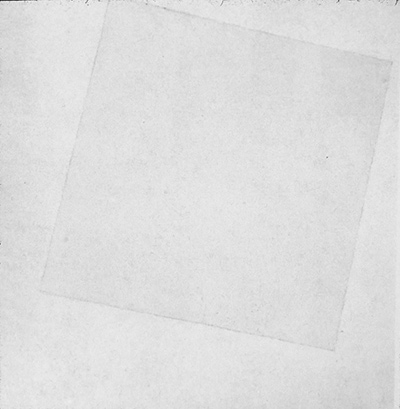
MoMA dates its White on White to 1918. Its tilted pale quadrilateral is discernible against a different pale field. The image does not require a hidden object to explain it, but it also cannot be understood as “nothing painted.” There is a support, paint, edge, orientation and differentiated lightness. The result makes unusually demanding use of small changes rather than broad dark–light contrast. [5]
Hoenigswald describes two other specifically catalogued 1917–18 white-on-white paintings in which the location of matte and glossy white is reversed: one has a matte field and glossy form, the other the opposite. She proposes that different whites, and perhaps medium or coating, helped create the effect. Some of her lead-white versus zinc-white distinctions were inferred from ultraviolet appearance without confirmatory pigment analysis. The observation about opposed surface effects is important, but the chemical reading must retain its uncertainty, and it should not be silently assigned to MoMA's painting. [1]
This is one reason a screen image has limits. Digitisation can show a pale shape clearly and let readers compare placement, but lighting, exposure and display settings flatten or exaggerate gloss and colour temperature. The owner-supplied high-resolution images on this site are valuable for annotated looking; they are not substitute evidence for microscopy or a museum's condition record. A close-reading caption should tell the reader what is visible and name the study when it goes beyond visibility. [1], [2]
Revisions, cracks and hidden compositions
X-rays can show a composition beneath the visible one. Hoenigswald reports a hidden head under Red House and an earlier composition beneath a White Square on White canvas. In the first case the prior image appears to have been covered. In other examined Suprematist paintings, lower colours and shapes can now be seen through cracks or later transparency. The significance of those appearances differs: a painter may have accepted a visible change, while another image may have become legible only as materials aged. One cannot decide intent from the word “underpainting” alone. [1]
The aged first Black Square makes this problem especially easy to see. Its crack network reveals a surface history that a perfect black computer square would erase. The technical story of that exact work is treated on its own page using Tretyakov evidence. This style guide does not claim that every crack in Malevich's oeuvre carries the same original purpose or that every later version has the first painting's underlayers. [6]
Drying cracks can reflect paint placed over material that had not fully set. Hoenigswald treats that as part of a broader working pattern, but she also cautions that present visibility may be changed by age. For Sportsmen she raises the possibility of added driers; no documentary purchase or decisive chemical result proves it in that essay. It should remain a proposed explanation rather than a label fact. [1]
Matte, gloss and later figures
Malevich's return to figures did not mean a return to one uniform paint surface. Hoenigswald describes selective coatings and varied gloss in a number of late works, sometimes affecting the modeled volume of a body and sometimes flattening it. She warns that it can be hard to tell whether a coating was put on by the artist or later. Specific pigment identifications based on ultraviolet fluorescence are also often offered as possibilities. A material explanation can be illuminating without having the status of a laboratory certainty. [1]
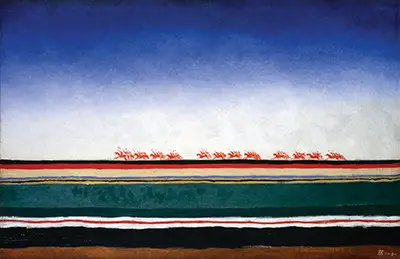
On Red Cavalry, long coloured bands sit beneath tiny riders. Hoenigswald observes alternating matte and glossy surface effects in those bands without an overall varnish. Their different reflective qualities contribute to the painted horizon; a flat JPEG makes that relationship harder to judge. The Russian Museum dates the surviving canvas to about 1932 despite its inscription “1918,” another reminder that a date on a work and a museum's assigned production date answer different questions. [1], [7]
Hoenigswald's ultraviolet observation on Girl with a Comb in Her Hair suggests differences in white material across the face. The Tretyakov identifies the physical painting, dated 1932–33. The possible white-pigment explanation must be attributed to the conservator, not presented as a chemical test result for every part of the portrait. What a viewer can directly see is a late face built with deliberately distinct areas of light and colour. [1], [8]
How to look closely without overclaiming
Begin with the whole image: where is its weight, what makes one form feel near or distant, how do colour and unpainted-looking intervals interact? Then look at an edge. Is it straight, softly handled, visibly altered or interrupted? Ask what a photograph can show before asking for a technical explanation. A high-resolution crop can reveal surface variation and brush direction, but it cannot by itself identify lead white, prove a varnish is original or reveal a buried drawing. [1], [2]
The best technical studies combine several methods. Infrared can clarify some drawing, X-rays can reveal changed structures, ultraviolet imaging can show different fluorescence, and material analyses can identify elements or compounds under stated limits. Even together they yield an interpretation of a particular object, not an all-purpose recipe. This is why the Art Institute's Football Player and Hoenigswald's Red Square findings are so useful: each connects a precise claim to a precise canvas. [1], [2], [3], [4]
Malevich's style is therefore visible in both the arrangement and the making. From a worker and machine to a dark square, from coloured planes to late figures, he repeatedly made form carry more than description. The physical paintings show revisions, supports, grounds and different degrees of finish. Their apparent simplicity is an invitation to look longer, not a reason to stop at the first clean geometric outline. [1], [2]
Documented Malevich collection records
Explore 665 catalogued source objects from museums and archives, including 87 exact links to local artwork pages. Records include works, print impressions, book components and archival items; they are not a deduplicated or complete oeuvre. Medium labels are grouped into broad English categories. Titles link to local artwork pages where available.
| Artwork title | Date | Medium |
|---|---|---|
| "Front line soldier" (Ratnik 1-go razriada) | Δεκαετία 1920 | Photograph |
| [Le Cheval blanc] | [circa 1930 - 1931] | Painting |
| [Sensation du danger] | [1930 - 1931] | Painting |
| A Game in Hell, Petrograd, 1913 (2nd expanded edition) | 1913 | Book |
| A Game in Hell: A Poem (Igra v adu: Poema) | 1914 | Book |
| A Peasant Woman Goes for Water | 1913 | |
| A pork-butcher came around to Lodz and we said "Good day." From Lodz to neighboring Radom he passed, and left behind one sorry ass. (Podoshel kolbasnik k Lodzi / my skazali : 'Pan dobrodzi!' Nu, a s Lodz'iu riadom Radom / i ushel s podbitym zadom.) | c. 1914 | |
| Alogisme 1. Portret Moskovskoy Damy (Alogisme 1. Portret van een Moskouse dame) | 1914 | Drawing |
| Alogisme 2. Vis, zaag, lepel, telegraafpaal | 1914 | Drawing |
| Alogisme 22. Malorossiyanin (Alogisme 22. Een kleine Rus) | 1915 | Drawing |
| Alogisme 23. Sobol, koshka (Alogisme 23. Sabel, kat) | 1915 | Drawing |
| Alogisme 29. Derevnya | 1915 | Drawing |
| Alogisme 3. Chastichnoe zatmenie (Alogisme 3. Gedeeltelijke eclips) | 1914 | Drawing |
| Alogisme 4. Apteka (Alogisme 4. Apotheek) | 1914 | Drawing |
| Alpha | 1923 / 1978 | Sculpture or object |
| An Austrian was going to Radzivily | 1914 | |
| An Austrian was going to Radzivily | 1914 | |
| Analytical Chart | 1924–27 | Drawing |
| Analytical Chart | 1924–27 | Drawing |
| Analytical Chart | 1924–27 | Drawing |
| Analytical Chart | 1924–27 | Drawing |
| Analytical Chart | 1924–27 | Drawing |
| Announcement for Malevich's lecture in Orenburg | 1917-1920 | |
| Apple Tree in Blossom | c. 1930 | Painting |
| Architecton Alpha | 1920 | Sculpture or object |
| Architecton Gota | 1923 (?) | Sculpture or object |
| Architectonische constructie | 1917 (versie ca. 1925) | Drawing |
| Architectons and Figurines | Späte 1920er Jahre | Sculpture or object |
| Architecturaal-kosmische compositie | 1920 (latere versie (1927?)) | Drawing |
| Architectural construction | ca. 1917 | Drawing |
| Aritmetica | 1913 | Drawing |
| Aritmetica | 1913 | Drawing |
| Arkhitekton Zeta | 1926 | Photograph |
| At Harvesting (Marfa and Vanka) | 1928-1929 | Painting |
| Aveniriens | vers 1931 - 1932 | Drawing |
| Aviator | 1914 | Painting |
| Aviator v Pobede nad solntsem (Vliegenier in Overwinning op de zon) | 1913 (versie ca. 1929) | Drawing |
| Baadsters op de rug gezien | 1910 | Painting |
| Back cover from Igra v adu (A Game in Hell) | 1913–14, published 1914 | Book |
| Back cover from Vzorval' (Explodity) | 1913 | Book |
| Bader | 1911 | Drawing |
| Betende Bäuerin | 1933 | Drawing |
| Biddende figuur | motief ca 1922, versie voor 1927 | Drawing |
| Birkenhain | um 1905 - 06 | Painting |
| Black Circle | c. 1923 | Painting |
| Black Cross | c. 1923 | Painting |
| Black quadrilateral | 1915 | Painting |
| Black Square | c. 1923 | Painting |
| Black Square and Circle | 1920-1921 | Drawing |
| Black Square and White Cylindrical Form | 1915 | Drawing |
| Black Square, Second State | 1915/20 | Drawing |
| Blacksmith | Study. 1933 | Painting |
| Blestifze (Pencils) | 1917–1918 | Drawing |
| Boer met baard | ca 1930 | Drawing |
| Boerenvrouw in het veld | ca. 1929-1930 | Drawing |
| Boerenvrouw met emmers | 1912 | Painting |
| Book of Selected Poems (Kniga izbrannykh Stikhotvorenii) | 1930 | Book |
| Boy (Vanka) | 1928–1929 | Painting |
| Boy wuth knapsack / Mal'chyk s rantsem | 1915 | |
| Brooch | 1920 | Sculpture or object |
| Brooch | 1920 | Sculpture or object |
| Bubnovy Valet 21. Boerenvrouw met kind | 1911-1912 (latere versie) | Drawing |
| Bubnovy Valet 40. Portret (van M.F. Larionov?) | 1910 | Drawing |
| Bubnovy Valet 41. Na uglu stoit apteka, lyubov sushit tseloveka (De drogist is op de hoek, van liefde droogt een man uit) | 1910-1911 (versie ca. 1930) | Drawing |
| Bubnovy Valet 42. Portret moei rodstvennitsy (Bubnovy Valet 42. Portret van mijn familielid) | 1911 | Drawing |
| Bubnovy Valet 43. Kop van een boer | 1912 (latere versie) | Drawing |
| Bubnovy Valet 44. Dansend paar | 1912 | Drawing |
| Bubnovy Valet 57. Lopende man | 1911 | Drawing |
| Bubnovy valet 8. Kop van een boer | 1912 | Drawing |
| Budetliyansky silach (Futuristische sterke man) | 1913 (versie 1915) | Drawing |
| Bêta | avant 1926 / 1978 | Sculpture or object |
| Car and Lady | Photograph | |
| Carpenter | 1928–1929 | Painting |
| Carré noir | [1923 - 1930] | Sculpture or object |
| Chelovek v ochkakh (Man met bril) | ca 1929 | Drawing |
| Compositie 1 z (Supremus nr. 67) | 1916 (versie jaren 1920) | Drawing |
| Compositie 10 t (Suprematisme: constructief moment) | 1917 | Drawing |
| Compositie 11 t (Supremus nr.18: constructievorming afhankelijk van de beweging naar een bol ) | 1916 | Drawing |
| Compositie 13 t (Supremus nr 38) | 1915-1916 | Drawing |
| Compositie 13 t (Supremus nr 38) | 1915-1916 (gedrukt 1920, annotaties jaren 1920) | |
| Compositie 14 t Oshchushchenie elektrichestva (Compositie 14 t Gevoel van electriciteit) | 1915 | Drawing |
| Compositie 15 k (Suprematisme) | 1916 (versie begin jaren 1920) | Drawing |
| Compositie 15 q (Supremus nr. 118) | 1918 | Drawing |
| Compositie 16 t (Suprematisme: groot zwart trapezium en vierkant tussen rechthoeken en lijnen) | 1915 | Drawing |
| Compositie 2 i (Suprematisme: gecombineerd gevoel: cirkel en vierkant) | 1916 (latere versie) | Drawing |
| Compositie 2 t (Verlengd vierkant met elementen overdwars) | 1915 (versie ca. 1920) | Drawing |
| Compositie 2 z Obshchushchenie magnita (Compositie 2 z Gevoel van een magneet) | 1916 (hernomen in 1919, versie jaren 1920) | Drawing |
| Compositie 3 t | 1916 | Drawing |
| Compositie 4 l Suprematisme van de geest | 1919 | Drawing |
| Compositie 4 t (Suprematisme: cirkel tussen rechthoeken en driehoeken) | 1916 | Drawing |
| Compositie 4 z (Supremus nr. 84) | 1916 (latere versie) | Drawing |
| Compositie 5 l Suprematisme van de geest | 1919 | Drawing |
| Compositie 6 d (Tekening verwant aan ‘Huis in aanbouw’) | 1915 | Drawing |
| Compositie 6 t Obshchushchenie vremeni (Compositie 6 t Gevoel van tijd) | 1916 | Drawing |
| Compositie 9 b. Fevralizm kak emotionizm (Compositie 9 b. Februarisme als emotionisme) | 1915 | Drawing |
| Compositie 9 h (Suprematisme: kruis en drie rechthoeken) | 1916 (versie 1920) | Drawing |
| Compositie 9 k (Suprematisme: zeven rechthoeken) | 1915 | Drawing |
| Compositie 9 t (Suprematisme: vier ruimtelijke elementen tegen een zwart trapezium) | 1915 | Drawing |
| Composition 1 e (Suprematisme: vierkant op diagonaal vlak) | 1915 | Drawing |
| Composition 1 t | [1916 / vers 1920] | Drawing |
| Composition 14 f | [1918] | Drawing |
| Composition 15 t | 1916 | Drawing |
| Composition 2 a | [1917 - 1918] | Drawing |
| Composition 3 z | [1919 / avant 1930] | Drawing |
| Composition 5 x | [été 1915] | Drawing |
| Composition 5 x | [été 1915] | Drawing |
| Composition alogique | [1915] | Drawing |
| Composition with La Gioconda (Partial Eclipse) | 1914 | Painting |
| Compositions 11 R | circa 1915–16 | Drawing |
| Construction 5 h | 1916 | Drawing |
| Costume study for the Budetlyan Athlete in Victory over the Sun | 1913 | Drawing |
| Cow and Violin | 1913 | Painting |
| Cow and Violin from On New Systems in Art (O Novykh Sistemakh Visk Usstve) | 1911–19 | |
| Croix [noire] | [1915] | Painting |
| Croix noire | [vers 1923 - 1926] | Sculpture or object |
| Dame | 1915 | Drawing |
| Dame an der Straßenbahnhaltestelle | 1913 | Drawing |
| Dame bij reclamezuil | 1914 | Painting |
| De gardist | 1913-1914 | Other |
| De houthakker (recto) / Boerenvrouwen in kerk (verso) | 1912 | Painting |
| De likdoornsnijder | 1911 | Drawing |
| De likdoornsnijder | 1911 | Drawing |
| De provincie | 1910 | Painting |
| De tuinman | 1911 | Painting |
| De vloerboeners | 1911 | Drawing |
| Der Häftling | 1930 | Drawing |
| Der Tod eines Menschen, gleichzeitig im Flugzeug und der Eisenbahn | um 1913 | |
| Desk and Room (legacy site: Bureau and Room) | 1913 | Painting |
| Dessin de Lissitzky d'après "Supremus n° 58, composition dynamique jaune et noire", 1916, de Malevitch | [1924] | Drawing |
| Deux plans de villes | [1916 / avant 1930] | Drawing |
| Deux plans en extension | [1916 - 1919] | Drawing |
| Diagramm | around 1917/1918 | Drawing |
| Die Hochzeit | 1903 | Other |
| Die Waschfrau | 1911 | Painting |
| Dorp | ca. 1906 | Other |
| Dorpje | 1908 | Drawing |
| Drei Köpfe | after 1930 | Drawing |
| Drie boerenvrouwen | 1917-1919 of eind jaren 1920 | Drawing |
| Drie figuren in een landschap | ca. 1928-1930 | Drawing |
| Drie naakte vrouwen en een kind, peren plukkend | 1909 | Drawing |
| Drie staande vrouwen | 1930 | Drawing |
| Drie vrouwenfiguren | ca 1905-1906 | Drawing |
| Druckstock für Holzschnitt | 1920 | |
| Dynamic Construction | 1923 | Photograph |
| Dynamic Figure from On New Systems in Art (O Novykh Sistemakh V Iskusstve) | 1911 | |
| Dynamic Suprematism | 1915/16 | Painting |
| Dynamisch suprematisme | 1917-1918 | Drawing |
| Een Engelsman in Moskou | 1914 | Painting |
| Een paar onder bomen | ca 1929 | Drawing |
| Elegant gezelschap in een park | ca 1908 | Drawing |
| Elementarer Suprematismus | 1917 | Drawing |
| Eléments d'architectone | [après 1924] | Drawing |
| Eléments non identifiés | [1923 - 1935] | Sculpture or object |
| Engelsman in Moskou | 1913-1914 | Drawing |
| Entwurf für das Gemälde 'Die roten Häuser' | 1910 | Drawing |
| Entwurf für die Bemalung der Pfeiler aus der Serie von Entwürfen für die Ausgestaltung des Roten Theaters in Leningrad | 1931 | Drawing |
| Entwurf für eine Deckenmalerei im Roten Theater in Leningrad | 1931 | Drawing |
| Eskiz k portretu Roslavtsa. Pesn golubym oblakam (Schets voor portret van de componist Roslavets. Lied van de blauwe wolken) | 1907-1908 | Drawing |
| Etude de paysan | fin 1911 | Drawing |
| Etyud suprematis 52 sistema A 4 | 1916-1917 (versie 1920-1927) | Drawing |
| Explodity (Vzorval') | 1913 | Book |
| Explodity (Vzorval') | 1913 | Book |
| Explodity (Vzorval) | 1913 | Book |
| Female Figure | 1928–1929 | Painting |
| Female portrait | ca. 1910-1911 | Painting |
| Female Torso | 1928–1929 | Painting |
| Female Torso | 1928-1929 | Painting |
| Figur mit ausgebreiteten Armen, ein Kreuz bildend | 1933 | Drawing |
| Figuren in Schwarz und Weiß | 1928/1930 | Drawing |
| Flower Seller | 1930 | Painting |
| Folio 1 from Igra v adu (A Game in Hell) | 1913–14, published 1914 | Book |
| Folio 15 from Igra v adu (A Game in Hell) | 1913–14, published 1914 | Book |
| Folio 17 verso from Igra v adu (A Game in Hell) | 1913–14, published 1914 | Book |
| Folio 18 from Igra v adu (A Game in Hell) | 1913–14, published 1914 | Book |
| Folio 19 from Igra v adu (A Game in Hell) | 1913–14, published 1914 | Book |
| Folio 19 from Vzorval' (Explodity) | 1913 | Book |
| Folio 20 from Igra v adu (A Game in Hell) | 1913–14, published 1914 | Book |
| Folio 23 from Vzorval' (Explodity) | 1913 | Book |
| Folio 25 from Igra v adu (A Game in Hell) | 1913–14, published 1914 | Book |
| Folio 27 from Igra v adu (A Game in Hell) | 1913–14, published 1914 | Book |
| Folio 27 from Vzorval' (Explodity) | 1913 | Book |
| Folio 29 from Igra v adu (A Game in Hell) | 1913–14, published 1914 | Book |
| Folio 31 from Vzorval' (Explodity) | 1913 | Book |
| Folio 32 verso from Igra v adu (A Game in Hell) | 1913–14, published 1914 | Book |
| Folio 34 verso from Igra v adu (A Game in Hell) | 1913–14, published 1914 | Book |
| Folio 37 from Igra v adu (A Game in Hell) | 1913–14, published 1914 | Book |
| Folio 4 verso from Igra v adu (A Game in Hell) | 1913–14, published 1914 | Book |
| Folio 7 from Igra v adu (A Game in Hell) | 1913–14, published 1914 | Book |
| Folio 9 from Igra v adu (A Game in Hell) | 1913–14, published 1914 | Book |
| Footballer / Futbolist | 1915 | |
| Four Squares | 1915 | Painting |
| Fragmenten van een tekst over het suprematisme | 1927 | Other |
| From Cubism and Futurism to Suprematism (Ot kubizma i futurizma k suprematizmu) | 1916 | Book |
| Front cover from Igra v adu (A Game in Hell) | 1913–14, published 1914 | Book |
| Fruit plukken / Overvloed | 1909 | Painting |
| Fuhrleute | 1909-1910 | Drawing |
| Full portrait of Malevich | 1931 | Photograph |
| Futuristische draak | 1913 | |
| Futurizm: dvizhenie cheloveka po lestnitse (Futurisme: beweging van een man op een trap) | 1919 | Drawing |
| Gebet II | um 1913 | |
| Gesellschaft in Zylindern | 1907 | Drawing |
| Girl in the Countryside | 1928–1929 | Painting |
| Girls in a Field | 1928-1929 | Painting |
| Gliad', pogliad' uzh blizko Visly. Nemtsev puchit, znachit kislo. | 1914/1918? | |
| Glyad, poglyad, uzh blizko Visly | 1914 | |
| Golgatha | around 1911 | Drawing |
| Gota | 1923 / 1978 | Sculpture or object |
| Gota 2-a | 1923 / 1978 | Sculpture or object |
| Grafik ... | ca. 1923 | Other |
| Grafik dvizheniya tvorcheskikh edinits v beskonechnosti | ca. 1923 | Other |
| Grammatica | 1913 | Drawing |
| Harvesting | Study for a painting. 1928–1929 | Painting |
| Head of a Peasant | Early 1930s | Painting |
| Head of a Peasant | 1928-1929 | Painting |
| Head of a Peasant | 1928–1929 | Painting |
| Hiëratisch suprematistisch kruis (groot kruis in zwart over rood op wit) | 1920-1921 | Painting |
| Houses of the Future Leningrad: Pilot's House | 1924 | Drawing |
| Huis, man, ladder | 1930-1931 | Drawing |
| Huit dessins suprématistes | [1917 / avant 1930] | Drawing |
| Huizen op het platteland | ca. 1906 | Other |
| Häuser und Kreuze (Golgatha) | 1930 | Drawing |
| I yu mane tor | ca. 1915 | Drawing |
| Igra v adu | 1914 | Other |
| Igra v adu (A Game in Hell) | 1914 | Book |
| Igra v adu (A Game in Hell) | 1914 | Book |
| Igra v adu (A Game in Hell) | 1914 | Book |
| Igra v adu (A Game in Hell) | 1913–14, published 1914 | Book |
| II | 1913 | Drawing |
| Illustration for the book by Aleksei Kruchenykh and Velimir Khlebnikov "Igra v Adu»" (2nd edition, Moscow 1914) | 1914 | |
| Ils vont à l'église | 1928 - 1932 | Drawing |
| Into Wagons of the French, German Corpses Were Tightly Wrenched; Their English Brothers Carried Kegs Stuffed with Germans Who Lost Their Legs | c. 1914 | |
| Izbornik stikhov s poslesloviem rechiaria. 1907–1914 gg. (A Selection of Poems with an Afterword by the Wordsmith: 1907–1914) | 1914 | Book |
| Jnitsa | 1913 | Drawing |
| K.Malevich, M.Matiushin, A.Kruchenykh, St.Petersburg, December 1913 | 1913 | Photograph |
| K.Malevich, M.Matiushin, A.Kruchenykh, St.Petersburg, December 1913 | 1913 | Photograph |
| K.Malevich, M.Matiushin, A.Kruchenykh, St.Petersburg, December 1913 | 1913 | Photograph |
| Kabarett | 1930 | Drawing |
| Kazimir Malevich lying seriously ill in his bed, shortly before he died | 1935 | Photograph |
| Kettle with lid | 1923 | Sculpture or object |
| Komposition mit einer Figur | after 1930 | Drawing |
| Konstruktion | around 1915 | Drawing |
| Kop van een boer, kruis, en landschap | 1928-1929 | Drawing |
| Kop van een boerenmeisje | 1912 | Painting |
| Kop van een boerenvrouw | 1913 | Drawing |
| Kopf | 1930 | Drawing |
| Kopf | around 1930 | Drawing |
| Kostüm für das Stück 'Maskenball' | 1913 | Drawing |
| Krestyanka (Boerenvrouw) | 1913 | |
| Krestyanka idet po vodu (Boerin haalt water) | 1913 | |
| Kubisme 25. Avtoportret (Kubisme 25. Zelfportret) | 1913 | Drawing |
| Kubisme 6. Wandklok | 1913 | Drawing |
| Kubisme 9. Molitva (Kubisme 9. Gebed) | 1913 | Drawing |
| Kubistische compositie | ca 1925 | Drawing |
| Kubistische figuur staand op de rug gezien | 1912-1913 (versie ca. 1925) | Drawing |
| Kubofuturistische compositie met piano | 1913-1914 | Painting |
| Kubosuprematismus | 1916/1920 | Drawing |
| Kuppel des Volkshauses in Leningrad | 1931 | Drawing |
| Lamp - Musical Instruments | Δεκαετία 1920 | Photograph |
| Lamp / Muziekinstrumenten | 1913 | Painting |
| Landscape | 1911 | Painting |
| Landscape | c. 1906 | Painting |
| Landscape with a White House | 1928–1929 in Gasper-Hulvat 2012; Christie’s groups work with early-1930s landscapes | Painting |
| Landscape with a Yellow House (Winter Landscape) | c. 1906 | Painting |
| Landscape with Five Houses | 1928–1929 | Painting |
| Landscape with house | c. 1905-1906 | Painting |
| Landschaft | around 1933/34 | Other |
| Landschaft (Der Winter) (Landscape (Winter)) | after 1927 | Painting |
| Lauf | 1917 | Drawing |
| Let's Grumble (Vozropshchem) | 1913 | Book |
| Liggende naakte vrouw met twee spelende kinderen | 1908 | Drawing |
| Lopende man met zaag onder de arm | ca. 1928-1929 | Drawing |
| Maaiende vrouw | 1913 | Drawing |
| Maaiende vrouw | 1913 | Drawing |
| Maaiende vrouw | 1913 | Drawing |
| Maaiende vrouw | 1912-1913 | Drawing |
| Magnetic construction | Drawing | |
| Magnetisch architectonische compositie | ca. 1920 (versie 1925-1926) | Drawing |
| Magnetischer Suprematismus | 1916 | Drawing |
| Male Portrait | 1933–1934 | Painting |
| Malevich archief | 1913-1927 | Other |
| Malevich with his students (UNOVIS) | Μάιος 1922 | Photograph |
| Man met zak | 1910-1911 | Painting |
| Manifesto handbill for the 0.10 exhibition | 1915 | Book |
| Mann in suprematistischer Landschaft | um 1930 - 31 | Painting |
| Mann mit Pferd | 1933 | Drawing |
| Manuscript with drawings, Page 27, 1 July 1916 | 1916 | Other |
| Maternity. Woman in Birth | 1908 | Drawing |
| Moederschap / Overvloed | 1910 | Painting |
| Morning in the Village after Snowstorm | 1912 | Painting |
| Muziekinstrument | 1913 | Drawing |
| Muziekinstrumenten | 1913-1914 | Drawing |
| Mystic Suprematism (Black Cross on Red Oval) | 1920–22 | Painting |
| Mysticus | 1930 | Drawing |
| Mystiek suprematisme (rood kruis op zwarte cirkel) | 1920-1922 | Other |
| Naakt met geheven handen | 1908 | Drawing |
| Nachtwandeling | 1909-1910 | Drawing |
| Nu i tresk-zhe, nu i grom-zhe byl ot niemtsev podlie Lomzhi. | 1914/1918? | |
| O Novykh Sistemakh V Iskusstve (On New Systems in Art) | 1919. (Prints executed 1910-1919). | Book |
| O novykh sistemakh v iskusstve. Statika i skorost' | 1919 | Other |
| O novykh systemakh v iskusstve. Statika i skorost' ( On New Systems in Art: Statics and Speed ) | 1919 | Book |
| O novykh systemakh v iskusstve: Statika i skorost’ (On New Systems in Art: Statics and Speed), Vitebsk | 1919 | Book |
| Ohne Titel | around 1904-1908 | Drawing |
| Ohne Titel | 1916 | Drawing |
| Ohne Titel | around 1931 | Drawing |
| Ohne Titel | 1916 | Drawing |
| Ohne Titel | around 1916 | Drawing |
| Ohne Titel (Untitled) | 1917–1930 | Drawing |
| Omslag van A. Kruchenykh en V. Khlebnikov, Igra v adu (Een spel in de hel) | 1913-1914 | |
| Omslag van Sezd Komitetov Derevenskoi Bednoty (Congres van Comités van Armoede op het Platteland) | 1918 | |
| Omslag van Troe (Het drietal) | 1913 | |
| Omslagontwerp voor Internatsional iskusstva (Internationale van de kunst) | 1918 | |
| Omslagontwerp voor N.N. Punin, Pervy tsikl lektsii (Eerste cyclus van lezingen) | 1920 | Drawing |
| Omslagontwerp voor Troe (Het drietal) | 1913 | Drawing |
| Ontwerp voor een architecton type 'Alfa' | ca 1925-1926 | Drawing |
| Ontwerp voor een architecton type Alfa | 1925-1929 | Drawing |
| Ontwerp voor een monument | ca. 1932-1933 | Drawing |
| Ontwerp voor een monument | ca. 1932-1933 | Drawing |
| Ontwerp voor een monument | ca. 1932-1933 | Drawing |
| Oogstende vrouwen/Het binnenhalen van de rogge II | 1912 | Other |
| Op de boulevard | 1910 | Painting |
| Opdoemende kruisvorm | 1917-1918 | Drawing |
| Ornements suprématistes | 1927 / 1978 | Sculpture or object |
| Ot kubizma i futurizma k suprematizmu. Novyi zhivopisnyi realizm (From Cubism and Futurism to Suprematism: New Painterly Realism) | 1916 | Book |
| Ot kubizma k suprematizmu. Novy zhivopisny realizm | 1916 | Other |
| Ot Sezanna do Suprematizma. Kritichesky ocherk | 1920 | Book |
| Ot Sezanna do Suprematizma. Kritichesky ocherk. | 1920 | Other |
| Paard en koets in beweging | 1913 | Drawing |
| Painterly Realism of a Boy with a Knapsack - Color Masses in the Fourth Dimension | 1915 | Painting |
| Painterly Realism of a Football Player—Color Masses in the 4th Dimension | Summer/fall 1915 | Painting |
| Patriotic poster against the Germans | 1914 | |
| Patriotic Poster Against the Germans | 1914 | |
| Patriotic Poster Against the Germans | 1914 | |
| Patriotic Poster Against the Germans | ||
| Patriotic propaganda postcard with verse by Vladimir Mayakovsky | 1914 | Book |
| Patriotic propaganda postcard with verse by Vladimir Mayakovsky | 1914 | Book |
| Patriotic propaganda postcard with verse by Vladimir Mayakovsky | 1914 | Book |
| Patriotic propaganda postcard with verse by Vladimir Mayakovsky | 1914 | Book |
| Patriotic propaganda postcard with verse by Vladimir Mayakovsky | 1914 | Book |
| Patriotic propaganda postcard with verse by Vladimir Mayakovsky | 1914 | Book |
| Patriotic propaganda postcard with verse by Vladimir Mayakovsky | 1914 | Book |
| Patriotic propaganda postcard with verse by Vladimir Mayakovsky | 1914 | Book |
| Patriotic propaganda postcard with verse by Vladimir Mayakovsky | 1914 | Book |
| Patriotic propaganda postcard with verse by Vladimir Mayakovsky | 1914 | Book |
| Patriotic propaganda postcard with verse by Vladimir Mayakovsky | 1914 | Book |
| Patriotic propaganda postcards with verse by Vladimir Mayakovsky | 1914 | Book |
| Paysanne | [1912 / 1932] | Drawing |
| Paysanne et deux enfants | [1911 / avant 1930] | Drawing |
| Peasant | Between 1930–1932 | Painting |
| Peasant bringing Water | 1912 (Thema), 1920er Jahre (Ausführung) | Drawing |
| Peasant in a Field | 1928–1929 | Painting |
| Peasant Woman | Early 1930s | Painting |
| Peasants | c. 1930 | Painting |
| Peasants | circa 1928 (NGA); 1928–1929 (Gasper-Hulvat) | Painting |
| Perfected Portrait of Ivan Kliun | 1913 | Painting |
| Peruyi Tsikl Lektsii | 1920 | Book |
| Pervyi tsikl lektsii chitannykh na kratkosrochnykh kursakh dlia uchitelei risovaniia (First Series of Lectures, Given at a Short-Term Course for Teachers of Drawing) | 1920 | Book |
| Plan d'éléments d'architectone | [après 1924] | Drawing |
| Planetaire constructie (magnetische kruisvorm) | 1916-1917 (ontwikkeld 1920-1922, latere versie (voor 1927)) | Drawing |
| Planetary-Architectural Suprematism | 1919-1920 | Drawing |
| Plate (folio 17) from Vzorval' (Explodity) | 1913 | Book |
| Plate (folio 21) from Igra v adu (A Game in Hell) | 1913–14, published 1914 | Book |
| Plate (folio 22) from Vzorval' (Explodity) | 1913 | Book |
| Po utru iz Lvova vyshli | 1914 | |
| Pobeda nad solntsem. Opera (Victory over the Sun: An Opera) | 1913 | Book |
| Podoshel kolbasnik k Lodzi | 1914 | Drawing |
| Pokhoronnoe byuro (Begrafeniskantoor) | 1914-1915 | Drawing |
| Porosiata | Saint Petersburg: 1913 | Book |
| Porosiata (Piglets) | 1913 | Book |
| Portrait of a Youth | 1933 | Painting |
| Portrait of M. V. Matyushin | 1913 in gallery-magazine object record; 1913–14 in Tretyakov education page | Painting |
| Portrait of the Artist’s Wife | 1933 | Painting |
| Portret M.V. Matyushina (Portret van M.V. Matyushin) | 1913 | Drawing |
| Portret stroitelya usovershenstvovan (Verbeterd portret van een bouwer) | 1913 | Drawing |
| Portret van de vader van de kunstenaar | ca 1902-1903 | Painting |
| Portret van een jonge vrouw (waarschijnlijk Sofia Rafalovitch) | 1908-1909 | Drawing |
| Portret van een man (Aleksei Morgunov?) | 1912 | Other |
| Portret van M.V. Matyushin | 1913 | Drawing |
| Prayer | 1913 | Drawing |
| Prayer | 1913 | |
| Prayer | Study for a fresco painting. 1907 | Painting |
| Prayer (plate, folio 19) from Vzorval' (Explodity) | 1913–14, published 1914 | Book |
| Primitiv (Schuhmacher) | 1910 | Drawing |
| Prografachnik | 1916 | Drawing |
| Projekt einer kosmischen Anlage | around 1917 | Drawing |
| Quadrat und Oval | 1915/1916 | Drawing |
| Quadrat und Viereck | 1914-1915 | Drawing |
| Red Cavalry | c. 1932 | Painting |
| Red House | 1932 | Painting |
| Red Square | Undated | Drawing |
| Red Square. Painterly Realism of a Peasant Woman in Two Dimensions | 1915 | Painting |
| Reicher Mann | around 1910 | Drawing |
| Relaxing (Society in Top Hats) | 1908 | Drawing |
| Reservist of the First Division | fall-winter 1914 | Painting |
| Roar!: Gauntlets of 1908-1914 (Riav!: Perchatki 1908-1914) | 1914 | Book |
| Rotes Quadrat auf Schwarz | around 1922 | Other |
| Samovar | 1913 | Painting |
| Schema I: Construction of Axes of a Model; Schema II: Cubist Structure (Construction); Schema III: Cubist Constructed Drawing from On New Systems in Art (O Novykh Sistemakh Visk Usstve) | 1919 | |
| Schets vooor de opera Voyna (Oorlog): Topor molodets ne brekhal (de jongeman Topor heeft niet gelogen) | 1918 | Drawing |
| Schets voor de opera Voyna (Oorlog): Bas, day stakan (Bas, geef me een glas) | 1918 | Drawing |
| Schets voor de opera Voyna (Oorlog): gekruisigde tegen een lichte achtergrond | 1918 | Drawing |
| Schets voor de opera Voyna (Oorlog): gekruisigde tegen een zwarte achtergrond | 1918 | Drawing |
| Schets voor de opera Voyna (Oorlog): interieur met figuur en hangend kruisbeeld | 1918 | Drawing |
| Schets voor de opera Voyna (Oorlog): Odin tikho (een stille) | 1918 | Drawing |
| Schets voor een architectonische structuur | 1920-1921 (versie 1923-1924) | Drawing |
| Schetsboekomslag | Drawing | |
| Schneider, Allogismus, Aushang | around 1915 | Drawing |
| Schnitter | 1909-1910 | Drawing |
| Schnitterinnen | 1909-1910 | Drawing |
| Schnitterinnen (Reapers) | 1909–1910 | Drawing |
| Schwarzes Viereck | 1914-1915 | Drawing |
| Scène uit Anathema | 1909-1910 | |
| Segodnyashnye sooruzheniya | 1920 (versie 1923-1924) | Drawing |
| Segodnyashnye sooruzheniya | 1923-1924 / 2010 | Other |
| Selected Verse, 1907–1914 (Izbornik stikhov, 1907-1914) | 1915 | Book |
| Self-Portrait | Study for a fresco painting. 1907 | Painting |
| Self-Portrait | 1910–1911 | Drawing |
| Self-Portrait (Artist) | 1933 | Painting |
| Shel avstriec v Radzivily | 1914 | |
| Sieg über die Sonne 1913-1973 | 1973 | |
| Sieg über die Sonne 1913-1973 | 1973 / 2010 | Other |
| Simultaneous Death in an Airplane and at the Railway | (1913) | |
| Simultaneous Death of a Man in an Airplane and on the Railroad (plate, folio 15) from Vzorval' (Explodity) | 1913–14, published 1914 | Book |
| Sketch for "Vertical Suprematist Construction»" | Undated | Drawing |
| Sketch for a Stage Curtain for the Opera Victory over the Sun | 1928 | Drawing |
| Sketch for Agit-Train | περ. 1918 | Drawing |
| Slovo Kak Takavoe (The Word as Such) | 1913 | Book |
| Slovo kak takovoe (The Word as Such) | 1913 | Book |
| Smert cheloveka odnovremmeno na aeroplane i zhel. doroge (De gelijktijdige dood van een man in een vliegtuig en op de spoorlijn) | 1913 | |
| Sportsmen | 1928–1932 | Painting |
| Square and Cone | 1915 | Drawing |
| Staande boer | 1928-1929 | Drawing |
| Staande boer met emmer | 1930-1932 | Drawing |
| Staande boer met zeis bij het hooien | 1928-1929 | Drawing |
| Staande duivel | 1913-1914 | |
| Staande figuur | 1927 | Drawing |
| Staande mannenfiguur | 1930-1931 | Drawing |
| Staande vrouw en man Kop en schouders Vijf figuren met twee suprematistische elementen | 1918 (latere versie) | Drawing |
| Staande vrouw met de armen over elkaar | ca 1930 | Drawing |
| Standing Figure | 1913 | Drawing |
| Standing Woman | circa 1930 | Drawing |
| Stikhi V. Maiakovskogo. Vypyt (The Poetry of V. Mayakovsky. [Vypyt]) | 1914 | Book |
| Still Life | c. 1910 | Drawing |
| Stroyuschiysya dom [House under construction] | 1915–16 (museum); reverse inscription 1914 distinguished from execution date | Painting |
| Studie für das Gemälde 'Die Rote Kavallerie' | 1930 | Drawing |
| Studie nach Picasso. Entwurf für das Bauhausbuch 'Die Gegenstandslose Welt' | 1926/1927 | Drawing |
| Studie nach Picasso. Entwurf für das Bauhausbuch 'Die Gegenstandslose Welt' | 1926/1927 | Drawing |
| Study for the rear curtain for Victory over the Sun | 1913 | Drawing |
| Study for the rear curtain for Victory over the Sun | 1913 | Drawing |
| Summer Landscape (Zomerlandschap) | circa 1929 | Painting |
| Suprematicheskoe postroenie N 118 (Suprematistische constructie nr. 118) | 1917-1918 (versie 1920) | Drawing |
| Suprematisch kruis (klein kruis in zwart over rood op wit) | 1920-1927 | Other |
| Suprematism | 1915 | Drawing |
| Suprematism | 1915 | Painting |
| Suprematism | 1915–1916 | Painting |
| Suprematism (Supremus No. 56) | 1915-16 | Painting |
| Suprematism (Supremus No. 58) | 1916 | Painting |
| Suprematism, 18th Construction | 1915 (artist's reverse inscription reads 1914) | Painting |
| Suprematisme | 1917-1918 | Drawing |
| Suprematisme van de geest | 1919 | Other |
| Suprematisme. Oplossende constructie, vorm 78 | 1918 (latere versie (1927)) | Drawing |
| Suprematisme: Compositie 5 c | 1915-1917 | Drawing |
| Suprematisme: drie overlappende rechthoeken | 1916-1917 (latere versie) | Drawing |
| Suprematisme: drie snijdende vlakken, vervagend | 1917-1918 | Drawing |
| Suprematisme: elementen in wisselwerking, vervagend | 1917-1918 | Drawing |
| Suprematisme: formatie van rechthoeken | 1916 (latere versie) | Drawing |
| Suprematisme: formatie van rechthoeken en vierkanten van verschillende grootte | 1916 (latere versie) | Drawing |
| Suprematisme: formatie van rechthoeken van verschillende grootte | 1916 (latere versie) | Drawing |
| Suprematisme: gevoelens van angst | 1917-1919 | Drawing |
| Suprematisme: in tweeën | 1917-1919 | Drawing |
| Suprematisme: krommingen en bogen | 1917-1918 | Drawing |
| Suprematisme: magnetische rechthoeken in stervorm Vier kaderlijnen | 1917-1919 | Drawing |
| Suprematisme: magnetische staven | 1917 | Drawing |
| Suprematisme: ovaal en rechthoek Twee staande vrouwen in een landschap Man met hoed (zogenaamd portret van Larionov?) Boer Vier figuren | 1916-1917 (latere versie) | Drawing |
| Suprematisme: Ovaal, boog en rechthoeken | 1917 | Drawing |
| Suprematisme: twee snijdende vlakken, vervagend | 1917-1918 | Drawing |
| Suprematisme: twee snijdende vlakken, vervagend Suprematisme: drie snijdende vlakken, vervagend | 1917-1918 | Drawing |
| Suprematisme: zwart vierkant en witte rechthoek met rode strepen | 1917-1919 | Drawing |
| Suprematismus | 1912-1913 | Drawing |
| Suprematist Composition | 1915 | Drawing |
| Suprematist composition | c. 1916 | Drawing |
| Suprematist Composition | 1916 | Photograph |
| Suprematist Composition | 1916 | Painting |
| Suprematist Composition with Plane in Projection | 1915 | Painting |
| Suprematist Composition: Airplane Flying | 1915 (dated on reverse 1914) | Painting |
| Suprematist Composition: White on White | 1918 | Painting |
| Suprematist Diagonal Construction 79 | 1917 | Drawing |
| Suprematist Drawing | (c. 1916-17) | Drawing |
| Suprematist Drawing | (c. 1916-17) | Drawing |
| Suprematist Element: Circle | (1923) | Drawing |
| Suprematist Elements: Squares | 1923 | Drawing |
| Suprematist interior decoration | 1920-1921 | Drawing |
| Suprematist Painting | 1916-17 | Painting |
| Suprematistisch schilderij (met zwart trapezium en rood vierkant) | 1915 | Other |
| Suprematistische compositie | 1915 (versie 1920-1927) | Drawing |
| Suprematistische compositie (met acht rode rechthoeken) | 1915 | Painting |
| Suprematistische compositie (met blauwe driehoek en zwarte rechthoek) | 1915 | Painting |
| Suprematistische compositie (met gele, oranje en groene rechthoek) | 1915-1916 | Other |
| Suprematistische Elemente im Raum | 1914-1915 | Drawing |
| Suprematistische Komposition | 1915-1916 | Drawing |
| Suprematistische Komposition | 1915/1916 | Drawing |
| Suprematistische Komposition (Suprematist Composition) | 1915 | Painting |
| Suprematistische schets | 1915-1920 | Drawing |
| Suprematistische Zeichnung (Plan eines Erdflugplatzes) | 1927 | Drawing |
| Suprematistisches Architekton | around 1926 | Sculpture or object |
| Suprematizm. 34 risunka | 1920 | |
| Suprematizm. 34 risunka (Suprematism: 34 Drawings) | 1920 | Book |
| Supremus No. 18 | 1916–1917 | Drawing |
| Supremus nr 51 | 1916 (versie 1920-1927) | Drawing |
| Supremus Nr. 38 | 1916 | Other |
| Supremus nr. 50 | 1915 | Other |
| Supremus nr. 58 | 1916 (versie begin jaren 1920) | Drawing |
| Sushchestvuet énergiya v sushchestve kot | ca. 1923 | Other |
| Sämann | 1910/1912 | Drawing |
| Tenhemelopneming van een heilige | 1907-1908 | Drawing |
| The Triumph of Heaven | 1907 | Painting |
| The UNOVIS way (Put' Unovisa) | Ιανουάριος 1921 | |
| The Word As Such (Slovo kak takovoe) | 1913 | Book |
| Third State of Being | designed in 1915, made in the 1920s | Drawing |
| Three Female Figures | Early 1930s | Painting |
| Threesome (Troe) | 1913 | Book |
| Thèmes pour des monuments architecturaux dans des parcs et sur des places | 1927 / 1978 | Sculpture or object |
| Tizian | around 1930 | Drawing |
| Tochil’schik Printsip Mel’kaniia (The Knife Grinder or Principle of Glittering) | 1912–13 | Painting |
| Toekomstige planits voor Leningrad. Het huis van de vliegenier | 1924 | Drawing |
| Toekomstige planits, huizen voor aardbewoners | 1920-1921 (versie 1923-1924) | Drawing |
| Toneelontwerp voor akte 1, scène 4 van Overwinning op de zon | 1913 | Drawing |
| Toneelontwerp voor Overwinning op de zon | 1913 (versie 1915) | Drawing |
| Torse féminin | [1908 / avant 1930] | Drawing |
| Torso (Figure with a Pink Face) | 1928–1929 | Painting |
| Torso (Prototype of a New Image) | 1928–1929 | Painting |
| Torso in a Yellow Shirt (Complicated Premonition) | c. 1932 | Painting |
| Transrationele compositie: geluiden | 1913 | Drawing |
| Trees | circa 1904 | Painting |
| Triple Portrait | Study for Socialist City (unexecuted). 1933 | Painting |
| Troe (The Three) | 1913 | Book |
| Troe (The Three) | 1913 | Book |
| Trois croix | vers 1930 - 1932 | Drawing |
| Trois dessins : tête de femme, buste et visage | [1908 / avant 1930] | Drawing |
| Troye | 1913 | Other |
| Tvorchestvo ne mozhet byt' svobodno | ca. 1923 | Other |
| Tvorchestvo ne mozhet byt' svobodno | ca. 1923 | Other |
| Twee duivels die een vrouw doormidden zagen | 1913-1914 | |
| Twee mannen in beweging | 1917-1918 of ca. 1930 | Drawing |
| Twee naakte vrouwen peren plukkend | 1909 | Painting |
| Twee vrouwen en een man tegen een lage horizon | 1930 | Drawing |
| Two figures with a stretcher | ca. 1930-1931 | Drawing |
| Two Male Figures | Early 1930s | Painting |
| Tête noire | vers 1930 | Drawing |
| Universal Landscape | 1913 | |
| UNOVIS Questionnaire | 1920 | |
| Untitled | 1920 | Drawing |
| Untitled | c. 1920 | |
| Untitled | αχρονολόγητο | |
| Untitled | Undated | Drawing |
| Untitled | Undated | Drawing |
| Untitled | 1913? | Drawing |
| Untitled (Suprematist Composition) | circa 1919–1926 | Drawing |
| Untitled (Suprematist Composition) | circa 1919–1926 | Drawing |
| Untitled (Suprematist Cross) | 1920, printed 1973 | |
| Untitled, Illustration for the book by Aleksei Kruchenykh and Velimir Khlebnikov "Igra v Adu»" (2nd edition, Moscow 1914) | 1913 | |
| Verdwijnend geel vlak | 1917-1918 | Painting |
| Verdwijnende constructie (diagonale balk met drie bogen in wit) | ca. 1917 | Other |
| Verdwijnende witte vlakken | 1917-1918 | Other |
| Verklarende kaarten over de theorie van het additionele of toegevoegde element in de schilderkunst | 1927 | Drawing |
| Verticale constructie, suprematisme | 1919-1920 (versie 1920-1925) | Drawing |
| Vier figuren in een landschap | ca. 1928-1930 | Drawing |
| Vijf geketende figuren op de rug gezien, geflankeerd door twee bewakers | 1910-1911 | Drawing |
| Vil'gel'mova Karusel' (Wilhelm's Carousel) | 1914 | |
| Vloerboeners | 1911 | Drawing |
| Voorstudie voor het omslag van het programma van het Congres van Comités van Armoede op het Platteland | 1918 | Drawing |
| Voorstudie voor het omslag van het programma van het Congres van Comités van Armoede op het Platteland | 1918 | Drawing |
| Voorstudie voor het omslag van Sezd Komitetov Derevenskoi Bednoty (Congres van Comités van Armoede op het Platteland) | 1918 | Drawing |
| Voorstudie voor het omslag van Sezd Komitetov Derevenskoi Bednoty (Congres van Comités van Armoede op het Platteland) | 1918 | Drawing |
| Voyna (Oorlog) | 1914 | Drawing |
| Vozropshchem (Let's Grumble) | 1913 | Book |
| Vrouw bij tramhalte | 1913-1914 | Other |
| Vrouw in lange jurk met kind | 1930 | Drawing |
| Vrouw met de armen over elkaar | 1931-1932 | Drawing |
| Vrouw met krant op schoot | 1904 | Other |
| Vrouw omgeven door vruchten | 1909 | Painting |
| Vrouwelijke figuur met uitgespreide armen | 1930? | Drawing |
| Vrouwenfiguur | 1909 | Drawing |
| Vrouwenfiguur met gespreide armen | 1930-1931 | Drawing |
| Vrouwenfiguur, vis, cirkel, kruis | ca. 1928-1930 | Drawing |
| Vsemirny peyzazh (Universeel landschap) | 1913 | Drawing |
| Vzorval | 1913 | Book |
| Vzorval' (Explodity) | 1913 | Book |
| Vzorval' (Explodity) | 1913 | Book |
| Vzorval' (Explodity) | 1913–14, published 1914 | Book |
| Wachthuisje, drie kruisen | ca 1930-1931 | Drawing |
| What a Rattle | 1914 | |
| Wilhelm Carousel | 1914 | |
| Windmills | ca. 1909-1910 | Painting |
| Wit suprematistisch kruis | 1920-1921 | Painting |
| Woman Reaper (front cover) from Slovo Kak Takavoe (The Word as Such) | 1913 | Book |
| Woman with Pails: Dynamic Arrangement | 1912-13 (dated on reverse 1912) | Painting |
| Woman Worker | 1933 | Painting |
| Women Bathers | Circa 1930 | Painting |
| Women Reapers (The Reapers) | 1928–1929; 1905 inscription separately documented by Gasper-Hulvat 2012 | Painting |
| Wraparound cover for the program S'ezd komitetov derevenskoi bednoty (Congress of Committees of Peasant Poverty) | 1918 | Book |
| Wäscherin | 1909-1910 | Drawing |
| Ya apostol novykh ponyaty b iskusstve (Ik, de apostel van nieuwe begrippen in de kunst | 1916 | Drawing |
| Zelfportret in twee dimensies | 1915 | Painting |
| Zeta | 1923 / 1978 | Sculpture or object |
| Zhnitsa (Maaiende vrouw) | 1913 | Drawing |
| Zittend naakt op de rug gezien | 1907-1908 | Drawing |
| Zwei Schwestern | around 1904-1906 | Drawing |
| «Живо заняли мы Галич...». | 1914 | |
| «Ну и треск же, ну и гром же...» | 1914 | |
| «Подошел колбасник к Лодзи...» | 1914 | |
| Весна – цветущий сад | 1928–1929 | Painting |
| Вильгельмова карусель | 1914 | |
| Голова крестьянина | Конец 1920-х | Drawing |
| Девочка под деревом. Этюд | 1932–1933 | Painting |
| Девушка с гребнем в волосах | 1932–1933 | Painting |
| Девушка с красным древком | 1932–1933 | Painting |
| Деревня. Три рисунка | 1928-1929 | Drawing |
| Динамический супрематизм | 1920 | Drawing |
| Динамический супрематизм. Аэроплан летит | 1920 | |
| Доктор Мабузо. Образец киноплаката | 1925–1926 | Painting |
| Ескіз розпису конференц-залу ВУАН в Києві (Sketch for the painting of the conference hall of the All-Ukrainian Academy of Sciences, Kyiv) | 1930 | Drawing |
| Женщина с граблями | 1930-1931 | Painting |
| Композиция с двумя прямоугольниками | 1920 | Drawing |
| Крестьянка | 1928-1929 | Drawing |
| Кубофутуризм. Динамическое ощущение натурщика. Авторская реплика композиций 1911 и 1919 года | Вторая половина 1920-х | Drawing |
| Кубофутуристический пейзаж | 1913 | Drawing |
| Лубок. «Вильгельмова карусель» | 1914 | |
| Лубок. «Глядь, поглядь, уж близко Висла» | 1914 | |
| Лубок. «Подошел колбасник к Лодзи» | 1914 | |
| Лубок. «Шел австриец в Радзивиллы» | 1914 | |
| На сенокосе | 1928-1929 | Painting |
| Пейзаж под Киевом | 1930 | Painting |
| Плащаница | 1908 | Drawing |
| Портрет А.А. Лепорской | Около 1933 | Painting |
| Портрет В.А. Павлова | 1933 | Painting |
| Портрет жены | 1934 | Painting |
| Портрет Н. Н. Пунина | 1933 | Painting |
| Портрет ударника (Краснознаменец Жарновский) | 1932 | Painting |
| Почтовая карточка «По утру из Львова вышли...» | 1914 | |
| Почтовая карточка. «Ах ты, милый город Люблин...» | 1914 | |
| Почтовая карточка. «Выезжали мы за Млаву...» | 1914 | |
| Почтовая карточка. «Выезжали мы из Ковны...» | 1914 | |
| Почтовая карточка. «Глядь, по глядь, уж близко Висла...» | 1914 | |
| Почтовая карточка. «Как заехали за Лык..» | 1914 | |
| Почтовая карточка. «Не ходи австриец плутом...» | 1914 | |
| Почтовая карточка. «Ну и треск, да ну и гром же...» | 1914 | |
| Почтовая карточка. «Скоро, скоро будем в Краков...» | 1914 | |
| Почтовая карточка. «Шел австриец в Радзивилы...» | 1914 | |
| Почтовые карточки | 1914 | |
| Принцип росписи стены | 1919 | Drawing |
| Сестры | 1930 | Painting |
| Смерть конного генерала | 1914 | Drawing |
| Станция без остановки. Кунцево | 1913-1914 | Painting |
| Супрематизм | 1920 | Drawing |
| Супрематизм | 1919 | Drawing |
| Супрематизм. Композиция с кругом | 1917-1918 | Drawing |
| Супрематическая композиция | 1917-1918 | Drawing |
| Три супрематических композиции | Начало 1920-х | Drawing |
| Туалетная шкатулка | 1913-1914 | Painting |
| Чашка (получашка) | 1923 | Sculpture or object |
| Чашка (получашка) «Супрематизм» | 1923 | Sculpture or object |
| Черный квадрат | 1929 | Painting |
| Черный квадрат (Black Square) | 1913 / circa 1932 in formal field; circa 1930–32 in museum essay | Painting |
| Черный супрематический квадрат | 1915 | Painting |
| ‘aF’ forma obema (‘aF’ vorm van volume) | 1915, versie 1924 of 1926 | Drawing |
Frequently asked questions
Did Malevich use a ruler for his geometric paintings?
The studied Football Player canvas and examples in Hoenigswald's essay show card-assisted edges, drawn planning, brush handling and revisions. A card can create a straight boundary while leaving impressions in wet paint. The evidence does not establish one universal tool for all Suprematist works. [1], [2]
Is the white background just bare canvas?
What pigments did Malevich use?
The 2016 Football Player study identifies a range of pigments on that canvas, including zinc white, vermilion, ultramarine and cobalt violet, with some qualified green and extender identifications. It is a sample of one object, not a complete list for the artist's paintings. [2]
Did he plan the irregular shape of Red Square?
Are cracks part of the original design of Black Square?
The cracks are real features of the aged 1915 canvas, but their present network should not be equated automatically with its 1915 appearance or with a fully intentional pattern. The work-specific article treats the technical evidence and its limits. [6]
Discussion
Which visible detail changes how you read a Malevich painting?
Name the work and separate your observation from any material claim that requires a technical study.
Reader Insights
How does the revised edge of Red Square affect its balance?
Where can the white field on Football Player be seen as worked paint?
What might a glossy band add to the rhythm of Red Cavalry?
Join the Conversation
Add a work-specific visual observation or a question about its documented making.
References
- Ann Hoenigswald, “Kazimir Malevich’s Paintings: Surface and Intended Appearance,” National Gallery of Art, Conservation Research 1996/1997, pp. 109–123: directly read technical study, with its hypotheses and sample limits retained. View source.
- Maria Kokkori, Stephanie D'Alessandro, Kristin Lister and Francesca Casadio, “Materials and Meanings: Analyzing Kazimir Malevich’s Painterly Realism of a Football Player,” Smithsonian, 2016, pp. 65–75: directly read object-specific imaging and materials analysis; Smithsonian bibliography. View source.
- Art Institute of Chicago, Painterly Realism of a Football Player—Color Masses in the 4th Dimension, 2011.1: exact physical work studied in source 2. View source.
- State Russian Museum, Red Square (Painterly Realism of a Peasant Woman in Two Dimensions), Жб-1643: owner identity for the object discussed in source 1. View source.
- MoMA, Suprematist Composition: White on White, 817.1935: 1918 painting and object record; not conflated with Hoenigswald's two opposed-gloss catalogue examples. View source.
- State Tretyakov Gallery, first Black Square, inv. 11925: exact 1915 canvas; see the separate Black Square research packet for technical-source distinctions. View source.
- State Russian Museum, Red Cavalry, Ж-9435: owner record for the circa-1932 canvas. View source.
- State Tretyakov Gallery, Girl with a Comb in Her Hair, Инв.20843: exact late object and date. View source.
- MoMA, Woman with Pails: Dynamic Arrangement, 815.1935: date, medium and reverse inscription. View source.
- Yale University Art Gallery, The Knife Grinder, 1941.553: exact Cubo-Futurist canvas. View source.
- Stedelijk Museum, The Woodcutter, A 7679: both painted sides and object identification. View source.
- Stedelijk Museum, An Englishman in Moscow, A 7656: exact alogical painting and collection context. View source.
- Splash image: Kazimir Malevich, Red Square, 1915, State Russian Museum, Жб-1643. Site-owner-supplied reproduction identified by the owner as public domain. Hoenigswald’s technical study of this physical painting informs the discussion below.