by Tom Gurney
Tom Gurney BSc (Hons) is an art history expert with over 20 years experience
Published on June 19, 2020 / Updated on October 2, 2026
Email: tomgurney1@gmail.com / Phone: +44 7429 011000
Kazimir Malevich did not make Black Square and leave his readers a single rule for understanding it. He published pamphlets, exhibition statements, essays, illustrated books and later theoretical writing while his work changed from recognisable scenes to nonobjective forms and back toward figures. Those texts are part of the story of the paintings. They are also difficult sources: titles change between 1915 and 1916, “third edition” does not mean an unchanged reprint, and familiar English quotations may have passed through more than one language and publication. This guide follows the dated texts and their material forms, then asks what each can—and cannot—tell us about a particular work. [1], [2], [3]
The key move was not simply to replace a tree with a square. Malevich disputed the expectation that painting must represent a known thing in a familiar space. He argued for relationships among colour, edge, plane and the painted field as a form of reality in themselves. In later writing he placed more emphasis on feeling or sensation, teaching, the development of artistic systems and possible spatial forms. He sometimes looked back at an earlier painting from a different intellectual point. An interpretation of the 1915 square based solely on words printed in German in 1927 therefore needs to identify the time gap. [2], [4], [10]
At a glance
- First Suprematist publications1915 pamphlet and a joint 0.10 exhibition manifesto sheet
- 1916 revisionFrom Cubism and Futurism to Suprematism: The New Painterly Realism, printed as a “third edition” in Moscow
- Vitebsk writingOn New Systems in Art (1919), Suprematism: 34 Drawings (1920), UNOVIS texts and later philosophical pamphlets
- German Bauhaus bookDie gegenstandslose Welt (The Non-Objective World), 1927, book 11 in the Bauhausbücher series
- Recurrent conceptsPainterly realism, objectlessness, colour and plane, the “zero” of form, feeling or sensation, artistic systems
- Reading cautionTitles, editions, authorial retrospective dates, OCR and translation must be checked before quoting
Contents
- Why a theory page needs to begin with paintings
- The 1915 pamphlet and exhibition statement
- The 1916 “third edition” was a new argument
- What “nonobjective” means—and what it does not
- After White on White : books, teaching and systems
- Suprematism: 34 Drawings as a printed object
- Later Vitebsk texts and a wider intellectual programme
- The 1927 Bauhaus book: feeling, additional elements and space
- How to read a Malevich quotation responsibly
Watch: Kazimir Malevich
Three short films place Black Square, the 1915 exhibition and Malevich’s later work in context.
Kazimir Malevich | TateShots
A curator introduces Black Square, the 0.10 exhibition and Malevich’s later work.
Watch on YouTubeWhy a theory page needs to begin with paintings
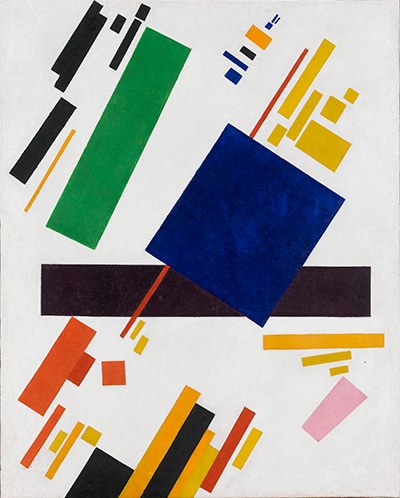
Malevich's arguments emerged while he was showing viewers new canvases, not after a settled style had been named for decades. MoMA's Suprematist Composition: Airplane Flying is dated 1915 by the museum, although “1914” is written on the reverse. Its coloured planes do not depict a literal aircraft. For MoMA, the artist's claim to “new painterly realism” concerns the visible facts of painting—colour, line and brushwork—rather than a return to illusionistic scene-making. The paradox of “realism” in the title begins to make sense when the painted relation is treated as real in its own right. [4]
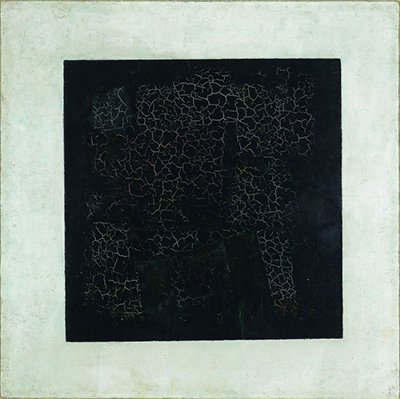
The 1915 Black Square pushes the question further. Its dark quadrilateral and pale field do not invite us to identify a pictured square object set in landscape space. They direct attention to the position, size, painted contour and relation of the two areas. The original canvas is an aged object with cracks and earlier work beneath it, so it must not be turned into a mathematically perfect symbol on a screen. The 0.10 exhibition placed it among many other canvases. A theory account should keep this room of varied works in view, instead of making every one of them an illustration of one sentence about a square. [5]
Before this moment Malevich painted rural labourers, machine-age movement and alogical combinations of recognisable objects. The Knife Grinder has a man and a task even as it breaks up their motion; An Englishman in Moscow names things but denies them a stable shared scene. Those paintings help us see why the later demand for autonomy of painted form was argued so sharply. The change was not from “art with thought” to “art without thought.” It was a question of what could organise a painting when an inherited subject and perspective no longer had to do the work. [3], [12]
The 1915 pamphlet and exhibition statement
The Malevich Society's bibliography lists a 1915 pamphlet, От кубизма к супрематизму: Новый живописный реализм, commonly rendered From Cubism to Suprematism: The New Painterly Realism. It separately lists a sheet of manifestos issued for the opening of the 0.10 exhibition, with Malevich, Ivan Kliun and Mikhail Menkov as named contributors. Those are related publications, not one anonymous block of words. The bibliography establishes their titles, makers and year; the physical 1915 pamphlet was not directly inspected for this page, so its exact wording is not quoted here. [1], [3]
The title sketches a journey through existing forms of modern painting toward something Malevich claimed as newly possible. Cubism and Futurism were not erased from his history; they were stages through which he described a break with imitation. The term “new painterly realism” is deliberately provocative. It asks the reader to consider the reality of a colour plane or a painted edge, rather than to search behind it for the object supposedly represented. In 1915 this was an argument bound to the works being shown. MoMA's museum essay on Airplane Flying is a useful interpretation of that claim, while the actual title and date of the pamphlet come from the specialist bibliography. [1], [4]
It is tempting to quote a famous phrase about becoming a “zero” of form as though it appeared unchanged in every edition. That would ignore the difference between an exhibition leaflet, the 1915 pamphlet and later reworkings. A phrase can be historically important and still require a named edition, page and translation before it can function as evidence. The Black Square article examines the contemporary room and later explanations; this page keeps the publication sequence visible. [1], [3], [5]
The 1916 “third edition” was a new argument
The National Library of Estonia provides a scanned Russian copy of Отъ кубизма и футуризма къ супрематизму. Новый живописный реализм, printed in Moscow in 1916. Its title page calls it a third edition. That is a fact about the object in the scan, but it is not a guarantee that a paragraph in this book already appeared in 1915. Aleksandra Shatskikh's critical edition notes that the 1916 text is greatly expanded and newly written, with a changed title. Both statements should be held together: the artist and publisher presented an edition sequence, while a specialist comparison finds substantial revision. [2], [3]
Early in the scanned text, on printed page 3, Malevich attacks the habit of expecting familiar natural views and ideal figures in pictures. He asks the reader to recognise a painterly work on its own terms. Later, on printed page 12, he describes painting as having been attached to things instead of autonomous. These are paraphrases of the inspected Russian page images. The old spelling and imperfect OCR make an effortless modern English “quote” unsafe; a critical translation would need to identify editorial choices. What is clear enough for this article is the direction of the argument: against the assumption that a painting's value rests on repeating the visible world. [2]
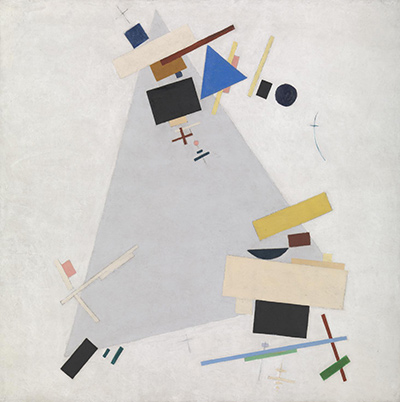
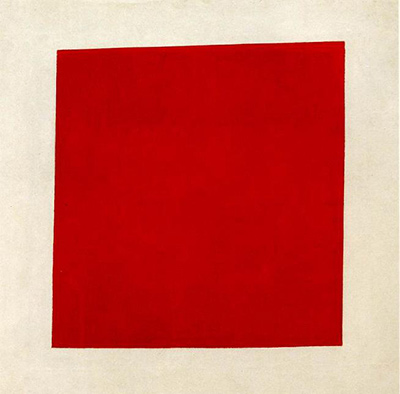
The presence of Futurism in the longer 1916 title also matters. It turns a two-step-sounding title into an explicit sequence of recent art movements. Malevich was not simply reporting neutral art history; he was making a polemical map in which his own new work appeared as the destination. A reader can study that claim without accepting that all artists progressed along the same road. The coloured planes of Red Square and Suprematist Composition make the practical variety of the new painting more evident than a title alone. [2], [3], [4]
What “nonobjective” means—and what it does not
“Nonobjective,” “objectless” and “without objects” are common English ways to convey terms in Malevich's Russian and the later German gegenstandslos. None means that the work is literally without a canvas, material or visible content. The painting can contain rectangles, colour, boundaries, brush marks and a physical support. The claim concerns the absence of a depicted object as the required subject and the rejection of ordinary subject matter as the primary source of pictorial value. That is why it is useful to look closely at a specific edge and field while reading the writing. [2], [4], [10]
The distinction also helps explain odd Suprematist titles. Airplane Flying invokes flight, but MoMA's work is not an airplane illustration. Painterly Realism of a Boy with a Knapsack similarly carries a figure in its extended title while showing isolated colour masses. The words could connect a new formal proposal to old categories or prompt questions about a fourth dimension, without licensing a claim that an unseen boy lies beneath every colour plane. The object's title, visible surface and dating must be read together. [4], [12]
Malevich's texts themselves do not allow the opposite simplification, that depicting a thing always makes a painting artistically worthless. The indexed German text of The Non-Objective World later distinguishes an object made the purpose of representation from the possible use of an object within a valuable artwork. This is one reason the late portraits and peasant canvases should not be treated as proof that their maker had forgotten his own theory. The 1927 account changes the terms of discussion from those of 1915, and the late works still need their own dates and contexts. [10], [12]
After White on White: books, teaching and systems
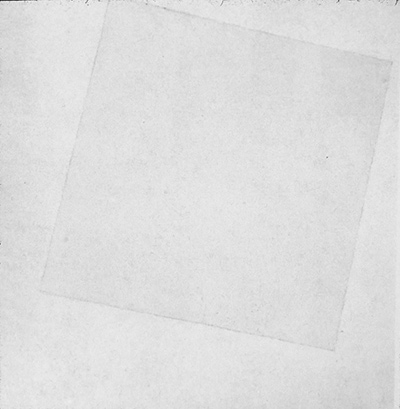
MoMA's White on White of 1918 is often used to mark an “end” of painting. The tilted pale form and surrounding white field are carefully differentiated, however, and Malevich went on making other visual work. He also devoted more energy to writing. The Malevich Society lists his 1919 pamphlet On New Systems in Art: Stasis and Speed, made in the Vitebsk period, and other texts that relate art to teaching and the creation of new systems. A retrospective announcement of painting's limit did not close the practical questions of how colour, form and institutions could operate. [1], [6], [12], [13]
The Russian National Electronic Library catalogues the original 1919 On New Systems in Art as a Vitebsk publication of 32 pages plus illustrated leaves. A critical Russian edition reproduces the text and describes its composition in 1919. There Malevich develops a vocabulary of economy, creative systems and the canvas as a site of construction. “Economy” in this setting should not be casually translated into a modern claim about household finance or state policy: it belongs to his changing account of artistic means. The national-library original could not be opened directly during this research, so this page identifies the edition used for its interpretive paraphrase and gives no false original-page citation. [6], [7]
In Vitebsk, writing and teaching joined collective production. UNOVIS was a group of teachers and students, not a one-man publishing imprint in the ordinary sense. The 1921 Path of UNOVIS is catalogued by MoMA with several named contributors. Malevich's own publications and the group's shared statements therefore require different attribution. The process of explaining a new form to students, designing for print and discussing the relation of an “I” to a collective extended the earlier dispute about a painting's subject into questions about how art was learned and used. [1], [9], [12]
Suprematism: 34 Drawings as a printed object
The 1920 Suprematism: 34 Drawings is an unusually concrete way to see theory leave the form of an essay. MoMA holds a copy with 35 lithographed illustrations including the cover and lithographed manuscript text. It identifies UNOVIS in Vitebsk as publisher and El Lissitzky as the probable printer. MoMA estimates an edition of about 100. Those qualifications matter: a catalogue's “probably” should not become a definite printing credit, and 34 in the title should not be expanded into a claim about all Malevich drawings. [8]
The book combines a hand-lettered introduction and a visual sequence of geometric elements. MoMA describes it as a theoretical and visual textbook. Its pages can show a reader how forms relate or change, rather than merely telling a reader that objects have been abandoned. The object is a printed multiple, unlike an individual drawing on paper or an oil canvas; it belongs in a prints guide only with its book, edition and medium stated. A photograph of one page cannot stand in for the full sequence. [8]
One museum label attached to the object gives a compact English formulation linking the black square to feeling and its white background to nothingness. Such statements are useful evidence of reception and translation, but the label alone does not name the exact Russian passage or edition from which each English word was taken. This page therefore explains the conceptual relationship without reproducing the line as an unqualified 1915 quotation. The quotes page must apply the same standard to every attributed aphorism. [8]
Later Vitebsk texts and a wider intellectual programme
The published-writing index records titles beyond a painting handbook: God is Not Cast Down: Art, the Church and the Factory in 1922, and periodical pieces on UNOVIS, poetry, museums and the party in art. A title by itself does not prove the full argument inside a text, yet the breadth of subjects is evidence that Malevich was not explaining only how to arrange a coloured square on a canvas. Religious, institutional and social language belongs to his writings; it must be studied in its original context rather than attached wholesale to any one painting. [1]
The same caution applies to the “Suprematist Mirror” and other later texts. Their terminology and dates can be found in the specialist bibliography, but a good explanation of a difficult passage would require the original or a named critical edition. It is better to give the reader an accurate route to the text than a confident-sounding but untraceable sentence. Within this cluster, the biography supplies the teaching chronology and the individual artwork pages show how theory did or did not align with each object. [1], [12]
The 1927 Bauhaus book: feeling, additional elements and space
Malevich's German Die gegenstandslose Welt (The Non-Objective World) appeared in 1927 as book 11 of the Bauhausbücher series. Heidelberg University Library's digitisation records two major parts: an introduction to the theory of the “additional element” in painting on printed pages 8–63, then a section on Suprematism on pages 64–100. The Met's catalogue of a 1980 reprint confirms the 1927 Munich original and notes that the later reprint includes facsimiles of unpublished Russian proofs. Bibliography and textual witness must be kept distinct: the Met record does not mean those proofs were the 1927 German pages. [10], [11]
In the German section on Suprematism, Malevich defines it through the priority of pure Empfindung in art. “Feeling” is a common English rendering; “sensation” is another possible shade. He argues that the particular visible thing which causes an experience is not the enduring artistic value in itself. He also allows that an object can appear within a work of high artistic value, while disputing the object as the aim of art. This is a paraphrase of the library's page-specific OCR for printed page 65, not a newly translated English quotation. The digitised page image was blocked during this research, so its OCR is treated as provisional for exact wording. [10]
The earlier part of the same book discusses “additional elements” by which Malevich characterises different artistic cultures. On printed page 59, the indexed text relates a dynamic straight line to Suprematism, contemporary aviation and a possible abstract architecture. These ideas move beyond the painterly argument of the 1915 pamphlet. The reader is now offered a proposed relation among artistic forms, environment, motion and spatial construction. The statement should not be used to claim that every Suprematist painting depicts an airplane or that an architecton was a realised building. [10]
The 1927 text also belongs to a particular international encounter. Malevich had travelled through Warsaw to Berlin, visited the Bauhaus and left works in the West when he returned to the Soviet Union. A German book could bring his ideas to readers who had not seen the 1915 exhibition. It was neither a neutral translation of all his prior writing nor the single final explanation of his career. Its title and language are part of its historical situation. [10], [12]
How to read a Malevich quotation responsibly
First identify the physical or editorial source: a 1915 pamphlet, a revised 1916 book, a Vitebsk publication, the 1927 German volume, a later critical edition or a museum label. Then identify the page, language and translator. An English maxim detached from those details may be memorable, but it cannot bear much evidential weight. A work's date and the quote's date must also be kept separate. A line written in 1927 may interpret a canvas from 1915 without recording exactly what the artist thought in the earlier room. [1], [2], [3], [10]
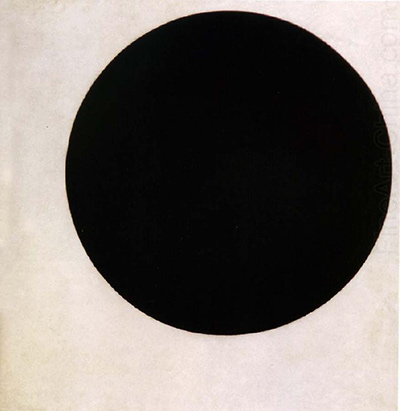
Second, look back at the object. The first Black Square has a specific installation, support and later material history. The 1916 Suprematist Composition has coloured masses and intervals very different from the square. The circa-1923 Black Circle on this site is a later physical version. An argument about basic form can help compare them, but it cannot make their dates, collections and surfaces identical. Exact object records should correct any too-general reading of a theoretical passage. [2], [4], [5]
Finally, distinguish Malevich's own polemical claims from a historian's explanation and this site's interpretation. MoMA's “textbook” description of 34 Drawings is a museum judgement about a book; Shatskikh's judgement that the 1916 “third edition” is substantially new is a scholarly comparison; and a reader's observation about a painted red edge is an interpretation of an image. Each is valuable when named for what it is. That discipline makes the writings more interesting, because they can be followed as changing acts of persuasion rather than stripped into decorative slogans. [3], [8]
A dated guide to the principal publications
| Year | Publication or text | What is secure from the consulted sources |
|---|---|---|
| 1915 | From Cubism to Suprematism: The New Painterly Realism | Bibliography identifies the pamphlet; the physical copy was not directly inspected. [1] |
| 1915 | Joint manifesto sheet for 0.10 | Malevich, Kliun and Menkov are named; their individual statements must not be collapsed. [1] |
| 1916 | From Cubism and Futurism to Suprematism | Moscow facsimile calls itself a third edition; critical edition describes major rewriting. [2], [3] |
| 1919 | On New Systems in Art: Stasis and Speed | National-library object record and a separately identified critical-edition text. [6], [7] |
| 1920 | Suprematism: 34 Drawings | MoMA catalogues a Vitebsk UNOVIS printed book with lithographs. [8] |
| 1921 | The Path of UNOVIS | MoMA catalogues a multi-contributor book; a collective context. [9] |
| 1922 | God is Not Cast Down | Bibliographically identified; passage-level interpretation remains open. [1] |
| 1927 | Die gegenstandslose Welt | Heidelberg digitisation documents two major parts; page-specific OCR checked with quotation caveat. [10] |
Documented Malevich collection records
Explore 665 catalogued source objects from museums and archives, including 87 exact links to local artwork pages. Records include works, print impressions, book components and archival items; they are not a deduplicated or complete oeuvre. Medium labels are grouped into broad English categories. Titles link to local artwork pages where available.
| Artwork title | Date | Medium |
|---|---|---|
| "Front line soldier" (Ratnik 1-go razriada) | Δεκαετία 1920 | Photograph |
| [Le Cheval blanc] | [circa 1930 - 1931] | Painting |
| [Sensation du danger] | [1930 - 1931] | Painting |
| A Game in Hell, Petrograd, 1913 (2nd expanded edition) | 1913 | Book |
| A Game in Hell: A Poem (Igra v adu: Poema) | 1914 | Book |
| A Peasant Woman Goes for Water | 1913 | |
| A pork-butcher came around to Lodz and we said "Good day." From Lodz to neighboring Radom he passed, and left behind one sorry ass. (Podoshel kolbasnik k Lodzi / my skazali : 'Pan dobrodzi!' Nu, a s Lodz'iu riadom Radom / i ushel s podbitym zadom.) | c. 1914 | |
| Alogisme 1. Portret Moskovskoy Damy (Alogisme 1. Portret van een Moskouse dame) | 1914 | Drawing |
| Alogisme 2. Vis, zaag, lepel, telegraafpaal | 1914 | Drawing |
| Alogisme 22. Malorossiyanin (Alogisme 22. Een kleine Rus) | 1915 | Drawing |
| Alogisme 23. Sobol, koshka (Alogisme 23. Sabel, kat) | 1915 | Drawing |
| Alogisme 29. Derevnya | 1915 | Drawing |
| Alogisme 3. Chastichnoe zatmenie (Alogisme 3. Gedeeltelijke eclips) | 1914 | Drawing |
| Alogisme 4. Apteka (Alogisme 4. Apotheek) | 1914 | Drawing |
| Alpha | 1923 / 1978 | Sculpture or object |
| An Austrian was going to Radzivily | 1914 | |
| An Austrian was going to Radzivily | 1914 | |
| Analytical Chart | 1924–27 | Drawing |
| Analytical Chart | 1924–27 | Drawing |
| Analytical Chart | 1924–27 | Drawing |
| Analytical Chart | 1924–27 | Drawing |
| Analytical Chart | 1924–27 | Drawing |
| Announcement for Malevich's lecture in Orenburg | 1917-1920 | |
| Apple Tree in Blossom | c. 1930 | Painting |
| Architecton Alpha | 1920 | Sculpture or object |
| Architecton Gota | 1923 (?) | Sculpture or object |
| Architectonische constructie | 1917 (versie ca. 1925) | Drawing |
| Architectons and Figurines | Späte 1920er Jahre | Sculpture or object |
| Architecturaal-kosmische compositie | 1920 (latere versie (1927?)) | Drawing |
| Architectural construction | ca. 1917 | Drawing |
| Aritmetica | 1913 | Drawing |
| Aritmetica | 1913 | Drawing |
| Arkhitekton Zeta | 1926 | Photograph |
| At Harvesting (Marfa and Vanka) | 1928-1929 | Painting |
| Aveniriens | vers 1931 - 1932 | Drawing |
| Aviator | 1914 | Painting |
| Aviator v Pobede nad solntsem (Vliegenier in Overwinning op de zon) | 1913 (versie ca. 1929) | Drawing |
| Baadsters op de rug gezien | 1910 | Painting |
| Back cover from Igra v adu (A Game in Hell) | 1913–14, published 1914 | Book |
| Back cover from Vzorval' (Explodity) | 1913 | Book |
| Bader | 1911 | Drawing |
| Betende Bäuerin | 1933 | Drawing |
| Biddende figuur | motief ca 1922, versie voor 1927 | Drawing |
| Birkenhain | um 1905 - 06 | Painting |
| Black Circle | c. 1923 | Painting |
| Black Cross | c. 1923 | Painting |
| Black quadrilateral | 1915 | Painting |
| Black Square | c. 1923 | Painting |
| Black Square and Circle | 1920-1921 | Drawing |
| Black Square and White Cylindrical Form | 1915 | Drawing |
| Black Square, Second State | 1915/20 | Drawing |
| Blacksmith | Study. 1933 | Painting |
| Blestifze (Pencils) | 1917–1918 | Drawing |
| Boer met baard | ca 1930 | Drawing |
| Boerenvrouw in het veld | ca. 1929-1930 | Drawing |
| Boerenvrouw met emmers | 1912 | Painting |
| Book of Selected Poems (Kniga izbrannykh Stikhotvorenii) | 1930 | Book |
| Boy (Vanka) | 1928–1929 | Painting |
| Boy wuth knapsack / Mal'chyk s rantsem | 1915 | |
| Brooch | 1920 | Sculpture or object |
| Brooch | 1920 | Sculpture or object |
| Bubnovy Valet 21. Boerenvrouw met kind | 1911-1912 (latere versie) | Drawing |
| Bubnovy Valet 40. Portret (van M.F. Larionov?) | 1910 | Drawing |
| Bubnovy Valet 41. Na uglu stoit apteka, lyubov sushit tseloveka (De drogist is op de hoek, van liefde droogt een man uit) | 1910-1911 (versie ca. 1930) | Drawing |
| Bubnovy Valet 42. Portret moei rodstvennitsy (Bubnovy Valet 42. Portret van mijn familielid) | 1911 | Drawing |
| Bubnovy Valet 43. Kop van een boer | 1912 (latere versie) | Drawing |
| Bubnovy Valet 44. Dansend paar | 1912 | Drawing |
| Bubnovy Valet 57. Lopende man | 1911 | Drawing |
| Bubnovy valet 8. Kop van een boer | 1912 | Drawing |
| Budetliyansky silach (Futuristische sterke man) | 1913 (versie 1915) | Drawing |
| Bêta | avant 1926 / 1978 | Sculpture or object |
| Car and Lady | Photograph | |
| Carpenter | 1928–1929 | Painting |
| Carré noir | [1923 - 1930] | Sculpture or object |
| Chelovek v ochkakh (Man met bril) | ca 1929 | Drawing |
| Compositie 1 z (Supremus nr. 67) | 1916 (versie jaren 1920) | Drawing |
| Compositie 10 t (Suprematisme: constructief moment) | 1917 | Drawing |
| Compositie 11 t (Supremus nr.18: constructievorming afhankelijk van de beweging naar een bol ) | 1916 | Drawing |
| Compositie 13 t (Supremus nr 38) | 1915-1916 | Drawing |
| Compositie 13 t (Supremus nr 38) | 1915-1916 (gedrukt 1920, annotaties jaren 1920) | |
| Compositie 14 t Oshchushchenie elektrichestva (Compositie 14 t Gevoel van electriciteit) | 1915 | Drawing |
| Compositie 15 k (Suprematisme) | 1916 (versie begin jaren 1920) | Drawing |
| Compositie 15 q (Supremus nr. 118) | 1918 | Drawing |
| Compositie 16 t (Suprematisme: groot zwart trapezium en vierkant tussen rechthoeken en lijnen) | 1915 | Drawing |
| Compositie 2 i (Suprematisme: gecombineerd gevoel: cirkel en vierkant) | 1916 (latere versie) | Drawing |
| Compositie 2 t (Verlengd vierkant met elementen overdwars) | 1915 (versie ca. 1920) | Drawing |
| Compositie 2 z Obshchushchenie magnita (Compositie 2 z Gevoel van een magneet) | 1916 (hernomen in 1919, versie jaren 1920) | Drawing |
| Compositie 3 t | 1916 | Drawing |
| Compositie 4 l Suprematisme van de geest | 1919 | Drawing |
| Compositie 4 t (Suprematisme: cirkel tussen rechthoeken en driehoeken) | 1916 | Drawing |
| Compositie 4 z (Supremus nr. 84) | 1916 (latere versie) | Drawing |
| Compositie 5 l Suprematisme van de geest | 1919 | Drawing |
| Compositie 6 d (Tekening verwant aan ‘Huis in aanbouw’) | 1915 | Drawing |
| Compositie 6 t Obshchushchenie vremeni (Compositie 6 t Gevoel van tijd) | 1916 | Drawing |
| Compositie 9 b. Fevralizm kak emotionizm (Compositie 9 b. Februarisme als emotionisme) | 1915 | Drawing |
| Compositie 9 h (Suprematisme: kruis en drie rechthoeken) | 1916 (versie 1920) | Drawing |
| Compositie 9 k (Suprematisme: zeven rechthoeken) | 1915 | Drawing |
| Compositie 9 t (Suprematisme: vier ruimtelijke elementen tegen een zwart trapezium) | 1915 | Drawing |
| Composition 1 e (Suprematisme: vierkant op diagonaal vlak) | 1915 | Drawing |
| Composition 1 t | [1916 / vers 1920] | Drawing |
| Composition 14 f | [1918] | Drawing |
| Composition 15 t | 1916 | Drawing |
| Composition 2 a | [1917 - 1918] | Drawing |
| Composition 3 z | [1919 / avant 1930] | Drawing |
| Composition 5 x | [été 1915] | Drawing |
| Composition 5 x | [été 1915] | Drawing |
| Composition alogique | [1915] | Drawing |
| Composition with La Gioconda (Partial Eclipse) | 1914 | Painting |
| Compositions 11 R | circa 1915–16 | Drawing |
| Construction 5 h | 1916 | Drawing |
| Costume study for the Budetlyan Athlete in Victory over the Sun | 1913 | Drawing |
| Cow and Violin | 1913 | Painting |
| Cow and Violin from On New Systems in Art (O Novykh Sistemakh Visk Usstve) | 1911–19 | |
| Croix [noire] | [1915] | Painting |
| Croix noire | [vers 1923 - 1926] | Sculpture or object |
| Dame | 1915 | Drawing |
| Dame an der Straßenbahnhaltestelle | 1913 | Drawing |
| Dame bij reclamezuil | 1914 | Painting |
| De gardist | 1913-1914 | Other |
| De houthakker (recto) / Boerenvrouwen in kerk (verso) | 1912 | Painting |
| De likdoornsnijder | 1911 | Drawing |
| De likdoornsnijder | 1911 | Drawing |
| De provincie | 1910 | Painting |
| De tuinman | 1911 | Painting |
| De vloerboeners | 1911 | Drawing |
| Der Häftling | 1930 | Drawing |
| Der Tod eines Menschen, gleichzeitig im Flugzeug und der Eisenbahn | um 1913 | |
| Desk and Room (legacy site: Bureau and Room) | 1913 | Painting |
| Dessin de Lissitzky d'après "Supremus n° 58, composition dynamique jaune et noire", 1916, de Malevitch | [1924] | Drawing |
| Deux plans de villes | [1916 / avant 1930] | Drawing |
| Deux plans en extension | [1916 - 1919] | Drawing |
| Diagramm | around 1917/1918 | Drawing |
| Die Hochzeit | 1903 | Other |
| Die Waschfrau | 1911 | Painting |
| Dorp | ca. 1906 | Other |
| Dorpje | 1908 | Drawing |
| Drei Köpfe | after 1930 | Drawing |
| Drie boerenvrouwen | 1917-1919 of eind jaren 1920 | Drawing |
| Drie figuren in een landschap | ca. 1928-1930 | Drawing |
| Drie naakte vrouwen en een kind, peren plukkend | 1909 | Drawing |
| Drie staande vrouwen | 1930 | Drawing |
| Drie vrouwenfiguren | ca 1905-1906 | Drawing |
| Druckstock für Holzschnitt | 1920 | |
| Dynamic Construction | 1923 | Photograph |
| Dynamic Figure from On New Systems in Art (O Novykh Sistemakh V Iskusstve) | 1911 | |
| Dynamic Suprematism | 1915/16 | Painting |
| Dynamisch suprematisme | 1917-1918 | Drawing |
| Een Engelsman in Moskou | 1914 | Painting |
| Een paar onder bomen | ca 1929 | Drawing |
| Elegant gezelschap in een park | ca 1908 | Drawing |
| Elementarer Suprematismus | 1917 | Drawing |
| Eléments d'architectone | [après 1924] | Drawing |
| Eléments non identifiés | [1923 - 1935] | Sculpture or object |
| Engelsman in Moskou | 1913-1914 | Drawing |
| Entwurf für das Gemälde 'Die roten Häuser' | 1910 | Drawing |
| Entwurf für die Bemalung der Pfeiler aus der Serie von Entwürfen für die Ausgestaltung des Roten Theaters in Leningrad | 1931 | Drawing |
| Entwurf für eine Deckenmalerei im Roten Theater in Leningrad | 1931 | Drawing |
| Eskiz k portretu Roslavtsa. Pesn golubym oblakam (Schets voor portret van de componist Roslavets. Lied van de blauwe wolken) | 1907-1908 | Drawing |
| Etude de paysan | fin 1911 | Drawing |
| Etyud suprematis 52 sistema A 4 | 1916-1917 (versie 1920-1927) | Drawing |
| Explodity (Vzorval') | 1913 | Book |
| Explodity (Vzorval') | 1913 | Book |
| Explodity (Vzorval) | 1913 | Book |
| Female Figure | 1928–1929 | Painting |
| Female portrait | ca. 1910-1911 | Painting |
| Female Torso | 1928–1929 | Painting |
| Female Torso | 1928-1929 | Painting |
| Figur mit ausgebreiteten Armen, ein Kreuz bildend | 1933 | Drawing |
| Figuren in Schwarz und Weiß | 1928/1930 | Drawing |
| Flower Seller | 1930 | Painting |
| Folio 1 from Igra v adu (A Game in Hell) | 1913–14, published 1914 | Book |
| Folio 15 from Igra v adu (A Game in Hell) | 1913–14, published 1914 | Book |
| Folio 17 verso from Igra v adu (A Game in Hell) | 1913–14, published 1914 | Book |
| Folio 18 from Igra v adu (A Game in Hell) | 1913–14, published 1914 | Book |
| Folio 19 from Igra v adu (A Game in Hell) | 1913–14, published 1914 | Book |
| Folio 19 from Vzorval' (Explodity) | 1913 | Book |
| Folio 20 from Igra v adu (A Game in Hell) | 1913–14, published 1914 | Book |
| Folio 23 from Vzorval' (Explodity) | 1913 | Book |
| Folio 25 from Igra v adu (A Game in Hell) | 1913–14, published 1914 | Book |
| Folio 27 from Igra v adu (A Game in Hell) | 1913–14, published 1914 | Book |
| Folio 27 from Vzorval' (Explodity) | 1913 | Book |
| Folio 29 from Igra v adu (A Game in Hell) | 1913–14, published 1914 | Book |
| Folio 31 from Vzorval' (Explodity) | 1913 | Book |
| Folio 32 verso from Igra v adu (A Game in Hell) | 1913–14, published 1914 | Book |
| Folio 34 verso from Igra v adu (A Game in Hell) | 1913–14, published 1914 | Book |
| Folio 37 from Igra v adu (A Game in Hell) | 1913–14, published 1914 | Book |
| Folio 4 verso from Igra v adu (A Game in Hell) | 1913–14, published 1914 | Book |
| Folio 7 from Igra v adu (A Game in Hell) | 1913–14, published 1914 | Book |
| Folio 9 from Igra v adu (A Game in Hell) | 1913–14, published 1914 | Book |
| Footballer / Futbolist | 1915 | |
| Four Squares | 1915 | Painting |
| Fragmenten van een tekst over het suprematisme | 1927 | Other |
| From Cubism and Futurism to Suprematism (Ot kubizma i futurizma k suprematizmu) | 1916 | Book |
| Front cover from Igra v adu (A Game in Hell) | 1913–14, published 1914 | Book |
| Fruit plukken / Overvloed | 1909 | Painting |
| Fuhrleute | 1909-1910 | Drawing |
| Full portrait of Malevich | 1931 | Photograph |
| Futuristische draak | 1913 | |
| Futurizm: dvizhenie cheloveka po lestnitse (Futurisme: beweging van een man op een trap) | 1919 | Drawing |
| Gebet II | um 1913 | |
| Gesellschaft in Zylindern | 1907 | Drawing |
| Girl in the Countryside | 1928–1929 | Painting |
| Girls in a Field | 1928-1929 | Painting |
| Gliad', pogliad' uzh blizko Visly. Nemtsev puchit, znachit kislo. | 1914/1918? | |
| Glyad, poglyad, uzh blizko Visly | 1914 | |
| Golgatha | around 1911 | Drawing |
| Gota | 1923 / 1978 | Sculpture or object |
| Gota 2-a | 1923 / 1978 | Sculpture or object |
| Grafik ... | ca. 1923 | Other |
| Grafik dvizheniya tvorcheskikh edinits v beskonechnosti | ca. 1923 | Other |
| Grammatica | 1913 | Drawing |
| Harvesting | Study for a painting. 1928–1929 | Painting |
| Head of a Peasant | Early 1930s | Painting |
| Head of a Peasant | 1928-1929 | Painting |
| Head of a Peasant | 1928–1929 | Painting |
| Hiëratisch suprematistisch kruis (groot kruis in zwart over rood op wit) | 1920-1921 | Painting |
| Houses of the Future Leningrad: Pilot's House | 1924 | Drawing |
| Huis, man, ladder | 1930-1931 | Drawing |
| Huit dessins suprématistes | [1917 / avant 1930] | Drawing |
| Huizen op het platteland | ca. 1906 | Other |
| Häuser und Kreuze (Golgatha) | 1930 | Drawing |
| I yu mane tor | ca. 1915 | Drawing |
| Igra v adu | 1914 | Other |
| Igra v adu (A Game in Hell) | 1914 | Book |
| Igra v adu (A Game in Hell) | 1914 | Book |
| Igra v adu (A Game in Hell) | 1914 | Book |
| Igra v adu (A Game in Hell) | 1913–14, published 1914 | Book |
| II | 1913 | Drawing |
| Illustration for the book by Aleksei Kruchenykh and Velimir Khlebnikov "Igra v Adu»" (2nd edition, Moscow 1914) | 1914 | |
| Ils vont à l'église | 1928 - 1932 | Drawing |
| Into Wagons of the French, German Corpses Were Tightly Wrenched; Their English Brothers Carried Kegs Stuffed with Germans Who Lost Their Legs | c. 1914 | |
| Izbornik stikhov s poslesloviem rechiaria. 1907–1914 gg. (A Selection of Poems with an Afterword by the Wordsmith: 1907–1914) | 1914 | Book |
| Jnitsa | 1913 | Drawing |
| K.Malevich, M.Matiushin, A.Kruchenykh, St.Petersburg, December 1913 | 1913 | Photograph |
| K.Malevich, M.Matiushin, A.Kruchenykh, St.Petersburg, December 1913 | 1913 | Photograph |
| K.Malevich, M.Matiushin, A.Kruchenykh, St.Petersburg, December 1913 | 1913 | Photograph |
| Kabarett | 1930 | Drawing |
| Kazimir Malevich lying seriously ill in his bed, shortly before he died | 1935 | Photograph |
| Kettle with lid | 1923 | Sculpture or object |
| Komposition mit einer Figur | after 1930 | Drawing |
| Konstruktion | around 1915 | Drawing |
| Kop van een boer, kruis, en landschap | 1928-1929 | Drawing |
| Kop van een boerenmeisje | 1912 | Painting |
| Kop van een boerenvrouw | 1913 | Drawing |
| Kopf | 1930 | Drawing |
| Kopf | around 1930 | Drawing |
| Kostüm für das Stück 'Maskenball' | 1913 | Drawing |
| Krestyanka (Boerenvrouw) | 1913 | |
| Krestyanka idet po vodu (Boerin haalt water) | 1913 | |
| Kubisme 25. Avtoportret (Kubisme 25. Zelfportret) | 1913 | Drawing |
| Kubisme 6. Wandklok | 1913 | Drawing |
| Kubisme 9. Molitva (Kubisme 9. Gebed) | 1913 | Drawing |
| Kubistische compositie | ca 1925 | Drawing |
| Kubistische figuur staand op de rug gezien | 1912-1913 (versie ca. 1925) | Drawing |
| Kubofuturistische compositie met piano | 1913-1914 | Painting |
| Kubosuprematismus | 1916/1920 | Drawing |
| Kuppel des Volkshauses in Leningrad | 1931 | Drawing |
| Lamp - Musical Instruments | Δεκαετία 1920 | Photograph |
| Lamp / Muziekinstrumenten | 1913 | Painting |
| Landscape | 1911 | Painting |
| Landscape | c. 1906 | Painting |
| Landscape with a White House | 1928–1929 in Gasper-Hulvat 2012; Christie’s groups work with early-1930s landscapes | Painting |
| Landscape with a Yellow House (Winter Landscape) | c. 1906 | Painting |
| Landscape with Five Houses | 1928–1929 | Painting |
| Landscape with house | c. 1905-1906 | Painting |
| Landschaft | around 1933/34 | Other |
| Landschaft (Der Winter) (Landscape (Winter)) | after 1927 | Painting |
| Lauf | 1917 | Drawing |
| Let's Grumble (Vozropshchem) | 1913 | Book |
| Liggende naakte vrouw met twee spelende kinderen | 1908 | Drawing |
| Lopende man met zaag onder de arm | ca. 1928-1929 | Drawing |
| Maaiende vrouw | 1913 | Drawing |
| Maaiende vrouw | 1913 | Drawing |
| Maaiende vrouw | 1913 | Drawing |
| Maaiende vrouw | 1912-1913 | Drawing |
| Magnetic construction | Drawing | |
| Magnetisch architectonische compositie | ca. 1920 (versie 1925-1926) | Drawing |
| Magnetischer Suprematismus | 1916 | Drawing |
| Male Portrait | 1933–1934 | Painting |
| Malevich archief | 1913-1927 | Other |
| Malevich with his students (UNOVIS) | Μάιος 1922 | Photograph |
| Man met zak | 1910-1911 | Painting |
| Manifesto handbill for the 0.10 exhibition | 1915 | Book |
| Mann in suprematistischer Landschaft | um 1930 - 31 | Painting |
| Mann mit Pferd | 1933 | Drawing |
| Manuscript with drawings, Page 27, 1 July 1916 | 1916 | Other |
| Maternity. Woman in Birth | 1908 | Drawing |
| Moederschap / Overvloed | 1910 | Painting |
| Morning in the Village after Snowstorm | 1912 | Painting |
| Muziekinstrument | 1913 | Drawing |
| Muziekinstrumenten | 1913-1914 | Drawing |
| Mystic Suprematism (Black Cross on Red Oval) | 1920–22 | Painting |
| Mysticus | 1930 | Drawing |
| Mystiek suprematisme (rood kruis op zwarte cirkel) | 1920-1922 | Other |
| Naakt met geheven handen | 1908 | Drawing |
| Nachtwandeling | 1909-1910 | Drawing |
| Nu i tresk-zhe, nu i grom-zhe byl ot niemtsev podlie Lomzhi. | 1914/1918? | |
| O Novykh Sistemakh V Iskusstve (On New Systems in Art) | 1919. (Prints executed 1910-1919). | Book |
| O novykh sistemakh v iskusstve. Statika i skorost' | 1919 | Other |
| O novykh systemakh v iskusstve. Statika i skorost' ( On New Systems in Art: Statics and Speed ) | 1919 | Book |
| O novykh systemakh v iskusstve: Statika i skorost’ (On New Systems in Art: Statics and Speed), Vitebsk | 1919 | Book |
| Ohne Titel | around 1904-1908 | Drawing |
| Ohne Titel | 1916 | Drawing |
| Ohne Titel | around 1931 | Drawing |
| Ohne Titel | 1916 | Drawing |
| Ohne Titel | around 1916 | Drawing |
| Ohne Titel (Untitled) | 1917–1930 | Drawing |
| Omslag van A. Kruchenykh en V. Khlebnikov, Igra v adu (Een spel in de hel) | 1913-1914 | |
| Omslag van Sezd Komitetov Derevenskoi Bednoty (Congres van Comités van Armoede op het Platteland) | 1918 | |
| Omslag van Troe (Het drietal) | 1913 | |
| Omslagontwerp voor Internatsional iskusstva (Internationale van de kunst) | 1918 | |
| Omslagontwerp voor N.N. Punin, Pervy tsikl lektsii (Eerste cyclus van lezingen) | 1920 | Drawing |
| Omslagontwerp voor Troe (Het drietal) | 1913 | Drawing |
| Ontwerp voor een architecton type 'Alfa' | ca 1925-1926 | Drawing |
| Ontwerp voor een architecton type Alfa | 1925-1929 | Drawing |
| Ontwerp voor een monument | ca. 1932-1933 | Drawing |
| Ontwerp voor een monument | ca. 1932-1933 | Drawing |
| Ontwerp voor een monument | ca. 1932-1933 | Drawing |
| Oogstende vrouwen/Het binnenhalen van de rogge II | 1912 | Other |
| Op de boulevard | 1910 | Painting |
| Opdoemende kruisvorm | 1917-1918 | Drawing |
| Ornements suprématistes | 1927 / 1978 | Sculpture or object |
| Ot kubizma i futurizma k suprematizmu. Novyi zhivopisnyi realizm (From Cubism and Futurism to Suprematism: New Painterly Realism) | 1916 | Book |
| Ot kubizma k suprematizmu. Novy zhivopisny realizm | 1916 | Other |
| Ot Sezanna do Suprematizma. Kritichesky ocherk | 1920 | Book |
| Ot Sezanna do Suprematizma. Kritichesky ocherk. | 1920 | Other |
| Paard en koets in beweging | 1913 | Drawing |
| Painterly Realism of a Boy with a Knapsack - Color Masses in the Fourth Dimension | 1915 | Painting |
| Painterly Realism of a Football Player—Color Masses in the 4th Dimension | Summer/fall 1915 | Painting |
| Patriotic poster against the Germans | 1914 | |
| Patriotic Poster Against the Germans | 1914 | |
| Patriotic Poster Against the Germans | 1914 | |
| Patriotic Poster Against the Germans | ||
| Patriotic propaganda postcard with verse by Vladimir Mayakovsky | 1914 | Book |
| Patriotic propaganda postcard with verse by Vladimir Mayakovsky | 1914 | Book |
| Patriotic propaganda postcard with verse by Vladimir Mayakovsky | 1914 | Book |
| Patriotic propaganda postcard with verse by Vladimir Mayakovsky | 1914 | Book |
| Patriotic propaganda postcard with verse by Vladimir Mayakovsky | 1914 | Book |
| Patriotic propaganda postcard with verse by Vladimir Mayakovsky | 1914 | Book |
| Patriotic propaganda postcard with verse by Vladimir Mayakovsky | 1914 | Book |
| Patriotic propaganda postcard with verse by Vladimir Mayakovsky | 1914 | Book |
| Patriotic propaganda postcard with verse by Vladimir Mayakovsky | 1914 | Book |
| Patriotic propaganda postcard with verse by Vladimir Mayakovsky | 1914 | Book |
| Patriotic propaganda postcard with verse by Vladimir Mayakovsky | 1914 | Book |
| Patriotic propaganda postcards with verse by Vladimir Mayakovsky | 1914 | Book |
| Paysanne | [1912 / 1932] | Drawing |
| Paysanne et deux enfants | [1911 / avant 1930] | Drawing |
| Peasant | Between 1930–1932 | Painting |
| Peasant bringing Water | 1912 (Thema), 1920er Jahre (Ausführung) | Drawing |
| Peasant in a Field | 1928–1929 | Painting |
| Peasant Woman | Early 1930s | Painting |
| Peasants | c. 1930 | Painting |
| Peasants | circa 1928 (NGA); 1928–1929 (Gasper-Hulvat) | Painting |
| Perfected Portrait of Ivan Kliun | 1913 | Painting |
| Peruyi Tsikl Lektsii | 1920 | Book |
| Pervyi tsikl lektsii chitannykh na kratkosrochnykh kursakh dlia uchitelei risovaniia (First Series of Lectures, Given at a Short-Term Course for Teachers of Drawing) | 1920 | Book |
| Plan d'éléments d'architectone | [après 1924] | Drawing |
| Planetaire constructie (magnetische kruisvorm) | 1916-1917 (ontwikkeld 1920-1922, latere versie (voor 1927)) | Drawing |
| Planetary-Architectural Suprematism | 1919-1920 | Drawing |
| Plate (folio 17) from Vzorval' (Explodity) | 1913 | Book |
| Plate (folio 21) from Igra v adu (A Game in Hell) | 1913–14, published 1914 | Book |
| Plate (folio 22) from Vzorval' (Explodity) | 1913 | Book |
| Po utru iz Lvova vyshli | 1914 | |
| Pobeda nad solntsem. Opera (Victory over the Sun: An Opera) | 1913 | Book |
| Podoshel kolbasnik k Lodzi | 1914 | Drawing |
| Pokhoronnoe byuro (Begrafeniskantoor) | 1914-1915 | Drawing |
| Porosiata | Saint Petersburg: 1913 | Book |
| Porosiata (Piglets) | 1913 | Book |
| Portrait of a Youth | 1933 | Painting |
| Portrait of M. V. Matyushin | 1913 in gallery-magazine object record; 1913–14 in Tretyakov education page | Painting |
| Portrait of the Artist’s Wife | 1933 | Painting |
| Portret M.V. Matyushina (Portret van M.V. Matyushin) | 1913 | Drawing |
| Portret stroitelya usovershenstvovan (Verbeterd portret van een bouwer) | 1913 | Drawing |
| Portret van de vader van de kunstenaar | ca 1902-1903 | Painting |
| Portret van een jonge vrouw (waarschijnlijk Sofia Rafalovitch) | 1908-1909 | Drawing |
| Portret van een man (Aleksei Morgunov?) | 1912 | Other |
| Portret van M.V. Matyushin | 1913 | Drawing |
| Prayer | 1913 | Drawing |
| Prayer | 1913 | |
| Prayer | Study for a fresco painting. 1907 | Painting |
| Prayer (plate, folio 19) from Vzorval' (Explodity) | 1913–14, published 1914 | Book |
| Primitiv (Schuhmacher) | 1910 | Drawing |
| Prografachnik | 1916 | Drawing |
| Projekt einer kosmischen Anlage | around 1917 | Drawing |
| Quadrat und Oval | 1915/1916 | Drawing |
| Quadrat und Viereck | 1914-1915 | Drawing |
| Red Cavalry | c. 1932 | Painting |
| Red House | 1932 | Painting |
| Red Square | Undated | Drawing |
| Red Square. Painterly Realism of a Peasant Woman in Two Dimensions | 1915 | Painting |
| Reicher Mann | around 1910 | Drawing |
| Relaxing (Society in Top Hats) | 1908 | Drawing |
| Reservist of the First Division | fall-winter 1914 | Painting |
| Roar!: Gauntlets of 1908-1914 (Riav!: Perchatki 1908-1914) | 1914 | Book |
| Rotes Quadrat auf Schwarz | around 1922 | Other |
| Samovar | 1913 | Painting |
| Schema I: Construction of Axes of a Model; Schema II: Cubist Structure (Construction); Schema III: Cubist Constructed Drawing from On New Systems in Art (O Novykh Sistemakh Visk Usstve) | 1919 | |
| Schets vooor de opera Voyna (Oorlog): Topor molodets ne brekhal (de jongeman Topor heeft niet gelogen) | 1918 | Drawing |
| Schets voor de opera Voyna (Oorlog): Bas, day stakan (Bas, geef me een glas) | 1918 | Drawing |
| Schets voor de opera Voyna (Oorlog): gekruisigde tegen een lichte achtergrond | 1918 | Drawing |
| Schets voor de opera Voyna (Oorlog): gekruisigde tegen een zwarte achtergrond | 1918 | Drawing |
| Schets voor de opera Voyna (Oorlog): interieur met figuur en hangend kruisbeeld | 1918 | Drawing |
| Schets voor de opera Voyna (Oorlog): Odin tikho (een stille) | 1918 | Drawing |
| Schets voor een architectonische structuur | 1920-1921 (versie 1923-1924) | Drawing |
| Schetsboekomslag | Drawing | |
| Schneider, Allogismus, Aushang | around 1915 | Drawing |
| Schnitter | 1909-1910 | Drawing |
| Schnitterinnen | 1909-1910 | Drawing |
| Schnitterinnen (Reapers) | 1909–1910 | Drawing |
| Schwarzes Viereck | 1914-1915 | Drawing |
| Scène uit Anathema | 1909-1910 | |
| Segodnyashnye sooruzheniya | 1920 (versie 1923-1924) | Drawing |
| Segodnyashnye sooruzheniya | 1923-1924 / 2010 | Other |
| Selected Verse, 1907–1914 (Izbornik stikhov, 1907-1914) | 1915 | Book |
| Self-Portrait | Study for a fresco painting. 1907 | Painting |
| Self-Portrait | 1910–1911 | Drawing |
| Self-Portrait (Artist) | 1933 | Painting |
| Shel avstriec v Radzivily | 1914 | |
| Sieg über die Sonne 1913-1973 | 1973 | |
| Sieg über die Sonne 1913-1973 | 1973 / 2010 | Other |
| Simultaneous Death in an Airplane and at the Railway | (1913) | |
| Simultaneous Death of a Man in an Airplane and on the Railroad (plate, folio 15) from Vzorval' (Explodity) | 1913–14, published 1914 | Book |
| Sketch for "Vertical Suprematist Construction»" | Undated | Drawing |
| Sketch for a Stage Curtain for the Opera Victory over the Sun | 1928 | Drawing |
| Sketch for Agit-Train | περ. 1918 | Drawing |
| Slovo Kak Takavoe (The Word as Such) | 1913 | Book |
| Slovo kak takovoe (The Word as Such) | 1913 | Book |
| Smert cheloveka odnovremmeno na aeroplane i zhel. doroge (De gelijktijdige dood van een man in een vliegtuig en op de spoorlijn) | 1913 | |
| Sportsmen | 1928–1932 | Painting |
| Square and Cone | 1915 | Drawing |
| Staande boer | 1928-1929 | Drawing |
| Staande boer met emmer | 1930-1932 | Drawing |
| Staande boer met zeis bij het hooien | 1928-1929 | Drawing |
| Staande duivel | 1913-1914 | |
| Staande figuur | 1927 | Drawing |
| Staande mannenfiguur | 1930-1931 | Drawing |
| Staande vrouw en man Kop en schouders Vijf figuren met twee suprematistische elementen | 1918 (latere versie) | Drawing |
| Staande vrouw met de armen over elkaar | ca 1930 | Drawing |
| Standing Figure | 1913 | Drawing |
| Standing Woman | circa 1930 | Drawing |
| Stikhi V. Maiakovskogo. Vypyt (The Poetry of V. Mayakovsky. [Vypyt]) | 1914 | Book |
| Still Life | c. 1910 | Drawing |
| Stroyuschiysya dom [House under construction] | 1915–16 (museum); reverse inscription 1914 distinguished from execution date | Painting |
| Studie für das Gemälde 'Die Rote Kavallerie' | 1930 | Drawing |
| Studie nach Picasso. Entwurf für das Bauhausbuch 'Die Gegenstandslose Welt' | 1926/1927 | Drawing |
| Studie nach Picasso. Entwurf für das Bauhausbuch 'Die Gegenstandslose Welt' | 1926/1927 | Drawing |
| Study for the rear curtain for Victory over the Sun | 1913 | Drawing |
| Study for the rear curtain for Victory over the Sun | 1913 | Drawing |
| Summer Landscape (Zomerlandschap) | circa 1929 | Painting |
| Suprematicheskoe postroenie N 118 (Suprematistische constructie nr. 118) | 1917-1918 (versie 1920) | Drawing |
| Suprematisch kruis (klein kruis in zwart over rood op wit) | 1920-1927 | Other |
| Suprematism | 1915 | Drawing |
| Suprematism | 1915 | Painting |
| Suprematism | 1915–1916 | Painting |
| Suprematism (Supremus No. 56) | 1915-16 | Painting |
| Suprematism (Supremus No. 58) | 1916 | Painting |
| Suprematism, 18th Construction | 1915 (artist's reverse inscription reads 1914) | Painting |
| Suprematisme | 1917-1918 | Drawing |
| Suprematisme van de geest | 1919 | Other |
| Suprematisme. Oplossende constructie, vorm 78 | 1918 (latere versie (1927)) | Drawing |
| Suprematisme: Compositie 5 c | 1915-1917 | Drawing |
| Suprematisme: drie overlappende rechthoeken | 1916-1917 (latere versie) | Drawing |
| Suprematisme: drie snijdende vlakken, vervagend | 1917-1918 | Drawing |
| Suprematisme: elementen in wisselwerking, vervagend | 1917-1918 | Drawing |
| Suprematisme: formatie van rechthoeken | 1916 (latere versie) | Drawing |
| Suprematisme: formatie van rechthoeken en vierkanten van verschillende grootte | 1916 (latere versie) | Drawing |
| Suprematisme: formatie van rechthoeken van verschillende grootte | 1916 (latere versie) | Drawing |
| Suprematisme: gevoelens van angst | 1917-1919 | Drawing |
| Suprematisme: in tweeën | 1917-1919 | Drawing |
| Suprematisme: krommingen en bogen | 1917-1918 | Drawing |
| Suprematisme: magnetische rechthoeken in stervorm Vier kaderlijnen | 1917-1919 | Drawing |
| Suprematisme: magnetische staven | 1917 | Drawing |
| Suprematisme: ovaal en rechthoek Twee staande vrouwen in een landschap Man met hoed (zogenaamd portret van Larionov?) Boer Vier figuren | 1916-1917 (latere versie) | Drawing |
| Suprematisme: Ovaal, boog en rechthoeken | 1917 | Drawing |
| Suprematisme: twee snijdende vlakken, vervagend | 1917-1918 | Drawing |
| Suprematisme: twee snijdende vlakken, vervagend Suprematisme: drie snijdende vlakken, vervagend | 1917-1918 | Drawing |
| Suprematisme: zwart vierkant en witte rechthoek met rode strepen | 1917-1919 | Drawing |
| Suprematismus | 1912-1913 | Drawing |
| Suprematist Composition | 1915 | Drawing |
| Suprematist composition | c. 1916 | Drawing |
| Suprematist Composition | 1916 | Photograph |
| Suprematist Composition | 1916 | Painting |
| Suprematist Composition with Plane in Projection | 1915 | Painting |
| Suprematist Composition: Airplane Flying | 1915 (dated on reverse 1914) | Painting |
| Suprematist Composition: White on White | 1918 | Painting |
| Suprematist Diagonal Construction 79 | 1917 | Drawing |
| Suprematist Drawing | (c. 1916-17) | Drawing |
| Suprematist Drawing | (c. 1916-17) | Drawing |
| Suprematist Element: Circle | (1923) | Drawing |
| Suprematist Elements: Squares | 1923 | Drawing |
| Suprematist interior decoration | 1920-1921 | Drawing |
| Suprematist Painting | 1916-17 | Painting |
| Suprematistisch schilderij (met zwart trapezium en rood vierkant) | 1915 | Other |
| Suprematistische compositie | 1915 (versie 1920-1927) | Drawing |
| Suprematistische compositie (met acht rode rechthoeken) | 1915 | Painting |
| Suprematistische compositie (met blauwe driehoek en zwarte rechthoek) | 1915 | Painting |
| Suprematistische compositie (met gele, oranje en groene rechthoek) | 1915-1916 | Other |
| Suprematistische Elemente im Raum | 1914-1915 | Drawing |
| Suprematistische Komposition | 1915-1916 | Drawing |
| Suprematistische Komposition | 1915/1916 | Drawing |
| Suprematistische Komposition (Suprematist Composition) | 1915 | Painting |
| Suprematistische schets | 1915-1920 | Drawing |
| Suprematistische Zeichnung (Plan eines Erdflugplatzes) | 1927 | Drawing |
| Suprematistisches Architekton | around 1926 | Sculpture or object |
| Suprematizm. 34 risunka | 1920 | |
| Suprematizm. 34 risunka (Suprematism: 34 Drawings) | 1920 | Book |
| Supremus No. 18 | 1916–1917 | Drawing |
| Supremus nr 51 | 1916 (versie 1920-1927) | Drawing |
| Supremus Nr. 38 | 1916 | Other |
| Supremus nr. 50 | 1915 | Other |
| Supremus nr. 58 | 1916 (versie begin jaren 1920) | Drawing |
| Sushchestvuet énergiya v sushchestve kot | ca. 1923 | Other |
| Sämann | 1910/1912 | Drawing |
| Tenhemelopneming van een heilige | 1907-1908 | Drawing |
| The Triumph of Heaven | 1907 | Painting |
| The UNOVIS way (Put' Unovisa) | Ιανουάριος 1921 | |
| The Word As Such (Slovo kak takovoe) | 1913 | Book |
| Third State of Being | designed in 1915, made in the 1920s | Drawing |
| Three Female Figures | Early 1930s | Painting |
| Threesome (Troe) | 1913 | Book |
| Thèmes pour des monuments architecturaux dans des parcs et sur des places | 1927 / 1978 | Sculpture or object |
| Tizian | around 1930 | Drawing |
| Tochil’schik Printsip Mel’kaniia (The Knife Grinder or Principle of Glittering) | 1912–13 | Painting |
| Toekomstige planits voor Leningrad. Het huis van de vliegenier | 1924 | Drawing |
| Toekomstige planits, huizen voor aardbewoners | 1920-1921 (versie 1923-1924) | Drawing |
| Toneelontwerp voor akte 1, scène 4 van Overwinning op de zon | 1913 | Drawing |
| Toneelontwerp voor Overwinning op de zon | 1913 (versie 1915) | Drawing |
| Torse féminin | [1908 / avant 1930] | Drawing |
| Torso (Figure with a Pink Face) | 1928–1929 | Painting |
| Torso (Prototype of a New Image) | 1928–1929 | Painting |
| Torso in a Yellow Shirt (Complicated Premonition) | c. 1932 | Painting |
| Transrationele compositie: geluiden | 1913 | Drawing |
| Trees | circa 1904 | Painting |
| Triple Portrait | Study for Socialist City (unexecuted). 1933 | Painting |
| Troe (The Three) | 1913 | Book |
| Troe (The Three) | 1913 | Book |
| Trois croix | vers 1930 - 1932 | Drawing |
| Trois dessins : tête de femme, buste et visage | [1908 / avant 1930] | Drawing |
| Troye | 1913 | Other |
| Tvorchestvo ne mozhet byt' svobodno | ca. 1923 | Other |
| Tvorchestvo ne mozhet byt' svobodno | ca. 1923 | Other |
| Twee duivels die een vrouw doormidden zagen | 1913-1914 | |
| Twee mannen in beweging | 1917-1918 of ca. 1930 | Drawing |
| Twee naakte vrouwen peren plukkend | 1909 | Painting |
| Twee vrouwen en een man tegen een lage horizon | 1930 | Drawing |
| Two figures with a stretcher | ca. 1930-1931 | Drawing |
| Two Male Figures | Early 1930s | Painting |
| Tête noire | vers 1930 | Drawing |
| Universal Landscape | 1913 | |
| UNOVIS Questionnaire | 1920 | |
| Untitled | 1920 | Drawing |
| Untitled | c. 1920 | |
| Untitled | αχρονολόγητο | |
| Untitled | Undated | Drawing |
| Untitled | Undated | Drawing |
| Untitled | 1913? | Drawing |
| Untitled (Suprematist Composition) | circa 1919–1926 | Drawing |
| Untitled (Suprematist Composition) | circa 1919–1926 | Drawing |
| Untitled (Suprematist Cross) | 1920, printed 1973 | |
| Untitled, Illustration for the book by Aleksei Kruchenykh and Velimir Khlebnikov "Igra v Adu»" (2nd edition, Moscow 1914) | 1913 | |
| Verdwijnend geel vlak | 1917-1918 | Painting |
| Verdwijnende constructie (diagonale balk met drie bogen in wit) | ca. 1917 | Other |
| Verdwijnende witte vlakken | 1917-1918 | Other |
| Verklarende kaarten over de theorie van het additionele of toegevoegde element in de schilderkunst | 1927 | Drawing |
| Verticale constructie, suprematisme | 1919-1920 (versie 1920-1925) | Drawing |
| Vier figuren in een landschap | ca. 1928-1930 | Drawing |
| Vijf geketende figuren op de rug gezien, geflankeerd door twee bewakers | 1910-1911 | Drawing |
| Vil'gel'mova Karusel' (Wilhelm's Carousel) | 1914 | |
| Vloerboeners | 1911 | Drawing |
| Voorstudie voor het omslag van het programma van het Congres van Comités van Armoede op het Platteland | 1918 | Drawing |
| Voorstudie voor het omslag van het programma van het Congres van Comités van Armoede op het Platteland | 1918 | Drawing |
| Voorstudie voor het omslag van Sezd Komitetov Derevenskoi Bednoty (Congres van Comités van Armoede op het Platteland) | 1918 | Drawing |
| Voorstudie voor het omslag van Sezd Komitetov Derevenskoi Bednoty (Congres van Comités van Armoede op het Platteland) | 1918 | Drawing |
| Voyna (Oorlog) | 1914 | Drawing |
| Vozropshchem (Let's Grumble) | 1913 | Book |
| Vrouw bij tramhalte | 1913-1914 | Other |
| Vrouw in lange jurk met kind | 1930 | Drawing |
| Vrouw met de armen over elkaar | 1931-1932 | Drawing |
| Vrouw met krant op schoot | 1904 | Other |
| Vrouw omgeven door vruchten | 1909 | Painting |
| Vrouwelijke figuur met uitgespreide armen | 1930? | Drawing |
| Vrouwenfiguur | 1909 | Drawing |
| Vrouwenfiguur met gespreide armen | 1930-1931 | Drawing |
| Vrouwenfiguur, vis, cirkel, kruis | ca. 1928-1930 | Drawing |
| Vsemirny peyzazh (Universeel landschap) | 1913 | Drawing |
| Vzorval | 1913 | Book |
| Vzorval' (Explodity) | 1913 | Book |
| Vzorval' (Explodity) | 1913 | Book |
| Vzorval' (Explodity) | 1913–14, published 1914 | Book |
| Wachthuisje, drie kruisen | ca 1930-1931 | Drawing |
| What a Rattle | 1914 | |
| Wilhelm Carousel | 1914 | |
| Windmills | ca. 1909-1910 | Painting |
| Wit suprematistisch kruis | 1920-1921 | Painting |
| Woman Reaper (front cover) from Slovo Kak Takavoe (The Word as Such) | 1913 | Book |
| Woman with Pails: Dynamic Arrangement | 1912-13 (dated on reverse 1912) | Painting |
| Woman Worker | 1933 | Painting |
| Women Bathers | Circa 1930 | Painting |
| Women Reapers (The Reapers) | 1928–1929; 1905 inscription separately documented by Gasper-Hulvat 2012 | Painting |
| Wraparound cover for the program S'ezd komitetov derevenskoi bednoty (Congress of Committees of Peasant Poverty) | 1918 | Book |
| Wäscherin | 1909-1910 | Drawing |
| Ya apostol novykh ponyaty b iskusstve (Ik, de apostel van nieuwe begrippen in de kunst | 1916 | Drawing |
| Zelfportret in twee dimensies | 1915 | Painting |
| Zeta | 1923 / 1978 | Sculpture or object |
| Zhnitsa (Maaiende vrouw) | 1913 | Drawing |
| Zittend naakt op de rug gezien | 1907-1908 | Drawing |
| Zwei Schwestern | around 1904-1906 | Drawing |
| «Живо заняли мы Галич...». | 1914 | |
| «Ну и треск же, ну и гром же...» | 1914 | |
| «Подошел колбасник к Лодзи...» | 1914 | |
| Весна – цветущий сад | 1928–1929 | Painting |
| Вильгельмова карусель | 1914 | |
| Голова крестьянина | Конец 1920-х | Drawing |
| Девочка под деревом. Этюд | 1932–1933 | Painting |
| Девушка с гребнем в волосах | 1932–1933 | Painting |
| Девушка с красным древком | 1932–1933 | Painting |
| Деревня. Три рисунка | 1928-1929 | Drawing |
| Динамический супрематизм | 1920 | Drawing |
| Динамический супрематизм. Аэроплан летит | 1920 | |
| Доктор Мабузо. Образец киноплаката | 1925–1926 | Painting |
| Ескіз розпису конференц-залу ВУАН в Києві (Sketch for the painting of the conference hall of the All-Ukrainian Academy of Sciences, Kyiv) | 1930 | Drawing |
| Женщина с граблями | 1930-1931 | Painting |
| Композиция с двумя прямоугольниками | 1920 | Drawing |
| Крестьянка | 1928-1929 | Drawing |
| Кубофутуризм. Динамическое ощущение натурщика. Авторская реплика композиций 1911 и 1919 года | Вторая половина 1920-х | Drawing |
| Кубофутуристический пейзаж | 1913 | Drawing |
| Лубок. «Вильгельмова карусель» | 1914 | |
| Лубок. «Глядь, поглядь, уж близко Висла» | 1914 | |
| Лубок. «Подошел колбасник к Лодзи» | 1914 | |
| Лубок. «Шел австриец в Радзивиллы» | 1914 | |
| На сенокосе | 1928-1929 | Painting |
| Пейзаж под Киевом | 1930 | Painting |
| Плащаница | 1908 | Drawing |
| Портрет А.А. Лепорской | Около 1933 | Painting |
| Портрет В.А. Павлова | 1933 | Painting |
| Портрет жены | 1934 | Painting |
| Портрет Н. Н. Пунина | 1933 | Painting |
| Портрет ударника (Краснознаменец Жарновский) | 1932 | Painting |
| Почтовая карточка «По утру из Львова вышли...» | 1914 | |
| Почтовая карточка. «Ах ты, милый город Люблин...» | 1914 | |
| Почтовая карточка. «Выезжали мы за Млаву...» | 1914 | |
| Почтовая карточка. «Выезжали мы из Ковны...» | 1914 | |
| Почтовая карточка. «Глядь, по глядь, уж близко Висла...» | 1914 | |
| Почтовая карточка. «Как заехали за Лык..» | 1914 | |
| Почтовая карточка. «Не ходи австриец плутом...» | 1914 | |
| Почтовая карточка. «Ну и треск, да ну и гром же...» | 1914 | |
| Почтовая карточка. «Скоро, скоро будем в Краков...» | 1914 | |
| Почтовая карточка. «Шел австриец в Радзивилы...» | 1914 | |
| Почтовые карточки | 1914 | |
| Принцип росписи стены | 1919 | Drawing |
| Сестры | 1930 | Painting |
| Смерть конного генерала | 1914 | Drawing |
| Станция без остановки. Кунцево | 1913-1914 | Painting |
| Супрематизм | 1920 | Drawing |
| Супрематизм | 1919 | Drawing |
| Супрематизм. Композиция с кругом | 1917-1918 | Drawing |
| Супрематическая композиция | 1917-1918 | Drawing |
| Три супрематических композиции | Начало 1920-х | Drawing |
| Туалетная шкатулка | 1913-1914 | Painting |
| Чашка (получашка) | 1923 | Sculpture or object |
| Чашка (получашка) «Супрематизм» | 1923 | Sculpture or object |
| Черный квадрат | 1929 | Painting |
| Черный квадрат (Black Square) | 1913 / circa 1932 in formal field; circa 1930–32 in museum essay | Painting |
| Черный супрематический квадрат | 1915 | Painting |
| ‘aF’ forma obema (‘aF’ vorm van volume) | 1915, versie 1924 of 1926 | Drawing |
Frequently asked questions
Did Malevich write one “Suprematist manifesto” in 1915?
Why call nonrepresentational painting “realism”?
Is “the square equals feeling” a verified 1915 quote?
MoMA prints a short English formulation on its 1920 34 Drawings object page, but that label does not provide the exact original Russian page and translation history for those words. It should not be labelled an independently checked 1915 verbatim passage on that evidence alone. [8]
Did he oppose every figurative painting?
Where should I begin reading?
Begin with the dates: compare the 1915 publication record, the directly scanned 1916 book, the material 1920 34 Drawings and the 1927 German work. Keep an artwork page open beside each text. The Black Square article is the natural first comparison, while the biography supplies the changing institutional setting. [1], [2], [8], [10]
Discussion
Which publication most changes how you look at a particular painting?
Name the text, edition and artwork so another reader can follow your evidence.
Reader Insights
How does a 1915 work read beside the revised 1916 argument?
What changes when a hand-lettered book teaches form through a sequence?
Which English word best communicates Empfindung in its 1927 setting?
Join the Conversation
Add a source-based question or observation about Malevich’s changing texts.
References
- The Malevich Society, writings published in his lifetime: titles, years and edition relationships; a bibliography, not a substitute for the texts. View source.
- National Library of Estonia DIGAR, 1916 Moscow third-edition facsimile, direct PDF: title page and printed pp. 3, 12 directly inspected. View source.
- Aleksandra Shatskikh, critical edition of the 1915 text and 1916 text/editorial note: comparison of the edition sequence; 1915 original pamphlet not directly inspected. View source.
- MoMA, Suprematist Composition: Airplane Flying, 1915, 248.1935: object and “new painterly realism” interpretation. View source.
- State Tretyakov Gallery, first Black Square, 1915, inv. 11925: physical object and 0.10 context. View source.
- Russian National Electronic Library, On New Systems in Art, 1919 object record: original publication metadata; direct reader access blocked during research. View source.
- Critical-edition text and notes for On New Systems in Art: separately identified later Russian edition. View source.
- MoMA, Suprematism: 34 Drawings, 1920, 82.2001: printed-object record, medium, edition estimate and museum interpretation. View source.
- MoMA, The Path of UNOVIS, 1921: collective book record. View source.
- Heidelberg University Library, Die gegenstandslose Welt, 1927, printed p. 59 and printed p. 65: page-specific OCR inspected; page rendering blocked, so direct quotation deferred. View source.
- The Met, 1980 reprint record for Die gegenstandslose Welt: identifies the original 1927 Bauhaus book and later reprint contents. View source.
- The Malevich Society, “About the Artist”: writing, teaching and 1927 chronology; birth-day information cross-checked elsewhere. View source.
- MoMA, White on White, 1918: physical painting and date. View source.
- Splash image: Kazimir Malevich, Black Square, 1915, State Tretyakov Gallery, Moscow. Site-owner-supplied reproduction identified by the owner as public domain; the image shows the physical 1915 canvas.