



 by Tom Gurney
Tom Gurney BSc (Hons) is an art history expert with over 20 years experience
Published on June 19, 2020 / Updated on November 6, 2025
Email: tomgurney1@gmail.com / Phone: +44 7429 011000
The Cumaean Sibyl by Michelangelo
Michelangelo’s Cumaean Sibyl bends over an enormous open book with the force of someone confronting a difficult weight. Her bare arms are monumental, her face deeply aged and her shoulders gathered around the text. Two youthful attendants stand close behind, sharpening the contrast between time in their bodies and hers. Prophecy has become prolonged, strenuous reading.
The Cumaean joins four other ancient prophetesses and seven scriptural prophets in the Sistine vault’s enthroned company.[1] Her name connects her to Cumae in southern Italy and to the most famous sibyl of Roman literary tradition. Michelangelo supplies no narrative landscape or episode from Virgil. He makes age, book and concentration establish authority.
At a Glance
- FigureThe Cumaean Sibyl, identified by the tablet CVMAEA
- Creator and techniqueMichelangelo Buonarroti, fresco
- LocationOne of the twelve prophetic thrones on the Sistine Chapel vault
- Commission datesWithin Julius II’s ceiling campaign of 1508–1512[2]
- EnsembleFive sibyls and seven prophets alternating around the Genesis centre[1]
- Cultural associationThe ancient oracle of Cumae, later incorporated into Christian sibylline tradition
- Defining featuresAged face, white head wrap, muscular exposed arms, massive open codex and two attendants
- Primary actionReading with intense downward concentration
- Key contrastAn elderly principal figure accompanied by youthful helpers
- Identity cautionThe inscription secures her as Cumaean; the fresco does not specify one exact oracle or literary passage
- Reception sourceA drawing after the fresco by Jean Robert Ango documents later study of the figure[6]
- Dating cautionNo exact individual execution day follows from the 1508–1512 campaign range
Contents
- The Sibyl of Cumae
- An Old Woman Made Colossal
- The Monumental Book
- Prophetic Books, Memory and Loss
- Reading as Weight
- Face Close to the Text
- Bare Arms and Covered Body
- The Two Attendants
- Painted Stone and Projecting Flesh
- Cumaean Age and Delphic Youth
- Strength Without Youth
- Among the Twelve Seers
- Position and Campaign Chronology
- Seeing the Cumaean from Below
- Restoration and Chromatic Structure
- The Cumaean Sibyl in Later Drawing
- Why the Cumaean Sibyl Matters
- Artist Up Close
Annotated Details from the Cumaean Sibyl
The annotated view focuses on the Cumaean Sibyl’s aged face, monumental book, powerful arms and attendant figures. The approved image remains source-led and its source note is recorded in the references.[10]
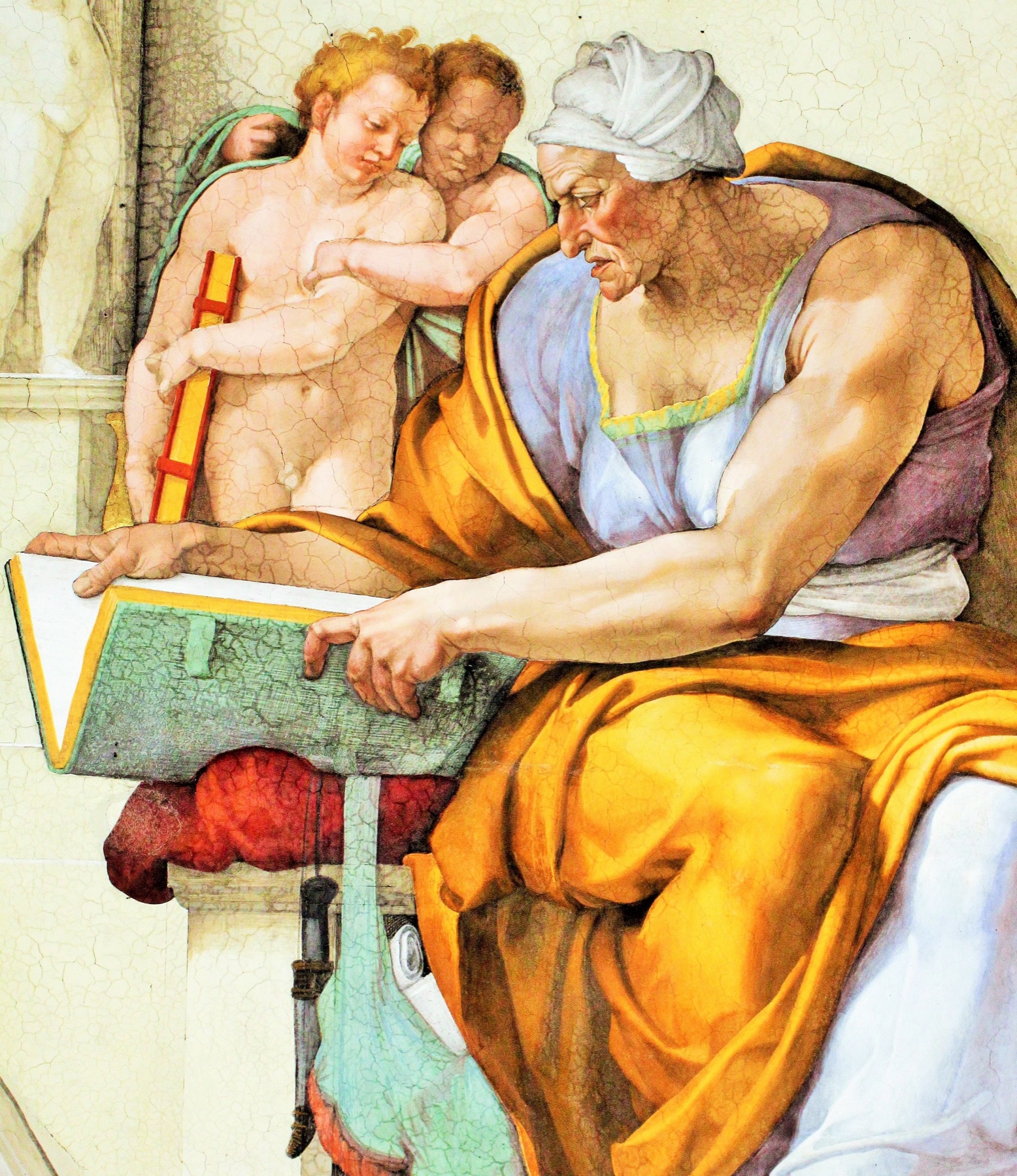
Details from THE CUMAEAN SIBYL
Close looking brings the Sibyl’s scale, book and surrounding attendants forward while keeping source and rights notes in the references.
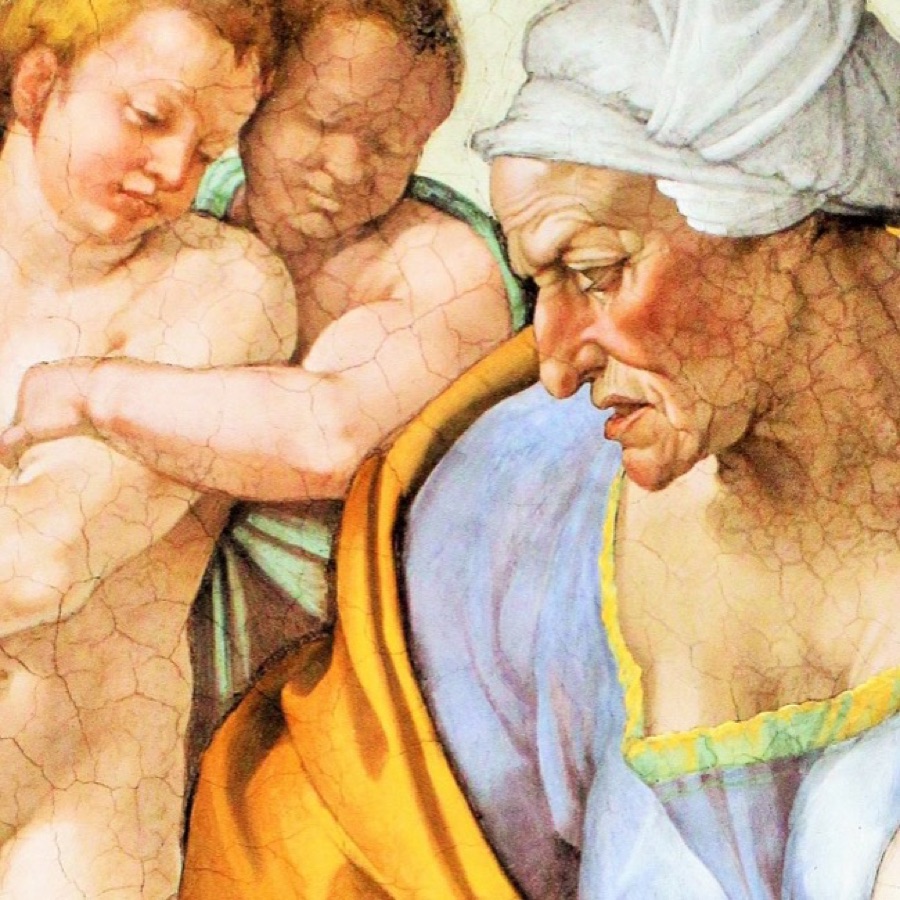
Aged face
The deeply modelled face gives the Sibyl the grave authority that distinguishes her from Michelangelo’s younger seers.
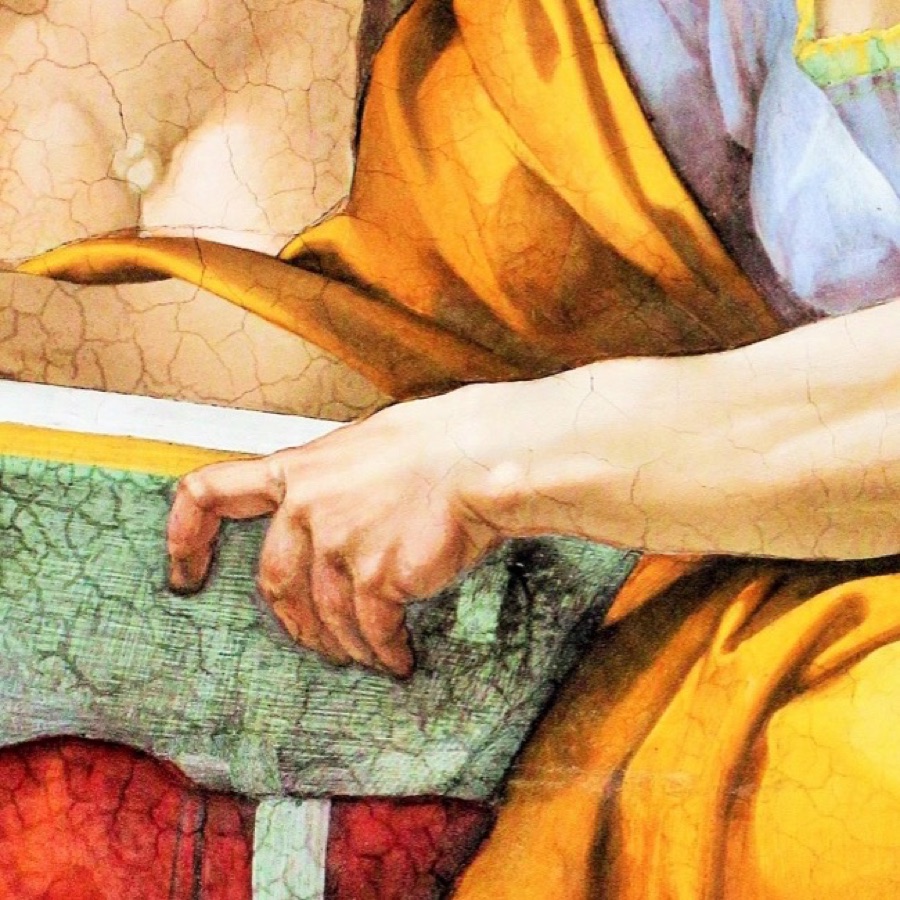
Book
The great open book turns reading into a physical act and anchors the figure’s prophetic identity.
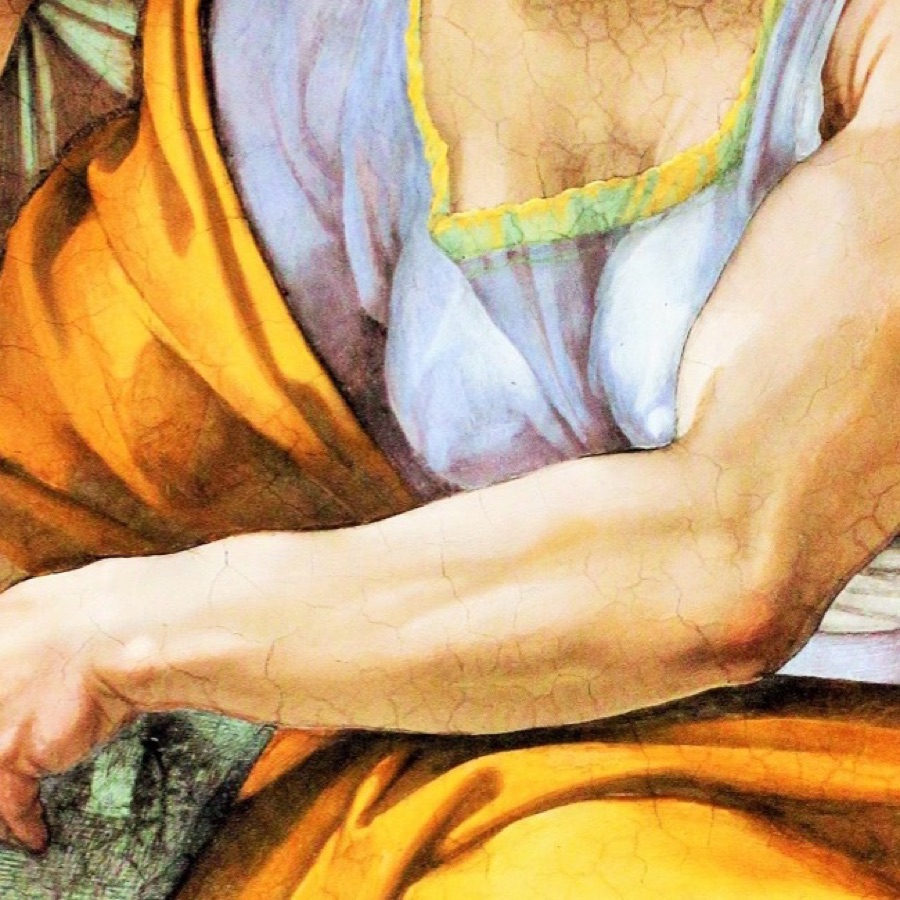
Arms and torso
The broad arms and torso make the seated figure feel monumental, almost architectural, within the ceiling frame.
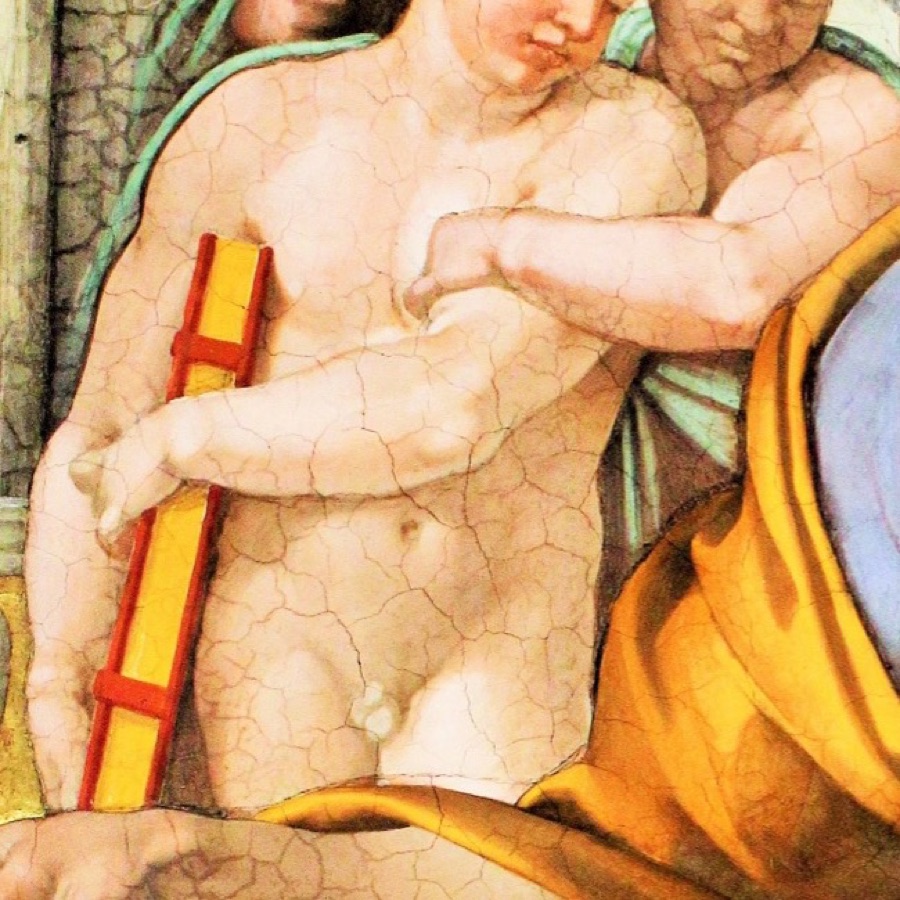
Attendant figures
The youthful attendants sharpen the contrast between age, reading and strength in the Sibyl’s design.
The Sibyl of Cumae
Ancient traditions associated a prophetess with the Greek colony of Cumae near Naples. Virgil’s Aeneid made the Cumaean Sibyl especially famous as Aeneas’s guide to the underworld, while other traditions connected her with collections of prophetic books.
Renaissance Christians read selected sibylline sayings as anticipations of Christ. This interpretive tradition explains her presence in the chapel more directly than the literary underworld journey.
Michelangelo avoids narrative illustration. There is no cave mouth, golden bough or Aeneas. The name tablet and the company of other seers establish identity within a Christian programme.
The huge book may resonate broadly with traditions of recorded prophecy, but its pages should not be assigned a specific text without evidence. It functions first as the material object of her concentrated reading.
An Old Woman Made Colossal
The Cumaean Sibyl’s age is unambiguous. Michelangelo emphasises a lined face, heavy features and a mouth drawn into concentration. The white head wrap frames rather than disguises this time-worn identity.
Yet the body refuses stereotypes of frailty. Shoulders, upper arms and forearms are exceptionally strong. Her flesh seems capable of supporting the volume and the burden of prophecy alike.
Age and power are not opposites. Michelangelo makes duration visible in the face while making endurance visible in anatomy.
This combination can unsettle expectations of feminine beauty. The Cumaean is not offered as a youthful ornament. Her authority comes partly from the refusal to soften her.
The Monumental Book
The open codex extends across the Sibyl’s lap and toward the edge of the throne. Its thick covers and broad pages make it appear almost architectural.
Both hands engage it. One spreads near an outer corner while the other steadies or follows the opposite side. The position suggests not a casual attribute but an object being actively managed.
The book’s scale answers the ceiling. From below, a small volume would disappear. Enlarged, it remains legible as the centre of her action.
It also creates pressure. The upper body curves forward, shoulders close and face approaches the pages. Knowledge occupies space and demands posture.
Prophetic Books, Memory and Loss
The Cumaean tradition was strongly associated with prophetic writings. Roman legend told of Sibylline books preserved and consulted in moments of crisis, while literary accounts of the Cumaean prophetess emphasised an extraordinarily extended life. Michelangelo need not illustrate one version literally for book and age to resonate together.
A bound volume makes prophecy durable beyond the moment of speech. Pages can be guarded, lost, recovered, interpreted and misread by later generations. The Sibyl’s concentration places her within that long transmission.
Her great age gives the act another dimension. She seems to belong to the duration the book records, as if body and text had both survived across epochs.
These associations remain broader cultural context, not a transcription of legible words on the painted pages. The safest insight is relational: Michelangelo joins old age to a massive archive of prophecy and makes their encounter physically demanding.
Reading as Weight
Michelangelo often represents thought through bodies under physical tension. In the Cumaean Sibyl, reading becomes the cause of that tension.
The book rests, but its implied heaviness persists. Arms brace, hands spread and torso inclines. The pose shows how sustained attention can gather a whole body around one object.
This does not mean prophecy is reduced to intellectual labour. The book signals inspired authority within the ensemble. Michelangelo’s contribution is to make that authority pass through ordinary physical conditions: weight, ageing eyes, balance and effort.
The result differs from the Delphic Sibyl’s interruption or the Libyan Sibyl’s twisting lift. The Cumaean represents knowledge held for a long time.
Face Close to the Text
The head projects forward, bringing eyes close to the pages. This may suggest intense focus or the practical difficulty of reading with age.
It would be excessive to diagnose impaired vision. The fresco gives pose, not a medical record. Proximity is enough to communicate concentration.
Profile emphasises the strong nose, furrowed brow and compressed mouth. Unlike outward-looking seers, she creates a closed circuit between face and book.
That inwardness gives the surrounding chapel an unusual silence. The enormous figure seems temporarily unaware of observers beneath her.
Bare Arms and Covered Body
The sleeveless garment exposes shoulders and arms while layered orange, blue and pale fabrics cover the torso and legs. Michelangelo directs anatomical emphasis to the parts that support reading.
The arms are not displayed independently. One leads toward the open leaf; the other anchors the volume. Muscular form serves action.
Below, the drapery spreads across thighs and falls between the legs, building a vast seated base. The contrast between exposed upper strength and covered lower mass makes the figure both active and immovable.
Colour further separates these functions. Cool blue near the torso, warm orange across the lap and pale lower cloth organise an otherwise compressed pose.
The Two Attendants
Two smaller youths stand behind the Sibyl. One pale figure holds a closed red book or object; the darker companion leans close and appears to adjust or attend to the other.
Their young bodies make the Cumaean’s age more pronounced. Smooth faces and smaller limbs occupy the shallow background while her monumental arms dominate the foreground.
They also create a secondary chain of textual activity. A closed volume accompanies the great open codex, suggesting preservation and assistance without requiring a precise narrative.
The institutional group record identifies attendants across the ensemble but does not give these two personal names.[1] Their visual functions are clearer than any invented biography.
Painted Stone and Projecting Flesh
The Cumaean sits on a fictive stone ledge between architectural supports. Her feet press near its outer edge, toes clearly visible, while the book and knee project into the viewer’s space.
The illusion makes the throne seem barely adequate. A body of this scale cannot be contained comfortably by the niche.
Small paired nudes appear in the painted architectural system to either side, further multiplying contrasts of age and scale. They are not participants in her prophecy.
The tablet below carries the Latinised name. At a distance, the bodily type may be recognised before the letters; at close range, inscription stabilises identity.
Cumaean Age and Delphic Youth
Michelangelo’s five sibyls encompass different ages. The Delphic appears young and suddenly alert; the Persian and Cumaean embody old age; the Libyan and Erythraean occupy other modes of active study.
This range prevents “the Sibyl” from becoming one female type. Prophetic authority can inhabit smooth or lined faces, quick turns or sustained stillness.
The Cumaean’s comparison with the Delphic is especially direct. One turns away from a scroll; the other encloses herself around a codex. One suggests arrival of new attention; the other accumulation.
Neither is more inspired because of age. Michelangelo distributes revelation across different experiences of time.
Strength Without Youth
The combination of old face and powerful arms has sometimes been described as masculine. Such language can reveal historical expectations more readily than the fresco itself.
Michelangelo’s anatomical practice drew heavily on male models and an ideal of muscular monumentality. Yet the finished figure is explicitly named as a female prophetess within the chapel.
Her body expands what femininity can look like in Renaissance sacred art. Strength does not erase gender, and age does not erase embodied power.
The Cumaean should therefore be understood neither as a failed naturalistic old woman nor as a man disguised by title. She is an intentional synthesis serving a colossal visionary.
The discrepancy between face and arms is precisely what prevents a conventional type from settling. An observer must reconcile age with power rather than choosing which feature is more “true.” The figure’s authority inhabits that reconciliation.
Among the Twelve Seers
The prophets and sibyls surround the central Genesis fields from their alternating thrones.[1][2] They belong to a layer of interpretation rather than to the landscapes of Creation and Noah.
The Cumaean’s inward pose slows the narrative rhythm. While events unfold nearby, she remains with a book whose temporal range exceeds a single scene.
Her body also answers other readers: Zechariah bends over a volume, Daniel works with assistance and the Persian holds a smaller book close. Repeated study generates distinct character.
Comparisons should not collapse the figures. The Cumaean’s distinctive contribution is the relation between age, physical magnitude and sustained textual focus.
Position and Campaign Chronology
The Sistine ceiling was commissioned by Julius II and executed between 1508 and 1512, with a major first-half completion in 1510.[2] The Cumaean belongs to that documented campaign.
An exact standalone date is not supplied by the Vatican overview. Nor does sequence along the chapel wall automatically equal order of execution.
Fresco production proceeds through plaster sections embedded in a larger programme. A throne, its attendants and adjacent architectural elements may relate practically even when modern discussion isolates the main figure.
Chronological precision should stop where the evidence stops. The secure achievement is the figure’s integration within an evolving ceiling project.
Seeing the Cumaean from Below
From the floor, the huge orange lap, bare arms, white head wrap and open book establish the figure before her wrinkles can be studied. Michelangelo designs identity at architectural range.
Close reproduction changes emphasis. Facial age, fingers and cracks become prominent, and the figure can seem like an easel portrait rather than part of a vault.
Smarthistory stresses the ceiling’s height and visual density.[5] Under those conditions, the Cumaean’s mass is an optical tool as well as expressive choice.
A complete understanding alternates between whole throne, ensemble location and detail. The monumental seer was made for all three levels, though no single view supplies them simultaneously.
Restoration and Chromatic Structure
Modern conservation brought renewed visibility to the vivid oranges, blues and pale violets organising the figure.[3][4] Older dark reproductions had encouraged a more uniformly sculptural interpretation of Michelangelo.
The bright surface does not eliminate material history. Cracking, repair and ageing remain visible, especially around face and background.
Digital photographs vary. Warm drapery may become saturated, flesh can shift in tone and fine shadow around the eyes may be exaggerated.
Descriptions should therefore prioritise relative colour relationships and compositional function over claims based on one file’s exact hue.
The Cumaean Sibyl in Later Drawing
Jean Robert Ango’s drawing after Michelangelo, now at the Metropolitan Museum, records a later artist studying the celebrated figure.[6] It is a work after the fresco, not a preparatory sheet by Michelangelo.
Translation to drawing isolates contour, modelling and pose from the ceiling’s colour and architecture. It can reveal what a later draughtsman found memorable while inevitably changing scale and medium.
The word “after” protects both authorships. Michelangelo devised the fresco; Ango produced a separate response to it.
Such copies helped the Sibyl travel beyond the chapel, turning an overhead painted giant into a portable study object.
Why the Cumaean Sibyl Matters
The Cumaean matters because Michelangelo makes age monumental without sentimentalising it. Her lined face and immense arms belong to one coherent authority.
She matters because reading is shown as an embodied commitment. The book bears down, the body gathers and knowledge persists through effort.
Most importantly, she expands the ceiling’s human range. Prophecy is not reserved for youthful beauty, dramatic outward gesture or masculine identity. It can take the form of an old woman who has been reading for what feels like centuries.
Artist Up Close
Michelangelo does not ask the Cumaean Sibyl to transcend her age. He builds revelation through it. Face records duration, arms record endurance and the book creates the pressure joining them. Her magnificence comes from no miraculous light or angelic interruption. It comes from staying with the text. The artist makes sustained attention as physically formidable as any act of creation.
Frequently Asked Questions
Discussion
What feels most powerful in Michelangelo's Cumaean Sibyl: the book, the age of the figure, or the monumental weight of the seated body?
Reader Insights
How does the large book make reading feel physically heavy?
Where is the line between describing age and over-reading biography?
How does the figure change when seen as one Sibyl among the ceiling's seers?
Join the Conversation
Compare the figure's book, body and Sistine setting while keeping the Cumaean Sibyl distinct from the wider ceiling programme.
References
- Vatican Museums, Sibyls and Prophets”:, View source.
- Vatican Museums, Sistine Chapel Ceiling”:, View source.
- Vatican Museums, Sistine Chapel History”:, View source.
- Vatican Museums, The Sistine Chapel Twenty Years Later: New Breath, New Light”:, View source.
- Smarthistory, Michelangelo, Ceiling of the Sistine Chapel”:, View source.
- The Metropolitan Museum of Art, Jean Robert Ango, The Cumaean Sibyl (after Michelangelo)”:, View source.
- Annotated image source: Michelangelo, Cumaean Sibyl, Sistine Chapel ceiling, 1508–1512. Page-ready image and detail crops prepared from Tom’s approved Commons source, File: Michelangelo, sibille, cumana 01.jpg, documented in the candidate packet as CC BY 3.0. Crops preserve the approved source-led orientation for overlay review, View source.