


 by Tom Gurney
Tom Gurney BSc (Hons) is an art history expert with over 20 years experience
Published on June 19, 2020 / Updated on August 8, 2026
Email: tomgurney1@gmail.com / Phone: +44 7429 011000
David and Goliath by Michelangelo
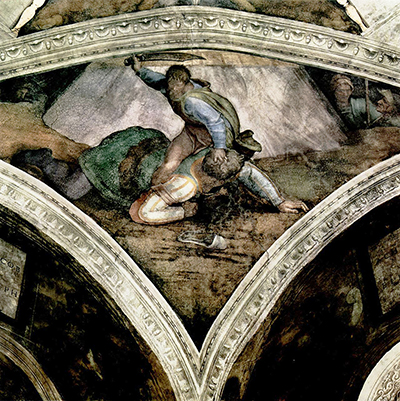
Michelangelo’s David no longer stands at a distance from Goliath. The giant is down on hands and knees, and the younger warrior straddles his back, gripping Goliath’s hair while raising the fallen man’s sword. A sling lies on the ground below them, the small weapon’s work already done. Victory has moved from miraculous strike to brutal physical completion.
The scene occupies one of the four corner pendentives on the Sistine Chapel ceiling.[1] The Vatican places it inside a deliverance cycle whose other fields show Judith’s escape, Haman’s reversal and the serpent-stricken Israelites.[1] Its curved triangular field compresses two unequal bodies into a struggle whose outcome is known but whose effort remains immediate.
How is Michelangelo's David and Goliath different from the marble David? This page concerns the Sistine Chapel pendentive fresco subject, one of the four corner narratives linked to Israel's deliverance. It is not the Florence marble David, not a central Genesis scene and not a general David biography page.
At a Glance
- SubjectDavid’s defeat and beheading of Goliath from 1 Samuel 17[5]
- Artist and mediumMichelangelo Buonarroti; fresco
- LocationOne of four corner pendentives in the Sistine Chapel
- CampaignPainted within Julius II’s 1508–1512 ceiling project[2]
- Moment chosenAfter the sling stone has felled Goliath, as David raises the giant’s sword
- Principal figuresDavid above; Goliath collapsed beneath
- Key objectsGoliath’s sword and David’s discarded sling
- SettingA tent-like field of cloth and shadow, with secondary figures at the sides
- Ensemble roleOne of four biblical deliverance narratives[1]
- Architectural challengeA curved triangular surface viewed obliquely from below
- Comparison cautionMichelangelo’s marble David shows anticipation before combat; the pendentive shows violent aftermath
- Image cautionA flattened reproduction cannot reproduce the corner’s curvature or viewing angle
Contents
- David’s Biblical Victory
- The Moment After the Sling
- David Straddling the Giant
- Youth Against Armoured Maturity
- Goliath Brought to the Ground
- The Raised Sword
- Hand in the Hair
- Tent, Light and Enclosed Combat
- The Secondary Figures
- A Story Designed for a Triangle
- David and the Other Pendentives
- David and Judith as Paired Deliverers
- The Pendentive and Michelangelo’s Marble David
- Deliverance and Unequal Scale
- Violence in Sacred Space
- Relation to the Genesis Centre
- Campaign and Chronology
- Looking into the Corner
- Restoration and Surface
- Why David and Goliath Matters
- Artist Up Close
David’s Biblical Victory
In 1 Samuel, the Philistine champion Goliath challenges Israel. David rejects Saul’s armour, confronts the giant with sling and stones, strikes his forehead and uses Goliath’s own sword to kill and behead him.[5]
The narrative opposes apparent weakness to military power. David’s confidence rests in divine deliverance rather than conventional weaponry.
Michelangelo selects the closing action, not the verbal challenge or sling cast. The stone has already reversed the power relation.
Yet the young victor must still act bodily. The fresco makes providential outcome coexist with effort, violence and weight.
The Moment After the Sling
The sling lies on the earth near the pointed lower part of the pendentive. Small, flexible and visually modest, it contrasts with the great sword above.
Its discarded position tells time. David no longer needs the weapon that made victory possible.
The sword belonged to Goliath, whose size and armour represented superior force.[5] David’s appropriation turns the enemy’s strength against him.
Michelangelo therefore includes two phases through objects even while painting one concentrated bodily action.
David Straddling the Giant
David places his legs around or across Goliath’s fallen torso. This unstable position allows him to control a body larger than his own.
One hand grips the giant’s hair, directing the head; the other raises the sword. Torso twists between downward restraint and upward preparation.
The pose avoids effortless triumph. David must organise his entire body around leverage.
Michelangelo makes the smaller combatant dominant through position rather than exaggerated size.
Youth Against Armoured Maturity
David’s relatively youthful, lightly dressed body contrasts with Goliath’s heavier armour and bulk. The visual difference sustains the biblical opposition between an untested shepherd and a professional champion.[5]
Michelangelo does not make youth delicate. David’s exposed legs and twisting torso possess the strength required by the final action, yet the giant’s equipment still represents conventional military advantage.
The victory therefore avoids one simplification. Divine favour does not turn David into a physically tiny symbol; it allows a capable young body to overcome scale, armour and weaponry through an unexpected sequence.
His clothing also helps isolate movement against the pale tent. Blue sleeve, warm mantle and bare legs divide the action into readable masses.
Goliath Brought to the Ground
Goliath braces on one hand and knee, his head pulled backward beneath David. His armour and coloured garments remain visible, but they no longer protect him.
The giant’s collapse fills the lower central mass. He is not an inert corpse yet; the pose preserves the final interval before beheading.
This creates ethical discomfort. Viewers see a defeated body about to receive a lethal blow.
The biblical deliverance is clear, but Michelangelo does not sanitise its violence.
The Raised Sword
The sword reaches toward the upper curve, using the pendentive’s widest height. Its diagonal carries attention from Goliath’s head through David’s arm.
Because the weapon is Goliath’s own, it embodies reversal. Power changes ownership in the instant before use.
The sword also makes the outcome visible from a distance. A small sling would not alone identify the chosen moment at chapel height.
Michelangelo exploits the object as narrative, theology and compositional axis at once.
The weapon’s size matters psychologically. It seems made for the fallen giant, so David’s ability to raise it becomes a second victory after the sling. What belonged naturally to Goliath must be mastered unnaturally by someone smaller.
This makes appropriation visible as effort rather than mere possession. David has not only taken the enemy’s weapon; he has made it answer another body.
Hand in the Hair
David’s gripping hand is as important as the sword hand. It controls the giant’s head and makes the coming strike credible.
Hair becomes a point of leverage. The gesture joins intimacy and brutality: victor and enemy are physically connected at the moment of separation by death.
This close contact differs sharply from the long-range sling attack. Michelangelo moves the story from distance into touch.
The transition gives David’s victory a bodily cost absent from a purely emblematic image.
Tent, Light and Enclosed Combat
A pale tent-like sheet rises behind the central struggle, catching light and isolating David’s upper body. Darker side zones contain shadowed figures and objects.
The cloth is not a complete battlefield panorama. It creates a shallow theatrical enclosure suitable to the corner.
Light behind David clarifies the sword arm while Goliath remains closer to dark ground.
Fabric also echoes the curved architecture, turning a makeshift military setting into a frame within a frame.
The Secondary Figures
Shadowed figures appear toward the sides, partly obscured by the triangular field and tent. They witness or accompany the event without competing with the combatants.
Their incomplete visibility reminds observers that the scene belongs to a broader battlefield narrative than the central pair can represent.
No secure personal identities are provided for each by the general pendentive record.[1] Describing them as witnesses or soldiers is safer than naming specific biblical individuals.
They also fill tapering zones that would be difficult to occupy with equal-scale principal action.
A Story Designed for a Triangle
The sword uses the upper height, the two bodies occupy the broad middle and the discarded sling falls near the lower point. Narrative hierarchy follows architectural shape.
Curved sides press the struggle inward. David and Goliath seem unable to escape the field’s compression.
Flattening the surface can make limbs appear oddly shortened or stretched. From below, those adjustments serve an oblique view.
Michelangelo designs through the building rather than imposing a rectangular composition upon it.
David and the Other Pendentives
Judith also defeats a stronger enemy and uses a sword, but her corner emphasises aftermath, concealment and female collaboration. David’s field concentrates on open bodily combat.[1]
Haman’s punishment reverses a political plot; the Brazen Serpent shows collective suffering and rescue through sight. Four corners offer four mechanisms of deliverance.
David contributes the young champion whose apparent weakness overturns armed might.
His individuality should remain clear inside the ensemble’s shared theme.
David and Judith as Paired Deliverers
Both stories feature an Israelite who overcomes an enemy commander through unexpected agency.[5][6] David is a young shepherd; Judith a widow entering a military camp.
Michelangelo’s choices emphasise different phases. David raises the sword during the killing; Judith transports the already severed head.
One scene is dominated by two entangled bodies. The other divides action between women, burden and tent interior.
Together they expand heroic action beyond one gender or method.
The Pendentive and Michelangelo’s Marble David
Michelangelo’s famous marble shows David before combat, alert and gathering resolve. The ceiling field depicts him after the sling strike, physically overpowering Goliath.
The works differ in date, medium, setting and narrative moment. They should not be treated as two views of one continuous model.
Comparison nevertheless reveals Michelangelo’s interest in suspended action. The statue holds decision before release; the fresco holds the sword before completion.
Both make victory depend on an interval not yet fully resolved.
Deliverance and Unequal Scale
Goliath’s superior size is essential to the biblical story.[5] Michelangelo preserves inequality without allowing it to govern composition.
David’s higher position and raised arm give him visual command. Vertical relation reverses bodily scale.
This is a pictorial analogue to the narrative’s theology: apparent strength does not determine outcome.
The giant remains physically formidable, making the reversal more rather than less impressive.
Violence in Sacred Space
The scene’s violence belongs to a history of Israel’s preservation, but it remains difficult. Beheading is not transformed into a bloodless symbol.
Michelangelo limits gore while showing the precise mechanics preceding death. Restraint and intensity coexist.
Viewers can recognise deliverance without celebrating cruelty as an independent spectacle.
The pendentive asks sacred art to hold judgment, fear and victory in the same bodily event.
Relation to the Genesis Centre
David belongs to a later biblical period than the central histories of Creation and Noah.[3] His field occupies a corner rather than the narrative spine.
The connection is thematic rather than chronological. Both centre and corners concern danger, disobedience, judgment and preservation.
He is not a participant in the Flood, an ancestor group or one of the enthroned prophets and sibyls merely because these images share the vault.[4]
Painted architecture keeps their representational systems distinct.
Campaign and Chronology
The corner belongs to Michelangelo’s 1508–1512 ceiling undertaking.[2] The public institutional overview does not assign an exact working day to David and Goliath.
Biblical chronology also does not dictate fresco order among the four corners because their stories come from separate books.
Technical study of plaster may refine phase, but the secure public account should not outrun it.
The scene’s identity and overall campaign frame remain firm.
Looking into the Corner
From the chapel floor, sword, pale tent and entwined bodies establish the event. The sling and background witnesses are harder to see.
A flattened close image clarifies objects while erasing the physical labour of looking diagonally upward.
The best study combines a chapel plan, an architectural view and a high-quality detail.
Only then does the way triangle, curvature and combat cooperate become clear.
Restoration and Surface
The Vatican’s history situates the ceiling within modern conservation and centuries of material change.[2]
Dark side passages, pale tent and bright garments can vary greatly across photographs. Cracks are more prominent in enlargement.
These conditions should not be mistaken for separate narrative zones Michelangelo intended through damage.
Stable analysis follows form, object and placement across reproductions.
Why David and Goliath Matters
The pendentive matters because it gives a familiar victory its difficult final weight. A miraculous sling strike leads to intimate bodily violence.
It matters because triangular architecture becomes narrative structure: sling below, bodies at centre, sword above.
Most importantly, Michelangelo makes reversal visible through leverage. The smaller figure controls the larger without ceasing to struggle.
Artist Up Close
Michelangelo understands victory as a problem of weight. David cannot look triumphant from a safe distance; he must grip, brace and raise a weapon too large for him. The corner’s pressure intensifies every action. Providence may determine the biblical outcome, but anatomy makes the decisive interval believable.
Frequently Asked Questions
Discussion
How does the compact corner field change the scene's impact?
What makes the story fit the Vatican's pendentive grouping?
How does this scene relate to Judith, Haman and the Brazen Serpent?
Join the Conversation
Compare the compact corner format, the deliverance theme and the relationship to the other Sistine pendentives.
References
- Vatican Museums, Pendentives”:, View source.
- Vatican Museums, Sistine Chapel Ceiling”:, View source.
- Vatican Museums, Central Stories”:, View source.
- Vatican Museums, Sibyls and Prophets”:, View source.
- United States Conference of Catholic Bishops, 1 Samuel, Chapter 17”:, View source.
- United States Conference of Catholic Bishops, Judith, Chapter 13”:, View source.