


 by Tom Gurney
Tom Gurney BSc (Hons) is an art history expert with over 20 years experience
Published on June 19, 2020 / Updated on November 6, 2025
Email: tomgurney1@gmail.com / Phone: +44 7429 011000
The Erythraean Sibyl by Michelangelo
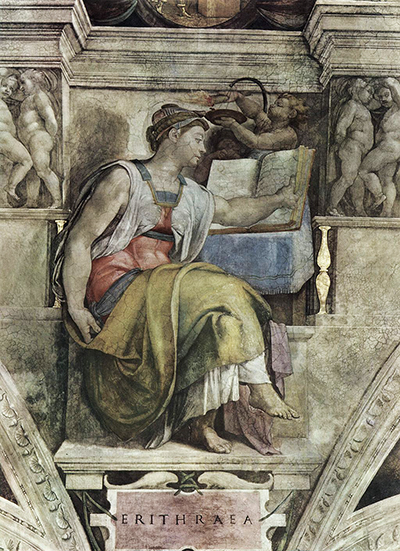
Michelangelo’s Erythraean Sibyl sits beside an open book while a small attendant raises a flaming lamp behind her. Her face is lowered, her left hand steadies the volume and her right arm descends along the throne. Broad yellow, green and white draperies turn the seated body into a measured structure. Illumination occurs almost literally above the text, yet the Sibyl’s concentration remains calm.
The name is variously rendered Erythraean, Erythrean or Erithrean in English. All refer to the prophetess identified in the ceiling’s sibylline company and traditionally associated with ancient Erythrae.[1] A British Museum study for her drapery provides rare evidence of Michelangelo solving clothing as a primary design problem rather than simply covering an already finished body.[5]
Why does the Erithrean Sibyl page use the Erythraean spelling? The inherited page title keeps the familiar route spelling, while British Museum, NGA and source-led body copy use Erythraean. This is a spelling note, not a change to the page address.
At a Glance
- Preferred English titleErythraean Sibyl
- Variant spellingsErythrean and Erithrean Sibyl
- Artist and techniqueMichelangelo Buonarroti, fresco
- SettingA monumental painted throne on the Sistine Chapel vault
- Campaign frameExecuted within Julius II’s 1508–1512 ceiling project[2]
- EnsembleOne of five ancient sibyls alternating with seven prophets[1]
- Traditional locationErythrae in Ionia, on the coast of Asia Minor
- Main actionSeated study beside an open book
- AttendantsOne tends a lamp above; another is partly hidden near the volume
- Important preparationBritish Museum drawing devoted to the figure’s drapery[5]
- Primary visual qualitiesStable seated mass, extended arm, lowered profile and colour-blocked folds
- Interpretive cautionThe lamp invites associations with illumination, but no single complete symbolic key is supplied by the institutional sources
Contents
- Erythrae and Renaissance Sibylline Tradition
- A Seated Figure in Measured Motion
- The Open Book on Its Support
- The Lamp Above
- Painted Flame and Chapel Light
- The Second Attendant
- The Lowered Face
- Arms, Shoulders and Asymmetrical Balance
- Drapery as Construction
- The British Museum Drapery Study
- From Drawing to Fresco
- The Bare Feet
- Name, Inscription and Spelling
- Comparing Her with the Delphic Sibyl
- Comparing Her with the Libyan Sibyl
- Place in the Twelve-Figure Ensemble
- Campaign Chronology
- Looking Up and Looking Close
- Restoration and Surface
- Why the Erythraean Sibyl Matters
- Artist Up Close
Erythrae and Renaissance Sibylline Tradition
Ancient Erythrae was an Ionian Greek city, and later traditions assigned a Sibyl to it. Renaissance Christian culture gathered this and other geographically named prophetesses into a group whose sayings were interpreted as anticipating Christ.
Michelangelo’s fresco belongs to that later Christian reception. It is not an archaeological reconstruction of an Ionian oracle or a portrait of a securely documented individual woman.
The throne’s identity depends upon the programme and inscription. No coastal landscape, temple or ethnographic costume establishes place.
This allows the Erythraean to participate equally in the chapel’s unified prophetic order while retaining a name that extends its imagined geography beyond biblical Israel.
A Seated Figure in Measured Motion
The Erythraean’s action is restrained compared with the Delphic’s turn or Libyan’s spiral. Her torso inclines gently, head lowers and one arm reaches across toward the book.
The opposite hand descends near the side, helping balance the upper action. Knees create a broad base beneath layered cloth.
Stillness is not inactivity. Michelangelo arranges several small directional changes—head, shoulder, wrist, knee—so that attention seems continuous.
The figure inhabits the duration of study rather than the instant of interruption.
The Open Book on Its Support
The large open volume rests above a draped support beside the Sibyl. Pages stand nearly vertical, making them visible both to her and to observers below.
Her extended hand touches or steadies the outer edge. The gesture links body to text without the extreme physical burden seen in the Libyan and Cumaean figures.
The book’s pale rectangle interrupts the coloured fabric and creates a second visual centre after the face. Written marks may be suggested, but their content cannot be read as a precise oracle from the floor.
Michelangelo makes a text present without turning the fresco into a legible inscription. Reading remains an image of knowledge rather than a quotation.
The Lamp Above
A youthful attendant raises or tends a lamp behind the Sibyl. A small flame burns above her head and book, while a curved handle or cord frames the action.
Light and prophecy invite association. The lamp may suggest illumination, vigilance or the practical conditions of reading. No one meaning needs to exclude the others.
Its placement is compositionally exact. The flame occupies open space above the main figure and draws attention upward without competing with her scale.
The attendant’s active arms contrast with the Sibyl’s settled posture. Illumination is being maintained around the person who interprets.
Painted Flame and Chapel Light
The small flame belongs to the represented world, while real light in the chapel falls across the plaster from changing sources. The two kinds of illumination should not be confused.
Michelangelo’s lamp does not physically light the Sibyl. Its painted glow is a narrative cue whose visibility depends on the actual conditions under which the ceiling is seen.
That distinction strengthens rather than weakens the metaphor. Human hands tend an image of light inside a sacred interior whose own illumination shifts with hour, conservation and viewing conditions.
Photographs can make the flame much brighter than it appears from below, or lose it entirely. Its meaning therefore depends on knowing it is present even when architectural distance makes it fragile.
The lamp is a small act of care. Revelation may be divinely framed, but study still requires someone to maintain the conditions in which words can be seen.
The Second Attendant
Another smaller head and body appear partly obscured behind the open volume and lamp-bearer. The figure deepens the recess and creates a layered group.
Partial visibility is purposeful. Michelangelo does not need every companion to present a complete pose. A face glimpsed between objects can make the throne feel inhabited beyond its monumental principal.
The attendants remain unnamed in the Vatican overview.[1] Assigning them individual angelic or mythological identities would exceed the evidence.
Together they establish a social environment of study: one tends light, another watches or assists and the Sibyl remains focused on the book.
The Lowered Face
The Erythraean’s head turns in profile and tips downward. Her eyes seem directed toward the text or into a zone of thought beside it.
The expression is neither startled nor burdened. It suggests absorption held within a composed facial structure.
Hair is gathered beneath an elaborate banded covering, creating a compact silhouette. The controlled head contrasts with the strong exposed arm.
As with other seers, likeness should not be converted into a named model. Individual presence is an artistic achievement, not documentary portrait identification.
Arms, Shoulders and Asymmetrical Balance
The left arm extends toward the book, elbow lifted and forearm nearly horizontal. The right drops with a relaxed yet weighty curve toward the seat.
These different actions prevent the torso from becoming frontal and static. One side participates in reading; the other secures balance.
Michelangelo exposes much of the upper arms while covering the torso in pale cloth. Muscular form serves intellectual action rather than independent display.
The asymmetry continues below: differently placed feet and knees create a stable but not mirror-balanced base.
Drapery as Construction
The Erythraean is organised by colour and folds. White fabric crosses the upper body, a warm orange-yellow mass spreads over one leg, green covers the other and lavender layers emerge beneath.
Each cloth performs a structural task. Pale upper fabric clarifies the arms; warm and cool lower masses separate the knees; smaller folds explain bends and pressure.
The figure’s volume would be less legible if drapery were treated as surface ornament. Clothing makes anatomy architectural.
This insight becomes concrete in the British Museum drawing, where Michelangelo studies folds as an independent design challenge.[5]
The British Museum Drapery Study
The British Museum preserves a study connected with the Erythraean Sibyl’s drapery.[5] Its existence shows Michelangelo devoting focused work to how cloth would fall, bunch and articulate the seated figure.
A drapery study is not simply a copy of the final fresco without colour. It may explore a portion, test alternatives or record an intermediate solution.
Paper permits repeated lines, revisions and concentrated attention away from the pressure of wet plaster. The wall then requires translation into scale, hue and architectural position.
The sheet confirms that folds were designed. Their apparent naturalness is the product of observation and selection.
From Drawing to Fresco
Translation changes the status of every line. A contour on paper becomes an edge between colours; a shaded fold becomes modelling integrated with the chapel’s light; an isolated study becomes one part of a named visionary.
The finished figure also has to remain legible at height. Large colour zones may simplify or strengthen what the close sheet investigates minutely.
Comparing objects should therefore focus on decisions, not on searching for perfect duplication. Difference is evidence of development.
Authorship remains distinct: the preparatory drawing and fresco are both Michelangelo works, but separate media with separate conditions and purposes.[5]
The Bare Feet
The Sibyl’s feet rest near the throne ledge, emerging from layers of fabric at different depths. One is more fully visible, while the other appears partly behind cloth.
They anchor a figure whose intellectual attention is directed upward and sideways. Skin against fictive stone strengthens the illusion of weight.
Toes and ankles also complete the descent of colour from head and arms through the broad lap. The body does not dissolve into garments.
From below, these projecting forms help make the throne seem occupied rather than decorated.
Name, Inscription and Spelling
English spellings vary because the ancient place name and Latin or Italian forms pass through different transliterations. Erythraean is a common scholarly English form; Erythrean and Erithrean also appear.
Variant spelling should not be mistaken for three different sibyls. Context, artist and ceiling location identify one work.
The name tablet within the painted architecture stabilises identity in the original programme even when modern titles vary.
Using one preferred spelling while acknowledging alternatives helps preserve discoverability without multiplying objects.
Comparing Her with the Delphic Sibyl
The Delphic turns outward from a scroll, caught by an unseen stimulus. The Erythraean remains oriented toward her book while light is tended behind.
Both are youthful, richly coloured and intellectually active. Their difference lies in tempo: interruption versus sustained composure.
Their textual objects differ as well. Flexible scroll crosses the Delphic’s arms; upright codex organises the Erythraean’s side.
Michelangelo thus varies prophecy through material culture as well as anatomy.
Comparing Her with the Libyan Sibyl
The Libyan’s book is a counterweight in violent transition. The Erythraean’s rests on support and can be studied without bodily upheaval.
Both figures reveal the importance of preparation. The Met sheet exposes anatomical design for the Libyan; the British Museum sheet focuses on Erythraean drapery.[5]
Together they show that Michelangelo did not solve every seer through the same study type. Different visual problems demanded different drawings.
The comparison also keeps “book” from becoming a generic symbol. Its physical use defines character.
Place in the Twelve-Figure Ensemble
The five sibyls and seven prophets occupy alternating thrones around the central Genesis fields.[1][2] Their scale mediates between narrative images and chapel architecture.
The Erythraean contributes an image of illuminated study. She is neither the company’s most aged nor most dramatically turning figure.
Her relative poise gives the sequence rhythm. Without quieter forms of concentration, every throne would compete through spectacle.
She remains part of the ensemble without being reducible to it. The lamp, book and designed drapery supply a distinct identity.
Campaign Chronology
Michelangelo painted the vault for Julius II between 1508 and 1512.[2] Institutional history establishes this overall frame and the later material life of the chapel.[3]
No exact isolated date for the Erythraean is securely supplied by those records. Nor does her position prove a simple linear working sequence.
The preparatory drawing documents design activity but does not by itself date every stage from first sketch to plaster.[5]
The proper chronology is therefore firm at campaign level and cautious at the level of a single throne.
Looking Up and Looking Close
From the chapel floor, broad yellow-green drapery, the pale upper body and the open book establish the figure. The small flame is easy to miss.
A close detail restores attendant, lamp and fold structure, but detaches them from the ceiling’s immense scale. Smarthistory emphasises the physical challenge of encountering the vault overhead.[6]
Different views answer different questions. The full throne explains pose, the ensemble explains placement and the drawing explains design labour.
No one image should be asked to replace all three.
Restoration and Surface
Vatican conservation history frames the bright colours now familiar in the Erythraean Sibyl.[3][4] Cleaning made warm and cool garment zones more distinct after darker photographic traditions.
Reproductions vary in hue and contrast. The orange can become brown or yellow; green may shift toward grey; the small flame may disappear.
Cracks and repairs visible under enlargement testify to a fresco that has aged on an active chapel surface.
Material history should be acknowledged without allowing damage to replace the designed relation of body, book and light.
Why the Erythraean Sibyl Matters
The Erythraean matters because Michelangelo represents illumination as maintained attention rather than sudden ecstasy. A lamp burns; a book waits; the body remains composed.
She matters because the surviving drapery study makes clothing central to artistic thought. Fold, colour and weight are structural knowledge.
Most importantly, her calm expands the range of prophetic experience. Michelangelo’s ceiling needs not only turning and burden, but the quiet endurance of study.
Artist Up Close
Michelangelo solves stillness with the same seriousness he gives violent motion. One hand steadies a book, another descends, a lamp flares above and coloured cloth distributes weight across the seat. The British Museum study confirms how deliberately this calm was built. Nothing is inert. The artist makes composure the outcome of many balanced forces.
Frequently Asked Questions
Discussion
What feels most important in Michelangelo's Erythraean Sibyl: the turning page, the drapery, or her place among the Sistine Chapel seers?
Reader Insights
How does the turning page make prophecy feel like an action rather than a label?
What can a preparatory drapery drawing tell us without replacing the fresco itself?
How does this Sibyl change when viewed beside the other seers?
Join the Conversation
Compare the figure's page, drapery and Sistine setting while keeping the Erythraean Sibyl distinct from the wider ceiling programme.
References
- Vatican Museums, Sibyls and Prophets”:, View source.
- Vatican Museums, Sistine Chapel Ceiling”:, View source.
- Vatican Museums, Sistine Chapel History”:, View source.
- Vatican Museums, The Sistine Chapel Twenty Years Later: New Breath, New Light”:, View source.
- British Museum, Study for the Drapery of the Erythraean Sibyl”:, View source.
- Smarthistory, Michelangelo, Ceiling of the Sistine Chapel”:, View source.