


 by Tom Gurney
Tom Gurney BSc (Hons) is an art history expert with over 20 years experience
Published on June 19, 2020 / Updated on August 8, 2026
Email: tomgurney1@gmail.com / Phone: +44 7429 011000
Haman’s Punishment by Michelangelo
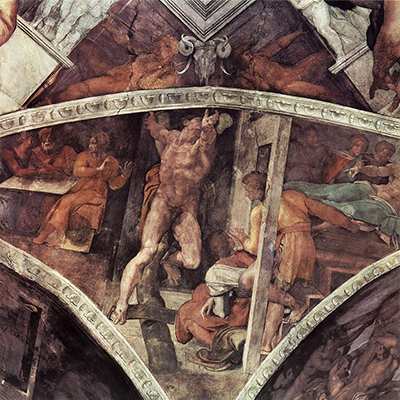
Michelangelo gives Haman no stable place on which to die. The condemned man is stretched across a timber whose angle seems to thrust his torso out of the Sistine ceiling, while his bent legs fall towards the chapel below. Around that colossal nude, smaller courtly episodes disclose how he arrived there. An accusation, a command and a public reversal unfold almost simultaneously.
Haman’s Punishment occupies one of the four great corner pendentives painted during Michelangelo’s 1508–1512 ceiling campaign.[1][2] Its subject comes from Esther, but the fresco does not simply illustrate one verse. It converts a story governed by concealed identity, political manipulation and sudden reversal into an unstable architecture of bodies, doors and sightlines.
How should Michelangelo's Haman's Punishment be separated from other Haman or Esther images? This route concerns the Sistine Chapel pendentive fresco, one of the four corner narratives linked by the Vatican to Israel's deliverance. It is not a generic Haman biography page, not a standalone Esther-cycle painting by another artist and not a central Genesis scene.
At a Glance
- WorkHaman’s Punishment, also called The Punishment of Haman or The Crucifixion of Haman
- Artist and mediumMichelangelo Buonarroti; fresco
- LocationA corner pendentive near the altar end of the Sistine Chapel
- CampaignPart of the ceiling painted for Pope Julius II, 1508–1512[2]
- Literary subjectThe overthrow of Haman’s plot in the Book of Esther[3][4]
- Principal figuresHaman, Queen Esther, King Ahasuerus and Mordecai
- Narrative methodSeveral moments from the story coexist in one field
- Dominant motifHaman’s immense, foreshortened nude body fixed to a cross-like timber
- Central themeThe intended destruction of the Jews rebounds upon its architect
- Ensemble roleOne of four corner histories of Israel’s deliverance[1]
- Important cautionThe support resembles a cross, but Haman must not be mistaken for Christ
- Viewing cautionA square reproduction cannot preserve the curved surface, oblique angle or relation to the altar below
Contents
- The Plot That Reverses Itself
- Three Moments in One Pendentive
- Esther’s Act of Disclosure
- Ahasuerus and the Change of Favour
- Haman’s Body as the Great Diagonal
- Hanging, Impalement or Crucifixion?
- The Cross-Like Timber
- Doorways and Moral Distance
- Scale and the Collapse of Rank
- Preparatory Thought on Paper
- A Corner Near the Altar
- One Deliverance Among Four
- Continuous Narrative and Suspended Time
- Looking at Colour and Surface
- Why Haman’s Punishment Matters
- Artist Up Close
The Plot That Reverses Itself
Haman rises to high office at the Persian court and becomes enraged when Mordecai, a Jew, refuses to bow to him. He does not seek revenge on Mordecai alone. He obtains authority for a decree against an entire people, unaware that Queen Esther herself is Jewish.[4]
Esther approaches King Ahasuerus, risks revealing her identity and exposes Haman at a banquet. The king’s anger turns upon the favourite he had elevated. The structure Haman prepared for Mordecai becomes the instrument of his own death.[3]
This symmetry is more than an ingenious ending. It gives the story its moral pressure. Haman tries to make personal resentment into state violence; his own machinery of punishment receives him instead.
Michelangelo makes that reversal bodily. The official who arranged other people’s destruction is himself displayed, stripped of insignia and held in a pose he cannot control.
Three Moments in One Pendentive
The fresco is a continuous narrative: separate episodes involving the same characters appear within one architectural field.[7]
At one side, Esther addresses the reclining or seated Ahasuerus and directs his attention towards Haman. At the other, the honours Haman expected for himself are transferred to Mordecai. Between these scenes, Haman’s punishment overwhelms the composition.
Michelangelo does not divide the episodes into equal compartments. The condemned nude is vastly larger than the court figures. Narrative consequence outweighs narrative cause.
This inequality makes the composition readable from below. A visitor may not immediately decipher every small exchange, but Haman’s exposed body announces that a catastrophe has reached its conclusion.
The side episodes then reward closer inspection. They convert the central spectacle from unexplained torment into a chain of political actions.
Esther’s Act of Disclosure
Esther’s power lies in speech, timing and the revelation of a fact Haman does not control. At the second banquet she identifies both herself and her people as the intended victims.[3]
Michelangelo places this disclosure within a domestic-looking court interior. Drapery, furniture and the king’s reclining posture contrast with the public violence at the centre.
Esther’s gesture directs accusation across the small space. She does not perform the punishment herself. Her intervention changes the king’s knowledge, and changed knowledge changes power.
That distinction matters. The fresco’s most physically imposing figure is Haman, yet the decisive agency belongs partly to a clothed woman speaking at a banquet.
Her action also differs from Judith’s in the neighbouring family of corner scenes. Judith enters the enemy camp and kills Holofernes directly; Esther works through court protocol, risk and testimony.[1]
Ahasuerus and the Change of Favour
King Ahasuerus is the pivot through which concealed danger becomes judgment. His authority first enables Haman’s rise and later enforces the reversal.
In the banquet episode, the king’s body appears sheltered by interior space. Haman’s body, by contrast, is forced into exposure. Political favour is translated into spatial protection or its loss.
The smaller episode concerning Mordecai supplies the other half of that reversal. Haman had imagined the royal honours as his own, only to be commanded to bestow them on the man he hated.[4]
Michelangelo compresses humiliation and death into one visual field. Haman’s fall is not a single downward step. Every sign of rank changes direction.
Haman’s Body as the Great Diagonal
Haman’s torso forms the fresco’s most forceful diagonal. One arm reaches upward, the other is pulled away; the chest opens towards the observer; one knee lifts while the other leg descends.
The pose is neither a calm cruciform nor a simple hanging body. It is an anatomical problem made expressive. Twisting pelvis, stretched abdomen and asymmetrical limbs convey force acting in several directions at once.
His size causes the painted architecture to feel inadequate. The pale door frame behind him and the timber before him cross at competing angles. Body, support and building appear to collide.
From the chapel floor, foreshortening would make the nude seem to project beyond the curved field. In a flat photograph, the proportions can look extreme because the adjustment to height and angle has been removed.
The result is a punishment experienced not as still aftermath but as continuing strain.
Hanging, Impalement or Crucifixion?
Titles require care. English versions and discussions of Esther variously describe a gallows, pole, stake, hanging or impalement. The scriptural event is Haman’s death on the structure he had prepared for Mordecai.[3]
Michelangelo’s timber is visibly cross-like, and art-historical titles often call the scene The Crucifixion of Haman.[7] Yet Haman is not Christ, and the fresco does not replace Esther’s villain with a New Testament subject.
The distinction is the source of the image’s power. A mode of display associated with an innocent redeemer is applied to a condemned persecutor. Formal resemblance creates a theological comparison without erasing moral opposition.
The Vatican describes all four pendentives as deliverances of Israel and interprets them within a Christian promise of redemption.[1] That institutional reading supports a typological layer, especially in a chapel centred upon Christian worship.
It does not license a one-to-one identification. Haman remains the aggressor whose intended violence rebounds upon him; Christ, in Christian belief, is the innocent victim through whom redemption occurs.
The Cross-Like Timber
The timber is not merely an attribute attached to Haman. It governs the entire geometry.
Its upright interrupts the courtly space. Its transverse direction echoes and contests the painted architectural borders. The human body adds a third set of angles.
Michelangelo therefore refuses the clean symmetry expected of a devotional Crucifixion. Haman slips, twists and spreads across a structure that feels improvised for punishment rather than solemnly presented for veneration.
This instability protects the scene’s narrative identity. The visual echo of the cross is unmistakable, but everything about posture and context says reversal, disgrace and judgment.
Doorways and Moral Distance
A pale doorway rises behind Haman. It belongs to the courtly environment yet also divides episodes and deepens the fiction of space.
The vertical frame gives the eye a measure against which the condemned body’s distortion becomes legible. Haman does not align obediently with it; he cuts across it.
Doors also suit a story driven by access. Esther gains entry to royal attention. Mordecai waits at the king’s gate. Haman moves from privileged proximity to total exposure.[3][4]
Michelangelo does not illustrate every threshold mentioned in Esther literally. Nevertheless, painted entrances turn political nearness and exclusion into a spatial language.
The court scenes appear recessed, while punishment advances. Private decision becomes public consequence.
Scale and the Collapse of Rank
Haman had been distinguished by office, access and royal favour. In the central scene he is distinguished only by bodily magnitude.
Clothing and status have disappeared together. Nudity strips him of the signs by which the side episodes organise social hierarchy.
His enlarged scale might seem heroic in isolation. Within the story it becomes anti-heroic: physical magnificence cannot restore moral or political control.
Michelangelo often grants compromised or defeated figures extraordinary beauty. That choice prevents moral meaning from depending on ugliness.
Haman’s developed body attracts the eye even as the narrative condemns him. Looking therefore becomes ethically uneasy rather than comfortably punitive.
Preparatory Thought on Paper
Surviving studies associated with Haman show that the pose was not a spontaneous anatomical flourish. The British Museum preserves a sheet connected with the figure’s design and another study at a larger scale, closer to the stage of transfer to the ceiling.[5][6]
The records describe repeated attention to the nude’s extension, rotation and foreshortening. One also notes that the only surviving fragment from a final cartoon for the face is preserved on the reverse of a sheet in Haarlem.[6]
These fragments matter because the finished body can look impossible when isolated. The studies show a process of testing how anatomy would read when projected into monumental, curved architecture.
They also reveal the losses behind the finished fresco. Michelangelo’s working drawings were tools, not necessarily objects intended to survive. What remains offers glimpses rather than a complete sequence.
Attribution must be stated precisely: museum catalogues distinguish Michelangelo’s own sheets from copies after lost or inaccessible studies. A related drawing is valuable evidence only according to the status assigned by its holding institution.[5][6]
A Corner Near the Altar
Haman’s field stands at the altar end of the ceiling, opposite the Brazen Serpent corner. That location gives its cross-like body an unusually charged relation to the liturgical centre.
The British Museum notes the figure’s visual and conceptual relation to the altar below, where Christian sacrifice is ritually commemorated.[5]
This relation should be understood architecturally before it is made speculative. A worshipper in the chapel encountered Haman not on an isolated museum wall but above a space of ceremony, scripture and Eucharist.
The corner also meets the central histories and the painted systems running down the walls. The Vatican calls the pendentives junctions between ceiling and wall narratives.[1]
Haman’s stretched body thus occupies both a narrative climax and a physical threshold.
One Deliverance Among Four
The four pendentives do not repeat a single formula.[1] David’s stone and sword defeat a giant. Judith’s stealth and courage destroy an enemy commander. The bronze serpent heals those willing to look. Esther’s disclosure overturns planned genocide.
Haman’s distinct contribution is political reversal. No battlefield fills the principal episodes. A decree, a banquet, royal favour and an apparatus of execution determine survival.
This makes the work especially alert to the danger of delegated violence. Haman attempts to give private hatred the force of law.
His punishment does not undo the terror already produced by that act, but the visual reversal declares that authority is not morally self-validating.
Continuous Narrative and Suspended Time
Because Haman appears across several moments, the fresco asks the eye to move nonlinearly. Cause and consequence are available together.
The central figure feels present and immediate, while the side episodes resemble remembered causes. Scale creates temporal emphasis.
Michelangelo leaves no neutral interval between honours, accusation and death. The very speed of the visual sequence makes fortune appear unstable.
This is well suited to Esther, where knowledge arrives late and reversals accumulate rapidly. The king cannot sleep; records are consulted; identities are disclosed; intended victim and intended beneficiary exchange positions.[3][4]
The fresco does not catalogue all these turns. It finds their equivalent in a composition that refuses equilibrium.
Looking at Colour and Surface
Warm flesh, pale architecture and intense passages of red, orange and green separate bodies within the crowded corner.
Haman’s nude form receives a clarity denied to many clothed figures, whose limbs merge with interiors and drapery. Colour assists the hierarchy already established by scale.
Cracks and irregular tonal passages belong partly to the material history of fresco. Enlarged photographs can make them seem more dominant than they are from below.
Conversely, reproductions often improve access to small scenes while destroying the bodily effort required to see a ceiling corner. Both distance and detail are necessary.
Why Haman’s Punishment Matters
The fresco matters because Michelangelo makes political reversal visible through anatomy. Haman’s authority contracts as his body expands.
It matters because one field contains several kinds of action: Esther speaks, Ahasuerus decides, Mordecai receives honour and Haman suffers the result.
Above all, the work makes resemblance dangerous and productive. Haman’s cross-like support invites a Christian comparison, but the moral identities remain opposed. The image asks viewers to distinguish form from meaning even while contemplating their connection.
Artist Up Close
Michelangelo turns a story of words and decrees into a collision between flesh and structure. Haman’s body is magnificent enough to command the corner, yet magnificence offers no defence. The court scenes explain the reversal; the nude makes it unforgettable. Architecture, anatomy and biblical sequence all become instruments for showing power lose control of its own design.
Frequently Asked Questions
Discussion
How does the reversal in Esther shape the way this scene reads?
What changes when the story is treated as a Sistine corner narrative?
How does Haman's story fit beside David, Judith and the Brazen Serpent?
Join the Conversation
Compare the Book of Esther story, the corner placement and the relationship to the other Sistine pendentives.
References
- Vatican Museums, Pendentives”:, View source.
- Vatican Museums, Sistine Chapel Ceiling”:, View source.
- United States Conference of Catholic Bishops, Esther, Chapter 7”:, View source.
- United States Conference of Catholic Bishops, Esther, Chapter 3”:, View source.
- British Museum, Drawing, Museum number 1895,0915.497”:, View source.
- British Museum, Drawing, Museum number 1926,1009.1”:, View source.
- Web Gallery of Art, Punishment of Haman”:, View source.