


 by Tom Gurney
Tom Gurney BSc (Hons) is an art history expert with over 20 years experience
Published on June 19, 2020 / Updated on August 8, 2026
Email: tomgurney1@gmail.com / Phone: +44 7429 011000
Judith and Holofernes by Michelangelo
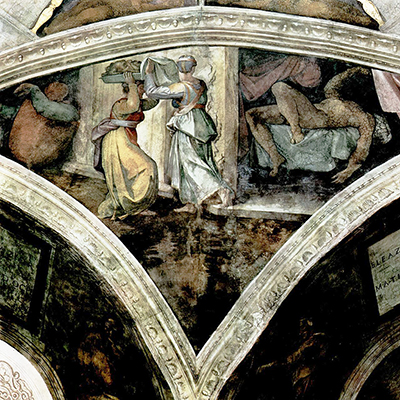
In Michelangelo’s Judith and Holofernes, the killing has already happened. Holofernes’s headless body twists inside a dark tent while Judith and her maid move away carrying his severed head on a tray or in a covered container. Judith turns back toward the danger they are leaving. The scene is less about the sword stroke than the difficult passage from secret violence to communal deliverance.
The fresco occupies one of the four curved corner pendentives on the Sistine Chapel ceiling.[1] It belongs with David and Goliath, The Punishment of Haman and The Brazen Serpent in the Vatican’s group of narratives concerning Israel’s salvation.[1] Michelangelo makes this corner distinct through female collaboration, burden, concealment and the unstable division between lit exterior and shadowed tent.
How should Michelangelo's Judith and Holofernes be separated from other Judith paintings? This route concerns the Sistine Chapel pendentive fresco, one of four corner narratives linked by the Vatican to Israel's deliverance. It is not a standalone Judith painting by another artist, not a central Genesis scene and not a generic Judith biography page.
At a Glance
- SubjectJudith and her maid escaping with the head of the Assyrian commander Holofernes[5]
- Artist and techniqueMichelangelo Buonarroti; fresco
- LocationOne of four narrative pendentives at the Sistine Chapel’s corners
- Campaign frameJulius II’s ceiling undertaking of 1508–1512[2]
- Biblical sourceJudith 13[5]
- Principal figuresJudith, her female attendant and the beheaded Holofernes
- Moment selectedAfter the decapitation, during removal of the head from the enemy tent
- Key objectsSevered head, tray or container, cloth and tent drapery
- Shared corner themeDeliverance of Israel under extreme threat[1]
- Architectural challengeA curved triangular field whose edges taper around the action
- Textual contextJudith is deuterocanonical in Catholic scripture; its canonical status differs among Christian traditions
- Identity cautionRoles are secure at group level; not every marginal or shadowed figure can be named confidently
Contents
- Judith’s Biblical Act
- A Deuterocanonical Heroine
- The Action After Decapitation
- Judith Turning Back
- The Maid and the Shared Burden
- The Severed Head
- Tray, Bag and the Problem of Naming the Container
- Holofernes in the Tent
- Light Outside, Shadow Within
- Cloth, Poles and Temporary Architecture
- A Composition Made for the Corner
- Judith and David
- Judith and Haman
- Female Agency and Renaissance Reception
- Deliverance Through Collaboration
- Relation to the Central Stories
- Campaign and Evidence Limits
- Looking Up at Judith
- Restoration and Material History
- Why Judith and Holofernes Matters
- Artist Up Close
Judith’s Biblical Act
The Book of Judith describes a Jewish widow whose city is threatened by the Assyrian army. She enters Holofernes’s camp, wins access to him and kills him while he lies drunk. Her maid places the head in a food bag, and the women return to Bethulia.[5]
Display of the head gives courage to Judith’s people and helps precipitate the enemy’s defeat. The story joins piety, strategy, beauty, deception and lethal courage.
Michelangelo selects the transition immediately after the killing. The women have secured the enemy’s head, but they have not yet completed the return.
This is a moment of burden and alertness. Victory remains physically dangerous.
A Deuterocanonical Heroine
Judith belongs to the Catholic Old Testament and is classified as deuterocanonical. Jewish and many Protestant canons do not include the book in the same way.
The Sistine Chapel is a papal Catholic setting, so Judith’s authority within its programme is unsurprising.
Stating canonical difference clarifies why audiences from different traditions may know the story unequally. It should not be used to diminish the fresco’s subject.
Michelangelo works within a culture where Judith was an established exemplar of deliverance and female courage.
The Action After Decapitation
Many representations of Judith focus on the sword entering or leaving Holofernes’s neck. Michelangelo shifts to the aftermath.
The severed head must be handled and transported. The commander’s body remains capable of terrifying visual presence despite death.
This temporal choice replaces one spectacular instant with several coordinated tasks: lifting, covering, carrying, turning and escaping.
The scene’s suspense comes from what follows violence, not from uncertainty about who wins.
Judith Turning Back
Judith stands near the centre, her torso and head turning toward the tent while her lower body participates in departure.
The divided orientation suggests vigilance. She does not flee blindly; she checks the danger behind.
Her clothing forms a pale, upright figure between the darker tent and her maid’s warmer garments.
Michelangelo makes courage compatible with caution. Judith’s heroism includes the capacity to look back without stopping.
Her turned head also joins the divided composition. Vision returns to the tent while weight travels outward. She becomes the hinge between dead commander and living community not yet shown.
The direction prevents triumphal ease. Judith cannot treat the danger as fully past until escape is complete.
The Maid and the Shared Burden
The attendant supports the head-bearing tray or container with Judith. Their hands and bodies coordinate around the object.
This collaboration reflects the biblical account, where the maid accompanies Judith and receives the head into the provisions bag.[5]
The maid is not ornamental. Escape depends on her practical labour.
Michelangelo’s corner therefore offers a two-woman form of heroism: Judith performs the killing, but deliverance is completed through shared action.
The Severed Head
Holofernes’s head appears on or within the object carried between the women. It is both bodily remains and evidence of victory.
Its weight is conveyed indirectly through their careful balance. The scene does not allow the object to float as an abstract symbol.
Covering and container introduce controlled concealment. The women must move through the camp without exposing what they carry.
At chapel distance, the head can be hard to distinguish, making the women’s posture essential to reading.
Tray, Bag and the Problem of Naming the Container
The Book of Judith says the maid places Holofernes’s head in the food bag.[5] Michelangelo’s painted support is often described as a tray because of its broad, level presentation.
The textual bag and visible tray-like form need not be forced into perfect equivalence. Artists adapt objects for legibility, and photographs of the curved field complicate their shape.
“Tray or covered container” keeps both kinds of evidence visible. What is certain is function: the women coordinate around a portable support bearing the head.
Naming caution improves the narrative. The object has to conceal, balance and transport evidence, and its ambiguity belongs to those competing tasks.
Holofernes in the Tent
At the darker side, the commander’s headless body twists amid bed and tent drapery. Limbs create a violent diagonal inside the enclosed space.
The body is no longer an active threat, yet its scale and movement-like pose keep danger present.
Tent fabric divides interior from escape path. It creates a threshold the women have crossed but still monitor.
Michelangelo avoids a clean separation between dead enemy and living deliverers. Cloth, shadow and curvature bind the zones.
Light Outside, Shadow Within
The central women occupy a brighter area, while Holofernes’s body recedes into a darker tent. The contrast clarifies narrative at distance.
Light should not be reduced mechanically to virtue and darkness to evil. The tent’s shadow also supplies privacy that made Judith’s act possible.
Compositionally, illumination marks emergence. The women carry hidden evidence into visibility.
The corner becomes a movement from dangerous enclosure toward public consequence.
Cloth, Poles and Temporary Architecture
Tent poles and hanging fabric organise the upper zones of the pendentive. They provide straight and curved lines against which bodies turn.
Military shelter is temporary by nature, an apt setting for power about to collapse.
Cloth also performs several roles: wall, curtain, covering and possible concealment of the severed head.
Michelangelo turns fabric into narrative infrastructure rather than decorative background.
A Composition Made for the Corner
The women occupy the field’s more open centre, while tent and body fit into a tapering side. Architectural curvature compresses their departure.
Diagonal lines of tray, arms and drapery lead across the triangle. The pointed lower zone receives less essential ground.
A flat crop can make distances and proportions look awkward. The image was calibrated for an observer below and to the side.
The corner’s pressure reinforces secrecy: there seems scarcely enough space for escape.
Judith and David
The two pendentives feature unexpected deliverers overcoming dominant enemy commanders.[1][5][6] Both stories involve the enemy’s own sword and eventual beheading.
Michelangelo chooses different moments. David still raises the weapon over Goliath; Judith has completed the killing and carries the head away.
David acts alone over an entangled body. Judith shares aftermath with her maid.
The pair broaden heroism across gender, strategy and temporal phase.
Judith and Haman
Haman’s corner also concerns an enemy plot reversed. Yet Haman’s punishment is public and judicial, while Judith’s action is clandestine and martial.[1]
One body is displayed upon a scaffold-like structure; another remains hidden in a tent while the head travels outward.
The contrast shows how deliverance narratives organise visibility. Justice can be exposed or secretly accomplished before public revelation.
Michelangelo gives each political reversal its own spatial ethics.
Female Agency and Renaissance Reception
Judith was a powerful but ambivalent figure for Renaissance audiences: admired for saving her people, yet unsettling because she deceives and beheads a man.
Michelangelo does not weaken her agency. The women control the object, direction and attention of the scene.
At the same time, aftermath replaces the most directly aggressive act. Viewers confront consequences rather than the sword stroke.
The fresco permits admiration and unease to coexist, which is more faithful to the story’s force than turning Judith into a placid emblem.
Deliverance Through Collaboration
The biblical narrative centres Judith, but her maid participates in the operation before and after the killing.[5]
Michelangelo makes that participation visible at the crucial carrying stage. Neither woman is redundant.
Their coordination contrasts with the solitary dominance of David and the dispersed suffering of the Brazen Serpent.
The four-corner ensemble thereby includes collective competence on a small, intimate scale.
Relation to the Central Stories
Judith’s book belongs to a later scriptural and historical frame than Genesis.[3] Her corner does not continue the nine central episodes chronologically.
The relation is thematic: divine preservation recurs after humanity’s origins and Noah’s survival.
She is also not a sibyl or female ancestor despite sharing the ceiling with those women.[4]
Architectural location and subject identify the figure’s distinct programme family.
Campaign and Evidence Limits
The fresco belongs to Michelangelo’s 1508–1512 ceiling campaign.[2] Public institutional sources secure its pendentive identity and ensemble theme.[1]
They do not establish an exact individual completion day or name every figure at the edges.
Biblical chronology cannot provide working order because the four corners draw from different books.
The proper account remains precise about subject and modest about production details not preserved publicly.
Looking Up at Judith
From below, the two standing women and dark tent provide the first division. The severed head and Holofernes’s exact pose require closer study.
Viewpoint is oblique, and real curvature changes the apparent widths of bodies and objects.
A detail of Judith may omit the corpse; a detail of the tent may omit the collaborative escape. Both distort the complete narrative.
Whole-field imagery should therefore accompany close inspection.
Restoration and Material History
The Vatican’s ceiling history frames modern conservation and the fresco’s long material life.[2]
Dark passages can lose detail in reproduction, while excessive brightening can flatten the tent’s spatial difference. Colour balance varies across files.
Cracks and wear visible at close range belong to the surface’s age.
Stable interpretation follows the women, burden, tent and body across those photographic variations.
Why Judith and Holofernes Matters
The pendentive matters because it moves beyond the famous killing to ask what victory weighs and how it is carried.
It matters because Judith’s maid is given a necessary role. Deliverance is heroic and collaborative.
Most importantly, Michelangelo transforms a compressed corner into an escape in progress. The women are not safely home; courage remains alert to what follows behind.
Artist Up Close
Michelangelo locates drama in divided direction. Judith’s feet carry her away while her head turns back; the maid advances while balancing a hidden human weight; Holofernes’s body twists inside the space they have left. The artist makes aftermath as tense as action. Victory is not complete until bodies, evidence and attention cross the threshold together.
Frequently Asked Questions
Discussion
How does the corner location change the way the Judith subject reads?
What makes Judith's story fit the Vatican's pendentive grouping?
How should Michelangelo's Sistine scene be kept distinct from later standalone Judith images?
Join the Conversation
Compare the corner placement, the deliverance theme and the difference between Michelangelo's Sistine pendentive and later Judith paintings.
References
- Vatican Museums, Pendentives”:, View source.
- Vatican Museums, Sistine Chapel Ceiling”:, View source.
- Vatican Museums, Central Stories”:, View source.
- Vatican Museums, Sibyls and Prophets”:, View source.
- United States Conference of Catholic Bishops, Judith, Chapter 13”:, View source.
- United States Conference of Catholic Bishops, 1 Samuel, Chapter 17”:, View source.