


 by Tom Gurney
Tom Gurney BSc (Hons) is an art history expert with over 20 years experience
Published on June 19, 2020 / Updated on November 6, 2025
Email: tomgurney1@gmail.com / Phone: +44 7429 011000
The Libyan Sibyl by Michelangelo
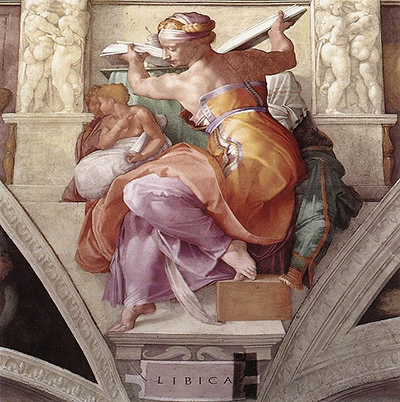
Michelangelo’s Libyan Sibyl turns with a book so large that reading becomes an athletic event. One foot braces on the ledge, the other rises onto a wooden block, the torso rotates away and both arms lift the open volume behind her shoulders. Drapery follows the spiral in bands of orange, rose and pale violet. The body seems caught between setting the book down and taking it up.
She is one of the vault’s five ancient sibyls, interleaved with the seven prophets of Hebrew scripture.[1][2] Unlike an image of passive inspiration, the Libyan makes knowledge a problem of balance, weight and transition. A celebrated preparatory sheet at the Metropolitan Museum reveals how Michelangelo built that action from studies of a nude male model before transforming it into the clothed prophetess.[4]
Why is Michelangelo's Libyan Sibyl so physically dramatic? The page focuses on her rotary movement, the large book, the relationship between body and text, and her place among the Sistine ceiling's prophets and sibyls.
At a Glance
- IdentityThe Libyan Sibyl, labelled LIBICA beneath her seat
- Artist and processMichelangelo Buonarroti; fresco developed through extensive drawing
- SiteOne of the colossal prophetic thrones on the Sistine Chapel vault
- Campaign range1508–1512, commissioned by Pope Julius II[3]
- Ensemble roleOne of five sibyls paired across the programme with seven prophets[2]
- Defining movementA seated spiral while lifting, closing or placing a very large book[1]
- Bodily structureBack turned, arms raised, one foot braced on a block and the other on the ledge
- AttendantsTwo smaller figures at the side, one seemingly holding a light
- Major studyMetropolitan Museum sheet with the principal nude pose and subsidiary studies[4]
- Later receptionAn anonymous engraving after Michelangelo records the figure’s reproductive circulation[5]
- Gender cautionA male studio model helped develop the pose; the finished subject is a named female sibyl
- Action cautionThe precise instant—lifting or setting down the book—remains visually suspended
Contents
- Libya and the Renaissance Sibyl
- A Movement That Refuses One Verb
- The Spiral from Foot to Hand
- The Exposed Back
- The Book as Counterweight
- Hands at the Limit of Reach
- The Block Beneath Her Foot
- Drapery Completing Anatomy
- The Metropolitan Museum Study
- Drawing as a Record of Thought
- The Attendants
- Youth, Strength and Female Authority
- In the Five-Sibyl Sequence
- Painted Architecture Under Pressure
- Position and Date
- Viewing from Below and in Reproduction
- Restoration and Colour
- The Libyan Sibyl in Print
- Why the Libyan Sibyl Matters
- Artist Up Close
Libya and the Renaissance Sibyl
The “Libyan Sibyl” belongs to an ancient and later Christian taxonomy of prophetesses associated with different regions. Renaissance theological culture interpreted sibylline sayings as pagan anticipations of Christian revelation.
Michelangelo does not provide a North African landscape, specific costume documentary or historical portrait. The tablet supplies the geographic name within a unified series of fictive thrones.
Her identity is therefore cultural and programmatic rather than ethnographic. It would be misleading to treat skin, facial type or garment as an accurate representation of a particular Libyan community.
Within the chapel, “Libyan” expands the imagined geography of prophecy while the figure’s monumental language keeps her visually equal to the other seers.
A Movement That Refuses One Verb
Is she taking the book down, lifting it onto a support or closing it after reading? The pose does not settle the question. Both hands grasp the volume above and behind, while head and torso turn in another direction.
This ambiguity gives the action duration. A completely finished lift would be static; a transition compels viewers to reconstruct what came before and what follows.
The Vatican description emphasises the powerful movement of the figure and book.[1] It need not be narrowed further to remain meaningful.
The suspended action also suits prophecy. Knowledge is being handled, transferred or momentarily left. The book is neither simply open for reading nor safely at rest.
The Spiral from Foot to Hand
The pose begins at the feet. One presses near the throne’s edge; the other is raised onto a rectangular block. Knees separate across the seated base, and hips turn against the upper torso.
From there, the spine rotates toward the shoulders. One arm extends across the book’s upper edge while the other bends to grasp the opposite side. Head turns back across the motion, completing a complex spiral.
This sequence distributes tension rather than concentrating it in one limb. The entire body participates in managing the volume.
Michelangelo makes anatomical cause legible. The elevated foot is not a decorative complication; it supplies leverage for the turn.
The Exposed Back
The Libyan Sibyl’s back is among the fresco’s most memorable features. A narrow garment leaves shoulders and upper torso exposed, allowing muscle and bone to articulate rotation.
The back communicates what the face alone cannot. Shoulder blades shift, the waist turns and the raised arms pull upward. Thought becomes visible from behind.
This orientation also withholds easy portrait contact. The Sibyl does not present herself frontally to the chapel. Observers encounter the mechanics of action before expression.
Her partial exposure should not be confused with the nudity of the preparatory model. In the fresco, clothing, identity and sacred setting transform anatomical study into a specific female visionary.
The Book as Counterweight
The open volume spans behind the Sibyl’s head and shoulders like a pale beam. Its rigid edges oppose the curved body.
Implied weight explains the pose. Arms rise because the object resists; the foot braces because balance must be maintained. The book is an intellectual attribute with physical consequences.
It also enlarges the silhouette for distant viewing. From the chapel floor, the horizontal white form remains visible even when individual fingers disappear.
Michelangelo does not make written words legible on its pages. The object signifies prophecy through scale and use rather than quotation.
Hands at the Limit of Reach
Both hands rise near the upper limits of the niche, but they do different work. One spreads across the book’s nearer edge while the other curls around the far side. The asymmetry allows rotation to continue through the object.
Fingers make weight believable. Without their varied pressure, the volume would seem attached to the background rather than held in a precarious transition. Michelangelo uses small articulations to sustain the monumental pose.
The hands also sit close to the book’s pale pages, creating high contrast visible from below. Fine anatomy serves an architectural reading pattern.
In the preparatory sheet, subsidiary studies allowed Michelangelo to revisit precisely such problems apart from the full body.[4] The method shows that a convincing instant can depend on repeated attention to extremities.
The Block Beneath Her Foot
The small wooden or box-like support beneath the raised foot is easy to overlook, yet the whole action depends on it. It changes the level of the knee and allows the pelvis to rotate.
This practical object makes the colossal figure momentarily human. Even a prophetess needs leverage.
The block also projects forward within the fictive space, strengthening the illusion that the throne contains real objects. Foot, box and ledge form a chain of weight close to the observer.
Details of support are central to Michelangelo’s design intelligence. Monumentality is built from believable points of pressure.
Drapery Completing Anatomy
Orange fabric wraps the torso, rose and violet cloth crosses the legs and a darker green mantle falls behind. The colours divide the spiral into readable stages.
Folds around the waist tighten with rotation. Broader fabric over the legs stabilises the seated mass, while the exposed back keeps the upward action clear.
The preparatory nude demonstrates that Michelangelo solved major anatomy before the final clothing.[4] Yet drapery is not an afterthought. It revises silhouette, gender presentation, colour and movement.
The finished pose is therefore neither the drawing copied in paint nor anatomy hidden by fabric. It is a new synthesis developed from both.
The Metropolitan Museum Study
The Met’s red-chalk sheet is one of the most celebrated survivals from Michelangelo’s ceiling preparation. It studies a nude male model in the principal turning pose and includes subsidiary investigations, including a head and hands.[4]
The drawing reveals exploratory concentration. Contour is strengthened where form matters; internal modelling tests the back, arm and shoulder; separate details solve problems that the whole pose cannot clarify alone.
It also documents transformation across media and identity. The male studio body provided anatomical information for a female prophetess. This was a practical design method within the restrictions and conventions of the period, not evidence that the fresco’s subject is secretly male.
Comparing sheet and fresco shows decisions rather than simple correspondence. Garments change the body, the book acquires visual prominence and colour binds the figure to the ceiling.
Orientation further complicates comparison. A drawing can be turned easily in the hand, whereas the fresco occupies a fixed place overhead and is photographed from chosen angles. Apparent reversals or changes of direction should be checked against the objects rather than described from memory.
The sheet offers privileged access to preparation, not an unmediated view of Michelangelo’s first idea. It is already a highly developed selection from many acts of observation.
Drawing as a Record of Thought
A preparatory sheet is not merely an incomplete fresco. It preserves questions that the wall resolves differently.
Michelangelo could rotate attention between whole body and isolated detail, working through balance before committing pigment to fresh plaster. Paper allowed correction, reinforcement and alternatives.
The sheet’s fame can tempt viewers to use it only as proof of genius. More specifically, it shows design as labour: posing a model, observing tension, selecting, revising and translating.
That process is especially relevant to the Libyan Sibyl because the final action is so difficult. Its apparent spontaneity depends on prolonged preparation.
The Attendants
Two smaller figures sit at the side behind the Sibyl’s turning body. One rests or leans with a hand near the face; the other appears to hold a small light or lamp.
Their compact stillness offsets the principal spiral. They occupy the recess while her book crosses above them.
The light can support an association between illumination and knowledge, but the institutional account does not require a single symbolic reading.[1] It is also a practical visual object within an atmosphere of study.
As elsewhere in the ensemble, the attendants remain unnamed. Their role is relational: they deepen space, accompany prophecy and magnify the central figure by contrast.
Youth, Strength and Female Authority
The Libyan Sibyl appears youthful, powerful and poised at the limit of balance. She differs from the aged Cumaean and Persian without representing a superior type of prophecy.
Her body takes space aggressively, but the action is intellectual. Strength serves the handling of a book.
This combination expands sacred female representation. Michelangelo does not choose between beauty and muscular capacity; he makes both conditions of the visionary’s presence.
Awareness of the male model should deepen understanding of design without erasing this finished identity. Gender in the work is produced through name, clothing, body and programme together.
In the Five-Sibyl Sequence
The Delphic turns outward from a scroll, the Cumaean bends into a codex, the Persian reads close to her face and the Erythraean remains engaged with book and attendant. The Libyan is defined by transition around a volume.
Such comparison reveals Michelangelo’s variation, but her dedicated identity should remain primary. She is not merely “the athletic sibyl” in a typology.
Among the seven prophets, Daniel offers a useful parallel because book-handling also becomes collaborative physical effort. The distinct pose and gendered presentation prevent equivalence.
Across all twelve, inspired knowledge acquires multiple bodily tempos. The Libyan contributes suspended rotation.
Painted Architecture Under Pressure
The Sibyl occupies a shallow throne bounded by apparent stone and paired architectural nudes. Knee, foot, back and book push toward its limits.
Her name tablet below fixes identity while the pose destabilises enclosure. A visionary assigned a permanent seat appears on the verge of leaving its stable orientation.
Michelangelo exploits the mismatch between real flat plaster and painted depth. The body seems to project, yet every foot, block and codex is pigment.
The illusion is especially persuasive from below, where the actual vault and fictive structure cooperate.
Position and Date
The overall ceiling was undertaken from 1508 to 1512 and opened in stages.[3] The Libyan Sibyl belongs securely to that campaign.
Her place within the chapel and comparison with nearby work can inform broad chronology. They do not provide an exact day or simple numbered execution order.
The Met drawing further proves preparation for the figure but is not a dated diary of every design stage.[4] Drawing, cartoon, plaster and paint formed a process whose full sequence does not survive.
Evidence is strongest when campaign boundaries and object identities remain distinct.
Viewing from Below and in Reproduction
At architectural distance, the open book, orange torso and pale-violet legs create the figure’s main pattern. The face and attendants become secondary.
Close imagery reveals shoulder modelling, hand pressure, cracks and the small block. It can also flatten the pose into a rectangular picture.
Smarthistory emphasises the ceiling’s scale and density.[8] The Libyan Sibyl’s broad silhouette answers that challenge without sacrificing complexity under enlargement.
Study works best through alternation: full vault for location, throne crop for action, detail for making and the Met sheet for design.
Restoration and Colour
The Vatican’s conservation history frames the bright colour through which modern audiences know the fresco.[6][7] Cleaning made chromatic distinctions more visible after generations familiar with darker images.
Reproduction remains variable. Orange may intensify, violet may turn pink and flesh can shift with lighting and screen calibration.
These changes do not erase colour’s role. They encourage relational description rather than false precision.
The conserved surface also shows age. Cracking and repairs belong to the material object, while the turning design remains legible across them.
The Libyan Sibyl in Print
The Metropolitan Museum holds an anonymous engraving after Michelangelo’s Libyan Sibyl.[5] The print translates fresco and colour into portable line and tone.
It also participates in the figure’s detachment from architectural context. A viewer can study the pose without looking up or locating the other seers.
Engraving may reverse, simplify or reinterpret forms, so it is not a neutral facsimile. Its maker and medium must remain visible.
Such circulation demonstrates the pose’s independent fame while reminding us that reception creates new objects, not substitutes for the wall.
Why the Libyan Sibyl Matters
The Libyan Sibyl matters because Michelangelo turns thought into balance. Book, back, arms, feet and block participate in one intellectual action.
She matters because the surviving drawing makes artistic transformation unusually visible: male model to female seer, nude anatomy to coloured drapery, red chalk to fresco.
Most of all, the figure refuses completion. She is always about to lift, lower, turn or look again. Prophecy lives in that unstable interval.
Artist Up Close
Michelangelo’s preparation makes spontaneity credible. The Met sheet studies how a back twists and an arm bears weight; the fresco then adds book, clothing, colour, name and architectural pressure. Nothing about the finished movement is casual, yet it feels unrepeatable. The artist’s intelligence lies in preserving transition after every problem has been carefully solved.
Frequently Asked Questions
Discussion
What feels most powerful in Michelangelo's Libyan Sibyl: the turning body, the large book, or the uncertainty of the gesture?
Reader Insights
How does the rotary pose make the figure feel almost sculptural?
Where should interpretation pause before lifting or lowering becomes too certain?
What does the Met study add without replacing the finished ceiling figure?
Join the Conversation
Compare the figure's movement, book and Sistine setting while keeping the Libyan Sibyl distinct from the wider ceiling programme.
References
- Vatican Museums, Libyan Sibyl”:, View source.
- Vatican Museums, Sibyls and Prophets”:, View source.
- Vatican Museums, Sistine Chapel Ceiling”:, View source.
- The Metropolitan Museum of Art, Studies for the Libyan Sibyl”:, View source.
- The Metropolitan Museum of Art, The Libyan Sibyl, anonymous engraving after Michelangelo”:, View source.
- Vatican Museums, Sistine Chapel History”:, View source.
- Vatican Museums, The Sistine Chapel Twenty Years Later: New Breath, New Light”:, View source.
- Smarthistory, Michelangelo, Ceiling of the Sistine Chapel”:, View source.