


 by Tom Gurney
Tom Gurney BSc (Hons) is an art history expert with over 20 years experience
Published on June 19, 2020 / Updated on November 6, 2025
Email: tomgurney1@gmail.com / Phone: +44 7429 011000
Palazzo Senatorio and Michelangelo’s Campidoglio
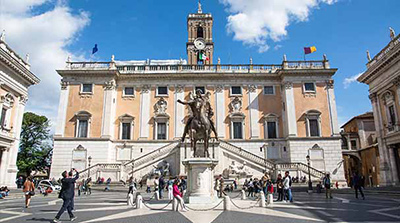
Palazzo Senatorio rises at the head of the Campidoglio like the fixed authority toward which the whole square turns. A broad double staircase climbs across its front; the bell tower marks the Roman skyline; flanking palaces angle inward, and the paving gathers movement around Marcus Aurelius at the centre. Michelangelo’s achievement cannot be isolated in one façade. He redesigned a civic ensemble.
Pope Paul III called upon him in the later 1530s to reorganise the Capitoline Hill, Rome’s ancient seat of civic identity.[1][2] The Palazzo Senatorio already existed in medieval form above the remains of the ancient Tabularium. Michelangelo revised its approach and architectural presence while turning the Campidoglio away from the Roman Forum and toward the living city and papal Rome.[3] Later architects, including Giacomo della Porta and Girolamo Rainaldi, carried the palace and square forward.[2] The famous oval-star paving was not executed until 1940.[3]
What is the safest way to connect Palazzo Senatorio to Michelangelo? The route focuses on his Campidoglio redesign while keeping façade, staircase, tower, paving and later execution history distinct.
At a Glance
- BuildingPalazzo Senatorio
- Urban ensemblePiazza del Campidoglio on Rome’s Capitoline Hill
- Principal redesignMichelangelo, commissioned under Pope Paul III in the late 1530s
- Earlier fabricMedieval civic palace built over and among ancient remains associated with the Tabularium
- Michelangelo’s major palace elementsMonumental double staircase, façade conception and integration with the piazza
- Later architectsGiacomo della Porta, Girolamo Rainaldi and other successors[2]
- Civic roleSeat associated with Rome’s municipal government
- Square geometryTrapezoidal arrangement focused on a central oval and the equestrian Marcus Aurelius[1][3]
- ApproachThe Cordonata, a broad, gently rising ceremonial stair-ramp[3]
- OrientationRecast toward modern Rome rather than the ancient Forum
- Paving cautionMichelangelo devised the oval/star concept, but the present pavement was executed in 1940[3]
- Central authorship cautionThe standing palace and square combine ancient, medieval, Michelangelesque, early modern and twentieth-century phases
Contents
- The Capitoline Before Michelangelo
- Above the Tabularium
- Paul III and a Ceremonial Crisis
- Turning Toward Modern Rome
- Palazzo Senatorio as the Visual Head
- The Double Staircase
- River Gods and the Fountain Zone
- The Façade as Later Realisation
- The Bell Tower
- Civic Sound and Public Time
- A Trapezoid Made Coherent
- Marcus Aurelius at the Centre
- The Oval and Star Paving
- The Cordonata
- Palace, Square and Approach as One Work
- Civic Rome and Papal Rome
- A Square Used, Not Merely Viewed
- The Capitoline Museums and the Ensemble
- Campidoglio and Palazzo Farnese
- Campidoglio and St Peter’s
- Twentieth-Century Completion and Fascist Rome
- How to Experience Palazzo Senatorio
- Why Palazzo Senatorio Matters
- Artist Up Close
The Capitoline Before Michelangelo
The Capitoline Hill carried enormous ancient prestige, but by the sixteenth century its principal civic spaces had developed through medieval use and piecemeal building. Palazzo Senatorio occupied the commanding edge above the Forum, incorporating older structures into a municipal seat.
Michelangelo did not rediscover an empty classical acropolis. He inherited a working political site with awkward geometry and buildings that did not form a unified composition. The task was transformation without wholesale erasure.
This layered beginning explains why the Campidoglio cannot be called a reconstruction of ancient Rome. It is a Renaissance reorientation of antiquity, medieval government and papal ambition.
Above the Tabularium
The ancient Tabularium formed a monumental archive and substructure on the slope facing the Forum. Palazzo Senatorio grew above and through this inherited fabric, making the civic building physically dependent on republican and imperial Rome.
Michelangelo’s design did not expose the ancient remains as a modern archaeological display. From the new piazza, viewers encounter a transformed governmental front. The antiquity beneath supplies authority through location and mass rather than a reconstructed classical façade.
This superimposition gives the palace exceptional temporal density. Roman records, medieval commune, papal redesign and current municipality occupy related ground. Government is represented as succession built literally on earlier government.
Paul III and a Ceremonial Crisis
Paul III’s interest intensified around the planned visit of Emperor Charles V in 1536. Rome needed a ceremonial civic setting worthy of imperial arrival and papal authority. The neglected hill demanded a coherent public face.
Commissioning Michelangelo joined art with urban diplomacy. The Campidoglio represented the Roman people, yet papal sponsorship shaped its renewal. Civic and ecclesiastical power met on ancient ground.
The resulting design does not illustrate one event. It converts the need for ceremony into a durable spatial order capable of receiving rulers, officials and citizens across generations.
Turning Toward Modern Rome
One of Michelangelo’s most consequential decisions was orientation. Ancient monumental focus had opened toward the Forum. The redesigned Campidoglio addresses the city approached from the opposite side, toward papal and contemporary Rome.[3]
This turn is symbolic and practical. Visitors ascend from the modern urban fabric, enter between flanking palaces and face Palazzo Senatorio. Antiquity remains physically behind and below, but it no longer controls the principal ceremonial approach.
Michelangelo does not reject the ancient city. He reorganises its inheritance for a new political centre. Orientation becomes historical argument.
Palazzo Senatorio as the Visual Head
At the far side of the trapezoid, Palazzo Senatorio provides the ensemble’s destination. Its centrality is not a matter of equal distance alone. The façade, staircase and tower gather the square’s converging lines.
The palace represents government, so making it the visual head gives architecture civic hierarchy. Visitors enter, turn their gaze across Marcus Aurelius and encounter the institutional seat beyond.
The flanking palaces help. Their angled fronts frame Palazzo Senatorio and correct an irregular site through perspective. The square feels ordered because its parts cooperate, not because the ground was naturally regular.
The Double Staircase
Michelangelo’s monumental stairs sweep upward in paired flights, meeting the palace at an elevated level.[2] The arrangement transforms access into civic theatre.
Two rising diagonals broaden the façade’s base and leave a central zone for fountain and sculpture. Movement is split and recombined: officials and visitors climb from either side toward one institutional front.
The stair also mediates older fabric. Instead of treating level differences as inconveniences, Michelangelo makes ascent the palace’s identifying gesture.
River Gods and the Fountain Zone
Ancient river-god statues occupy the lower composition, and the central fountain area became associated with Roma. These sculptures link civic Rome with water, antiquity and territorial identity.
Their placement beneath the stair gives ancient bodies an architectural role. They do not stand as isolated archaeological trophies. The palace’s modern government appears to rise above a classical foundation.
Because the fountain and sculptural arrangement developed across later phases, exact authorship must remain differentiated. Michelangelo established the powerful framework within which successors completed details.
The Façade as Later Realisation
Michelangelo’s conception guided the palace, but Giacomo della Porta and Girolamo Rainaldi participated in later completion and alteration.[2] The standing façade is therefore not a surface personally finished by Michelangelo.
Successors interpreted drawings and the already changing ensemble. They worked under new practical and political circumstances while preserving enough of the governing design for the square to retain unity.
The correct phrase “by Michelangelo” refers here to transformative authorship through design. Naming later makers makes that authorship more exact, not less impressive.
The Bell Tower
The tower gives Palazzo Senatorio a vertical marker visible beyond the piazza. Its present form belongs to the later history of the building rather than Michelangelo’s personal execution.
Vertical emphasis helps the palace hold its position against the broad horizontality of square and steps. Sound would also have carried civic time and authority across the city.
As with the façade, the tower demonstrates how a monument can follow Michelangelo’s urban hierarchy while incorporating later architectural language.
Civic Sound and Public Time
A civic tower is not only visual. Bells historically announced hours, ceremonies, alarms and governmental events across a population that might never enter the palace. Sound extended municipal architecture beyond the piazza.
This acoustic reach resonates with the four-dimensional design below. People climb the Cordonata, cross the paving and hear time marked from above. The palace organises bodies and civic duration.
The present soundscape is altered by traffic and modern communications, but the tower still signifies a government meant to be seen and heard.
A Trapezoid Made Coherent
The piazza is not a perfect rectangle. Its flanking palaces create a trapezoid that widens or narrows according to approach. Michelangelo uses the irregularity to heighten perspective.[1][3]
Converging façades guide the eye to Palazzo Senatorio. The geometry feels dynamic because the visitor’s movement changes apparent spacing. An awkward site becomes a deliberate optical device.
This is urban design as choreography. Michelangelo does not force every building into abstract symmetry; he makes existing differences serve a unified experience.
Marcus Aurelius at the Centre
The ancient bronze equestrian statue of Marcus Aurelius became the square’s central focus. Its survival owed much to historical misidentification with the Christian emperor Constantine. On the Campidoglio, it provided imperial antiquity with a living rider’s movement.
Michelangelo designed the square around the monument, giving it an oval field and a relation to the palace axis.[1][3] The statue now seen outdoors is a copy, with the ancient original conserved within the Capitoline Museums; this later conservation distinction should not be confused with the Renaissance placement.
Horse and rider create a mobile centre against which architecture turns. The square is not empty space framed by façades. It is organised around a body in bronze.
The Oval and Star Paving
The famous pavement draws an oval around the equestrian centre and unfolds a radiating star-like pattern. It makes the ground appear active, almost convex, gathering the trapezoid into one figure.[3]
Michelangelo’s design is sixteenth-century; its execution is not. The present paving was installed in 1940 on the basis of the historic conception.[3] This gap of centuries is essential to honest attribution.
The late realisation demonstrates the potency of an unbuilt idea. It also warns that the square Michelangelo knew did not look exactly like the iconic modern aerial view.
The Cordonata
The Cordonata provides a broad, shallow ascent suitable for ceremonial movement and historically for mounted approach.[3] It is neither an ordinary steep staircase nor a modern road.
Ascending slowly allows the piazza to reveal itself. The flanking statues and balustrades mark transition, while Palazzo Senatorio emerges beyond the central bronze.
The approach transforms topography into expectation. By the time visitors enter the square, their bodies have already been disciplined by Michelangelo’s urban sequence.
Palace, Square and Approach as One Work
Musei Capitolini describes the piazza and palaces as an intended organic unity.[1] That term is valuable because no element can be understood fully alone. Cordonata determines entry, façades shape enclosure, paving controls centre and Palazzo Senatorio provides culmination.
This unity is experiential rather than solely stylistic. Different building phases and makers can still cooperate when their spatial roles remain aligned.
Michelangelo’s deepest authorship lies in that alignment. He made several inherited objects behave as one civic composition.
Civic Rome and Papal Rome
Palazzo Senatorio represents municipal authority on a hill redesigned under a pope. The coexistence is characteristically Roman. Ancient senate memory, medieval commune and papal patronage overlap rather than succeeding cleanly.
The Campidoglio’s turn toward the modern city can be read as papal appropriation of civic prestige, but the palace’s governmental function prevents the site from becoming merely a papal court.
Architecture negotiates these powers through hierarchy. Paul III commissions; Roman civic identity occupies; antiquity legitimises; Michelangelo composes.
A Square Used, Not Merely Viewed
Piazza del Campidoglio functions as an approach to museums and municipal institutions as well as an admired design. Officials, visitors, ceremonies and ordinary crossings continually test its geometry.
Use distinguishes urban architecture from a self-contained artwork. Crowd, security, temporary barriers and weather can interrupt the ideal centre visible in plans. The design succeeds because the trapezoid and axis remain legible despite those contingencies.
Michelangelo’s piazza is therefore completed repeatedly by movement. A person ascending, circling the bronze and approaching the stair makes the drawn sequence actual.
Palazzo Senatorio adds a further kind of use: administration behind the ceremonial front. Decisions, offices and institutional routines give practical substance to the civic authority proclaimed outside. The distinction matters because a governmental palace is not only a symbol placed at the end of an axis. Its representative façade and working interior are different aspects of the same public identity.
Michelangelo’s staircase makes that relationship visible. It raises entry above the square, dramatizing access, yet its paired flights also deliver people to a functioning building. Theatricality and utility are not opposites here. Each depends on movement having a real destination.
The Capitoline Museums and the Ensemble
The flanking palaces now belong to the Capitoline Museums, whose institutional accounts provide the governing history of piazza, buildings and Cordonata.[1][2][3] Their collections deepen the hill’s association with Roman antiquity.
Museum function also affects perception. Visitors may treat the square as a vestibule between collection buildings, while civic architecture asks them to read the open centre itself.
The best encounter combines both: ancient objects preserved inside, ancient equestrian authority at the centre, and Renaissance urban design binding them to a living municipal palace.
Campidoglio and Palazzo Farnese
Both were major Paul III-era projects shaped by Michelangelo after earlier work. Palazzo Farnese concentrates dynastic authority in a residence; the Campidoglio organises civic authority across urban space.
At the palace, a cornice and central window transform a broad façade. On the hill, orientation, trapezoid and approach transform multiple buildings. Scale of intervention differs, but strategic revision connects them.
Rome’s official Michelangelo itinerary places both within the late architectural network.[5] Each must still retain its own authorship sequence and function.
Campidoglio and St Peter’s
St Peter’s offers another multi-generation project recorded by its governing institution.[6] Michelangelo inherited a vast church design and sought structural and visual unity. The Campidoglio required comparable synthesis across an urban ensemble rather than a basilica.
The comparison shows late Michelangelo working from centres: dome and crossing in one case, Marcus Aurelius and civic palace axis in the other. Strong focal organisation allows complexity around it.
No direct formal equivalence is necessary. The shared method is hierarchy capable of surviving later execution.
Twentieth-Century Completion and Fascist Rome
The paving’s 1940 execution occurred under a regime deeply invested in appropriating Roman antiquity and Renaissance grandeur.[3] That historical layer complicates the apparent timelessness of the square.
Michelangelo’s star-oval concept gained material reality through twentieth-century political culture. The design should not be credited to that regime, but neither should its act of execution be erased.
The Campidoglio thus embodies several Romes simultaneously: ancient, medieval, papal, national and modern municipal.
How to Experience Palazzo Senatorio
Begin at the foot of the Cordonata rather than inside the square. Watch the palace emerge during ascent. At the threshold, note how the angled side palaces guide attention.
Walk around the central Marcus Aurelius and feel how the paving redistributes the trapezoid. Then approach the double staircase and trace its two routes upward.
Finally turn back toward the city. The reverse view reveals Michelangelo’s reorientation: Palazzo Senatorio is the destination of an approach deliberately detached from the Forum behind it.
Why Palazzo Senatorio Matters
The palace matters because Michelangelo made an inherited civic building the head of one of Europe’s most influential public ensembles. Architecture, sculpture, paving and movement become a political order.
It matters because irregularity is not concealed. The trapezoidal site becomes the engine of perspective, and ancient objects become active components of Renaissance design.
Most importantly, Palazzo Senatorio teaches that urban authorship operates across time. Michelangelo conceived the hierarchy; della Porta, Rainaldi and others realised later phases; twentieth-century workers completed the pavement. The unity is historical, not instantaneous.
Artist Up Close
Michelangelo approached the Campidoglio as more than a designer of façades. He controlled the visitor’s climb, the square’s centre, the angles of existing palaces and the governmental building’s visual authority. The Met’s architecture galleries and Rome’s city itinerary place this urban work within his late disegno.[4][5] His genius was organisational: he saw how ancient statue, medieval palace and uneven hill could become a single civic experience without pretending any of them began with him.
Frequently Asked Questions
Discussion
How does Palazzo Senatorio change when it is read as part of a civic ensemble rather than a single building “by Michelangelo”?
Reader Insights
What changes when the palace is read with the whole Campidoglio?
Where does Michelangelo's redesign meet later execution?
How do the stair, paving and cordonata shape civic movement?
Join the Conversation
Compare civic redesign, later makers, staircase, paving and urban setting while keeping the monument's phases distinct.
References
- Musei Capitolini, The Piazza and Its Palazzi”:, View source.
- Musei Capitolini, Palazzo Senatorio”:, View source.
- Musei Capitolini, The Square and the Flight of Steps (Cordonata)”:, View source.
- The Metropolitan Museum of Art, Michelangelo: Divine Draftsman and Designer — Exhibition Galleries”:, View source.
- Roma Capitale / Turismo Roma, Michelangelo’s Locations”:, View source.
- Fabric of Saint Peter, The Basilica”:, View source.