


 by Tom Gurney
Tom Gurney BSc (Hons) is an art history expert with over 20 years experience
Published on June 19, 2020 / Updated on November 6, 2025
Email: tomgurney1@gmail.com / Phone: +44 7429 011000
The Persian Sibyl by Michelangelo
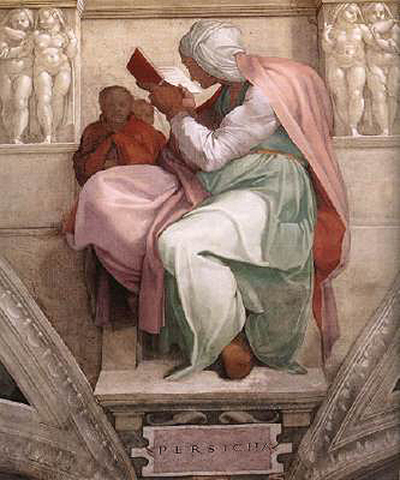
The Persian Sibyl nearly turns her back on the chapel. Wrapped in pale green, white and rose, she brings a small red-covered book close to an aged face while one attendant waits in shadow behind her. Unlike the Delphic Sibyl’s sudden outward gaze or the Libyan’s sweeping rotation, this prophetess withdraws. Michelangelo makes revelation private, slow and difficult to overhear.
She joins the vault’s company of five ancient sibyls and seven prophets from Hebrew scripture.[1] The label PERSICHA fixes her identity within a Renaissance Christian geography of pagan prophecy. Beyond that name, the fresco resists specificity: it supplies no portrait, landscape or legible oracle that could locate her securely in historical Persia.
Why does Michelangelo's Persian Sibyl feel so inward? The page focuses on her book, older or withdrawn visual presence, stillness, ceiling group context and later print/copy evidence.
At a Glance
- FigureThe Persian Sibyl, identified by the tablet PERSICHA
- Painter and mediumMichelangelo Buonarroti; fresco
- Architectural settingA fictive throne within the Sistine vault’s prophetic company
- CampaignJulius II’s ceiling project, executed from 1508 to 1512[2]
- EnsembleFive named sibyls interleaved with seven biblical prophets[1]
- Defining featuresAged profile, wrapped head, small book held near the eyes and body turned partly away
- Colour structurePale green and white garments under a rose-coloured mantle
- CompanionsTwo smaller attendants compressed into the background
- Primary moodWithdrawal and absorbed scrutiny
- Identity caution“Persian” is a programmatic ancient designation, not evidence that the image documents Persian dress or physiognomy
- Object cautionThe book’s exact text is not legible or securely identified
- ReceptionGiorgio Ghisi translated the figure into an engraving within his printed series after Michelangelo[4]
Contents
- A Persian Prophetess in Papal Rome
- A Body Turned Away
- The Book Held Close
- Age Without Display
- Head Wrap, Mantle and Concealment
- The Foreground Knee and Hidden Foot
- The Attendants in Shadow
- The Name Tablet and Fictive Throne
- Inwardness Among the Five Sibyls
- Gender, Age and the Refusal of Beauty
- Campaign and Chronological Limits
- Seeing Distance and Detail
- Restoration and Reproduced Colour
- Giorgio Ghisi’s Engraving
- Why the Persian Sibyl Matters
- Artist Up Close
A Persian Prophetess in Papal Rome
Renaissance lists of sibyls associated prophetic women with different regions of the ancient world. The Persian Sibyl expanded that tradition eastward, placing an imagined non-biblical witness to Christ beyond the Greek and Roman centres represented by Delphi and Cumae.
This framework is Christian and European. It does not reproduce Persian religious traditions on their own terms. Michelangelo’s figure belongs to the theology of the Sistine Chapel, where classical and foreign prophecy is gathered into a narrative of Christian fulfilment.
The absence of an exotic setting is significant. She sits on the same kind of painted throne as the other seers. Garments and body individualise her, while architecture absorbs her into one institutional order.
The name should therefore be used accurately but modestly. It identifies her assigned place in the sibylline company; it cannot support a detailed cultural biography.
A Body Turned Away
The Sibyl’s torso faces toward the side and partly away from observers below. Her shoulders form a sloping mass beneath the rose mantle, and the head turns toward the small book.
This orientation denies easy encounter. We see less of her face than of garment and back. Michelangelo makes access to the visionary proportional to her absorption.
The turn also creates depth within a shallow niche. Foreground knee, receding shoulders and background attendant occupy distinct layers.
Unlike the Libyan Sibyl, whose rotation announces exertion, the Persian’s turn closes space. Movement has settled into privacy.
The Book Held Close
The red-bound book rises near her eyes, held in both hands. Its modest dimensions distinguish it from the Cumaean’s vast codex and the Libyan’s broad volume.
Proximity may suggest intense concentration or the practical demands of aged sight. It should not be turned into a medical diagnosis. Michelangelo supplies an act of looking, not an ophthalmological record.
The book’s red edges create a sharp accent among pale fabric. At ceiling distance, this concentrated colour helps identify the object even when pages are indistinct.
No words are visibly available to most observers, and the institutional ensemble account does not assign a precise oracle.[1] Prophecy is communicated through her relation to the book rather than a quoted text.
Age Without Display
The Persian Sibyl is old, but Michelangelo represents her age differently from the Cumaean’s. The Cumaean turns a lined face and immense arms more openly toward the viewer. The Persian recedes beneath fabric and shadow.
Her age appears in profile, posture and the close-held volume. It is a condition of prolonged attention rather than an anatomical spectacle.
This distinction prevents the aged sibyls from becoming a repeated type. One is physically expansive; the other inward and remote.
Authority does not require visibility. The Persian Sibyl’s refusal to present herself becomes the source of her gravity.
Head Wrap, Mantle and Concealment
A large white head wrap encloses the skull and extends the volume of the head. The rose mantle passes over shoulders and down the back; green and white garments spread across the legs.
Clothing performs more than colouristic variety. It hides much of the anatomy Michelangelo displays elsewhere, making the figure a structure of layered surfaces.
The pale fabrics catch light while her face remains comparatively shaded. Visibility belongs to clothing and book before expression.
This inversion is apt for a seer defined by withdrawal. The body is monumental as a mass, but personal access is limited.
The Foreground Knee and Hidden Foot
One bent knee projects forcefully under pale drapery, establishing the seated body’s scale. Below, a foot appears near the ledge, partly obscured by fabric.
These points of support keep the turn believable. The Sibyl may recede above, but her lower body occupies the throne with weight.
Folds converge around knee and ankle, translating anatomy into cloth. Michelangelo allows drapery to reveal pressure without outlining every limb.
At architectural distance, the pale angular knee becomes a primary marker in the silhouette.
The Attendants in Shadow
Two smaller companions occupy the space behind the Sibyl. One face and hand are more visible, while the other figure remains compressed and dark.
Their obscurity contrasts with the bright garments in front. They create a shadowed human background from which the aged seer separates.
The attendants do not obviously hand her the book or interrupt her. Their quieter presence reinforces solitude inside company.
No individual names are provided by the Vatican ensemble record.[1] They are best understood through scale, companionship and spatial function.
The Name Tablet and Fictive Throne
The inscription PERSICHA appears on the tablet below, framed by Michelangelo’s painted architecture. It fixes a name that the pose alone could not supply.
Paired nude figures and apparent stone supports border the niche. Their lighter bodies and frontal presence contrast with the clothed seer turned inward.
This architectural system joins the Persian to the other eleven thrones while allowing her pose to resist the system’s frontality.
The wall is physically continuous plaster, yet paint creates ledge, recess, name plaque and a body inhabiting depth.
Inwardness Among the Five Sibyls
The five sibyls represent different relations to knowledge. The Delphic looks away from a scroll, the Erythraean reads while an attendant tends a lamp, the Cumaean bears down over a great book and the Libyan turns with one.
The Persian takes withdrawal furthest. Her book is small, her face partly concealed and her attention directed away from the chapel’s open space.
This does not make her passive. Sustained scrutiny can be as active as sudden revelation. Michelangelo registers activity through closeness rather than amplitude.
Her difference enriches the ensemble’s psychology. Prophecy may be proclaimed, received, carried or silently guarded.
Gender, Age and the Refusal of Beauty
The Persian Sibyl does not conform to a narrow ideal of youthful feminine beauty. Michelangelo allows old age, bodily volume and concealing dress to occupy sacred monumental space.
Her gender remains secured by name and programme, even though the fresco does not eroticise her body. Femininity is not reduced to display.
This is especially important beside the youthful Delphic and Libyan figures. The sequence makes no single female age the exclusive bearer of inspiration.
The Persian’s authority emerges from what she withholds: face, speech and easy access.
Campaign and Chronological Limits
The figure belongs to Michelangelo’s 1508–1512 ceiling campaign for Julius II.[2] The chapel history supplies this firm range and broader conservation context.[3]
Her location can be mapped within the vault, but it does not produce an exact execution day. Fictive architecture, seers and adjacent compartments were parts of an interconnected fresco undertaking.
Stylistic differences among the sibyls can suggest development; they should not be converted into undocumented calendar entries.
Chronological caution preserves the strongest evidence: a specific figure integrated into a documented four-year monumental project.
Seeing Distance and Detail
From the floor, the large pale garments and red book read more quickly than the profile. The body appears as a turned chromatic mass.
Close imagery allows study of the aged face, fingers and attendants, but it can make the niche seem like an independent vertical painting. Smarthistory stresses how the ceiling’s height and density complicate ordinary viewing.[5]
The apparent remoteness therefore has two sources: Michelangelo’s pose and actual architectural distance.
To understand both, the figure should be seen as full throne, as one of twelve, and through details that recover what the chapel floor suppresses.
Restoration and Reproduced Colour
Modern conservation renewed visibility of the Persian Sibyl’s pale green, rose and white structure.[3][6] The colours differentiate garments whose folds could otherwise merge.
Digital versions vary in saturation and shadow. The face and attendants may almost disappear in one file and become unnaturally bright in another.
The material fresco also carries cracks and repairs. These are evidence of age and conservation, not components of the intended prophetic expression.
Reliable description focuses on durable relationships while recognising that every reproduction mediates colour and surface.
Giorgio Ghisi’s Engraving
Giorgio Ghisi engraved the Persian Sibyl as part of a series after the Sistine prophets and sibyls.[4] The print translated fresco into line and portable paper.
Such translation could clarify contour and pose while removing Michelangelo’s colour and changing orientation. It allowed collectors to examine the seer outside Rome.
The print is not a Michelangelo drawing or a neutral facsimile. Ghisi is its maker, and “after Michelangelo” describes the relation of invention.
Its survival demonstrates how individual thrones acquired an afterlife separate from the twelve-part ceiling ensemble.
Why the Persian Sibyl Matters
The Persian Sibyl matters because she makes prophetic authority compatible with withdrawal. Michelangelo does not require every inspired person to face the audience.
She matters because old age and concealed anatomy remain monumental. The body is powerful as occupied space rather than exposed muscle.
Most importantly, the small book creates an intimate centre inside a colossal environment. The Sibyl seems to protect a thought from the very chapel that displays her.
Artist Up Close
Michelangelo can command attention by withholding it. The Persian Sibyl does not look at us, and much of her face disappears beneath head wrap and book. Yet the bent knee, layered mantle and concentrated hands make her presence immense. The artist turns privacy into monument. What cannot be shared easily becomes the source of authority.
Frequently Asked Questions
Discussion
What feels most powerful in Michelangelo's Persian Sibyl: the book, the inward stillness, or her place among the ceiling's other Sibyls?
Reader Insights
How does the book make the figure feel withdrawn rather than theatrical?
Where should interpretation pause before inwardness becomes invented psychology?
What do prints and copied works preserve, and what can they never prove about the fresco?
Join the Conversation
Compare the figure's book, stillness and Sistine setting while keeping the Persian Sibyl distinct from the wider ceiling programme.
References
- Vatican Museums, Sibyls and Prophets”:, View source.
- Vatican Museums, Sistine Chapel Ceiling”:, View source.
- Vatican Museums, Sistine Chapel History”:, View source.
- The Metropolitan Museum of Art, Giorgio Ghisi, The Persian Sibyl, from Prophets and Sibyls in the Sistine Chapel”:, View source.
- Smarthistory, Michelangelo, Ceiling of the Sistine Chapel”:, View source.
- Vatican Museums, The Sistine Chapel Twenty Years Later: New Breath, New Light”:, View source.