


 by Tom Gurney
Tom Gurney BSc (Hons) is an art history expert with over 20 years experience
Published on June 19, 2020 / Updated on November 6, 2025
Email: tomgurney1@gmail.com / Phone: +44 7429 011000
Porta Pia by Michelangelo
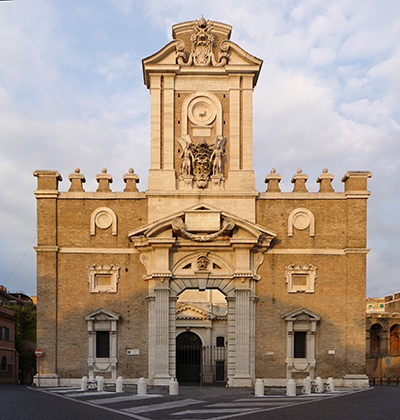
Michelangelo’s Porta Pia turns the ceremonial face of a city gate inward. Its most inventive elevation addresses Rome rather than the countryside: a deeply modelled composition of broken and curved forms, an emphatic opening and architectural details that seem almost bodily. It marks departure and arrival at once, but its history cannot be compressed into a single façade or hand.
Pope Pius IV commissioned the gate at the end of the new Strada Pia, and Michelangelo supplied the design late in his life. After his death in 1564, Giacomo del Duca continued the work.[1] The outward-facing elevation and upper portions were shaped or replaced in later campaigns, particularly in the nineteenth century.[1] Porta Pia is therefore both a Michelangelo invention and a monument whose two faces belong to different moments.
Which part of Porta Pia is safest to connect to Michelangelo? The route focuses on the inward-facing design while keeping Giacomo Del Duca's continuation and nineteenth-century outward/attic work separate.
At a Glance
- Architect and designerMichelangelo Buonarroti
- CommissionerPope Pius IV
- DateDesigned in the early 1560s; continued after Michelangelo’s death in 1564
- PurposeNew gate in the Aurelian Walls terminating the Strada Pia
- LocationNortheastern Rome
- Primary Michelangelo focusThe inward-facing elevation toward the city
- ContinuationGiacomo del Duca carried work forward after 1564[1]
- Later changesNineteenth-century work altered upper portions and the outward façade[1]
- Historical associationThe 1870 breach of Rome’s walls occurred nearby, making the area central to Italian unification memory
- Present contextPorta Pia is associated with the Historical Museum of the Bersaglieri[1]
- Central cautionThe present monument is not wholly Michelangelo’s executed work, and the two façades should not be dated or attributed as one design
Contents
- Pius IV and a New Urban Axis
- Why the Principal Face Looks Inward
- A Gate Inside Ancient Walls
- The Central Opening
- A Gate Is Both Building and Gap
- Design Choice and Papal Preference
- Architectural Forms That Behave Like Bodies
- Broken Pediments and Controlled Instability
- Surface, Depth and Shadow
- Michelangelo’s Late Design
- Giacomo del Duca Continues the Work
- The Outward Façade
- The Attic and Later Alterations
- The Breach of 1870
- Damage, Repair and National Memorial
- Traffic Through a Ceremonial Threshold
- The Bersaglieri
- Porta Pia and St Peter’s
- Porta Pia and the Campidoglio
- How to Look at Porta Pia
- Why Porta Pia Matters
- Artist Up Close
Pius IV and a New Urban Axis
The gate belonged to the remaking of a street. Pius IV developed the Strada Pia as an urban axis leading northeast through Rome, and Porta Pia gave that line a monumental conclusion.[1]
Naming joined pope, road and gate. “Pia” commemorates the patron while also carrying religious resonance. Architecture converted a practical opening in defensive walls into papal urban identity.
The commission should therefore be understood from the city outward. Porta Pia was not merely a military aperture receiving travellers from the countryside. It was the end point of an internal approach staged through Rome.
Why the Principal Face Looks Inward
Traditional gates often reserve their most impressive front for those arriving from outside, advertising the city’s power. Porta Pia reverses that priority. Michelangelo’s celebrated elevation addresses people approaching from the Strada Pia.
This orientation makes sense in a papal improvement programme. The gate completes a view from within and monumentalises the patron’s street. Departure becomes the ceremonial experience.
It also explains why photographs can create confusion. An “exterior” view may show later architecture, while the Michelangelo focus lies on the urban side. Direction must accompany attribution.
A Gate Inside Ancient Walls
Porta Pia cuts through the Aurelian Walls, the vast late-antique defensive circuit that remained part of Rome’s physical identity. Inserting a Renaissance gate brought papal modernisation into direct contact with ancient infrastructure.
The wall’s mass demands an opening of real structural and symbolic force. Michelangelo did not design a freestanding triumphal arch placed against scenery. He designed a threshold embedded in fortification.
This contrast—old defensive fabric and new papal face—captures Rome’s layered urbanism. Renewal rarely erased the city’s past; it occupied and redirected it.
The Central Opening
The passage is the gate’s practical core. Around it, Michelangelo concentrates frames, projections and curved elements so that crossing gains visual weight.
An ordinary opening removes wall. Porta Pia makes the removed zone appear actively held. Architectural members press toward the void and announce the effort of maintaining a breach safely within masonry.
The gate’s expressive force arises from this relation between load and passage. Movement is permitted, but architecture makes the permission ceremonial.
A Gate Is Both Building and Gap
Most architecture gains identity from what it encloses. A gate is defined equally by absence: the opening through which wall, road and authority are negotiated. Its success depends on keeping that absence structurally safe and politically controlled.
Porta Pia makes the contradiction visible. Massive masonry confirms the wall; elaborate framing dignifies the hole cut through it. Travellers experience architecture by passing into its void rather than remaining before a façade.
This dual nature distinguishes the gate from Michelangelo’s palace and church work. At Palazzo Farnese, the entrance serves a larger residence. At Porta Pia, passage itself is the programme.
Design Choice and Papal Preference
Accounts of the commission preserve Pius IV’s active role in choosing among Michelangelo’s proposals. Even when exact anecdotes vary, the gate emerged through a relation between designer and patron, not unbounded invention.[1]
Papal preference could govern cost, appearance and how strongly the new Strada Pia was commemorated. Michelangelo then developed architectural language within that selected direction.
The process reminds us that presentation drawings are arguments. Patrons choose, combine or reject. The built gate represents Michelangelo’s imagination filtered through papal decision and later execution.
Architectural Forms That Behave Like Bodies
Michelangelo’s late architecture often bends classical vocabulary toward bodily analogies. At Porta Pia, curved pediments, scroll-like forms, straps and frames seem to stretch, hang or grip.
Such language has encouraged humorous comparisons to towels, basins or other everyday objects. Those associations can sharpen looking if they remain responses rather than claims that Michelangelo literally designed a domestic-object allegory.
The deeper point is tactile. Classical members no longer feel like abstract geometry alone. They appear subject to tension and weight, as if architecture possessed muscles and joints.
Broken Pediments and Controlled Instability
A pediment traditionally provides a stable triangular or curved crown. Michelangelo interrupts and layers such forms, making gaps and reversals part of the composition.
Broken architecture does not mean structurally broken. The wall stands because practical loads are managed; visual fragments create energy at the surface. Convention is manipulated, not abandoned.
The result suits a threshold. Gates separate and connect. Their architecture can embody division while functioning as passage.
Surface, Depth and Shadow
Porta Pia’s city face depends on relief. Elements project or recede enough for Roman light to create strong shadow, making the composition change through the day.
This plasticity distinguishes Michelangelo’s approach from a flat pattern applied to masonry. Frames overlap, curves catch light and recesses deepen the central axis.
The analogy with sculpture is useful here: he designs the façade as mass articulated by removal and projection. Yet it remains architecture, organised around an opening used by people and vehicles.
Michelangelo’s Late Design
Porta Pia belongs to Michelangelo’s final years, alongside immense responsibility at St Peter’s and other Roman works. Rome’s civic itinerary situates the gate within that late architectural geography.[2]
Age did not make his design conservative. The gate’s unconventional forms demonstrate continued willingness to test classical language. Late style here means concentration and freedom, not decline.
The Met’s exhibition and publication place architecture within Michelangelo’s continuing practice of drawing and design.[3][4] The built gate translates that inventive disegno through collaborators and later phases.
Giacomo del Duca Continues the Work
Michelangelo died before Porta Pia was complete. Giacomo del Duca carried the project forward, making the visible monument a collaboration across the boundary of death.[1]
Continuation requires interpretation. Drawings and instructions do not answer every site question. Dimensions, masonry and changing decisions compel the successor to design as well as execute.
Del Duca should therefore remain named. Michelangelo’s authorship governs the principal conception; the building’s existence depended on another architect’s labour and judgment.
The Outward Façade
The face toward the exterior has a different history from the city-facing design. Later work, particularly in the nineteenth century, gave it the appearance now seen.[1]
This phase distinction prevents a common error: attributing both fronts to Michelangelo because they belong to one gate. Buildings accumulate interventions while retaining one name.
The later façade also reflects altered needs. Defensive, ceremonial and urban meanings changed as Rome expanded and modern statehood approached.
The Attic and Later Alterations
Upper elements were modified or added after the sixteenth-century campaign.[1] Silhouette, inscriptions and heraldry therefore preserve later moments alongside the Michelangelo core.
Alteration is especially common at gates because roads widen, traffic changes and political regimes seek visible ownership. A threshold is strategically and symbolically exposed.
Responsible looking separates phases without pretending that the later fabric is dispensable. The present Porta Pia is the result of their coexistence.
The Breach of 1870
On 20 September 1870, Italian forces breached the Aurelian Walls near Porta Pia, leading to the capture of Rome and the end of papal temporal rule. The event transformed the gate’s surroundings into a national site of memory.
Michelangelo did not design for Italian unification three centuries later. The association is an afterlife produced by location. A papal gate became the landmark nearest an event that displaced papal sovereignty.
This irony enriches the monument without changing its original commission. Architecture can be inherited by histories its maker could not imagine.
Damage, Repair and National Memorial
Military action and later commemoration altered how the area was maintained and understood. Walls built for defence became evidence of the moment defence failed, while the gate became a marker of national entry.
Repair at such a site faces a double obligation. Fabric must remain stable, but traces and memory of conflict may themselves carry historical value. Restoration cannot simply return Porta Pia to an imagined 1560s purity.
The nineteenth-century outward face and Risorgimento association therefore belong together in the modern monument’s biography. Michelangelo’s city-facing work remains essential, but it no longer controls every public meaning.
Traffic Through a Ceremonial Threshold
The vehicles and movement around Porta Pia differ radically from early modern Rome. A gate once tied to wall control now encounters the pressures of a modern capital. Traffic can make it difficult to recover the slow ceremonial axis of the Strada Pia.
That change demonstrates why urban monuments are never seen under fixed conditions. Roads persist because they remain useful, and usefulness transforms perception.
Looking historically means mentally reducing modern speed without pretending it can be removed. The gate’s stone holds several regimes of movement at once.
That tension explains why the monument can appear almost object-like in photographs yet remains inseparable from streets and walls. Its architecture was devised to terminate an avenue, admit passage and identify a papal boundary. Removing the movement conceptually would remove part of the design. The opening is not empty space left between decorated masses; it is the gate’s central working element.
Modern circulation also reverses and repeats older experiences. What once distinguished city from countryside now lies within an expanded metropolis. Travellers may cross without the ceremonial awareness the façade solicits, but the inward elevation still turns an ordinary transit into an encounter with Michelangelo’s late architectural language.
The Bersaglieri
The Bersaglieri troops became closely associated with the breach and with Porta Pia. The historical museum dedicated to the corps now forms part of the site’s identity.[1]
Military memory returns the gate to the subject of passage through walls, but under modern national rather than papal conditions. Ceremony, defence and commemoration overlap.
Visitors may therefore encounter Porta Pia first as Risorgimento history and only then as Michelangelo’s architecture. Both readings are legitimate if their centuries remain distinct.
Porta Pia and St Peter’s
The Fabric of Saint Peter documents the basilica as a long, multi-architect enterprise to which Michelangelo gave decisive form.[5] Porta Pia is much smaller, but it shares the issue of a late design completed by successors.
The comparison ends there. A city gate and basilica solve different structural and sacred problems. Porta Pia’s broken frames cannot be treated as miniature versions of the dome.
What links them is the durability of design across incomplete personal execution. Michelangelo left ideas strong enough for others to continue.
Porta Pia and the Campidoglio
Both projects reshape urban movement. The Campidoglio reorganises a civic hill and turns its ensemble toward modern Rome. Porta Pia terminates a street and directs passage through ancient walls.
Michelangelo’s architecture is therefore not confined to isolated façades. He thought about approach, direction and how a body enters public space.
At Porta Pia, that urban intelligence is compressed into the surprising choice of an inward-facing ceremonial front.
How to Look at Porta Pia
First determine which face you are seeing. Stand on the city side to study the Michelangelo design, then compare the outward elevation’s later language.
Trace the central passage and the layers that frame it. Notice how broken curves, projections and recesses create shadow and tension.
Finally step back into the Strada Pia axis. The gate’s purpose becomes clear when it is read as the destination of a street, not merely an isolated object in the wall.
Why Porta Pia Matters
Porta Pia matters because Michelangelo made an urban threshold psychologically active. Passage, wall and papal axis are concentrated into a façade whose classical forms appear to strain.
It matters as a layered monument. Michelangelo conceived, del Duca continued, nineteenth-century architects altered, and national history transformed the site. Sole-authorship language would make that richness false.
Most of all, the gate demonstrates how orientation creates meaning. By directing its most inventive face inward, Porta Pia honours the city and the street that approach it. It is not simply Rome opening to the world; it is Rome looking at itself as it departs.
Artist Up Close
Michelangelo designed Porta Pia when he was approaching ninety, yet the work is among his most unconventional architectural inventions. Physical age did not quiet his manipulation of classical forms. He conceived a powerful city-facing composition and relied on another architect to carry it into masonry. The monument preserves both late imaginative freedom and the practical limits of a life ending before construction did.
Frequently Asked Questions
Discussion
How does Porta Pia change when it is read as a layered urban gate rather than a monument simply “by Michelangelo”?
Reader Insights
Which side of the gate is being described?
Where does Michelangelo's design role end and later work begin?
How does the gate shape movement through Rome?
Join the Conversation
Compare design, continuation and later outward-facing changes while keeping the monument's phases distinct.
References
- Roma Capitale / Turismo Roma, Porta Pia e il Museo Storico dei Bersaglieri”:, View source.
- Roma Capitale / Turismo Roma, Michelangelo’s Locations”:, View source.
- The Metropolitan Museum of Art, Michelangelo: Divine Draftsman and Designer — Exhibition Galleries”:, View source.
- The Metropolitan Museum of Art, Michelangelo: Divine Draftsman and Designer”:, View source.
- Fabric of Saint Peter, The Basilica”:, View source.