


 by Tom Gurney
Tom Gurney BSc (Hons) is an art history expert with over 20 years experience
Published on June 19, 2020 / Updated on November 6, 2025
Email: tomgurney1@gmail.com / Phone: +44 7429 011000
Michelangelo and Sebastiano del Piombo
Michelangelo and Sebastiano del Piombo built one of the Renaissance's most consequential artistic partnerships from difference. Michelangelo supplied monumental figure inventions and the authority of Florentine disegno. Sebastiano brought Venetian colour, oil technique, landscape and the practical ability to turn drawings into large paintings. Together they produced images neither artist would have made alone.
Their collaboration began after Sebastiano arrived in Rome in 1511 and continued, sometimes at long distance, for more than two decades.[1] It shaped the Viterbo Pietà, the Borgherini Chapel and The Raising of Lazarus. Friendship, patronage and rivalry with Raphael helped sustain it. A dispute over whether the Sistine Last Judgement should be painted in oil or fresco marked its collapse in the 1530s.[2]
The partnership demands exact credits. Sebastiano painted the collaborative panels and murals. Michelangelo contributed designs, revisions or ideas in varying degrees. “By Michelangelo” erases Sebastiano; “by Sebastiano alone” can erase evidence carried by drawings, letters and technical study.
At a Glance
- MichelangeloFlorentine sculptor, painter, architect and designer, 1475–1564
- SebastianoVenetian-born painter, about 1485–1547; later keeper of the papal lead seal
- Meeting contextRome after Sebastiano's arrival in 1511
- Principal collaborative periodAbout 1512 to the mid-1530s
- First major collaborationLamentation over the Dead Christ, or Viterbo Pietà, about 1512–16
- Further projectsBorgherini Chapel, 1516–24; The Raising of Lazarus, 1517–19; later sacred designs including work connected with Úbeda
- Best-known surviving paintingThe Raising of Lazarus, National Gallery NG1
- Division of labourMichelangelo supplied selected figure designs and compositional thought; Sebastiano executed the paintings and made substantial original decisions
- Competitive settingRivalry with Raphael, especially Lazarus versus the Transfiguration
- RuptureDisagreement over oil versus fresco preparation for the Sistine Last Judgement
- Primary evidenceDrawings, letters, panel backs, technical examination and surviving paintings
Contents
- Sebastiano Before Michelangelo
- Michelangelo After the Ceiling
- Friendship in Letters
- The Viterbo Pietà
- Who Did What in Viterbo?
- The Borgherini Chapel
- The Raising of Lazarus
- Michelangelo's Intervention in Lazarus
- The Rivalry with Raphael
- Public Triumph and Private Bond
- Venetian Colour and Florentine Disegno
- Long-Distance Collaboration
- Patronage and Shared Reputation
- Sebastiano Becomes “del Piombo”
- The Úbeda Pietà and Later Designs
- Oil Versus Fresco
- Why Technique Became Personal
- Collaboration Is Not Copying
- Sebastiano's Independent Achievement
- The Partnership's Wider Impact
- Lazarus as National Gallery Number One
- How to Look at a Collaborative Work
- Why Michelangelo and Sebastiano Matter
Sebastiano Before Michelangelo
Sebastiano was not an empty vessel waiting for Michelangelo's ideas. He trained in Venice, where colour, atmosphere and oil paint held a different status from the drawing-centred tradition associated with Florence.[1]
His early work is connected with Giorgione's example. Broad tonal transitions, sensuous colour and landscape mood formed part of his artistic identity before Rome.
Agostino Chigi, the powerful papal banker, brought Sebastiano into Roman patronage. The young Venetian entered a city dominated by Raphael's expanding workshop and by the fame Michelangelo had secured on the Sistine ceiling.
That background explains why the partnership could be complementary. Sebastiano did not need Michelangelo to teach him how to paint. He could offer something Michelangelo rarely pursued: sustained oil surfaces, nocturnal landscape, glazed colour and an active career as a portraitist.
Collaboration worked because both artists retained capacities the other did not simply duplicate.
Michelangelo After the Ceiling
When Sebastiano arrived, Michelangelo was completing the Sistine ceiling. His reputation rested upon colossal bodies, sculptural intelligence and command of disegno—a word encompassing both physical drawing and governing design.
Michelangelo did not establish a large painting workshop comparable to Raphael's. He increasingly supplied drawings to trusted colleagues while concentrating upon sculpture, architecture and difficult papal obligations.
This mode allowed his inventions to enter coloured painting without requiring him to execute every surface. It also gave him a painterly ally in Rome's competitive culture.
Sebastiano could translate bodies conceived as chalk masses into oil, integrate them with landscape and complete commissions for patrons who wanted Michelangelo's authority alongside Venetian colour.
The arrangement was flexible. Michelangelo's level of intervention changed from work to work, and Sebastiano was never merely a technician following a complete script.
Friendship in Letters
An extensive correspondence records both professional exchange and personal attachment. The artists discussed commissions, rivals, patrons, payment, health and Roman news.[3]
Letters make the partnership more than a stylistic theory constructed from resemblance. They show works moving through a social network: a drawing promised, a figure revised, a patron managed or a competitor watched.
Sebastiano often wrote to Michelangelo during the latter's long periods in Florence. Distance did not end collaboration; it made paper essential.
Drawings could travel, while letters explained their intended use. A figure designed in Florence might become part of a Roman painting whose colour and background Michelangelo never physically touched.
The warmth and dependence in the correspondence also complicate the later rupture. This was not a brief contractual association. The disagreement over the Last Judgement ended a relationship built across years of shared ambitions.
The Viterbo Pietà
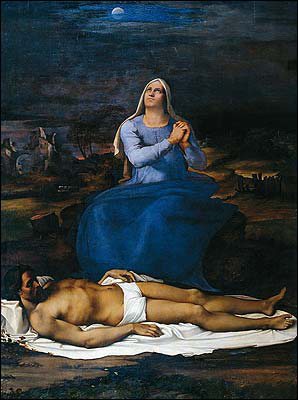
The Lamentation over the Dead Christ, usually called the Viterbo Pietà, was made about 1512–16 for San Francesco in Viterbo and is regarded as their first major collaboration.[4]
Christ lies on the ground rather than across the Virgin's lap. Mary raises her joined hands and looks upward, while a dark nocturnal landscape stretches behind the pale body.
Michelangelo had made the Vatican Pietà as a marble group around 1498–99. In Viterbo, the relation is reconceived for painting. Christ's body is separated from his mother and placed close to the altar-like lower edge.
Sebastiano's night is not secondary scenery. The National Gallery describes it as the first large-scale nocturnal landscape of its kind and stresses the freedom of its paint.[4] Darkness expands Mary's grief into the world and makes Christ's body shine with terrible exposure.
Free sketches by both artists on the reverse of the panel provide material evidence of close exchange.[5] The back is not an irrelevant hidden surface; it records collaboration inside the object.
Who Did What in Viterbo?
Michelangelo is generally credited with crucial design, especially the commanding figures and the radical separation of mother and son. Sebastiano executed the painting.
That division does not mean every contour belongs intellectually to Michelangelo and every coloured area mechanically to Sebastiano. Painters revise as they transfer, and landscape, illumination and surface determine how a body is experienced.
The moonlit or darkened setting makes the prone Christ appear colder and more exposed than the same outline on blank paper would. Mary's isolation depends upon the surrounding void Sebastiano painted.
Conversely, the sculptural weight and altar-like placement of the body carry Michelangelo's prolonged thought about the Pietà.
“Combined vision” is useful if it remains precise. It recognises interdependence without dissolving two makers into one imaginary hand.[4]
The Borgherini Chapel
Success at Viterbo helped Sebastiano secure the decoration of the Borgherini Chapel in San Pietro in Montorio, Rome, carried out from 1516 to 1524.[4]
The programme included the Flagellation of Christ and Transfiguration. Michelangelo supplied important drawings or ideas, while Sebastiano organised them as painted wall and chapel imagery.
The collaboration joined architectural setting, multiple scenes and liturgical use. A figure design could not simply be enlarged without considering the chapel's sightlines, curved surfaces and surrounding decoration.
Sebastiano's achievement was therefore synthetic. He had to make Michelangelo-like bodies inhabit a coherent painted environment and sustain devotional legibility beyond the intimacy of a sheet.
The chapel also occupied a competitive Roman landscape. Raphael's Transfiguration was later placed on the high altar of the same church, making differences among the masters unusually visible.[6]
The Raising of Lazarus
Cardinal Giulio de' Medici commissioned The Raising of Lazarus for Narbonne Cathedral, probably in late 1516. The painting was completed between 1517 and 1519 and is now National Gallery NG1.[6]
It is enormous—381 by 289.6 centimetres—and was painted in oil, originally on wood before later transfer to a composite support.[6]
Christ stands and commands Lazarus to emerge from death. The resurrected man sits at the tomb's edge while attendants unwind his burial cloth. Mary kneels; Martha recoils; disciples and witnesses spread through a vertical landscape.
The National Gallery's attribution reads “Sebastiano del Piombo, incorporating designs by Michelangelo.”[6] Every part of that formula matters. Sebastiano is the painter; Michelangelo's intervention is real but selective.
Michelangelo's Intervention in Lazarus
Technical and documentary research indicates that Sebastiano had begun the altarpiece on his own. Michelangelo intervened at a relatively advanced stage, especially by revising Lazarus's figure.[4]
Three preparatory studies by Michelangelo survive in Bayonne and the British Museum. They intensify the body's twist and the psychological shock of restored life.[6]
This evidence corrects an older heroic story in which Michelangelo simply handed Sebastiano a complete design. Collaboration was iterative. A painted figure already existed; Michelangelo reconsidered it; Sebastiano absorbed the revisions into the whole.
Lazarus is an ideal site for such exchange. His body must appear both corpse-like and newly active. Michelangelo's anatomical invention can stage that contradiction, while Sebastiano's colour describes flesh returning from burial.
The figure is collaborative not because attribution is confused, but because sequential interventions are documented.
The Rivalry with Raphael
Giulio de' Medici commissioned Raphael's Transfiguration for the same cathedral at approximately the same time. The two altarpieces became direct rivals.[6]
Michelangelo was eager to help Sebastiano surpass Raphael. Letters record anxiety that Raphael might obstruct completion or avoid side-by-side comparison.
Sebastiano delayed final delivery while Raphael's work remained unfinished. His altarpiece was publicly displayed in his Roman studio in 1519 and formally shown at the Vatican later that year to considerable admiration.[6]
Competition was not merely personal hostility. It stimulated solutions to the vertical altarpiece, the relation between foreground miracle and distant landscape, and the emotional organisation of crowds.
Raphael and Sebastiano observed and responded to one another. The paintings share ideas without becoming replicas, and their rivalry helped define a new Roman monumental style.
Public Triumph and Private Bond
The completion of Lazarus coincided with the birth of Sebastiano's first son, and Michelangelo became the child's godfather.[6] The role gives the partnership a familial dimension beyond strategic alliance.
When the altarpiece was formally unveiled at the Vatican in December 1519, its admirers reportedly included the pope. Michelangelo's intervention helped Sebastiano at the most publicly consequential point of his career, while Sebastiano converted those drawings into a work capable of commanding an immense display.
Public acclaim did not erase tension over credit or comparison. It made the stakes of their alliance higher. Sebastiano's success could vindicate Michelangelo against Raphael, but the painting also proved that Sebastiano could absorb powerful external designs without losing his own pictorial identity.
The godparenthood and unveiling belong together: intimate trust and public ambition were not separate engines of the collaboration.
Venetian Colour and Florentine Disegno
Renaissance theory often contrasts Venetian colorito with Florentine disegno. Sebastiano and Michelangelo made that distinction productive rather than absolute.
Michelangelo's chalk bodies establish torque, weight and expressive anatomy. Sebastiano's oil glazes produce depth, changing hue and a surface through which light seems to enter.
In Lazarus, bright colours weave across the crowd. The National Gallery notes Sebastiano's use of high-key and cangiante colour, influenced by Michelangelo's Sistine ceiling, alongside his distinct Venetian oil technique.[6]
Influence moved both ways. The 2017 exhibition argued that Sebastiano's solutions could affect how Michelangelo approached form, including sculpture.[7]
The partnership should therefore not be diagrammed as idea flowing from a genius to an executant. Each artist changed through the encounter.
Long-Distance Collaboration
Pope Leo X sent Michelangelo to Florence in 1516 to work on the façade of San Lorenzo. He remained burdened by Medici projects and the tomb of Julius II for years.
Sebastiano continued in Rome, where he depended on letters, drawings and mutual contacts to maintain the partnership.
Distance made the division of labour clearer but also riskier. Sebastiano had to decide how far to interpret a supplied sketch. Michelangelo could criticise a painting he had not continuously supervised.
The correspondence preserves enthusiasm and frustration generated by that arrangement. Collaboration was not a seamless merging of minds; it required negotiation across cities.
Its success demonstrates the mobility of disegno. A drawing could function as instruction, gift, argument and transferable intellectual property.
Patronage and Shared Reputation
Patrons valued the combination. A painting executed by Sebastiano could carry Michelangelo's inventions and thus participate in his prestige without claiming to be painted by him.
For Sebastiano, Michelangelo's support helped secure major commissions and positioned him against Raphael. For Michelangelo, Sebastiano provided an accomplished painter through whom his ideas entered media and projects he did not wish to execute personally.
This exchange was not equal in reputation. Michelangelo's fame could overshadow Sebastiano, and later histories often treated the painter as dependent.
Yet patrons commissioned Sebastiano because he offered more than access. His portraits, colour, nocturnes and oil technique were widely admired.
Shared authorship operated inside a hierarchy, but hierarchy does not eliminate agency.
Sebastiano Becomes “del Piombo”
After the Sack of Rome in 1527, Sebastiano returned and received the office of keeper of the papal seal in 1531. The seal was made of lead—piombo—giving rise to the name by which he is now known.[1]
The office brought income, status and administrative responsibilities. It also changed his appearance and working rhythm; portraits show him in the habit associated with the post.
Michelangelo's career meanwhile became increasingly architectural and Roman after his definitive return in 1534.
Their partnership entered a different phase. It no longer depended upon young artists jointly challenging Raphael, who had died in 1520.
Institutional success and changing priorities did not immediately erase friendship, but they altered the conditions under which collaboration had flourished.
The Úbeda Pietà and Later Designs
Sebastiano worked from the 1530s on a Pietà for El Salvador in Úbeda, Spain. A Michelangelo drawing in the Louvre is associated with the project.[8]
The commission extends the collaborative model beyond Rome and central Italy. Michelangelo could supply a core sacred invention for a painting destined for Spain, while Sebastiano realised it in his preferred medium.
Attribution must again remain layered. The drawing is Michelangelo's; the painting is Sebastiano's; related copies or variants require their own credits.
The project also shows the persistence of themes established at Viterbo: the dead Christ as bodily and devotional centre, supported by figures whose gestures translate weight into mourning.
Repetition did not mean reuse without thought. Each patron, site and format demanded a new resolution.
Oil Versus Fresco
The decisive dispute concerned the altar wall of the Sistine Chapel. Sebastiano favoured painting the Last Judgement in oil on plaster, a technique he had practised successfully.[2]
He helped arrange a smooth wall preparation suited to oil. Work on the surface extended through much of 1535 while Michelangelo developed the project.[2]
Michelangelo ultimately rejected the preparation and required the wall to be remade for true fresco. Painting began in 1536.
Vasari later framed the disagreement through a cutting remark attributed to Michelangelo about oil painting and Sebastiano. The anecdote reflects artistic polemic and should not be repeated as neutral fact without recognising its gendered insult and biographical agenda.
The documented core is sufficient: Sebastiano prepared for oil; Michelangelo insisted on fresco; the relationship did not recover.[2][9]
Why Technique Became Personal
The dispute was not only a disagreement about materials. Oil and fresco embodied the artists' identities.
Sebastiano's authority rested heavily on oil: slow transitions, depth, correction and colour. Recommending it for the enormous wall may have been practical concern, creative conviction and an opening for renewed collaboration.
Michelangelo's Sistine fame rested upon fresco. Accepting oil preparation could imply dependence upon Sebastiano's expertise or a division of execution resembling earlier projects.
The altar wall was also a papal commission of unmatched visibility. Control over medium meant control over authorship.
After years in which shared making had been useful, the conditions now made it threatening. The same complementary difference that once united them became the point of rupture.
Collaboration Is Not Copying
The word “collaboration” can conceal several different operations:
1. Michelangelo proposes an entire composition. 2. He supplies studies for selected figures. 3. He revises a figure Sebastiano has already painted. 4. Sebastiano adapts Michelangelo's forms within his own design. 5. Both artists sketch on an object's reverse or exchange ideas through letters.
These are not equivalent levels of intervention. Each work must be reconstructed separately.
The National Gallery's wording for Lazarus is exemplary because it names the painter first and Michelangelo's incorporated designs second.[6]
No credit formula can replace object-specific evidence, but careful language prevents fame from swallowing labour.
Sebastiano's Independent Achievement
Sebastiano became one of Rome's leading portraitists and religious painters. After Raphael's death, he held exceptional standing in the city.[1]
His portraits derive force from psychological concentration and colour rather than from borrowed Michelangelesque bodies. His sacred works can be sombre, atmospheric and emotionally restrained in ways distinct from Michelangelo.
The partnership strengthened these capacities but did not create them from nothing.
Recognising independence changes how collaborative works appear. The nocturnal landscape in Viterbo and oil colour in Lazarus are not packaging around Michelangelo's designs. They are primary meaning made by Sebastiano.
The painter's later reputation suffered partly because attribution narratives valued drawing as the true origin of art. Modern technical study can restore making to the painted surface.
The Partnership's Wider Impact
Sebastiano's fusion of Venetian oil and monumental Roman form influenced religious painting well beyond the immediate works. The National Gallery connects his example with Roman art across the following century and with developments in Spain and France.[5]
The spread is understandable. Their collaboration offered a model for combining powerful, sculptural bodies with atmospheric colour and emotionally grave settings.
It also established a practical authorship structure later used by Michelangelo with Marcello Venusti and others: the master's drawing could generate paintings for varied patrons.
That model created opportunities and confusion. It extended Michelangelo's visual reach while encouraging later viewers to credit every derivative object to him.
The partnership's legacy is therefore both artistic and catalogical. It teaches how Renaissance invention moved among hands.
Lazarus as National Gallery Number One
After leaving Narbonne, The Raising of Lazarus entered the Orléans collection and then the collection of John Julius Angerstein. When the British government bought Angerstein's paintings in 1824 to establish the National Gallery, Sebastiano's altarpiece received inventory number NG1.[6][10]
That number does not rank it as the “best” work. It records its place in the institution's founding group.
Its later transfer from wood to a composite support also means that the object now visible in London has undergone major material intervention. Sebastiano's painted surface survives, but not on its complete original panel structure.
The painting's modern identity therefore combines Renaissance collaboration with nineteenth-century nation-building and conservation history. A work made for a French cathedral through Italian rivalry became the first numbered object in Britain's National Gallery.
How to Look at a Collaborative Work
Begin with the museum's attribution line. Does it say “by Sebastiano,” “incorporating designs by Michelangelo,” or “after Michelangelo”?
Identify the physical evidence: a surviving Michelangelo drawing, underdrawing, revision, letter or sketch on the panel back.
Then look for decisions a drawing cannot contain—colour, glaze, landscape, scale, surface and relation to architecture.
Do not treat sculptural anatomy as proof that Michelangelo painted the figure. Design can travel.
Finally, compare the result with Sebastiano's independent paintings. Collaboration becomes clearer when both artists, not only the more famous one, have a visible history.
Why Michelangelo and Sebastiano Matter
Their partnership matters because it replaces the myth of solitary genius with documented exchange. Drawings travelled, figures were revised, paint answered chalk, and competition shaped invention.
It produced the nocturnal gravity of the Viterbo Pietà and the bodily resurrection of Lazarus. It also ended when medium and control could no longer be negotiated.
The friendship's rise and rupture reveal the same truth: artistic difference can be a source of extraordinary creation, but only while each participant can recognise a place for the other's authority.
Frequently Asked Questions
Discussion
What details, sources or comparisons stand out to you in Sebastiano & Michelangelo?
Reader Insights
Which formal detail changes how the work reads?
Which documented source or collection history feels most useful?
Which related Michelangelo work should readers compare next?
Join the Conversation
Add a source-led observation, comparison or question for other readers.
References
- National Gallery, London, “Sebastiano del Piombo., View source.
- Bernadine Barnes, Michelangelo's Last Judgment, Cambridge University Press excerpt on wall preparation and technique, View source.
- National Gallery, Michelangelo & Sebastiano,” exhibition press release on works and correspondence, View source.
- National Gallery, Michelangelo & Sebastiano: Death and Resurrection., View source.
- National Gallery, Michelangelo & Sebastiano: In Focus,” exhibition overview, View source.
- National Gallery, The Raising of Lazarus, NG1, View source.
- National Gallery, 2017 exhibitions announcement, Michelangelo and Sebastiano, View source.
- Louvre, Michelangelo, Étude pour une Pietà, connected with Sebastiano's Úbeda commission, View source.
- Metropolitan Museum of Art, interview with Carmen C. Bambach, discussion of the partnership's break over the Last Judgement, View source.
- National Gallery, Collection History,” the Angerstein purchase and founding paintings, View source.