 by Tom Gurney
Tom Gurney BSc (Hons) is an art history expert with over 20 years experience
Published on June 19, 2020 / Updated on October 13, 2026
Email: tomgurney1@gmail.com / Phone: +44 7429 011000
Overview
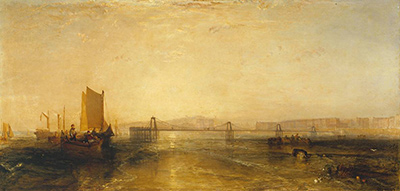
J. M. W. Turner's The Chain Pier, Brighton is the Tate painting recorded as N02064 and dated c.1828.[1] Tate Images identifies the work as oil paint on canvas, with a support measuring 711 x 1365 mm, and links it to the Turner Bequest of 1856.[2] Art UK gives the same work as oil on canvas, c.1828, 71.1 x 136.5 cm, accession N02064.[3]
The painting is unusually wide. Its long horizontal format suits the subject: Brighton's Royal Suspension Chain Pier crossing the sea as a thin engineered line, with boats, shore, weather and resort life gathered around it. Turner does not make the pier a dry record of construction. He makes it part of a coastal world in motion.
The pier was new when Turner painted it. Brighton Museums states that the Royal Suspension Chain Pier opened to the public on 25 November 1823 and was Brighton's first pier.[4] The National Piers Society identifies it by its full title, gives the opening date, names Captain Samuel Brown as designer, and records four 260-foot spans.[5] Turner painted a modern Brighton landmark only a few years after it changed the town's relation to the sea.
The painting brings modern structures, travel and coastal change into a particular Brighton setting. A seaside suspension pier becomes an oil painting in which engineering, resort culture, shipping and atmosphere share the same long field. Its coastal modernity differs from the railway and steam subjects Turner later developed.
The work belongs to Tate's collection under accession N02064.[1] Its display arrangements can change, and Tate supplies current viewing information for visitors. The collection and Bequest history are distinct from any temporary gallery location.
At a Glance
- ArtistJoseph Mallord William Turner
- TitleThe Chain Pier, Brighton
- DateAbout 1828
- MediumOil paint on canvas
- Support71.1 x 136.5 cm
- CollectionTate
- AccessionN02064
- ProvenanceTurner Bequest, accepted 1856
- StructureRoyal Suspension Chain Pier
- Pier opened25 November 1823
Contents
- Overview
- Object Identity
- The Royal Suspension Chain Pier
- Brighton as Resort and Port
- Format and Design
- Oil Paint and Atmosphere
- Modern Engineering and Coastal Life
- Petworth and Egremont
- Constable and Other Chain Pier Images
- The Pier and the Sea
Object Identity
Tate identifies the work as The Chain Pier, Brighton by Joseph Mallord William Turner.[1] Tate, Tate Images and Art UK date it to c.1828, or about 1828.[1][2][3] The approximate date places it soon after the pier's opening, rather than at a later stage of Brighton's pier history.
The medium is oil paint on canvas.[2] The support dimensions are 711 x 1365 mm, equivalent to 71.1 x 136.5 cm.[2][3] These dimensions are central to the painting's effect. The canvas is much wider than it is high, which lets Turner stretch pier, sea and shore laterally rather than building the picture around a vertical landmark.
The accession number is N02064.[1][3] Tate Images connects the painting with the Turner Bequest in 1856.[2] Butlin and Joll provide the standard catalogue framework for Turner's oils, including title, date, provenance and relation to associated versions.[8]
Turner made related Brighton subjects, and John Constable also painted the Chain Pier. The shared landmark offered Turner and Constable different possibilities for sea and sky. Tate's shop associates this version with the Earl of Egremont and Petworth.[7] N02064 is Turner's wide oil canvas, with its own date, handling and collection history.
The related Brighton from the Sea at Petworth shows Brighton over the Chain Pier and is dated circa 1829/30.[9] It has different dimensions and a separate collecting history from N02064. The two canvases connect the pier subject with Egremont's patronage without becoming the same painting.
The Royal Suspension Chain Pier
The Chain Pier was an engineering landmark as well as a seaside amenity. Brighton Museums states that it opened on 25 November 1823, was among the earliest piers in the United Kingdom, and was Brighton's first.[4] It stood east of the old town and remained a dominant landmark for 73 years.[4]
The pier's purpose was practical before it was recreational. Brighton Museums explains that before it existed, travellers for the Continent had to move from the beach to larger vessels offshore by small boats, often under uncomfortable conditions.[4] The Brightelmston Suspension Pier Company formed in 1821 to provide a safer landing platform for passengers and cargo.[4]
The structure was modern in both design and appearance. Brighton Museums names Captain Sir Samuel Brown as the marine engineer who designed and managed the work, and describes wooden platforms suspended from eight wrought-iron chains, carried by four large cast-iron pylon towers.[4] The National Piers Society likewise names Brown, records the 1823 opening, and notes four 260-foot spans.[5]
Those details help explain why Turner would find the subject compelling. The pier was not merely a scenic accessory. It was a new way of organizing Brighton's contact with the sea. It made landing, departure, promenade and looking outward part of one built structure.
The suspension line crosses the water like a measure of distance, while boats and weather keep the scene unstable. Turner makes the pier part of the coast's visual order rather than isolating it as an engineering diagram.
The structure also changes the relation between near and far. A conventional seascape might separate beach, water and horizon into broad bands. The Chain Pier cuts across those bands and gives the view a man-made rhythm. Turner uses that rhythm without letting it become rigid. The pier's regularity is continually softened by light, air and water.
Brighton as Resort and Port
Brighton in Turner's painting is both resort and port. The Chain Pier served travellers and cargo, but Brighton Museums also describes it as a multi-purpose place with employees, shopkeepers, entertainers, fishermen and fashionable society.[4] It was a working structure and a leisure space.
This dual identity matters for the painting. Turner does not paint a purely industrial subject, nor a purely holiday view. The pier belongs to a coastal town where travel, commerce, social display and weather meet.
The sea is therefore not just a background. It is the reason for the pier's existence and the force against which the structure is tested. Boats, waves and atmospheric haze all remind the viewer that the pier extends into a changeable environment.
Brighton Museums notes that the pier inspired artists, photographers, poets, composers and writers, and that it served both as a main subject and as background detail in local images.[4] Turner belongs to that wider visual response, but his oil painting is not a local souvenir. It turns the pier into a large, atmospheric composition.
The painting also differs from simple architectural celebration. The pier may be new and elegant, but Turner surrounds it with sea, weather and maritime movement. Modern construction enters a coastal world that remains older and less controllable than the structure itself.
The resort context changes the emotional register. Brighton's seafront was associated with fashionable movement, health, bathing, display and cross-channel departure. The pier gathers these uses into one structure, giving the painting a town's outward relationship with the sea and its visitors.
This makes the painting less mechanical than the subject might sound. The pier is engineering, but it is also social space. Turner paints a structure that people used, crossed, watched from, sailed from and gathered around. The result is a modern subject with human implications rather than a bare study of metal and timber.
Format and Design
The canvas's proportions are one of the first things to notice. At 711 x 1365 mm, the support is almost twice as wide as it is high.[2] Turner uses that width to make the pier's lateral reach the painting's organizing fact.
The long shape can be considered alongside the related Petworth commission. The National Trust describes four final works for the Carved Room, commissioned by the 3rd Earl of Egremont, including a Chain Pier subject.[10] Those works answered a specific interior setting; the Tate canvas remains a separate version within the wider patronage context.
The horizontal format makes the picture different from a seascape organised around one central vessel. Its width gives the pier room to stretch and the boats and shore space to punctuate the scene. The structure's reach becomes a pictorial problem in its own right.
The pier functions almost like a line drawn across the sea. It establishes scale, direction and a relation between land and open water. Turner can then use haze, sails and changing light to complicate that order.
This is one reason the painting feels modern without being mechanical. The engineered structure imposes geometry, but the sea and air soften it. Turner is interested in the visual meeting between design and weather.
The composition also depends on intervals. The pier sets up a measured span, but boats, sails and shore details interrupt that measure. These interruptions keep the eye moving. Instead of reading the canvas as one continuous band, the viewer shifts between engineered line, floating forms and atmospheric gaps.
The wide support also lets Turner avoid a single dominant centre. The subject stretches. That spread matters because the pier itself was a device for extension, reaching from land into the sea. Format and subject therefore echo each other.
Oil Paint and Atmosphere
The oil canvas gives Turner a broad field for atmospheric handling.[2] Townsend's account of his painting methods examines the material construction of light, weather and movement.[11] Here, stronger accents and softer passages bring the engineered line into changing marine air.
In The Chain Pier, Brighton, the engineering subject depends on atmosphere. If the pier were drawn with hard descriptive isolation, it would read as a technical diagram. Turner instead lets haze, water and sky draw the structure into the coastal environment.
This does not make the pier vague. It remains identifiable. The painting's tension lies in that balance: the object is modern and specific, while the atmosphere resists hard certainty.
Oil paint allows Turner to work across this tension. He can set stronger accents around boats, pier and shore, while broader passages of air and water keep the surface mobile. The width of the canvas makes this especially effective because the eye travels through zones of detail and softness.
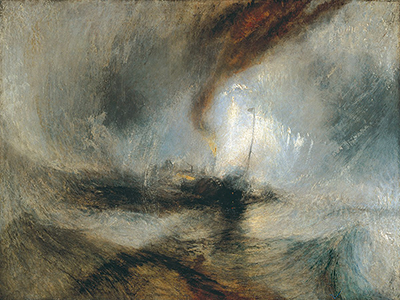
The result is not a storm picture in the same sense as Snow Storm - Steam-Boat off a Harbour's Mouth. The weather here is subtler. It is coastal haze, light, wind and marine movement surrounding a built form.
The oil surface also gives the pier a different presence from Turner's works on paper. A watercolour study might depend on reserved paper and transparent wash. This canvas allows broader modulation of sea and sky, while still leaving the engineered structure comparatively fine and light. Turner uses oil without making the pier heavy.
That lightness is important. A suspension pier could easily be described as an assertion of engineering strength. Turner's version makes it seem almost delicate, a set of lines and supports held in marine air. The painting therefore keeps strength and fragility in play at once.
Modern Engineering and Coastal Life
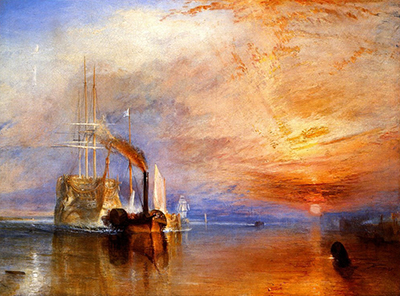
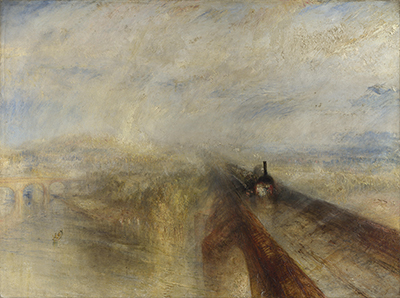
The Royal Suspension Chain Pier gives Brighton's changing seaside world a modern structure. Unlike Rain, Steam, and Speed or The Fighting Temeraire, this painting centres on the connection between shore and offshore vessels. Its engineering is a means of coastal access rather than railway motion or the final journey of a warship.
The Chain Pier was modern because it changed movement between shore and sea. Brighton Museums explains the problems of embarkation before the pier and the company's plan to provide a safer landing platform.[4] The National Piers Society adds that sailing vessels initially called there and that steamer boats later increased passenger use.[5]
Turner registers that modernity through composition rather than through explanation. The pier is a new line in the coastal view. It extends human design over moving water. It makes arrival and departure visible.
At the same time, Turner avoids a simple celebration of progress. The sea remains active. Boats remain vulnerable. Weather still controls visibility. The pier is impressive, but it does not master the coast.
That restraint is important. Turner often made modern structures appear within larger natural and social forces. Here, the new pier is elegant and useful, but it is also fragile-looking against the breadth of water and sky.
Its modern element is coastal: a suspension structure, a resort town, cross-channel movement and the transformation of a beach into a place of embarkation. Engineering enters the scene through practical movement between land and water, while weather continues to shape what can be seen.
Petworth and Egremont
Lord Egremont and Petworth form an important context for the painting. Tate's shop links this version to the Earl and his home at Petworth.[7] The National Trust's four-work Carved Room commission included a related Chain Pier subject.[10] The patronage connection joins these versions without identifying N02064 as the final painting installed in the room.
Egremont's interests and Brighton's new pier bring contemporary social and economic concerns into marine painting. The related country-house commission shows how a coastal engineering subject could enter an interior ensemble, while the Tate version explores the pier across its own unusually wide support.
Tate N02064 retains its own accession, approximate date and medium.[1] The related Brighton from the Sea is catalogued by the National Trust at Petworth.[9] Its separate history gives the shared subject another setting rather than changing the identity of this canvas.
The Chain Pier belonged to a world of improvement, movement and coastal enterprise. Tate's shop connects the subject's modernity, trade and tourism with Egremont's patronage.[7] These associations place the engineered landmark within the social world that supported Turner's painting.
For Turner, the pier offered a contemporary, coastal and visually unusual subject. The long canvas makes its extension a bold marine composition. The related Petworth commission shows how the same landmark could also answer a decorative setting.
The Egremont context extends the painting beyond a conventional town view. Place, commerce and improvement meet in the pier, but Turner makes the subject atmospheric as well as recognisable. Its association with patronage does not reduce the image to a record of a building or a prescribed interior design.
Constable and Other Chain Pier Images
John Constable painted the Chain Pier too, as Tate's shop notes.[7] The new structure attracted both artists, but each brought his own relationship with Brighton, sky and sea to the subject. Their paintings have separate dates, formats and histories.
Constable's Brighton images come from his own relation to the town, beach and sky. Turner's The Chain Pier, Brighton is a different object, with a different format, patronage context and handling of the pier as a long structural line.
The comparison is useful because it shows how visually compelling the new pier was. It attracted major artists because it changed the appearance of Brighton's seafront. Yet each artist made a different pictorial argument from the same structure.
Tate research records a detailed drawing of Brighton's front with the recently erected Chain Pier in the distance.[6] The drawing preserves a related observation of the town and structure, while N02064 develops the subject in a wide oil canvas.
The related Brighton from the Sea includes the Chain Pier within a view of the town.[9] Its distinct dimensions, date and provenance make it another treatment of the same coastal landmark rather than a second title for N02064.
The Pier and the Sea
The painting's subject is a pier, but its real field is the meeting of structure and sea. The pier reaches outward, offering stability and passage. The sea moves around it, making that stability provisional.
This relation gives the work much of its energy. The pier is a practical object: a landing stage, a promenade, a structure of chains and pylons. But in Turner's painting it also becomes a visual instrument. It measures distance and organizes light.
The boats are important because they keep the scene maritime. Without them, the pier might feel like an abstract line. With them, the viewer sees the structure as part of actual movement: vessels, passengers, coast, departure and return.
The shore is also important. Brighton was not a remote coastal ruin. It was a growing resort town with new architecture, leisure culture and cross-channel connection. Turner paints the pier as a sign of that changing identity.
Yet the sea prevents the picture from becoming a simple town view. The water and air dominate the experience. Brighton appears through marine conditions, not as a fixed urban panorama.
The painting therefore balances three kinds of movement. Boats move across or into the water. Visitors and workers are implied by the pier's function. Weather moves through the field of vision. Turner lets the fixed structure gather these movements without stopping them.
This is why the pier can seem both central and elusive. It is the named subject, but it does not fill the canvas with solid mass. Its importance lies in relation: to boats, to shore, to haze, to open water, and to the changing role of Brighton as a seaside town.
The width of the scene reinforces that relational meaning. No single boat, building or figure owns the view. The pier gathers many small coastal facts into one extended line, while sea and sky keep the whole image open.
How to Look at The Chain Pier, Brighton
Begin with the shape of the canvas. Its width is not incidental. It creates the room in which pier, boats, shore and weather can extend laterally.
Then follow the pier. Notice how it draws the eye across water and turns engineering into pictorial rhythm. It is both structure and line.
Next, look at the boats. They give scale and motion, and they remind the viewer that the pier existed for practical movement between land and sea.
After that, study the atmosphere. Turner softens the modern structure with coastal haze and light. The pier is visible, but it belongs to air and water rather than standing apart from them.
Finally, consider the range of related images. Constable's painting, Turner's Brighton drawings and Petworth's Brighton from the Sea show different uses of the same landmark. In this canvas, the long pier, sails, shore and marine light are gathered into an extended field.
Why the Painting Matters
The Chain Pier, Brighton matters because it gives Turner a modern coastal subject without turning him into a simple painter of technology. The pier is new, engineered and socially current, but the painting remains deeply concerned with sea, weather and light.
It matters because the format and subject are inseparable. The long canvas lets Turner make the pier's extension over water the painting's central act. The support's dimensions are therefore not mere catalogue data; they shape the whole experience.[2]
It matters because it connects Brighton, Petworth and national collection history. The work is linked to Egremont and Petworth context, yet it entered national care through the Turner Bequest and is now Tate N02064.[1][2][7][10]
The painting brings a specific form of modernity into Turner's art: a new seaside structure seen through wind, water, boats and atmosphere. Its concern with embarkation and coastal access differs from the railway's speed or the Temeraire's change of use. Engineering becomes part of an inhabited marine landscape.
Most of all, the painting matters because Turner makes engineering look temporary and alive. The pier stretches across the sea, but the sea and sky remain larger. Modern construction enters the landscape, and Turner asks what it looks like when atmosphere begins to absorb it.
The work also matters within Turner's Petworth group because it translates a patron's contemporary interests into marine painting. The subject could have become a documentary record of a new pier. Instead, Turner made it a meditation on how a new structure alters seeing: the coast becomes measured, extended and opened, but never fully controlled.
Frequently Asked Questions
Tate Images identifies the material as oil paint on canvas.[2]
Discussion
How does Turner make a new suspension pier belong simultaneously to engineering, resort life, shipping and coastal atmosphere?
Reader Insights
How does the unusually wide canvas organise pier, shore and open water?
Where does the engineered structure remain distinct from the surrounding sea?
How do light, boats and weather soften the pier's regular geometry?
Join the Conversation
Share a close observation or a source-based question for other readers.
References
- Tate, "The Chain Pier, Brighton." https://www.tate.org.uk/art/artworks/turner-the-chain-pier-brighton-n02064
- Tate Images, "The Chain Pier, Brighton, Joseph Mallord William Turner, c.1828." https://www.tate-images.com/n02064-The-Chain-Pier-Brighton.html
- Art UK, "The Chain Pier, Brighton." https://artuk.org/discover/artworks/the-chain-pier-brighton-202390
- Brighton & Hove Museums, "World Above the Waves: Brighton's Chain Pier." https://brightonmuseums.org.uk/discovery/history-stories/world-above-the-waves-brightons-chain-pier/
- National Piers Society, "Brighton Chain Pier." https://piers.org.uk/piers/brighton-chain-pier/
- Tate Research Publication, "On the Front at Brighton, with Chain Pier." https://www.tate.org.uk/art/research-publications/jmw-turner/joseph-mallord-william-turner-on-the-front-at-brighton-with-chain-pier-r1181228
- Tate Shop, "JMW Turner: The Chain Pier, Brighton." https://shop.tate.org.uk/jmw-turner-the-chain-pier-brighton/turner1522.html
- Martin Butlin and Evelyn Joll, The Paintings of J. M. W. Turner, revised edition, Yale University Press, 1984.
- National Trust Collections, "Brighton from the Sea." https://www.nationaltrustcollections.org.uk/object/486628
- National Trust, "JMW Turner at Petworth House and Park." https://www.nationaltrust.org.uk/visit/sussex/petworth/jwm-turner-at-petworth-house-and-park
- Joyce H. Townsend, How Turner Painted: Materials & Techniques, Thames & Hudson, 2019.