 by Tom Gurney
Tom Gurney BSc (Hons) is an art history expert with over 20 years experience
Published on June 19, 2020 / Updated on August 29, 2026
Email: tomgurney1@gmail.com / Phone: +44 7429 011000
Overview
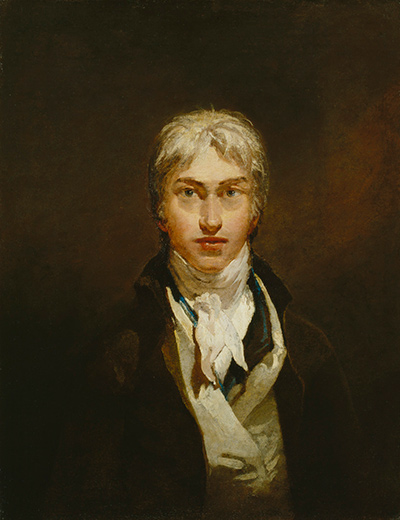
J. M. W. Turner's Self-Portrait is the Tate painting recorded as N00458 and dated c.1799.[1] Tate's current record identifies the artist as Joseph Mallord William Turner, gives the medium as oil paint on canvas, and lists the work as on display at Tate Britain.[1] Tate Images reports a 743 x 584 mm support and gives its provenance as the Turner Bequest, accepted by the nation in 1856.[2] Art UK corroborates the c.1799 date, oil on canvas medium, 74.3 x 58.4 cm dimensions and N00458 accession.[3]
The painting shows Turner as a young artist, facing directly outward from a dark ground. Pale hair, brightly lit skin, a white neckcloth, layered waistcoats and a dark coat create a controlled public image. The picture is often used as the face of Turner, but it should be read as a made portrait, not as direct access to inner character.
This distinction matters because the self-portrait sits near the beginning of Turner's professional career. National Gallery places Turner in Royal Academy training from 1789, records watercolour exhibits there beginning in 1790, and gives 1796 as the point at which he began showing oils.[5] The c.1799 date therefore places the portrait in a period when Turner was already publicly ambitious and working across media.
The object authority for this work is Tate N00458, not the inherited Wallace Collection reference sometimes attached to the older local article. The Tate record, Tate Images and Art UK provide the stable identity: title, date, medium, dimensions, accession and Turner Bequest provenance.[1][2][3]
The painting is not an autobiography in paint. It is a self-presentation by a young professional artist. Turner gives himself presence, polish and directness. The viewer encounters not only a face, but a carefully staged claim to artistic standing.
At a Glance
- ArtistJoseph Mallord William Turner
- TitleSelf-Portrait
- Datec.1799
- MediumOil paint on canvas
- Support74.3 x 58.4 cm
- CollectionTate
- AccessionN00458
- ProvenanceTurner Bequest, accepted 1856
- Career contextEarly Royal Academy rise
- Reading cautionPublic likeness, not psychological proof
Contents
- Overview
- Object Identity
- A Young Professional Image
- Face, Gaze and Costume
- Royal Academy Ambition
- Portrait, Not Confession
- Public Image and Later Fame
- Oil Paint and Surface
- The Turner Bequest
- Not the Wallace Object
Object Identity
The preferred title is Self-Portrait.[1] The artist is Joseph Mallord William Turner. Tate dates the painting c.1799 and classifies it as oil paint on canvas.[1] In the Tate Images entry, the support is 743 x 584 mm.[2] Art UK gives the equivalent measurements as 74.3 x 58.4 cm and records accession number N00458.[3]
The painting belongs to Tate and, at current verification, Tate's record stated that it was on display at Tate Britain.[1] Display information can change, so the durable object identity remains Tate N00458, c.1799, oil paint on canvas, Turner Bequest.
The work entered national ownership through the Turner Bequest, accepted by the nation in 1856.[2] That later history matters because the portrait became part of the same posthumous body of works through which Turner's career was publicly understood. Yet the painting itself belongs to a much earlier moment, when Turner was in his twenties.
Butlin and Joll give the painting its necessary scholarly setting among Turner's oils, including its title, date, ownership history and relationship to other portraits of the artist.[6] This is useful because Turner's image has a complicated afterlife in prints, drawings, recollections and later reproductions.
The object facts should stay in view. This is not a generic Turner likeness. It is the Tate painting N00458, c.1799, oil paint on canvas, 743 x 584 mm, from the Turner Bequest.
A Young Professional Image
The c.1799 date gives the portrait much of its significance. Turner was not yet the aged, celebrated painter of later memory. He was a young artist already building a public career. In National Gallery's chronology, 1789 marks his entry into the Royal Academy Schools, 1790 the beginning of his Royal Academy watercolour exhibits, and 1796 the first showing of oils.[5]
That background helps explain the portrait's controlled presentation. Turner faces the viewer directly. His dress is careful. The white neckcloth and pale waistcoat draw light upward toward the face. The dark coat and background make that lit face appear more assertive.
The painting therefore functions as more than likeness. It presents a young painter as serious, composed and professionally legible. Nothing in the portrait suggests the rough anecdotal Turner of later stories. The image is polished and forward-looking.
This does not mean it is false. A self-portrait can be both truthful and constructed. Turner had to decide how much of the body to show, how strongly to light the face, how to arrange dress, and how directly to meet the viewer. Those choices create meaning.
The portrait's restraint is part of its force. There are no studio props, no palette, no brushes and no dramatic landscape behind him. Turner gives the viewer a face, clothing and presence. The absence of attributes makes the claim sharper: the artist himself is the subject.
That economy is especially meaningful for Turner. Many later accounts of his career stress weather, travel, architecture, maritime subjects and brilliant colour. This painting withholds all of that. It asks the viewer to start with the maker before moving outward to the works. The portrait therefore has a double role: it is an early likeness, and it is a visual threshold for the career that followed.
Face, Gaze and Costume
Turner sets the face against a plain dark ground. The head is lit strongly enough for the features to stand out, but the edges remain painterly rather than hard. The result is immediate without becoming dryly descriptive.
The gaze is central. Turner looks outward with directness, but the expression is controlled. It is tempting to read confidence, reserve or ambition into the eyes. Those impressions may be useful as viewing responses, but they should remain cautious. The painting is evidence of pose and handling, not a transparent record of psychology.
The costume does important work. The dark coat frames the lower face and neck. The white neckcloth creates a bright vertical accent. The layered waistcoats add refinement and social polish. Turner presents himself as someone fit for professional and public recognition.
The hair also matters. Its pale, slightly loose handling gives life to the head and prevents the portrait from becoming stiff. Against the dark ground, the hair helps separate face from background and gives the upper part of the image a bright focus.
The background is spare. It does not locate Turner in a room, studio or landscape. This absence keeps attention on the constructed encounter between sitter and viewer. The young artist appears out of darkness, framed by clothing and light.
The portrait's power depends on this economy. Turner does not need many details. He uses face, collar, neckcloth, coat and ground to make a concise statement of artistic identity.
The format strengthens that statement. The support is vertical and large enough for a commanding bust-length presence, yet narrow enough to keep the figure close. Turner is not lost in space. He fills the visual field without appearing theatrical. The viewer is held at a short distance, near enough to study the face and brushwork, but far enough for the formal dress to carry social meaning.
The relation between head and clothing is carefully judged. The illuminated head is the focus, but the neckcloth and coat keep the image from becoming only a floating face. They anchor the body, place Turner in a world of professional manners, and make the portrait read as a public appearance rather than a private study.
Royal Academy Ambition
The portrait belongs close to Turner's early Royal Academy rise. National Gallery's artist record places his Academy schooling in the late 1780s, his first watercolour exhibits at the Academy in 1790, and his public turn to oil painting in 1796.[5]
By c.1799, Turner had moved well beyond student promise. He was actively presenting work in the main public institution of British art. The self-portrait can be read against that professional context, though it should not be reduced to a single event unless a source states that directly.
The image suits ambition because it is frontal and composed. Turner does not show himself as a humble craftsman or as a casual observer. He appears in formal dress, with a direct gaze and controlled bearing.
That bearing matters in relation to his early career. Turner was making his way in a world where institutional recognition, exhibition culture and social presentation all had weight. A self-portrait could help shape how a young artist imagined and displayed himself.
The portrait also differs from the landscapes and marine subjects that would make Turner famous. It has no storm, lake, ruin or ship. Yet it belongs to the same career because it establishes the public identity of the person who would paint those subjects.
This is why the work should not be treated as a decorative head alone. It is an image of professional self-fashioning at a crucial early stage.
The timing also helps explain the absence of eccentricity. The later Turner could be described through unusual habits, intense working methods and a reputation that mixed admiration with anecdote. The young artist here offers something more measured. The painting speaks in the language of poise, finish and seriousness. It belongs to the culture of exhibition and patronage in which a painter's appearance could support a painter's standing.
Portrait, Not Confession
The painting is often approached as if it could reveal the "real" Turner. That impulse is understandable. A self-portrait seems to promise access. But this image should be handled with restraint.
A portrait is a set of artistic decisions. Lighting, pose, costume, cropping and finish all shape the result. Even when the sitter and painter are the same person, the image remains a construction.
Turner's expression is especially easy to overread. The eyes meet the viewer, the mouth is closed, and the face is calm. These features can suggest self-possession, youth or reserve. They do not license a full psychological biography.
The National Portrait Gallery's extended Turner entry is useful because it shows how complex Turner's portrait record became. It identifies Turner as a landscape painter and discusses early self-portraits, later likenesses, uncertain images and the wider iconography around him.[4] That complexity should make viewers careful rather than speculative.
The Tate painting is therefore best read as a major early public likeness, not as the final key to Turner's personality. It tells us how Turner could present himself around c.1799. It does not tell us everything he was.
This cautious reading actually makes the portrait more interesting. The painting becomes evidence of ambition, image-making and public identity rather than a shortcut to character.
That evidence is still personal, but it is personal in a painterly way. The face is Turner's, the hand is Turner's, and the choices of light, dress and address are Turner's. What the work refuses is the idea that a face can simply be decoded into a life. The portrait gives a measured encounter with selfhood shaped through art.
Public Image and Later Fame
Tate N00458 has become one of the most familiar images associated with Turner. That familiarity can make the painting seem inevitable, as if this youthful face always stood for the whole career. In fact, the portrait comes from a specific early moment.
The later Turner became famous for light, weather, marine subjects, modern transport and late works in which form often dissolves into colour. The young man in the self-portrait does not visibly predict all of that. He appears as a polished professional at the threshold of greater recognition.
The gap between the youthful portrait and the later career is productive. Viewers know what Turner became, but the portrait shows him before that full public identity had formed. It captures a claim rather than a conclusion.
The National Portrait Gallery's iconography entry also reminds readers that Turner's later visual record is uneven and complicated.[4] There are drawings, recollections, caricatures and uncertain portraits. Against that complex field, the Tate self-portrait has unusual force because it is early, direct and tied to Turner's own hand in the institutional record.
That later fame should not flatten the picture. The portrait is not simply the face on which later admiration was hung. It is a painting with its own structure: dark ground, bright head, formal dress and frontal address.
The work's afterlife matters, but it should not replace looking. Before it became an emblem of Turner, it was a painted act of self-presentation.
Oil Paint and Surface
The medium is oil paint on canvas.[1][2] That matters because the portrait's authority depends on surface as well as likeness. Turner builds the head through light and tone, but leaves enough painterly movement for the image to remain alive.
The face is the most finished area. Skin, eyes, nose and mouth receive concentrated attention. The surrounding clothing is broader and darker. This hierarchy directs the viewer immediately to the head.
The white neckcloth is handled as a bright painterly structure. It is not merely costume detail. It brings light into the lower centre of the image, catches the eye, and helps lift the face out of the dark coat.
The background appears deliberately restrained. Its dark brown field gives no narrative setting. It supports the figure by contrast. The absence of distraction gives the portrait its severity and force.
Townsend's study of Turner's materials and methods helps shift attention back to facture: Turner effects come from the management of paint, support, tone and touch, not only from chosen subject matter.[7] Even a portrait this direct depends on material decisions: layering, tonal contrast, edge control and the balance of finish against breadth.
The painting is therefore not separate from Turner's wider art. It is less atmospheric than many later works, but it already shows a concern with light emerging from darkness and with the expressive power of controlled surface.
The surface also keeps the portrait from feeling merely formal. Turner does not polish every passage to the same degree. The most urgent finish belongs to the face, while the darker costume and ground are allowed to recede. That variation gives the painting movement. The eye does not travel across equal detail; it moves toward the parts Turner wants most strongly seen.
The white neckcloth is crucial in this movement. It interrupts the dark clothing, catches light and creates a bridge between body and face. Without it, the head would still be bright, but the transition from coat to skin would be harsher. With it, Turner builds a small architecture of light at the centre of the image.
The Turner Bequest
The portrait's later public life is inseparable from the Turner Bequest. Tate Images records that the work was accepted by the nation as part of that bequest in 1856.[2] National Gallery explains that the Turner Bequest included finished pictures, unfinished pictures and thousands of drawings and sketches, with most paintings later transferred to the National Gallery of British Art, now Tate.[5]
This later history gave the portrait a public role beyond its original moment. It became part of the national Turner inheritance: not just an image of a young artist, but an image held among the works that defined his posthumous reputation.
The bequest also makes the portrait part of a larger institutional story. Turner left an immense body of material. The young face in N00458 sits within that body as a point of identity, allowing viewers to connect the person with the works.
At the same time, the bequest should not make the portrait seem late. The object was accepted in 1856, but the painting is dated c.1799.[1][2] Its visual language belongs to the early career, even though its public afterlife belongs to national collection history.
This double time is one of the portrait's strengths. It shows Turner near the start of his career, but it reached a broad public through the legacy of the career as a whole.
Not the Wallace Object
The inherited local article attached a Tate / Wallace Collection authority line to this subject. That should not be used for Tate N00458. The object under discussion here is the Tate self-portrait recorded as N00458.[1]
The distinction matters because collection records are not interchangeable. A general Turner exhibition, a Wallace Collection discussion, or another Turner-related image may provide context, but it does not define this object unless it specifically records Tate N00458.
For this painting, the core authorities are Tate, Tate Images and Art UK.[1][2][3] They agree on the title, artist, c.1799 date, oil-on-canvas medium, Tate holding and accession. Those are the facts that should govern the account.
This correction is not a minor housekeeping issue. It changes how the portrait is framed. The painting is not a borrowed example from a Wallace Collection discussion. It is a Tate work from the Turner Bequest, now central to Turner's public image.
Keeping that identity clear also protects readers from a common confusion in artist articles: using a convenient reference for the wrong object. Here, the accession number N00458 keeps the evidence precise.
The correction also improves the reading of the painting itself. If the portrait is treated as a vague Turner image, it becomes an illustration of biography. If it is held to its object record, it becomes a specific c.1799 oil in Tate's care, with dimensions, medium and provenance that can be checked against institutional records. That precision helps the visual argument stay grounded.
How to Look at Self-Portrait
Begin with the face. Turner places it in strong light and keeps it near the centre of the image. The eyes meet the viewer directly, creating an unusually immediate encounter.
Then look at the neckcloth. It is more than dress. Its white forms bring light into the lower part of the portrait and help frame the face.
Next, study the dark coat and collar. They create a strong silhouette and make the pale face and hair more prominent. Costume becomes a structure of attention.
After that, notice the background. It gives no clear interior setting. Its darkness makes the figure appear more self-contained.
Finally, resist overreading the expression. The portrait can suggest ambition and composure, but it should be understood as a staged public image. Its meaning lies in the relation between youthful likeness, professional dress and painterly control.
A second viewing can begin from the edges. The figure is not fully described all the way down. Turner lets clothing and ground merge in places, which keeps the image focused on the head and upper body.
A third viewing can compare finish with reserve. The face invites close looking, but the darker passages ask for slower adjustment. The painting becomes stronger when the viewer notices how little information Turner needs in order to hold the composition together. The work is not empty around the face; it is disciplined.
It is also worth returning to the scale. The canvas is not tiny. At 743 x 584 mm, the picture has enough physical presence for the encounter to feel direct.[2] The size supports the frontal gaze and gives the young artist room to appear socially and professionally substantial.
Why the Painting Matters
Self-Portrait matters because it gives Turner a public face at the beginning of his rise. The c.1799 date places it close to his early Royal Academy momentum, after years of exhibiting watercolours and shortly after his oil exhibitions had begun.[5]
It matters because the painting is concise. Turner does not surround himself with tools, studio objects or landscape references. He presents face, dress and bearing. The result is direct and memorable.
It matters because the object has a clear institutional identity. Tate N00458, c.1799, oil paint on canvas, 743 x 584 mm, Turner Bequest: those facts keep the portrait separate from inherited Wallace references and other Turner likenesses.[1][2][3]
It also matters because it resists easy biography. The portrait is a self-image, but not a confession. It shows a young artist constructing presence, not simply revealing private feeling.
Most of all, the painting matters because later viewers know the career that followed. The young face looks out before the great storms, fires, seas, railways and late light effects. The portrait does not explain those works, but it gives the career a beginning image: Turner as a serious young professional, already aware that an artist's public identity had to be made.
The work's restraint is its strength. A dark ground, a lit face, a white neckcloth and a direct gaze are enough. Turner gives himself no grand setting, yet the painting has become one of the central images through which the artist is remembered.
Frequently Asked Questions
Tate records Joseph Mallord William Turner as the artist of Self-Portrait.[1]
Tate identifies the work as an oil painting on canvas.[1]
No. The object discussed here is Tate N00458. Wallace Collection material should not be used as the authority for this Tate painting.[1]
It should be read cautiously. The painting shows a carefully constructed public likeness, not direct psychological evidence.
Discussion
How does Turner use pose, costume, light and paint to construct a public image of the young professional artist?
Reader Insights
How does the direct look shape the encounter without proving inner character?
What do the neckcloth, waistcoats and dark coat contribute to professional presence?
Where does Turner vary finish to draw attention toward the face?
Join the Conversation
Share a close observation or a source-based question for other readers.
References
- Tate, "Self-Portrait." https://www.tate.org.uk/art/artworks/turner-self-portrait-n00458
- Tate Images, "Self-Portrait, Joseph Mallord William Turner, c.1799." https://www.tate-images.com/n00458-Self-Portrait.html
- Art UK, "Self-Portrait." https://artuk.org/discover/artworks/self-portrait-202289
- National Portrait Gallery, "Joseph Mallord William Turner: Regency Portraits Catalogue." https://www.npg.org.uk/collections/search/personExtended/mp04566/joseph-mallord-william-turner?tab=iconography
- National Gallery, London, "Joseph Mallord William Turner." https://www.nationalgallery.org.uk/artists/joseph-mallord-william-turner
- Martin Butlin and Evelyn Joll, *The Paintings of J. M. W. Turner*, revised edition, Yale University Press, 1984.
- Joyce H. Townsend, *How Turner Painted: Materials & Techniques*, Thames & Hudson, 2019.