 View the object record
at MFA Houston
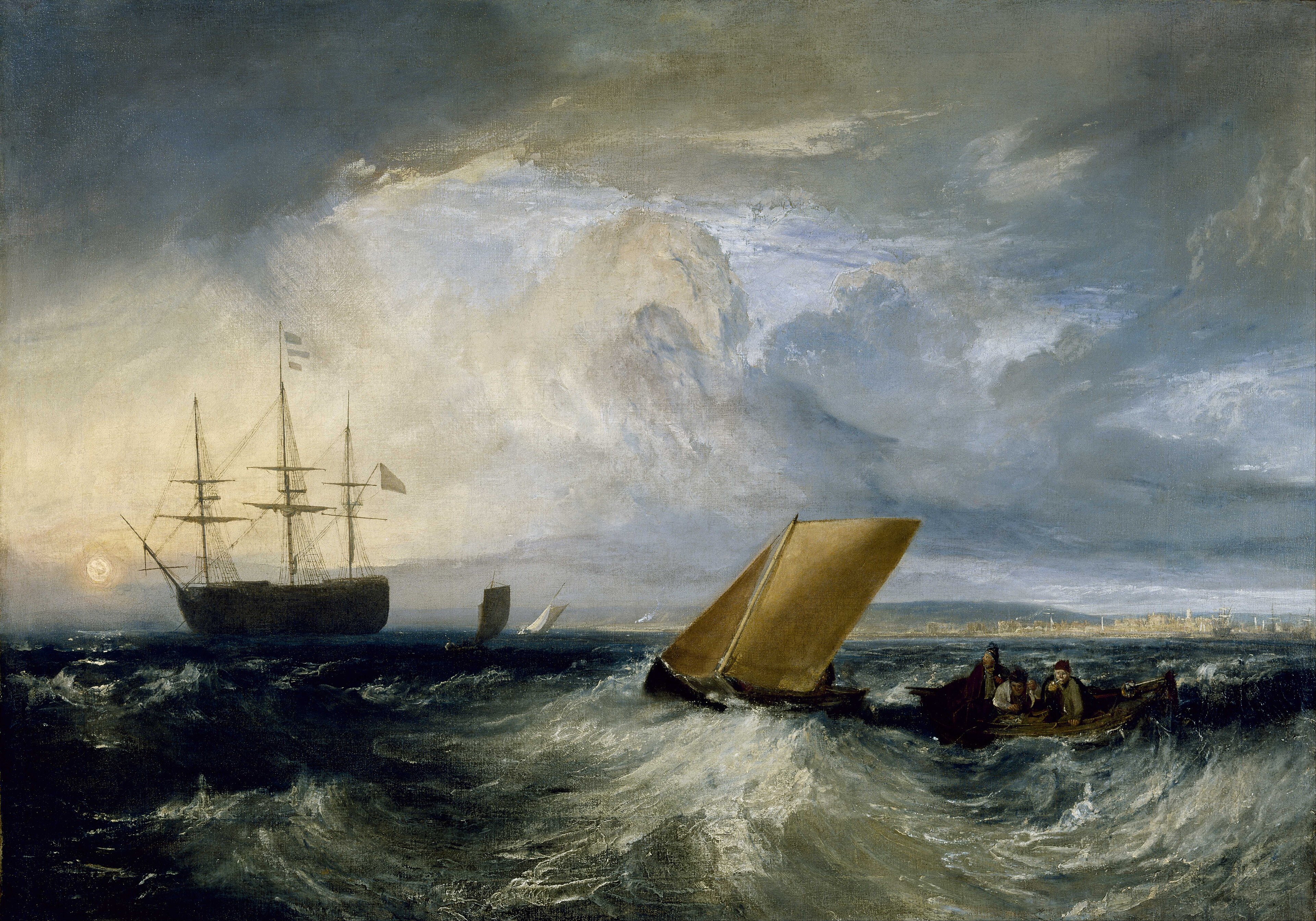
Museum of Fine Arts, Houston, object 2005.31. Public-domain image via Google Art Project and Wikimedia Commons.
 by Tom Gurney
Tom Gurney BSc (Hons) is an art history expert with over 20 years experience
Published on June 19, 2020 / Updated on August 29, 2026
Email: tomgurney1@gmail.com / Phone: +44 7429 011000
Sheerness as Seen from the Nore at Houston
J. M. W. Turner painted Sheerness as seen from the Nore in 1808. The large oil on canvas now belongs to the Museum of Fine Arts, Houston, where it has the object number 2005.31. Its current dimensions are 104.5 by 149.6 centimetres, or 41 1/8 by 58 7/8 inches.[1] A historic exhibition measurement is slightly larger, but the museum's present record supplies the controlling object data.[3]
The painting shows a view across the Nore anchorage toward Sheerness, at the meeting of the Thames estuary and the entrance to the Medway. A great anchored guardship rises left of centre. Smaller sailing craft work through choppy water, figures occupy an open boat in the lower right, and the dockyard lies as a thin strip on the far horizon. Above them, cloud and light consume nearly two-thirds of the canvas.[1][2]
Turner exhibited the work at his own gallery at 64 Harley Street in 1808. It belonged to a concentrated group of Thames and estuary subjects rather than to the crowded mixture of genres at the Royal Academy. The Houston museum describes it as one of the masterpieces of Turner's early period, arriving near the end of a decade in which he transformed British marine painting.[1]
That claim does not depend on treating Sheerness as an early forecast of the vaporous works of the 1840s. Its achievement is already complete in the terms of 1808. Rigging is exact, waves have weight, distant buildings locate the scene, working figures carry social scale, and atmosphere reorganises every one of those facts without erasing it.
The title matters. Turner does not call the work a storm, a naval review or a portrait of a named ship. He describes Sheerness “as seen from the Nore.” The wording establishes a viewpoint within a navigable and militarised body of water. The viewer is not on a promenade looking out to sea. The viewer is among vessels, shoals, tide and wind, looking back toward an institution on land.
This direction reverses the conventional hierarchy between secure shore and dangerous water. Sheerness is distant and compressed; the anchorage is immediate and immense. Naval power dominates the left, but it shares the canvas with fishing labour, small-craft movement and weather. Turner gives no single element complete command.
Looking from the Nore
The Nore is not simply a poetic name for the sea. It is a sandbank at the mouth of the Thames and a historic anchorage near the entrance to the Medway. Royal Museums Greenwich identifies it as the naval anchorage off the Medway entrance and notes that it later gave its name to a major Royal Navy command.[12] From here, routes to London, Chatham, Sheerness and the North Sea intersected.
The title therefore carries practical geography. To see Sheerness from the Nore is to look from an area where depth, tide and channel mattered to every hull. The low horizon creates breadth, but the water is not empty. A broad wave rises across the foreground, smaller crests repeat behind it, and craft are distributed at different distances. Space is measured through the labour of remaining afloat.
The apparent eye-level is low. The horizon does not descend beneath a commanding terrestrial viewpoint, and the nearest wave seems capable of passing under the observer. Houston educational material proposes that Turner probably worked from a small boat of the kind represented in the painting.[2] That is a persuasive account of the immediacy, though no surviving drawing fixes the exact platform from which the final composition was observed.
This waterborne position changes the scale of the guardship. Seen from a low boat, its hull becomes a wall and its masts a second architecture. Sheerness itself, despite housing the dockyard, loses monumental prominence. The mobile eye encounters naval organisation first as a ship, then as a distant line of buildings.
The Nore also prevents a simple distinction between river and ocean. Fresh and tidal waters, the Thames and Medway routes, North Sea weather, mud and sandbanks, civilian traffic and naval command converge there. Turner paints a threshold rather than a bounded place. The image is topographical because its relations are specific, not because every building can be named.
In the related Junction of the Thames and the Medway, a later inscription identifies the Nore buoy, distant Sheerness and the Isle of Sheppey.[8] That canvas opens a wide prospect across shipping and water. Sheerness advances closer to the anchorage's physical forces. Its viewpoint gives topography bodily consequence: the viewer must negotiate the same wave field as the open boat.
Contents
- Sheerness as Seen from the Nore at Houston
- Looking from the Nore
- A Sky Larger than the Dockyard
- The Anchored Guardship
- The Small Sail under Pressure
- Fishermen in the Foreground
- Three Systems of Motion
- Sheerness on the Horizon
- Shoals, Signals and the First Floating Light
- The Nore Mutiny Eleven Years Earlier
A Sky Larger than the Dockyard
Sky is the painting's largest material fact. A heavy slate-grey cloud presses in from the upper left. Near the centre, a towering illuminated mass swells upward and outward. Cooler blue-grey bands extend across the right, their edges alternating between softness and sharply lit ridges. The entire upper field appears to move even though no cloud has a single readable speed.
The low sun burns at far left, just above the horizon. Its pale yellow light passes behind and around the guardship rather than illuminating the vessel from the front. Hull and rig become silhouette, while thin lights on water record a path through the darkness. Historic catalogues called the effect sunrise, but Turner's current title does not dictate an hour.[1]
Cloud and water answer each other. The great central vapour resembles a crest expanding in the sky, while the foreground wave carries grey, white and warm reflected tones drawn from above. This correspondence does not make sea and atmosphere identical. Water has directional resistance; cloud has swelling volume. Turner gives each a related rhythm while preserving different physical behaviour.
The dockyard's horizontal strip is tiny by comparison. Buildings, masts and towers remain visible, yet weather exceeds the institution they serve. This is not a claim that nature defeats the navy. The guardship remains upright and ordered. Rather, Turner places organised power within a medium it can use but never abolish.
The sky also controls how detail is perceived. Rigging appears clearest where it crosses pale cloud and sunrise. The same line becomes harder to follow against darker vapour. Distant vessels materialise through small white or brown accents, then nearly disappear. Visibility is a changing condition inside the scene, not a transparent window through which everything can be inventoried.
Calling the image a tempest would overstate it. The open boat still works, the guardship lies securely at anchor and the small sail holds wind without obvious disaster. Yet calling it calm would ignore the wave and the loaded clouds. Turner paints weather in transition: enough disturbance to demand skill, enough light to make every change visible.
The surface makes that transition cumulative. Broad modulations build the cloud's weight, but narrow lights sharpen selected edges and small accents reopen depth. Turner does not outline one stable cloud bank and then colour it. Vapour seems to assemble through differences of density, so that the illuminated centre can look substantial at one moment and penetrable at another. Against this uncertain body, every mast becomes a measuring instrument.
The proportion of sky also slows recognition of the human subject. A viewer may first register radiance and pressure, then locate the guardship's hull, then discover the sail and foreground crew. This delayed sequence is not vagueness. It recreates a maritime condition in which a vessel's visibility depends on the atmospheric field through which it is approached.
The Anchored Guardship
The guardship is the painting's largest human construction. Its dark broadside hull lies left of centre, with three masts rising into the illuminated cloud. Sails are furled or absent, yards extend horizontally, and dense standing rigging creates a network of verticals and diagonals. A bowsprit points left toward the sunrise.[4]
Its anchorage is as important as its size. The vessel does not surge into battle or heel under canvas. It stays in place while smaller boats move around it. Stillness becomes an expression of function. A guardship stationed at a naval anchorage could embody supervision, readiness and command without firing a gun.
Several flags hang or stream from the masts. Rectangular signals occupy the central rig, while a longer pennant or triangular form extends from another mast. Royal Museums Greenwich preserves Royal Navy signal books issued in 1799 and 1808, as well as Home Popham's 1803 telegraphic vocabulary. Flags belonged to a living communications system in Turner's year.[12]
The painted combination, however, has not been securely decoded. It would be false precision to turn coloured marks into a sentence, name an admiral or infer an operational order. Their documented value is broader and still important: the ship can transmit and receive authority across distance. Its rig is both mechanical apparatus and information structure.
The guardship is often described as protecting the smaller vessels. That interpretation fits a patriotic account of naval force during the Napoleonic Wars, but the canvas does not show a protective action. No enemy appears, no rescue is underway and no threat is intercepted. The safer conclusion is that civilian and naval craft inhabit the same administered water.
Turner makes this coexistence visually unequal without making it simple. The warship overwhelms the distant buildings but does not overwhelm the sky. It towers over the working boat but remains farther away. Its black hull is heavy, yet the brightest light belongs to the atmosphere behind it. Power is real, located and limited.
The broadside view offers another controlled ambiguity. It displays the length and gun-deck mass expected in a marine portrait, but the darkness prevents a complete inventory of ports, decoration and crew. Turner gives enough naval construction to establish authority, then lets silhouette withhold individual identity. The vessel becomes both particular ship and institutional presence.
Its masts divide the luminous cloud into intervals. The central mast crosses the brightest swelling vapour, while outer spars reach toward darker weather. This placement turns rigging into a scale for atmosphere: cloud becomes enormous because the known height and complexity of a warship can be compared with it. Conversely, the ship feels engineered because each line keeps its tension against forms that have none.
The Small Sail under Pressure
At centre-right, a much smaller sailing craft meets the lifting water. Its warm tan-brown sail leans steeply, forming the most forceful diagonal in the lower half. The sail catches enough light to separate itself from both dark wave and blue-grey sky.
This boat activates the space between guardship and foreground crew. Without it, the naval vessel might appear as a static emblem and the fishermen as an isolated genre incident. The intermediate craft turns the anchorage into a sequence of different responses to wind: anchored mass, sailing adjustment and close bodily labour.
The sail's shape is broad and irregular from the viewer's angle. It should not be assigned a precise class without stronger evidence. What matters visually is pressure. Wind fills the cloth, the hull rides near a crest, and the diagonal mast and sail counter the guardship's upright spars.
The craft also interrupts the course toward Sheerness. Its warm surface partly occupies the water leading to the distant settlement, forcing the eye to pass through present movement before reaching topography. Turner does not offer an unobstructed survey. The view is crowded by the things that make the estuary function.
Light reaches this vessel differently from the guardship. The great ship becomes a silhouette against dawn; the small sail becomes a receiving surface. Scale and material generate separate optical identities. Dark timber holds institutional weight, while cloth records the immediate wind.
There is risk, but not catastrophe. The boat heels or turns through broken water without visible wreckage. Its angle asks the viewer to imagine continuous correction. The work of sailing occurs between fixed points, not as a single heroic gesture.
Fishermen in the Foreground
The open boat in the lower right is the closest human world. Several figures sit, crouch or stand among lines, nets and equipment. Their bodies overlap with the gunwale and one another, making an exact count less useful than the collective impression of concentrated work.[4]
One upright dark figure helps establish the boat's scale. Others bend lower, their postures absorbed into gear and hull. They do not turn the marine prospect into leisure. No passenger surveys the sunrise for pleasure; the figures occupy working positions in a craft exposed to the same wave that confronts the viewer.
Their proximity gives them a visual importance disproportionate to their size. The guardship may represent the largest concentration of capital, weapons and personnel, but the fishing boat contains the bodies whose balance can be read most immediately. A viewer feels the curl of the wave through their position.
Turner had made fishing labour central from Fishermen at Sea onward. In Sun Rising through Vapour, people unload and clean a catch while distant warships become pale silhouettes.[17][20] Sheerness redistributes that relation. The navy is darker and more prominent, the fishermen are afloat rather than ashore, and unsettled water replaces reflective calm.
The fishermen should not be romanticised as a timeless community outside modern systems. They work beside a Royal Navy anchorage, within regulated channels and under signals. Their livelihood occupies the same estuary that carries warships, dockyard materials and traffic toward London.
Yet institutional context does not erase practical knowledge. The crew's low postures, equipment and placement close to a crest convey adaptation learned at bodily scale. Turner gives different expertise to each vessel. The guardship requires hierarchy and rigging; the sailboat reads wind; the open boat negotiates wave and work with little protective height.
The boat's location at the lower edge increases that exposure. Part of its visual field is cut by the canvas boundary, so it seems to continue into the viewer's space rather than sit as a complete motif at a distance. The wave does the same. Its crest has no comfortable strip of foreground before it, and the viewer meets working craft and water almost simultaneously.
Colour binds the crew to their tools. Dark coats, warm timber, pale foam and indistinct gear overlap, refusing the clear separation of portraiture. This does not make the people unimportant. It records the way labour joins body to material: hands, line, net and gunwale matter through use, not through isolated display.
Three Systems of Motion
The lower composition can be read through three systems: the guardship's held position, the sailboat's diagonal passage and the working boat's close engagement with the wave. Each occupies a different distance and each translates weather into a different visible response.
Anchor, sail and oar
Anchoring is not absence of motion. The great vessel lifts with water, strains against cable and keeps its orientation through forces the image does not expose directly. Its rigging trembles visually because so many fine lines cross mobile cloud, even while the hull remains stable.
The tan sail makes wind legible. Its angle carries force down toward the hull and across the wave. The foreground boat presents another order of movement, lower and less geometrically clear. Bodies, gear and gunwale form a compact unit that must ride rather than dominate the sea.
Turner links the three through repeated diagonals. The bowsprit extends left, the small sail drops across centre-right, and the wave sweeps toward the fishermen. These vectors prevent the broad horizontal canvas from becoming placid. Even the distant shore is crossed by masts and pale vertical accents.
The systems are social as well as physical. The anchored warship concentrates the state; the sailing craft implies passage and exchange; the open boat foregrounds extraction and subsistence. No label in the painting defines those categories, but scale and equipment make their differences visible.
Weather passes through all three without belonging to any. The navy can organise signals and anchorage, yet cannot command the cloud. The fishermen can read a crest, yet cannot flatten it. The sailor can trim cloth, yet must use the wind that arrives. Turner's marine world is structured by skilled responses to forces no single actor owns.
This is why the composition feels eventful without depicting a named incident. Motion is distributed. The drama lies in simultaneous adjustment rather than collision, wreck or battle.
Sheerness on the Horizon
Sheerness appears as a low band of pale buildings, vertical masts, towers and dockyard forms along the right horizon. The settlement is specific enough to justify the title but too distant for confident identification of individual structures.[1][4] Turner makes a place recognisable through its relation to water and shipping rather than through an architectural portrait.
The Royal Navy founded the dockyard in 1665. Its position near the Nore anchorage, Chatham and a deep-water channel gave it strategic value. Initial works were burned during the Dutch raid on the Medway in 1667, after which Charles II's engineer Bernard de Gomme developed stronger defences.[10][11]
Sheerness first served largely for storage and refitting. A second dry dock was added in 1720, and the yard built mainly fourth- and fifth-rate warships during peacetime.[11] By Turner's date it was both service installation and manufacturing environment, supporting ships whose apparent independence at sea depended on labour and materials ashore.
Historic England's study of the area reveals substantial growth by 1800. Reclaimed land, an additional dry dock, an enlarged waterside area and a broader range of buildings and trades had expanded the yard. Late-eighteenth-century defensive lines, completed around 1800, enclosed Blue Town and established a new military boundary.[9][10]
The horizon should not be reconstructed from later survivals. Between 1815 and 1826, John Rennie and others completely rebuilt Sheerness into the planned dockyard now central to its architectural history.[11] Those basins and monumental structures postdate the canvas. Turner shows the older establishment on the eve of transformation.
Distance makes the dockyard look slight, but knowledge reverses that impression. The narrow line contains dry docks, workshops, stores, officers, shipwrights and garrison structures. The guardship's dark hull is the mobile extension of that hidden labour. Turner binds sea power to a barely visible industrial shore.
Sheerness's value did not make it an easy place to build. Historic England records an exposed position, marshy ground, expensive engineering problems, shipworm in the water and an historic shortage of fresh water. A successful well in 1782 addressed one constraint, while reclamation using old hulks expanded usable land.[9]
These facts deepen the painting's relation between solidity and instability. The dockyard appears as a firm horizontal boundary, yet it had been made through repeated interventions into marsh, moat and tide. The warship seems self-contained, yet it depends on facilities wrested from difficult ground.
The wave field in front of Sheerness is therefore not an untouched natural opposite to industry. Channels were marked, hulls sunk to create breakwaters, land reclaimed and defences extended. Human action had already altered the meeting of earth and water long before Turner arrived.
At the same time, engineering never made the environment inert. Shoals still endangered navigation, weather still changed visibility and exposed structures remained vulnerable. The canvas preserves that tension in visual form. Pale dockyard geometry stays narrow; cloud and sea retain volume.
The contrast also protects the picture from a purely celebratory reading. Sheerness can represent British naval capacity during war, but its history includes destruction, vulnerability and costly maintenance. An anchored guardship may signify readiness precisely because the location required vigilance.
Turner does not paint workshops in documentary detail or turn marsh engineering into an explicit subject. He does something more compressed. He places the distant products of administration behind moving craft whose survival still depends on immediate skill. Institutional power and environmental exposure occupy the same view.
Shoals, Signals and the First Floating Light
The Nore's importance arose partly from danger. Shoal-infested approaches complicated entry to the Thames and Medway, making marks and local knowledge essential. In 1732, a lightvessel was moored near the Nore Sands. Trinity House describes it as the first floating light in the world.[13]
Royal Museums Greenwich preserves a contemporary model of the Nore lightship associated with 1796. The small vessel carried two lanterns on a yard that could be raised for use. The museum traces the first recorded Nore light to Robert Hamblin and David Avery's 1732 scheme, financed through dues from shipping.[12]
The lightship does not appear clearly in Turner's canvas and should not be inserted among the distant marks. Its relevance is structural. The anchorage was not merely occupied; it was read through aids, signals and regulated routes. Darkness and poor visibility had prompted a technological response decades before Turner painted his sunrise.
The 1796 model is especially close in date to Turner's working knowledge. It shows that a specialised service craft could remain moored as infrastructure, its purpose realised through a light raised above the hull. The Nore thus contained different kinds of stationary vessel: one marked danger, another embodied naval command. Their immobility supported the movement of others.
The guardship's flags belong to another system of making distance intelligible. A light warns many vessels of fixed danger; naval signals transmit contingent information among ships and shore. Turner places coloured signs high in the rig, where they depend on visibility against cloud. Communication itself becomes subject to weather.
This relation sharpens the meaning of the low sun. Dawn is not only beautiful illumination. It changes what can be seen, from wave crests and sail angles to flags and the distant dockyard. The painting's dramatic contrast between silhouette and brightness is also a drama of recognition.
The title's preposition “from” now carries further weight. A viewer at the Nore would need to know where safe water lay, what ship commanded the anchorage, what signals were flying and where Sheerness began. Turner does not provide a chart, yet he fills the view with the forms through which navigators and naval personnel organised the place.
Topography and atmosphere therefore reinforce rather than oppose each other. The more unstable visibility becomes, the more important marks, masts and lights are. The Nore's history as the location of the first floating light reveals that Turner's luminous marine was also an environment already shaped by efforts to manage light.
The Nore Mutiny Eleven Years Earlier
In May 1797, the Nore anchorage became the centre of one of the Royal Navy's most serious internal crises. It followed a more orderly mutiny at Spithead, where sailors had demanded improved pay, conditions and treatment. At the Nore, demands expanded to shore leave, fairer prize distribution and changes to the Articles of War.[14]
The crews' attempt to blockade the Thames transformed a labour dispute within the fleet into a direct threat to trade and government. The movement fragmented under pressure, supplies were restricted, ships returned to obedience and its nominal leader Richard Parker was executed aboard HMS Sandwich. Others were hanged, imprisoned or flogged.[14]
The location was not incidental. Warships concentrated at the anchorage could collectively interrupt access to London. The same geography that made the Nore valuable to naval command made organised refusal there unusually powerful.
HMS Sandwich had served as the guardship and became the delegates' headquarters. Turner later placed another dark guardship at the centre of his view, but there is no evidence that he intended it as Sandwich or encoded the mutiny. Eleven years separate event and painting, and the sunrise scene contains no explicit revolt.
The history still changes how authority at the Nore can be understood. An anchored warship was not simply a stable emblem. It contained a large working population whose obedience could not be taken for granted. Masts, signals and command depended on sailors living under discipline.
A painting by William Joy shows HMS Clyde arriving at Sheerness at dawn after its captain persuaded the crew to leave the mutinous fleet. The port admiral then raised his flag aboard her after it had been hauled down on Sandwich.[15] That later image demonstrates how sunrise, anchorage and flag could carry precise political meaning in representations of the episode.
Turner's painting does not narrate that return. Its flags are not Joy's documented admiral's signal, and its figures do not stage loyalty or insurrection. The comparison instead marks an interpretive limit. The Nore had a recent history in which visibility, flags and guardships mattered intensely, but Sheerness turns those elements into a broader account of maritime order under changing weather.
The mutiny also complicates the scale of the anonymous crew. Hundreds of sailors could inhabit ships that appear from outside as unified black hulls. Naval discipline encouraged viewers to imagine a vessel as one obedient instrument, but the events of 1797 had made its internal population politically visible. Turner's exterior view does not reveal individual seamen on the guardship, yet historical memory prevents the silhouette from being socially empty.
This need not make the canvas oppositional. The foreground fishermen are not stand-ins for mutineers, and the wave does not symbolise rebellion. The value of the history is more exact: it reveals that order at the anchorage was produced through labour, negotiation and force. The apparent stillness of a guardship was an achievement of people as well as anchors.
Nelson, Victory and Direct Observation
Turner had another recent reason to know Sheerness. In December 1805, HMS Victory returned from Trafalgar carrying Horatio Nelson's body. Turner went to the vessel at Sheerness, sketched it and gathered information that informed his great 1806-08 Battle of Trafalgar, whose full title locates the imagined view in the flagship's mizzen rigging.[16]
Royal Museums Greenwich describes this as a pursuit of first-hand evidence. Turner examined the battered ship and used accounts from those who had experienced the battle. His Trafalgar canvas compresses multiple moments into a crowded history painting rather than offering a mechanically literal record.[16]
That expedition anchors Sheerness in experience. Turner was not inventing the Nore from an atlas or treating naval architecture as remote convention. He had encountered the estuary as a place where a celebrated but damaged flagship returned, national mourning met dockyard procedure and eyewitness testimony could be gathered.
It does not follow that the guardship is Victory. The hull, flags and anchorage provide no secure identification, and the title avoids a vessel's name. Nor should the sunrise be described as a memorial for Nelson. Houston educational material links Turner's visit to the setting, but the object record does not claim a concealed commemoration.[2]
The relationship is better understood through artistic method. In Trafalgar, Turner used detailed shipboard research to construct epic confusion. In Sheerness, precise naval observation supports a scene without named action. The knowledge remains, but battle has given way to readiness, labour and weather.
The two paintings also treat the boundary of history differently. Trafalgar combines death, smoke, signals and combat aboard a famous ship. Sheerness makes the guardship anonymous and places it among ordinary craft. One turns naval experience into a national event; the other finds historical pressure within a normal anchorage.
Nelson's return therefore belongs to the painting's formation, not necessarily its iconography. It helps explain Turner's attention to the place and his authority with naval forms. The distinction preserves both documentary value and visual openness.
The timing is striking. Only three years separate the Victory studies from the Houston canvas, and Turner's Trafalgar was itself still being reconsidered in 1808. He was moving between two modes of contemporary history: the reconstruction of an extraordinary battle and the observation of the maritime system that existed before and after such events.
That movement helps explain why anonymity is productive. A named flagship arrives with biography already attached; an unnamed guardship asks what naval presence looks like in ordinary time. Turner shifts attention from a hero's deck to the relations among ship, anchorage, workers, dockyard and weather. The second subject is quieter but not less modern.
A Wartime Marine without Battle
Britain was at war with Napoleonic France in 1808. Trafalgar had defeated the combined French and Spanish fleets in 1805, but conflict continued across Europe and at sea. Naval dockyards, home anchorages, signals and access to London retained immediate strategic significance.[16][25]
Turner does not need to show cannon fire for that context to register. The guardship's very stationing indicates organised readiness. Sheerness's defences and service facilities connect the distant horizon to the navy's capacity to maintain ships. The Nore's channels link local water to national and international movement.
Yet “wartime” must not become a licence to invent an enemy. The clouds are meteorological, not smoke from combat. The small boats are not demonstrably under escort. The fishermen's activity does not become patriotic service merely because a warship is near them.
The painting's strength lies in coexistence. Naval force appears beside the civilian practices a maritime state claimed to secure and also regulated. Fishing, exchange, dockyard labour and fleet readiness share a physical environment. Turner shows their proximity without converting every relation into harmony.
This ambiguity matters because the Royal Navy could signify protection and coercion at once. The Nore mutiny had exposed poor conditions and severe discipline inside the institution. Trafalgar had produced victory and mass death. Sheerness had been founded through fear of Dutch attack and rebuilt after destruction. The dark guardship carries that complicated history even when it remains at anchor.[10][14]
The rising light offers no simple national allegory. It can support ideas of vigilance, renewal or British endurance, especially in relation to the 1857 title, but Turner supplied no explanatory verse or patriotic caption. The sun illuminates fishermen and cloud as readily as naval rig.
By refusing a named incident, Sheerness expands what a wartime marine can contain. Routine becomes historically charged. The maintenance of position, the reading of wind and the visibility of signals are quieter than battle but essential to maritime power.
Trafalgar had reduced the immediate possibility of a French invasion fleet, but it did not end the naval war or Britain's dependence on maritime movement. Ships still required repair, provisioning, command and communication; coastal waters still had to be watched; commercial routes still sustained the war economy. An anchorage painting could therefore address the infrastructure of power after victory's spectacle had passed.
The canvas also keeps coercive capability visible without displaying violence. The dark broadside carries guns even when individual ports are difficult to count. This latent force distinguishes the guardship from the smaller craft. Turner neither fires the weapons nor pretends they are absent, allowing readiness itself to become a visual condition.
Turner on the Thames
Turner's engagement with the Thames began long before 1808. London gave him daily access to river traffic, wharves, bridges and changing light, while journeys downstream opened reaches, marshes and the estuary. By 1805 he had commissioned a boat or yacht that supported work on the river.[5]
Contemporary criticism recognised sustained observation in the 1808 group. John Landseer described the paintings as connected by named places along the Thames and praised a mind flowing as freely as the river. His language is rhetorical, but it confirms that viewers understood individual prospects as parts of a larger investigation.[5]
The river offered Turner more than scenery. It joined the city to seaborne trade, naval stations and the coast. Moving downstream changed architecture, occupation, water condition and scale. A painter could pass from urban bridge to broad reach, from cultivated bank to dockyard and anchorage without leaving one connected system.
Turner's own mobility is crucial. A boat allows repeated shifts in viewpoint and makes the horizon responsive to actual movement. It brings the observer close to working vessels rather than arranging them from a distant bank. The low standpoint in Sheerness gives the finished oil the authority of that embodied practice, even though its arrangement was constructed in the studio.
This balance between encounter and composition should be protected. Turner did not paint a photographic instant. The cloud, guardship, working boat and distant shore are organised for contrast and movement. But invention operates on knowledge: how a broadside sits, how sail receives wind, how rig cuts against light and how estuary waves differ from a glassy calm.
The Thames also let Turner claim a modern British territory for ambitious landscape. He did not need ancient ruins or Alpine catastrophe to achieve scale. A working anchorage near London could sustain history, weather, labour and formal grandeur.
That choice explains why topographical names remain prominent. “Purfleet,” “Thames,” “Medway,” “Nore” and “Sheerness” insist that the painted world is local and contemporary. Turner measures national maritime life through places that many elite viewers knew as routes rather than as subjects of high art.
The Independent Harley Street Gallery
Turner lived at 64 Harley Street by 1800 and developed a private exhibition room behind the house. Insurance records show that in 1804 he covered both the pictures and the brick room itself. By spring 1808, he again insured the gallery and its contents before opening the display.[5]
This was not merely a studio where buyers happened to visit. It was a controlled exhibition environment. Turner could select relationships among paintings, retain wall space for his own work and address collectors, connoisseurs and artists outside the Royal Academy's mixed annual spectacle.[6]
The distinction mattered in 1808. Turner sent only The Unpaid Bill to the Academy, where critics treated the genre scene as a failed attempt to rival David Wilkie. At Harley Street, visitors encountered a fuller statement: landscapes engaging Claude, Rubens, Cuyp and Van de Velde, new Thames subjects and the continuing Liber Studiorum project.[6]
The marine group therefore participated in an argument about Turner's range. Exact ships and English places could stand beside old-master emulation and a systematic classification of landscape. The guardship at Sheerness was not low subject matter admitted apologetically. It occupied the artist's own account of modern landscape's ambition.
The gallery was also commercial. Research based on insurance and exhibition evidence indicates that seven of twelve oils sold rapidly, perhaps earning more than £1,785.[5] Sheerness was probably among the pictures purchased directly that year, by Samuel Dobree.[1]
Private display altered the social encounter with scale. Visitors could compare several Turners without the surrounding competition, vertical crowding and genre hierarchy of the Academy. The Thames subjects could accumulate meaning from one another: a shore seen along a reach, a confluence, an anchorage, different vessels and distinct conditions of light.
The arrangement also let Turner make old-master comparison commercially useful. Collectors familiar with Cuyp, Claude, Rubens and Van de Velde could recognise inherited problems while seeing modern English answers. Purchasing Sheerness meant acquiring both a precise national prospect and an intervention in the history of marine painting.
Control did not mean isolation from criticism. Landseer's review gives the titles of the 1808 works because no printed Turner catalogue for that display survives. The gallery generated public discussion while allowing the painter to arrange its initial terms.[5][7]
The correct address is important. Later memory often calls Turner's exhibition room Queen Anne Street because that became his enduring address and connected with the Harley Street property. The museum's exhibition history identifies 64 Harley Street in 1808.[1] Restoring that location clarifies the gallery as a purpose-built extension of the home Turner had already occupied and insured.
Three Estuary Paintings in 1808
The principal 1808 estuary sequence comprised Purfleet and the Essex Shore, as seen from Long Reach, The Confluence of the Thames and Medway and Sheerness as seen from the Nore.[7] The titles create a conceptual journey from a river reach to a junction and then to the exposed naval threshold.
Purfleet is the most explicitly shore-oriented of the three. Turner signed and dated it 1808, and the fifth Earl of Essex bought it from the gallery for Cassiobury Park.[22] Its named relation between Long Reach and the Essex bank begins with lateral river vision.
The Washington Junction broadens that field. Shipping is dispersed across a calm or moderately moving prospect, and a later inscription names the Nore buoy, Sheerness and the Isle of Sheppey.[8] Waterways meet before the viewer reaches the guardship-dominated anchorage.
Sheerness intensifies the sequence. Its canvas is larger, the sky more forceful and the nearest wave more bodily. The view has travelled downriver, but it has not achieved placid openness. Greater maritime reach brings increased exposure.
These relations do not prove a commissioned triptych. The dimensions differ, buyers separated the works and no contract establishes a single ensemble. Their unity lies in exhibition, date, titles and repeated study of the Thames system.[5][7]
Turner continued the exploration in 1809. Fishing upon the Blythe-Sand, Tide Setting In represents waters off Sheerness with fishing vessels under active sail and was shown in his gallery among other Thames views.[21] Shoeburyness Fishermen Hailing a Whitstable Hoy similarly joined labour, vessel recognition and estuary place.
A surviving 1809 title, Guardship at the Great Nore, Sheerness, &c., creates a trap. It has sometimes been associated with the Houston painting, but the 1808 titles are independently known and the later catalogue may refer to another work.[7] The works should not be merged merely because guardship, Nore and Sheerness recur. Turner's sustained attention produced related images, not a single object with interchangeable names.
From Fishermen at Sea to Sunrise at Sheerness
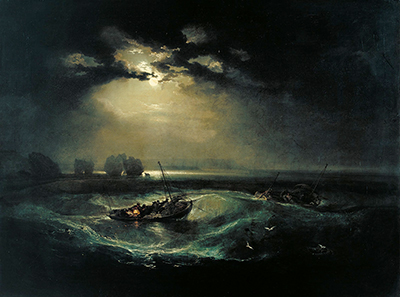
Turner's first exhibited oil, Fishermen at Sea of 1796, already joined working boats, vulnerable human light and a larger atmospheric power. Moonlight breaks across rough water while a small lantern flickers among the vessels.[17] The image announced that marine painting could carry both close observation and emotional scale.
In Dutch Boats in a Gale of 1801, Turner answered the seventeenth-century marine tradition through heavily loaded boats in dangerous proximity. The Duke of Bridgewater paid £250, Turner's highest price for an oil to that date. The apparent threat of collision gives learned emulation immediate force.[18]
Calais Pier in 1803 drew on Turner's own stormy Channel crossing. A passenger ferry approaches harbour amid fishing boats, agitated water and a breaking shaft of light. The scene is crowded, unstable and socially detailed, with labour and travellers exposed to the same conditions.[19]
Sun Rising through Vapour, exhibited at the Royal Academy in 1807, offered a different problem. Low morning light spreads over a calm sea while fishermen unload and prepare their catch. Warships appear almost ghostly in the vapour. Turner acknowledged the Dutch “calm” tradition while making atmosphere the painting's unifying medium.[20]
Sheerness gathers these experiments without simply combining them. It has the working human presence of Fishermen at Sea, the dark ship and pressure of Dutch marine painting, the active water and harbour complexity of Calais Pier, and the low illumination of Sun Rising through Vapour. But it locates them within a named British naval geography.
The sequence also reveals Turner's refusal to adopt one marine formula. Moonlit danger, gale, harbour disorder, calm and estuary squall demand different structures. Mastery consists in varying relation among hull, labour, light and water rather than repeating a recognisable effect.
Houston's description places Sheerness near the culmination of this early decade.[1] Its confidence supports that judgement. Turner can make the guardship meticulously present while letting cloud dominate; he can place fishermen closest without turning them into anecdote; he can name a strategic location without reducing the image to survey.
Dutch Tradition and a Modern British Estuary
Seventeenth-century Dutch marine painting supplied Turner with an exacting standard. Willem van de Velde and others had represented ship types, manoeuvres, calms, storms and naval formations with technical authority. British collections made those works available as models and as objects against which a young marine painter could be judged.[18][20]
Turner responded competitively rather than submissively. Dutch Boats in a Gale openly adopts Dutch vessels and a historic mode, while increasing the drama of near collision. Sun Rising through Vapour takes the traditional calm and fills it with English fishing labour and an unusually pervasive atmospheric light.[18][20]
In Sheerness, the old-master vocabulary meets present British infrastructure. The broad low horizon, carefully differentiated craft and rigging remain indebted to marine tradition. The named Royal Dockyard, Nore anchorage and recent wartime setting make the result contemporary.
Aelbert Cuyp's warm river light also formed part of the 1808 gallery's conversation with Dutch art.[6] Yet Turner's sunrise is not simply “Cuypian” gold applied to an English subject. Heavy blue-grey cloud and the cool wave complicate warmth. Light does not settle the scene into pastoral harmony.
This distinction is visible in the guardship. A conventional ship portrait might identify the vessel, display its lines and preserve a clear sky around its rig. Turner instead withholds the name and lets masts enter the unstable cloud. Naval exactitude survives inside meteorological drama.
The fishermen likewise prevent learned emulation from becoming antiquarian. Their work belongs to a living estuary. The distant dockyard is not a picturesque ruin but an active facility whose buildings and trades had expanded by 1800.[9]
Turner thereby uses inherited marine language to enlarge modern landscape. He demonstrates knowledge of the masters while insisting that the Thames, Medway and Sheerness can carry equal pictorial ambition. The British estuary does not imitate the Dutch coast; it enters a transnational tradition with its own institutions, weather and conflicts.
Scale marks the difference. Dutch precedent often taught viewers to inspect hulls and manoeuvres across a low horizon, but Turner makes the cloud mass rival the largest vessel. He retains the credibility needed for comparison while shifting authority from ship portrait to total environment. The eye can admire seamanship and still recognise that the atmosphere sets the terms of visibility.
His engagement with tradition also prevents a misleading story of solitary genius. Turner's originality grew through looking, collecting, travelling, competing and adapting. The 1808 display made those relationships legible. Innovation in Sheerness is not freedom from predecessors; it is the capacity to make inherited marine intelligence answer a specific British present.
Changing Titles and the Other Sheerness
The 1808 title survives through Landseer's Review of Publications of Art: Sheerness as seen from the Nore.[5][7] Its restraint is notable. Place and viewpoint are enough. The guardship, sunrise and weather remain discoveries within the image rather than promises in the caption.
When the painting reappeared at the British Institution in 1852, it was called A Seapiece. That generic title removed the exact geography. At Manchester's Art Treasures exhibition in 1857, it became Sunrise, man of war at the mouth of the Thames.[1] The later wording restores time, ship type and location but changes the order of attention.
“Sunrise” supports the reading of the low left-hand light. “Man of war” shows that mid-nineteenth-century viewers understood the great vessel as naval. “Mouth of the Thames” translates the less familiar Nore into broader geography. None of these later descriptions identifies the ship by name.
A separate work creates enduring confusion. Turner made a later watercolour of Sheerness for a harbour publication. Thomas Lupton engraved it, and it appeared posthumously in 1856 in The Harbours of England under a title nearly identical to the oil's.[23]
The later design is compositionally distinct. A busy port lies to the left, a ship of the line anchors at the right and brigs and yachts fill the middle. Lupton's mezzotint translates Turner's watercolour; it is not a print after the Houston canvas.[23]
John Ruskin and The Art Journal praised the published plate, with the journal describing crisp estuary seas and a dark wedge of cloud. That reception belongs to the 1856 engraving and cannot be transferred to the 1808 oil.[23]
Keeping the two works separate reveals continuity rather than redundancy. Turner returned to Sheerness and the Nore across decades because port, warship, wind and estuary remained fertile. The early oil makes sunrise, guardship and fishing labour monumental; the later design reorganises the harbour under a stronger division of port and ship.
The distinction also protects the painting's reception history. A celebrated judgement attached to one Sheerness image can easily migrate to the other because artist, place and wording coincide. The 1856 plate received Ruskin's and The Art Journal's documented praise; the 1808 oil had its own exhibition life under several names. Evidence should follow the object rather than the attractiveness of a quotation.
The same caution applies to a sentence often repeated about one of Turner's 1808 marines being among the finest British sea pieces. Surviving summaries do not securely establish that the critic meant the Houston canvas rather than Purfleet. Omitting the compliment is not excessive scepticism. It preserves a more valuable fact: contemporary viewers treated the Harley Street river group as a connected achievement, while individual attributions within that response remain uneven.
Titles can illuminate without settling interpretation. A Seapiece emphasises genre, the Manchester wording emphasises sunrise and warship, and the original emphasises viewpoint. Reading all three together reveals what successive audiences noticed. None licenses a named vessel, a decoded flag or a concealed episode.
From Samuel Dobree to Houston
Samuel Dobree probably bought Sheerness directly from Turner in 1808. The museum retains the qualifier because the first transfer is strongly believed rather than proven by an unbroken set of contemporary documents. The painting descended to Dobree's son, Harry Hankey Dobree.[1]
At Christie's on 17 June 1842, it appeared as lot 12. Bryant acquired it for Sir Thomas Baring, second baronet. Baring's own sale followed on 2 June 1848, where the painting was lot 61. It then entered the collection of William Wells.[1]
The work's titles during this period reveal changing familiarity. Its 1852 and 1857 exhibitions used generic or descriptive alternatives, even while its visual identity remained strong. Repeated public display helped restore Turner's early marine achievement to audiences beyond the first private-gallery visitors.
At Wells's sale on 10 May 1890, Agnew's bought the canvas for Robert Loyd Lindsay, first Lord Wantage. It remained in the Loyd Collection at Lockinge through family descent until 1991. Long private ownership did not mean complete invisibility: it appeared in Royal Academy Old Masters displays, the 1899 Guildhall Turner exhibition, the 1910 Academy exhibition and Tate's 1931 survey of Turner's early oils.[1]
Idemitsu Kosan later owned it in Tokyo. The Museum of Fine Arts, Houston purchased the painting in 2005 with support from several acquisition funds, adding a major early Turner oil to a collection that already included his works on paper.[1]
Subsequent loans repositioned it within broad accounts of the artist. The 2007-08 Turner retrospective travelled from Washington to Dallas and New York. Turner & the Sea placed it within his lifelong marine practice in 2014, while Turner's Modern World connected his art to war, technology and social change in 2021-22.[1][24][25]
The provenance is not an afterthought. Direct sale from Turner's gallery, nineteenth-century retitling, aristocratic and corporate ownership, transcontinental movement and museum acquisition all shaped who could see the canvas and under what description. Its present public status reunites topographical, naval and artistic histories that earlier titles sometimes separated.
Weather, Work and Turner's Achievement
Sheerness as Seen from the Nore does not ask the viewer to choose between ship painting and atmosphere. The guardship's rigging is persuasive because cloud gives every line changing contrast. The cloud is powerful because mast and yard provide a measured structure against which its expansion can be felt.
Nor does the image ask for a choice between naval history and fishing labour. The great hull, small sail and open boat belong to one field, but they do not carry equal resources or identical purposes. Turner makes their hierarchy visible and then subjects all of them to wind, water and light.
The distant dockyard completes that relation. Buildings support the warship while remaining visually smaller than the craft they maintain. Historic knowledge recovers the workshops, docks, reclaimed land and defences compressed into the horizon. The painting turns institutional depth into optical distance.
Recent history presses on the place without becoming a puzzle to solve. The Nore mutiny exposed conflict inside naval order. Victory brought Nelson's body through Sheerness and drew Turner there as an investigator. War made signals and dockyards urgent. None of these facts names a secret episode in the canvas; together they explain why ordinary anchorage could carry such weight.
Turner's own gallery gave him the freedom to assemble that weight. Beside Purfleet and the Thames-Medway junction, Sheerness formed the exposed conclusion to a river journey. Collectors could read the oils as modern British prospects and as answers to Dutch and French old masters.
The sunrise remains beautiful, but it does not guarantee serenity. Dark cloud advances, the wave rises, the small sail leans and the fishermen work. The guardship's silhouette is at once impressive and dependent: dependent on anchor, crew, dockyard, signal, visibility and navigable depth.
That network is the painting's deepest subject. Turner presents the estuary as a system in which natural forces, skilled labour, state power and communication continuously meet. He finds the sublime not outside modern life but within its fragile coordination.
The viewer remains low among the waves. Sheerness can be seen, but it cannot be possessed as a stable panorama. A crest interrupts, a sail crosses, flags wait to be read and cloud changes the available light. Turner's title promises a view; his painting reveals that seeing from the Nore is itself maritime work.
That work continues for the modern viewer. Close inspection recovers fishermen from the dark boat, small traffic from the horizon and rigging from the cloud, but certainty stops where the evidence stops. The unnamed ship and undecoded signals are not deficiencies awaiting imaginative repair. They keep attention on relations Turner made fully visible: weight against vapour, anchorage against passage, distant administration against nearby labour, and human order against a weather system already changing.
Discussion
How does Turner balance anchored naval power, working boats and changing weather without turning the scene into battle?
Reader Insights
What does the still guardship contribute beside the moving sail and labouring boat?
How does looking from the water toward Sheerness change the hierarchy of place?
Where do cloud and wave echo one another across the composition?
Join the Conversation
Share a close observation or a source-based question for other readers.
References
- Museum of Fine Arts, Houston, “Sheerness as seen from the Nore,” 2005.31, https://emuseum.mfah.org/objects/69601/sheerness-as-seen-from-the-nore
- Museum of Fine Arts, Houston, “History Mystery: Sheerness as Seen from the Nore,” https://lta.mfah.org/lesson-plan/64a60d301c7e9462a313f2c5
- National Gallery of Art, *J.M.W. Turner* exhibition image list, 2007, https://www.nga.gov/content/dam/ngaweb/press/exh/2832/2832-list.pdf
- Wikimedia Commons, public-domain Google Art Project image, https://commons.wikimedia.org/wiki/File:Joseph_Mallord_William_Turner_-_Sheerness_as_seen_from_the_Nore_-_Google_Art_Project.jpg
- Alex J. Taylor, “The Sun Is God: Turner, Angerstein, and Insurance,” *Oxford Art Journal* 47.1, https://academic.oup.com/oaj/article/47/1/39/7695169
- Royal Academy Chronicle, “1808: Turner's Unpaid Bill and Artistic Rivalry,” https://chronicle250.com/1808
- Martin Butlin and Evelyn Joll catalogue data, “Guardship at the Great Nore, Sheerness, &c.,” https://www.performan.org/works/turner-1775-1851/153-guardship-at-the-great-nose-sheerness-c/
- National Gallery of Art, “The Junction of the Thames and the Medway,” 1942.9.86, https://www.nga.gov/artworks/1226-junction-thames-and-medway
- Historic England, *A Characterisation of Sheerness, Kent*, https://historicengland.org.uk/research/results/reports/7063/ACharacterisationofSheernessKent_ProjectReport
- Historic England, “Sheerness Defences,” list entry 1471141, https://historicengland.org.uk/listing/the-list/list-entry/1471141
- Royal Museums Greenwich, “Royal Naval Dockyards,” https://www.rmg.co.uk/stories/maritime-history/royal-naval-dockyards
- Royal Museums Greenwich, “Nore (1796); Service vessel; Lightship,” SLR0590, https://www.rmg.co.uk/collections/objects/rmgc-object-66551
- Trinity House, “1732: The first lightvessel in the world,” https://www.trinityhouse.co.uk/about-us/history-of-trinity-house/timeline/1732
- Royal Museums Greenwich, “The Spithead and Nore mutinies of 1797,” research guide B8, https://www.rmg.co.uk/collections/research-guides/research-guide-b8-spithead-nore-mutinies-1797
- Royal Museums Greenwich, “HMS Clyde Arriving at Sheerness After the Nore Mutiny,” BHC0497, https://www.rmg.co.uk/collections/objects/rmgc-object-11989
- Royal Museums Greenwich, “Turner's The Battle of Trafalgar: a maligned masterpiece?”, https://www.rmg.co.uk/stories/art-culture/turners-battle-trafalgar-maligned-masterpiece
- Tate, “Fishermen at Sea,” N00530, https://www.tate.org.uk/art/artworks/turner-fishermen-at-sea-n00530
- National Gallery, “Dutch Boats in a Gale,” L297, https://www.nationalgallery.org.uk/paintings/joseph-mallord-william-turner-dutch-boats-in-a-gale-the-bridgewater-sea-piece
- National Gallery, “Calais Pier,” NG472, https://www.nationalgallery.org.uk/paintings/joseph-mallord-william-turner-calais-pier
- National Gallery, “Sun Rising through Vapour,” NG479, https://www.nationalgallery.org.uk/paintings/joseph-mallord-william-turner-sun-rising-through-vapour
- Tate/Google Arts & Culture, “Fishing upon the Blythe-Sand, Tide Setting In,” N00519, https://artsandculture.google.com/asset/fishing-upon-the-blythe-sand-tide-setting-in-joseph-mallord-william-turner/MQG2rOTbb5MaqQ
- Sotheby's, “Purfleet and the Essex Shore as seen from Long Reach,” lot 50, https://www.sothebys.com/buy/2ebac549-3b76-4994-bcfe-bdbf223d44cd/lots/29d3849b-aa5a-46e9-8b4c-60581eaada52
- Museum of New Zealand Te Papa Tongarewa, “Sheerness, as seen from the Nore,” 2024-0026-1/5, https://collections.tepapa.govt.nz/object/1483139
- Peabody Essex Museum, “Turner & the Sea,” https://www.pem.org/exhibitions/turner-the-sea
- Museum of Fine Arts, Boston, “Turner's Modern World,” https://www.mfa.org/exhibition/turners-modern-world