 by Tom Gurney
Tom Gurney BSc (Hons) is an art history expert with over 20 years experience
Published on June 19, 2020 / Updated on August 29, 2026
Email: tomgurney1@gmail.com / Phone: +44 7429 011000
Mountains, Travel and Visual Scale
Switzerland and the Alps gave Turner one of the great testing grounds of his art. The region offered height, distance, weather, water, tourism and danger in forms that could not be reduced to ordinary topography. Turner first encountered the Alps during his 1802 Continental journey, and Alpine subjects continued to matter across his career. The National Gallery records his early European travel and the importance of continental experience to his development.[1] Tate's works-on-paper research gives the fuller evidence: sketchbooks and watercolours preserve the repeated labour of looking, recording and transforming Alpine motifs.[2]
The Alps mattered because they forced questions of scale. How could a small sheet suggest overwhelming height? How could watercolour hold snow, mist, shadow and reflected light? How could an oil painting turn mountain weather into historical drama? Turner answered these questions differently at different moments, which is why Switzerland appears in his work as both observed territory and imaginative force.
At a Glance
- First Alpine encounterThe 1802 Continental journey
- Core problemMountain scale under changing weather
- Central territoriesThe Alps, Lake Lucerne and Mount Rigi
- Primary portable mediumPencil and watercolour sketchbooks
- Major sublime exampleSnow Storm: Hannibal Crossing the Alps
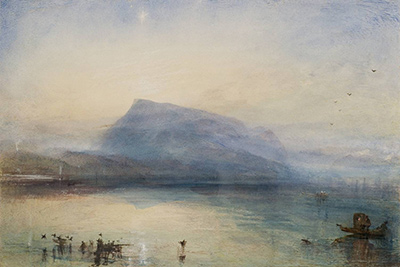
- Late watercolour exampleThe Blue Rigi, Sunrise
- Working sequenceObservation, rapid record, memory and studio transformation
- Cultural settingTourism, travel literature and collector demand
- Topography boundaryRecognisable place altered by atmosphere and recollection
- Abstraction boundaryLate dissolution remains rooted in specific visual conditions
Contents
- Mountains, Travel and Visual Scale
- The 1802 Journey
- The Sublime and Its Limits
- Lake Lucerne and the Rigi
- Watercolour as Alpine Instrument
- Switzerland, Tourism and the Market
- Switzerland and the Rest of Turner's Career
- Alpine Travel and British Viewers
- Sketchbooks and the Pace of Looking
- Hannibal and the Politics of Scale
The 1802 Journey
The Peace of Amiens made Turner's first major Continental journey possible. Switzerland exposed him to mountains whose scale and weather had already become central to European ideas of the sublime. For a young Royal Academician trained in topography and ambitious for landscape's higher status, the Alps offered a subject that could join observation with terror, beauty and historical association.
The journey did not simply produce a set of picturesque views. It gave Turner material he could keep reworking. Alpine experience fed later watercolours, exhibition pictures and mental habits of contrast: human smallness against natural vastness, track against precipice, clear distance against obscuring storm. These contrasts became part of his wider pictorial language.
The Sublime and Its Limits
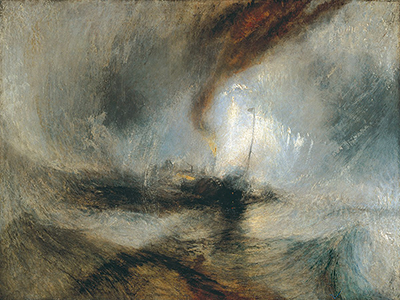
The Alps naturally invite the word sublime, but Turner used mountain subjects with more variety than that label alone suggests. Snow Storm: Hannibal and his Army Crossing the Alps turns mountain weather into historical catastrophe, with the storm dominating the army it nearly consumes. Yet other Alpine works are quieter, built from light across water, a ridge emerging through haze or colour suspended over a lake.
This range matters. Turner did not treat Switzerland only as a theatre of terror. He also saw it as a place of changing atmosphere, tourist circulation, memory and market demand. The same mountain system could support grand history, intimate travel record and luminous late watercolour.
Lake Lucerne and the Rigi
The Rigi subjects are among the most important late Swiss works. The Blue Rigi, Sunrise belongs to a group in which Turner returned to Lake Lucerne and mountain light with extraordinary delicacy. Tate's material on the Lucerne sketchbook describes watercolour sketches made during Turner's final trip to Lucerne, with Mount Rigi as a recurring subject and changing weather as central to the effect.[3]
The Rigi works show how far Turner's Alpine art had moved from topographical demonstration alone. The mountain remains identifiable, but the main drama lies in atmosphere: colour held in suspension, reflections softened, rain and sun shifting across distance. These images helped create the later reputation of Turner as a painter of light, but they should still be understood as disciplined works of place, memory and medium.
Watercolour as Alpine Instrument
Watercolour was especially suited to Turner's Swiss subjects because it could move quickly between clarity and evaporation. Wash, reserve, scraping, opaque touches and paper tone allowed him to suggest mist, snow, water and sky without heavy description. Tate's Turner sketchbook research, and Warrell's account of the sketchbooks, stress the notebooks as records of travel and of ideas that could lead to larger works.[2][4]
The medium did not merely record Switzerland; it shaped what Switzerland became in Turner's art. A pencil line could fix a ridge. A thin wash could make distance. A stronger colour note could preserve a moment of weather. Later, the artist could return to these fragments and decide whether the subject demanded precision, breadth or near-dissolution.
Switzerland, Tourism and the Market
Turner worked in a world where Alpine travel had cultural and commercial value. Collectors wanted images of Switzerland, Lake Lucerne, mountain passes and celebrated views. Turner understood that market, but he did not simply feed it with attractive souvenirs. His Swiss works often question what can be possessed in a view. Weather interrupts clarity; distance resists ownership; light changes before it can be fixed.
This tension helps explain the power of the late Swiss watercolours. They are desirable images, but they are also images about evanescence. Turner gives the collector a mountain that refuses to be merely a property of vision.
Switzerland and the Rest of Turner's Career
Swiss subjects connect to many other parts of Turner's work. They belong to travel, watercolour, the sublime, late colour, the bequest and the relationship between observation and memory. They also link to his classical ambitions, because Alpine force could become historical force in Hannibal. They link to his technical practice, because mountain light demanded refined control of paper, pigment and reserve.
Switzerland therefore should not be treated as a scenic chapter between more important works. It is one of the places where Turner's central questions become visible: how to paint changing light, how to enlarge landscape's emotional range, how to convert travel into art and how to make natural force carry historical meaning without losing its physical immediacy.
Alpine Travel and British Viewers
Turner's Swiss subjects also belonged to a British culture increasingly fascinated by Alpine travel. Mountains had become places of tourism, danger, science, memory and aesthetic theory. British viewers might know Switzerland through travel accounts, prints, guidebooks and watercolours before seeing it themselves. Turner's images entered this market, but they also unsettled the idea that a mountain view could be simply possessed.
For collectors, Swiss subjects offered prestige and refinement. A view of Lake Lucerne or the Rigi could signal travel culture, taste and sensitivity to light. Turner understood that appeal. Yet his best Alpine works rarely behave like souvenirs. They give the viewer weather as much as place, change as much as outline. The mountain is present, but it is also passing through light.
Sketchbooks and the Pace of Looking
The Swiss sketchbooks are vital because mountains and lakes change under the eye. A ridge can disappear into cloud; a reflection can break; a shower can alter colour across water. Tate's Lucerne material stresses the immediacy of the late sketchbook studies and their attention to Mount Rigi under changing conditions.[3] Such evidence helps explain why Turner returned to the same motif. Repetition was a way of studying difference.
Sketchbook work also allowed rapid response. A small sheet could catch relations that a large oil might later elaborate: lake, shore, cloud, rain, sun, distant mountain. The fragment did not need to solve everything. It needed to preserve enough for memory and later invention.
This is one reason Switzerland was so fertile for Turner. Alpine scenery rewarded both the quick note and the long meditation. A sketch could be immediate; a finished watercolour could be distilled; a historical oil could transform mountain experience into sublime drama.
Hannibal and the Politics of Scale
Snow Storm: Hannibal and his Army Crossing the Alps remains one of the clearest examples of Turner turning Alpine experience into historical force. The work is not a literal travel record of Switzerland, but it draws on the Alpine imagination: storm, altitude, danger, obscurity and human vulnerability. Tate identifies the painting as an 1812 exhibited work, and its scale makes weather into a power that overwhelms the army.[2]
The political force of the picture is partly indirect. Hannibal's campaign evokes empire, invasion and military ambition. Turner's storm makes that ambition small. The mountain does not merely host history; it judges it. This is a key difference between Turner's Alpine sublime and a simple picturesque view.
The painting also shows how Turner could move from travel to invention. The Alps he had seen became part of a broader visual language that could be applied to ancient history and contemporary feeling.
The Rigi and Late Watercolour
The Rigi watercolours show another side of Switzerland. Where Hannibal is forceful and public, the Rigi works are often intimate, serial and atmospheric. The Blue Rigi, Sunrise and related studies concentrate on colour changes, reflections and mountain presence under shifting weather. Tate's Lucerne sketchbook description highlights rain, sunbeams and rainbows as part of the late Swiss record.[3]
These works are not slight because they are delicate. Their refinement depends on decisions about reserve, wash, paper and tonal balance. Turner does not need heavy description to make the mountain felt. He lets colour relationships carry the sensation of distance and weather.
The Rigi also complicates the idea of Turner's late art as purely inward. These images are rooted in place and repeated looking. Their abstraction, if that word is used at all, grows from concentration on specific visual conditions.
Switzerland Between Topography and Memory
Swiss works often move between recognisable topography and remembered atmosphere. A named mountain or lake may anchor the image, but Turner lets weather and colour alter the terms of recognition. This makes the works valuable for understanding his broader practice. He did not choose between accuracy and imagination as rigid opposites. He used each to strengthen the other.
In Switzerland, topography gave him structure. Memory gave him breadth. The sketchbook preserved contact; the finished work selected and intensified. The result is a body of Alpine art that can be read through travel history, watercolour technique, sublime theory and the market for views without belonging wholly to any one category.
Alpine Afterlife
Turner's Swiss works helped shape later admiration for his treatment of light. The Rigi watercolours, in particular, show why nineteenth-century watercolour could become a medium of extraordinary subtlety. They also show why Turner's bequest matters: the survival of sketchbooks and colour studies lets viewers follow the relation between journey, observation and final image.
Switzerland therefore sits at the crossing of several Turner stories. It is part of his travel career, his watercolour practice, his sublime imagination, his late colour and his public afterlife. It is not a minor branch of the oeuvre. It is one of the places where his art learns to make atmosphere carry structure.
Passes, Roads and Human Infrastructure
The Alps were not untouched wilderness for Turner. They were crossed by roads, guides, inns, bridges and routes made for travellers. That human infrastructure matters because it places the sublime inside a modern travel culture. Turner could experience mountain danger and grandeur while also moving through systems designed to make such experiences accessible.
This mixture gives Alpine art a special tension. The mountains appear overwhelming, yet they are also visited, sketched, purchased and remembered. Turner makes that contradiction visible. He offers the grandeur sought by travellers while refusing to make it completely comfortable.
Roads and passes also provide compositional drama. A track cutting through mountains, a bridge over a gorge or a figure dwarfed by rock can make scale intelligible. Human marks do not weaken the sublime; they help the viewer feel it.
Snow, Mist and the Loss of Outline
Swiss and Alpine subjects helped Turner explore the loss of outline. Snow, mist and rain can soften edges until mountain, cloud and water seem to exchange properties. This was not merely atmospheric prettiness. It allowed Turner to ask how much information a landscape needs before it remains recognisable.
The late Rigi works are particularly important in this respect. The mountain is still there, but it appears through colour, reflection and weather rather than hard contour. The viewer recognises a place while also experiencing its instability. That balance between identification and dissolution would become central to Turner's later reputation.
Alpine weather therefore contributed to Turner's broader experiments with perception. Switzerland gave him natural conditions in which form could appear and vanish without losing meaning.
The Market for Alpine Light
Turner's Swiss watercolours also belonged to a refined market. Collectors valued their delicacy, travel associations and atmospheric sophistication. The Rigi works show how a celebrated view could become a highly charged object of collection. Yet Turner did not reduce the subject to luxury. He made the marketable view intellectually and technically demanding.
This is one of the paradoxes of his late watercolours. They are beautiful and collectible, but they also challenge ordinary possession. Their subjects seem to change under the eye. Light, rain and reflection make the image feel momentary, as if the collector has acquired not a stable scene but a visual event.
Switzerland and Turner's Larger Geography
Switzerland also links Britain, France and Italy in Turner's travel imagination. It is a passage as well as a destination. Alpine journeys could connect northern Europe to Italy, topography to classical ambition, and physical travel to pictorial transformation. The mountains stood between worlds.
This in-between quality matters. Turner's Alpine works often feel transitional: between observation and memory, place and atmosphere, topography and sublime history. Switzerland gave him a geography of thresholds. Roads cross borders; weather changes quickly; mountains divide and connect.
For Turner, such thresholds were artistically fertile. He repeatedly sought subjects where one state becomes another: day into night, calm into storm, structure into light, travel into recollection. The Alps gave him those transformations on a grand scale.
Why Switzerland Supports a Full Article
Switzerland deserves more than a short note because it gathers so many strands of Turner's practice. It involves early Continental travel, Alpine sublime, watercolour technique, late colour, collecting, sketchbook evidence and the bequest. Few geographical subjects touch so many parts of his career.
The Swiss works also show Turner at several speeds. He can be rapid in a sketchbook, theatrical in Hannibal, refined in The Blue Rigi and experimental in late colour studies. That range is exactly why the subject supports sustained treatment. Switzerland was not only a place Turner visited. It was a set of visual problems he kept reopening.
Switzerland and Colour After Travel
Swiss subjects also show how travel could continue long after the journey ended. A mountain seen in changing weather might become a watercolour refined for a collector, a colour memory in the studio, or part of a larger imaginative structure. The distance between first sight and finished work is part of the subject.
This afterlife helps explain the delicacy of the late Swiss watercolours. They do not simply report weather; they distil it. Turner uses colour to hold a visual memory that would have vanished almost immediately in nature. The result is both specific and elusive: the Rigi, Lake Lucerne, rain, sun and reflection are present, but they appear as a remembered experience rather than a diagram.
Switzerland therefore clarifies a central Turner method. He saw intensely, stored economically and later transformed. The Alps gave him some of the richest material for that process because their effects were powerful, fleeting and repeatable.
The result is a Swiss Turner who is never only topographical. He is historical in Hannibal, refined in the Rigi studies, practical in the sketchbooks and experimental in late colour.
That range is the point.
It endures.
Discussion
How does Turner make an identifiable Alpine place carry scale, weather, memory and market desire at once?
Reader Insights
Which pictorial cues make a small watercolour convey mountain vastness?
How do mist, snow and reflected light preserve place while weakening outline?
Where does direct observation become later selection and studio transformation?
Join the Conversation
Share a close observation or a source-based question for other readers.
References
- National Gallery, Joseph Mallord William Turner artist record, https://www.nationalgallery.org.uk/artists/joseph-mallord-william-turner
- Tate Research Publication, *J.M.W. Turner: Sketchbooks, Drawings and Watercolours*, https://www.tate.org.uk/art/research-publications/jmw-turner
- Tate Shop, *J.M.W. Turner: The Lucerne Sketchbook*, https://shop.tate.org.uk/jmw-turner-the-lucerne-sketchbook/21608.html
- Tate Shop, Ian Warrell, *Turner's Sketchbooks*, https://shop.tate.org.uk/turners-sketchbooks/16438.html