 by Tom Gurney
Tom Gurney BSc (Hons) is an art history expert with over 20 years experience
Published on June 19, 2020 / Updated on October 13, 2026
Email: tomgurney1@gmail.com / Phone: +44 7429 011000
Travel as a Working Method
Turner's travel was not a leisure habit attached to an otherwise studio-bound career. It was one of the engines of his art. From early tours in Britain to journeys through France, Switzerland, Italy, Germany and the Low Countries, he used movement to gather subjects, test effects and build a store of visual memory. Tate's research publication on Turner's sketchbooks, drawings and watercolours presents him as a tireless traveller whose works on paper preserve a vast record of places, impressions and developing ideas.[1]
The sketchbook is central to this story. Ian Warrell's Tate publication describes Turner's notebooks as records of the many places he visited across Britain and Europe, and as evidence for ideas that could later feed major paintings.[2] They were practical tools: portable, sequential and responsive to weather, architecture, boats, roads, mountains and rivers. They also complicate the idea of immediate transcription. Turner often transformed travel notes much later, turning direct observation into exhibition pictures, watercolours for collectors or designs for print.
At a Glance
- MethodTravel, sketchbook, memory and studio transformation
- BritainLondon, Thames, Wales, Scotland, north and south coast
- First major Continental tour1802 during the Peace of Amiens
- European territoriesFrance, Switzerland, Italy, Venice, Germany and Low Countries
- Portable toolSequential sketchbooks
- Observed materialArchitecture, roads, rivers, boats, mountains and weather
- Professional usesCommissions, watercolours, paintings and print projects
- Studio afterlifeNotes recombined and intensified later
- Essential distinctionDirect record is not identical to finished composition
- Travel conditionsRoads, sea crossings and mountain routes
Contents
- Travel as a Working Method
- Britain Before the Continent
- Wales, Scotland and the North
- The First Continental Journey
- France, Rivers and Modern Movement
- Italy, Venice and Rome
- Switzerland and the Alps
- Travel and the Studio
- Sketchbooks as Travel Machines
- Routes, Publishers and Reproductive Projects
Britain Before the Continent
Turner's travel began close to home. Early commissions and topographical work took him through London, the Thames, Wales, the north of England and the south coast. These journeys trained his eye in architecture, geology, river systems, harbours and ruins. The National Gallery places his earliest production within older British topographical practice.[3] That tradition could be commercial and descriptive, but Turner pushed it toward drama, atmosphere and historical association.
British travel also connected him to patrons and publishers. Castles, abbeys, lakes and coastal towns were not only subjects; they were part of a visual economy in which drawings became watercolours, engravings and collected images. Turner learned how a place could be made legible, marketable and emotionally charged without becoming merely picturesque.
Wales, Scotland and the North
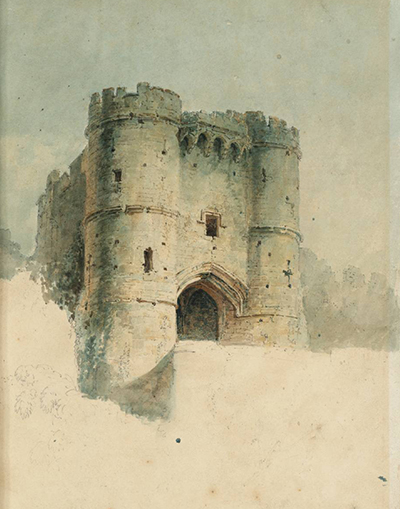
Wales and the north of Britain gave Turner architecture and weather at a scale that suited his developing ambitions. Subjects such as Dolbadarn Castle, Caernarvon, Conway, Warkworth and Buttermere allowed him to combine topography with history and atmosphere. Ruined towers and mountain weather offered more than scenic variety. They let Turner explore time, power and human smallness within a landscape.
Scotland and northern subjects also sharpened his sensitivity to water and light. Lakes, estuaries, rain and mountain edges recur because they allowed him to test transitions: solid into vaporous, local detail into breadth, observation into memory. The mature painter of luminous late works still carries the discipline of these early tours.
The First Continental Journey
Turner's first major Continental journey came in 1802 during the Peace of Amiens. The National Gallery's Calais Pier catalogue records the crossing to France, Swiss tour and subsequent study in the Louvre.[5] The trip combined direct encounter with European art and Alpine scale. The Louvre exposed him to Old Master painting under extraordinary historical circumstances, while Switzerland gave him mountains, weather and light on a scale unavailable in southern England.
The journey did not instantly create the Turner of the 1840s, but it gave him a durable set of problems. How should painting hold grandeur without becoming theatrical? How could watercolour record speed, height and shifting light? How could a travelled sketch become a studio picture years later? These questions remained alive throughout his career.
France, Rivers and Modern Movement
France gave Turner rivers, ports, architecture and a visual culture shaped by war, tourism and publication. The Seine, the Loire, coastal crossings and northern French towns supplied subjects for drawings, watercolours and print-related work. Cross-Channel travel also had a physical intensity that appears in paintings such as Calais Pier, where arrival is not a polite episode but an unstable meeting of weather, bodies and boats.
Turner's travel art often makes movement itself visible. Roads, bridges, packets, steamboats and later railways are not incidental. They show how the modern world altered the experience of place. A Turner journey is rarely just a line between destinations; it becomes an encounter with transport, delay, danger, speed and changing forms of access.
Italy, Venice and Rome
Italy entered Turner's art through classical ambition, direct travel, sketchbooks and later memory. Rome and Venice gave him very different kinds of material. Rome linked landscape to antiquity, Claude, ruins and imperial imagination. Venice offered water, architecture, reflected light and the unstable boundary between topographical record and chromatic vision. Tate's works-on-paper cataloguing is especially important here because the notebooks help distinguish what Turner saw, what he studied and what he later transformed.[1]
Italian travel also sharpened Turner's relationship with art history. He was not only collecting views. He was measuring himself against Claude, Titian, Canaletto and the long European tradition of landscape and city imagery. The result is not imitation. Italy gave him pressure, and he answered by making landscape more elastic.
Switzerland and the Alps
Switzerland remained one of Turner's most productive travel territories. Alpine journeys combined physical scale, tourism, danger and commercial appeal. The Rigi and Lake Lucerne later became central to his watercolour practice, while earlier Alpine experience fed the ambition of Snow Storm: Hannibal and his Army Crossing the Alps. The same region could become topography, sublime history or delicate atmospheric study.
This range is why travel cannot be separated from medium. A pencil note, a colour study, a finished watercolour and an oil painting do different things with place. Turner moved between them with unusual freedom. He could store an outline, return to a motif, change the weather, shift the emphasis and let memory work alongside observation.
Travel and the Studio
Turner's journeys did not end when he came home. The studio was where travel material was sorted, recombined and intensified. Sketchbooks preserved sequences; loose sheets allowed elaboration; oil and watercolour developed different kinds of finish. The bequest lets scholars follow this movement more closely than would otherwise be possible.[1]
The result is a career in which place is never merely local. A castle can become historical drama; a harbour can become modern instability; a mountain can become a test of perception; a city can become light. Turner travelled because he needed subjects, but he also travelled because movement gave his art its structure: encounter, memory, transformation and return.
Sketchbooks as Travel Machines
Turner's sketchbooks were not passive albums. They were working machines for travel. A notebook could hold routes, rapid outlines, place names, weather notes, architectural fragments and later compositional seeds. Warrell's account of the sketchbooks stresses that they offer the nearest thing to a record of Turner's impressions across Britain and Europe.[2] The point is not that every sketch became a finished work, but that the sketchbooks preserved the conditions from which finished works could later emerge.
The portable book also shaped Turner's way of seeing. A sketchbook imposes sequence. It records movement from one view to another, sometimes quickly, sometimes with repeated attention to a motif. It can show a coastline unfolding, a river journey, a series of castle views or the changing aspect of a mountain. That sequence is different from a finished picture's single statement. It lets modern viewers see Turner thinking through movement.
The notebooks also reveal economy. Turner often recorded just enough: a contour, a bridge, a shore, a mast, a notation of light. He did not need every detail at the moment of looking. Later, in the studio, such shorthand could be expanded, combined or reimagined. Travel therefore supplied raw material, but it also trained memory.
Routes, Publishers and Reproductive Projects
Much of Turner's travel was linked to publication. Topographical watercolours, engraved series and illustrated books depended on journeys through recognisable places. Judy Egerton's National Gallery catalogue biography describes his work for print publishers, including Picturesque Views in England and Wales and Wanderings by the Seine.[4] Such projects tied travel to a broad public market for images of Britain and Europe.
Print projects required selection, clarity and repeated invention. They extended Turner's reach beyond those who could see exhibition oils or buy original watercolours. Travel subjects circulated through engraving, connecting commercial production with a wider public understanding of landscape.
The engraved Turner is often less spectacular than the late Turner of popular memory, but it is vital. It shows his ability to make places readable and memorable within the constraints of reproduction. It also shows how his reputation was built through networks of publishers, engravers and collectors, not only through the Academy wall.
Travel, Risk and Weather
Travel in Turner's lifetime was physically demanding. Roads, sea crossings and mountain routes involved discomfort and risk. Calais Pier makes the Channel crossing feel unstable and bodily. Alpine subjects convert travel into encounters with height and weather. Even where the image is calm, the act of reaching the place may have mattered to Turner's sense of the subject.
The effort of travel helped shape the visual record without making every journey an act of heroism. A sketch made from a boat, coach, roadside or mountain path carries different conditions from a studio invention. Movement and changing weather could encourage compression and speed, although a rapid mark alone does not reconstruct the traveller's experience.
Weather was especially important because it turned travel into time-sensitive observation. Mist could erase a mountain; rain could change a town; sunset could remake a harbour. Turner became one of the great painters of transition partly because travel kept placing him before transitional effects.
Travel and the British Landscape
Turner's British journeys gave him a range of subjects that challenged any narrow southern or metropolitan identity. Wales offered castles, mountains and political-historical associations. The north of England gave him ruins, river valleys, industrial hints and patronal connections. Scotland and the Lake District contributed scale, water and weather. The south coast gave him marine and modern leisure subjects.
These journeys also helped Turner build a national landscape without making it uniform. A Welsh castle is not a Thames view; a Lake District shower is not a Brighton pier; a Yorkshire subject carries different historical and social associations from a southern harbour. Turner's strength lies in his ability to preserve difference while giving the works a recognisable pictorial intelligence.
British travel also connected to national memory. Ruins, abbeys, battle associations, castles and coastal defences allowed landscape to carry history. Turner could make place feel layered without turning it into antiquarian illustration.
Travel and Europe After War
European travel was shaped by war and peace. The 1802 journey took advantage of the Peace of Amiens; later movements followed changing Napoleonic and post-Napoleonic conditions.[5] Access depended on politics, transport, money and opportunity rather than an unchanging freedom to travel.
This context matters because Turner was a British artist encountering Europe after decades of conflict and cultural rivalry. The Louvre, the Alps, the Rhine, Rome and Venice each carried different meanings. They were artistic destinations, but also places caught in political and historical imagination. Turner travelled through a Europe where Old Master study, modern tourism and recent war could not be fully separated.
His art rarely turns these conditions into direct political reportage. Instead, they enter through atmosphere, ruins, routes and comparison. Travel let Turner place British landscape ambition into a European frame.
Memory, Repetition and Return
Turner returned to places and subjects. Repetition was not failure of invention; it was one of his methods. A place seen once could be revisited in a later medium, different weather or another scale. Venice recurs because it kept yielding new relations of light and architecture. Switzerland recurs because mountain and lake could be endlessly recalibrated. British castles and coasts recur because they offered durable structures for weather, history and memory.
Return also allowed Turner to separate place from immediate observation. A later work might depend on an old sketch, a remembered effect, a collector's request or a print commission. The image could become less documentary and more synthetic. Travel gave Turner contact; memory gave him freedom.
The Studio as the End of the Journey
Every Turner journey eventually entered the studio. There, sketches could be sorted, mined, ignored or transformed. The bequest makes this afterlife visible because so much working material survived.[1] A journey is therefore not just the moment of seeing; it includes the later labour of conversion.
Turner's travels connected observation, visual experiment, patrons and publishers. Journeys supplied local experiences that could later become paintings and watercolours of extraordinary range, extending well beyond a record of destinations.
Rivers, Coasts and Moving Viewpoints
Rivers and coasts were especially important because they made movement visible. A river journey changes viewpoint gradually: banks turn, bridges appear, towns open and close, light shifts across water. Coastal travel is more abrupt and risky: cliffs, harbours, tides, ships, weather and arrival all become part of the subject. Turner used both kinds of movement throughout his career.
The Thames gave him one form of modern and historical river space. The Seine and Loire offered another, shaped by French architecture and publication projects. The Rhine and Swiss lakes offered yet others, where tourism, castle ruins and mountain light met. In each case, water supplied continuity while the surrounding world changed.
This moving viewpoint helps explain Turner's resistance to static scenery. Many works feel as if they have been seen in passage. The viewer is invited into a moment that belongs to a journey rather than a fixed survey. That sense of movement is one reason even topographical subjects can feel alive.
Castles, Ruins and Historical Geography
Turner's travel repeatedly brought him to castles and ruins. These subjects suited the market for picturesque and antiquarian imagery, but Turner made them more than picturesque landmarks. A castle could become a historical pressure point, a sign of violence, memory, national identity or time. Welsh and northern subjects were especially rich in this way.
Dolbadarn, Conway, Caernarvon, Warkworth and other castle subjects show how travel and history entered the same image. Turner could record the visible structure while making weather and light carry emotional force. A ruin is not only architecture without a roof; it is history exposed to climate.
This historical geography allowed Turner to make British landscape ambitious before he even reached the full scale of classical and Alpine subjects. Travel through Britain gave him a language for placing human time inside natural space.
The Working Economy of Travel
Turner's travel was also practical. He needed subjects for commissions, watercolours, engravings and later paintings. The sketch made on a journey might become a collector's watercolour, a print design, an exhibition picture or a reference years later. Travel fed the economy of the studio.
This economy helps explain the sheer volume of movement. Turner did not travel simply when inspiration struck. Travel was part of professional production. It generated material that could be developed in multiple forms and sold into different markets. A journey through Britain or Europe could yield a whole chain of works.
The professional basis of travel does not make the art less sincere. It shows how discipline and opportunity worked together. Turner could be commercially alert and imaginatively intense at the same time.
The Eye Trained by Repetition
Repeated travel trained Turner's eye to recognise types of visual event. He learned how weather gathers over mountains, how smoke changes distance, how ships sit under different winds, how architecture reads from water, how sunset alters stone. Such knowledge could be applied beyond the place first observed.
This is why the same Turnerian intelligence appears across many geographies. Venice, the Thames, Lake Lucerne and the Channel are different, but all are understood through movement, reflection and atmosphere. Turner did not impose one formula on them. He developed a flexible visual language capable of responding to difference.
Repetition also strengthened memory. A subject revisited over years could become less dependent on direct record and more open to transformation. Turner's travel art is therefore not simply documentary. It is cumulative.
Europe as Comparison
Europe mattered because it made comparison unavoidable. British ruins could be measured against Roman antiquity; British rivers against the Seine or Rhine; British marine subjects against Dutch and Venetian traditions; British landscape ambition against Claude. Travel widened the field in which Turner judged himself.
This comparative habit is central to his greatness. Turner did not remain a local painter who occasionally went abroad. He became a British artist in European conversation. His travels allowed him to absorb, resist and rival the traditions he encountered. The result is a body of work that is national in formation but international in reach.
Travel and the Unfinished Archive
The bequest's travel material also changes how viewers understand unfinished work. A rapid sketch may look slight until it is seen as part of a journey. A fragmentary colour study may carry the memory of a weather effect that mattered intensely. A sketchbook sequence may reveal how a subject was approached from several positions.
This is why travel and archive belong together. Without the bequest, Turner's journeys would be reconstructed mainly from finished works and documents. With the bequest, they can be followed through marks, sequences and studies. The artist's movement becomes visible not as biography alone, but as working evidence.
The Thames as Origin and Return
The Thames deserves special attention because it was both ordinary and inexhaustible for Turner. He grew up in London, knew the river as a working environment and returned repeatedly to its bridges, traffic, weather and light. The Thames was not as exotic as Venice or the Alps, but it trained him in movement, reflection and modern urban life.
River subjects also helped Turner join local observation to national meaning. The Thames was commercial, ceremonial, industrial, historical and domestic. It carried boats, buildings, smoke, crowds and memory. For a painter interested in light and water, it offered constant variation; for a painter interested in modern Britain, it offered a living artery.
The river also gave Turner a way to think about continuity. Unlike a single monument, a river changes as one moves along it. It connects city, suburb, countryside and sea. That continuity helped shape Turner's broader travel imagination.
Travel and the Sea Crossing
Crossing water was one of Turner's most charged travel experiences. The Channel was not merely a passage to France. It was a threshold between Britain and Europe, between home and foreign study, between topographical habit and continental ambition. Calais Pier shows how intensely Turner could imagine arrival: bodies, boats and weather all collide at the edge of land.
Sea crossings also exposed travellers to instability. Weather, sickness, delay and danger belonged to the experience. Turner did not need to invent drama from nothing; travel itself supplied it. The crossing became one of the places where physical movement and pictorial movement met.
This is why travel in Turner often has a bodily quality. The viewer senses not only where the artist went, but what it meant to be moved through weather, water and unfamiliar space.
Travel, Language and Naming
Turner's travel record is full of names: rivers, towns, castles, lakes, passes, cities and harbours. Naming gave sketches and finished works a public anchor, but names never exhausted the image. A title might identify a place, while the picture turned that place into atmosphere, memory or historical reflection.
This balance between name and transformation is one of Turner's great strengths. He respects place enough to record it, but he refuses to leave it as bare record. The named subject becomes a field of pictorial possibility. That is why his travel works can remain meaningful even when the viewer has never visited the location.
Travel as a Career-Long Discipline
The importance of travel is not limited to youth. Turner kept moving, looking and revisiting subjects through the mature and late phases of his career. Early travel trained the topographical eye; later travel fed Venice, Switzerland, France and the late watercolours. The practice changed, but it did not disappear.
The continuity of travel joins biography, medium, market, print culture, landscape theory, patronage and the bequest. Place-gathering and repeated encounters with changing conditions kept Turner's art in contact with the world throughout his career.
The record of travel also keeps Turner from becoming too abstract a figure. His art may dissolve buildings into light or turn mountains into colour, but it begins again and again with roads, rivers, harbours, boats, inns, weather and notebooks. The visionary painter was also a working traveller with practical habits and an extraordinary memory for places.
That practical grounding is what makes the later transformations persuasive. Turner could depart from literal record because he had first trained himself so deeply in the experience of moving through actual places.
The journeys gave imagination ballast.
They also gave his audiences places they could recognise and rethink.
Discussion
How does travel remain visible after Turner transforms direct observation through memory and studio work?
Reader Insights
What can a sketchbook journey reveal that a single finished picture cannot?
Where does direct record give way to memory, composition or commercial purpose?
How did European travel enlarge Turner's understanding of British landscape?
Join the Conversation
Share a close observation or a source-based question for other readers.
References
- Tate Research Publication, J.M.W. Turner: Sketchbooks, Drawings and Watercolours, https://www.tate.org.uk/art/research-publications/jmw-turner
- Tate Shop, Ian Warrell, Turner's Sketchbooks, https://shop.tate.org.uk/turners-sketchbooks/16438.html
- National Gallery, Joseph Mallord William Turner artist record, https://www.nationalgallery.org.uk/artists/joseph-mallord-william-turner
- Judy Egerton, "Joseph Mallord William Turner," National Gallery Catalogues: The British Paintings, London, 2000, online catalogue biography. https://www.nationalgallery.org.uk/paintings/catalogues/egerton-2000/joseph-mallord-william-turner
- Judy Egerton, "Calais Pier," National Gallery Catalogues: The British Paintings, London, 2000, especially the account of Turner's first trip abroad and Louvre studies. https://www.nationalgallery.org.uk/paintings/catalogues/egerton-2000/calais-pier