_DSC2252.jpg) View the source record
View the source recordat Wikimedia Commons
Exact Tate N00532 object photographed on display. Wikimedia Commons CC0 public-domain dedication.
 by Tom Gurney
Tom Gurney BSc (Hons) is an art history expert with over 20 years experience
Published on June 19, 2020 / Updated on August 29, 2026
Email: tomgurney1@gmail.com / Phone: +44 7429 011000
A Late Encounter, Not a Conversion
J. M. W. Turner was almost seventy when he read Charles Lock Eastlake's English edition of Johann Wolfgang von Goethe's Theory of Colours. By then Turner had spent more than half a century observing atmospheric effects, comparing old masters, testing pigments and organising pictures through powerful chromatic contrasts. He had lectured on colour at the Royal Academy, drawn his own diagrams and endured years of mockery for making yellow and blue dominate ambitious paintings. Goethe did not awaken a dormant colourist.
What the 1840 book offered was something more interesting: a provocative vocabulary for questions Turner already knew through practice. Goethe asked how colour arises at boundaries between light and darkness, how the eye generates an opposite hue after staring, why shadows can appear coloured and how warm or cool fields affect feeling. Eastlake translated these observations for British painters while warning readers that Goethe's attacks on Newtonian optics were often mistaken.[1]
Turner's copy survives with extensive marks and short comments. They establish direct, serious reading, but not submission. He agreed in places, queried experiments, made jokes and rejected claims. When Goethe tried to build a system from yellow and blue, the painter who had long worked with red, yellow and blue primaries responded with disbelief. When the author sought to detach colour study from mathematical optics, Turner identified that separation as the central problem.[3][5]
Three years later he exhibited two Flood paintings whose opposition of cool evening and warm morning unmistakably engages the translated book. One title names Goethe. Yet even these pictures refuse to become illustrations of a theory. Scripture, Turner's verse, pigment, mortality and the effort of recognition complicate every chromatic association.
The relationship is best understood as an argument conducted through reading and paint. Goethe supplied experiments and polarities; Eastlake reframed them for artists; Turner tested both against decades of visual intelligence. The result matters precisely because no participant owns the final meaning of colour.
The chronology also changes the kind of question that can responsibly be asked. For Turner's early and middle career, resemblance to Goethe identifies parallel interests, not dependence. For works made after 1840, the translated volume becomes a possible stimulus, but possibility alone still does not establish a connection. Only the annotated copy and the explicit 1843 title make the encounter documentary fact. This graduated scale of evidence is essential because Turner's late pictures have often been made to illustrate ideas that their dates, titles and histories cannot sustain. A useful account must distinguish what he demonstrably read, what he could have applied and what later viewers have inferred.
What Goethe Wanted from Colour
Goethe published Zur Farbenlehre in 1810 after years of looking through prisms, arranging coloured surfaces and varying illumination. He regarded this scientific undertaking as central to his achievement, even though physicists rejected much of its challenge to Newton. The work combines experiment, classification, history, aesthetics and polemic on an extraordinary scale.[9]
Its ambition differs from a modern handbook that provides one diagram and a few mixing rules. Goethe wanted to connect bodily perception, atmospheric appearance, material change, artistic harmony and emotional response. Colour belonged to the eye, to light moving through media and to substances. It could be observed, produced, remembered, compared and felt.
This breadth arose from method. Instead of beginning with a mathematical account of light, Goethe varied situations and watched what changed. He looked at pale and dark boundaries through prisms, stared at coloured objects before shifting his gaze, examined shadows cast under differing illumination and studied colour in cloudy liquids, bubbles and the sky. Simple effects were connected into families.
Historians of science describe this as exploratory experimentation. The investigator does not merely test a fully formed law; variation helps reveal which concepts may organise the phenomena. Goethe's success was therefore uneven. Some observations are sharp and repeatable, while the physical explanation he built against Newton fails.[9][10]
For painters, that unevenness could still be useful. Painting depends on appearances as they reach an observer: a grey may seem warmer beside blue, a shadow may carry reflected colour and a glaze can alter both hue and depth. An account attentive to such effects addressed decisions that a theory of refrangible rays did not directly solve.
Goethe's importance to Turner lies in that practical and phenomenological field. The book encouraged artists to treat perception as active and relational. Turner did not need its false physics in order to find its experiments challenging.
Contents
- A Late Encounter, Not a Conversion
- What Goethe Wanted from Colour
- Newton, the Prism and a Different Question
- Physiological, Physical and Chemical Colour
- The Eye as an Active Participant
- Afterimages and Compensatory Colour
- Coloured Shadows
- Turbid Media and Atmospheric Colour
- Plus, Minus and Chromatic Polarity
- Sensuous and Moral Effects
Newton, the Prism and a Different Question
Any account of Goethe's colour theory must keep Isaac Newton's discoveries clear. Newton passed a narrow beam of sunlight through a prism and showed that white light separates into differently refracted rays. He could recombine the dispersed spectrum into white. Colour was not created by a prism adding something to homogeneous light; the optical apparatus separated components with distinct refrangibility.[2]
Goethe's starting observation was also real. When he looked through a prism at a broad, evenly white field, much of it remained white. Coloured fringes appeared near transitions between light and dark. He concluded that colour arose through an interaction of those poles rather than from the composition of white light.
The mistake lay in treating a boundary condition as a refutation of Newton. A prism does not produce a visibly spread spectrum at every point of an unbounded field. Overlapping rays can recombine in the eye, while edges reveal their displacement. Goethe described what appeared but rejected the stronger physical account that explained why it appeared.
Eastlake understood the danger. His preface notes the hostility created by Goethe's attacks and explicitly refuses to defend alleged errors. At the same time, he argues that the useful observations had been neglected because of the polemic. Newton's theory explained physical light with unmatched power, but it said comparatively little about chromatic harmony or how adjacent hues act upon perception.[1]
David Brewster sharpened the scientific objection in 1840. He praised Eastlake's translation and notes while condemning Goethe's attempt to derive colour from light-dark polarity. Brewster had modified parts of Newtonian spectral classification through his own experiments, yet he retained refraction as the essential physical basis. Opposition to Goethe was not blind loyalty to every Newtonian detail.[13][14]
Turner entered this dispute as a painter with scientific acquaintances, not as an optical theorist equipped to resolve it. He could recognise that material colours and coloured lights behave differently, while still relying on the traditional painter's primaries. The value of his response lies in pictorial experiment, not a hidden victory over physicists.
The disagreement also reveals why an artist could profit from a scientifically defective argument. Newton's experiment analyses light under controlled conditions and produces a physical explanation with predictive force. Goethe's demonstrations often begin from ordinary acts of seeing and record changes in apparent colour as conditions vary. A painter needs both causal knowledge and disciplined attention to appearance, but the two answer different questions. Eastlake's edition allowed readers to preserve that distinction. Turner could reject Goethe's assault on refrangibility while retaining experiments in contrast, adaptation and atmosphere as prompts for the studio. His later use of the book is therefore neither anti-scientific nor a secret alternative physics. It is a critical transfer from observed phenomenon into pictorial construction.
Physiological, Physical and Chemical Colour
Goethe divides colour phenomena into three broad classes. Physiological colours belong to the living eye. Physical colours appear through temporary interactions of light, darkness and transparent or translucent media. Chemical colours adhere to materials and can be fixed, altered or destroyed within substances.[1]
The categories are not identical to modern divisions, but they helped readers distinguish experiences often treated as one problem. An afterimage is not pigment. Blue sky is not blue paint. A mineral's hue persists differently from the fringe seen through a prism. Artists move among all three: they perceive with eyes, imitate aerial effects and apply material colour.
Turner had already developed a related distinction. In an Academy lecture he described the colours of light as capable of returning towards white, whereas mixing material pigments tends towards darkness. The phrasing was difficult and the primary colours inaccurate by later standards, but the conceptual contrast is significant. He knew that a rainbow and a palette do not combine in the same way.[4]
This matters for the 1843 paintings. Their light is an optical fiction made from oil. Pale scumbles, warm layers and dark interruptions remain chemical and material colour while prompting an experience of radiance. Pigment imitates what it cannot physically become.
Goethe's categories also prevent a simplistic symbolic reading. Yellow can be a material substance with ageing problems, a perceived brightness near white, an atmospheric effect or an emotional stimulus. Which yellow is being discussed? A theory that ignores the difference can turn every hue into a label.
Turner repeatedly holds the categories together without collapsing them. His paint records a surface, builds an atmosphere and activates the spectator's eye. The work is strongest where those functions disagree: a dark material touch can become brilliant light through contrast, or a luminous field can describe death rather than joy.
The Eye as an Active Participant
Goethe's most enduring contribution concerns the observer. The eye does not receive colour like an empty vessel. Its own activity helps shape what appears. Adaptation, contrast and afterimages mean that looking has a before and after; one chromatic experience changes the next.[3]
This proposition challenged an account of vision imagined only as rays arriving from stable objects. Goethe asked readers to perform experiments themselves. Stare at a bright or coloured form, look away and an altered counterpart appears. View one hue beside another and its apparent intensity changes. The observer becomes part of the event.
Turner's late work often stages such participation. Broad colour is encountered first; named objects become legible only after attention adjusts. Moving closer can reveal paint texture while losing the larger image. Stepping back may organise a vortex but dissolve tiny bodies. Vision is active because distance, duration and expectation matter.
It would be wrong to attribute every such effect to Goethe. Turner's art had demanded patient looking for decades, and painters had exploited contrast long before 1810. The secure connection is that Goethe gave a systematic language to a practice Turner recognised and then explicitly addressed.
The active eye also carries moral implications. If perception partly constructs what is seen, viewers become responsible for attention. In the evening Flood canvas, animals and people emerge slowly from cool darkness. A spectator who dismisses the work as shapeless repeats the failure to recognise warning inside the subject. In the morning companion, lost bodies appear within warm colour only when radiance is examined rather than enjoyed as a general glow.[15][16]
Goethe's observer is not therefore a licence for arbitrary meaning. Effects can be repeated and compared. Turner similarly supplies titles, verses and visual marks that constrain interpretation. The eye participates within evidence.
Afterimages and Compensatory Colour
Afterimages provided Goethe with direct evidence that colour can arise within perception. If someone stares at a red form and then looks towards a pale surface, a greenish counterpart may appear. Yellow calls forth violet; blue prompts orange. The eye seeks a chromatic completion beyond the original stimulus.[1]
The effect is successive because it unfolds through time. Yet Goethe also recognised simultaneous contrast. A colour occupying one part of the visual field can make the surrounding area seem tinged with its opposite. The same physical grey may look different depending on its neighbour.
These observations helped organise Goethe's colour circle. Diametrically opposed hues answer one another, creating a totality the eye finds satisfying. Harmony becomes dynamic rather than a fixed property inside one patch of colour.
For a painter, the implications are practical. A small accent can affect a much larger field. A cool mark placed inside warm atmosphere may intensify both. A pale centre surrounded by darkness can seem brighter than the same paint viewed alone. Turner had understood these relations through old-master study and his own work before reading Goethe.
The Flood pair makes successive contrast architectural. Spectators encounter a predominantly cool evening and a predominantly warm morning as separate but related objects. Looking from one to the other carries chromatic memory across the interval. The pair activates the eye's tendency to compare, whether or not an exact afterimage is produced.[17]
Turner also frustrates complementarity. Neither painting offers a pure half. Warm colour infiltrates evening, and dark lost forms disturb morning. The eye seeks closure but finds contradiction. Goethe's circle becomes a starting condition for historical and emotional complexity rather than a final solution.
Coloured Shadows
Shadows seemed especially important to Goethe because they undermine the idea that darkness is simply black. Under mixed illumination, a shadow may take the complementary hue of the light that remains. Reflections from sky, ground and nearby objects can also colour areas shielded from a direct source.
Eastlake expanded these observations for painters. A shadow beside green can appear pinkish; blue near red can intensify the red. He discussed how coloured illumination, glazing and surrounding masses alter local appearance. His additions brought Goethe into conversation with Renaissance techniques and more recent experiments.[3]
Turner was not easily satisfied. His marginalia complain that Goethe said too little about shade and shadow as pictorial and optical problems. That criticism came from an artist who had spent decades making darkness luminous, transparent, coloured or materially dense. The book did not exhaust knowledge acquired at the easel.[5]
His objection is a warning against mechanical decoding. A blue shadow in Turner need not mean a Goethean “minus” state. It may register aerial distance, reflected skylight, local material, tonal structure or contrast with orange. Several causes can coincide.
The evening Deluge makes this plurality central. Coolness and darkness dominate, but a pale central light persists. Brown, grey, blue and black do different work. Some passages recede; others compress bodies towards the surface. “Shade” in the title is therefore not a uniform colour but a field of relations.
Goethe helped articulate the active border between illumination and obscurity. Turner accepted the problem while resisting the adequacy of the answer. Their disagreement is visible in the richer shadow structure of the paintings.
Turbid Media and Atmospheric Colour
Goethe explained many colours through turbid media. Light seen through a dimmed or translucent substance tends towards yellow and red; darkness viewed through an illuminated medium appears blue. Sunrise, sunset, smoke, mist and cloudy liquid seemed to display this polarity.[1]
The physical account is incomplete, but the visual observation is compelling. A low sun crosses more atmosphere and often appears warm. Distant dark terrain can look blue through luminous air. Suspended particles alter the path and distribution of light. Painters had represented these effects long before precise scattering theory.
Turner's art is full of such media. Vapour, rain, smoke, spray and thin cloud stand between source and observer. Glazes and scumbles imitate that interruption through layered paint. A white or yellow passage dragged over darker colour can appear like light diffused inside atmosphere rather than a solid object.
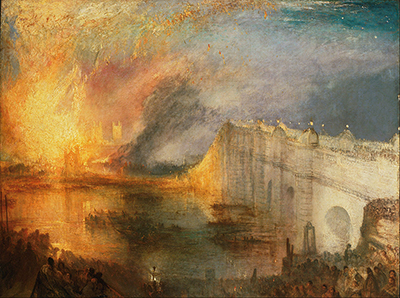
This convergence made Goethe attractive. His language of light and darkness meeting through a medium resembled what Turner did materially. Yet practice precedes reading. The 1834 Parliament fire, painted years before the English translation, turns flame, smoke and reflection into a chromatic system of yellow, blue, red and brown.[25]
The morning Flood painting intensifies the relation. Turner's verse describes the sun drawing humid bubbles from saturated earth. The circular field can be read as vapour, bubble, solar disc and eye. Colour exists through moisture and perception at once.[18][19]
Goethe's concept therefore operates most productively as an analogy between atmosphere and paint. It should not be mistaken for a complete account of why the sky, bubble or glaze has its hue.
Plus, Minus and Chromatic Polarity
Goethe arranges colour through polarities. On the positive side stand yellow, red-yellow and yellow-red, associated with light, warmth, nearness, action, liveliness and aspiration. The negative side contains blue, red-blue and blue-red, linked to darkness, cold, distance, restlessness, susceptibility and longing.[1]
The terms are not moral verdicts. Positive does not simply mean virtuous, and negative is not wicked. Goethe describes experiential tendencies. Yellow seems to advance and brighten; blue seems to recede while drawing the viewer after it. Each can become beautiful or disturbing according to condition.
He also knew that hue changes through contamination and context. Clear yellow may appear agreeable, while a dirtied yellow can become unpleasant or carry degrading social associations. Blue can feel empty, cold and melancholic, yet its recession creates desire. Polarity is dynamic rather than fixed.
Turner recognised the power of opposition but resisted simplification. His strongest compositions rarely assign one emotion to one pigment. Warm fire can destroy Parliament; a red sunset surrounds imprisoned Napoleon; cool moonlight can dignify coal labour. Subject and contrast alter association.[28][29]
The 1843 pair uses plus and minus at the largest scale. Morning expands through yellow, white, orange and red; evening contracts through blue-grey, brown and black. But mortality inhabits the warm field, while warning light survives the cold one. Turner accepts polarity and refuses its reduction to hope against despair.
This is the central difference between a colour chart and painting. A chart isolates relations. A painting makes them carry bodies, time, narrative and material history.
Sensuous and Moral Effects
Goethe's later discussion of the sensuous and moral effects of colour drew artists because it treated hue as bodily experience. Looking through coloured glass or entering a room dominated by one colour can alter mood. The eye, he says, requires colour as it requires light.[1]
Yellow is lively and gently exciting near its clear state. Red-yellow increases energy; intensified red can convey gravity, dignity or force. Blue carries darkness and distance, combining attraction with melancholy. Violet can feel uneasy, while green offers rest through equilibrium.
These descriptions are historically influential, not universal laws of psychology. Culture, subject and memory change response. Saturation matters; so do scale, tone and neighbouring colours. Turner, whose work repeatedly overturns expected associations, had reason to remain sceptical of any permanent code.[34]
His marginal comments dismiss Goethe's analogy between painting and music as too general. The objection reveals a practical mind. Saying that two arts create harmony does not tell a painter how one coloured passage should act beside another. Turner wanted relations grounded in visual operation.
The difference matters when interpreting titles. Light and Colour names an idea but also depicts the aftermath of universal death. Shade and Darkness sounds negative while preserving the ark, moon and movement towards survival. Emotion arises from tension among title, hue, scripture and recognition.
Goethe gave Turner terms for discussing tendency. Paint allowed him to test how quickly tendency breaks under historical pressure.
Eastlake as Translator and Editor
Charles Lock Eastlake's 1840 edition was not a neutral transfer from German to English. His preface, selection and extensive annotations shaped how British readers encountered Goethe. At first he planned to extract only experiments directly useful to painting. He decided that a connected account was necessary, but continued to distinguish observed merit from theoretical error.[1]
Eastlake considered the book valuable because Newtonian optics did not directly teach harmony, contrast or pictorial practice. Goethe's attacks on Newton had distracted from accurate observations about the eye. Translation could recover those observations without endorsing the polemic.
The notes made the volume especially useful. Eastlake drew upon Aristotle, Leonardo, Italian Renaissance paintings, technical treatises and contemporary science. He discussed how varying illumination affects hues, how glazes enrich or alter colour and how large and small masses interact. He sometimes corrected Goethe for attributing effects too exclusively to the eye rather than to coloured light.[3]
This editorial work reflects Eastlake's unusual career. Trained as a painter, he spent fourteen years in Rome, travelled widely and built scholarly relationships across Europe. He later became Secretary to the Fine Arts Commission, President of the Royal Academy and the National Gallery's first Director.[7][8]
His translation therefore joined several ambitions: improve British artistic education, connect national practice to European scholarship and make colour intellectually respectable within an Academy culture still weighted towards drawing and composition.
Eastlake's annotations repeatedly change the practical reach of the text. When Goethe describes a perceptual effect in general terms, the translator asks how it appears in painted flesh, drapery, landscape distance or glazing. He compares illumination at different strengths, warns that material mixtures do not preserve the brilliance of optical colour and invokes examples from Leonardo and Venetian practice. The notes turn a German argument about natural phenomena into a portable course in artistic judgement. They also expose disagreements that a shorter extract would have concealed. A British reader met Goethe beside Eastlake's qualifications on reflected light, local colour and the limits of physiological explanation.
That editorial doubleness is central to Turner's response. Marks beside Goethe's propositions cannot always be separated from the note immediately below them, and some of the most painterly material belongs to Eastlake. The surviving volume records a conversation across main text, translation, commentary and annotation. To say simply that Turner “read Goethe” compresses this layered object into a single voice and misses the learned painter who made the encounter possible.
Turner read Goethe through this mediation. References to “Goethe's theory” in his work necessarily include Eastlake's decisions, notes and painterly examples. The intellectual encounter has three participants.
Eastlake and Turner
Eastlake had entered the Royal Academy Schools in 1809, when Turner held the professorship of perspective. He later established himself in Rome, where sustained old-master study shaped both his painting and scholarship. Turner and Eastlake became friends, and their paths converged closely during Turner's 1828-29 stay.[7]
Eastlake's recollections show that Turner worked on Roman canvases again before London exhibition. Their association included practical matters as well as theory. Turner and Thomas Lawrence encouraged the younger painter to brighten his colour. Advice moved in both directions: Eastlake later supplied Turner with European knowledge, assistance and professional correspondence.
Their temperaments differed. Eastlake was systematic, multilingual and institutionally organised. Turner could be verbally obscure, visually daring and suspicious of tidy explanation. That contrast made the translation a productive object between them. It offered meticulous notes to a painter who preferred testing propositions against sight.
Eastlake also stood near the centre of public art policy. As Secretary to the Fine Arts Commission, he helped organise competitions for the decoration of the rebuilt Palace of Westminster. In 1843, Turner's Goethe pair appeared while debates over national history painting were especially intense.[8]
The friendship should not be romanticised into shared doctrine. No evidence shows Turner commissioning the translation or Eastlake prescribing the Deluge pictures. Their relation is better understood as intellectual access. Turner received a book from a trusted painter-scholar whose judgement he knew, then covered it with signs of independent response.
The surviving exchange demonstrates how theory entered practice through people and institutions, not only through solitary reading.
Eastlake's later institutional eminence can make the relationship appear more formal in retrospect than it was in 1840. The translation preceded his presidency of the Academy and directorship of the National Gallery, but it already displayed the habits that would define those roles: close examination, documentary comparison and a desire to improve public artistic knowledge. Turner, the senior Academician, did not need elementary instruction from him. What Eastlake supplied was access to a large continental text, technical commentary and a trustworthy map of its disputed claims. Friendship gave the book a living professional context without converting it into an agreed programme.
Turner's Annotated Copy
Turner's marks in Eastlake's volume provide the strongest evidence for his Goethe engagement. They occur throughout the text and include emphatic lines, question marks and brief verbal reactions. The copy is not reverently preserved doctrine; it is a working arena.[5]
Some comments are comic. Goethe describes how shadows from spread fingers divide under crossing lights. Turner replies that, if true, the result would make two men from one. The joke tests whether verbal explanation corresponds to visible probability.
Other notes expose conceptual resistance. Goethe asks readers to derive three primary colours from the transformations of blue and yellow. Turner reacts with incredulity because his painter's system required red, yellow and blue. Where Goethe separates colour theory from optics and mathematics, Turner observes that the crucial question lies precisely there.
He objects to statements about sculpture and finds the proposed relation between painting and music too general. Elsewhere he agrees or marks useful observations. The pattern is selective attention, not hostility to the whole undertaking.[3]
What marginal notes can prove
They prove possession, reading and reaction. They can show which passages caught Turner's eye and whether a terse response appears affirmative or doubtful. They cannot by themselves reconstruct the order or date of every annotation, nor turn fragments into a finished theoretical treatise.
The comments are sometimes hard to read and brief enough to permit nuance. A joke may reject an experiment, its description or simply Goethe's phrasing. Responsible interpretation compares the mark with Turner's established practice and other evidence.
What remains unmistakable is intellectual independence. Turner encountered a famous author through a friend's learned edition and argued in the margins. The 1843 paintings continue that method in another medium.
The physical distribution of the annotations matters as much as any memorable phrase. Turner did not confine himself to the celebrated section on emotional effects, nor merely underline passages that confirmed his taste. His attention ranged across experimental procedure, the status of primaries, shade, artistic analogy and the relation of colour to optics. Such breadth indicates sustained engagement with the architecture of the book. It also explains why isolated comments can mislead. An exclamation beside one proposition belongs to a longer pattern in which assent, humour and resistance coexist.
Marginalia are especially valuable because Turner was rarely a lucid public theorist. His lecture notes are difficult, his verse compressed and his reported remarks often anecdotal. The marks do not solve those problems, but they catch judgement at the point of reading. They show a practitioner measuring printed authority against remembered effects, pigment behaviour and previous systems. The annotations make critical thought visible without pretending that Turner ever converted it into a coherent written doctrine.
Colour Before Goethe
Turner's engagement with colour began decades before 1840. In the Louvre in 1802 he analysed how Poussin distributed blue, red and yellow among figures to create what he called harmonious confusion. The observation concerns organisation: separate chromatic groups move towards unity without losing complexity.[4]
Around 1811 he filled several notebook leaves with yellow pigment recipes. At his death, his studio contained more varieties of yellow than any other colour. Practical interest ranged from manufacture and handling to the way a hue could dominate atmosphere.
By 1818 he distinguished aerial from material colour. Around the same period he connected red, yellow and blue to stages of day, describing grey morning, yellow midday and crimson evening. Light and darkness already formed a temporal landscape cycle.[3][4]
His work confirms the chronology. Golden and blue structures appear in early watercolour, Italian subjects, river scenes and 1820s exhibition paintings. In 1826 critics complained that boats, buildings, water and figures had all been submerged in intolerable yellow against violent blue. Turner joked that he had intentionally taken yellow into his keeping.[4]
The date is decisive. Goethe's original German text was not shown to have shaped these years, and Eastlake's edition did not exist. Similarity demonstrates common problems or independent convergence, not influence.
When Turner finally read Goethe, he brought an already mature history of looking. The encounter could sharpen, name or challenge existing ideas, but it did not supply their origin.
The Academy Colour Lectures
Turner served as Royal Academy Professor of Perspective from 1807 and delivered lectures intermittently. In 1828 he unexpectedly devoted separate attention to colour and chiaroscuro. Earlier professors had discussed light and shade, but an independent colour lecture was unusual.[4][33]
The timing followed growing public hostility to his chromatic practice. Rather than retreat, Turner tried to place colour within an intellectual system. His delivery and phrasing were notoriously difficult, and the small audience diminished. The lectures appear to have ended soon afterwards.
Two diagrams clarify part of the argument. One treats coloured light as remaining pure when combined and returning towards white. The other uses material primaries whose mixture tends towards black. Turner was approaching what later science would call additive and subtractive combination, though he lacked accurate light primaries and clear terminology.[4]
He linked the painter's triad to landscape time: grey morning, yellow midday, crimson evening. Theory remained tied to effects experienced in nature. Yellow stood nearest light; blue indicated distance; red carried material substance.
Chiaroscuro mattered because Turner worked closely with engravers. Highly coloured watercolours had to become black-and-white tonal structures. A successful design needed chromatic force that could survive translation into line or mezzotint.
These lectures make the Goethe encounter legible. Turner already understood polarity, distinguished pigment from light and used colour emotionally. He also remained uncertain about the physics. Eastlake's volume entered exactly that unresolved territory.
The lecture setting imposed a problem different from the studio. Turner had to translate knowledge embedded in repeated acts of painting into diagrams and spoken propositions that students could follow. His failure to communicate clearly does not mean the visual thinking was empty. The surviving schemes separate operations, connect hue with tone and place chromatic relations inside landscape time. They reveal an effort to reason from practice even when vocabulary proved unstable.
Audience response is equally revealing. Colour had lower academic status than drawing, anatomy and composition, and Turner's increasingly unconventional pictures already strained critical patience. A poorly attended colour lecture by the artist most publicly accused of chromatic excess carried an unavoidable defensive charge. He was explaining not a decorative supplement but an organising principle of serious painting. Goethe's later insistence that colour deserved systematic attention would therefore have met a professional argument Turner had already tried, with limited success, to make inside the Academy.
Moses Harris and the Painter's Circle
Moses Harris's Natural System of Colours, first issued in 1766, organised red, yellow and blue as three principal material colours. Hand-coloured circular diagrams showed their mixtures, intermediates and oppositions. Harris claimed that hundreds of tints could be understood through a compact vocabulary.[11]
The work had special Academy associations. Its first edition was dedicated to founding president Joshua Reynolds; an 1811 issue honoured Benjamin West. Thomas Phillips, Turner's fellow professor and friend, incorporated the system into teaching during the late 1820s.
Turner adapted Harris rather than copying him. He took the central triangular relation among primaries but ignored the surrounding complementary structure. Yellow represented light, while blue and red represented forms of shade. Multiplied as pigments, the three moved towards black.[4]
This differs sharply from Goethe's yellow-blue polarity. Harris begins with material mixing and includes red as primary. Goethe derives a dynamic sequence from light and darkness, with intensified yellow and blue tending towards red. Turner's astonished annotation shows that he did not simply exchange one model for the other.
Lawrence Gowing later proposed that Moses in the morning Deluge work may pun on Moses Harris. The central colour-circle form and the biblical writer's name make the suggestion attractive.[17] Harris was also an entomologist, while Turner's verse compares hope to a short-lived summer fly.
No surviving statement confirms the wordplay. It should remain an ingenious possibility. The secure connection is Turner's earlier use of Harris's diagram, which proves that the 1843 circle had a British painterly ancestry as well as a Goethean context.
George Field, Pigment and Scientific Dissent
George Field approached colour through the material needs of artists. He manufactured and tested pigments, advised painters and published Chromatography in 1835. Turner subscribed and used products associated with Field's colour business.[12]
The book joined theory to durability, mixture and practice. Pigments can fade, darken or react; a beautiful relation at first application may not survive. Modern manufacture widened the palette but also made reliable knowledge of materials urgent.
Field's chromatic ideas shared some emphasis on polarity and harmony with Goethe without deriving from the German book. Turner could therefore meet familiar propositions in 1840 through a different intellectual lineage. New terminology did not imply a new visual discovery.
Scientific dissent was equally present. Turner met Brewster in Edinburgh in 1834 and probably knew his severe review of Eastlake's translation. Brewster objected that Goethe's light-dark explanation placed artistic principle in alliance with physical error, even while respecting the translator.[13]
Turner did not choose neatly between Field, Brewster and Goethe. Material practice required Field; interest in optics made scientific objections relevant; perception and emotional colour made Goethe useful. The annotated copy registers this plural environment.
The episode warns against a single “theory Turner followed.” His colour emerged through pigments, old pictures, natural effects, lectures, engravings, scientists and experiment. Goethe became one powerful participant in a crowded field.
Field's role also restores manufacture to a discussion easily dominated by abstract circles. Painters bought colours whose names could conceal variable recipes, adulteration and instability. A hue's optical relation to its neighbour mattered only if the substance could be ground, mixed, layered and kept. Turner's unusually extensive range of yellows gave this issue particular urgency: transparent and opaque varieties produced different kinds of luminosity, while chemical incompatibility could compromise the result. The colour theorist and the colourman therefore addressed overlapping but non-identical problems.
Brewster represents another necessary limit. His criticism reminds us that contemporary readers did not have to wait for later physics to recognise Goethe's errors. Turner encountered the translation inside an active British dispute involving experimental scientists as well as artists. His note about mathematics and optics is more intelligible in that setting. He did not oppose visual experience to science as two sealed cultures; he tested a book whose editor and reviewers were already arguing over where useful observation ended and mistaken explanation began.
Old Masters as Colour Theory
Pictures themselves taught Turner how colour works. In 1802, his notes on Poussin's Israelites Gathering Manna describe how chromatic groups move through the composition. Moses unites blue and red while surrounding figures carry related hues into the centre. Order arises without obvious mechanism.[4]
This is theory extracted from practice. Turner asks not only which colours appear but how they distribute attention, bind figures and create depth. The analysis predates his own formal lectures and demonstrates that colour could carry narrative structure.
Claude offered another education in luminous atmosphere. Titian and Venetian painting showed rich colour independent of strict local description. Rembrandt demonstrated light emerging from extensive darkness. Turner absorbed methods without reducing any master to a rule.
Eastlake's edition worked similarly. His notes brought Goethe into relation with Leonardo, Renaissance treatises and Italian paintings. Different degrees of illumination may best reveal different hues; glazes alter depth and saturation; surrounding masses change local appearance.[3]
The old-master context prevents a false conflict between tradition and modern experiment. Turner could use a centuries-old compositional lesson to paint a steam vessel or industrial fire. Colour knowledge accumulates across observation, material craft and later explanation.
Goethe was valuable partly because Eastlake made him speak to this historical practice. Turner did not abandon Poussin, Claude or Titian for a scientific circle. He used the new book to reopen questions their works had already posed.
Yellow, Blue and Public Controversy
Turner's use of yellow became notorious during the 1820s. In 1826, critics attacked three Academy exhibits for allowing the hue to pervade architecture, water, boats, horses and people, violently opposed to blue. Another joke imagined allegiance to a “Yellow Dwarf.” Turner kept the cutting and replied to friends with deliberate humour.[4]
The criticised works included a Rhine arrival, a Roman forum and Mortlake. Their different subjects shared a high-keyed atmosphere that loosened local colour. Yellow did not merely fill a sun; it became the medium through which the scene appeared.[31][32]
Blue supplied both opposition and depth. Because yellow is naturally lighter in tone than many blues, the pair combines hue contrast with a strong light-dark interval. It can construct an entire landscape economy: warmth advances, coolness recedes and intermediate colour binds them.
Goethe later described yellow and blue as colours closest to the poles of light and darkness. The resemblance is striking, but the chronology gives Turner priority within his own practice. He had arrived at the pair through old masters, atmosphere, pigments and repeated experiment.
The 1840 reading may nevertheless have made the longstanding contrast newly self-conscious. Goethe told Turner that his favourite opposition belonged to a complete perceptual and emotional theory. The artist's sceptical annotations suggest he did not accept the offered explanation whole.
His later Norham Castle, Sunrise shows how little a formula can contain. Yellow, pale blue and white create nearly weightless radiance, yet the image remains attached to remembered place, cattle, water and dawn.[30] Calling it Goethean may illuminate one relation while obscuring decades of return to Norham.
The 1840 Marine Context
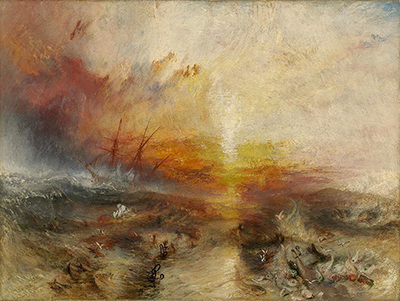
Eastlake's translation appeared in the same year Turner exhibited a remarkable group of marine paintings. Slave Ship made hot sunset, dark vessel and violent water inseparable from enslavement and murder. Rockets and Blue Lights named warnings in a cold, dangerous coastal world. Their colours invite comparison with Goethean warmth, coolness and polarity.[26][27]
The timing makes influence possible. Turner could have been reading the new book while preparing or completing works for exhibition. Institutional commentary has connected the hot and cool marine pictures to Goethe's divisions.
Evidence nevertheless stops short of certainty. None of their titles names Goethe. Turner had used warm-cool contrast for years. Maritime subject, weather, warning signals and poetic association provide independent reasons for the palettes.
The strongest formulation is that 1840 created a fresh theoretical context for an established practice. Goethe may have sharpened Turner's attention to the emotional force of paired fields without causing their invention.
This caution also protects the paintings' ethical and material specificity. The red-orange sky of Slave Ship cannot be translated into a simple positive state; it surrounds atrocity. The blue and white disturbance of Rockets does not merely encode melancholy; it describes perilous visibility and signaling.
The marine group prepares the explicit 1843 experiment by showing how quickly chromatic tendency becomes unstable under narrative pressure.
The 1843 Pair as a Painted Argument
At the 1843 Royal Academy exhibition, Turner presented Shade and Darkness and Light and Colour as related Deluge paintings. Their approximately square supports, historically perceived octagonal framing and circular movement distinguish them from conventional horizontal landscape. One treats evening before catastrophe; the other morning after it.[15][16]
Goethe is named only in the morning title, but the relation governs both. Cool darkness, recession and anxiety oppose warm brightness, nearness and energy. The eye moves from minus towards plus while remembering each field in the other.
Turner immediately complicates the scheme. Evening contains a pale moonlit centre and moving life. Morning contains drowned forms, dark accents and verse comparing hope to something that expands and dies. Warmth does not certify salvation; coolness does not abolish possibility.
Scripture adds another polarity. The Flood destroys and renews. Animals enter the ark before waters rise, while Moses belongs generations later as the traditional author of Genesis. Turner compresses warning, event, aftermath and future narration rather than illustrating one instant.
Paint supplies the final argument. Material colour imitates light through broken veils and contrast. Recognisable forms appear at the threshold of abstraction but remain tied to title and verse. Goethe's phenomenology becomes a test of how viewers create meaning under unstable conditions.[18][20]
The pair is therefore neither scientific demonstration nor religious illustration. It is a painted dispute among systems: Newtonian light, Goethean polarity, painter's primaries, biblical history and Turner's own chromatic experience.
Their operation as a pair is more exact than a simple contrast of palettes. Comparable dimensions and circular structures invite the eye to search for correspondences, but the temporal directions differ. Evening anticipates destruction; morning follows it. One gathers creatures before the event, while the other invokes the future author through whom the ancient catastrophe becomes text. The cool work holds warning inside obscurity, and the warm work holds death inside renewed illumination. Chromatic opposition is thus crossed by narrative asymmetry.
This structure tests Goethe at the point where tendency meets history. Warm colour may advance and excite, yet it cannot restore drowned life. Cool colour may withdraw and trouble, yet it can make warning and survival visible. Each field contains enough of the other to prevent isolation, just as each moment of the Flood contains memory or anticipation of its companion. The viewer supplies comparison across the gap, but the subject denies an effortless harmony.
Turner's achievement is to make theoretical reading inseparable from looking. The titles announce an intellectual frame; the paintings then complicate it through every delayed figure and unstable passage. Someone who knows Goethe can recognise plus and minus, while someone who does not can still experience warm-cool succession, adaptation and difficulty. Theory informs the encounter without becoming an admission requirement. That balance explains why the works remain more than records of an elderly artist's reading: they turn a disputed book into a public experiment whose result changes with attentive vision.
Morning: Warmth and Unstable Hope
Light and Colour is dominated by a pale yellow-white field ringed with orange, red and brown. A minute Moses, a dark staff and serpent, a mountain-like lower mass and faint lost faces become legible slowly. The whole can suggest sun, bubble, eye, colour circle or rotating atmosphere.[15]
Goethe's positive register is clearly relevant. Yellow stands near light; warm intensification carries activity, force and proximity. The title names his theory, removing doubt that the painter intended comparison.
Turner's verse prevents a cheerful reading. Returning sun draws humid bubbles from the earth, and lost forms appear in prismatic guise. Hope rises like a summer insect, expands and dies. The warmth reveals victims rather than cancelling their death.[17]
Moses complicates time. He is imagined writing the beginning of Genesis within the aftermath he will later narrate. The brazen serpent belongs to a still later episode and acquired Christian meaning as a prefiguration of the Crucifixion. Authorship, punishment, healing and salvation overlap.
The chromatic circle is equally unstable. A diagram promises order, while vapour and bodily fragments resist fixed placement. The eye finds completion only by recognising what radiance almost hides.
Turner does not reject Goethe's plus side. He demonstrates its insufficiency. Warm colour can stimulate hope while carrying memory of destruction. The most positive field in the pair contains the deepest temporal loss.
Evening: Coolness and Persistent Light
Shade and Darkness gathers blue-grey, brown and black around a broad pale centre. Birds arc through the upper field, while animals and human forms move through dense lower passages towards the ark. Turner's verse names moonlight and warning before the flood.[16]
The work broadly activates Goethe's negative register: coolness, recession, anxiety and darkness. Blue seems to withdraw while pulling vision deeper. Contours are delayed, so the spectator experiences uncertainty before narrative recognition.
Yet the central light survives. Darkness does not function as an absolute void. Moonlight, birds and movement preserve orientation. The minus pole becomes necessary to colour rather than identical with evil.
Turner's critical note about shade is relevant. He found Goethe's account pictorially inadequate, and the painting responds with many kinds of darkness. Cool haze recedes, opaque marks block, brown veils carry warmth and small highlights release individual forms. No single “blue equals anxiety” formula explains the structure.
The companion also alters the experience. After looking at morning's warm expansion, evening may appear colder; reversing direction can make the pale centre seem newly active. The pair uses remembered colour between objects.
Its subject gives that visual relation moral weight. Failure to identify animals and warning signs becomes part of a catastrophe about recognition arriving too late. Goethe's active eye meets Turner's historical sublime.
What Paint Can and Cannot Do
Turner used pigment to become “emulous of light,” competing with illumination while accepting material difference. Oil paint absorbs, reflects and scatters light at a surface. Transparent glazes, opaque highlights, rough scumbles and coloured grounds can create depth or brilliance, but mixed pigments do not behave like combined rays.[6]
His 1828 diagrams approached this distinction. Coloured light could move towards white; red, yellow and blue pigments mixed towards black. Modern science would replace his light primaries with another set, yet the contrast between additive and subtractive processes was perceptive.[4]
The 1843 works make theory physical. Pale paint dragged irregularly over warm or cool layers allows undercolour to break through. Local dark accents become figures through contrast. Circular brush movement guides the eye without smoothing the surface into an illusion.
General conservation research confirms Turner's use of absorbent grounds, glazing, scumbling, scraping and a wide range of old and newly manufactured pigments.[23][24] Such findings establish available methods, not an exact recipe for every passage. A reproduced yellow cannot be securely named by sight alone.
Goethe's category of chemical colour reminds us that material hue has its own history. Pigments fade, react or darken. A theory concerned with immediate appearance cannot guarantee permanence.
Turner's painting therefore both realises and corrects Goethe. It creates relational colour for an active eye, but it does so with substances that possess weight, texture and ageing behaviour. Light is the subject; matter is the means and limit.
The 1843 Audience
The Royal Academy exhibition of 1843 contained 1,530 works by 789 artists. A concurrent display of cartoons for the new Houses of Parliament intensified argument about Britain's capacity for monumental history painting. Turner's compact, chromatically organised Flood pictures entered that debate from landscape.[22]
The Spectator treated them as riddles and derided their apparent octagonal daubs. The critic needed titles to locate animals, Moses and other narrative elements. Yet the same review recognised deliberate harmonies: one cool, the other warm.[21]
That combination of recognition and rejection is important. Viewers perceived the colour theory but found the historical subject insufficiently legible. Turner had not failed to organise the pair; he had challenged expectations about how narrative should appear.
The titles themselves were demanding. Goethe, Flood chronology, Mosaic authorship and Turner's verse offered multiple interpretive paths. Catalogue reading did not simplify the pictures. It made spectators aware of how much they could not immediately see.
Critics should not be dismissed as foolish. The works deliberately break agreements among body, action and title. Their difficulty is evidence of ambition, not proof that every interpretation is equally valid.
Later enthusiasm for near-abstraction can be equally reductive. The pair was publicly exhibited as history, poetry and chromatic experiment. Its radical surface belongs to those purposes. Recovering the first audience helps keep subject and theory attached.
The placement within a vast annual display sharpened the test. Turner's two compact works had to communicate amid crowded walls, varied genres and the social movement of visitors. Their broad chromatic opposition could register at a distance before the minute narrative details became available. In that sense, colour functioned as public exhibition architecture: cool and warm fields announced relation across physical separation, while titles and appended verse demanded closer reading. The paintings organised successive modes of attention rather than offering one stable viewing point.
Contemporary ridicule also records a genuine historical threshold. Viewers trained to expect clearly staged actions could identify deliberate harmony yet remain unable to reconcile it with the promised Flood narrative. The difficulty was not simply that Turner had abandoned subject. He had displaced much of narrative work into atmosphere, contrast and delayed recognition. Goethe's active observer became a practical condition of exhibition: only a spectator willing to look repeatedly could assemble animals, victims, Moses and chromatic theory into one experience.
Applying Goethe Beyond the Deluge
Goethe's theory can illuminate many Turner paintings, but chronology and evidence must govern the claim. Works made before 1840 show comparable interests because Turner had independent colour knowledge. They cannot result from reading Eastlake's edition.
The Parliament fire demonstrates convergence. Yellow flame, blue sky, coloured shadows and mixed reflection organise a scene painted in 1835. Goethe's light-dark polarity helps describe its effect, but the painter had witnessed a real blaze and already mastered warm-cool opposition.[25]
After 1840, possibility increases. The marine paintings, paired Peace and War, Venetian studies and late sunrises can be examined through Goethean questions. Warm and cool fields, coloured atmosphere and active perception are relevant.[28][29]
Still, no title beyond the morning Deluge work offers the same explicit evidence. Each comparison must compete with subject, old-master precedent, material experiment and direct observation. Norham Castle arises from decades of memory as well as late chromatic freedom.[30]
Nor should interpretation proceed hue by hue. Yellow is not always plus, blue not always minus and red not merely their intensification. Tone, saturation, adjacency and narrative alter response.
Goethe is most useful when he sharpens questions: what does the eye supply, how does a boundary generate colour, what emotional tendency does a field establish and how does its opposite disturb it? He is least useful when turned into a decoder.
What Turner Rejected
Turner's disagreements reveal the seriousness of his reading. He resisted Goethe's attempt to derive a complete system from yellow and blue. The material fact that those pigments produce green did not persuade him that their higher intensification produced red. His Academy triad retained an independent red.[4][5]
He questioned whether colour could be separated from optics and mathematics. As a painter, he valued appearances; as someone acquainted with scientists, he understood that causes could not simply be dismissed. Goethe's phenomenology was useful without defeating Newton.
He considered the treatment of shade inadequate. That objection reflects a career spent translating illumination into complex darkness. He rejected claims about sculpture and found the painting-music analogy too broad to explain practice.
Most importantly, Turner resisted fixed association. Colour has emotional force, but the same warmth can sustain sunset, fire, murder or revelation. A theory that assigns stable moral value to hue cannot account for historical painting.
These refusals are not footnotes to influence. They define the encounter. Turner selected what could be tested and left what failed. His paintings transform Goethe because they make polarity carry contradiction.
The active reader in the margins becomes the active painter on the Academy wall. In both places, Turner accepts no authority without visual trial.
Why the Encounter Matters
Turner and Goethe matter together because they approached colour from different but overlapping forms of attention. Goethe varied phenomena and described what the eye experiences. Eastlake translated those observations into a painter's historical and practical education. Turner brought them into contact with pigment, narrative and public looking.
The relationship corrects two myths. Turner was not an instinctive genius untouched by theory; he read, annotated, lectured and compared systems. Nor was he a passive follower whose late colours can be explained by one famous book. His practice predates the encounter and his marginalia preserve resistance.
The 1843 pair is the strongest outcome because it refuses resolution. Plus and minus, morning and evening, light and darkness, life and death form a structure, but every pole contains its opposite. The eye seeks harmony while history prevents comfort.
That tension also clarifies Turner's modernity. Perception is not assumed to be transparent. Titles guide without mastering vision; paint displays its material surface while evoking atmosphere; spectators must test distance and duration. Meaning occurs through an encounter among object, eye and memory.
Goethe gave Turner a language for the active observer. Turner answered by showing that observers confront more than colour. They confront drowned bodies, warning animals, scripture, unstable hope and the limits of knowledge. Emotional association becomes ethical attention.
The achievement belongs to argument rather than agreement. Newton explains the physical decomposition of light; Goethe expands attention to perception; Eastlake recovers artistic application; Turner makes pigment test them all. No single theory exhausts what the paintings do.
Discussion
How does Turner's argument with Goethe change the way you read colour in the 1843 Deluge pair?
Reader Insights
What can the annotated copy prove, and where must interpretation remain cautious?
How do contrast, adaptation and afterimages make the viewer an active participant?
Where does pigment imitate light while remaining physically different from it?
Join the Conversation
Share a close observation or a source-based question for other readers.
References
- Johann Wolfgang von Goethe, *Theory of Colours*, translated by Charles Lock Eastlake, John Murray, 1840. https://www.gutenberg.org/cache/epub/50572/pg50572-images.html
- Isaac Newton, *Opticks*, fourth edition, 1730. https://archive.org/details/opticksortreatis1730newt
- Linda M. Shires, “Color Theory - Charles Lock Eastlake's 1840 Translation,” BRANCH. https://branchcollective.org/?ps_articles=linda-m-shires-color-theory-charles-lock-eastlakes-1840-translation-of-johann-wolfgang-von-goethes-zur-farbenlehre-theory-of-colours
- John Gage, “Emulous of Light: Turner's Colour Revisited,” Turner Medal Lecture, 2009. https://www.colour.org.uk/wp-content/uploads/2017/10/John-Gage-Turner-Medal-Lecture-2009-Emulous-of-Light-CGweb.pdf
- John Gage, “Turner's Annotated Books: Goethe's Theory of Colours,” *Turner Studies* 4.2, 1984, pp.34-52.
- John Gage, *Colour in Turner: Poetry and Truth*, 1969.
- National Gallery, “Sir Charles Lock Eastlake.” https://www.nationalgallery.org.uk/about-us/history/directors/sir-charles-lock-eastlake
- National Gallery, “Art for the Nation: Sir Charles Eastlake.” https://www.nationalgallery.org.uk/exhibitions/past/art-for-the-nation-sir-charles-eastlake-at-the-national-gallery
- Friedrich Steinle and Hakim Al-Hafiz, “Exploratory Experimentation: Goethe, Land, and Color Theory,” *Physics Today* 55.7. https://physicstoday.aip.org/features/exploratory-experimentation-goethe-land-and-color-theory
- Neil Ribe and Friedrich Steinle, “Exploratory Experimentation,” *Physics Today* 55.7, 2002.
- Moses Harris, *The Natural System of Colours*, 1766, Library of Congress. https://www.loc.gov/item/50048542/
- George Field, *Chromatography*, 1835. https://archive.org/details/chromatographyor00fieluoft
- David Brewster, “Goethe's Theory of Colours,” *Edinburgh Review* 72, October 1840, pp.99-131.
- Anja Klonk, *Spaces of Experience*, Goethe, Eastlake and Brewster notes. https://www.kunstgeschichte.hu-berlin.de/wp-content/uploads/2019/11/Klonk_Spaces-of-Experience_ohne_Bilder_komprimiert.pdf
- Tate, *Light and Colour (Goethe's Theory)*, N00532. https://www.tate.org.uk/art/artworks/turner-light-and-colour-goethes-theory-the-morning-after-the-deluge-moses-writing-the-book-n00532
- Tate, *Shade and Darkness - the Evening of the Deluge*, N00531. https://www.tate.org.uk/art/artworks/turner-shade-and-darkness-the-evening-of-the-deluge-n00531
- Lawrence Gowing, *Turner: Imagination and Reality*, Museum of Modern Art, 1966. https://assets.moma.org/documents/moma_catalogue_2572_300062313.pdf
- Gerald Finley, *Angel in the Sun: Turner's Vision of History*, 1999. https://www.jstor.org/stable/j.ctt80v2x
- Gerald Finley, “The Deluge Pictures: Reflections on Goethe, J. M. W. Turner and Early Nineteenth-Century Science,” *Zeitschrift fur Kunstgeschichte* 60.4, 1997.
- Gerald Finley, “Pigment into Light: Turner, and Goethe's Theory of Colours,” *European Romantic Review* 2.1, 1991, pp.39-60.
- *Spectator*, “Fine Arts: Royal Academy Exhibition,” 13 May 1843. https://archive.spectator.co.uk/article/13th-may-1843/19/fine-arts
- Catherine Roach, “1843,” *Royal Academy Chronicle*. https://chronicle250.com/1843
- Joyce H. Townsend, *How Turner Painted: Materials, Methods and Techniques*, 2019.
- Joyce H. Townsend, “Painting Techniques and Materials of Turner,” Getty Conservation Institute. https://www.getty.edu/publications/resources/virtuallibrary/0892363223.pdf
- Cleveland Museum of Art, *The Burning of the Houses of Lords and Commons*, 1942.647. https://www.clevelandart.org/art/1942.647
- Clark Art Institute, *Rockets and Blue Lights*, 1955.47. https://www.clarkart.edu/artpiece/detail/rockets-and-blue-lights
- Museum of Fine Arts Boston, *Slave Ship*, 99.22. https://collections.mfa.org/objects/31102/
- Tate, *Peace - Burial at Sea*, N00528. https://www.tate.org.uk/art/artworks/turner-peace-burial-at-sea-n00528
- Tate, *War. The Exile and the Rock Limpet*, N00529. https://www.tate.org.uk/art/artworks/turner-war-the-exile-and-the-rock-limpet-n00529
- Tate, *Norham Castle, Sunrise*, N01981. https://www.tate.org.uk/art/artworks/turner-norham-castle-sunrise-n01981
- Frick Collection, *Cologne, the Arrival of a Packet Boat: Evening*, 14.1.67. https://collections.frick.org/objects/275/
- National Gallery of Art, *Mortlake Terrace*, 1937.1.109. https://www.nga.gov/artworks/80-mortlake-terrace
- Maurice Davies, *Turner as Professor: The Artist and Linear Perspective*, Tate, 1992.
- Martin Kemp, *The Science of Art: Optical Themes in Western Art from Brunelleschi to Seurat*, Yale, 1990.