 View the open-content object record
at the Getty
J. Paul Getty Museum, object 93.PA.32. Getty Open Content, CC0.
 by Tom Gurney
Tom Gurney BSc (Hons) is an art history expert with over 20 years experience
Published on June 19, 2020 / Updated on August 29, 2026
Email: tomgurney1@gmail.com / Phone: +44 7429 011000
Van Tromp at the J. Paul Getty Museum
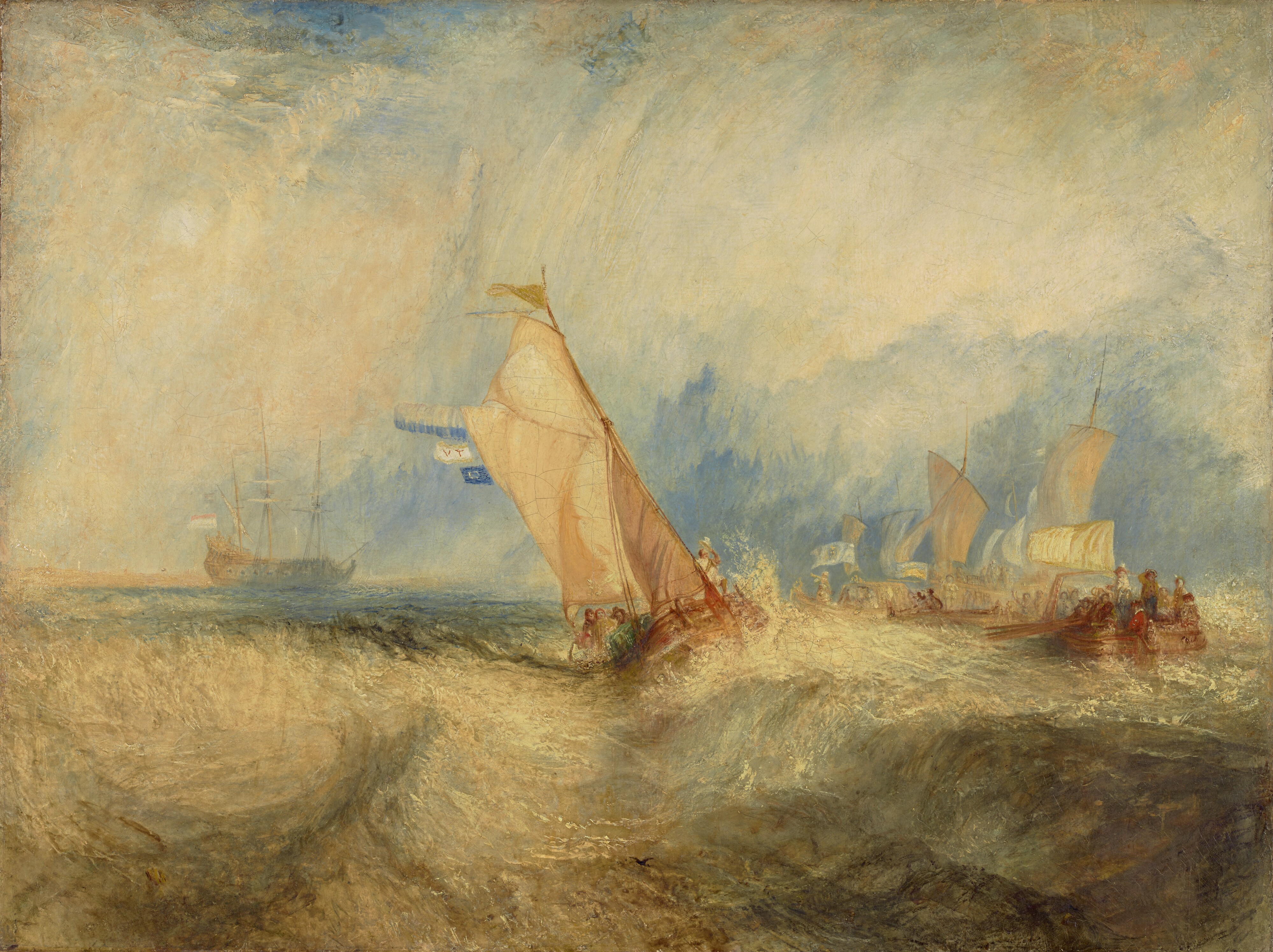
J. M. W. Turner exhibited Van Tromp, going about to please his Masters, Ships a Sea, getting a Good Wetting at the Royal Academy in 1844. The oil painting now belongs to the J. Paul Getty Museum in Los Angeles, where it carries the object number 93.PA.32. A Getty scholarly catalogue gives its dimensions as 91.4 by 121.9 centimetres, or 36 by 48 inches.[1][2] It is one of Turner's standard large exhibition canvases, yet almost nothing about it behaves as a conventional historical monument.
The title promises an admiral, a motive and an action. The image supplies a tiny pale figure on a low craft, a sail driven diagonally across the centre, boats gathering through spray, a remote warship and a sea that threatens every attempt at command. Even the identity of “Van Tromp” is unstable. Getty scholarship understands the protagonist as an apparent amalgam of two Dutch admirals, Maarten Harpertszoon Tromp and his son Cornelis. Neither man used “van”; the prefix had become attached to the family name in English accounts by Turner's time.[2]
This is not a minor cataloguing inconvenience. The picture turns historical uncertainty into a principle of composition. The viewer looks for a named hero but repeatedly encounters water, light and movement. A broom-like sign at the masthead evokes a famous tale about Maarten Tromp, while the phrase “to please his Masters” fits an episode in the career of Cornelis more readily. One clue pulls toward the father, another toward the son, and the visible event refuses to settle the choice.
Turner's complete Royal Academy title continued with the direction “Vide ‘Lives of Dutch Painters.’” It sounds like a promise that reading will solve the riddle. No exact publication and episode have been securely established, however. The marine painter W. L. Wyllie admitted in his 1905 biography of Turner that he did not know the story.[19] The apparent citation therefore intensifies rather than ends the uncertainty. Turner provides the manner of an authority without leaving modern viewers a reliably identifiable text.
The painting rewards a different kind of historical attention. Instead of asking only which admiral stands on which deck on which day, it asks how naval memory is made. Names are altered in transmission. legends migrate into biography, exhibition titles shape what viewers see, and old paintings supply forms for later history. Turner places those processes inside a marine image in which every solid thing is being revised by wind and wave.
The result is both specific and elusive. It belongs to a four-painting sequence about Tromp, to Turner's sustained engagement with Dutch art, and to a remarkable group of works shown in 1844. Its boats can be examined, its nautical terms defined and its ownership traced. Yet its historical centre remains deliberately resistant. The canvas does not fail to tell one story. It allows several imperfect stories to collide in the same weather.
A Title That Tacks
Turner's title is so long that it is often shortened to Van Tromp Going About to Please His Masters. The shorter form is convenient, but it removes the sequence that makes the original unusually active. Read in full, the admiral goes about for his superiors, takes a sea aboard and ends thoroughly wet: person leads to motive, motive to seamanship, seamanship to accident, and accident to bodily comedy.
“Going about” has an exact nautical sense. A sailing vessel goes about when it tacks, turning its bow through the wind so that the sails fill on the opposite side.[11] The phrase can still be heard conversationally, as though Tromp were proceeding with a duty, but the image insists on the technical meaning. The central craft heels below a strongly inclined sail. Its change of direction is not merely described in words; it gives the composition its hinge.
“Ships a sea” is equally compact maritime language. It means that a breaking wave comes aboard, spilling over the deck rather than passing harmlessly beneath the hull.[12] Turner's final phrase, “getting a Good Wetting,” translates that danger into ordinary speech. The technical expression and its comic gloss refer to the same event, but they value it differently. One belongs to experienced sailors; the other sounds like a spectator's teasing summary.
The grammar is carefully unstable. Is Tromp going about because his superiors commanded him to manoeuvre, or is he figuratively changing course to regain their approval? Does the wave punish obedience, expose the limits of skill, or simply supply the hazard through which skill becomes visible? The title does not place commas around a single interpretation. It keeps shifting semantic tack.
“Masters” is also unusually charged. In a naval narrative it can mean political or military superiors. In an art exhibition it can recall the old masters whose reputations Turner had measured himself against throughout his career. It may even suggest the Royal Academy audience before whom he submitted this unruly sea. There is no document proving that Turner intended all those meanings, so they should remain interpretations. The wording nevertheless makes them possible because authority is introduced without being named.
The last clause matters most because it refuses the tone expected of heroic history. Admirals conventionally command fleets, win battles and embody national power. Turner's admiral gets wet. Bathos does not make the danger unreal: a wave powerful enough to flood a small craft can kill. Instead it adjusts scale. The grand name in the catalogue belongs to the speck of white paint caught near the bow, while the supposedly secondary sea controls almost everything.
That reversal begins before the viewer studies a single brushstroke. The title announces a person as subject, then narrates his subjection to wind, wave and authority. It behaves like the pictured vessel, crossing from one pressure to another. To preserve the full title is therefore to retain Turner's first and most precise compositional device.
Contents
- Van Tromp at the J. Paul Getty Museum
- A Title That Tacks
- What the Eye Encounters
- The Central Craft and the Human Figure
- Sea, Sky and the Work of Paint
- History Without a Fixed Event
- Cornelis Tromp and the Problem of Obedience
- Maarten Tromp, the Convoy and the Broom
- One Admiral Made from Two
- The First Van Tromp: Turner and Soane
What the Eye Encounters
The first impression is a broad division between moving water and luminous air. Warm cream and pale gold dominate the upper field, interrupted by blue-grey cloud. Below, olive, brown, grey and white gather into a sea whose crests and troughs are never repeated mechanically. Turner does not build a neutral setting and then insert an episode. Weather is the condition through which the episode becomes visible.
Near the centre is a low single-masted craft. Its dark mast rises into the pale sky, and its large tan sail leans sharply down toward the right. The sail is the most legible planar shape in the painting. It catches light but also looks strained, as if wind were pressing its entire surface into the manoeuvre. Beneath it, the hull meets a broad ridge of broken water.
A minute light figure stands toward the forward portion of the vessel. Getty identifies this person as Tromp and notes the ahistorical white clothing that makes him flare against darker material.[2] At normal viewing distance, the figure is less a portrait than a point of resistance. Pale body, white spray and illuminated sail approach one another without merging completely. The admiral's visibility depends on the same brightness that threatens to erase him.
To the right, several smaller vessels and crowded boats collect in a restless cluster. Their sails range from pale triangular patches to brown, partly obscured forms. Dark strokes can become bodies, gunwales or shadow according to their neighbours. Red-brown touches animate the group without establishing a uniform flag or costume. The eye can recognise activity more confidently than it can count participants.
At the left horizon, a larger multi-masted ship emerges through haze. Its upright rigging contrasts with the pitched central sail, yet atmospheric distance weakens its authority. The warship might dominate a more conventional naval canvas. Here it is held at the edge, an emblem of organised power made remote by light.
Above the central mast appears a broom-like sign or pennant. Its small scale demands care. The form is visible enough to connect with the legend of Maarten Tromp, but it does not transform the whole image into documentary illustration. Like the pale figure, it functions as a clue whose significance comes partly from words outside the painted field.
The high-resolution open image helps distinguish these relations without eliminating uncertainty.[23][24] A magnified view reveals how often Turner allows an edge to perform two jobs. White can be wave foam and glare; a brown passage can imply sailcloth before dispersing into cloud shadow; a dark line can locate rigging while participating in a larger diagonal rhythm. Getty's adoption of interoperable image standards also permits unusually close comparison with other Turner marines.[25] Magnification, however, should not be mistaken for certainty. More pixels expose the material argument; they do not identify every mark.
The painting is best encountered through changes of distance. From afar, the sea coheres as force and the craft as a dangerous angle. Closer, the narrative fractures into touches. Stepping back does not correct an unfinished image. It reveals that local instability and total coherence were designed to coexist.
The Central Craft and the Human Figure
The central boat is often described as Tromp's vessel, but its role is more complex than that possessive suggests. It is a machine for translating invisible wind into visible direction. Mast, sail, lines and hull organise pressure. Because the craft is going about, its position is transitional: the sails are not shown in a placid, settled run but at a moment when their relation to the wind changes.
Turner makes the sail carry much of this action. It cuts across the near-horizontal division of sea and sky, creating a diagonal that joins the upper brightness to the lower turbulence. The eye follows it downward into the breaking crest and then outward toward the right-hand flotilla. It works as an enormous directional arrow, but its cloth-like warmth and irregular edge prevent it from becoming a diagram.
The hull below is harder to secure. Dark, warm material passes through wave shadow, side planking and clustered occupants. That ambiguity conveys exposure. A vessel “shipping a sea” is momentarily invaded by the medium it is built to exclude. Deck and water no longer maintain a clean boundary. Turner's handling makes the nautical phrase physically intelligible.
Tromp's presumed figure is tiny enough to destabilise the category of portraiture. There is no facial likeness to compare with known images of Maarten or Cornelis. Instead, posture and colour bear the meaning. The figure appears braced near the forepart, bright against spray and shadow. Getty scholarship reads the stance as defiant even in the act of compliance.[2] That interpretation is persuasive because the body remains upright, but the scale forbids theatrical certainty about gesture.
Around this pale point are darker companions whose identities cannot be fixed. They are indispensable precisely because they prevent the event from becoming a solitary hero's ordeal. Going about requires coordinated labour: helm, lines and sails must be handled in relation to wind. The painting distributes that labour through compact marks rather than detailing a crew member by member.
The craft's smallness relative to the canvas is crucial. Turner could have enlarged Tromp until historical personality dominated. Instead, much of the upper half contains no human form at all, while the lower half subjects all craft to moving water. Social rank determines the title, not the amount of painted space.
This difference between verbal and visual scale produces a searching account of command. Orders can initiate a manoeuvre, and experience can execute it, but neither abolishes contingency. The “masters” remain outside the image. The admiral is visible, his crew barely so, and the sea is everywhere. Power has not disappeared; it has been placed inside a system larger than itself.
Getty's educational material treats the picture as a historical narrative within Romantic painting.[22] That framing is useful if narrative is understood as a set of pressures rather than a frozen anecdote. The boat is not merely illustrating what happened next in a written life. It is the place where obedience, expertise, danger and visibility become one event.
Sea, Sky and the Work of Paint
Turner's sea avoids the repeated curling formulas by which waves can become decorative units. At lower right, a dark trough pulls the surface inward. Across the centre, a broad crest rises and breaks toward the boat. Farther left, lighter horizontal touches spread the water toward the distant ship. Each zone belongs to the same sea, but each carries a different velocity and weight.
White is structural. It marks spray at the hull, flashes along crests, softens the horizon and migrates into cloud. Because it crosses the sea-sky division, it makes air and water appear continuous without confusing them completely. The lightest passages do not simply sit on objects; they describe the transfer of energy from wave to spray and from atmosphere to perception.
Brown and olive tones anchor the lower field. They are especially dense beneath and to the right of the central craft, where the eye expects depth and danger. Warmer passages also pass into sail and cloud, preventing a simple equation of brown with earth or shadow. There is no shore. Weight must be generated from colour relations alone.
The sky is not a vacant reserve above the action. Cream and gold open around the upper centre, while cooler blue-grey masses interrupt that radiance. The effect is neither a uniformly sunny day nor a sealed storm. Weather appears to be changing across the very interval represented. That temporal breadth helps explain why the image feels larger than an anecdote about one wave.
Getty describes quick slanting strokes and scumbled white as means of making the sea turbulent.[1][22] The visible surface supports those terms, but not an invented recipe. One can observe thin and thick passages, dragged touches and abrupt accents without claiming an exact sequence of application. The importance lies in how varied handling distributes attention.
The distant warship demonstrates this economy. A few vertical and horizontal relations establish masts, yards and hull through haze. Turner knew enough about ships to make abbreviation convincing. The lack of minute finish is not lack of observation; it is a decision about optical conditions. Distance, glare and vapour determine what can be seen.
The foreground is equally selective. Dark strokes at the bottom edge do not form a stable repoussoir from which a secure spectator surveys the event. They continue the troubled water almost to the viewer's position. There is no dry platform within the composition. The observer is denied the detached command promised by conventional history painting.
This is where Turner's technique becomes an argument. Stable outlines would give each object a sovereign boundary. Broken boundaries show ships, bodies, weather and light acting upon one another. The image does not celebrate dissolution for its own sake. It uses material uncertainty to represent a world in which a competent vessel can still be overwhelmed by the element it navigates.
History Without a Fixed Event
The complete title sounds more exact than the image. It names a historical person, describes an action and gestures toward a biographical authority. Yet no scholar has demonstrated one occasion that accounts for every clue. Getty's principal interpretation therefore offers two candidates rather than pretending that uncertainty can be removed.[2]
What Can Be Held Securely
Turner painted the canvas in 1844 and exhibited it that year. He intended viewers to associate the scene with “Van Tromp,” as English culture then named him. The central craft is going about in rough water; a wave has come or is coming aboard; a pale protagonist and broom-like masthead sign are visible. The title invokes superiors and a Dutch-painter biography. Those propositions have different kinds of evidence, but none requires choosing between father and son.
Beyond them, interpretation divides. Cornelis Tromp experienced a period of dismissal followed by reconciliation and restored command, which makes “please his Masters” historically suggestive. Maarten Tromp became attached to the broom story and to a celebrated convoy action, which makes the masthead sign and surrounding shipping suggestive. Each candidate explains what the other leaves awkward.
This mismatch may reflect confused reading, creative compression or deliberate synthesis. There is no need to diagnose Turner from a distance. Historical painting often combined separate times, emblematic attributes and later traditions to make a subject intelligible. Turner's version is unusually candid because the turbulent style keeps those joins open.
The false “van” is a small but revealing instance. Turner did not invent the error; he inherited an English naming convention. Once repeated across four exhibition titles, it became part of the works' identity. Modern catalogues must retain enough of the historical title to identify the paintings even while explaining that the admiral was Tromp, not Van Tromp.
The instruction to consult “Lives of Dutch Painters” operates similarly. It belongs securely to the 1844 catalogue, but the implied textual foundation has receded. Rather than fill the absence with an attractive candidate, a careful account preserves it. The missing book is part of the work's history of reception.
Uncertainty here is not ignorance elevated into mystique. It can be organised. Visible facts, institutional records, biographical proposals and legends occupy distinct levels. Once separated, they reveal how skilfully Turner made an unstable subject carry meaning. He did not need the viewer to possess an admiral's service record before recognising the conflict between command and sea.
The historical puzzle also prevents a nationalist simplification. If Maarten is shown after defeating English forces, the picture grants a Dutch enemy heroic presence. If Cornelis is shown accommodating superiors, the theme is divided authority within Dutch command. If both are compressed, the canvas concerns the manufacture of maritime reputation more than one nation's victory.
Cornelis Tromp and the Problem of Obedience
Cornelis Tromp was born in 1629, the son of Maarten, and inherited both a celebrated name and a difficult place within Dutch naval politics. Royal Museums Greenwich records his participation in major actions of the Second Anglo-Dutch War: Lowestoft in 1665, followed by the Four Days' Battle and the St James's Day Battle in 1666.[8] His career combined conspicuous courage with conflict over discipline and command.
The central professional rivalry was with Michiel de Ruyter. Tromp's independence and failure to follow orders contributed to his dismissal in 1666. This is the biographical episode that gives Turner's phrase “to please his Masters” a plausible political edge. An admiral famous for pursuing his own judgement had to alter course in relation to authority.
Cornelis returned to service in 1673, reconciled with de Ruyter and fought in the Third Anglo-Dutch War. He took part in all three principal fleet actions and distinguished himself at Texel.[8] Restoration did not erase rivalry, but it supplied the arc from disobedience to renewed command that Getty scholars detect in the title.
If the pale figure is Cornelis, the image is not a simple picture of humiliation. He remains upright on the foredeck as the craft is hit by water. The manoeuvre may comply with orders, yet it still requires expertise and nerve. Submission and defiance can occupy the same posture. Getty's term “ahistorical” for the white dress is important: brightness makes the protagonist readable but should not be used to date the event or identify a uniform.[2]
The sea complicates the moral judgement. A political superior can demand that an officer change course; wind determines whether the vessel can carry it out; a breaking wave can disrupt both intention and skill. Turner's image thereby converts a career dispute into a physical structure. Obedience is not discussed abstractly. It is performed under pressure.
There are limits to the proposal. The broom-like object is not a familiar attribute of Cornelis. The convoy of surrounding vessels fits stories attached to Maarten. No inscription within the image says 1666 or 1673, and no securely identified literary passage links this exact wetting to Cornelis's reconciliation. The hypothesis is powerful because it explains the wording, not because it has solved the pictured instant.
Cornelis nevertheless enlarges the painting's theme. Naval history is often narrated as a sequence of victories and defeats. His candidacy introduces institutional friction: who commands, who obeys, and what happens when individual reputation conflicts with hierarchy. Turner makes those questions visible through a tack. A change from one side of the wind to the other becomes a metaphor grounded in actual seamanship.
The son also demonstrates why the father-and-son amalgam should not be treated as a mere mistake. Their reputations overlapped in later British memory. One supplied a narrative of contested obedience; the other supplied the most memorable emblem. The painting gains from the collision because it can address authority and legend together.
Maarten Tromp, the Convoy and the Broom
Maarten Harpertszoon Tromp, born in 1598, became one of the Dutch Republic's leading naval commanders. His career included war against Spain and then England, and his death in battle in 1653 fixed him within a heroic national tradition. An English biographical account could therefore present him as both formidable enemy and exemplary sailor.[9]
In 1652, during the First Anglo-Dutch War, Tromp escorted a great body of merchant shipping through the Channel. He later defeated an English fleet under Robert Blake at the Battle of Dungeness. Getty scholarship links the many vessels in Turner's painting to the convoy and the masthead object to the story that Tromp raised a broom after victory.[2]
The legend claimed that the broom announced his intention to sweep the English from the seas. It is irresistible imagery: a domestic tool transformed into an admiral's boast, raised where a pennant would ordinarily communicate identity or command. Turner needed only a small dark tuft above the mast to activate an entire narrative.
The story is not reliable evidence of what Tromp actually did. The ninth edition of the Encyclopaedia Britannica described it as probably mythical, and Historic England's account of Dungeness identifies it as a later British invention.[9][10] Some versions add that Blake answered by flying a whip, an equally suspicious symmetry. Such tales made naval rivalry memorable by converting strategy into emblems.
Turner's picture belongs to the history of that legend even if the act never occurred. A painter represents what cultures remember as well as what archives establish. The crucial distinction is between saying that Turner painted the broom tradition and saying that Tromp historically hoisted a broom. The first is supported by visible and scholarly evidence; the second is not.
Maarten's candidacy clarifies several visual features. The distant warship and clustered smaller vessels can suggest convoy protection. The low central craft recalls the admiral's movement between vessels, a motif already present in Turner's 1831 picture. The rough Channel-like sea turns escort and command into an environmental ordeal rather than a ceremonial parade.
Yet “going about to please his Masters” fits Maarten less neatly. It might describe compliance with state authorities or naval orders in a general sense, but no event has been securely attached to the words. A triumphant broom also points away from submission. The father hypothesis solves the emblem while opening a contradiction in tone.
That contradiction is productive. A boast of sweeping opponents from the sea is answered by the sea coming aboard the boaster's own craft. Nature performs a rude correction. This can be read as Turner's irony without pretending it documents a specific punishment. The admiral who claims mastery receives a “Good Wetting,” and the largest force in the picture belongs to neither Dutch nor English command.
One Admiral Made from Two
The idea of an amalgam avoids a forced verdict, but it should not become a vague statement that anything is possible. The painting draws selected attributes into a structured composite. From Cornelis comes the conflict between independence and obedience. From Maarten comes the convoy commander and the broom. From inherited English usage comes the incorrect “Van.” From Turner's own marine practice comes the tack through violent water.
Composite historical figures have a long visual history. Attributes, costume and setting can condense a life rather than record a minute. Turner's procedure is stranger because the two lives belong to father and son and because the title seems so anecdotal. It presents synthesis in the grammatical form of eyewitness precision.
The tiny figure helps the composite work. A close portrait would demand age, facial features and costume consistent with one man. Distance frees the pale body to carry the name Tromp at the level of historical type. The broom and title then do the differentiating work, but they point in separate directions.
This division also fits the structure of reputation. Maarten's fame shaped Cornelis's career; Cornelis inherited an expectation he could neither simply repeat nor escape. Later accounts could conflate their actions because “Tromp” already signified Dutch naval prowess to British readers. Turner was painting that accumulated name as much as an individual likeness.
The sea keeps the composite from hardening into allegory. Wind presses actual sailcloth; a wave crosses an actual deck; small crews handle actual boats. Turner does not place two labelled symbols on a calm stage. He tests historical memory against the material knowledge of marine painting.
There is a corresponding visual amalgam. The picture joins the crowded shipping familiar from Dutch harbour and convoy scenes to the violent atmosphere of a Romantic sublime. It joins abbreviated late handling to the standard exhibition scale associated with finished oils. It joins comedy in the title to genuine exposure in the craft. None of those pairings cancels the other term.
Getty's formulation that Turner saw sublime nature through the lens of Dutch seascape captures this double structure.[2] A lens both clarifies and transforms. Dutch art supplied Turner with ships, horizons, weather and historical associations; his 1844 handling made them operate at the border of recognition.
The two-admiral problem is therefore an interpretive key rather than a defect to apologise for. It teaches the viewer not to demand that every sign converge on one anecdote. Turner's history exists as a field of contested authority, just as his sea exists as a field of intersecting strokes. Coherence comes from relation, not from the elimination of difference.
The First Van Tromp: Turner and Soane
Turner's engagement with Tromp began long before the Getty canvas. In 1831 he exhibited Admiral van Tromp's Barge at the Entrance of the Texel, 1645, now in Sir John Soane's Museum. The oil measures approximately 90.2 by 121.9 centimetres, close to the later work, and survives in the elaborate frame Turner selected for it.[4]
The scene concerns an admiral's smaller craft at the Texel, the Dutch anchorage through which fleets and merchant shipping passed. As in 1844, a low vessel mediates between individual commander and larger ships. Open water supplies both passage and risk. The historical actor does not stand above maritime labour; he must move through it.
Sir John Soane bought the painting directly from Turner after its Royal Academy display for £272 10s. Their relationship mattered to both men. Soane's densely installed house allowed Turner's modern marine to enter conversation with architecture, antiquities and earlier paintings. The survival of Turner's chosen frame preserves something of how he wanted the canvas to assert itself in that environment.[4]
The Soane catalogue also identifies a precise Dutch pictorial stimulus. Turner owned Abraham Storck's Ships on the IJ before Amsterdam, and elements of its central yacht and right-hand shipping fed the 1831 composition.[4] This is more informative than a loose claim that the work “looks Dutch.” Turner studied an object in his possession, extracted relations, and redirected them toward a historical theme.
Storck's harbour imagery offered crowded but intelligible traffic, ceremonial vessels and a low horizon under spacious sky. Turner did not copy it transparently. He altered disposition, weather and narrative emphasis. Borrowing became a way to announce lineage while demonstrating difference.
The 1831 title already contains historical trouble. The false “van” is present, and the date 1645 supplies an exactness that the later series would not sustain. Yet the first canvas establishes durable motifs: a small admiral's boat, large ships nearby, national maritime memory and a composition in which sky and water exceed the human incident.
Scholars have proposed that the sequence responded indirectly to the Belgian Revolt and the European powers' treatment of the Netherlands in 1830-31. On that reading, Tromp's defence of Dutch independence offered a historical analogy and expressed Turner's sympathy.[4] The proposal is worth noting, but the paintings contain no explicit contemporary programme. It remains a contextual possibility rather than a decoded message.
What is secure is Turner's decision to return. He exhibited Tromp subjects in 1831, 1832 and 1833, then revived the name in 1844. The Soane picture was not a one-off antiquarian exercise. It initiated a sustained exploration of how Dutch naval history could animate modern marine painting.
The Disputed Pictures of 1832 and 1833
The middle of the Van Tromp sequence demonstrates how titles can drift away from objects. Turner exhibited Van Tromp's Shallop, at the Entrance of the Scheldt in 1832 and Van Tromp Returning after the Battle off the Dogger Bank in 1833. Surviving canvases in Tate and the Wadsworth Atheneum have long been assigned those names, but the match has never been straightforward.[5][6]
Tate N00537 is currently called Van Tromp Returning after the Battle off the Dogger Bank. Its arrangement includes a large single-masted vessel and distant shipping. The Wadsworth painting, current title Van Tromp's Shallop, at the Entrance of the Scheldt, contains a prominent standing figure in a foreground boat. Both titles could plausibly fit either marine composition, which allowed inherited identifications to persist.[6]
New evidence altered the balance. A small study by John Sell Cotman records a single-masted barge sailing toward a warship. Its framing line and inscriptions include the 1832 Royal Academy number associated with the Scheldt exhibit. The disposition corresponds closely to Tate's painting. David Hill's publication of the drawing therefore supports identifying N00537 with the 1832 title rather than the 1833 one.[6]
That reassignment has an implication for Wadsworth. If Tate's canvas is the Scheldt work, the Hartford painting becomes the stronger candidate for Van Tromp Returning after the Battle off the Dogger Bank. A contemporary review of the 1833 exhibit joked about the comic actor John Liston standing in a boat. Wadsworth's conspicuous foreground figure makes sense of the remark; Tate's canvas offers no equivalent.[6]
The conclusion is strong but should be phrased carefully. Institutional titles have not all been synchronised to the proposed re-identification. A viewer consulting Tate will still encounter the Dogger Bank name.[5] It is therefore clearer to distinguish “current museum title” from “likely exhibition identity” than to state that one institution is simply wrong.
The National Gallery of Art's Rotterdam Ferry-Boat record supplies another trace of confusion around Turner's Dutch marines. That painting too was once drawn into Van Tromp identifications within the literature.[7] Similar dimensions, changing ownership and long catalogue titles made the field unusually vulnerable to mismatch.
For the 1844 canvas, this history is instructive. The full title may appear to guarantee a single story, but the earlier works show how unstable verbal attachments can become. Turner repeatedly used titles to make weather into historical action, while later cataloguers used compositions to infer which title belonged where.
The middle pair also expands the final painting's meaning. Across the series, Tromp is imagined at an anchorage, on the Scheldt, returning from battle and subjected to a wet tack. The sequence moves among geography, combat, command and comic adversity. Its unity lies less in a continuous biography than in recurrent tests of the admiral's relation to ships and sea.
Holland and Turner's Dutch Education
Turner's Dutch dialogue was sustained by travel. He visited the Netherlands in 1817, returned in 1825 and went again in 1841. Rivers, canals, ports and low coastlines presented an environment in which sky occupied unusual breadth and boats organised human movement. His sketches and finished works absorbed that geography without treating it as featureless flatness.[16]
The journey of 1817 came soon after the Napoleonic wars made continental travel easier. Turner could study works in collections and encounter places already mediated by seventeenth-century painting. Rotterdam, Dordrecht and Amsterdam were both modern ports and names within an art-historical imagination.
Dutch masters offered different resources. Aelbert Cuyp joined river traffic to golden atmosphere. Jacob van Ruisdael made weather and terrain carry dramatic structure. Jan van Goyen explored tonal economy and low horizons. Abraham Storck arranged ceremonial and commercial shipping. Willem van de Velde the Younger combined close knowledge of vessels with calm, battle and storm.
Turner's response was neither passive reverence nor a simple contest. He could quote a motif, invent a location such as “Port Ruysdael,” place an artist's name in a title, or transform a Dutch naval reputation into British exhibition painting. These acts made the old masters active interlocutors.
Marine art had special national weight. Dutch and English fleets had fought for trade and strategic power in the seventeenth century, while the Van de Veldes later worked in England for Charles II. Their pictures crossed the same national boundary that their battle subjects dramatised. By Turner's era, Dutch seascapes belonged prominently in British collections.
Janssen's study of Turner's Dutch marine subjects argues that the late works return to Dutch foundations while pushing colour and handling toward the sublime.[16] The Getty painting supports that reading. Its low shipping, broad sky and historical name look backward; its broken surface and unstable light refuse pastiche.
Holland also trained Turner to see a maritime landscape without mountains or monumental ruins. History could be carried by traffic, weather, flags and remembered names. A horizon barely above the water could sustain as much cultural density as an Italian architectural view.
The 1841 journey is especially relevant because it preceded the final Van Tromp by only three years. It renewed direct contact with Dutch waterways during the phase of Turner's most radical late oils. The painting is not the fading recollection of a youthful tour. It belongs to a relationship repeatedly refreshed across more than two decades.
Dutch Storm Painting and Maritime Knowledge
Willem van de Velde the Younger's Ships in a Gale offers a useful comparison for the tradition Turner inherited. Painted around 1660, it shows Dutch and English vessels struggling near rocks while small figures attempt rescue or survival. The National Gallery of Art emphasises Van de Velde's accurate understanding of ships, fluid handling, cool colour and focused light.[17][18]
That combination matters. Accuracy and drama were not opposing options in Dutch marine painting. Knowledge of hulls, rigs and how vessels behave in wind enabled a painter to make danger convincing. Van de Velde's carefully differentiated ships are acted upon by cloud, wave and light; technical credibility intensifies emotional force.
Storm scenes could also carry meanings beyond the represented incident. A threatened ship had religious, moral and political associations: the soul, the state or human life exposed to forces it could not control.[18] Such readings did not require the depicted vessel to stop being a vessel. Allegory arose from material peril.
Turner adopts that double capacity. His central craft is specific enough for the title's sailing terms to make sense. Mast and sail explain “going about,” while water across the hull explains “ships a sea.” At the same time, the manoeuvre supports a broader reflection on obedience and mastery.
He changes the balance of legibility. Van de Velde's rigging and hulls reward close descriptive study; Turner's 1844 craft repeatedly crosses into atmospheric marks. The difference should not be caricatured as old precision against modern chaos. Turner's abbreviations depend on accumulated maritime observation, and Dutch weather painting already made form contingent on light.
The National Gallery of Art provenance for Ships in a Gale contains a later annotation that a “Turner” bought it in 1860, nine years after J. M. W. Turner's death.[17] The name cannot safely be used as proof that the artist owned this exact panel. That chronological warning illustrates a larger principle: provenance names, like painting titles, require testing rather than repetition.
Turner's secure ownership of Storck's harbour scene gives the Van Tromp sequence a firmer object-specific connection.[4] Van de Velde remains crucial as a broader artistic precedent. His storms show why marine painting could be at once observational, historical and emblematic.
The Getty canvas extends that tradition by making paint itself enact exposure. Its marks do not merely depict wind passing over ships; they make the viewer's recognition unstable under analogous pressure. Maritime knowledge survives, but it is experienced through interruption.
Seascape Raised to History Painting
Within academic theory, history painting traditionally occupied the highest rank. Biblical episodes, classical narratives and exemplary national events were expected to test invention, figure composition and moral intelligence. Landscape and marine painting were commonly placed lower because they seemed to represent places or natural effects rather than consequential human action.
Turner's career repeatedly challenged that hierarchy. He gave landscape literary titles, set ancient and modern histories within weather, and asked natural forces to carry ethical and political weight. Van Tromp makes the challenge explicit by attaching an admiral's biography to a seascape in which the figure is almost the smallest element.
Getty scholarship argues that the historical narratives elevate the marine subject to the prestige of history painting, whatever their accuracy.[2] The qualification is essential. The work does not earn seriousness by becoming a reliable illustration. It asks whether history itself may be represented as unstable memory exposed to forces beyond individual control.
The human incident remains necessary. Without the title, craft, pale figure and broom, the image could still be a compelling rough sea, but it would not stage the same conflict between command and contingency. Without the sea, the admiral's difficulty would shrink into anecdote. The categories strengthen each other.
The sublime supplies another bridge. In Romantic aesthetics, magnitude, obscurity and danger could overwhelm ordinary measures of beauty. Turner's broad weather, uncertain distance and threatened boat activate those conditions. Yet the sublime should not be used as praise detached from the scene. It names a disturbance in the viewer's ability to master what is seen.
Obscurity is especially important. The identity problem in scholarship has a visual counterpart in the tiny figure and broken vessels. The viewer cannot possess the scene instantly. Recognition arrives through title, distance and inference, then remains incomplete.
This does not mean nature simply defeats history. The painting survives because a human artist organised its turbulence. Sailors' skill is visible in the continuing manoeuvre. Ships remain technologies capable of crossing dangerous water. The sublime relation is dynamic: mastery is exercised, challenged and revised rather than either guaranteed or abolished.
Turner's history painting therefore has no podium. It unfolds across a wet deck, an angled sail and an unstable horizon. The admiral is not isolated by triumphal light; he shares the brightness of spray. National memory enters the picture but cannot command its terms. Sea and sky become historical actors without becoming human characters.
Turner's Exhibition of 1844
The Royal Academy exhibition opened on 6 May 1844 and ran until 27 July. Its 1,410 works created a dense competitive environment in which Turner's canvas, catalogue number 253, had to assert itself among portraits, histories, landscapes, sculpture and architecture.[13] It was not encountered in the quiet isolation of a modern museum.
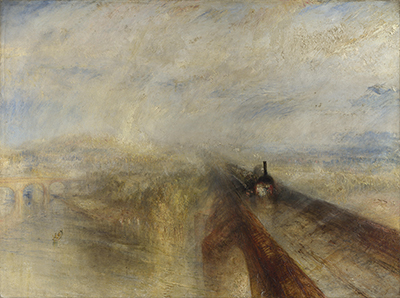
Turner sent seven oils. Rain, Steam, and Speed - The Great Western Railway appeared as number 62. The marine group included Ostend and Fishing Boats Bringing a Disabled Ship into Port Ruysdael. Three Venetian subjects completed a display that moved from modern railway engineering to Channel weather, Dutch allusion and Mediterranean architecture.[13][15]
The juxtaposition matters. Rain, Steam, and Speed puts new mechanical power into mist, rain and velocity. Van Tromp places older naval power under wind and wave. Both make command visible through atmospheric resistance, but one invokes industrial modernity while the other invokes inherited maritime memory.
Port Ruysdael is a particularly close companion. Turner invented the place name while invoking Jacob van Ruisdael. The title presents an imaginary geography with the confidence of a destination. Van Tromp presents an uncertain anecdote with the confidence of biography. Each uses naming to make an old-master relation publicly legible.[16]
The Venetian paintings prevent the 1844 display from reading as a single national programme. Turner was testing how water, architecture, history and light could be transformed across very different settings. Venice offered built splendour and decline; the northern seas offered ships, weather and contested mastery.
Turner was sixty-nine when the exhibition opened and would turn seventy in November. His age mattered to contemporaries because the works seemed at once the culmination of a long career and a refusal of settled seniority. He had been exhibiting at the Academy since the 1790s, yet his handling remained contentious.
Getty's later exhibition Painting Set Free placed this continued experimentation at the centre of Turner's final fifteen years. Its curators also stressed that formal freedom did not erase narrative or market awareness.[21] The 1844 group demonstrates both. Turner supplied elaborate titles, selected subjects with recognised cultural weight and still made surfaces that challenged conventional finish.
The Academy context makes “please his Masters” resonate beyond Dutch naval command, though only as a suggestive echo. Turner was himself a Royal Academician exhibiting before colleagues, critics and buyers. The picture does not meekly satisfy them. It performs a difficult change of course while retaining its own turbulence.
Critics, Distance and Delayed Recognition
The Spectator reviewed the Royal Academy shortly after it opened and treated Turner's marine paintings as major tests of vision. The critic objected to apparent extravagance at close range but praised the daring originality, truth and power that emerged from a suitable distance. Seas appeared as boiling surge, and clouds as vapour rather than solid props.[14]
The named examples were Ostend and Fishing Boats Bringing a Disabled Ship into Port Ruysdael, so the review should not be misrepresented as a sentence-by-sentence response to Van Tromp. It nevertheless records how a contemporary viewer understood the shared handling of Turner's 1844 marines. The Getty canvas asked for the same movement between near marks and distant effect.
Distance was an aesthetic argument, not merely advice about where to stand. Academic finish encouraged close inspection of bounded forms. Turner distributed coherence across the whole field, so local strokes could appear rough while their relations produced weather and movement. The viewer had to relinquish one kind of scrutiny to gain another.
Van Tromp makes that negotiation part of its content. Up close, the admiral risks dissolving into pale paint and the crew into dark touches. Farther back, boat, wave and figure cohere, but individual biography remains unavailable. One can improve visual comprehension without solving historical identity.
The critic's language of “truth” is important. Turner's defenders did not have to claim that every rope was meticulously described. Truth could lie in the total behaviour of sea and air, the way a vessel is swallowed by spray, or the instability of light across moving water. The picture's freedom was measured against experience, not against abstraction.
Detractors saw the same methods as evasion or mannerism. Turner's late palette and broken handling made it easy to joke that titles supplied what paint failed to show. The full Tromp caption, with its literary direction and nautical wording, exposed him to that charge. Yet it also made viewers test whether language and image could cooperate without duplicating each other.
The best response is neither to insist that everything is obvious nor to celebrate illegibility. The painting calibrates recognition. Warship, sail, craft, figure and broom arrive at different speeds. Some marks never become one named object. This unevenness mimics looking through adverse conditions.
Modern high-resolution access changes the rhythm but not the principle. A viewer can inspect the image closely without approaching the physical canvas, yet magnification increases the visibility of separate touches. The work still requires mental stepping back. Its historical reception remains relevant because the tension between material mark and represented sea has not disappeared.
Humour, Authority and the Limits of Mastery
“Getting a Good Wetting” is an extraordinary phrase to attach to a grand oil. It sounds like reported speech, perhaps affectionate mockery, rather than the elevated language of official commemoration. Turner lets a bodily inconvenience puncture the dignity of rank.
The joke does not require the sea to be harmless. Sailors know that water aboard can destabilise a craft, injure a crew or wash someone overboard. Humour arises from disproportion between the admiral's reputation and the blunt physical result, not from denial of risk.
If the figure is Maarten, the wetting can answer the broom's boast. The admiral symbolically claims dominion over an enemy's sea, and the sea replies by crossing his deck. If the figure is Cornelis, the wetting complicates his effort to regain approval: even correct obedience cannot secure smooth passage. Both readings expose the limits of command.
The plural “Masters” invites wider reflection. The Dutch admirals Turner painted were themselves masters of seamanship. Willem van de Velde, Storck, Cuyp and Ruisdael were artistic masters whose reputations framed Turner's practice. Royal Academicians and critics exercised institutional judgement. Buyers exercised economic choice. Turner's phrase places mastery everywhere and leaves its object undefined.
That ambiguity can sustain a reflexive reading. Turner may be imagined “going about” to please the old masters by returning to Dutch marine subjects, only to produce a picture too materially adventurous to count as submission. He may also be giving the Academy a history painting that refuses academic decorum. These are illuminating analogies, not documented private jokes.
What the image establishes is a hierarchy repeatedly overturned. The warship is physically largest but visually distant. Tromp is highest in rank but smallest in scale. The central boat commands attention but cannot command the wave. The broadest passages are sky and sea, neither of which has a human master.
Turner avoids a simplistic sermon against ambition. The vessel does not surrender. Its sail remains engaged, its mast upright and its crew active. Mastery is limited, not meaningless. Human expertise appears most impressive when the picture makes its conditions difficult.
Humour protects that insight from pomposity. The title can admire seamanship, question authority and enjoy the indignity of soaked greatness at once. Its tonal complexity matches the paint, where luminous beauty and physical threat are inseparable. A “Good Wetting” becomes the verbal equivalent of scumbled spray: light, disruptive and impossible to keep outside the boat.
From Gillott to Royal Holloway
The painting's early provenance begins with a probable rather than fully documented identification. Getty research associates it with an entry in the account of Birmingham pen manufacturer and collector Joseph Gillott. The record concerns a picture bought through Charles Birch from George Pennell for £400 on 12 March 1845.[3] Because the description is not an unambiguous modern object number, the connection must retain its qualification.
By 1850, the canvas belonged to John Miller of Liverpool, a collector with significant modern British holdings. It appeared at Christie's on 22 May 1858 as lot 248. The work was bought in under the name of dealer Ernest Gambart for £567 5s rather than passing cleanly to a new public bidder.[3]
Agnew's acquired it in January 1867 and sold it in March to Henry Woods, MP, of Warnford Park. This short interval illustrates the central role dealers played in moving Turner's major oils between private collections. Prices and titles travelled with the object, but neither remained fixed.
At Woods's sale on 5 May 1883, Christie's offered the painting under a title associated with another member of the sequence, Van Tromp's Shallop. The misnaming anticipates the modern difficulty of matching the 1832 and 1833 canvases. In the nineteenth-century market, such slippage could become part of an object's sale identity.[3]
Thomas Holloway bought the painting through the sale name “Martin” for £3,675. Holloway had made a fortune from patent medicines and assembled a collection for the women's college he founded at Egham. The purchase moved Turner's wet Dutch admiral from a succession of private interiors toward an educational institution.
Royal Holloway College inherited the collection and displayed it within its elaborate Victorian setting. There the painting remained for more than a century. Its presence linked Turner's 1844 Academy ambitions to a later project of philanthropy, women's education and cultural prestige.
The chain also affected interpretation. At Soane's house, the 1831 Tromp remained in a setting shaped by the purchaser and artist. At Royal Holloway, the 1844 work became one component of a founder's collection. Ownership created new ensembles and new reasons for preserving or selling.
Provenance is often treated as a neutral list after visual analysis. Here it repeats the article's central themes. Names are attached and revised; institutional masters change; monetary value rises; a canvas concerned with going about passes through several changes of direction. The object stays materially continuous while its public meanings are repeatedly renegotiated.
The 1993 Sale to the Getty
Royal Holloway's decision to sell the painting in 1993 produced controversy because the college sought funds for repairs and because the work had entered through a founder's philanthropic collection. Critics argued that dispersal weakened the integrity of the gift and sent a major British painting abroad. The legal sale and the ethical debate must be distinguished.
The Getty paid more than $16 million, reported at roughly £11 million, a record auction price for a British artist at the time.[20] Such figures transformed a canvas once bought for hundreds of pounds into an international cultural asset. The price also made a domestic rescue unusually difficult.
British export procedures allowed an interval in which a matching purchaser could keep the painting in the country. No British institution or buyer matched the sum, and the work entered the Getty collection as 93.PA.32.[1][20] Its move was therefore authorised, even though opposition to the college's decision continued.
The episode exposes competing forms of stewardship. Royal Holloway had buildings and an educational mission to maintain. Opponents believed the collection itself was an inseparable part of that mission and of Holloway's intent. The Getty could offer conservation, scholarship and public access but would remove the work from its long institutional setting and national context.
Turner's subject makes the dispute unexpectedly resonant. A painting about pleasing masters changed masters through a controversial sale. It crossed the Atlantic after depicting a Dutch admiral remembered through Anglo-Dutch rivalry. These parallels should not be mistaken for Turner's intention, but they belong to the work's afterlife.
Getty scholarship has substantially clarified the object. The museum's acquisition publication reconstructed provenance, while its collection catalogue articulated the two-admiral problem.[2][3] The canvas also became a key work in the 2015 exhibition J. M. W. Turner: Painting Set Free, which reassessed the artist's final years as both experimental and alert to narrative and market.[21]
Open-content imaging has further changed access. The Getty image can be enlarged, compared and studied far beyond Los Angeles.[23][25] This does not recreate the scale, texture or changing reflection of the physical oil, but it permits scrutiny once limited to travel and specialist photography.
The 1993 controversy should therefore end neither in celebration of acquisition nor in a simple story of loss. It altered the painting's institutional life. Royal Holloway lost a central object; the Getty gained one and produced consequential research. The ethical question remains part of the provenance rather than an obstacle to discussing the art.
Why Van Tromp Still Matters
The Getty Van Tromp is at once a marine painting, an unstable history, an old-master homage and a comedy of rank. None of those descriptions is sufficient alone. Their interaction gives the canvas its exceptional density.
Its original Academy setting joined it to Rain, Steam, and Speed, Dutch-referential seascapes and Venetian views. Turner was not retreating into a private blur. He was publicly testing how modern paint could carry old histories and new velocities before a vast audience.
Its later ownership carries further questions. Private collectors, dealers, Royal Holloway and the Getty each framed the work differently. The record price and export debate in 1993 made it a test of institutional responsibility as well as artistic value. Subsequent scholarship and open imagery have widened knowledge while preserving the controversy.
What finally matters is Turner's refusal to separate mastery from vulnerability. The sailor must know how to tack; the admiral must negotiate command; the painter must organise apparent disorder; the viewer must adjust distance. Each exercise of skill occurs within conditions it cannot wholly control.
The tiny white figure is therefore neither defeated nor triumphant. He remains aboard, visible at the instant when rank, legend and seamanship meet a breaking wave. Around him, Turner's paint turns historical certainty into weather. The “Good Wetting” is comic, dangerous and profound because it restores even an admiral to the scale of the sea.
Discussion
How does Turner's unstable marine transform contested naval biography into an image of authority under pressure?
Reader Insights
Which forms become legible first in the pale storm of sea, sky and spray?
What changes when Cornelis and Maarten Tromp remain rival explanations?
How does the dangerous tack complicate the title's language of obedience?
Join the Conversation
Share a close observation or a source-based question for other readers.
References
- J. Paul Getty Museum, “Van Tromp, going about to please his Masters, Ships a Sea, getting a Good Wetting,” 93.PA.32, https://www.getty.edu/art/collection/object/103RK1
- J. Paul Getty Museum, *Masterpieces of Painting in the J. Paul Getty Museum: Paintings*, 1997, pp. 64-65, https://www.getty.edu/publications/resources/virtuallibrary/0892364289.pdf
- *The J. Paul Getty Museum Journal*, volume 22, 1994, acquisition entry and provenance, https://www.getty.edu/publications/resources/virtuallibrary/0892363002.pdf
- Sir John Soane's Museum, “Admiral van Tromp's Barge at the entrance to the Texel, 1645,” P272, https://collections.soane.org/object-p272
- Tate, “Van Tromp Returning after the Battle off the Dogger Bank,” N00537, https://www.tate.org.uk/art/artworks/turner-van-tromp-returning-after-the-battle-off-the-dogger-bank-n00537
- David Hill, “Cotman and Turner's ‘Van Tromp’: A newly identified study of 1832,” *Sublime Sites*, 9 March 2016, https://sublimesites.co/2016/03/09/cotman-and-turners-van-tromp-a-newly-identified-study-of-1832/
- National Gallery of Art, “Rotterdam Ferry-Boat,” 1951.61.1, https://www.nga.gov/artworks/52279-rotterdam-ferry-boat
- Royal Museums Greenwich, “Cornelis Tromp, 1629-91,” BHC3069, https://www.rmg.co.uk/collections/objects/rmgc-object-14533
- *Encyclopaedia Britannica*, ninth edition, “Tromp,” Wikisource transcription, https://en.wikisource.org/wiki/Encyclop%C3%A6dia_Britannica%2C_Ninth_Edition/Tromp
- Historic England Heritage Gateway, “Battle of Dungeness, 30 November 1652,” https://www.heritagegateway.org.uk/Gateway/Results_Single.aspx?resourceID=19191&uid=a14afa8d-ab75-4354-b2ef-75233076172a
- Yacht Racing Association, Dixon Kemp, *Practical Boat-Sailing*, 1878, Project Gutenberg, https://www.gutenberg.org/files/39805/39805-h/39805-h.htm
- Howard Patterson, *Illustrated Nautical Dictionary, Unabridged*, 1921, Internet Archive/Wikimedia Commons, https://upload.wikimedia.org/wikipedia/commons/2/22/Illustrated_nautical_dictionary%2C_unabridged_%28IA_cu31924030750776%29.pdf
- Royal Academy Chronicle, “1844,” https://chronicle250.com/1844
- “Fine Arts: Royal Academy Exhibition, 1844,” *The Spectator*, 11 May 1844, https://archive.spectator.co.uk/article/11th-may-1844/18/fine-arts
- National Gallery, Judy Egerton, “Rain, Steam, and Speed - The Great Western Railway,” collection catalogue, https://www.nationalgallery.org.uk/paintings/catalogues/egerton-2000/rain-steam-and-speed-the-great-western-railway
- Anouk Janssen, *A Sea Painter in Holland: J. M. W. Turner's Dutch Marine Subjects*, 2014, RKD digitisation, https://rkddb.rkd.nl/rkddb/digital_book/201500003.pdf
- National Gallery of Art, Willem van de Velde the Younger, “Ships in a Gale,” 2000.72.1, https://www.nga.gov/artworks/112264-ships-gale
- National Gallery of Art, scholarly catalogue, “Ships in a Gale, 1660,” https://www.nga.gov/research/publications/online-editions/dutch-paintings-seventeenth-century-ships-gale-1660
- W. L. Wyllie, *J. M. W. Turner*, 1905, public-domain digitisation, https://pettersson-fanpage.de/Turner1/J.M.W.%20Turner%20-%20Wyllie%2C%20William%20Lionel%2C%201851-1931.pdf
- Suzanne Muchnic, “Getty Buys Turner Painting for More Than $16 Million,” *Los Angeles Times*, 24 February 1993, https://www.latimes.com/archives/la-xpm-1993-02-24-ca-614-story.html
- J. Paul Getty Museum, “J. M. W. Turner: Painting Set Free,” 2015, https://www.getty.edu/art/exhibitions/turner/
- J. Paul Getty Museum, “Painting Romanticism,” educational resource, https://www.getty.edu/education/teachers/classroom_resources/curricula/stories_in_art/sia_lesson05.html
- Google Arts & Culture, Getty Museum, “Van Tromp...,” high-resolution object presentation, https://artsandculture.google.com/asset/van-tromp-going-about-to-please-his-masters-ships-a-sea-getting-a-good-wetting-joseph-mallord-william-turner/0QFJdCscu4R3pg?hl=en
- Wikimedia Commons, Getty open-content image of *Van Tromp...*, https://commons.wikimedia.org/wiki/File:Joseph_Mallord_William_Turner_(British_-_Van_Tromp,_Going_About_to_Please_His_Masters_-_Google_Art_Project.jpg
- J. Paul Getty Museum, “30,000 Getty Museum Images Published Online as IIIF,” 1 June 2017, https://www.getty.edu/news/30000-getty-museum-images-published-iiif/