


 by
Tom Gurney
Tom Gurney BSc (Hons) is an art history expert with over 20 years experience
Written on November 8, 2026 / Updated on November 8, 2026
Email:
tomgurney1@gmail.com
/ Phone:
+44 7429 011000
The Fort of Antibes
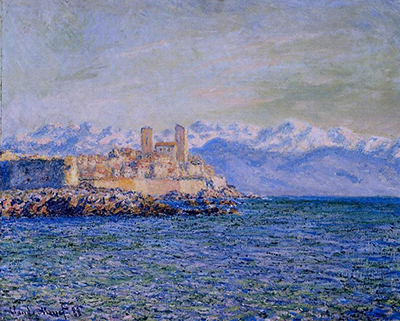
Claude Monet’s The Fort of Antibes brings a compact, sunlit town into a broad field of Mediterranean water and sky. Painted in 1888, this particular canvas belongs to the Hasso Plattner Collection at Museum Barberini in Potsdam. Its catalogue number, W1161a, distinguishes it from Monet’s other Antibes views. The scene joins the firmness of walls and towers to a sea made restless by many small, differently coloured strokes.[1][2]
At a Glance
A particular Antibes painting
The signature and date, Claude Monet 88, appear at the lower left. Museum Barberini records the canvas as 65 by 81 centimetres. Sotheby’s 2011 catalogue gives 65 by 81.5 centimetres and explicitly notes the older catalogue measurement of 60 by 81. These reported measurements belong to the same painting; the discrepancy should not create an imaginary additional version. The stable catalogue and inventory identifiers are more useful than a title alone when tracing its history.[1][2][3]
The familiar English title can suggest an isolated military building, yet the painted motif is the fortified old town seen across the water. Museum Barberini identifies the viewpoint as the Plage du Ponteil. This distinction matters visually: the architectural group is spread along the coast, while the nearest rocky projection belongs to the Pointe d’Illette. The composition does not present the freestanding Fort Carré as its central building.[1]
The Mediterranean visit of 1888
Monet’s Antibes campaign ran from January to May 1888, according to Museum Barberini. He stayed at the Château de la Pinède, following advice from Guy de Maupassant. This was a working visit to a different coastal environment, rather than a permanent move away from Giverny. The dazzling light in the finished image should not turn the whole visit into a story of uninterrupted fine weather.[1][4]
His correspondence gives a more varied account of the practical work. In a letter to Alice Hoschedé dated 23 January, he described scraping down two unsuccessful beginnings before feeling happier with the day’s painting. On 26 January, he reported good weather but deliberately slow progress, limiting the number of canvases underway. These comments concern the campaign: they do not identify a particular alteration, day of work or scraped passage in W1161a.[4]
The letter of 26 January also explains an unexpected obstacle. Monet understood that restrictions on sketching fortified towns affected his intended views of Antibes, and he planned to ask Jules Castagnary to help obtain permission. Seen alongside the painting, this contemporary concern makes the town walls more than picturesque scenery. They belonged to a place where a landscape painter’s choice of subject could encounter military administration.[4]
Walls, towers and the Alps
Museum Barberini identifies the Bastion Saint-André, the Château Grimaldi and the cathedral of Notre-Dame-de-la-Platea among the architectural features. Behind the town, the snowy Alps extend the landscape far beyond the immediate coast. Town and mountains share the middle part of the canvas, but they do not have equal solidity: darker upright buildings stand out against a much lighter, less insistent mountain band.[1]
The grouping is markedly uneven. Most of the hard-edged architecture gathers to the left, whereas open water gives the right side room to breathe. The pointed, irregular rock below the buildings directs the eye into the sea. Above it, two prominent towers interrupt the softer horizontal movement of the shoreline. Their vertical accents help the small town hold its place within a much larger expanse.
The distant peaks are important partly because their colours are restrained. Pale pinks and cool whites make the mountains visible without giving them the heavy edges of the nearby walls. This produces depth through contrast rather than a succession of precisely outlined objects. The viewer can recognise a distant snowy range while still seeing a thin band of paint that belongs to the overall surface.
Water, light and colour
The foreground sea occupies enough of the canvas to become a subject in its own right. Short marks cross and overlap, with blue, green and lighter touches refusing to settle into a single flat colour. Some strokes feel almost horizontal; others cut across that direction. Their accumulation suggests an uneven, flickering surface without describing each wave as a separate, bounded shape.
The water close to the town does not act as a neat mirror. It breaks up the relationship between the solid buildings and their surroundings, so that warm colours on the shore remain concentrated rather than repeated as a second architectural image. Across the lower area, changes in the density of marks create variation within the broad blue-green field. The surface remains connected even where individual strokes are conspicuous.
Warm ochres and pinks in the town draw attention because so much of the surrounding picture is cooler. Those warmer notes also answer the lightly coloured mountain range. Sky and sea are both blue, but their handling differs: the sky offers a more open area, while the water is crowded with small interruptions. This difference makes the horizon a meeting of two painted textures, not simply a boundary between two named things.
Seen from farther away, the small marks cohere into a readily legible coastal view. At closer range, their separate directions become harder to ignore. That movement between an identifiable place and an active painted surface is central to this canvas’s effect. It does not require the assumption that every visible mark was laid down at once, or that the painting records one exact, recoverable minute.
Related views and catalogue numbers
Monet returned to similar views during the Antibes campaign, but related compositions have separate histories. The catalogue raisonné reproduces W1161a alongside other coastal views, making comparison possible without treating them as interchangeable. A nearby catalogue number can indicate a relationship in the published sequence; it is not, on its own, proof that two pictures were painted on consecutive days.[2]
The Museum of Fine Arts in Boston owns the related Antibes, Afternoon Effect, W1158, inventory 27.1324. That picture is distinct from the present canvas, which also formerly belonged to the Boston museum but carried inventory 1978.634. Keeping both accession numbers in view prevents an easy mistake: a current Boston collection reference for W1158 does not establish the present location of W1161a.[1][2][5]
Ownership and exhibition history
Durand-Ruel bought this canvas from Monet on 6 June 1890. On 25 September that year, it passed through Joseph Foxcroft Cole to the Boston collector Peter Chardon Brooks, Jr. It descended to Eleanor Brooks Saltonstall and then, in 1962, to a private collection. In January 1978 it entered the Museum of Fine Arts, Boston, as a gift. These successive records explain why older publications associate the painting so strongly with Boston.[3]
The painting was consigned by the museum to Sotheby’s New York sale of 2 November 2011, as lot 9. It is now identified with the Hasso Plattner Collection at Museum Barberini. The 2011 auction estimate is not a sale result, and the sources used here do not establish a precise later acquisition date. The present collection can be stated without inventing that missing link.[1][3]
Its documented exhibition history includes the Saint Botolph Club’s Monet exhibition in Boston in 1892, where it was number 6, and the Boston memorial exhibition of 1927, where it was number 77. The proposed identification with number 100 in the 1889 Monet–Rodin exhibition is marked as uncertain in the records. That qualification remains important even though the possibility places the canvas within an especially interesting early exhibition context.[2][3]
Looking again at Antibes
Begin with the two towers, then follow the shoreline toward the open water. Compare the concentrated warmth of the town with the cooler sea, and the weight of the near rocks with the lightly indicated Alps. Returning to the whole image reveals how these different forms remain balanced: no single feature has to dominate every part of the picture for the coast to become recognisable.
Frequently Asked Questions
He painted this canvas in 1888, during his Antibes campaign. It is signed and dated Claude Monet 88 at the lower left.[1]
The view shows the fortified old town from the Plage du Ponteil, including the Bastion Saint-André, Château Grimaldi and cathedral. The Fort Carré is not the central building identified in this composition.[1]
Discussion
These editorial prompts invite a closer look at Monet’s coastal composition.
Reader Insights
Which warm accent stands out most clearly against the sea?
How do the small towers change your sense of distance?
Where do separate strokes become most visible in the water?
Join the Conversation
Share an observation or question about The Fort of Antibes below.
References
- Museum Barberini — Claude Monet, The Fort of Antibes, MB-Mon-25: object record, interpretation and collection history. View source
- Wildenstein Plattner Institute — Daniel Wildenstein, Monet, Catalogue Raisonné, volume III: W1158 and W1161a, comparative plates and entry (printed pages 438–442). View source
- Sotheby’s — Antibes, le fort, New York, 2 November 2011, lot 9: dimensions, provenance and exhibition history. View source
- Art Institute of Chicago / Daniel Wildenstein — Claude Monet: Biographie et catalogue raisonné, volume III, letters 814 and 818 to Alice Hoschedé, 23 and 26 January 1888. View source
- National Gallery of Victoria — French Impressionism: artwork labels, Antibes, Afternoon Effect (Museum of Fine Arts, Boston, 27.1324). View source







