


 by
Tom Gurney
Tom Gurney BSc (Hons) is an art history expert with over 20 years experience
Published on October 6, 2016 / Updated on October 23, 2026
Email:
tomgurney1@gmail.com
/ Phone:
+44 7429 011000
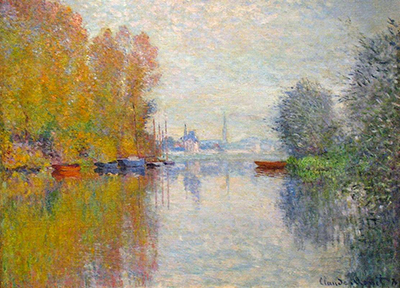
Autumn on the Seine at Argenteuil, 1873
Autumn on the Seine at Argenteuil places warm foliage beside a luminous stretch of water. Painted in 1873, it belongs to Atlanta's High Museum of Art, accession 2000.205. The orange trees and their reflections form one side of a view that opens towards a distant town. [1]
At a Glance
A passage between two banks
The composition is organised around the open water in the middle. Tall trees gather along the left bank, while cooler, darker foliage forms a less regular screen on the right.
Between them, the river leads towards pale buildings and a narrow vertical landmark in the distance. The High Museum identifies the Chateau Michelet among the recognisable architecture. [1]
This is not a view with a sharply drawn road directing every movement of the eye. Depth comes from the narrowing banks, the reduction in the boats' size and the softer definition of the far shore.
The large trees at the left extend beyond the top edge. Their reflections continue towards the lower edge, making that side feel almost like a curtain of colour.
The centre remains comparatively open. That contrast between a dense margin and a luminous passage is central to the painting's sense of space. It allows a closely framed river view to feel broader than its modest canvas.
Autumn colour and cool water
Gold, orange and rust-coloured foliage supply the most immediately noticeable accents. The left-hand trees do not appear as a single uninterrupted mass, however. Small variations of colour break their surface into leaves, branches and openings.
The right bank is more restrained. Grey-blue and green passages balance the warmer colours without mirroring them exactly.
A few boats give these relationships firmer shapes. Their hulls sit close to the boundary between bank and water, and thin masts introduce upright lines among the looser marks of foliage.
The pale centre is equally important. Without it, the two banks and their reflections could merge into a crowded pattern. Light through the middle lets the viewer look between the colours as well as at them.
The Painting Light article explores Monet's wider interest in such relationships. Here, the season is suggested by changing leaves, while the whole arrangement depends on the exchange between warm colour and cooler surroundings.
Reflections that do not become a second landscape
The water repeats the trees, boats and sky, but not as an equally precise copy. Reflected forms stretch and fragment as they move towards the foreground.
Near the left bank, warm colour travels downward in broken passages. In the centre, the sky's pale tones create a wider area of brightness. At the right, cooler shadows make the bank seem to continue beneath the surface.
The boundary between an object and its reflection can briefly become difficult to separate. A boat or a dark bank supplies a useful clue, then the surrounding colour loosens that certainty again.
Short marks across the water interrupt the vertical repetitions. They allow the river to be understood both as a reflective depth and as a surface extending towards us.
This is not a mechanical mirror image. It is a painted relationship between forms above and below the bank.
The Painting Water article follows this tension through other river and pond subjects. In this canvas, the distinction remains clear enough to recognise and fluid enough to keep the eye moving.
A likely studio-boat viewpoint
The High Museum suggests that Monet probably painted this scene from his small floating studio. Its wording is cautious: the boat is a likely explanation of the viewpoint, not a documented certainty for every stage of this particular canvas. [1]
The National Gallery of Ireland's account of a separate Argenteuil painting describes the boat Monet fitted out in 1872. It offered a way to observe the Seine and its banks from the water. [3]
That possibility helps explain the feeling of being within the river rather than looking at it from a distant promenade. Both banks become active boundaries of the scene.
It does not establish an exact position, a particular hour or the motion Monet felt under his feet. Those details cannot be recovered simply by imagining oneself aboard.
The Seine overview considers the river as a changing working environment. The studio boat expanded the positions available to Monet, but the resulting pictures still depended on choices of framing, emphasis and finish.
Argenteuil was not an untouched rural retreat
Monet settled at Argenteuil in 1871. Rail links made it accessible from Paris, and its river attracted visitors interested in boating and other leisure activities. It was also a working town undergoing industrial change. [2]
The quietness of this painting should therefore be understood as a selection from a more varied place. The water and autumn trees do not erase the town visible beyond them.
The National Gallery of Art's account of the period emphasises the different artists who visited Monet there, including Renoir, Manet, Sisley and Caillebotte. Their meetings and experiments helped develop new ways of painting modern life. [2]
That does not mean they all stood together before this exact view. The value of the shared setting lies in the range of approaches it supported.
The Argenteuil guide follows this combination of domestic life, transport, industry and recreation. Autumn on the Seine concentrates on a quieter stretch, but its distant architecture keeps that wider world within sight.
Related views require separate evidence
The Courtauld owns a different 1873 canvas, Autumn Effect at Argenteuil. Its museum account discusses the contrast of orange leaves and blue water, and specifically records Monet scratching the trees' paint with his brush handle. [4]
That technical detail belongs to the Courtauld painting. It should not be transferred automatically to the Atlanta canvas because the subjects and translated titles are similar.
The comparison nevertheless reveals how a river motif could produce distinct treatments. Similar banks, trees and reflections can be reorganised through their proportions, colour intensity and handling.
Another useful contrast is the National Gallery's Petit Bras of the Seine at Argenteuil, painted in 1872. Its quieter side channel, subdued colours and sparse figures present a more wintry atmosphere. [5]
These works do not form a set of interchangeable seasonal illustrations. Each selects a different balance of place and visual effect. Paying attention to the individual collection record is especially important when the river, town and season recur in several titles.
From an autumn view to an exhibition picture
Wildenstein's biography identifies this canvas as catalogue number 291 and connects it with Victor Chocquet's recent purchase at the time of the second Impressionist exhibition in 1876. [6]
That later setting is worth considering alongside the apparently immediate landscape. A picture first associated with an outdoor view could also be collected, lent and compared with other paintings in an exhibition.
Its appeal does not depend only on documenting what Argenteuil looked like on one autumn day. The arrangement of foliage and reflection gives it a structure that survives changes of setting.
In the centre, pale water and sky hold the scene open. At the margins, trees and reflections gather into more insistent colour. Small boats and distant buildings keep the view recognisable without overwhelming those relationships.
The painting's calm is therefore active rather than empty. It is made through differences: warm and cool, dense and open, upright trees and broken reflections, a nearby bank and a town receding into light.
Frequently Asked Questions
No. It belongs to the High Museum of Art in Atlanta, accession 2000.205. [1]
The museum describes that as likely, not certain. [1]
No. That is a separate 1873 canvas with its own evidence and collection history. [4]
Discussion
Look again at the images and ideas explored in Autumn on the Seine at Argenteuil, 1873. These editorial prompts invite your observations.
Reader Insights
Compare the dense warm bank with the cooler trees opposite.
Follow the changes between a tree and its reflection.
Consider how distant buildings qualify the impression of a secluded natural scene.
Join the Conversation
Share a detail, comparison or question about Autumn on the Seine at Argenteuil, 1873 below.
References
- High Museum of Art , Autumn on the Seine, Argenteuil, 1873, 2000.205; exact work, dimensions, landmarks and likely studio-boat viewpoint. View source .
- National Gallery of Art / Paul Hayes Tucker , The Impressionists at Argenteuil, 2000; institutional publication overview, the town and visiting artists. View source .
- National Gallery of Ireland , Argenteuil Basin with a Single Sailboat, 1874, NGI.852; a separate work and the studio-boat context. View source .
- The Courtauld , Autumn Effect at Argenteuil, 1873; a distinct canvas and its particular paint handling. View source .
- National Gallery, London , The Petit Bras of the Seine at Argenteuil, 1872, NG6395; a separate, quieter river view. View source .
- Daniel Wildenstein / Wildenstein Plattner Institute , Monet biography, second Impressionist exhibition discussion; Chocquet and Autumn on the Seine at Argenteuil, catalogue 291. View source .







