


 by
Tom Gurney
Tom Gurney BSc (Hons) is an art history expert with over 20 years experience
Published on October 6, 2016 / Updated on October 23, 2026
Email:
tomgurney1@gmail.com
/ Phone:
+44 7429 011000
Red Boats at Argenteuil
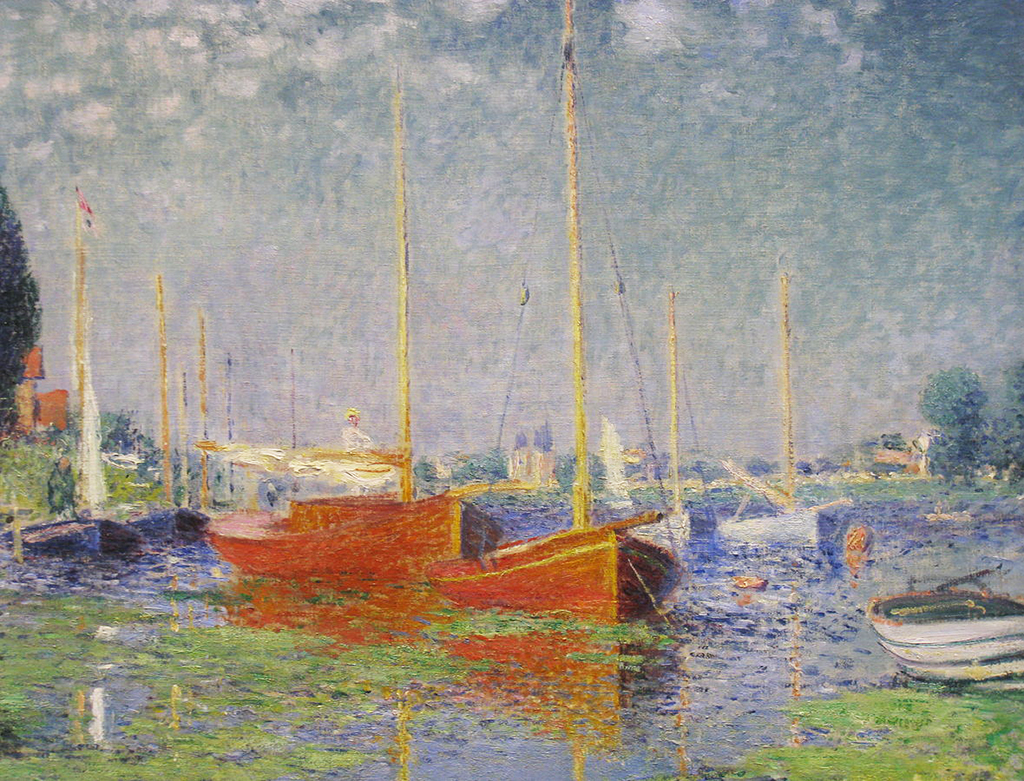
In Red Boats, Argenteuil , Claude Monet gives a pair of bright hulls an unusually commanding role in a view of the Seine. Their warm colour catches the eye before the many masts, small craft and broken reflections begin to register. Painted in 1875, the oil on canvas belongs to Harvard Art Museums. It brings together two central concerns of Monet's Argenteuil years: a modern river used for recreation and the difficulty of painting a surface that continually changes with light and movement. [1]
At a Glance
Which Red Boats painting is this?
Harvard's painting is also known by the French title Les Bateaux rouges, Argenteuil . The museum-supplied record gives a height of 61.8 centimetres and a width of 82.5 centimetres. Those measurements, the 1875 date and the Harvard collection identify the work more securely than a shortened reproduction title. Daniel Wildenstein's catalogue places Les Bateaux rouges, Argenteuil at number 369. [1] [3]
It should be distinguished from Monet's Argenteuil , also dated 1875, in the Musee de l'Orangerie. That painting measures 56 by 67 centimetres and has a different collection history. Both works feature striking red boats, which makes the distinction especially important when comparing illustrations or reading about their owners. [4]
Argenteuil: a working town and a place of leisure
Monet settled in Argenteuil late in 1871 and remained there until 1878. The town offered access to Paris by train while giving him riverbanks, gardens, bridges and changing weather close to home. The National Gallery's account of The Petit Bras of the Seine at Argenteuil stresses that this was already a partly industrialised suburb as well as a centre for pleasure boating. Quiet water and modern development existed beside one another. [5]
Paul Hayes Tucker's exhibition catalogue The Impressionists at Argenteuil treats the town as a meeting place for Monet and fellow artists, including Renoir, Manet and Sisley. Its importance lay partly in this combination of ordinary modern subjects and opportunities to work together. Sailboats belonged to the social life of the place, rather than serving only as picturesque accessories. Their masts, hulls and sails also gave painters a varied set of shapes against the water. [6]
How the boats organise the composition
The two red hulls sit low in the composition, where their broad curves contrast with the narrow uprights of the masts. One vessel stands farther back and to the left; the nearer boat extends across the centre towards the right. This slight overlap helps establish depth without a strongly marked foreground bank. The hulls create a concentrated area of warmth within the much larger field of cool water and sky.
Above them, the masts carry the eye almost to the top of the canvas. Some appear pale yellow, others darker or less complete. Their spacing prevents the open sky from becoming an empty backdrop. Rigging and smaller distant vessels introduce finer lines between the largest verticals. At the edges, pieces of shore and boats are cut off, giving the scene a sense of continuing beyond the frame.
A light-coloured rowing boat at the lower right offers a useful contrast. Its curved rim is more continuous than many of the strokes around it, yet it remains cropped and partly absorbed into the water. The painting therefore moves between clearly recognisable things and marks that need a little distance to become legible. These are visible relationships within the composition, rather than evidence of a fixed symbolic meaning for the red boats.
Reflections and the movement of paint
The reflected hulls do not form smooth mirror images. Red and orange passages break into green, blue and pale strokes, so that colour spreads sideways across the surface. The water beneath a boat still belongs to the same painted field as the water around it. This makes the reflections feel less like separate objects than temporary disturbances in light and colour.
The masts undergo a similar transformation. Above the boats they provide long vertical accents; below them their reflections become shorter and less certain. The difference helps distinguish solid structure from moving water without requiring every ripple to be outlined. Small floating birds give another indication of the scale of the open surface.
A related effect appears in The Bridge at Argenteuil of 1874 at the National Gallery of Art. The museum explains how distinct dabs coalesce into a convincing scene when seen from farther away, while close viewing reveals separate colours and different kinds of brushwork. The comparison helps explain Monet's method of building an image through touches, without assuming that every Argenteuil canvas was made in exactly the same way. [7]
A shore viewpoint and a composition revised
Monet owned a studio boat, but that does not establish where he painted this particular view. Harvard's gallery text suggests that its low viewpoint was taken from the shoreline. It also notes that factory smokestacks visible at the site were omitted, leaving recreational and picturesque features to dominate the scene. [2]
The museum's technical evidence complicates the impression of an entirely spontaneous sketch. X-radiographs show that Monet painted out a sixth duck on the left and revised the area now occupied by lavender strokes along the horizon. The loose surface therefore contains decisions made through alteration. Harvard notes that the work has sometimes been described as a study, but its apparently unresolved appearance does not mean that Monet simply stopped recording the first thing he saw. [2]
Comparison with the Orangerie's Argenteuil
The Orangerie's Argenteuil offers a close comparison because it also concentrates on anchored sailing boats around 1875. Its museum commentary describes the vermilion hulls against blue sky and water, with green vegetation on the Seine. The white sails and dark blue hulls contribute further contrasts, while the masts give the composition rhythm. These observations concern that specific version, rather than supplying a description that can be transferred unchanged to Harvard's painting. [4]
Looking at the two works together shows how much could vary within a repeated subject. The width of the view, the spacing of the masts and the distribution of bright colour alter the balance between open water and solid craft. Repetition gave Monet a way to test the river's pictorial possibilities. It does not make the canvases interchangeable, and the red boats alone cannot identify a reproduction.
The river beyond a single bright view
Other Argenteuil paintings widen the context. In the National Gallery's Petit Bras , Monet turns towards a quieter channel and a more secluded setting. The museum contrasts this retreat with the bustle of the town's boating areas. That distinction makes it possible to understand Red Boats as one choice among several kinds of riverside experience. [5]
In Autumn Effect at Argenteuil of 1873, the Courtauld describes orange foliage against blue water, with thick parallel strokes suggesting the river's surface. Its account also identifies Monet's studio boat as the viewpoint for that work. Comparing the autumn scene with Red Boats brings out his changing use of colour and setting, while keeping the evidence for each painting separate. A boat can be a subject, a compositional structure or a platform for painting; those roles should not automatically be conflated. [8]
From the Wertheim collection to Harvard
The Harvard-supplied credit identifies the painting as a bequest from the collection of Maurice Wertheim, Class of 1906. Its museum accession number is 1951.54. A Getty publication also reproduces these identifying details, providing an independent institutional check on the work's title, date, medium and collection. [1] [9]
Harvard Magazine's account of the Wertheim gift places Red Boats among the Fogg's group of modern French paintings and sculpture. The collection reached the museum in 1951, after Wertheim's death. This history belongs to the Harvard canvas. The Orangerie painting's connection with Domenica Walter belongs to its separate ownership record and should not be attached to Red Boats . [10] [4]
Seen through these collection histories and through close looking, the painting is more than a familiar image of red hulls and blue water. Its anchored boats hold together an active, revised arrangement of colour and line. Its subject also locates Monet within the modern riverside world that supported so much of his work during the 1870s. The broader Seine paintings and boating subjects show how often he returned to that world, finding different relations between leisure, landscape and the painted surface.
Frequently Asked Questions
The Harvard painting is dated 1875. [1]
It belongs to Harvard Art Museums/Fogg Museum, accession 1951.54. This identifies the collection; it is not a statement about its current display location. [2]
No. The Orangerie's 1875 Argenteuil is a different canvas, measuring 56 by 67 centimetres, with its own collection history. [4]
Discussion
Look again at the images and ideas explored in Red Boats at Argenteuil. These editorial prompts invite your observations.
Reader Insights
Which seems more important to the painting's balance: the red hulls or the tall masts?
Compare a mast with its reflection. Where does a continuous line become separate patches of colour?
Does the evidence of revisions change how you understand the painting's loose surface?
Join the Conversation
Share a detail, comparison or question about Red Boats at Argenteuil below.
References
- Harvard Art Museums , Red Boats, Argenteuil, 1875, museum-supplied object record on Google Arts & Culture. View source .
- Harvard Art Museums , Red Boats, Argenteuil, accession 1951.54, object 228650; object data, Gallery Text and conservation observations. View source .
- Daniel Wildenstein , Monet: Catalogue raisonne, volume II, 1996, no. 369; digitised volume, pp. 156-159. View source .
- Musee de l'Orangerie , Argenteuil, 1875, RF 1963 106; object record and commentary. View source .
- National Gallery, London , The Petit Bras of the Seine at Argenteuil, 1872, NG6395; collection commentary. View source .
- National Gallery of Art , Paul Hayes Tucker, The Impressionists at Argenteuil, 2000; publication overview. View source .
- National Gallery of Art , The Bridge at Argenteuil, 1874; object commentary and visual description. View source .
- The Courtauld , Autumn Effect at Argenteuil, 1873; collection commentary. View source .
- Getty , Images Online: Perspectives on the Museum Educational Site Licensing Project, illustration credit for Red Boats, Argenteuil, Harvard accession 1951.54. View source .
- Harvard Magazine , A Roomful of Masterworks, March-April 2001; the Wertheim gift to the Fogg. View source .







