


 by
Tom Gurney
Tom Gurney BSc (Hons) is an art history expert with over 20 years experience
Published on October 6, 2016 / Updated on October 23, 2026
Email:
tomgurney1@gmail.com
/ Phone:
+44 7429 011000
Flowered Riverbank, Argenteuil
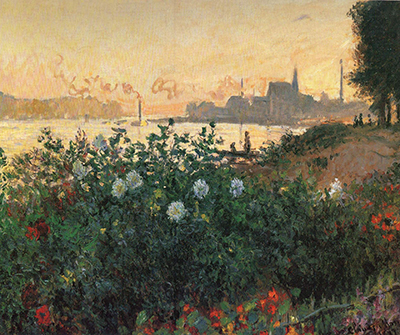
Flowered Riverbank, Argenteuil is Claude Monet's 1877 painting in the Pola Museum of Art, Hakone. [1] A thick screen of flowers fills the near bank, while the Seine and a distant built-up shore glow beyond it. Known in Wildenstein's catalogue as W453, the canvas makes an unusually strong contrast between immediate vegetation and a remote, light-filled town. [3]
At a Glance
A foreground that blocks the view
The flowers do not form a tidy border around an open view. They rise across much of the lower half, concealing the near edge of the river and interrupting the connection between the observer and the far shore. Their stems bend in several directions, while pale blossoms catch the light above the darker leaves.
Red touches appear lower down, especially near the bottom edge. They are easy to miss when attention first goes to the bright sky, but they keep the darkest part of the picture active. The plants become more than a silhouette placed against a sunset.
A small angled fence enters at the lower right. Its straight pieces contrast with the tangled vegetation without making the foreground easy to navigate. There is still no broad, clear path inviting the viewer directly towards the water.
This obstruction is central to the experience. We look over and through the flowers, not simply past them. They establish both a physical position near the bank and a strong painted surface that resists being treated as a transparent window.
The river and the golden distance
Beyond the plants, the river opens as a comparatively light strip. Small horizontal marks interrupt its brightness, suggesting a surface that is neither a flat mirror nor a dramatic succession of waves. The contrast with the dark foreground makes that narrow band feel more expansive than its share of the canvas might suggest.
The sky is also warm, moving through yellow, cream and pale pink. Thin marks and soft transitions distinguish it from the dense, knotted handling of the vegetation. The eye travels between two very different kinds of painted space.
The distant buildings are muted grey and purple. Their outlines remain visible, but they are less definite than the nearest stems. This difference in clarity helps separate the far shore from the screen of flowers.
Monet's water subjects often depend on reflections, but here the river does not occupy the entire foreground. Much of its near surface is withheld. The visible brightness becomes something glimpsed beyond an obstacle, rather than a broad area immediately available to the viewer.
A town of leisure and industry
The distant shore is not empty countryside. Roofs, a prominent tower and upright chimneys establish a built environment. Smoke-like marks cross part of the warm sky. The small scale of these features should not make them disappear from an account of the painting.
The Pola Museum's interpretation places the work within the industrial growth of Argenteuil . It reads the flowering vegetation against the factories behind it, bringing cultivated or growing nature and urban development into the same field of vision. [2]
The promenade at the right supplies another kind of human presence. Tiny walkers appear on the raised ground, and their small vertical forms contrast with the long bank. The river scene remains somewhere people use, not merely a detached arrangement of plants and colours.
Paul Hayes Tucker also draws attention to a small steamboat and the factory chimneys in his study of this canvas. [4] Pleasure, transport and industry coexist here. The picture does not require us to choose between calling Argenteuil a resort and recognising it as a working town.
A late return to a familiar promenade
The painting belongs to the later part of Monet's residence at Argenteuil. The museum describes it as one of his last works of the locality, while the catalogue identifies the view as the promenade looking downstream. [2] [3]
Wildenstein places it beside three other riverbank paintings dated 1877, W450-W452. Their related viewpoints do not make them interchangeable. Different foregrounds, proportions and light effects distinguish individual canvases. [3]
That distinction is important for a subject with so many similar English titles. Riverbank at Argenteuil can describe a location without uniquely identifying a painting. The Pola work is securely recognised through its mass of pale flowers, golden distance and catalogue number W453.
A return to a familiar site could produce a new composition rather than a repetition. The painter already knew the river and promenade, but knowledge of a place did not determine how much of it he would reveal. In this version, the plants impose themselves on the view and fundamentally change its accessibility.
Brushwork and competing scales
The flowers are formed from short touches, curls and broken light marks. Some appear to sit on top of darker strokes; elsewhere the leaves and stems seem to merge. Close looking makes the plants less like a botanical diagram and more like a densely worked field of paint.
The distant shore calls for a different pace of attention. A roof or tower can be indicated with a few connected shapes, while the surrounding haze softens the intervals. The viewer does not receive the same amount or kind of information at every distance.
These differences in handling create tension between surface and depth. The bright river and buildings draw the eye away, but the large foreground marks continually bring it back. Neither part completely takes over the picture.
The apparent energy of the strokes is not evidence that Monet finished the canvas in one sitting. His technique should be understood through what the painted surface and documented evidence support, rather than through a universal story about racing against a disappearing instant of light.
Interpretation without a fixed message
The Pola Museum associates the high horizon and large foreground obstruction with the compositional influence of Japanese prints . [2] That comparison concerns the organisation of the view; it does not identify a single print that Monet copied.
Tucker gives the painting a more unsettled reading than a simple celebration of riverside leisure. He discusses the separation between the dark, immediate flowers and the luminous town, proposing nostalgia and conflicting ideas of freedom as possible meanings. [4]
Those are critical interpretations, not recorded statements of Monet's intention. The visible contrast can support several responses. Some viewers may find the distant light inviting; others may feel that the thicket keeps them uncomfortably apart from it. Both reactions begin with the actual arrangement of the picture.
It would be equally limiting to describe the work as a straightforward denunciation of factories or an image of untouched nature. Built structures remain present, and the flowering bank is part of a place shaped by human activity. Monet's view allows those elements to coexist without resolving their relationship into a slogan.
The painting to look for
The modern museum record gives the dimensions as 53.8 by 65.1 centimetres. Wildenstein's older catalogue rounds them to 54 by 65 and reproduces the same composition. [1] [3] These small measurement differences do not indicate a second version.
W453 is also distinct from Manet's Banks of the Seine at Argenteuil of 1874, which shows Camille and Jean at the left of a much more open boating scene. The Courtauld's institutional account identifies that different artist, date and arrangement. [6]
Comparing Monet and Manet can be illuminating, but their riverside pictures should retain their individual identities. In the Pola canvas, the chief encounter is between a crowded near bank and a glowing reach of the Seine . Flowers, factory chimneys, water and walkers share the view, each contributing to its distinctive balance of closeness and distance.
Frequently Asked Questions
The Pola Museum of Art in Hakone, Japan, inventory 006-0467. [5]
No. Manet's canvas shows a different composition with Camille and Jean near the left edge. [6]
Discussion
Look again at the images and ideas explored in Flowered Riverbank, Argenteuil. These editorial prompts invite your observations.
Reader Insights
Do the foreground flowers invite you into the scene or keep you outside it?
How do the chimneys change your reading of the distant light?
Which parts seem most descriptive and which most visibly painted?
Join the Conversation
Share a detail, comparison or question about Flowered Riverbank, Argenteuil below.
References
- Pola Museum of Art , Flowered Riverbank, Argenteuil, 1877. View source .
- Pola Museum of Art , Japanese curatorial interpretation of Flowered Riverbank, Argenteuil. View source .
- Daniel Wildenstein , Monet, 1996, volume II, pp.182-183, W450-W453, original WPI catalogue. View source .
- Paul Hayes Tucker , The Impressionists at Argenteuil, National Gallery of Art, 2000, cat.52, pp.174-175. View source .
- Art Platform Japan , museum-supplied record W34110, Pola inventory006-0467. View source .
- The Courtauld , Banks of the Seine at Argenteuil by Edouard Manet, institutional record via Google Arts & Culture, a separate work. View source .







