


 by Tom Gurney
Tom Gurney BSc (Hons) is an art history expert with over 20 years experience
Published on October 6, 2016 / Updated on April 3, 2026
Email: tomgurney1@gmail.com / Phone: +44 7429 011000
Snow at Argenteuil (1875) - Monet and the Quiet Drama of Winter
Claude Monet's Snow at Argenteuil (1875) is one of the most refined and atmospheric winter scenes of the Impressionist movement - his most famous of all remains The Magpie.
Painted during an unusually harsh winter in northern France, it transforms a modern suburban street into a subtle study of light, colour and silence.
Rather than presenting a dramatic narrative, Monet captures a fleeting moment — the stillness of snow-covered ground under diffused winter light.
This is the essence of Impressionism, and Monet himself became a true master of winter paintings, completing a number of other scenes of snow and ice around Argenteuil at around the same time.
The subject is simple - a road, a few figures, bare trees, and distant buildings. Further inspection, however, reveals the true genius of Monet. Subtle touches are everywhere to be found within this composition, from the way in which light interacts with snow, how colour emerges from shadow and the general haze that generates a winter atmosphere.
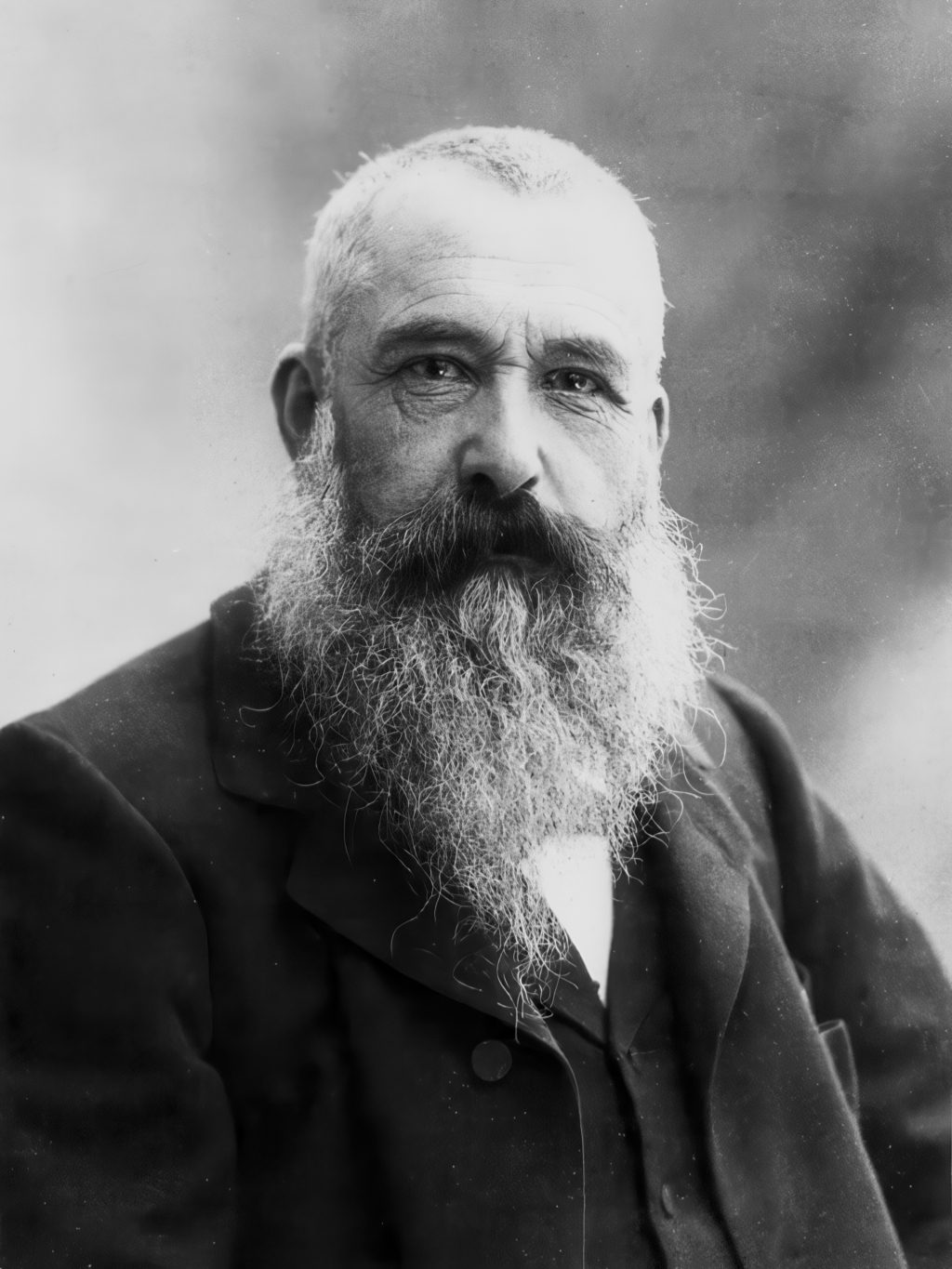
I have finally discovered the true colour of the atmosphere. It is violet. Fresh air is violet.
Monet at Argenteuil: A Modern Setting Transformed
Monet settled in Argenteuil in 1871, during a period of relative stability after the upheavals of the Franco-Prussian War. Located just outside Paris, Argenteuil was both a suburban retreat and a centre of modern life, connected by railway and increasingly popular with leisure seekers. It was a time of great social and technological change, both in Argenteuil and France as a whole.
This dual identity — part rural, part modern — made Argenteuil an ideal subject for Monet. He painted its bridges, riverbanks, regattas, and streets, capturing the transitions occurring right across the country. He chose to complete a cluster of winter-based artworks in this region, and they would become an integral part of his oeuvre. This body of work also brought about unique challenges to the artist.
In Snow at Argenteuil, from 1875, the blanket of snow subdues all other details - we can identify people going about their daily lives, buildings, trees and fences, but all through the restrictive prism of winter, which impacts detail and palette. The atmosphere generated by this is more contemplative than would have been the case on a bright spring or summer day.
- Artist:Claude Monet
- Painting Title:Snow at Argenteuil
- Artist:Claude Monet
- Original French Title:Rue sous la neige, Argenteuil
- Alternative Title:Snow Scene at Argenteuil
- Year:1875
- Medium:Oil on canvas
- Place Depicted:Argenteuil, France
- Movement:Impressionism
- Subject:Winter landscape, suburban street
- Ownership:National Gallery, London
The Winter of 1874-1875
The winter of 1874-1875 was particularly severe, though a benefit to Monet who was able to complete a large number of winter paintings. By the end of it, he was much further developed in his understanding of this sub-niche, and several works from this period are considered amongst his finest paintings of all.
Snow allowed Monet to simplify the visual world, stripping away detail and focusing on essential relationships between light and form. It also introduced new technical challenges, requiring rapid work in cold conditions and careful observation of fleeting effects.
One can connect this reduction in detail to the use of abstraction which followed in the 20th century, with Monet playing a role in the movement away from extreme realism to more expressive art.
Production
He made it while staying at his home in Argenteuil during a time that it was covered in a blanket of snow - the winter of 1874 to 1875. It is one of eighteen in a series, this one being the largest.
The majority of this series of paintings were created in several locations near his home where Monet and his family recently moved into - the boulevard Saint-Denis.
The view that is seen in this particular painting of the series is what Monet could see when looking from his home toward the rue de la Voie-des-Bans. The River Seine is just out of view to the back with the local rail station behind Monet's perspective.
Technique
Composition
Monet organises the scene around a central road that recedes into the distance. This creates a sense of depth and perspective. Additionally, the road allows movement, with figures walking to and from the nearby station. The cart tracks in the foreground also underline this, and are angled inwards to continue this perspective.
Monet is careful to avoid huge expanses of uniform tones of white. Details are therefore used in different areas, as well as variation in tone, with other colours merged in. Additionally, the objects can help to lead the eye towards the key focal point.
A common practice in landscape art is to frame a scene with vertical constructs on either or both sides of the composition. In this example we find Monet doing just that, using trees for vertical balance, and then fences running towards the focal point.
The buildings in the distance are softened and partially obscured, dissolving into the atmosphere rather than standing out as defined forms - this helps to preserve the Impressionist manner, as do the blurred figures.
Ultimately, the composition strikes the perfect balance between a loose impression, and a structured painting, also capturing the atmosphere of winter but without completely losing the detail of the scene to a blanket of snow.
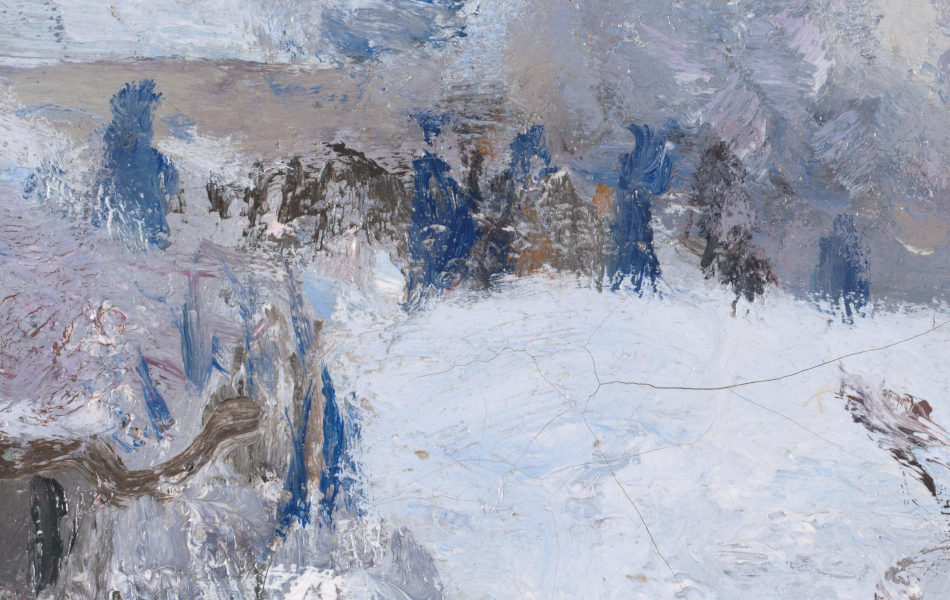
A snow-covered road stretches into the distance, with small figures walking through Monet's quiet suburban scene at Argenteuil. The soft light and muted tones create a calm winter atmosphere.
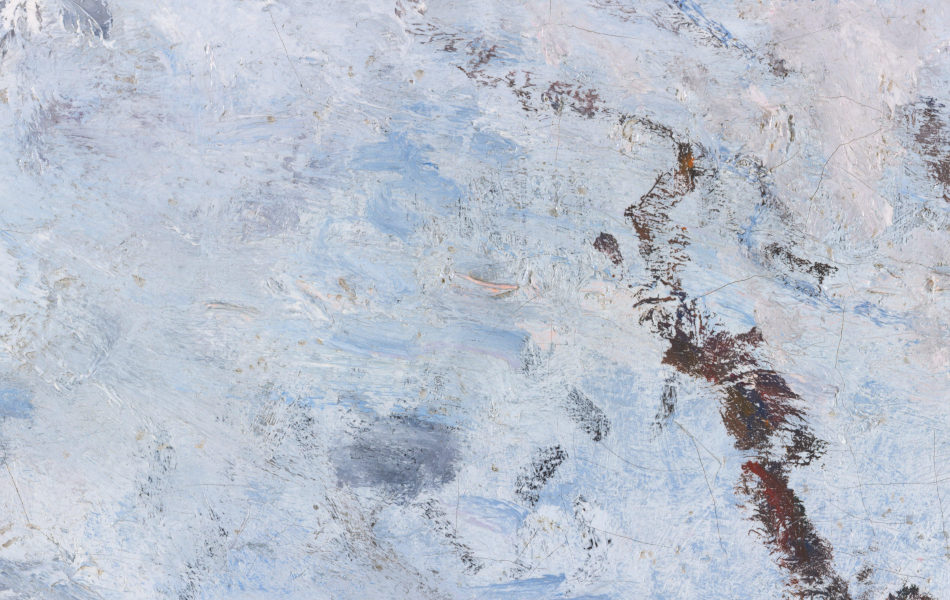
In the foreground, tracks cut through the snow, adding texture and guiding the viewer's eye into the composition. Monet uses subtle variations in colour to suggest depth and movement.
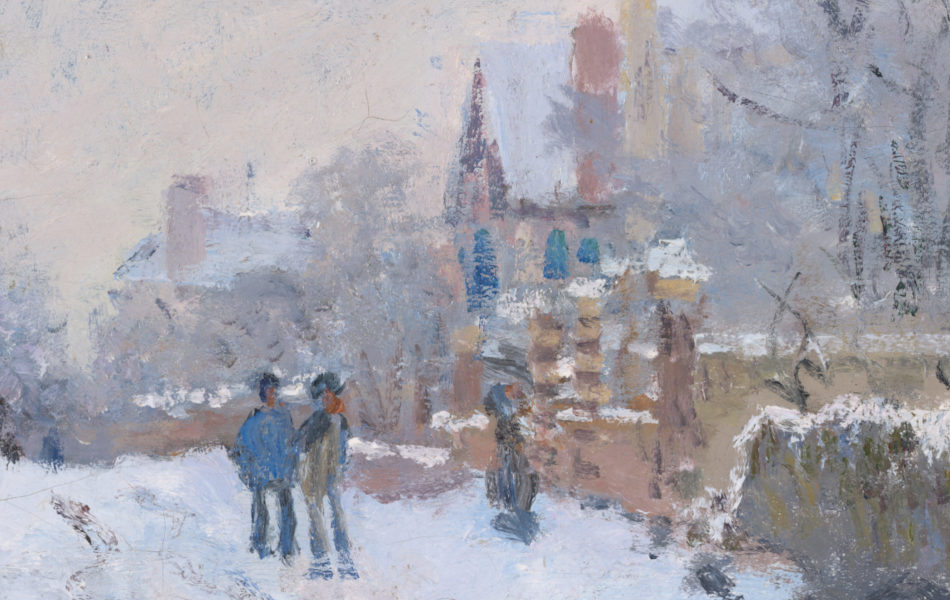
Distant buildings emerge softly through the winter light, their forms partially obscured by the atmospheric conditions. This creates a sense of depth and quiet distance.
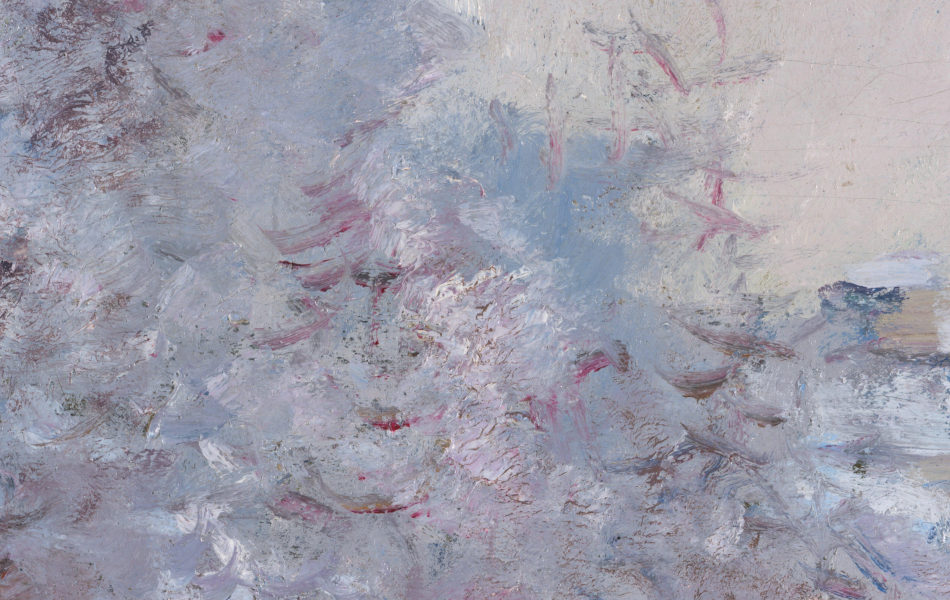
Trees providing vertical balance, with fences providing perspective
Atmosphere and Perception
Snow at Argenteuil is a painting about perception. It captures not just what the scene looks like, but how it feels to experience it. The muted light, the softened edges, and the reduced palette all contribute to a sense of quiet observation. He, essentially, reduced the visual world to its essential forms.
Impressionism marked a shift away from traditional approaches to landscape painting, bringing in an emphasis on atmosphere, embracing ambiguity, allowing forms to dissolve in a similar manner to how Turner had worked in the Romanticism movement. From different angles, and distances, we can enjoy different experiences with the same painting.
Texture and Surface
In the foreground, Monet applies the paint more thickly, particularly along the road where the snow has been disturbed. This creates a tactile contrast with the smoother areas of untouched snow, bringing real texture and variety to the physical aspects of this painting. Individual brushstrokes are visible in some parts of the work, because of the nature of Impressionism, where perfectly refined colours and blends are not desired.
Monet's use of texture in his brushstrokes would become more and more apparent in later works, but in this painting we see early signs of this progression. It is one of many innovations found within this movement, and another reason for critics to initially reject their work.
Figures and Human Presence
The figures in Snow at Argenteuil are small and loosely defined, yet they are essential to the composition. They introduce scale, movement, and a subtle narrative element without dominating the scene. They remind some of the later work of British artist L. S. Lowry, with their simple features.
There is an anonymity to these figures, we can see enough to notice them, but no more than that. They merge with the background, rather than merely walking within it. Everything in the scene is intended to fuse together seamlessly.
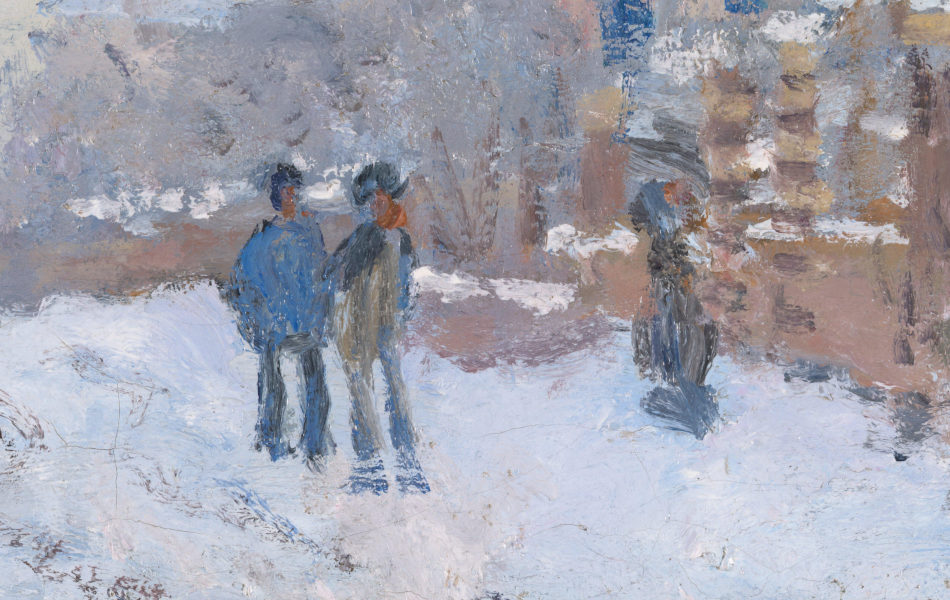
The small figures are loosely defined, blending into the landscape rather than standing apart from it. Their presence adds scale while maintaining the painting's atmospheric unity.
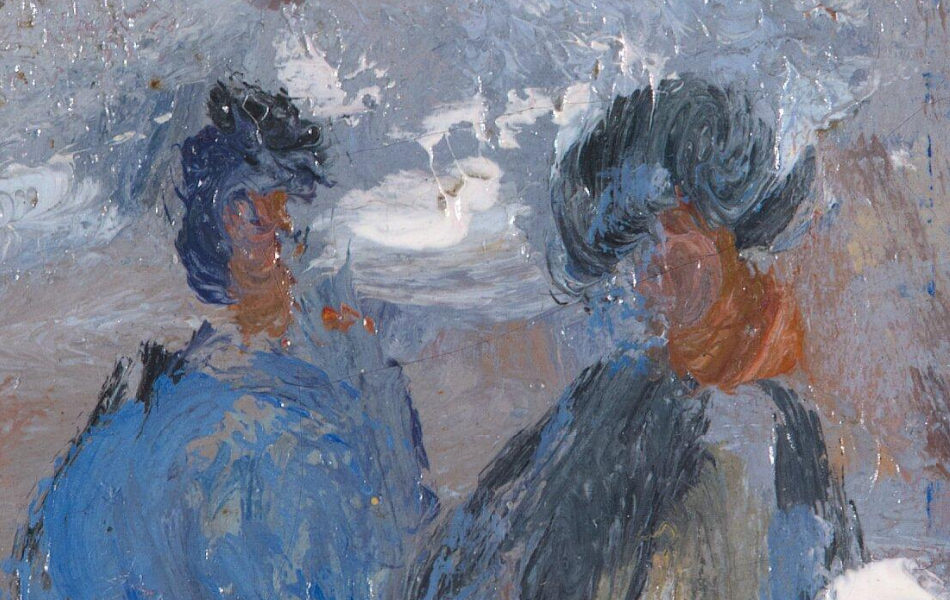
Two Figures Chatting on the Road
Colour
One of Monet's most important achievements in this painting is his rejection of the idea that snow is simply white. Upon close inspection, strokes of reds, yellow, green and dark blues help to break up the large areas of expanse.
This approach reflects a broader Impressionist principle: that colour is relative, shaped by surrounding tones and changing conditions. Snow becomes a surface that reflects the sky, absorbs shadows, and responds to light in constantly changing ways.
The sky itself is overcast, casting a diffuse, even light across the scene. There are no strong shadows, only soft transitions between tones. This creates a muted palette, but one that is rich in variation when observed closely.
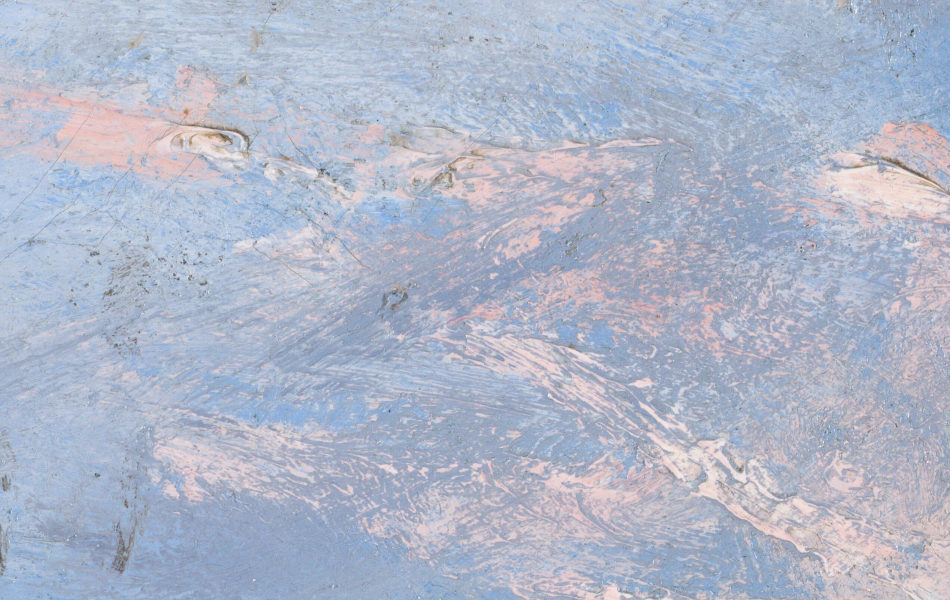
Monet avoids pure white in the snow, instead using blues, greys, and violets to capture the effects of light and shadow. This subtle use of colour is central to Impressionist technique.
Impressionism and Modern Life
Impressionist artists such as Monet are most famous for their landscapes and seascapes, but they also captured modern life in its many different guises. Monet showed within paintings such as this that even seemingly ordinary scenes or views could be uplifted into artistic beauty, with subtle touches of brilliance and creativity in colour, light and composition.
Previously, French art was dominated by bolder subjects, such as historical or mythological subjects, but Monet and his colleagues pushed away from this, opening up new genres of art that would, eventually, gain favour in their native France.
Provenance
The painting was sold to Théodore Duret in December 1879. Duret recalled a conversation with another artist known as Édouard Manet, reporting that Manet once wanted to capture snow in a painting. Duret showed Manet the painting that he acquired from Monet and once Manet saw it, he claimed that it was perfect and that he would not know how to do better.
He then gave up on the idea of painting snow. Snow at Argenteuil was then sold to the art dealers Boussod, Valadon et Cie, located in Paris, in 1892. In 1983, Harris Whittemore of Connecticut bought it until it was acquired by the Acquavella Galleries of New York in the 1970s.
Simon Sainsbury later purchased the painting in 1973 from the Gallery. The painting remained with him until it was bequeathed in 2006 to the National Gallery in London. It remains on display to the public in the gallery to this day.
Where is the Painting Located Today?
Claude Monet's Snow at Argenteuil from 1875 is today located at the National Gallery, London, UK.
The painting was bequeathed by Simon Sainsbury to the National Gallery in 2006. Typically it resides in Room 41 of the permanent collection, alongside other significant Impressionist paintings.
Address of The National Gallery
The National Gallery,
Trafalgar Square,
London,
WC2N 5DN
United Kingdom
Large Detailed Image of Monet's Snow at Argenteuil
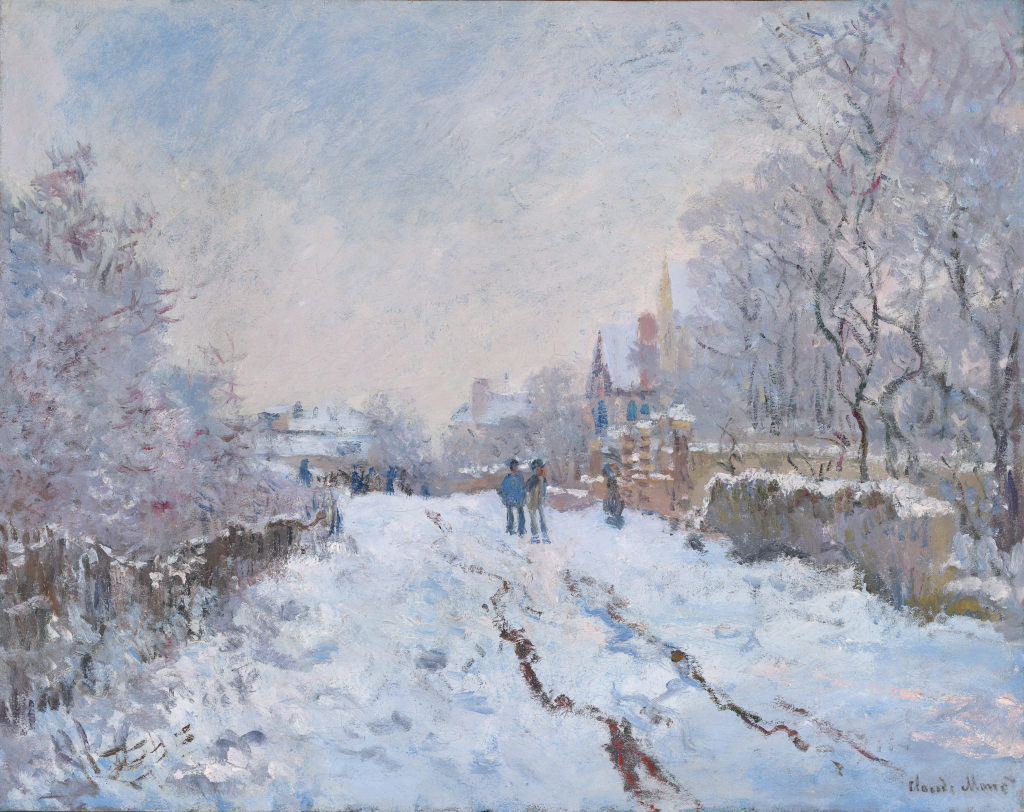
Snow at Argenteuil, Claude Monet, 1875, National Gallery, London
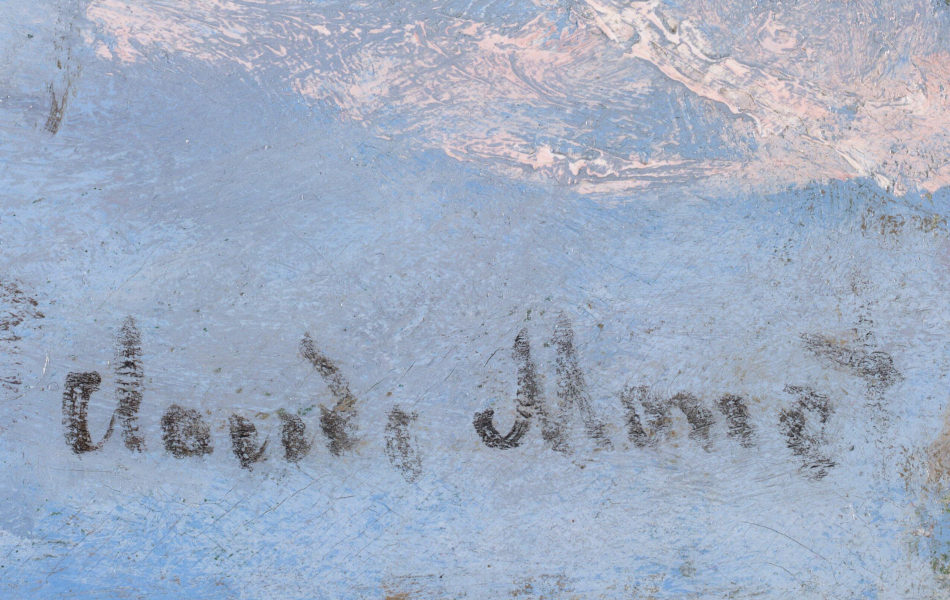
Signature on Bottom Right of Canvas
Connections to Other Winter Paintings
Snow at Argenteuil can be closely linked to other winter scenes by Monet, particularly The Magpie (1868-1869). While The Magpie focuses more on rural stillness and sharp winter light, Snow at Argenteuil introduces a more modern, suburban setting and a softer, more diffused atmosphere, due to their different locations.
Monet became a master of winter paintings, but this ability evolved over time, through his series of snow-based paintings. In the artwork found here, we see some of the early developments, as he worked on his handling of light and colour. Over time, Monet moved from a more defined and structured composition toward a looser, more atmospheric style - light and colour would truly take precedence over form.
Significance of Monet's Snow at Argenteuil
This painting is recognised as one of Monet's most important winter landscapes. It underlines the subtle touches of his work, and ability to re-invent content under varying conditions. the prioritisation of light over form, the embrace of modern content and the commitment to capturing the fleeting qualities of a moment in time are all perfect examples of Impressionism, as it would become, in action.
Snow at Argenteuil is a subtle and unassuming work that reminds us of how even the most ordinary moments can reveal extraordinary depth when observed closely.
Critical View
A recent publication on Monet's life provided additional information on the artist's winter series, including the passage below:
Complementing the atmosphere of retreat and stillness are sixteen snowscapes of Argenteuil silent, etherealized in muted whites tinged with lavender, violet, pale greys, beneath opalescent skies.
Duret bought the largest, Snow Scene at Argenteuil, depicting the boulevard Saint-Denis looking toward the river. One winter he showed it to Manet, who had talked of painting a snow scene; on seeing it, Manet declared it impossible to do better, and gave up the idea.
Jackie Wullschlager, Monet - The Restless Vision, PP164, Allen Lane
Discussion
Monet's Snow at Argenteuil is a painting that reveals more the longer you look. At first, the scene appears simple — a quiet road, a few figures, and a blanket of snow. But with closer attention, subtle details begin to emerge, from the colour within the snow to the way the composition guides the eye into the distance.
This kind of understated scene often sparks different interpretations. Some viewers are drawn to the atmosphere and stillness, while others notice the structure and careful balance beneath the surface.
What do you notice?
Is your attention drawn first to the figures, the tracks in the snow, or the soft winter light? Do you see this as a peaceful moment, or as a glimpse of everyday life in a modernising world?
Reader Insights
Atmosphere: The muted colours make the scene feel very still and quiet, as if sound itself is absorbed by the snow.
Question: Do you think the figures are important to the painting, or would it work just as well without them?
Join the Conversation
Have a thought about Snow at Argenteuil? Share your perspective below — whether it's a detail you've noticed, a question, or simply your reaction to the scene. Selected insights may be featured on this page.

Observation: The tracks in the snow feel like they carry the whole composition forward, almost pulling the viewer into the painting.