


 by
Tom Gurney
Tom Gurney BSc (Hons) is an art history expert with over 20 years experience
Written on November 8, 2026 / Updated on November 8, 2026
Email:
tomgurney1@gmail.com
/ Phone:
+44 7429 011000
Valley of the Creuse (Sunlight Effect)
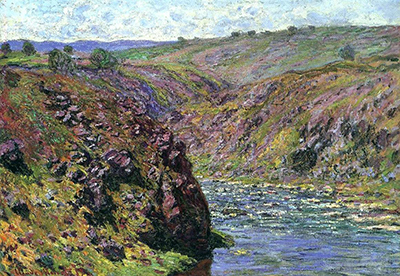
Claude Monet’s Valley of the Creuse (Sunlight Effect) brings a rocky river landscape into a concentrated pattern of blues, greens and violet shadows. Painted in 1889 near Fresselines, this canvas belongs to the Museum of Fine Arts, Boston, as inventory 25.107. The catalogue raisonné identifies it as W1219. A heavy rock formation projects into the foreground at the left, while the river bends away through the valley, its surface interrupted by bright strokes of white.[1][2][3]
At a Glance
Identifying the sunlight effect
This is a particular painting within a group of Creuse views, rather than a general title for the whole campaign. In the catalogue raisonné, W1219 appears under the French title Les Eaux semblantes, Creuse, effet de soleil. It is signed and dated Claude Monet 89 at the lower left. The catalogue records a horizontal canvas of 65 by 92 centimetres, a format that allows both the near rock face and the opposite slope to occupy substantial areas.[2]
Boston’s own exhibition credits identify the work as Valley of the Creuse (Sunlight Effect), in the Juliana Cheney Edwards Collection, 1925. They distinguish it from the museum’s Valley of the Creuse (Gray Day), inventory 06.115. The two titles describe different canvases. Keeping the accession and catalogue numbers together prevents the sunlight picture from acquiring the other work’s dimensions or ownership history.[2][3]
Fresselines in 1889
Monet’s sustained work around Fresselines belongs to the spring of 1889. The catalogue places the local landscape campaign between March and May. The Musée des impressionnismes Giverny’s chronology also records his spring stay with the poet Maurice Rollinat. This was an excursion from the region of Giverny to a landscape where rocky slopes and the meeting of rivers offered a different set of visual problems.[2][4]
The meeting of the Grande Creuse and Petite Creuse gave Monet more than one direction in which to look. The catalogue’s description of the wider view W1218 identifies the junction at the place called Les Piles and places the painter on the slope descending from Confolent farm. That wider view helps orient the group. W1219 concentrates on the large rock formation and the river winding away beyond it, rather than repeating the entire panorama.[2]
The geographical setting matters because the river is not simply a band laid beneath an attractive hill. Its bend determines where the slopes meet and where the nearest rock cuts into the water. The picture’s structure therefore grows from the relationship between channel and landform. Without needing to show a broad horizon, Monet makes the movement through this restricted space legible.
Rock, slopes and the river’s course
The foreground rock at the left is the most forceful near object. Its dark central face contrasts with smaller light marks along its broken upper edge. The form feels heavy, yet its outline is far from a smooth silhouette. Irregular projections and patches of colour make it look uneven, and the surrounding vegetation helps join it to the larger slope instead of isolating it as a separate specimen.
Across the valley, the land rises in long diagonals. Violet and mauve passages run among greens and warmer earth colours, producing a surface that seems folded and interrupted. The opposing slopes guide attention toward the narrowing middle distance. They also keep the blue water from becoming an empty central opening: it remains pressed between substantial, differently angled banks.
Only a narrow strip of sky appears above the ridges. That limited opening makes the valley occupy almost the whole canvas. The distant skyline is lower and gentler at the left, then climbs toward the right. Its movement answers the stronger diagonals below without competing with them. The eye has an exit toward the distance, but the painting continues to emphasise the immediate encounter of rock and water.
The river’s route is easiest to follow where the lightest marks gather. It is broadest near the lower right and becomes more compressed as it turns into the valley. That change in width creates depth, while the near rock interrupts a straightforward recession. The viewer must look around it, following an implied curve instead of a single unobstructed line toward the horizon.
Sunlight, water and painted colour
The Museum of Fine Arts describes the confluence under midday sun and draws attention to the white impasted strokes in the water. This is the museum’s interpretation of the light effect. It is not an exact time recorded by a clock in the painting. The brighter passages make the river sparkle, while the shadows keep the rock forms from dissolving into a uniformly sunny surface.[1]
Blue water runs against the warmer and greener banks, but neither side of that contrast is uniform. White and pale yellow-green strokes interrupt the blue. On the land, small dark patches and violet passages sit beside more luminous touches. The scene is held together by these repeated differences, rather than by one continuous outline separating every object from its surroundings.
Many of the brightest water marks stretch across the direction in which the river recedes. They let the surface feel active even as its larger shape carries the eye into depth. Near the lower edge, the strokes are easier to distinguish; farther back, they gather more tightly. The painted surface thus suggests both a moving river and a dense arrangement of separate marks.
The land has a different rhythm. Marks appear to follow changes in slope, broken ledges and scattered vegetation. In the foreground, the darkest rock area creates a strong pause within that variety. The contrast between dense land and flickering water helps explain why the landscape remains readable despite its many small touches. Texture is part of the composition, not merely a final decoration added to it.
Nothing in a reproduction can establish every stage of Monet’s work. The visible energy of the brushwork does not prove that the entire canvas was completed in one sitting. Nor can a blue or violet passage identify a chemical pigment by sight alone. What can be observed is the deliberate relationship between differently handled surfaces, and the way those relationships make sunlight seem present throughout the view.
Related views and changing effects
The catalogue places W1219 near several related river landscapes. W1220, a view at the end of the day, is recorded in the Musée des Beaux-Arts in Reims, while W1221 is the grey-sky picture in Boston. The neighbouring works provide comparisons in format, atmosphere and emphasis. Their position in the catalogue does not establish a day-by-day order in which Monet painted them.[2]
In the grey-sky version, the land and water are less sharply separated by flashes of brightness. Comparing that image with W1219 makes the sunlight effect more specific: the light does not simply add yellow to a fixed arrangement. It changes which edges stand out and which areas attract attention. The rock mass and the bend remain recognisable, yet the balance among them shifts.[2]
Other canvases adopt different viewpoints or different proportions. W1218 is a vertical overview, whereas W1219 spreads the encounter between opposing banks across a wider field. These choices affect how much surrounding terrain the viewer receives. A shared place is therefore the basis for variation, not evidence that every Creuse painting shows an identical view with only its colours altered.[2]
Ownership and the Boston collection
The catalogue traces W1219 from Monet to Boussod, Valadon et Cie in June 1889, then to Williams and Everett in 1891. It records James F. Sutton as an owner around 1905. At the Sutton sale in January 1917, the picture appeared as lot 153 and passed to Durand-Ruel. These details belong to the sunlight canvas, rather than to the adjacent views in the catalogue.[2]
Juliana Cheney Edwards is recorded as the owner in 1924. The catalogue then describes the painting’s 1925 bequest by Robert J. Edwards in memory of his mother to the Museum of Fine Arts, Boston. The museum’s exhibition credits retain the Juliana Cheney Edwards Collection designation and accession 25.107. The named collection and inventory number connect the historical record to the work identified by the museum.[2][3]
The early exhibition record includes the Monet–Rodin exhibition at Boston’s Copley Hall in 1905, where the catalogue lists it as number 28, and a Brooks Reed Gallery presentation in Boston in 1920. Its proposed appearance as number 128 in the Paris Monet–Rodin exhibition of 1889 is marked uncertain. That question mark remains part of the evidence and should not disappear when the history is retold.[2]
Looking again at the confluence
Start with the large left-hand rock, then trace the brightest marks as the river turns into the distance. Compare the diagonals of the slopes with the more horizontal strokes on the water. Finally, notice how little sky the picture needs. The valley becomes spacious through the relationships within it, even though the framing gives the surrounding land almost all the room.
Frequently Asked Questions
This canvas dates from 1889, during his work around Fresselines. It is signed and dated Claude Monet 89 at the lower left.[2]
Discussion
These editorial prompts invite your observations about Monet’s river landscape.
Reader Insights
How does the large rock change the path your eye follows through the valley?
Which violet passage changes most when seen beside the blue water?
Where do the white water marks have the strongest effect?
Join the Conversation
Share an observation or question about Valley of the Creuse (Sunlight Effect) below.
References
- Museum of Fine Arts, Boston — Valley of the Creuse (Sunlight Effect), 1889: About the Artwork, MFA Custom Prints. View source
- Wildenstein Plattner Institute — Daniel Wildenstein, Monet, Catalogue Raisonné, volume III, W1218–W1221, printed pages 464–465. View source
- Museum of Fine Arts, Boston — Monet and Boston: Virtual Exhibition Celebration, art credits, Valley of the Creuse (Sunlight Effect), 25.107. View source
- Musée des impressionnismes Giverny — Before the Water Lilies: Monet Discovers Giverny, 1883–1890, 2026 press pack, timeline, page 10. View source







