


 by
Tom Gurney
Tom Gurney BSc (Hons) is an art history expert with over 20 years experience
Written on November 8, 2026 / Updated on November 8, 2026
Email:
tomgurney1@gmail.com
/ Phone:
+44 7429 011000
The Hunt
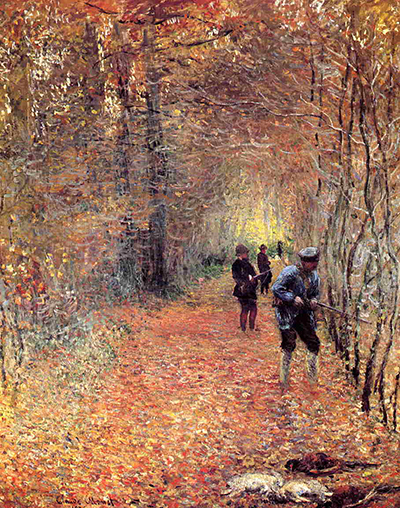
Claude Monet’s The Hunt places three hunters within a tall woodland scene. A path draws the eye into the trees, autumn colour spreads across the ground and foliage, and the nearest figure’s blue upper garment makes a strong accent on the right. Painted in 1876 and catalogued as Wildenstein 433, the canvas formed part of Ernest Hoschedé’s decorative commission for Montgeron. Its large format brings human activity and landscape into the same field, while the game in the foreground helps establish the hunting subject.[1][2]
At a Glance
Identifying the 1876 panel
Wildenstein catalogues the painting as W433 and records an oil on canvas measuring 173 by 140 centimetres. Monet signed and dated it Claude Monet 1876 at the lower left. Its vertical format, woodland setting and hunting figures identify a particular large decorative panel, rather than a general example of a forest scene. The title The Hunt describes the activity that links the people, their equipment and the game in the foreground.[1]
The figures share the image with a substantial area of landscape. Trees rise through much of its height, and the path creates room between the nearest person and the hunters further away. The scene can therefore be approached both as a view through woodland and as a hunting party placed within it. The subject emerges through the relationship of those elements, rather than through an isolated portrait.
The Montgeron commission
Ernest Hoschedé commissioned a decorative group for his Château de Rottembourg at Montgeron in 1876. The Hunt was one of four panels, alongside The Turkeys, Corner of the Garden at Montgeron and Pond at Montgeron. Wildenstein’s account places the commission in the summer and records delivery of The Hunt in December 1876. The Art Institute of Chicago’s scholarly discussion likewise associates the four works with Hoschedé’s commission.[1][2]
This setting gives the size of the painting a practical context. At 173 centimetres high, the canvas offers a substantial vertical field for figures and trees. It could participate in a larger decorative ensemble while retaining a complete composition of its own. The subject also relates an activity on the estate to the planted and wooded surroundings represented by the other panels, giving the group a range of ways to encounter the place.[1][2]
The commission does not make all the related woodland paintings the same object. The nearby catalogue entries W431 and W432 concern separate wooded subjects. Their exhibition and ownership records remain distinct from W433. Keeping the objects separate is particularly useful here because trees, paths and autumn colour can create a broad family resemblance, even when a picture’s scale, figures and role within the commission differ.[1]
The path and the vertical trees
The path supplies the main movement into the scene. It opens space near the lower edge and carries the eye towards the smaller figures deeper in the woodland. The nearest hunter occupies the right-hand side rather than standing at the end of a rigid central perspective. This offset arrangement allows a person to be prominent while leaving the route through the picture available to the viewer.
Trunks establish a different rhythm. Their upright lines extend the scene above the people and give the woodland a scale that exceeds the human activity below. The spaces between them are equally important, allowing fragments of light and more distant ground to appear. A tree can act as a boundary between nearer and further passages without turning the view into a series of completely closed compartments.
The relationship between path and trunks makes distance readable. One direction recedes across the ground; another rises through the height of the canvas. Smaller figures help measure the recession, while the tree structure keeps the eye aware of the larger vertical field. Monet brings these movements together so that the woodland remains an inhabited space, with people moving through an environment that retains its own complexity.
The hunters and their scale
The nearest hunter’s blue upper garment gives the right-hand figure a clear place among warmer ground and foliage. His prominence depends on that contrast as well as his size. The other figures are smaller and further along the woodland route, allowing the viewer to register a succession of distances. Their arrangement makes the group readable without lining every person up across the same shallow foreground.
Wildenstein identifies Ernest Hoschedé among the hunters in the middle ground. This places the patron within the landscape connected to his commission. The attribution is specific to that part of the scene; it does not name every person or turn the nearest figure into an established portrait of Hoschedé. The painting can retain both a documented personal connection and figures whose identities remain unrecorded in the cited entry.[1]
The hunting equipment and game help explain the activity. Carried guns distinguish the party from people simply walking through the woods, while the game introduces another element near the viewer. These details give the figures a reason to occupy the setting, but they remain part of the overall composition. The path, trees and changing colour continue to hold much of the image’s visual attention.
Autumn colour and the decorative surface
Warm autumn colours spread through the woodland and ground. Against them, darker trunks and cooler accents give the eye points of contrast. The blue garment is particularly useful in this respect, because it introduces a compact area that differs from the surrounding earth and foliage. The figures become legible through colour relationships as well as through their outlines and the space they occupy.
Light appears through the intervals between the trees and across portions of the path. These openings prevent the vertical structure from becoming a flat screen. A brighter passage can suggest space beyond a trunk, while a darker interval brings another form closer. The scene’s depth therefore develops through changing colour and tone as well as the more direct signs of overlapping forms and diminishing figures.
Seen as a decorative panel, the work combines this activity of small marks with a larger arrangement of uprights and open ground. The viewer can recognise the group and the route through the wood from the overall structure, then return to the less regular details of colour. The painting’s scale allows those two kinds of looking to coexist: an organised landscape at a distance and a varied surface at closer range.
Ownership and exhibitions
The recorded history begins with delivery by Monet to Ernest Hoschedé in December 1876. Wildenstein then lists Théodore Duret in connection with 1880, with a question mark. The qualification matters to that early stage of the provenance. A later entry is more precise: the Duret sale at Georges Petit in Paris on 19 March 1894, where the painting was lot 25 and Durand-Ruel is recorded.[1]
The subsequent names in the catalogue include the Comtesse de Brecey in Paris and Durand-Ruel. The 1996 record describes a deposit at the Musée de la Chasse et de la Nature in the Hôtel Guénégaud, Paris. This is a historical collection statement, rather than a confirmation of the painting’s present location. It describes the position recorded by that catalogue at a particular point in the work’s history.[1]
The exhibition entries also help separate this canvas from the neighbouring woodland pictures. Wildenstein records an appearance with Paul Cassirer in 1905, number 20, and at Georges Petit in 1924, number 31. These are records for The Hunt itself. Keeping their object connection clear gives the painting a more precise history than a general account of Monet’s forest scenes or the commission as a whole.[1]
A later document and an enduring composition
A later administrative record adds two further dates. The French Ministry of Culture’s published list records a refusal of an export certificate for La Chasse on 10 June 1997 and a certificate issued on 19 June 2000. These entries document administrative steps. By themselves they do not show that the picture was exported, sold or moved to a particular collection, so they cannot supply a missing account of its present whereabouts.[3]
The image remains compelling as a meeting of human activity and a wooded estate. The three hunters occupy different distances, the nearest blue accent holds the right-hand foreground, and the trees extend above them through the tall canvas. Its decorative purpose helps explain the substantial format, while the path and changing colour give the landscape an internal movement. The scene can be understood as one complete work and as part of Hoschedé’s larger Montgeron commission.
Frequently Asked Questions
It dates from 1876 and is signed and dated Claude Monet 1876 at the lower left. Wildenstein catalogues it as W433.[1]
Wildenstein identifies him among the hunters in the middle distance. The record does not identify every figure.[1]
The 1996 catalogue records Durand-Ruel, Paris, with a deposit at the Musée de la Chasse et de la Nature. That historical entry does not establish a current location or display status.[1]
Discussion
Look again at the woodland path, hunters and changing colour in this painting. These editorial prompts invite your observations.
Reader Insights
Follow the path from the foreground towards the smaller figures.
Compare the upright trunks with the receding movement of the ground.
How does the panel’s large vertical format change the balance of figures and landscape?
Join the Conversation
Share a detail, comparison or question about The Hunt below.
References
- Daniel Wildenstein / Wildenstein Plattner Institute — Monet, volume II, 1996, entry 433, printed pages 175–176 (digital viewer 179–180): identity, commission, figures and historical record. View source
- Art Institute of Chicago — Monet scholarly catalogue, discussion of Hoschedé’s 1876 Montgeron commission and its four panels. View source
- French Ministry of Culture — Historical export-certificate record, list dated 30 April 2019, page 3, row 41: La Chasse, refusal in 1997 and certificate issued in 2000. View source







