


 by
Tom Gurney
Tom Gurney BSc (Hons) is an art history expert with over 20 years experience
Published on October 6, 2016 / Updated on October 23, 2026
Email:
tomgurney1@gmail.com
/ Phone:
+44 7429 011000
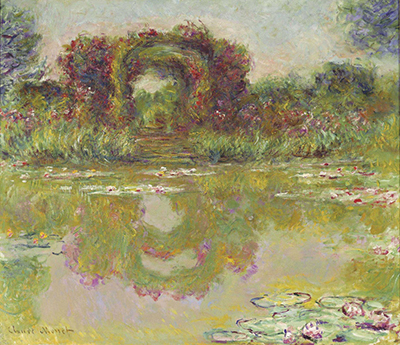
The Rose Arches, Giverny, 1913
The Rose Arches, Giverny is the pond-side scene held by Phoenix Art Museum as Les arceaux fleuris, Giverny, or Flowering Arches, Giverny. Dated 1913, it is inventory 1964.231. A flowering arch on the far bank faces its reflection across a broad expanse of water dotted with lily pads. [1]
At a Glance
A flowering tunnel across the water
The arch occupies the upper centre of the painting. Its supporting structure is largely concealed by plants, leaving a rounded opening framed by warm red, purple and green strokes.
A narrow path can be followed through this opening, but the view does not invite us to walk directly into it. Water separates the viewer from the far bank, making the bower something seen across a reflective surface.
The garden's official educational trail identifies this subject with a viewpoint opposite the jetty. That is a useful distinction from the rose-covered central paths in the flower garden nearer the house. [3]
The arrangement gives the arch a double role. It suggests a sheltered place through which a person could pass, yet also functions as a concentrated shape against the comparatively pale water.
The Giverny garden article supplies the larger setting. In this painting, one part of that cultivated environment becomes an unusually strong focus without losing its connection to the surrounding pond.
The reflected arch changes the composition
Below the bank, the arch appears again, turned upside down. Its reflected opening is softer and less secure than the one above, but still clear enough to draw the eye towards the centre of the water.
The two forms almost make a loop. Between them, the bank and a band of lighter strokes interrupt a simple symmetrical reading. Monet keeps the relationship recognisable without making the reflection mechanically exact.
Warm touches from the flowering plants reappear in the pond, while cooler passages spread around them. A patch that first reads as water can therefore become an image of something growing above it.
The open surface also controls distance. The bower seems accessible enough to understand, but too far away to inspect individual blossoms.
The Painting Water article examines this interplay of surface and reflected space. Here a single repeated shape makes the effect especially tangible: the arch is both a solid feature on the bank and a fragile presence within the pond.
Lily pads bring the foreground closer
The largest lily pads gather near the lower right. Their curved outlines and pale centres are more individually legible than the foliage covering the distant arch.
Small pink-white flowers create accents among them. Elsewhere, thinner horizontal groups of leaves cross the water, helping separate the immediate foreground from the farther bank.
These groups do not form a regular decorative border. Their unequal spacing leaves broad passages of quieter colour, allowing the eye to move towards the reflected opening.
The nearest leaves also prevent the picture from becoming only a view of the bower. The pond has its own life and scale, and its plants occupy a different plane from the climbing roses.
The Water Lilies overview considers Monet's many ways of framing this subject. In the Phoenix painting, waterlilies remain part of a larger garden scene rather than filling the canvas from edge to edge.
Colour without a simple recipe
Phoenix Art Museum draws attention to the effect of contrasting reds and greens and to the painting's textured surface. [1] The two colour families are especially noticeable where the flowering arch meets its darker interior.
They do not divide the canvas into separate zones. Warm marks enter the water, while greens appear both in the distant plants and in the nearer lily pads.
The pale lilac-grey passages matter just as much. They give the stronger colours space and prevent every part of the painting from demanding equal attention.
Visible strokes cannot, however, reveal every mixture on Monet's palette. A vivid effect is not proof that he used only unmixed paint straight from the tube, nor that one standard sequence governed the whole canvas.
The Technique article separates observation from technical examination. Here colour can be described closely without inventing a pigment analysis or a universal method for all of Monet's work.
Why the date 1913 matters
The Fondation Beyeler's chronology places the flowering-arches paintings in the summer of 1913. It distinguishes this activity from the renewed large-scale Water Lilies project of the following years. [6]
The date also prevents confusion with the much later rose-path paintings. The Phoenix canvas belongs to an earlier investigation of a pond-side motif, not automatically to every work containing an arch covered with roses.
A Christie's catalogue for a different 1913 painting identifies a small group that includes the Phoenix work. Its account is useful for comparison, but the private painting's ownership and sale history belong to that other canvas. [8]
The appearance of this scene should not be turned into a precise diary of Monet's feelings. A bright colour arrangement cannot by itself establish recovery from grief, and a blurred passage is not a medical diagnosis.
The stronger conclusion is pictorial: by 1913 Monet could make the familiar garden sustain a composition in which one flowering structure and its reflection organise a large field of colour.
Not the later path under rose arches
The Musee Marmottan Monet holds L'allee des rosiers, Giverny, inventory 5089, dated 1920-1922. Its account locates that rose alley in the extension of the house and describes a densely painted arch surrounded by vegetation. [5]
That is a related motif, but not the Phoenix picture. Titles translated as rose arches or rose path can obscure the difference between a view across water and a view into a planted passage on land.
The distinction changes interpretation. In the pond-side scene, reflection doubles the arch and broadens the composition downwards. In a path painting, the passage through the vegetation can become the principal route into the image.
The Kimbell's account of Monet's late work also stresses the prolonged activity visible in many canvases. Outdoor observation and extended revision need not be opposites. [7]
The Painting Series guide follows such returns to related subjects without treating every repeated motif as one continuous, uniformly dated series.
A designed garden and a museum history
Monet's pond was made, planted and maintained. The official Giverny history records his acquisition of the water-garden land in 1893 and the diversion of the Ru, a branch of the Epte. [4]
The arch adds another layer of design. Plants grow over a structure, and Monet then selects how much of that structure, its surroundings and its reflection to include. Natural growth and deliberate arrangement remain intertwined.
Phoenix's museum history records the Harringtons' donation of this painting during the collection's expansion in 1964-1965. The current object record credits Mr. and Mrs. Donald D. Harrington. [1] [2]
Within the canvas, the most revealing comparison remains between the far arch and the nearer lily pads. One is a distant mass with an opening; the others are scattered forms whose outlines can be followed individually. Water brings them into the same field while keeping their distances distinct.
The painting's richness comes from that balance of recognition and dissolution, not from a generic formula about painting outdoors.
Frequently Asked Questions
The painting discussed here belongs to Phoenix Art Museum, object 1964.231. [1]
Phoenix dates it to 1913. [1]
No. The Marmottan's inventory 5089 is a different painting dated 1920-1922. [5]
No. The flowering arch shares the composition with its reflection, the pond and groups of waterlilies.
Discussion
Look again at the images and ideas explored in The Rose Arches, Giverny, 1913. These editorial prompts invite your observations.
Reader Insights
Compare the opening in the arch with its reflection below.
Follow the spaces between groups of lily pads.
Notice how pale water balances the dense red-green foliage.
Join the Conversation
Share a detail, comparison or question about The Rose Arches, Giverny, 1913 below.
References
- Phoenix Art Museum , Les arceaux fleuris, Giverny, 1913, 1964.231; current collection record. View source .
- Phoenix Art Museum , Press Kit 2025-2026, printed pages 9 and 13; reproduction and Harrington donation history. View source .
- Fondation Claude Monet / Maison et jardins , Educational trails, The Artist's Place, item 3 and answer page; the Phoenix canvas and viewpoint. View source .
- Maison et jardins de Claude Monet , Water lily pond; construction and cultivation. View source .
- Musee Marmottan Monet , L'allee des rosiers, Giverny, 1920-1922, inventory 5089; a distinct later canvas. View source .
- Fondation Beyeler , Claude Monet, 2002 exhibition chronology; the 1913 flowering-arches campaign. View source .
- Kimbell Art Museum , Monet: The Late Years, 2019; later working process and garden motifs. View source .
- Christie's , Les arceaux de roses, Giverny, 1913, 2007 lot 11; a separate canvas and comparison with the Phoenix painting. View source .







