


 by
Tom Gurney
Tom Gurney BSc (Hons) is an art history expert with over 20 years experience
Published on October 6, 2016 / Updated on October 23, 2026
Email:
tomgurney1@gmail.com
/ Phone:
+44 7429 011000
Boats in the Port of Honfleur
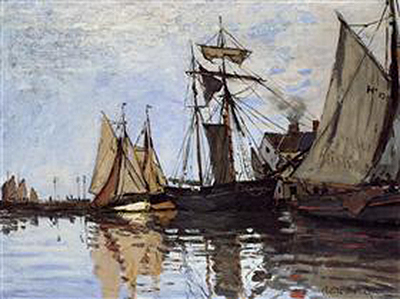
In Boats in the Port of Honfleur , Claude Monet brings the viewer close to the water, beneath a rising network of sails and rigging. A dark-hulled vessel anchors the centre while lighter sails lead towards the harbour entrance on the left. Painted in 1866, the oil is catalogued as Wildenstein 77a. Its compact view of working boats belongs to Monet's early exploration of the Normandy coast, before the first Impressionist group exhibition. [1] [2]
At a Glance
A harbour seen from close to the water
The boats rise above a low stretch of water rather than being surveyed from a high quay. This makes their hulls seem substantial and their masts unusually tall. The largest sail on the right is cut by the edge of the canvas, suggesting that the harbour continues beyond the frame instead of being arranged as a self-contained display.
The view opens towards the left, where smaller sails and the line of a jetty mark a greater distance. That opening balances the crowded right-hand side. Monet allows a relatively broad area of pale sky above the smaller vessels, giving the tallest rigging room to spread without filling every part of the picture equally.
The shoreline buildings remain partly concealed behind the ships. Their roofs and chimney offer a sense of the town, but architecture does not take command. Honfleur is encountered through its vessels and waterfront activity, rather than through a panoramic inventory of streets and monuments.
Sails, masts and a web of rigging
A principal pleasure of the picture is the movement between large shapes and fine lines. The sails present broad, uneven triangles; ropes cross the sky as narrow diagonals. Vertical masts hold these different elements together. The eye can move from one vessel to the next by following the directions of the rigging, even where the hulls overlap.
The dark centre keeps this complexity from becoming weightless. Above it, several levels of horizontal spars and gathered canvas interrupt the mast. To the right, a much larger pale sail spreads almost like a screen. On the left, warmer sails produce a smaller, repeated rhythm towards the harbour entrance.
Although the boats are packed closely, they do not merge into one anonymous mass. Differences of height, colour and angle give each a distinct presence. Monet makes that differentiation part of the composition without requiring the viewer to identify every vessel or understand the technical function of each rope.
Reflections that loosen the solid forms
Below the boats, the picture changes its vocabulary. The masts and sails are reflected, but their straightness is broken by the water. Long dark shapes dissolve into shorter horizontal strokes; warm sail colours reappear as irregular patches. The reflections make the water carry the boats' colours without becoming a second, inverted harbour.
This is particularly clear beneath the central vessel. Its solid dark hull gives way to an interrupted shadow, crossed by lighter marks. Nearby, the pale sail and smaller yellow accents create a different rhythm. The surface has a gentle movement, far removed from the breaking surf of Monet's coastal storm scenes.
The result is not a division between a carefully described upper half and an unimportant foreground. The water actively reorganises what stands above it. It connects the vessels while softening their boundaries, and its lighter intervals prevent the cluster of dark hulls from closing off the lower part of the painting.
Honfleur in Monet's early coastal work
Monet's knowledge of the region developed through repeated stays and contact with other painters. The Musee cantonal des Beaux-Arts in Lausanne records his coastal work with Johan Barthold Jongkind in 1862 and his stay with Frederic Bazille at the Saint-Simeon farm in Honfleur in May 1864. Its account stresses both outdoor beginnings and subsequent studio work in his early marine painting. [3]
Those circumstances help place the 1866 harbour canvas within a period of learning and experimentation, rather than a fully settled formula. Boats offered complex structures, changing light and water in the same subject. The artist could investigate the relation between a physical vessel and the less stable appearance of its reflection.
The connection with Eugene Boudin likewise belongs to this wider coastal formation. It does not make every early marine painting an imitation of one teacher. The tight framing and low viewpoint here give Monet's familiar subject a particularly concentrated character.
A small canvas beside a larger harbour project
During the same period Monet undertook a much larger Port of Honfleur , catalogued as number 77. Wildenstein records dimensions of 148 by 226 centimetres for that painting and reports its destruction during the Second World War. It is a separate object from the surviving 49-centimetre-high canvas discussed here. [2]
Christie's places Boats in the Port of Honfleur within the group of harbour paintings associated with the larger undertaking. That context explains the intensity with which Monet examined the boats, but it should not erase the smaller picture's own organisation. Its close grouping, cropped sail and broad reflections work within a compact rectangle. [1]
A study can be valuable as an independent encounter with a motif as well as through its relationship to another project. Here the boats' proximity matters more than the breadth of the port. The painting draws strength from what it excludes: much of the town, extensive quays and any large foreground narrative.
Pastels show another side of the maritime research
Portland Art Museum holds a separate Honfleur, Sailboats, and Lighthouse , dated 1866-1867. Curator Mary Weaver Chapin describes the pastel as a study containing both lightly indicated boats and more developed vessels. She also notes that its blue paper contributes to the sea and sky, providing a middle tone against which lighter and darker marks can be built. [4]
That sheet offers useful evidence of the attention Monet gave to maritime forms. A quick appearance need not mean casual observation. A mast's angle, a sail's outline or the relationship between neighbouring boats could be investigated in drawings and pastels as well as oils.
The Portland work is not established as a direct preparatory study for this canvas. The comparison is broader: it reveals different ways of investigating Honfleur at approximately the same stage of Monet's career. His pastels belong alongside the paintings as works with their own materials and visual possibilities.
The Cassatt and Getty collection history
Wildenstein records Alexander J. Cassatt's acquisition through his sister, the painter Mary Cassatt. The later Christie's catalogue places the work in his Philadelphia collection around 1881 and follows it through descendants before its sale in 1991, when Ann and Gordon Getty acquired it. It appeared again in their collection sale in 2022. These are documented historical associations, not an identification of the present owner. [1] [2] [6]
The painting also has an exhibition history extending beyond those private collections. The 2022 catalogue records its inclusion in Origins of Impressionism in 1994-1995, Manet and the Sea in 2003-2004 and Monet: The Early Years in 2016-2017. Different exhibitions have therefore approached it through early style, maritime painting and Monet's development. [1]
Its historical titles have not always been consistent. The catalogue notes its appearance as Boats: Holland in a 1920 exhibition. The established Honfleur identification and catalogue number keep that older title from turning into a different geographical claim. [1] [2]
Not the later Marmottan painting
The Musee Marmottan Monet holds another Bateaux dans le port de Honfleur , dated 1917 in its current record. That oil measures 50 by 61 centimetres, carries inventory number 5022 and entered through Michel Monet's bequest in 1966. It must not supply the date or collection for the 1866 canvas. [5]
The repeated title is a reminder that names alone are not enough to distinguish Monet's paintings. Here the catalogue number, dimensions and image identify the early work. Its pale sails, dark central hull and broken water reflections belong to a particular composition, not a generic illustration of any Honfleur visit.
Within the wider Honfleur paintings , it offers a close, almost water-level encounter with the port. Its strength lies in the exchange between solid boats and mobile reflections: a carefully structured scene that remains alive with small variations of light and direction.
Frequently Asked Questions
No. Marmottan's similarly titled oil is a different work dated 1917. [5]
Discussion
Look again at the images and ideas explored in Boats in the Port of Honfleur. These editorial prompts invite your observations.
Reader Insights
Follow the paths made by the rigging between the boats.
How do the reflections differ from the forms above them?
What does the low viewpoint reveal that a high harbour panorama would not?
Join the Conversation
Share a detail, comparison or question about Boats in the Port of Honfleur below.
References
- Christie's , Bateaux dans le port de Honfleur, Ann and Gordon Getty collection sale, lot 53, 2022; primary object, provenance and exhibition catalogue. View source .
- Daniel Wildenstein / Wildenstein Plattner Institute , Monet, volume II, 1996, entries 77 and 77a, printed pages 42-43; separate objects, date and historical ownership. View source .
- Musee cantonal des Beaux-Arts, Lausanne , Sailing Boats at Sea; institutional account of Monet's early coastal work and Honfleur stays. View source .
- Mary Weaver Chapin / Portland Art Museum , Daily Art Moment: Claude Monet; Honfleur, Sailboats, and Lighthouse, 1866-1867, 2020.23.1. View source .
- Musee Marmottan Monet , Bateaux dans le port de Honfleur, 1917, inventory 5022; a distinct later painting. View source .
- Christie's , Ann and Gordon Getty Collection results, 20 October 2022; confirmation of the later sale. View source .







