


 by
Tom Gurney
Tom Gurney BSc (Hons) is an art history expert with over 20 years experience
Published on October 6, 2016 / Updated on October 23, 2026
Email:
tomgurney1@gmail.com
/ Phone:
+44 7429 011000
Claude Monet Pastels
Claude Monet's pastels reveal a different way of working with the colour and atmosphere familiar from his oil paintings. A pastel stick can make a fine line, a rough patch or a broad area of tone without the intermediary of a loaded brush. [6] Monet used that flexibility for coastal views and skies, and later for studies of London. These works deserve attention as individual images, not merely as minor companions to his better-known canvases.
At a Glance
- Medium Dry pigment-based pastel on a support, commonly paper
- Principal settings Normandy and London
- 1874 exhibition Seven pastels alongside five oil paintings. [1] [8]
- Featured work Etretat, the Needle Rock and Porte d'Aval, about 1885
- Featured collection Scottish National Gallery, D 5672, allocated in 2016. [3]
- Scope Selected works and methods, not a complete inventory
Colour and drawing in the same mark
Pastel is made from pigment, a filler such as chalk or clay, and a small amount of binder, formed into sticks and dried. Applied directly, it can leave a distinct stroke or be softened into a wider passage of colour. [6]
The medium is therefore not simply a halfway stage between a pencil sketch and an oil painting. Line and colour arrive together. A dark stroke can describe an edge while contributing to the overall tonal arrangement; the side of a stick can establish a larger shape.
The texture of the support also matters. Pastel particles sit near the surface rather than becoming enclosed in a transparent oil film. The Met explains the characteristic matte appearance through the way light scatters from these particles. [7]
There is no need to imagine a binder evaporating as the artist draws. The dry material is deposited on the support. That distinction helps explain both its directness and its vulnerability to rubbing. Portability did not make a finished pastel physically robust.
Boudin and the Normandy skies
Monet's early connection with Eugene Boudin provides an important context. Boudin studied coastal skies in pastel, concentrating on changing weather and light. MuMa's account traces Monet's own interest in sunset effects during the 1860s and in a group of sky studies around 1868. [5]
In these works, a low horizon can leave most of the sheet available for atmosphere. A small bush, a narrow field or a distant roof supplies just enough land to give the sky scale. The landscape is recognisable, but it is not described through a dense collection of topographical details.
The repeated arrangement is significant. Similar masses of land and sky allow differences of colour to become especially conspicuous. The viewer is asked to notice how an expanse changes, rather than to identify a new landmark in every sheet. [5]
This is one reason Monet's pastels belong within a discussion of his Normandy work . Their small scale does not prevent them from addressing large spaces or sustained questions about perception.
Pastels at the first Impressionist exhibition
Monet did not keep all his pastels outside public view. Charles Stuckey's chronology records five paintings and seven pastels in his contribution to the first Impressionist exhibition in 1874. [8]
The distinction between works and catalogue entries matters. Geraldine Lefebvre explains that six pastels were grouped in pairs under three entries, while a seventh appeared separately. Their generic catalogue descriptions do not securely identify each surviving work. [1]
The evidence establishes that Monet regarded the medium as worth exhibiting alongside oil painting. It does not justify attaching an 1874 exhibition history to any attractive early pastel with a plausible date.
This also changes how the exhibition is imagined. The familiar account centred on Impression, Sunrise leaves out a substantial part of Monet's contribution. His public presentation included works on paper, where the relationship between a drawn mark and a field of colour could be explored at a much smaller scale.
The Etretat pastel shown here
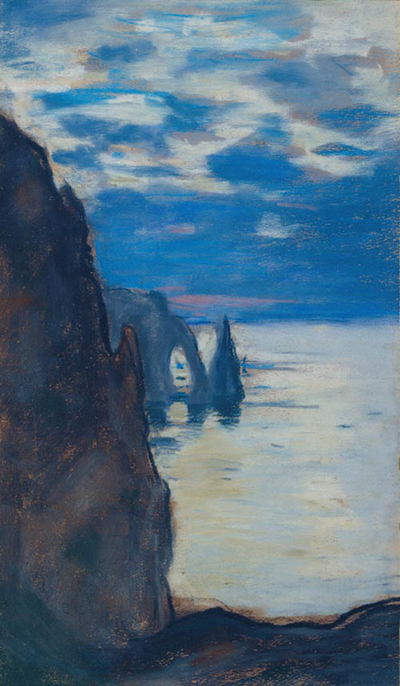
The featured work is Etretat, the Needle Rock and Porte d'Aval, the Cap d'Antifer, also called Cliffs at Etretat. The Scottish National Gallery dates it to about 1885 and records pastel on paper, 39 by 23 centimetres. It entered the collection through an allocation in 2016 and has the accession number D 5672. [3]
Its tall format is immediately distinctive. A dark cliff occupies much of the left side, while a broad opening of sea and sky remains on the right. Farther away, the arch and the slender needle form a second, smaller group.
The nearest cliff does not function as a neutral frame. Its weight presses against the brighter water, making the gap beyond it feel more open. The receding formations then establish distance without requiring a detailed account of the beach.
The museum describes muted blue, cream and brown tones and an evening atmosphere. [3] Different reproductions can alter their balance, so the composition is a firmer starting point than an exact colour match on a screen. This pastel is one particular Etretat view , not a substitute for every painting of the same rocks.
What the marks make visible
Across the upper part of the Etretat sheet, cloud shapes remain broken and irregular. Some strokes are broad and soft; others retain a more distinct edge. The sky feels assembled from many touches rather than filled with one smoothly blended tone.
Below, the sea has a different rhythm. Longer horizontal intervals carry light across the surface, contrasting with the cliff's downward sweep. The narrow needle interrupts that horizontal movement with a small vertical accent.
Near the bottom, dark foreground shapes overlap the water. They bring the viewer close to the cliff edge while leaving the distant horizon relatively unobstructed. The result depends on the contrast between near obstruction and far openness.
These observations explain more than simply calling the pastel sombre or comparing it loosely to another artist's emotional palette. The sense of drama grows from proportion, overlap and the distribution of dark and light. Those are decisions visible within the sheet itself.
A winter landscape in Frankfurt
A different example is Winter Landscape with Evening Sky in the Stadel Museum. Its current record dates it approximately 1870-1880 and describes pastel chalk on wove paper, measuring 230 by 326 millimetres. [4]
The museum emphasises the combination of drawing and painterly colour. A dark horizontal embankment gives depth to a snowy meadow, while short pink and blue marks establish the evening sky. The precise location is not identified with certainty. [4]
This work is useful because it moves the discussion beyond cliffs. The atmospheric interest remains, but the spatial structure changes: a broad, low landscape replaces the tall Etretat composition.
The Stadel also cautions against treating Monet's pastels simply as preparatory layouts for oils. [4] A study can be an exploration of expression in its own medium. Its value need not depend on finding a corresponding large canvas, and an approximate date need not be replaced with a more precise but unsupported year.
London and the relationship with oil painting
The London pastels had a particularly close connection with Monet's work in oils. Lefebvre relates his use of pastel in January 1901 to the delayed arrival of his painting materials. His letters describe the sketches as useful exercises in observing conditions on the Thames. [2]
Charing Cross and Waterloo Bridge supplied recurring structures within the fog. The pastel studies could help him recognise effects for his canvases, without becoming mechanically exact plans for a single finished painting. [2]
The distinction is important: some pastels could support work in another medium, while others functioned more independently. A general rule that every sheet was either a preparatory sketch or a finished autonomous work would flatten those different circumstances.
Monet's London campaign also shows why portability is only part of the explanation. Pastel allowed rapid coloured notation, but its usefulness lay in what it helped him see. The bridge, river and atmosphere could be reconsidered through marks with different physical qualities from oil paint.
Pastels, drawings and reproductions
A pastel is an original work made with a particular material, not a print of an oil painting in softer colours. Nor does the term require a pale palette. Strong darks and bright accents are as possible as delicate tones. [6]
The boundaries with drawing are more productive than rigid. Museums may classify a pastel as a drawing or a work on paper while still discussing its painterly handling. The classification does not determine how complete or ambitious the image is.
For the same reason, a reproduction offered among Monet prints is a different object from the pastel it reproduces. Paper, surface texture, scale and the behaviour of dry colour all affect the original encounter.
The most rewarding approach is to identify a sheet, establish what is known about its date and history, and then examine its marks. Monet's pastels broaden his art not by duplicating every subject in his oils, but by offering another material way to organise colour, distance and light.
Frequently Asked Questions
Yes. The scholarly chronology records seven pastels alongside five oil paintings. [8]
It belongs to the Scottish National Gallery, accession D 5672, allocated in 2016. [3]
No. It names a material, which can produce both strong and delicate colours. [6]
Discussion
Look again at the images and ideas explored in Claude Monet Pastels. These editorial prompts invite your observations.
Reader Insights
How does the tall Etretat composition differ from a wide coastal oil painting?
Where do individual strokes remain visible, and where do they merge?
What is gained by studying a pastel without searching for an oil-painting counterpart?
Join the Conversation
Share a detail, comparison or question about Claude Monet Pastels below.
References
- Geraldine Lefebvre , Introduction, Claude Monet, les pastels, Wildenstein Plattner Institute, 2023. View source .
- Geraldine Lefebvre , Les pastels de Londres, Claude Monet, les pastels, Wildenstein Plattner Institute, 2023. View source .
- National Galleries of Scotland , Etretat, the Needle Rock and Porte d'Aval, the Cap d'Antifer, about 1885, D 5672. View source .
- Stadel Museum , Winter Landscape with Evening Sky, about 1870-1880, SG 410. View source .
- MuMa Le Havre , Monet au Havre, sections on Boudin and Monet's early pastel skies. View source .
- National Gallery of Art , The Touch of Color, pastel materials and techniques, 2019. View source .
- The Metropolitan Museum of Art , The Rise of Pastel in the Eighteenth Century, materials and surface effects. View source .
- Charles Stuckey , Monet chronology, 1874, Art Institute of Chicago research archive. View source .







