


 by
Tom Gurney
Tom Gurney BSc (Hons) is an art history expert with over 20 years experience
Published on October 6, 2016 / Updated on October 23, 2026
Email:
tomgurney1@gmail.com
/ Phone:
+44 7429 011000
Boatyard near Honfleur
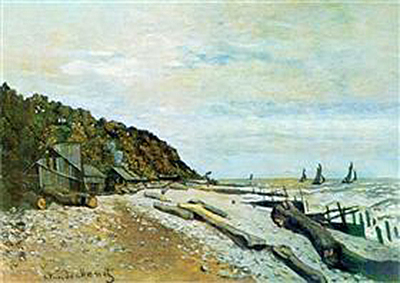
Heavy tree trunks lie across the foreground of Claude Monet's Boatyard near Honfleur , their diagonal forms pointing along a pebbled shore towards sheds and a wooded hill. Beyond them, small sails pass over the open water. Painted in 1864, this oil is the version catalogued as Wildenstein 27. Its French title, Le Chantier de petits navires, pres de Honfleur , identifies the practical coastal setting, while the contrast between solid timber and shifting sea gives the scene much of its force. [1] [2]
At a Glance
The timber leads into the scene
The largest trunks enter from the lower right and stretch towards the middle of the beach. Their cropped ends make them feel close enough to obstruct the viewer's path. They do not sit politely inside the frame: the image seems to cut through a larger working space, leaving the rest of the timber outside our view.
Their direction is crucial. It carries the eye away from the foreground and towards the buildings on the left, then towards the narrowing shore beyond. The trunks' long, relatively continuous forms contrast with the scattered stones around them. Large and small elements therefore establish different scales of attention within the same strip of beach.
The nearer wood also gives physical weight to a scene with a great deal of sky. Its darker surfaces hold the lower corner while the clouded air opens above. Without those foreground forms, the distant boats and low shoreline would make a much less anchored composition.
An ordinary place of coastal work
The wooden sheds are built into the meeting of beach and hillside. Their irregular roofs and upright walls are plain, practical shapes rather than a grand architectural subject. A faint plume above the buildings adds a small vertical movement to the much broader slope of the trees.
The title directs attention to boatbuilding, but the picture is not a detailed account of a particular construction process. Timber, buildings and waterside structures establish a working environment without showing every stage of labour. The coast is neither an empty wilderness nor a beach arranged primarily for visitors. Its materials and structures suggest everyday use.
The setting lies below the Cote de Grace, along the shore between Honfleur and Trouville, according to the catalogue raisonne. This places the boatyard in the landscape associated with Saint-Simeon, rather than inside a densely enclosed harbour basin. The open water remains an essential part of the view. [2]
A low horizon beneath a broad sky
The wooded slope descends from the left towards the horizon. Its downward movement meets the long diagonals of the foreground timber, so that land and wood seem to draw together near the centre. From there the sea opens out towards the right, where small sails punctuate a much flatter space.
Above this relatively low horizon, the sky has room for several layers of cloud. Cooler blue intervals appear between grey and warmer pale passages. The clouds do not supply a single theatrical spotlight; instead they make the light uneven and mobile across the scene.
The boats are far smaller than the trunks nearest us, although their sails would be substantial at close range. That difference gives the water a convincing depth. The painting's sense of space depends less on a sequence of carefully drawn buildings than on the contrast between immediate material objects and distant, lightly indicated forms.
Two versions of the boatyard
Wildenstein distinguishes this painting, number 27, from an earlier version, number 26. The catalogue places the first in the summer of 1864 and describes the second as a variation painted in early October at Sainte-Adresse. The two canvases are similar in size, but the water, boats and arrangement of timber are not identical. [2]
The sequence is important because it complicates an easy assumption about Monet. A picture of a recognisable outdoor place need not have been completed entirely in front of it. The catalogue's account places the later version away from the Honfleur shore, drawing on an already explored subject.
The differences are not merely additions to a finished design. Changing the disposition of foreground wood alters the route taken by the eye. Putting sails on more active water changes the balance between still materials and movement. Repetition becomes a way of reconsidering the landscape, not just making another copy of it.
Different surfaces, different marks
The beach is built from many small light and dark accents. They suggest stones and rough ground without counting individual pebbles across the whole foreground. The trunks, by contrast, are described in longer passages that emphasise their length and mass. The same limited colour range can therefore create very different kinds of surface.
In the trees, irregular touches make a dense but varied edge against the sky. The sheds retain firmer lines, giving the small group of buildings enough structure to stand out from the hillside. Farther to the right, the sea's shorter horizontal marks establish a less stable surface.
These changes of handling matter more than a simple label such as loose or detailed. Monet adjusts the marks to what each part of the scene needs. The rough ground, heavy wood, leafy slope and open water remain distinct even though they belong to one broadly harmonious atmosphere. The painting combines a clear spatial framework with many local variations.
Saint-Simeon and the range of early subjects
Lausanne's museum account records Monet's arrival at Saint-Simeon with Frederic Bazille in May 1864, following earlier coastal work with Jongkind. This was a setting in which looking, painting outdoors and exchanging ideas with other artists could reinforce one another. The same account notes that Monet also developed outdoor studies in the studio. [3]
The boatyard was only one of the subjects available nearby. The National Museum of Western Art in Tokyo holds Walk (Road of the Farm Saint-Simeon) , also dated 1864, with a farm road and trees rather than an open shore. Boston's Museum of Fine Arts holds Rue de la Bavole, Honfleur , dated about 1864, which turns towards the town's streets. [4] [5]
These works place Boatyard near Honfleur within a varied period of early landscape painting. A shoreline, a road and a street called for different arrangements and viewpoints. The region offered more than a single scenic formula, and Monet's developing practice was tested across those different environments.
The painting's documented history
The 2012 Christie's catalogue records the painting with Goupil de Bouille by about 1952, later with Wildenstein and Richard L. Feigen, and in a Sotheby's sale in New York in 1982. It was subsequently offered from a private European collection. Those records identify historical points in its ownership; they do not establish a publicly named present owner. [1]
The exhibition history also reveals earlier uncertainty. Christie's notes that the 1957 Saint Louis exhibition used the title The Beach at Sainte-Adresse and dated it incorrectly to 1867. The established identification as the Honfleur boatyard and the 1864 date keep those historical labels from being mistaken for a different painting. [1] [2]
Within Monet's Honfleur work , the canvas remains distinctive for making ordinary materials carry so much of the composition. The nearby Boats in the Port of Honfleur looks up towards sails and rigging; this view begins with timber underfoot. Both find visual complexity in the working coast, but they organise that experience in very different ways.
Frequently Asked Questions
Yes. The catalogue distinguishes the summer version, number 26, from this variation, number 27. [2]
The primary 2012 catalogue records a private European collection. A current museum location is not established by that record. [1]
Discussion
Look again at the images and ideas explored in Boatyard near Honfleur. These editorial prompts invite your observations.
Reader Insights
Trace the diagonals made by the foreground trunks and descending hillside.
Compare the marks used for wood, stones, foliage and water.
How does the working shoreline differ from a view centred on a landmark?
Join the Conversation
Share a detail, comparison or question about Boatyard near Honfleur below.
References
- Christie's , Le Chantier de petits navires, pres de Honfleur, 2012 catalogue; dimensions, signature, provenance and exhibition history for Wildenstein 27. View source .
- Daniel Wildenstein / Wildenstein Plattner Institute , Monet, volume II, 1996, entries 26 and 27, printed pages 18-19; location, two versions and October dating. View source .
- Musee cantonal des Beaux-Arts, Lausanne , Sailing Boats at Sea; Monet's early coastal formation, Saint-Simeon and outdoor/studio practice. View source .
- The National Museum of Western Art, Tokyo , Walk (Road of the Farm Saint-Simeon), 1864, P.1959-0147; a separate regional subject. View source .
- Museum of Fine Arts, Boston , Rue de la Bavole, Honfleur, about 1864, 48.580; a separate early town view. View source .







