


 by
Tom Gurney
Tom Gurney BSc (Hons) is an art history expert with over 20 years experience
Published on October 6, 2016 / Updated on October 23, 2026
Email:
tomgurney1@gmail.com
/ Phone:
+44 7429 011000
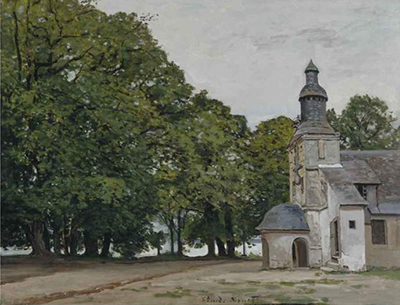
The Chapel of Notre-Dame de Grace at Honfleur
Claude Monet's The Chapel of Notre-Dame de Grace at Honfleur places a modest church beside a much larger expanse of trees. The pale facade and narrow tower stand on the right, while a shaded road passes through the foreground towards openings between the trunks. Painted in 1864 and catalogued as Wildenstein 35, the oil belongs to Monet's early Normandy work. Its subject is architecture within a living landscape, rather than a detached portrait of a monument. [1] [2]
At a Glance
A church at the edge of the picture
The chapel occupies the right-hand portion of the canvas, with part of its body continuing beyond the edge. Monet has not centred the building or given it a symmetrical setting. Its tower rises above the roof and foliage, but much of the picture's width belongs to the trees and the space before them.
This arrangement changes the viewer's approach. The church is encountered from outside, across an ordinary stretch of ground. The low porch and dark doorway provide a possible entrance, yet the eye is also invited to follow the road towards the left. Architecture is one destination within the scene rather than its only point of interest.
The tower's stacked forms give a firm vertical accent. Their narrower upper stages contrast with the broad roof below and the irregular canopy beside them. The little structure can hold its place against the trees because its shapes are more defined, not because it is larger than everything around it.
The trees are an equal subject
The mass of foliage on the left fills much of the canvas from top to bottom. Its darker lower passages open into separate trunks, and the pale distance between them makes the shaded grove feel permeable. The trees are not a flat green curtain placed behind the chapel. They create a space that the road can enter.
Small gaps in the canopy let the sky appear in fragments. Their scattered shapes contrast with the more continuous pale area above the tower. On the building, light can gather into broad surfaces; among the leaves, it breaks into smaller intervals. The two kinds of form require different rhythms of looking.
The road and bare foreground help connect them. Shadows spread across the ground without forming a rigid boundary between church and woodland. This shared surface prevents the composition from dividing into two unrelated halves, one architectural and the other natural.
Pale walls and restrained colour
The chapel's walls are light but not uniformly white. Grey and warmer pale tones give its projecting parts a sense of volume, while the doorway and windows provide small dark accents. The roof's cooler surface separates it from the surrounding greens without becoming a sharply isolated patch.
Monet keeps the colour range relatively restrained. The picture does not depend on a vivid sunset or brilliant blue sky. Its interest lies in the exchanges between pale stone, grey roof, dark trunks and varied foliage. Close tones can distinguish materials as effectively as strong contrasts.
The building's edges are generally easier to follow than the outer limits of the trees. Nevertheless, neither is described with the finish of an architectural survey or botanical illustration. The painting remains concerned with the appearance of a whole setting, in which solid forms and interrupted light have to coexist.
The building and the older sanctuary
The French heritage inventory places the chapel at Equemauville, on the heights associated with Honfleur, and dates its principal construction to the first half of the seventeenth century. The site has a longer religious history, but the building Monet saw should not simply be described as an intact medieval chapel. [3]
The chapel's own historical account gives 1613 as the completion of its reconstruction. It also preserves the tradition of an earlier foundation associated with Richard II of Normandy in 1023. The distinction between the remembered origin of a sanctuary and the fabric of its later building is important here. Monet painted the exterior before him, not an illustration of its foundation story. [6]
The heritage record notes the chapel's protection as a historic monument in 1938, long after the canvas was made. The painting therefore precedes that official recognition. It preserves a nineteenth-century encounter with a place whose architectural and devotional histories extended beyond the painter's visit. [3]
A maritime place without a visible harbour
Notre-Dame de Grace has strong associations with the people of the port. The parish describes the chapel's dedication to the Virgin as protectress of Honfleur and its mariners, and records the ex-votos, model boats, plaques and paintings offered in gratitude. These objects belong to the site's religious life, although they are not visible in Monet's exterior view. [5]
Knowing that background connects the quiet hilltop building with the working sea below. It does not mean that the canvas is itself a devotional statement, or that Monet's personal beliefs can be read from the subject. A painter could choose the chapel for its forms, surroundings and local importance without explaining his own faith.
The contrast with his Boatyard near Honfleur is revealing. That painting gives the foreground to heavy timber beside open water. Here the coastline is out of sight, and the encounter is with a building enclosed by trees. Both belong to the landscape of the same coastal community.
Jongkind's related view
Wildenstein draws attention to a watercolour by Johan Barthold Jongkind dated 14 September 1864, showing the same subject from almost the same angle. Sotheby's later catalogue presents this as evidence that the two artists may have worked beside one another. It remains a plausible relationship, not proof that Monet's canvas was completed on that exact day. [1] [2]
The Morgan Library and Museum holds Jongkind's The Chapel of Notre-Dame de Grace, Honfleur , made in watercolour and opaque watercolour over black chalk on laid paper. Its record establishes a separate work in a different medium, rather than an alternative attribution for Monet's oil. [4]
The comparison matters because a shared motif can make artistic exchange unusually concrete. Both painters could consider the church, trees and open ground, while resolving their relationship through different materials and marks. The connection is more informative than treating influence as a simple transfer of a finished style from teacher to pupil.
Honfleur in 1864
Monet was still near the beginning of his career when he made this view. Lausanne's museum account records his stay with Frederic Bazille at the Saint-Simeon farm in May 1864, following coastal work with Jongkind in 1862. It places outdoor observation alongside the subsequent development of paintings in the studio. [7]
The chapel offered a different challenge from the region's harbours and beaches. Its walls, porch and tower gave fixed shapes against which the irregular foliage and shadows could be organised. The subject allowed Monet to investigate light without relying on the conspicuous movement of waves or sailing boats.
The canvas thus belongs to a wider exploration of Honfleur , rather than an isolated excursion into church painting. The region provided roads, farms, buildings and waterside activity within a comparatively small area. Their variety helped make familiar surroundings a demanding field of study.
A documented but incomplete ownership history
Wildenstein records the painting's seizure at Ville-d'Avray in December 1866 or early 1867, an indication of the financial difficulties surrounding Monet's early career. Later ownership includes Jacques Charles in Paris around 1918. Sotheby's traces it through a 1942 Drouot sale, Pierre Colle, a 2002 sale and Noortman Master Paintings before its appearance at auction in 2009. [1] [2]
These records do not establish a publicly named present owner or a permanent museum location. They are points in the history of a privately held canvas whose subject remains identifiable. Its catalogue number and dimensions help preserve that identity despite changes of ownership.
What remains most immediate is the picture's balance. The church is solid but not isolated; the trees are abundant but not shapeless. A pale doorway, a narrow tower and patches of light between trunks make a modest corner of Normandy worth sustained attention. The scene finds its character in the relationship between a built place and the landscape around it.
Frequently Asked Questions
The sanctuary has an older tradition, but the heritage inventory dates the present chapel's principal construction to the first half of the seventeenth century. [3]
Discussion
Look again at the images and ideas explored in The Chapel of Notre-Dame de Grace at Honfleur. These editorial prompts invite your observations.
Reader Insights
How does placing the chapel to one side affect the composition?
Compare the light on the walls with the openings among the trees.
What connects this hilltop scene with Monet's working-coast subjects?
Join the Conversation
Share a detail, comparison or question about The Chapel of Notre-Dame de Grace at Honfleur below.
References
- Sotheby's , La Chapelle de Notre-Dame-de-Grace, Honfleur, lot 64, 2009; primary object and ownership catalogue. View source .
- Daniel Wildenstein / Wildenstein Plattner Institute , Monet, volume II, 1996, entry 35, printed page 22; date, dimensions, early provenance and Jongkind comparison. View source .
- French Ministry of Culture, POP/Merimee , Chapelle Notre-Dame-de-Grace, PA00111299; location, construction period and historic protection. View source .
- The Morgan Library and Museum , Johan Barthold Jongkind, The Chapel of Notre-Dame de Grace, Honfleur, 1998.28; separate watercolour record. View source .
- Paroisse Notre Dame de la Cote Fleurie , Notre-Dame de Grace; maritime dedication and ex-votos. View source .
- Presbytere de Grace, Honfleur , La Chapelle de Grace; reconstruction and the site's older foundation tradition. View source .
- Musee cantonal des Beaux-Arts, Lausanne , Sailing Boats at Sea; institutional context for Monet's early coastal work and Saint-Simeon stay. View source .







