


 by
Tom Gurney
Tom Gurney BSc (Hons) is an art history expert with over 20 years experience
Published on October 6, 2016 / Updated on October 23, 2026
Email:
tomgurney1@gmail.com
/ Phone:
+44 7429 011000
La Pointe de la Heve, Sainte-Adresse
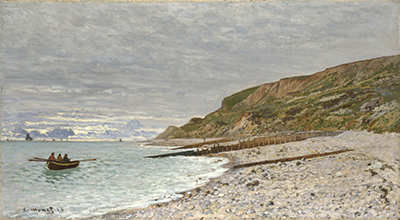
A small boat approaches a pale, stony shore in Claude Monet's La Pointe de la Heve, Sainte-Adresse . The long cliff and wooden breakwaters carry the view towards the headland, while a low band of light opens beneath the clouds. Catalogued as Wildenstein 39, the oil measures 41 by 73 centimetres and bears the date 1864. It is the smaller coastal view now in London's National Gallery, not the larger 1865 painting at the Kimbell. [1] [2]
At a Glance
A narrow canvas and an extended coast
The picture's proportions are noticeably broad in relation to its height. They encourage the eye to travel along the shore, from the nearby pebbles towards the small headland in the distance. The cliff is substantial, but it is not presented as an isolated vertical spectacle. It becomes part of a long, receding coastline.
The shore occupies the lower right, with water opening to the left. Between them, the curving beach provides a gradual transition rather than a sharp corner. A sequence of wooden barriers repeats that movement, carrying attention from the nearer ground towards the distant projection of land.
This extended arrangement makes the small size of the figures especially apparent. The boat remains legible, but it does not compete with the coast's full length. Monet gives enough information for the people to register before allowing the wider setting to absorb attention again.
The result is a view that feels open without being formless. Cliff, beach and water each have their own area, and the repeated diagonals hold the different parts together.
The rowing boat as a point of entry
The boat sits to the left of the principal curve of shore. Its dark hull gives it a compactness that contrasts with the paler, more scattered marks around it. The figures within it rise only a little above the gunwale, making the vessel's outline more immediately readable than their separate actions.
The water around the boat is handled through short changes of tone and direction. Some marks suggest the disturbance of movement; others belong to the wider surface of the sea. The boat seems to occupy this changing surface rather than rest on a flat blue background.
Its placement also creates a useful interval. Between the boat and the nearest stones there is enough water to make the shore feel approached rather than already reached. We are not looking at a tightly framed landing scene. The small human action remains within a much larger spatial arrangement.
Nothing in the visible image identifies the occupants by name. Their value to the composition does not depend on a biographical explanation. They provide scale, direction and a concentrated dark form in an otherwise lightly coloured part of the painting.
Pebbles, timber and the cliff face
The foreground shingle is made from many small, unequal touches. Pale marks sit beside darker ones, giving the beach a granular appearance without turning every stone into an individually outlined object. This is a different kind of description from the broad passages in the water.
The wooden barriers provide a firmer rhythm. Their uprights and connecting edges form darker runs across the beach, repeating with variations as they recede. The near shore and distant headland are linked by these modest structures, which are easier to follow than the irregular stones.
Above them, the cliff introduces larger patches of brown, green and pale exposed surface. Its contours are not perfectly smooth, and the broken colour helps convey that roughness. The painting distinguishes the cliff's mass from the smaller, loose material along its base.
These differences of handling are important. Stone, timber, water and cliff do not all receive the same type of mark. Monet makes the surfaces distinct while keeping them within a consistent, restrained range of colour.
The light beneath the clouds
The sky is largely pale grey, with darker passages passing across it in an uneven pattern. Near the horizon, a thin interval of brighter light sets off the distant boats and the edge of the sea. It is not a broad expanse of blue sky, but a narrow opening that gives the distance clarity.
The foreground remains comparatively light too. The shingle reflects more brightness than the darker cliff, helping prevent the heavy landform from dominating the whole picture. The sea lies between these different values, with soft changes rather than a single uniform tone.
The scene can feel cool and exposed, but appearance alone does not establish a winter date. Wildenstein places it in the summer or autumn of 1864, looking northwards from Sainte-Adresse. [1] Keeping that catalogue evidence separate from the atmosphere of the image avoids turning a visual impression into an unsupported calendar claim.
The interest lies in how the light is distributed. A subdued scene can contain many distinctions: the distant opening, the pale stones, the cooler water and the darker cliff all contribute to its particular balance.
A study with a separate pictorial character
The related La Pointe de la Heve at Low Tide is the large 1865 Salon canvas in Fort Worth. The scholarly Art Institute catalogue places that work among Monet's studio-developed seascapes based on smaller coastal studies. [4]
Comparison reveals changes beyond size. The larger picture has a cart in the shallows, horses and people on the shore, and a more imposing cloud mass. Here, the boat remains the principal human focus, and the lighter shingle receives a particularly broad space.
The smaller view should therefore not be judged only by what it lacks in relation to the later painting. Its boat, lighter surface and long proportions create a more concentrated encounter with the shore. It has a complete arrangement even when understood within a developing project.
The two canvases show how observation could lead to more than one pictorial solution. They do not require the assumption that the larger painting simply reproduces the smaller one at exhibition scale. The changes alter the viewer's movement through the scene.
Normandy observation and studio development
The Lausanne museum's account of Monet's early coastal practice records work with Jongkind in 1862 and his arrival with Frederic Bazille at Saint-Simeon in May 1864. It describes a process in which outdoor beginnings could be followed by work in the studio. [3]
That context is helpful because the freshness of a landscape is not a complete record of how it was made. Direct-looking marks can coexist with sustained decisions about proportion, emphasis and the relationship between forms.
In this canvas, the boat's dark shape and the shore's pale sweep are placed with considerable economy. The cliff supplies a stable framework, while the sky and sea introduce more variable surfaces. The painting's apparent simplicity depends on these relationships remaining clear.
The coast was not only a source of dramatic scenery. It offered recurring problems of scale, distance and changing light. A relatively modest stretch of beach could become a demanding subject when each surface required a different kind of attention.
The picture's recorded history
Wildenstein records the canvas with the singer and collector Jean-Baptiste Faure around 1883 and lists it in the Durand-Ruel Monet exhibition of that year. The catalogue subsequently traces it through Durand-Ruel, Munich's Neue Staatsgalerie and later private ownership before a London sale in 1996. These are recorded milestones, not a claim that every intervening transfer is fully explained. [1]
The painting is now identified by the National Gallery as NG6565. [2] Its distinct inventory and catalogue numbers help keep the small 1864 canvas separate from other similarly named views of the coast.
Within Monet's Normandy paintings , its appeal is unusually quiet. The small boat, narrow brightness at the horizon and long shingle shore hold attention without a large incident or spectacular central object. The coast becomes compelling through the precision of the relationships within it.
Frequently Asked Questions
No. Wildenstein identifies a northward view from the beach at Sainte-Adresse towards La Heve. [1]
The canvas is dated 1864 and catalogued as Wildenstein 39. [1]
It belongs to the National Gallery in London, inventory NG6565. [2]
Discussion
Look again at the images and ideas explored in La Pointe de la Heve, Sainte-Adresse. These editorial prompts invite your observations.
Reader Insights
Compare the small pebble marks with the broader handling of the sea.
Follow the wooden barriers as they diminish into the distance.
Consider how the rowing boat affects the scale of the coast.
Join the Conversation
Share a detail, comparison or question about La Pointe de la Heve, Sainte-Adresse below.
References
- Daniel Wildenstein / Wildenstein Plattner Institute , Monet, volume II, 1996, entry 39; exact dimensions, dated signature, northward Sainte-Adresse view and recorded collection history. View source .
- National Gallery, London , La Pointe de la Heve, Sainte-Adresse, NG6565; holding-collection identity and exact object record. View source .
- Musee cantonal des Beaux-Arts, Lausanne , Sailing Boats at Sea; institutional context for Monet's coastal work with Jongkind and Bazille and the relationship between outdoor and studio practice. View source .
- Art Institute of Chicago , Monet Paintings and Drawings, catalogue 13, The Beach at Sainte-Adresse; scholarly context for the 1865 Salon seascapes and smaller coastal studies. View source .
- Kimbell Art Museum , La Pointe de la Heve at Low Tide, 1865, AP 1968.07; separate larger canvas. View source .







