


 by
Tom Gurney
Tom Gurney BSc (Hons) is an art history expert with over 20 years experience
Published on October 6, 2016 / Updated on October 23, 2026
Email:
tomgurney1@gmail.com
/ Phone:
+44 7429 011000
The Seine near its Estuary, Honfleur
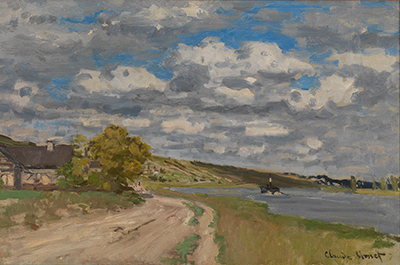
A country road bends beside a broad river in Claude Monet's The Seine near its Estuary, Honfleur . A farmhouse and leafy tree occupy the left, a small barge moves through the water, and clouds fill much of the view. The RISD Museum in Providence dates the oil to about 1868 and identifies it as accession 57.236. Wildenstein catalogues it as number 115. [1] [2]
At a Glance
The curve of the road
The road is the clearest route into the painting. It begins near the lower left, where its pale surface is broad enough to show changes in texture, then curves towards the middle distance. The bend carries the eye past the farmhouse and tree before joining the longer movement of the riverbank.
Dark tracks and irregular strokes prevent it from becoming a smoothly drawn ribbon. Its edges vary, with grass intruding into the lighter ground. The road feels used rather than geometrically imposed upon the landscape.
Its curve is also a compositional device. Without it, the broad sky and river might seem to extend beyond our reach. The nearer ground gives the viewer a place from which to enter, and the road offers a gradual transition from that foreground to the more distant bank.
The two tiny figures farther along the path make this recession easier to judge. They do not dominate the scene or establish a narrative. Their smallness helps show how much space lies between the foreground and the next part of the shore.
A farmhouse held at the edge
The farmhouse is pushed towards the left side of the canvas, where part of the building is cut off. Its low roof and lighter walls give it a solid presence, but Monet does not centre the landscape upon the architecture.
The neighbouring tree is more expansive. Yellow-green and darker passages break its foliage into unequal masses, with light catching some areas more strongly than others. Its irregular outline contrasts with the straighter roof beneath and beside it.
Together, building and tree form a concentrated foreground group. They give the left side weight, balancing the more open water at the right. The road passes this group and carries attention onward, so that the nearest structures do not obstruct the view.
This arrangement makes the painting more than a general panorama. We encounter the river from beside an inhabited piece of land. Roof, foliage, worn ground and bank create a particular approach to the water, even though the exact occupants and ownership of the farmhouse are not established.
A river surface with restrained movement
The water is comparatively quiet. It does not break into the large white crests of a rough seascape, and its colour changes are softer than those in the sky. A series of horizontal passages gives it breadth.
The small dark barge becomes especially noticeable within this open area. Its vertical feature interrupts the low line of the farther shore, while a short, lighter disturbance behind it suggests movement. The vessel is neither large enough nor detailed enough to turn the painting into a technical portrait of river transport.
Its position nevertheless matters. It gives the water a point of activity and a scale against which the distant buildings can be understood. The surrounding space remains ample, making the boat's movement seem modest within the river's width.
The near bank is handled differently. Brown and green strokes gather along its edge, giving it a rougher surface and stronger colour than the water. That contrast allows the viewer to distinguish stable ground from the comparatively even flow beyond it without a hard, continuous outline.
Clouds occupy the larger stage
The sky is not a neutral backdrop. White cloud masses gather above darker grey passages, with blue showing through between them. The marks are broad enough to remain visible as paint, but their arrangement still suggests overlapping forms and changing depth.
The nearer tree and roof seem compact beneath this much larger field. Clouds stretch beyond either side of the canvas, making the visible land feel like one part of an extended environment.
There is no need to assign a precise meteorological event to this appearance. The interest lies in the distribution of light: some cloud edges are emphatically bright, other areas recede into grey, and the blue gaps offer intervals between the masses.
The river does not reproduce every cloud as a distinct mirror image. Instead, its quieter bands of tone belong to the same atmosphere without repeating the sky's pattern exactly. This difference helps maintain the separation between the two surfaces while giving the scene a coherent light.
How certain is the Honfleur title?
The RISD Museum retains The Seine Near its Estuary, Honfleur as its title. The 1996 Wildenstein catalogue, however, lists the work as The Seine near the Estuary and warns that the Honfleur identification has sometimes been applied incorrectly. The exact location should therefore remain qualified rather than replaced with a new guess. [1] [2]
This uncertainty does not prevent identification of the painting itself. Its dimensions, collection number, composition and catalogue entry agree. The question concerns the precise site named in the title, not whether it is the same canvas.
It is also distinct from Mouth of the Seine at Honfleur , the much larger 1865 Salon picture now in the Norton Simon Museum. That work features sailing boats and choppier water seen across a harbour. The similar river titles should not cause the Salon history to be transferred to the RISD landscape. [3]
Keeping those distinctions clear allows the quieter picture to be considered on its own terms: a broad river seen beside a road and farmhouse, rather than an illustration of a better-known exhibition milestone.
The Seine as more than one kind of subject
The Musee des impressionnismes Giverny's exhibition L'Impressionnisme au fil de la Seine distinguished several aspects of river life, including traditional work, industrial change, leisure and artists' places of residence. That framework is useful here because the Seine did not offer Monet a single, unchanging type of landscape. [4]
The RISD picture contains signs of use without making any one of them spectacular. A road provides passage on land, a barge moves on the water, and the farmhouse establishes habitation. The scene's quietness does not mean that it is untouched by human activity.
A later comparison is RISD's separate The Seine at Giverny , dated 1885. [5] Its different arrangement of foliage and reflections belongs to another moment and place in Monet's river painting. These works need not be called a formal series to show how varied his encounters with the river could be.
The earlier canvas is especially open to the sky. Its low landforms and broad water make atmosphere a larger presence than enclosure. The riverbank is a starting point for looking outward, not a screen of vegetation closing around the viewer.
From private collection to RISD
Wildenstein records the painting with Alex Reid in Glasgow, J. McNeill Reid in London, Sam Salz in New York and Carroll Carstairs before the Metcalf collection in Providence. These names trace part of the canvas's recorded movement through the art market, not a fully explained account of every transfer. [2]
RISD records the Metcalfs' purchase from Carstairs in 1945 and George Pierce Metcalf's bequest to the museum in 1957. [1] The accession number keeps this individual work identifiable within a much broader body of Monet river landscapes.
Its lasting interest is in the balance of small activity and expansive setting. A modest boat, two distant figures and a roadside building provide enough human presence to give scale. Above them, cloud and light occupy a space that none of those details controls.
The painting rewards a slower movement between its parts: from the road's worn surface to the tree, from the tree to the river, and from the river into the broken sky. Its quiet character rests on this carefully sustained distribution of attention.
Frequently Asked Questions
RISD dates it to about 1868. [1]
No. The Norton Simon Museum holds that separate, larger painting. [3]
It belongs to the RISD Museum in Providence, accession 57.236. [1]
Discussion
Look again at the images and ideas explored in The Seine near its Estuary, Honfleur. These editorial prompts invite your observations.
Reader Insights
Follow the road's curve into the middle distance.
Compare the broad cloud marks with the quieter river surface.
Consider how the small barge changes the scale of the water.
Join the Conversation
Share a detail, comparison or question about The Seine near its Estuary, Honfleur below.
References
- RISD Museum , The Seine Near its Estuary, Honfleur, about 1868, 57.236; exact object record, dimensions, Metcalf acquisition and bequest. View source .
- Daniel Wildenstein / Wildenstein Plattner Institute , Monet, volume II, 1996, entry 115; catalogue identity, location caution and recorded collection history. View source .
- Norton Simon Museum , Mouth of the Seine at Honfleur, 1865, F.1973.33.2.P; separate Salon seascape. View source .
- Musee des impressionnismes Giverny , L'Impressionnisme au fil de la Seine, 2010 exhibition dossier, pages 5-7; thematic distinctions between river work, industrialisation, leisure and residence. View source .
- RISD Museum , The Seine at Giverny, 1885, 44.541; separate later river painting used for comparison only. View source .







