


 by
Tom Gurney
Tom Gurney BSc (Hons) is an art history expert with over 20 years experience
Published on October 6, 2016 / Updated on October 23, 2026
Email:
tomgurney1@gmail.com
/ Phone:
+44 7429 011000
Cliffs and Sailboats at Pourville
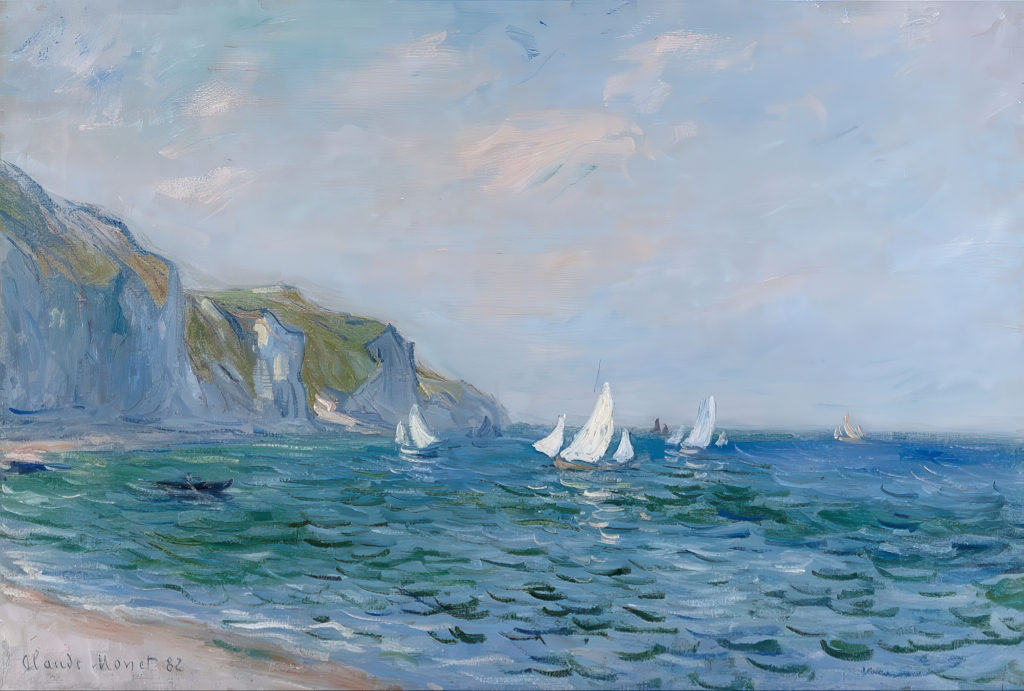
Cliffs and Sailboats at Pourville is an 1882 oil painting by Claude Monet, catalogued as Wildenstein 785. [1] White sails gather before a line of chalk cliffs, while blue-green waves spread across the foreground. The picture combines a recognisable coast with an unusually vivid sense of changing air and water.
At a Glance
White sails against a moving sea
The brightest sails sit close to the centre of the composition. Their pale surfaces catch the eye against a darker band of water, while slender masts project into the sky. Other vessels sit farther away, reduced to much smaller touches of white, orange or brown.
This variation gives the sea depth without turning the picture into a diagram of maritime traffic. The nearer sails are readable as broad shapes; distant boats become compact accents along the horizon. A dark, low vessel at the left offers a different silhouette from the taller sailing craft.
Monet gives the water an active painted surface. Green, turquoise and blue strokes cross one another, broken by pale flicks that suggest small wave crests. The marks become larger and easier to distinguish towards the foreground. They do not form a continuous, smoothly blended sheet.
The sails provide a useful contrast to this restless field. Their curved and triangular shapes remain relatively clear even when their edges are loosely handled. The effect is of boats held within moving air and water, rather than carefully finished models placed on an empty background.
Cliffs receding into distance
The coastline enters strongly from the left and falls away towards the middle distance. Successive projections overlap, so the viewer can follow the cliff's movement around the bay. Its grassy top is irregular, rising and dipping above the pale rock.
The rock faces are far from uniformly white. Blue-grey shadows spread across them, interrupted by lighter streaks and warmer pinkish passages. Near the centre, a small sunlit patch makes one recess more conspicuous. The greenery above adds another set of colours and textures.
A narrow strip of beach curves into the lower left corner. Its pink and beige tones soften the meeting between the hard cliff and the more mobile sea. Along that edge, water and land form a shallow diagonal that helps lead the eye towards the boats.
This arrangement creates two different kinds of movement. The cliffs retreat gradually through overlapping masses, while the wave marks spread sideways across the canvas. The boats sit where these movements meet, joining the expansive foreground to the more distant coast.
Monet's two coastal visits in 1882
The Art Institute of Chicago's research describes two Normandy visits in 1882: one from February to mid-April and another from mid-June to early October. Monet returned to the coast from Poissy, bringing Alice Hoschede and their combined family on the later visit. [3]
The same research warns that similar subjects and titles can make it difficult to assign individual canvases confidently to one trip or the other. [3] The date 1882 is secure for Cliffs and Sailboats, but its bright appearance alone does not establish an exact day or month.
The larger campaign was far more extensive than a handful of coastal views. It brought together beaches, paths, cliff faces and elevated prospects. The Art Institute places its own Cliff Walk at Pourville within nearly a hundred Normandy canvases from that year. [3]
That wider activity is important here because the scene is not an isolated experiment with the sea. Monet was repeatedly testing how a familiar stretch of coast could change when approached from another height, direction or position. This painting makes the vessels prominent while retaining enough shoreline to locate them within a larger landscape.
Pourville as a working and visiting place
The Cleveland Museum of Art describes nineteenth-century Pourville as a fishing village with a boardwalk, broad beach and cliffs. Its account of Monet's spring visit also notes his stay in a small hotel close to the sea. [4]
This setting helps explain why a marine subject could contain different kinds of human presence. There were boats on the water and buildings near the shore, while the beach also attracted visitors. Those aspects of the place need not all appear in every canvas.
Here the vessels matter more than individual people. Their sails and hulls show that the water is being navigated, but Monet does not supply a detailed narrative about crews, passengers or destinations. It would be difficult to identify a specific event from the image alone.
The lively sails may suggest a breeze, just as the scattered pale marks suggest rippling water. Neither effect requires an invented account of a race or an exact wind direction. The painting's sense of activity is already convincing at the level of visible shapes and painted rhythms.
Changing height changes the subject
Monet's Pourville works can look closely related in title while being markedly different in structure. The National Gallery of Art's Cliffs at Pourville, also dated 1882, looks across grassy heights towards the sea and includes two small figures. That is a separate canvas, W754, not this sailboat painting. [5]
A high viewpoint makes the sea spread below the spectator and gives the cliff top a strong foreground role. In Cliffs and Sailboats, the eye is much closer to the level of the shore. The rock faces become substantial vertical surfaces, and the boats have enough height to compete with them.
The difference is not merely a matter of including or omitting figures. It changes the balance of the whole image. One view can emphasise a walk across land; another can make the sea itself the main arena of activity.
The Art Institute's study also stresses Monet's experiments with viewpoint and horizon placement during these coastal campaigns. [3] Comparing the pictures therefore reveals active choices rather than a series of interchangeable souvenirs. The same region offered different problems of scale, distance and composition.
A documented painting with a private history
Wildenstein's catalogue records the signature and date at the lower left and identifies the work as W785. Its ownership history includes D. G. van Beuningen, a 1965 Sotheby's sale and the collection of Mr and Mrs Perry R. Bass in 1967. [1]
A later Christie's record places the painting in the estate of Robert Carmel. It also lists exhibitions in Amsterdam in 1930 and 1931 and New York in 1968 and 1969. [2] These are historical records of this particular object, not confirmation of a present museum display.
Such documentation is especially useful when titles are translated or shortened. Cliffs and Sailboats at Pourville, Falaises et voiliers a Pourville and the catalogue number refer to the same composition. [1] The identifier helps separate it from the many other coastal paintings with similar names.
The picture's distinctive character remains easy to recognise: pale sails interrupt a dark, patterned sea; cliffs retreat from the left; and a broad, lightly clouded sky opens above them. In Monet's Pourville paintings , it offers a particularly direct meeting of a solid coastline and the shifting activity offshore. Its lasting interest lies in that balance, rather than in a generic story about Impressionism.
Frequently Asked Questions
In 1882. [1]
Wildenstein 785. [1]
No. The National Gallery owns the separate W754 composition with a cliff-top viewpoint. [5]
Discussion
Look again at the images and ideas explored in Cliffs and Sailboats at Pourville. These editorial prompts invite your observations.
Reader Insights
Which sail first draws your attention, and what makes it stand out?
How do the overlapping cliffs create a sense of distance?
How would a higher viewpoint change the role of the boats?
Join the Conversation
Share a detail, comparison or question about Cliffs and Sailboats at Pourville below.
References
- Daniel Wildenstein , Monet: Catalogue raisonne, 1996, volume II, W785, p. 292, Wildenstein Plattner Institute digital edition. View source .
- Christie's , Claude Monet, Falaises et voiliers a Pourville, historical object, provenance and exhibition record. View source .
- Gloria Groom and Jill Shaw , Cliff Walk at Pourville, Art Institute of Chicago online scholarly catalogue, contextual research on the 1882 visits. View source .
- Cleveland Museum of Art , Low Tide at Pourville, near Dieppe, 1882, contextual account of the village and Monet's stay. View source .
- National Gallery of Art , Cliffs at Pourville, 1882, W754, accession 1985.64.27. View source .







